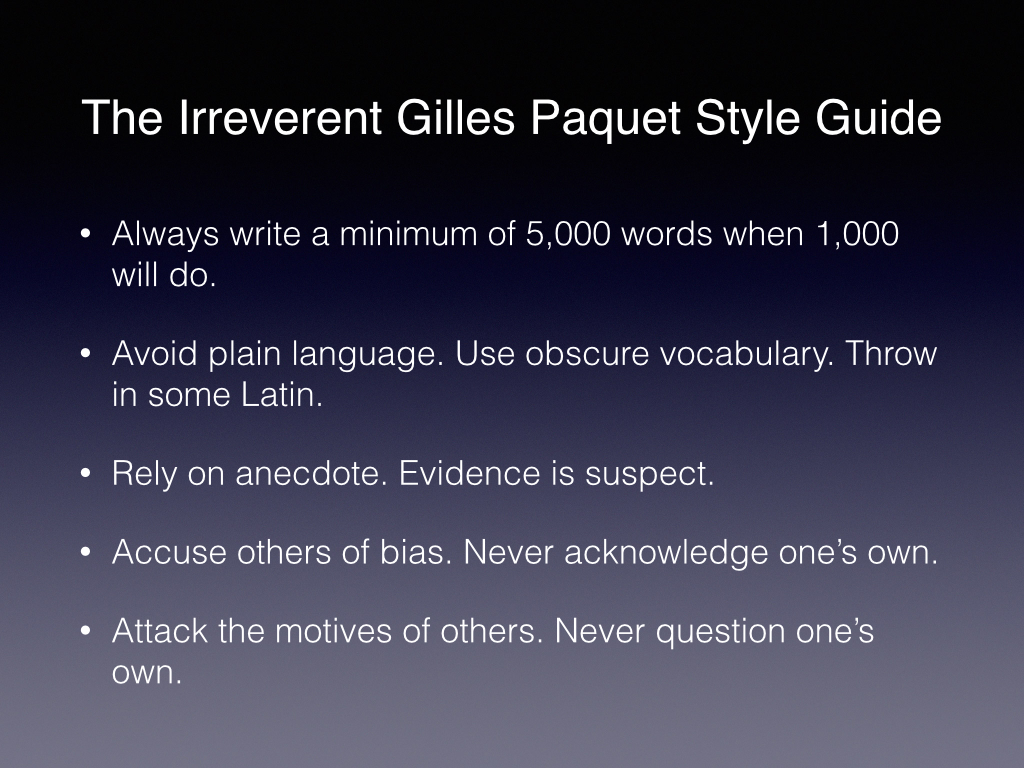
Federal executives lack training, flexibility, Hubbard and Paquet

Ruth Hubbard and Gilles Paquet on the public service:

Hubbard draws her conclusions from a series of confidential discussions she and University of Ottawa Prof. Gilles Paquet held with more than 100 executives between 2006 and 2009 about thorny topics the public service doesn’t like to publicly air or even acknowledge – from disloyalty, security and ethics to in-house operational and institutional challenges.

“In our view, the state of mind of senior executives has come to be tainted by a multitude of bad habits: creeping cognitive dissonance and political correctness, erosion of critical thinking. These bad habits of the mind have unwittingly led to reprehensible behavior; rewarding failure, punishing success; failure to confront, disloyalty,” the pair wrote in a recently released book.

They argue this state of mind, coupled with the lack of capabilities, could, if left unchecked, lead to the further “deterioration” or “fading away” of the public service.

Federal executives lack training, flexibility, expert says | Ottawa Citizen.

Her direct reply to Ralph Heintzman (Public service needs ‘moral contract’ to keep it neutral, study says | Ottawa Citizen):

Only a very bizarre and unfit public servant would suggest

(1) that the technocracy should always oppose the political, and would conclude that, when there is accord, there must have been promiscuity; and

(2) that a senior bureaucrat should not work collaboratively with his minister unless the minister has a notion of the public interest aligned completely with his own.

Such would appear to be Heintzman’s views, and they are unreasonable.

While Hubbard and Paquet are correct to point out some of the failings of the public service, they largely ignore or dismiss the failings on the Government side.

Of course, the public service must adapt to the government of the day, but the Conservative government came from a very different space in terms of values and ideologies, combined with a high level of distrust that made this more challenging. Its dismissal of evidence and expertise, rather than merely challenging public service advice,  its unwillingness to listen to alternate views and its systematic attempt to weaken independent bodies are also part of the picture.

Just as Heintzman goes to far in his view of the independence of the public service, Hubbard and Paquet go too far in the other direction (readers may recall that in the end, the divergence between Paquet’s and my views was too great to publish with his private press – see my earlier post Gilles Paquet’s Critique of Policy Arrogance or Innocent Bias).

Ruth Hubbard: The real problem with the public service

For the record: Romeo Dallaires last speech in the Senate

Romeo Dallaire’s call to arms and condemnation of “huff and puff” or “lecture and leave” diplomacy:

That is why Canada still has a role to play; it simply needs to reclaim its position as a leader in resolving international conflicts and preventing atrocities. Canada is not currently fulfilling that role.

What we do have, however, is a proud tradition of championing human rights and peace around the world. Indeed, Canadians played a key role in the creation of the Charter of the United Nations; the Universal Declaration of Human Rights; the International Criminal Court; the Convention on the Prohibition of the Use, Stockpiling, Production and Transfer of Anti-personnel Mines and on Their Destruction; and the Responsibility to Protect. We more or less invented modern peacekeeping.

We have exceptional armed forces, made up of bright and courageous young men and women — veterans nearly to the man and woman. We have a talented and dedicated diplomatic corps. We have development people and other whole-of-government agencies prepared to deploy and whose ingenuity is invaluable in today’s increasingly complex and ambiguous operations.

We have a vibrant civil society that won’t stop banging at the door even after we’ve changed the locks. Indeed, we have many tools we can deploy in our engagement with the world. We most definitely have a citizenry that takes pride in all of the above.

In recent years, however, things have changed. Today we have 43 peacekeepers deployed out of a possible 110,000 peacekeepers worldwide. Today we have to dance around the words “responsibility to protect” and the International Criminal Court, and even the term “child soldiers” to protect out of fear of having to actually maybe turn our alleged principled foreign policy into principled action.

Today we point to the humanitarian aid dollars we’ve given, which are never enough, and proclaim we’ve done our part. Today we have more sabre-rattling and less credibility; more expressions of concern and less contingency planning; more endless consultation with allies, or so we are told, and less real action being taken; and more empty calls for respect for human rights and less actual engagement with the violators.

I have said this before, but I cannot stress it enough: If we are to overcome the challenges facing the world today, we need transcendent leadership with the deepest conviction and the most honourable of intentions. In other words, we need statesmanship. There is a dearth of statesmanship, of taking risk, demonstrating flexibility, innovation and humility. The question is: When will Canada finally answer the call again?

For the record: Romeo Dallaire’s last speech in the Senate – Macleans.ca.

Public service not irrelevant | Michael Hatfield (pay wall)

More on recent comments by David Emerson and Wayne Wouters (Public servants risk becoming policy dinosaurs, David Emerson warns), and policy advice from inside and outside government. Michael Hatfield has had experience on both sides of the policy divide and captures some of the weaknesses in Emerson and Wouter’s arguments. He neglects, however, to address adequately some of the biases in public service advice that public servants need to be more mindful of:

As Emerson suggests, it is vital for the public interest that ministers have access to the highest quality and best-informed policy advice in order to make good policy decisions. But that advice will only be forthcoming and respected under two conditions. The first is that ministers are open to hearing ideas and information that may be at variance with their own preferences. The second is that public servants focus on assuring ministers that their priority is to provide access to the best information and advice they can find which is relevant to the minister’s interests and responsibilities.

Contrary to what Wouters seems to think, simply aggregating and adapting to the Canadian context the methods and approaches of outside analysts and sources of data is neither the best nor the only realistic future role for the public service. Instead, the public service needs to return its focus to developing and maintaining high quality data sources and professional expertise and knowledge in public policy areas and identifying early on those public policy questions which are ministerial priorities. That is the way the public service can best serve the real interests of ministers and the broader public interest. The question then becomes is the Clerk prepared to make available the resources necessary to sustaining public service relevance?

Public service not irrelevant | hilltimes.com.

Public service needs ‘moral contract’ to keep it neutral, study says | Ottawa Citizen

More on the respective roles of the Government and the public service, this time from Ralph Heintzman and Canada 2020. While much of his observations and criticism is valid, it is no accident that no government has accepted an explicit moral contract or charter to govern the relationship. Ambiguity has its advantages for both sides, and the wish for clarity in the essentially messy business of governing is unrealistic.

None of this condones a number of the actions of the Conservative government but as I argued in my book, Policy Arrogance or Innocent Bias: Resetting Citizenship and Multiculturalism, the public services was also responsible for some of the breakdown in the relationship:

Canada 2020, a progressive think-tank, plans to release a paper Wednesday that calls for a “charter of public service” or a “moral contract” to set the boundaries for a bureaucracy whose role and responsibilities have become blurred by a powerful Prime Minister’s Office with an iron grip on communications.

Ralph Heintzman, the University of Ottawa research professor who wrote the paper, said the line between public servants and politicians has been blurring for years, but rapidly changing technology, the 24-hour news cycle and government’s obsession with communications and “spin” have made the problem worse.

“I think behaviours in the public service are not what they should be, but not because they are bad-willed but rather because we don’t have the right systems, rules and mechanisms to direct people how to behave properly,” he said in an interview.

Heintzman proposes a new charter that would be legislated and far-reaching. It would enshrine a value and ethics code to guide behaviour. It would include tougher communications rules; give teeth to the accountability of deputy ministers as accounting officers; and revamp the appointment process for deputy ministers by taking it out of the hands of the Clerk of the Privy Council.

… Heintzman argued the three-way relationship – between public servants, MPs and ministers – is critical to the implementation of any government’s agenda regardless of political stripe, but the need for a charter is more critical today for a public service that has been “neglected,” “devalued” and has seen its neutrality “abused” by the Harper government.

The role of the public service has been in the spotlight because of Privy Council Office Clerk Wayne Wouters’s ongoing Blueprint 2020 exercise to retool the future public service. Wouters’s report, like many previous reform exercises over the past 25 years, dodged the deteriorating relationship.

… The grey zone between politicians and bureaucrats was at the heart of everything that went wrong and led to the sponsorship scandal, concluded Justice John Gomery, who headed the sponsorship inquiry. He also recommended a legislated charter. The Tait report made a similar recommendation a decade earlier.

Heintzman argued the Conservatives’ flagship Federal Accountability Act, meant in part to fix the problem, was badly flawed and increased confusion around deputy minister accountability.

Heintzman concludes a big problem is that the Conservatives don’t value the public service as a national institution for Canada’s democracy and see it as an extension of the government to be used as desired; for example it is expected to adhere to a communications strategy to rebrand the “Government of Canada” as the “Harper government.”

“They make no distinction between the Harper ministry and the government of Canada,” he said. They think it is the same thing, so the public service is just there to achieve their own partisan objectives.”

Public service needs ‘moral contract’ to keep it neutral, study says | Ottawa Citizen.

Subsequent article and interview comments are even more critical:

The study, Renewal of the Public Service: Toward a Charter of Public Service, released by the think-tank Canada 2020, says Privy Council Office Clerk Wayne Wouters became the government’s political spokesman for stonewalling Page and refusing the information Parliament needed to do its job – right down to the language of a letter in which he wrote that “in our view” the government’s reductions are credible.

The new study, written by University of Ottawa Prof. Ralph Heintzman, argues that Wouters could have provided an explanation of the government’s reasoning but should never have publicly justified or defended a “contestable political decision” and made it his own.

“Words such as ‘in our view’ – our! – would be quite natural in the mouth of a prime minister. In the mouth of the head of the public service, they are very difficult to explain, or justify. In using them, the clerk left no space whatever between himself and the current ministry,” writes Heintzman.

“A Privy Council Office that could draft such a letter and a clerk who could sign it are at serious risk of abolishing the distinction between a public service and the political administration it serves. No wonder that under the Harper administration, the PCO has become home to a large communications machine serving the partisan needs of the incumbent government and the prime minister.”

When public servants go partisan: new study seeks solutions

The alternate view by  Maryantonett Flumian and Nick Charney, in Canadian Government Executive, is more nuanced, noting how the public service has to adapt to the government of the day:

As the new Clerk, Wouters could have taken the public service in many directions. He chose to rise to the challenge by recognizing the somewhat strained relationships and by doing what he is best at, thoughtfully and persistently building bridges between those who must work as one in the public interest. With the Prime Minister’s public support, he chose a path of reenergizing the public service and channeling its leadership toward transformation and modernization of the institution supported with the necessary infrastructure and tools to serve Canadians and the government. He has not ducked the challenges, nor has he focused on confrontation.

To everything there is a season, and this is the time when both major players seem to have understood that they depend on each other to fashion a modern, resilient and agile public service that supports a modern nation in achieving its place on the global stage. And so, in Wouters’ time at the PCO, his greatest skill as head of the public service may well turn out to be his capacity to get the Prime Minister on side and work with him on issues having to do with the role of the public service, the size of the workforce, and changing the business model of government. This bridge to the future began when he launched the Administrative Services Review. The review looked for government-wide opportunities to consolidate and standardize government operations and led, among other things, to the creation of Shared Services Canada.

Wouters’ ability to work closely with the Prime Minister has manifested itself in other areas than public service renewal, however important that may be. He used his position as Clerk, working with colleagues such as the deputy minister of Finance, to support the government’s economic goals, ensuring the development of five successive budgets that kept Canada out of recession and brought the government back into surplus. His support and advice was critical to the finalization of a number of bilateral trade agreements, including the Comprehensive Economic and Trade Agreement with the European Union and the Canada-Korea Free Trade Agreement. ….

Through Blueprint 2020, Wouters is moving the public service into unchartered waters. Responding to criticism that the public service is too focused on the short term, he is using it to promote a longer term view of policy, program development and service delivery. He is staking the future on the belief that the leadership – at all levels of the largest employer and most diverse workforce in the country, operating in very complex domains – is up to the challenge.

The Prime Minister and the Prime Ministers’ Advisory Committee on the Public Service, until recently chaired by David Emerson, are supportive and aligned to the challenge. The call to arms in the Blueprint 2020 exercise has been launched against a backdrop of cynicism, cost reduction, and a drive to operational efficiency. This renewal starts at a time when the same sort of efforts at transformation are being led by public services around the world. Blueprint 2020 fundamentally recognizes that existing policies, tools and processes no longer fit the needs of today.

The issues of engagement, culture, agility and relevance are at the heart of this renewal. There is a profound recognition, which the cynics missed in the early days, that reforming public service is a team sport where every player must be called upon to be a leader, where every step, big and small, will add up to change. With the public service going through a transformation, the need for broad engagement is fundamental. That is the engagement that Wouters, as head of the public service, has unleashed in Blueprint 2020. Over 100,000 public servants from 85 different departments and agencies have participated in this dialogue.

With the release of Destination 2020, the call to action is clear and the momentum continues. Social media, along with the openness of spirit and engagement with which Wouters has launched this dialogue on collaboration, innovation and modernization, is unprecedented in the history of public service reform. The engagement at so many different levels of the organization will ensure that the momentum will not end with the “tabling” of this living, crowd-sourced document.

To come full circle, two unlikely partners – Stephen Harper and Wayne Wouters – picked each other to work together in support of the public interest. Each is working to reshape his own sphere. There is no question that tough conversations occur – as they must – behind closed doors. What will be accomplished is a modern, relevant public service better able to serve Canadians.

I find this to be an overly optimistic take on the government-public service relationship. It avoids the difficult issues of conflicting ideologies, reliance on anecdotes over evidence, and major reductions in core policy and analytical capacity.

However, relationships and trust matter, the Clerk, deputies and other senior managers have to decide the appropriate balance between “fearless advice and loyal implementation,” and where greater cooperation rather than “confrontation” is appropriate. The public service has to adapt to the government more than the other way round.

I worked at Service Canada under Flumian and she was one of the strongest and effective leaders I have encountered. Like Steve Jobs in her ability to inspire and develop a vision, with some of the same human flaws. One of my most rewarding times in government.

To everything there is a season

ICYMI: Capitalism Eating Its Children – Mark Carney

Stronger than his statements while Bank of Canada Governor:

…..Mark Carney, the Canadian governor of the Bank of England, lays into unfettered capitalism. “Just as any revolution eats its children,” he says, “unchecked market fundamentalism can devour the social capital essential for the long-term dynamism of capitalism itself.”

All ideologies, he continues, are prone to extremes. Belief in the power of the market entered “the realm of faith” before the 2008 meltdown. Market economies became market societies. They were characterized by “light-touch regulation” and “the belief that bubbles cannot be identified.”

Carney pulls no punches. Big banks were too big to fail, operating in a “heads-I-win-tails-you-lose bubble.” Benchmarks were rigged for personal gain. Equity markets blatantly favored “the technologically empowered over the retail investor.” Mistrust grew — and persists.

“Prosperity requires not just investment in economic capital, but investment in social capital,” Carney argues, having defined social capital as “the links, shared values and beliefs in a society which encourage individuals not only to take responsibility for themselves and their families but also to trust each other and work collaboratively to support each other.”

Capitalism Eating Its Children – NYTimes.com.

Suzanne Legault warns of growing federal government secrecy

Information Commissioner Suzanne Legault confirming what we all know: that ATIP is broken and many departments are not in compliance with the principles and requirements of ATIP.

Not surprised to see CIC on the list of one of the worst departments in this regard as my experience indicates (still have an outstanding request for over a year for information that should have been released a long-time ago).

But Legault omits to mention the Government’s complicity for a culture of secrecy and lack of openness, and how this affects the public service role:

Legault blamed a lack of leadership toward transparency at the political level and within the senior ranks of some departments and agencies for creating an environment where the tendency is to try to keep information under lock and key.

“The main reason why the system is fragile and volatile is because for some reason, leadership in the institutions varies,” she said.

“When there is not very strong leadership at all levels of an institution in favour of timely transparency, we see institutions falter on releasing information. When we have strong leadership within the institutions, usually institutions perform well.”

Among the worst performers last year were Citizenship and Immigration Canada, the RCMP, Transport Canada and the Department of National Defence.

The federal Access to Information Act was introduced in 1985 and has remained largely unchanged since then despite frequent criticisms that the system is broken.

Legault writes in her report that real improvement to the access system will only come by modernizing the law, which she described as “a long-overdue step that is crucial to advancing the cause of transparency and accountability in Canada.

”In the House of Commons, Treasury Board President Tony Clement defended the government’s record on access to information Thursday, saying it had responded to more requests than previous governments combined.

“The total number of access to information requests that have been replied to since 1983, 50 per cent of them have been replied to by this government. We have replied to more access to information requests than the Trudeau, Mulroney, Turner, Campbell, Chrétien and Martin governments combined. That is our record on access to information and we are darn proud of it.”

Suzanne Legault warns of growing federal government secrecy | Ottawa Citizen.

Audit slams feds’ ‘Open Data’ performance

Unfortunate, as paper (and pdfs) make an unnecessary complication to analyze data.

CIC publishes many operational stats in electronic format, making it easy to analyse. More formal ATIP requests are either paper or pdfs, inserting a tedious step of conversion.

Have a few new ATIP requests with the provinces (for data) and will see what comes back (have requested electronic format):

Newspapers Canada directly tested federal, provincial and municipal transparency laws with almost 400 formal requests for information last October and November, the 10th annual audit carried out by the organization.

This years version added 172 requests for electronic data sets, requiring the information to be provided in a format that can be digested and manipulated by computer.

Most government bodies fell short, many insisting on providing the data requested on paper, or providing it in the electronic equivalent of a photo — impossible to process in a spreadsheet or database program.

Among the worst performers were some departments of the federal government, which has been promoting its Open Data agenda as evidence of transparency, including the proactive posting of some 200,000 data sets online.

The audit found that Prime Minister Stephen Harper’s own department, the Privy Council Office, refused to release any information in electronic format, insisting on paper printouts.

Audit slams feds’ ‘Open Data’ performance | National Newswatch.

Judith Maxwell: The government built the ‘Ottawa bubble’ it mocks

Judith Maxwell, former Chair of the Economic Council of Canada and the former President of Canadian Policy Research Networks, has it about right:

First, interpretation. The federal government is not the only policy actor in Canada. The other 13 governments taken together are larger and likely have more impact than Ottawa does. Then there are the big cities, the community service agencies, employers, big and small, plus researchers in universities, colleges, think tanks, industry associations etc. No policy choice should be made without seeking input from the people who know the subject, what solutions have been tried, and whether or not they worked.

Instead, public servants are blocked from interacting with stakeholders. No roundtables with all viewpoints represented at the table. No participation in meetings where researchers and stakeholders work through the evidence. No right to publish in-house research from federal policy units. No right to comment on the work of others. If consultations are held, only the “friendly voices” are invited. The bubble was built by the government, designed to keep insiders in and outsiders out. Perversely, in this respect, it has been quite successful.

Second, choosing the best option. The way things work now, the Prime Minister’s Office decides on the preferred policy action and then asks the public service to advise on damage control. This turns the policy-making process upside down. First, you find out works, then you decide.

She had her own run in with the Mulroney government when the ECC published a report that downplayed the economic costs of separation (and led the Mulroney government to close the ECC down in 1992)

Judith Maxwell: The government built the ‘Ottawa bubble’ it mocks | Ottawa Citizen.

U.S. investors begin to imagine a return to Iran – Washington Post

Not terribly surprising that US companies, like companies from other countries, are positioning themselves for a post-sanctions environment should the current nuclear talks lead to a deal:

“There will be phenomenal opportunities for American investors. I would definitely consider investing in Iran, and I think that’s the universal answer,” said Dick Simon, chief executive of RSI, a Boston-based real estate development and investment management company, who helped organize a recent trip to Iran composed of mostly U.S. entrepreneurs, as well as several who were Canadian or British.

In the absence of diplomatic relations, such contact can serve to de-escalate tensions between the two governments — which analysts say is a strategic goal for the administrations of President Obama and Rouhani — as negotiations over Iran’s controversial nuclear program are ongoing.“

An increasing number of Americans, both inside and outside government, understand the value of whetting the appetite of business people in Iran,” said Reza Marashi, research director at the National Iranian American Council NIAC.

According to Marashi, NIAC has been inundated this year by calls from Americans who want to travel to Iran. The organization, which favors greater contact between Americans and Iranians, is one of the few non-governmental entities in regular communication with officials in both governments.

As to Canada, still stuck in its standard “huff and puff” rhetoric, with no sign of change (see my earlier piece in the GlobeIf Iran opens for business, Canada will need a new approach – and fast).

U.S. investors begin to imagine a return to Iran – The Washington Post.

Bias-Free Hiring: Interview questions not to ask

An interesting but somewhat frustrating checklist of what to ask and what not to ask in interviewing candidates, as bias-free as possible. All too familiar to those of us in government, where the guidelines below are followed religiously and yet are deeply unsatisfying given the over-scripting that occurs. Sometimes it works out fine, sometimes less so:

  • Use the job description to identify the essential skills and abilities needed for the job. Determine which of these skills and abilities are best assessed through a written or practical test, through an interview, and from reference checks. From there, interview questions should be developed and clearly linked to the skills and abilities needed to do the job.
  • Develop the responses which you will look for in the candidates’ responses.
  • Attach a score to each question.
  • Use an interview panel when interviewing. Require each interviewer to write down each candidates’ responses to each question.
  • Ask each candidate the same questions.
  • After each interview, have the interview panel discuss the candidate’s responses and come to an agreed score for each question.

Bias-Free Hiring: Interview questions not to ask.