Cohen: Time to move beyond the myth of Vimy

Andrew Cohen on Vimy, with help from Jack Granatstein:

“For the first time, Canadians soldiers fought as one unit, under the command of Canadian officers and employing tactics developed by Canadians,” according to an article in the National Post in 2013. “And we won, trouncing the Germans where our allies had failed and congratulating ourselves ever since.”

As J.L. Granatstein argues, that view “is almost completely wrong. Almost. All that it gets right is that Canadians have congratulated themselves ever since.”

Granatstein, the highly decorated military historian who chaired the advisory board of the Vimy Foundation until 2014, is not belittling the foundation or Canada’s role in the Allied offensive that spring. Nor am I.

But, as he points out in his provocative new book, The Greatest Victory: Canada’s One Hundred Days, 1918, we have come to believe a more comforting mythology. His persuasive point is that our decisive impact came in the last three months of the war, that those were our greatest battles.

At Vimy, Granatstein writes, the Canadian Corps was not commanded by a Canadian but by British Lieutenant General Sir Julian Byng. The planners were not Canadians, as widely thought, but Britons. Seven of nine of the Heavy Artillery Groups that put Canadians on Vimy Ridge were from the Royal Artillery. And the supplies, weapons and ammunition were largely from Britain, he says.

While thousands of the soldiers at Vimy were born in Canada, most were recent British immigrants to Canada. (Indeed, we had no citizenship then.)

Most important – and hardest for us to accept – is that Vimy changed little. Yes, we took the ridge with courage, daring and innovation, a magnificent victory. But the Germans retreated a few miles east into new trenches, suffering a “tactical” more than a strategic defeat.

“Vimy regrettably did not win the war or even substantially change its course,” concludes Granatstein.

Yet that is not what Canadians know about Vimy. More likely, they hear that it “began our evolution from dominion to independent nation.” Or, more breathlessly, it marked “the birth of a nation.”

It helped that the battle opened under gun metal skies on Easter Sunday, fostering a poetic sense of resurrection. That some 10,300 were killed or wounded, that they fought through snow and sleet, that it was our greatest victory in the war up to then – all contributed to a national mythology.

But the birth of a nation? Lord, we had been here for 300 years, and organized as a country since 1867. To say that we fell from the heavens in 1917 denies centuries of achievement and sacrifice. That we began to emerge in the world afterward because we went to the Versailles Conference is an empty boast; in reality, we had little international influence until the Second World War.

All this may be useful to those who crave a comforting narrative. A century ago, as an adolescent people, we needed one.

Today we should remember Vimy. But we should also ask what we were doing there, and in the slaughterhouse of the Great War itself, and what the war did to us. That’s what a mature, self-confident people does.

Vimy is a myth. It’s time to move beyond it.

Cohen: Time to move beyond the myth of Vimy | Ottawa Citizen.
Employment Equity in the Public Service of Canada 2013–14

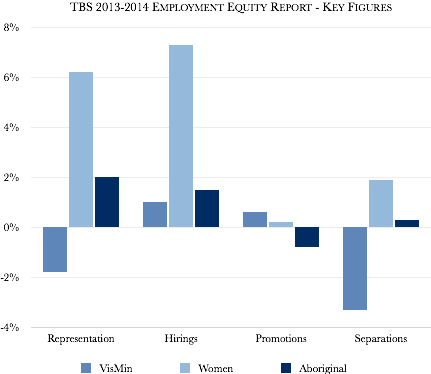
EE - TBS 2013-14 Summary Chart

Disappointing that TBS has not updated labour market availability (LMA) from 2006 (unlike Labour Canada for federally-regulated sectors – banking, communications, transport – has (17.8 percent visible minorities). However, while visible minorities remain under-represented, the hirings, promotions and separations data is relatively strong:

As at March 31, 2014, all four employment equity designated groups exceeded their workforce availability, as determined from 2006 Census data. Aboriginal peoples continued to increase their representation, from 5.0 per cent to 5.1 per cent; members of a visible minority group increased their representation from 12.6 per cent to 13.2 per cent; the representation of persons with disabilities decreased marginally from 5.8 per cent to 5.7 per cent; and women’s representation decreased slightly from 54.2 per cent to 54.1 per cent.

Within the executive cadre, representation rates continued to exceed workforce availability for three of the four designated groups. Women increased their representation from 46.0 per cent to 46.1 per cent; persons with disabilities increased their representation from 5.3 per cent to 5.4 per cent; and members of a visible minority group increased their representation from 8.2 per cent to 8.5 per cent. The representation of Aboriginal peoples remained stable at 3.7 per cent, below their workforce availability for executives.

For those interested, this table shows the overall trend over the past 5 years:

2009-10

2010-11

2011-12

2012-13

2013-14

Representation

10.7%

11.3%

12.1%

12.6%

13.2%

Hirings

11.3%

9.8%

10.7%

14.7%

16.0%

Promotions

12.1%

12.5%

13.5%

13.5%

13.8%

Separations

6.4%

7.1%

7.7%

8.9%

9.9%

Despite most of these years being under restraint and cutbacks, it is encouraging that representation, hirings and promotions continue to increase (separations may reflect cutbacks).

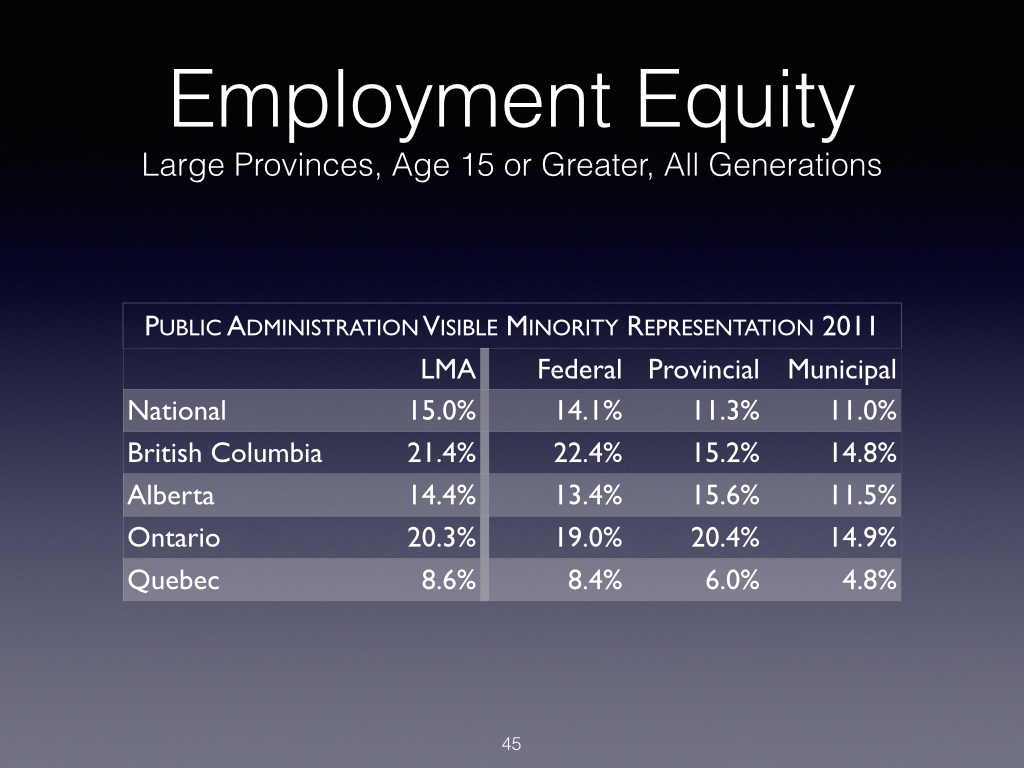
While TBS has not yet issued a revised LMA, a rough calculation would suggest the LMA has increased from 12.4 in 2006 to 15.0 percent in 2011.

This is based on the percentage of the population which is visible minority (19.1 percent) and adjusting for the percentage that are also Canadian citizens (78.3 percent).

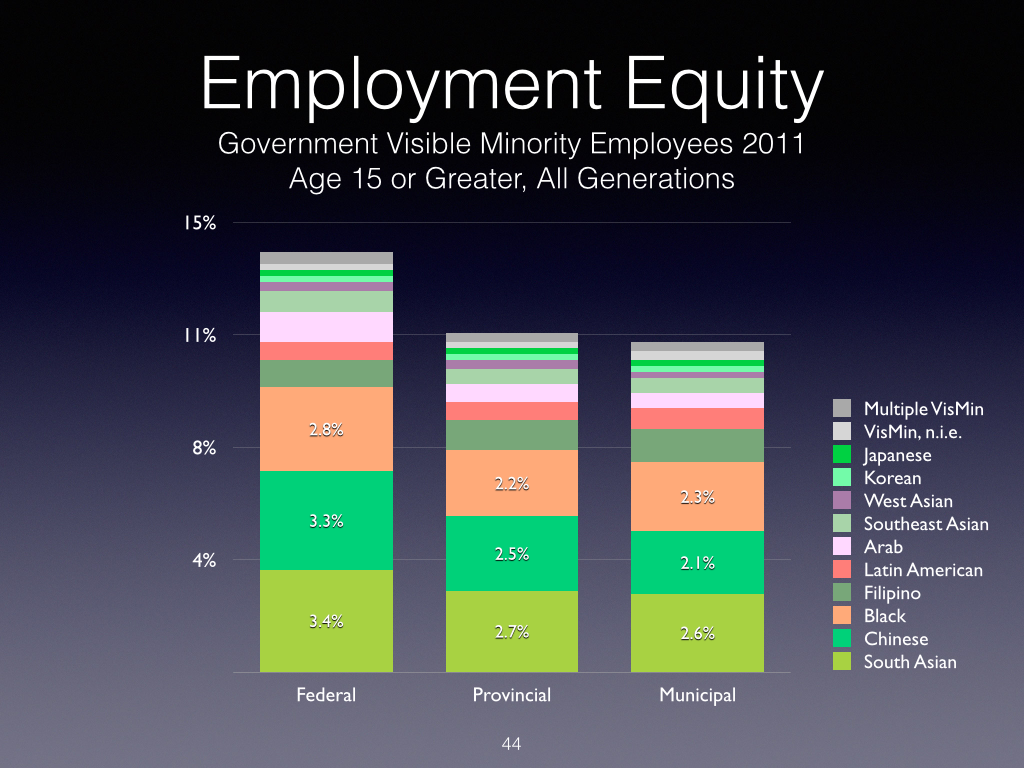
Another view of public service employment equity can be derived from the National Household Statistics on public sector employment, which covers all federal public institutions (less the Canadian Forces), not just the Schedule 1 departments covered in the TBS reports:


Multiculturalism in Canada-Evidence and Anecdote Deck - April 2015.044 Multiculturalism in Canada-Evidence and Anecdote Deck - April 2015.045

Employment Equity in the Public Service of Canada 2013–14.

Ralph Heintzman: Creeping politicization in the public service

Heintzman on the Finance Department’s crossing the line and calling for stronger action by the Clerk:

But we don’t need to wait for action until the next Parliament. The arrival of a new clerk gives her an opportunity to provide the kind of leadership for which the rest of the public service yearns.

It’s time to stand up for a professional, non-partisan public service, as described in all the official laws, regulations and policies of the government of Canada. But too often betrayed in practice.

It’s not enough to reaffirm, verbally, “the principles of a non-partisan professional public service,” as the clerk did in a recent interview (Canadian Government Executive, 2 February 2015). Words like these are only hot air if they’re contradicted by public service behaviour. The walk has to match the talk.

If the clerk wants her words to be taken seriously, she should start by doing something about the unaddressed and still uncorrected case of the department of finance. And she should tell us what’s being done to prevent public servants from crossing the line, from non-partisan to partisan communications, in future.

Ralph Heintzman: Creeping politicization in the public service | Ottawa Citizen.

CRA audits of charities look fair but feel foul – Don McRae

Looking and finding patterns in the selection of charities for CRA audit:

The Charities Program Update states that one of the factors in building the audit plan was that groups from all four charitable categories were audited. (The categories are relief of poverty, advancement of education, advancement of religion, and other purposes of benefit to the community.)

As of Jan. 31, 2014, there were 31 files under audit. Twenty-two of the 31 audits were community benefit groups (where environmental, social justice and human rights groups are found). This segment, which is 23.3 per cent of all charities, makes up 71 per cent of the 31 audits. There appears to be no cause for an over-representation of these groups as they make up only 18.5 per cent of all charities revoked for cause since 1967.

In a Canadian Press story last August, the director general of the charities directorate, Cathy Hawara, explained the audit selection process. She said the CRA considered formal complaints from citizens, lobby groups, MPs or even cabinet ministers. (Having a complaint from a minister raises questions about the selection process.) These external complaints led to 30 “leads” to investigate.

From 2008-09 to 2010-11, there was an average of 24 such complaints to the CRA each year. This went up to 139 complaints in 2011-12 and 159 the year after that. Ethical Oil, the lobby group with Conservative ties that encourages “people, businesses and governments to choose Ethical Oil from Canada’s oilsands,” made several complaints and at least five of these groups are being audited.

Of the 20 self-identified charities, 11 do some work on environmental issues and seven work on social justice or international development. Seven of the 20 have had their federal funding eliminated since 2006. KAIROS, the group that was famously not recommended by the former CIDA minister Bev Oda, is being audited under the auspices of the United Church of Canada. Four other groups identified on the church’s website as partners are being audited. Some of the audits have taken years, draining staff time, resources and energy from the organizations.

The Conservative government has assured Canadians that the system of political activity audits is fair and neutral. The limited evidence we have suggests a different conclusion. To paraphrase Frodo in The Lord of the Rings, the system looks fair but feels foul.

There are two major losers in this process. The first are Canadians, who will not benefit from the research, experience and advice of Canadian charities. The second is the CRA, which must defend what appears to be a stunted and warped selection process by finding new ways to say “trust us.”

CRA audits of charities look fair but feel foul | Toronto Star.

Let there be light, and access to information, in Ottawa – Globe Editorial

Cannot agree more, even if in my former life, reviewing ATIP requests was a chore:

When in doubt, disclose – that is one of the admirable messages delivered last week by Suzanne Legault, the Information Commissioner of Canada, in her report on how to modernize the federal government’s access-to-information system.

In fact, the principle in question is even broader. The presumption should be that any document made for a public, governmental purpose should be made public in the first place; that is, it should be posted on the Internet when it is created, and made available to a citizen seeking the information – unless there is some valid, solid reason not to do so. In other words, most public documents should be open “by default.” The burden of proof should be on the concealer.

The privacy of citizens will often be such a reason; secrecy in governmental activity is less often a solid ground.

The current ATI law is 30 years old, and has been amended in only minor ways since then. Governments and bureaucracies have little incentive to provide most information. This history demonstrates that both Liberals and Conservatives are to blame; we may well doubt that the NDP will be any better if they ever come to power in Ottawa.

All this should be, and could be, much easier in an age of electronic documents, when transmitting information is convenient and easy, and when metal filing cabinets are mostly obsolete. But that has not happened.

One recommendation in Ms. Legault would simplify life for everybody. The charging of fees for requests should end – New Brunswick has already done this in 2011.

The most fraught access-to-information question is cabinet confidences – that is, what is genuinely part of the deliberations of the cabinet, and what is being used as “a cloak” to conceal information. Ms. Legault is right that “purely factual and background information” should not treated as cabinet confidences, but “analyses of problems and policy options” may be another matter.

The fact, however, that cabinet confidence was invoked 3,136 times in 2013-2014 gives us pause. Ms. Legault’s recommendation that a few members of her office should be able to assess whether cabinet confidence is being used for its proper purpose is a good one – as is characteristic of this excellent report as a whole.

via Let there be light, and access to information, in Ottawa – The Globe and Mail.

Contemporary Directions in Canadian Citizenship and Multiculturalism – Toronto Event

Will be in Toronto today talking about the general political/public service issues as well as citizenship.

York U Event

How complexity imperils faith in our public institutions – Hugh Segal

Thoughtful comments. Money quote:

One must also be clear that certain aspects of the public sector have an interest in the salutary obfuscation of complexity. National security agencies, finance departments, central banks, some immigration and social service regimes find complexity and conflicting goals and applications helpful in maintaining their unchallenged jurisdiction and broad discretion. Their intent may be constructive but constructing through rules, regulations, contradictory and time-sensitive criteria and related machinations a cloud of uncertainty raises complexity and its construction to an act of sheer artistry.

The challenge for governments and those who care about democracy is not of doing away with complexity – which in a multifaceted, multi-racial and economically diverse society is unavoidable. The challenge is in finding ways to reduce it, simplify it and manage it so that the complexity itself does not destroy the efficacy of public institutions but even the public desire for those institutions to exist and be of service in the first place.

How complexity imperils faith in our public institutions – The Globe and Mail.

Stewart Prest: An informal coalition of experts has become the most effective opposition to the Tory government

Interesting piece on the emergence of coalitions to oppose recent government legislation:

Between C-51 and C-23, we are gaining a good sense of what an effective contemporary opposition coalition looks like. In both cases, participation has extended far beyond what might be called “typical” activism to include a range of principled, non-partisan and evidence-based opinions. Many members are drawn from civil society, but I would argue the coalition as a whole is not synonymous with it.

Key actors in both examples include academics working together in large groups, encompassing different disciplines and approaches; senior civil servants, both current and former; members of the legal profession; both partisan and non-partisan voices within what for lack of a better term I’ll call the country’s broader political class (former statesmen, editorial boards, columnists, and so on); maximal indigenous leaders; and dissenting voices within the country’s conservative movement.

Beyond studiously resisting appearances of partisanship, many within such coalitions have taken pains to note wherever possible ways in which their concerns might be addressed without undermining the government’s stated objectives. They attempt to remain politically neutral even in their opposition to the proposed legislation, seeking to offer the government advice on how to implement its preferred agenda while taking into consideration things like respect for human rights, the potential violations of the Charter, and important elements of political convention within the Canadian context, particularly those associated with maintaining the integrity and legitimacy of the Canadian political system as a whole.

Stewart Prest: An informal coalition of experts has become the most effective opposition to the Tory government

In politics, it’s dangerous to take the low road: Bruce Anderson

Bruce Anderson, is his usual diplomatic way, makes strong points about wedge politics, topical given some of the comments by Conservative MPs in particular:

They [political strategists] know that voters have had a bellyful of manufactured drama – politicians getting hot and bothered about issues that shouldn’t be at or near the top of the agenda.

For one reason, the audience can spot the manipulation. It’s like a magic trick when the audience has figured out how the illusion is done: not only is it not entertaining, it’s awkward and embarrassing. At best, voters might just ignore you, because they know the tactic is not serious, just a game.

But the bigger reason to hesitate is the risk of starting a hazardous chain reaction, one that gets outside your control quickly. When you use a controversial issue to rally your base, there is a greater risk of also hardening and energizing your opponents too.

There are highly skilled and experienced campaign teams all across the spectrum, people who know how to turn a wedge attack aimed against them into an opportunity to raise money and ire and generate a backlash.

The late U.S. politician Adlai Stevenson (who twice failed in presidential bids against Dwight Eisenhower) said, almost 60 years ago, “the hardest thing about any political campaign is how to win without proving that you are unworthy of winning.”

It would be naïve to suggest that we’re in for a new golden age of only positive campaigning. But a pretty fair case can be made that voters are noticing and responding well to high-road campaigning, which reveals how fed up they are with the opposite.

And the smartest campaigners know that wedge issues are becoming less like a magic potion for electoral success, and more like nitroglycerine: a choice that could go pretty badly, if fumbled.

In politics, it’s dangerous to take the low road – The Globe and Mail.

Tory-linked charity behind monument declared it was not active politically

Another illustration that charities chosen for CRA audits, and those not chosen, appear to reflect ideological or political criteria:

The charity behind the campaign to erect a monument to the victims of communism has declared zero political activity in its five-year history, even though it originally told the Canada Revenue Agency some of its work would be political.

A review of Tribute to Liberty’s official filings with the CRA reveals a clear intention to engage in political activity. When asked if it planned to engage in political activities, it answered “Yes” in its 2009 application for charitable status. It said this would involve contacting MPs and senators to gain their support for the project.

Yet, in the five years that followed, the charity answered “No” each time it was asked by the CRA in annual reporting forms whether it conducted political activity.

Dozens of Canadian charities have faced scrutiny since the 2012 Conservative budget set aside $8-million for CRA audits to determine whether they are following rules regarding political activity. The CRA has not published a list of the 60 charities it has identified for auditing. However, some of the groups that said they were audited were critical of government policy. The CRA has rejected suggestions the selection was politically motivated.

Tory-linked charity behind monument declared it was not active politically – The Globe and Mail.