ADMs have become too insular and inexperienced: study

Interesting and relevant study on ADMs by Jim Lahey (disclosure have spoken to his EX2-3 course on the lessons from Policy Arrogance or Innocent Bias: Resetting Citizenship and Multiculturalism) and Mark Goldenberg, with relevant thoughts on how to improve their expertise and depth of experience:

Once they have become ADMs, they tend to move from job to job and spend less than two years in a position. Most of those moves are within their own departments.

“ADMs move too much and don’t necessarily make the right moves. ADM churn needs slowing down. They are moving too frequently, and not always making the kinds of moves that can broaden and deepen their knowledge, experience and skills,” said Lahey.

“It is absolutely wrong to have ADMs who are generic managers divorced from policy and content. There has been a kind of managerialization of ADM jobs … bringing those jobs down below what they should be.”

The report offers five areas of reform to “raise the bar” for managing and recruiting these senior executives so they have more responsibility, experience, knowledge and leadership skills. It says future ADMs should be a strategic thinkers and visionary; should focus on results, effectiveness and economy; have strong interpersonal skills; and be able to work collaboratively.

Lahey said the overall executive cadre could be significantly cut but this must be managed slowly while targeting the talent in the lower executive levels to develop for the future. Slashing jobs to delayer is too disruptive; instead, the key is to figure out the roles and responsibilities for each level of management. This means adjusting the expectations of ministers and political staff – which could be tough in an era of mistrust between politicians and bureaucrats.

The report also urged bringing in new blood from outside the public service with external recruits accounting for up to 15 per cent of ADM appointees. It also suggests fast-tracking younger executives in their 30s and 40s so they become ADMs – and DMs – at a younger age and having them stay in the jobs longer before retiring.

The study also suggested ADMs stay in a position at least three years before moving to another. In fact, it argued that staying in the job, mastering it and leadership should be tied to performance pay.

ADMs have become too insular and inexperienced: study | Ottawa Citizen.

Canada’s public service and the new global normal of change: Lynch

Former Clerk of the Privy Council Kevin Lynch on the role and challenges for the public service:

The public service plays a core role in our Westminster system of government. It is nonpartisan, it is permanent, serving governments past, present and future, of any political party, with equal loyalty and effectiveness, and its appointments are merit-based. It offers evidence-based policy advice to the government of the day, it administers the policies, programs and regulations approved by Parliament on a nonpartisan basis, and it provides the essential services of government. Given its roles, responsibilities, and accountabilities, a Westminster public service should not be mistaken for an administrative service, nor should it be confused with an American civil service, which is institutionally designed to be partisan and non-permanent at all senior levels.

These same global trends are impacting Canadian public services, both federally and provincially. Demographics—our public services are aging, and recruiting, training and retaining the next generation of public servants, and developing its leaders are a key challenge. The competition for exceptional talent is intensifying, and the public service will be able to attract such talent only if the work environment within government offers the ability to make a difference, help shape policy options and choices, be innovative in service delivery, and do great science. Globalization—a public servant today needs a worldview not a parochial one, an understanding that something happening anywhere in the world can have impacts here in Canada. And technology—innovations in ICT, social media, cloud computing, data analytics and adaptive learning have enormous potential to reshape both the “back office” of government operations and the “citizen-facing” service delivery and interaction functions.

The public service is under stress, both responding to these demographic, globalization and technology pressures and dealing with a challenging governance environment. At a time when Canada faces many longer-term policy issues, there seems to be little demand for public service policy advice. At a time when the private sector is shifting to distributed leadership and entrepreneurship models and risk management, the governance model of the federal government is moving towards ever greater centralization and risk aversion. At a time when attracting and retaining superb talent to the federal public service is facing stiff competition from the private sector here and abroad, there is ambiguity from the government itself about the importance of government and governance to the economy and society in these transforming global times—hardly motivating to prospective public servants. As leading experts on the public service such as Donald Savoie have stressed, the apparent antipathy of the government today toward the public service may have deleterious long term impacts on the public service as an institution.

http://ipolitics.ca/2015/07/09/canadas-public-service-and-the-new-global-normal-of-change/ (paywall)

Catching up: Stories that caught my interest

While I have not been blogging over the past month, I have been following events and these stories and reports caught my eye.

From a general perspective, the Environics Institute latest Focus Canada annual survey showed continued strong support for immigration and multiculturalism, including some notable increases in support (e.g., general support for multiculturalism, reduced fear immigrants not adapting to Canadian values, that immigrants can be as good citizens as Canadian-born) along with increased recognition of discrimination and the need for policies and programs to address it.

Jeffrey Simpson in the Globe reminded us of just how successful the Canadian model of citizenship, immigration and multiculturalism has been.

Citizenship

The Canadian government launched its first revocation proceeding, selecting Hiva Alizadeh as the test case given that he is a dual national of Canada and Iran, was tried and convicted in a Canadian court where he pleaded guilty (avoiding many of the issues raised during C-24 hearings regarding due process in foreign courts).

The remaining provisions of the changes to the Canadian Citizenship Act came into force on June 11, provoking the usual stories about how some were affected by the date chosen (no matter which date was picked, there would always be some affected by the transition. The release of ATIP documents on the Citizenship Act consultations revealed that ethnic groups were particularly concerned about longer residency requirements and increased fees, with some concerned about revocation, and many questioned why advertising was focussed on revocation provisions rather than the changes they were concerned about.

Minister Alexander’s Canada Day message repeated the historic naturalization rate of over 85 percent, despite his department knowing that the recent rate is lower. His conflating of niqab-wearing women with terrorists and his highly selective citing of Liberal government restrictions on immigration and related discriminatory practices were savaged by some commentators.

CIC has yet to provide an explanation for the significant drop (over 30 percent) in the number of citizenship applications in 2013 and 2014 (Full 2014 Citizenship Statistics: Declining Applications).

The Australian government, despite a vigorous internal debate on citizenship revocation, appears committed to a fairly draconian approach, applying to both single and dual nationals and the children of those convicted.

Multiculturalism

The usual Multiculturalism Day messages by political parties, with the Government (Ministers Kenney and Uppal) emphasizing “peaceful pluralism and ordered liberty,” sport and “the values of freedom, democracy and the rule of law” (no mention of human rights), the NDP Multiculturalism Critic emphasizing “tolerance, understanding and equality” and the Liberal Party leader emphasizing “acceptance, fundamental freedoms, and mutual respect.”

The Government reversed a new policy requiring “pat-downs” of turbans, following protests by Canadian Sikhs (likely reflecting their political importance), leaving Minister for State for Multiculturalism Uppal to explain why an exemption for one form of religious headgear (the turban) and not another (the niqab). While there is a difference between covering one’s hair and covering one’s face, ironic that this decision took place in the same month as families of the Air India bombing commemorated the 30th anniversary, the largest terrorist attack in Canadian history with some families noting that some temples have pictures of the Sikh mastermind behind the bombing.

A thoughtful discussion of the challenges health care professionals face in dealing with accommodation requests for different groups, and the processes used to decide what can be accommodated and what not.

Declining support for immigration and multiculturalism post 9/11 and 7/7 in Britain was significant (56 percent in 2015 believe multiculturalism makes Britain worse compared to 32 percent in 2001).

Meanwhile, French Prime Minister Walls notes that Islam is “here to stay in France” while highlighting unacceptable behaviour (antisemitism and hate speech). In addition, despite the formal separation of church and state in France, some have initiated programs to have a more open approach to discussing religion in schools.

In a significant discrimination case, the US Supreme Court ruled that the actual results of policies and programs trumped the intent of these policies, providing a basis for challenging systemic racism and discrimination in future cases.

Canadian antisemitic incidents are reported as rising given B’nai Brith reports (which contrast with Statistics Canada police-reported hate crimes report which show a decline).

An interesting opinion piece that tries to assess the boundary between criticism of Israeli policies and antisemitism provided some nuance to debate on either side of the issue. As Israeli governments provide more support to the Israeli Rabinate, a divide may be emerging between American Jews and Israel.

A good discussion on some of the issues around providing Holocaust education to German Muslims, how it gets tied to the general Israel-Palestine issue, and the efforts by the German government to develop programs to reduce radical Islam by establishing centres for the study of Islam. Meanwhile, the Netherlands postpones the release of a report showing antisemitism among Dutch Muslim youth.

An account of how “trying white food” is part of the experience of children of immigrants, which complements the increased interest by “white people” in ethnic food, highlights one aspect of integration.

Google quickly learns the limits of its image recognition software when its software labels Blacks as gorillas, but quickly deletes the gorilla label as an interim step to ensuring better image recognition. Appears that software too can be subject to implicit bias and should be made to take the Implicit Association Test (IAT).

New Canadian Media held its first workshop for integration and settlement agencies on how to engage the mainstream media in ethnic community issues.

An amusing yet relevant discussion on when multiculturalism advertising can become offensive, using examples from the 1970s (particularly McDonalds and advertising targeted to Black Americans) and some tips to avoid crossing the line.

Following months of wedge and identity politics around Canadian Muslims (the most recent being the Bill tabled just before the House rose banning the niqab at citizenship ceremonies) and the threat of Islamic-inspired extremism, the PM makes a more positive gesture in hosting an Iftar dinner at 24 Sussex.

President Obama delivers one of his best, and arguably one of the best ever, speeches on racism in America and the need for action in his eulogy at the Charleston funeral for those gunned down by a white extremist. Worth taking the time to view in its entirety:

https://www.youtube.com/watch?v=RK7tYOVd0Hs

Nell Painter, recapping some of her insights of her book The History of White People, notes that “whiteness” is often defined by what it is not (“blackness”) and that we need to move beyond such binary expressions of identity.

Extremism

A reminder that right wing extremism has been a greater threat in North America than Islamic-inspired extremism provides again a note of nuance to current security and related debates.

A Canadian government-funded study demonstrated that there are various paths to radicalization, showing that despite rhetoric, the Government is sponsoring sociological research.

An interesting counterpoint to ISIS/ISIL’s destruction of non-Islamic (and non-Sunni) monuments can be seen in Israel considering restoring the historic Islamic site of Khirbat al-Minya, the ruins of an Umayyad palace complex on the northern shore of the Sea of Galilee.

Immigration

As been mentioned before, and as apparent in the analysis I did for my forthcoming book (Multiculturalism in Canada: Evidence and Anecdote), immigration is becoming increasingly dispersed beyond the larger urban centres, given housing costs and economic opportunities.

An ATIP request indicates profiling and bias in CIC’s review of potential marriage fraud, although the guide has subsequently been revised, with examples highlighting the extensive documentation required.

Following the Toronto police carding debate, and likely other but less high-profile debates elsewhere in Ontario, the Ontario government decides to develop and implement a province-wide policy.

The Quebec government provided fewer resources to organizations delivering integration courses as part of overall austerity measures.

Other immigration stories of interest included accusations of racial profiling of Roma travellers and the effective ending of the live-in-caregiver program and the impact on childcare needs,

Other

Rick Salutin wrote a good piece looking at the history and definitions of “barbaric cultural practices” providing perspective on the current government fetish to use the term for political marketing purposes.

Daniel Savoie had his usual biting commentary of some of the weaknesses of current governments and their apparent inability to deliver programs and policies effectively.

The issue of Saudi financing of Islamic religious schools in Canada was reported on, with little indication that this funding was influencing the curriculum and approach (largely appeared to be for buildings and other infrastructure).

As part of Canada Day reporting, CBC interviewed foreign academics on their views on how Canada was perceived abroad, highlighting their assessment that it had worsened, not surprising given their more centrist and left-wing perspective. The cut to the Canadian Studies Abroad program in 2012 was again lamented.

Sadly, but not surprisingly, the Government does not make any changes to the mandatory Census questions that would improve the quality of the data, and continues with the voluntary NHS approach.

Will be back to my regular posting schedule on Monday.

Don Cayo: Policy decisions made without facts can only fall back on whim, bias and ideology

More on anecdotes vs. evidence, this time in the context of Vancouver house prices but a broader message by Cayo:

But populism, political pandering, intuition or ideology — call it what you will, the made-up facts that are spewed in so many debates — are always a poor basis for decision-making. Yet we see a heavy reliance on this at every level of government, not to mention with voters every time we go to the polls. And, sadly, we seem doomed to see a lot more.

Every government is prone to ignore relevant data, even when it’s available, or to spin it to favour their ideological or political priorities. And there are lots of gaps in the data they can draw on — like the gaping hole in the Vancouver housing picture that invites us to jump to any conclusion that suits our mood.

Worse, the federal government has been refining this shortcoming. It has launched what looks like a focused assault on the sources of information that could inform debate on myriad issues.

The worst step in this direction was the 2010 decision to scrap the mandatory long-form census. Despite continuing outcries of not just political opponents but also of apolitical researchers and analysts in many important fields, the government won’t budge.

This move didn’t have many immediate consequences, but its effect will multiply over time. Because the response rate to the voluntary replacement for the mandatory long form plummeted from well over 90 per cent in 2006 to less than 70 per cent in 2011, and because most non-responders are from smaller places and poorer segments of society, the resulting data is skewed. It’s no longer reliable enough to do the job it once did: informing intelligent planning and the like.

The result will be more policy debates and decisions driven by ideology, bias or whim, just like Robertson’s and Clark’s conflicting views on housing policy. And no side will be unable to authoritatively back its case or counter the other side’s without trustworthy data.

The list of growing impediments to intelligent debate goes on: Cutbacks to research budgets; the muzzling of federal scientists and other experts with information to contribute; the chill on non-profits, some with considerable expertise, because they fear loss of funding and/or being singled out for audits that seem to be targeting perceived advocates of positions not favoured by the federal government.

Don Cayo: Policy decisions made without facts can only fall back on whim, bias and ideology.

Mary Campbell: History shows we need a good correctional investigator

Former DG of Corrections and Criminal Justice Directorate at Public Safety Canada, Mary Campbell, on the non-reappointment of Howard Sapers, the current correctional investigator:

What is not needed is a “political friend” of the likes of many of this government’s appointments. It’s not just inmates’ safety that depends on this, it’s your safety, ultimately.

Mary Campbell: History shows we need a good correctional investigator | Ottawa Citizen.

Conservative judges, bureaucracy, Senate a likely constraint on future government: Atkin

David Akin on the possible constraints facing an incoming new non-Conservative government, using PM Harper’s 2006 language regarding Liberal constraints on an incoming Conservative government:

“The reality is that we will have, for some time to come, a Liberal Senate, a Liberal civil service, at least at the senior levels where they’ve been appointed by the Liberals, and courts that have been appointed by the Liberals,” Harper said. ”These are obviously checks on the power of a Conservative government. That’s why I say … there is certainly no absolute power for a Conservative government and no real, true majority.”

Though all those checks and balances might seem obvious, the Martin Liberals used this comment by Harper as an attack point, to suggest that, absent all those Liberal judges and bureaucrats, Harper would impose a Conservative revolution on the otherwise peaceable kingdom that was Canada in 2006.

The Liberal attacks were successful to a point: They helped keep Harper’s win to a minority.

But now, more than eight years later, as we look at the polls and consider the possibility of another ideologically driven party, the New Democrats, potentially forming government, it’s useful to consider the wisdom of what Harper said at the end of that 2006 campaign.

Right now, we have a Conservative Senate. There is not a single New Democrat senator. That’s a virtue now for NDP Leader Thomas Mulcair, but it could be a liability if he becomes prime minister and needs a Senate full of Conservatives and Liberals to pass his government’s legislation.

If course, the NDP has vowed to get rid of the Senate altogether. Good luck doing that without your own senators, New Democrats!

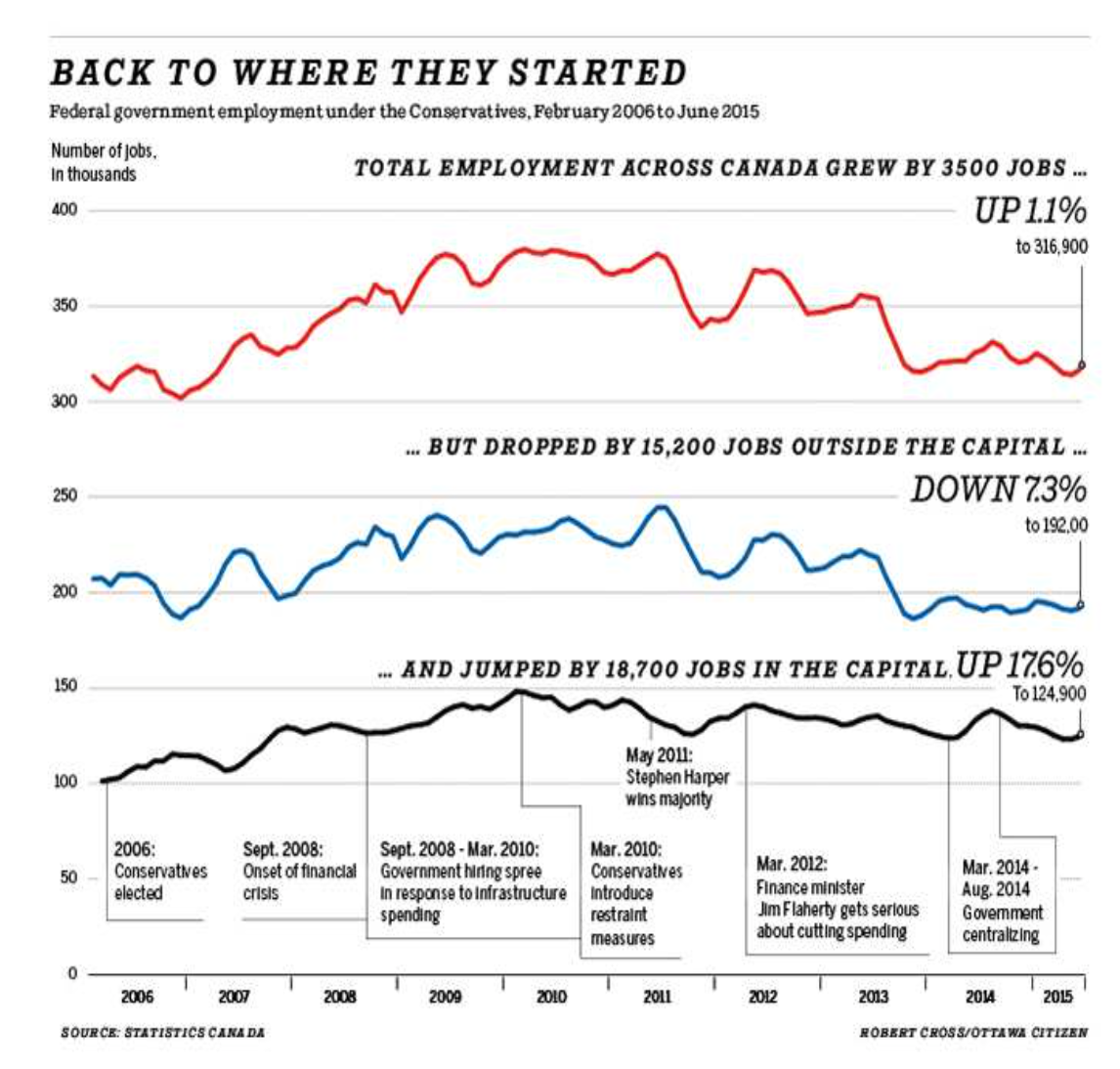
What about the civil service? Public sector union bosses might prefer a New Democrat government but an entire generation of leaders and managers in the civil service is now in place that were hand-picked by the Harper Conservatives. The Clerk of the Privy Council — the top bureaucrat among the 257,000 federal bureaucrats — is Janice Charette. She cut her political teeth as a former chief of staff to former Progressive Conservative leader Jean Charest and other PC ministers before going into the ‘non-partisan’ public service.

And then there are those judges. When Harper looked at the Supreme Court in 2006, all he saw was Liberals. But now, if Thomas Mulcair becomes PM and looks at the court, he will see 7 of 9 justices appointed by Harper, one — the Chief Justice Beverley McLachlin — appointed by Brian Mulroney and just one appointed by a Liberal PM.

By Harper’s own logic of 2006, between the Senate, the bureaucracy and the judiciary, there would be much to constrain an NDP government should that happen this fall.

Harper made that point in 2006, was attacked for making it, and won a minority government. Will Mulcair make the same point in this election season with the same effect?

Comments on senior officials is of interest. Suspect some may be vulnerable that have appeared to stray the line (but doubt that Charette would be considered among them).

And of course, as others have argued (and I in my book, Policy Arrogance or Innocent Bias: Resetting Citizenship and Multiculturalism), the Harper government distrust of the public service never was fully overcome.

Conservative judges, bureaucracy, Senate a likely constraint on future governmen.

Has Canada’s immigration system lost its heart?

Some good overall statistics on wait times, and a rather amusing comment from the CIC Minister’s spokesperson about anecdotes, given the reliance the government often places on anecdotes in formulating and communicating policy:

While the Conservative government has invested resources in expediting the processing of skilled immigrants, investors, refugees and people slated for deportation, wait times keep growing for family reunification programs.

Currently, it takes nearly four years (47 months) simply to assess a sponsor’s eligibility to bring in parents and grandparents. The aging would-be immigrants then have to wait years for their own assessment at visa posts abroad.

To sponsor a husband or wife already living in Canada takes 27 months. To renew a permanent resident card, it’s a minimum of 67 days; for citizenship, at least two and up to three years; and for eligible live-in caregivers to receive permanent status (so their spouses and kids can finally join them here), 44 months.

“I’m a proud Canadian and grateful for the opportunities this country has given me,” said Djordje Momcilovic, 48, an occupational health and safety consultant. “But I’m not proud that the Canadian government is promoting family values and reunion but in fact it is keeping and tearing families apart.” Momcilovic sought help from his local MP to temporarily delay his mother’s removal.

Immigration Minister Chris Alexander’s office said Canada will admit about 70,000 people as permanent residents under the family class in 2015.

“Anecdotal accounts are not necessarily more broadly representative or, unfortunately, even factual in some cases,” said Alexander’s spokesperson, Kevin Menard. “Certainly, each case is unique, and each is assessed on its merits based on the information applicants provide to officials.

“We are working to eliminate backlogs and reduce processing times of all kinds … Our government is committed to reuniting as many spouses and partners as possible, as quickly as possible, while ensuring permanent resident targets are met for all immigration streams.”

Has Canada’s immigration system lost its heart?

When it comes to cyberspace, should national security trump user security? – Citizen Lab

Always valuable, the insights and activities of the Citizen Lab of UofT’s Munk Centre, with the highly pertinent, and rhetorical, question at the end:

As the Snowden document makes plain, CSE and its allies in the United States, United Kingdom, Australia and New Zealand knew about UC Browser’s privacy and security problems since at least 2012. But rather than disclose them to the public and notify the company (as we felt compelled to do), they sat on and exploited them.

Of course, a leaky browser application is not as critical as a fault in a pacemaker, a 747, or a nuclear enrichment facility. Or is it? Consider that in China where the browser is most popular, all network operators are required by law to retain customer data and turn it over to security agencies upon request. The Chinese regime does not look fondly on political opposition and public demonstrations, the organization of which is now almost entirely dependent on mobile devices. Each year, China executes thousands of people for crimes against the state, and sends thousands of others to re-education labour camps. Chinese dissidents with UC Browser on their mobile device have been sitting ducks for China’s targeted surveillance, for years.

Did CSE and its allies deliberate seriously about these moral tradeoffs? Hard to say, as such deliberations are classified. For what it’s worth, the White House’s Cybersecurity Coordinator, Michael Daniels, has said the United States has a “disciplined, rigorous, and high-level decision-making process for vulnerability disclosure” in which “all of the pros and cons are properly considered and weighed.” The top-secret documents, however, evince a different attitude, one full of only excitement at the discovery and the prospects for exploitation.

The case of UC Browser is one illustration of a larger public policy problem around cybersecurity. We stand at a crossroads. Down one path is a future where governments secretly stockpile information vulnerabilities as weapons, weaken encryption to make eavesdropping easier, and engineer secret “back doors” into our networks to steal info and sabotage systems. Heading down this path will turn the global information commons into an inter-state battlefield. In worst case scenarios involving the targeting of critical infrastructure, it will lead inevitably to large-scale loss of life.

There is another path we can head down, one in which the security of users, regardless of nationality or geography, is the primary concern. Going down this path would begin with the premise that cyberspace is a shared common resource requiring stewardship. It would imply a much greater role for civilian, as opposed to military, agencies. From this view, securing cyberspace would be undertaken by independent and globally distributed individuals and groups insulated from national rivalry. The core of this approach would involve the public disclosure of vulnerabilities wherever they occur in the interests of global public policy, human rights and international humanitarian law.

Are we confident our governments are on the right path?

When it comes to cyberspace, should national security trump user security? – The Globe and Mail.

Chianello: Communism memorial’s saga spotlights Tories’ poor process

More on the proposed memorial to visitors of communism and the Government’s railroading over process and lack of broader consultation:

The official Long Term Vision and Plan is a comprehensive and sensitively designed development strategy for the Parliamentary Precinct, the Judicial Precinct and Library and Archives Canada. It’s not meant to be a rigid to-do list, but a framework for making decisions, ensuring that future developments “make a positive contribution to the total composition of the Precincts, while avoiding negative impact on the landscape.”

It’s hard to see how the proposed memorial will do any of these things. Kenney may insist that the massive, brutalist design for the memorial will be “more like a park,” but two dozen of the country’s most prominent architects have decried the plans, not to mention the chief justice of the Supreme Court, the mayor, and pretty much every architectural and planning organization in the country.

Ottawa’s city council will debate and likely pass a motion next week asking the federal government to relocate the proposed memorial because it would violate the guiding principles of the government’s plan.

“I believe fundamentally that due process has to be followed,” says Dewar, “so development can be protected from the whims of any political interference.”

If you care about the outcome, you need to care about the process. But this Conservative cabinet seems to care mostly about the political outcome, and has thus managed this memorial with an opaque, political process.

Chianello: Communism memorial’s saga spotlights Tories’ poor process

Steve Campana, Canadian biologist, ‘disgusted’ with government muzzling

Confirmation of previous stories, with a human face:

A recently retired Fisheries and Oceans Canada biologist says the muzzling of federal government scientists is worse than anyone can imagine.

Steve Campana, known for his expertise on everything from great white sharks to porbeagles and Arctic trout, says the atmosphere working for the federal government is toxic.

The Halifax-based scientist, who only agreed to talk to CBC after he retired from the department, says federal scientists have been working in a climate of fear.

“I am concerned about the bigger policy issues that are essentially leading to a death spiral for government science,” he said in an exclusive interview.

“I see that is going to be a huge problem in the coming years. We are at the point where the vast majority of our senior scientists are in the process of leaving now disgusted as I am with the way things have gone, and I don’t think there is any way for it to be recovered.”

Public-sector unions have organized rallies in a number of locations across the Ottawa area on Tuesday to protest the alleged muzzling of public scientists.

“We have very strict directives of what we can say and the approval steps we have to go through, and very often that approval seems to be withheld for totally arbitrary reasons,” Campana says.

He says government scientists often have to find their own funding, travel is often turned down and they are rarely allowed to talk to the media, even about their own groundbreaking research.

via Steve Campana, Canadian biologist, ‘disgusted’ with government muzzling – Nova Scotia – CBC News.