Why Canada’s shift to conservatism isn’t dead: Bricker and Ibbitson

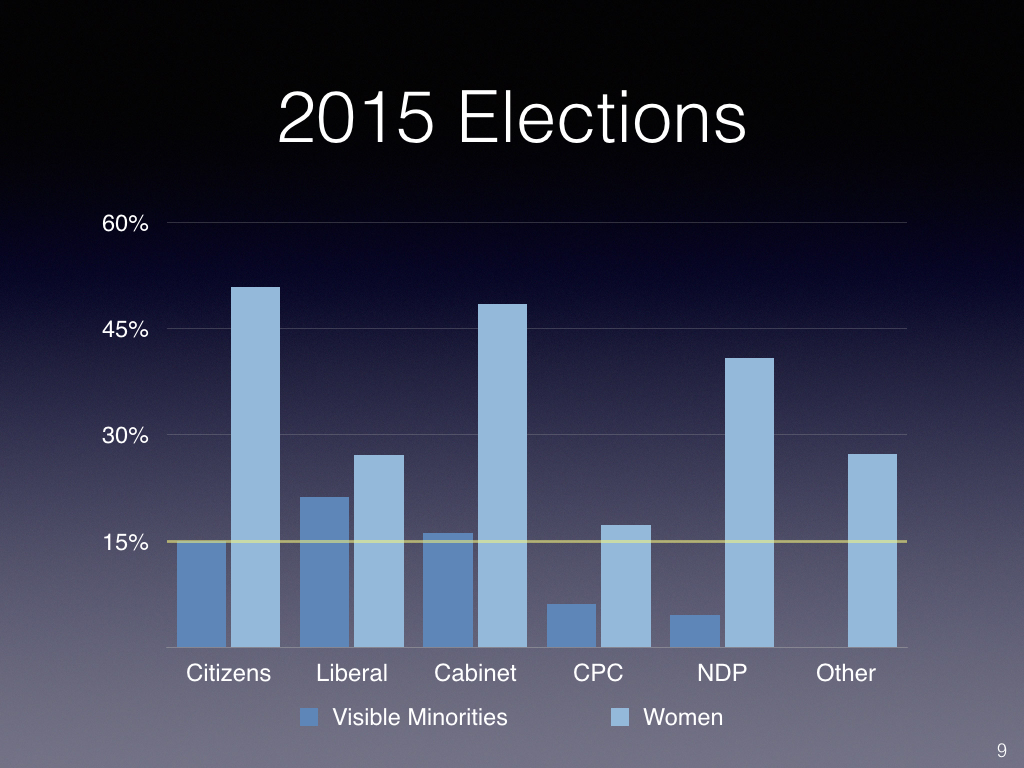
Bricked and Ibbitson appear to be remain in denial mode given the results in the 33 ridings where visible minorities are the majority and where the Liberals won 52 percent of the popular vote compared to the Conservatives 32 percent.

Their thesis was always suspect as it presumed that more conservative social and political views among some visible minority groups would lead to a permanent conservative shift.

They neglected to factor in issues of particular interest to new Canadians (e.g., immigration and citizenship policies) and broader values also influence election outcomes.

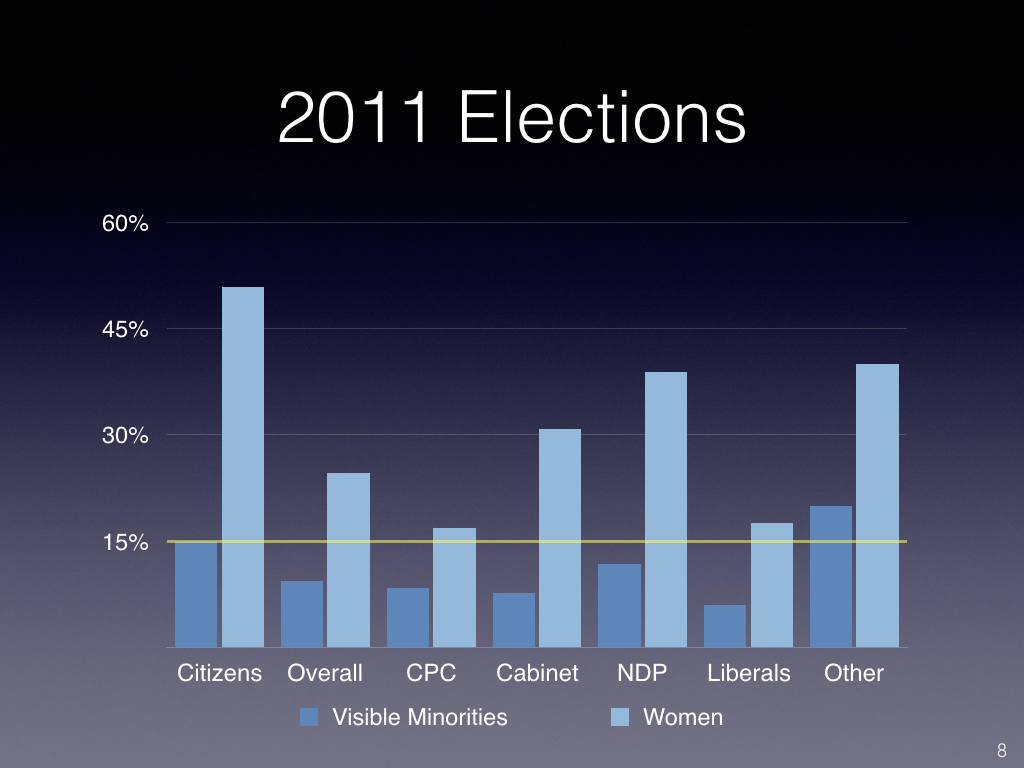
Moreover, using 2011 as a baseline was always questionable, given that the 2011 election was characterized by an exceptionally inept Liberal leader and campaign:

Mr. Trudeau’s astonishing revival of the Liberal Party – one of the greatest political achievements in this country’s history – masks a contradiction within his caucus. That caucus consists of a large contingent of MPs from Atlantic Canada and Quebec, where attitudes to wide-open immigration and multiculturalism are ambivalent at best. Both regions are, broadly speaking, economically weak, making them dependent on federal subsidies.

But the caucus also contains a large swath of MPs from the so-called 905, the suburban cities surrounding Toronto, named after their area code; and from similar ridings outside Vancouver. Polling shows that the immigrant voters who dominate these ridings are economically and socially more conservative than many of the native-born with European backgrounds.

The prospect of four more years of Mr. Harper pushed them away from the Conservatives and over to the Liberals. But we believe that, all things being equal, they will be inclined to drift back.

Of course, all things may not be equal. Mr. Trudeau may prove to be an inspired prime minister. The Tories could choose badly when they select the next leader. Any student of history knows that both tectonic forces (the U.S. economy surpassed all others in the 19th century) and individuals (Lincoln became president at the Republic’s most perilous hour) shape events. In the next Canadian election, anything could happen.

But slumping commodity prices notwithstanding, Western Canada will continue to grow in population and influence. In recent years, the Conservatives boosted immigration from 250,000 a year to 285,000. If any further proof of the seismic demographic shift that is under way were needed, Statistics Canada reported Tuesday that (a) between 2011 and 2014, the Canadian population grew by a healthy 1.1 per cent per year, (b) two-thirds of that growth was due to immigration and (c) the three fastest-growing provinces were Alberta, Saskatchewan and Manitoba.

Asian immigration and the rising West are making Canada a more Pacific and a more conservative place. We note that Mr. Trudeau, while campaigning on a message of hope and change, crafted a platform that left the meat of the Harper government’s agenda – low taxes, non-interference with the provinces, expanding trade opportunities, tougher penalties for some crimes – intact.

The shift is real and it will only grow more real with every passing year. We suspect no one understands that better than Mr. Trudeau himself. To beat him, the next Conservative leader must embrace it as well.

And my letter in today’s Globe making the same points:

The case for the “big shift” toward conservatism driven by more conservative suburban immigrant voters assumes that more conservative social and economic values will dominate over general Canadian values.

The Conservatives lost decisively in most of the ridings in the Greater Toronto Area and in B.C.’s Lower Mainland that they so assiduously courted. Look at the seat counts in 33 visible-majority ridings: the Conservatives: 2; the Liberals: 30; the NDP:1.

The Conservatives took 32 per cent of the total popular vote in these ridings, compared to 52 per cent for the Liberals, a much wider gap than the overall popular vote. While many of these voters may have more conservative values, these did not trump concerns over restrictions to immigration and citizenship, the divisiveness of the Conservative campaign, and the likely attraction of infrastructure investment to reduce gridlock.

As Michael Adams has argued, “Canadians deeply value their pluralistic society; they believe government has a role to play in building a fair country; they believe in empathy and compromise as social habits.”

The election results indicate that these values are shared by new and old Canadians alike.

 Oct. 29: Bronze statues of limitations, and other letters to the editor 

Will Justin Trudeau keep fighting Stephen Harper’s court battles?

Likely that a number of these kinds of cases will be dropped, presumably to the relief of Justice Canada lawyers (given that at least part of the Harper government’s motivation appeared to be more scoring of political points than enforcing the law):

Bahareh Esfand couldn’t vote for Justin Trudeau, but she sees the prime minister-designate’s victory reflected in her own Federal Court battle

For the past year, the Coquitlam, B.C., woman has locked horns with a Conservative government bent on winning the right to remove her permanent resident status.

It’s a complicated story: Esfand came to Canada from Iran in 2006 with her political refugee husband, but the minister of citizenship and immigration wants to strip her of refugee status for returning to see her ailing mother.

Regardless, the battle is almost pointless, because even if the government won, it’s unlikely they could deport a hard-working, non-criminal mother of a Canadian-born child and wife of a newly minted Canadian citizen.

As if to put a fine point on all of that, Federal Court Judge George Locke sided with Esfand this week in a scathing decision that suggests the outgoing government was “more concerned with removing refugee status than granting it.”

‘They’ve got a lot of decisions to make’

Esfand claims Stephen Harper’s government threw her life off balance in a bid to score an ideological point.

In that, she wouldn’t be alone. Canada’s courts are packed with claimants alleging their rights were violated by an agenda that purported to be tough on bogus refugees and tough on crime.

But her case also raises a question. What next? Even before Locke handed down his decision on Esfand, Ottawa announced plans to appeal if they lost.

But will Trudeau want to continue fighting Harper’s battles?

“They’ve got a lot of decisions to make,” said Josh Paterson, executive director of the B.C. Civil Liberties Association.

“They’re going to have to take a good, hard look at the whole suite of laws that have been passed by the current government and the legal challenges that are out there and figure out what to do.”

Broadly speaking, the cases in front of appeal or Federal Court judges involve either broad Charter of Rights challenges to legislation or specific cases where the application of policy allegedly undermines the intent of a law.

Issues range from mandatory minimum sentences, victim surcharges, the Fair Elections Actrefugee health care and Bill C-51 to the controversial niqab issue — just for a start.

Source: Will Justin Trudeau keep fighting Stephen Harper’s court battles? – British Columbia – CBC News

Long-form census could be reinstated for 2016, experts say

An early test  of the incoming Liberal government, one that looks like it could be done:

The return of the long form, promised by Justin Trudeau during the election campaign, would yield vastly more reliable data and cost less than running another national household survey, the former heads of the agency say.

“It should be possible. I am certainly very hopeful. But [the decision] needs to be done very soon. It’s an enormous logistical operation,” said Ivan Fellegi, chief statistician from 1985 to 2008.

It’s “no problem” to reintroduce the long form in time for the 2016 census, said Munir Sheikh, head of the agency from 2008 to 2010. The questions needn’t change, he said – just the instructions at the top. “All they need to do is put on the front page that this is mandatory.”

The other step is for “cabinet to approve it as a census, which they can do at any time – it would take a matter of seconds.”

Researchers are already pressing for action. “Undoing these mistakes cannot wait; the time for action is now as Statistics Canada is on the cusp of launching the 2016 census,” says a letter signed this week by 61 academics and directors of research centres, including Statscan’s former assistant director Alain Bélanger.

Issuing an immediate order in council “is the only way to implement the long form in time for the census six months from now,” they said. “This must be one of the first moves made ​​by the Liberal government of Mr. Trudeau. It would mark a clear break with the previous government and ensure that future social policies can be made on scientific grounds rather than ideological dogmatism.”

….The Liberal platform pledges to “immediately” restore the mandatory long form – and make Statistics Canada “fully independent.”

Mr. Sheikh, who resigned over the controversy in 2010, said having the agency operate at arm’s length to the government is an even more crucial step. “I would say that is more important than restoring the long-form census, because that really was the cause of the problem, that the government can interfere with Statscan on issues like this.If you have an independent agency, the census in the future wouldn’t be the cabinet or minister’s problem, it would be the chief statistician’s problem.”

Mr. Sheikh said “anyone who uses data” will benefit from the return of the census. The biggest beneficiaries would be governments at all levels, “which have to base their policies on reliable data. And then of course researchers, who use this data to determine social outcomes, the condition of households in terms of income, poverty, unemployment, the state of housing, transportation needs, the needs of ethnic minorities, language, the employment equity act. Any kind of social and economic policy issues you can think of really are related to the census.”

As well, “the census provides an anchor to all other surveys, will have much more reliable data to check all other survey results against that.”

Both former chief statisticians said the switch could save money by reducing printing costs and expenditures associated with the labour required to administer and analyze the separate household survey. The NHS was sent to about 4.5 million Canadian households while the 2006 long-form census was sent to 2.5 million dwellings. Running any census is a massive undertaking that typically takes years to plan. The total projected budget for the 2016 census – which had been planned as a mandatory short form and voluntary NHS – is $701.8-million.

Statistics Canada wouldn’t comment on whether it’s possible to make the changes in time for the 2016 census. “It’s a policy matter, and we can’t comment,” said spokesman Peter Frayne.

Other experts say it can be done. “It is inherently easier to return to a well-tested methodology” such as the traditional census, said Ian McKinnon, chair of the National Statistics Council. “If any statistical agency in the world can do it, Statistics Canada can.”

Reinstating the census “soon, both sends a signal of change of policy, and interest in basing policy on evidence – evidence-based decision-making, which I think is very healthy,” said Charles Beach, professor emeritus at Queen’s University and head of the Canadian Economics Association. Moreover, “doing something that is both cost effective and more useful, it’s an economic no-brainer.”

Source: Long-form census could be reinstated for 2016, experts say – The Globe and Mail

Nancy Peckford and Grace Lore: When it comes to gender parity in Parliament, better is always possible

More from Equal Voice on women representation in Parliament:

But there is one change that we at Equal Voice hoped for that did not happen. The percentage of women elected to the House of Commons did not meaningfully increase. It is just one point higher than the last time, at 26 per cent. How could this be? Many remarkable women were elected. Eighty-eight in fact. Fifty of them Liberal women. Further, the Conservative party, which fielded the lowest percentage of women, lost. Resoundingly. And yet, still the percentage of women barely increased.

In short, we can’t elect more women unless far more of them are on the ballot. More women won’t win unless many more women run. While overall in this election, there was a small uptick in the percentage of female candidates for the major five parties (33 per cent), it wasn’t enough. The significant variability among parties produced, in the end, a House of Commons whose gender balance is no different. While the NDP has a much smaller caucus of over 44 MPs, 18 are women (41 percent). The Conservatives, now with 99 MPs, elected 17 per cent women, the same as when they were in government. The Greens, despite hopeful projections, elected only the party’s leader Elizabeth May. The Bloc Québécois elected two women out of 10.

The women-held NDP seats that were lost in Quebec went to largely male contenders from the other parties. In Ontario, while Liberal women won far more seats, 28, it wasn’t enough to make up the difference. In Alberta and B.C., while the raw numbers stayed the same even with the addition of new seats, proportionally, women won fewer of them than they did last time. Other than Ontario, only in the Atlantic and Saskatchewan did we see an increase in the proportion of women elected.

Election after election, the uneven addition of women candidates to party slates has meant very small incremental gains when it comes to women in the House. And while the dramatic turnover in party fortunes means the addition of some incredibly talented newly elected women, in addition to the return of some high performers from all sides, the pace of change is incredibly slow. Given this rate of change over the last five elections, it will take 89 years before we reach parity.

We know we can and must do better than this. According to the Inter-Parliamentary Union, Canada’s ranking has changed from 50 to 48 among 190 countries when comparing elected women in national Parliaments. Equal Voice has a plan to change this. Our multi-partisan national board has committed to encouraging and equipping up to 5,000 women to run over the next five years. This way, political parties won’t have to do all of the heavy lifting. We will recruit and help prepare hundreds, if not thousands, of prospective women candidates. So that more women will self identify as candidates, say yes when approached to run or, even better, not wait to be asked.

We know the next prime minister, Justin Trudeau, who understands the merit of a cabinet that is 50 per cent women, wants to make his own mark on the just society to which he believed so many Canadians wished to return. We can imagine no better goal than ensuring gender parity in the House during his lifetime. In his words, better is always possible.

Source: Nancy Peckford and Grace Lore: When it comes to gender parity in Parliament, better is always possible | Ottawa Citizen

Union wants top bureaucrat to help restore public service ‘neutrality’ | Ottawa Citizen

Various commentary on the decision by unions to play a partisan role in the election. I agree with the overall message that this harms the overall public service-political relationship:

This wasn’t the first election in which unions opposed the government of the day but many say it was the most aggressive.

“The decision of unions to campaign against Harper … was unfortunate and harmful because it legitimizes the Conservative view that the public service is a partisan institution. I don’t think it is, but the actions of unions certainly makes it appear to be,” said Ralph Heintzman, a University of Ottawa professor who has proposed various reforms to restore public service neutrality.

He said a Liberal or NDP government would have to wonder about whether the public service could turn on them.

“No party can rejoice in public servants becoming actively involved in electoral politics against the government,” said Heintzman. “Mulcair and Trudeau … can’t be thrilled with unions campaigning against the Conservative government because it suggests that if unions don’t like what you do, they will become partisan again.”

That trust was further called into question when a secret policy briefing, prepared by the Department of Foreign Affairs for deputy ministers on Canada’s shrinking international clout, was leaked during the election campaign. Charette called in the RCMP to find the leak. In a separate incident, the deputy minister at Citizenship and Immigration called the Mounties to track down who leaked that the Prime Minister’s Office had directed bureaucrats to stop processing Syrian refugees pending an audit.

Donald Savoie, a Canada Research Chair in Public Administration and Governance at Université de Moncton, said leaking information to embarrass the government in an election is such a breach of the public service’s ethos that the clerk had to play hardball and call the Mounties.

“They hurt the institution they service. What is the opposition supposed to think if they do this to the government of the day; what will stop them from leaking when we’re the government?” said Savoie.

But Daviau is convinced the public service will have the trust and respect of the Liberals or NDP because both parties were “forthright” in their promises and consulted with unions on their proposed reforms months before the election.

“I feel confident that with the declarations of the other parties to revert back to the traditional way of doing business, that the genie can be put back in the bottle, but now comes the work to get us back to where we were,” said Daviau.

But Heintzman said the eroding neutrality of the public service goes much further than unions’ electoral activism and the system needs a structural overhaul.

He said the Conservative government “exploited all the ambiguities of the parliamentary system for its own partisan advantage,” pushing public servants over the line that used to be drawn between politics and public service.

A big problem, he said, is that deputy ministers didn’t challenge this politicization of the public service, particularly “turning the PCO into a partisan communications machine.” The most talked-about example was a video Employment Minister Pierre Poilievre had public servants produce with department funds to promote the Conservatives’ universal child-care benefit.

“The clerk is part of the problem. (Her) role corrupts the public service by creating a hierarchy of power that no deputy minister will challenge. The deputy minister is appointed by the clerk, looks to the clerk as boss and won’t challenge directions from PCO,” said Heintzman.

David Zussman, the Jarislowsky Chair on Management in the Public Sector at the University of Ottawa, has written a book on transitions from one government to another called Off and Running. He said questions about neutrality will have to be dealt with but they won’t be on the priority list of a new government.

But the public service is the key player in managing a transition, giving it a “chance to shine” – which can go a long way to rebuilding trust, Zussman said.

Source: Union wants top bureaucrat to help restore public service ‘neutrality’ | Ottawa Citizen

Federal Access to Information law ‘critically sick’: new study

Confirms all the various articles and reports over the years, along with my experience:

The federal access-to-information law is “effectively crippled” as a means of promoting accountability, says a new study that tested open records legislation across the country.

The latest annual freedom of information audit by lobby group Newspapers Canada says long delays, staff shortages and blacked-out pages add up to an Access to Information Act “that just doesn’t work.”

The organization, which represents more than 800 newspapers, sent almost 450 access requests to federal government departments and Crown corporations, ministries, departments and agencies in all provinces and territories and to municipalities and police forces.

The report says the results revealed familiar, entrenched patterns, and some new ones.

In the digital age, it stresses, the willingness to disclose data in formats that can be read by computers is increasingly important and, once again, the audit found many public bodies “resistant to releasing information in these formats.”

People who want information from Canada’s cities could expect reasonably speedy service, while provinces, on average, took a little longer and the federal government trailed far behind.

Requesters who file an application under the federal Access to Information Act should be prepared for a long wait and to see more information withheld, the report says.

“There is no doubt that the federal access system is critically sick. Departments can take months to answer requests, even though the normal time from start to finish is supposed to be 30 days or fewer.”

Neil Macdonald: Government sensitivity over you hearing about ‘sensitive’ information

While MacDonald is unfair to CIC DM Anita Biguzs (she had no option but to investigate the leak), his broader points are valid:

But to Biguzs and her fellow mandarins at Citizenship and Immigration, the public should never have been told any of these things in the first place, and the fact that it was constituted a grave crime.

Interestingly, Biguzs’s memo does not call the information leaked “classified.” She calls it “sensitive.” There’s a big difference.

Classified information is an official secret, determined by security professionals to be potentially injurious to national security. (Or at least that’s supposed to be how it works.)

Disclosing an official secret is a crime.

“Sensitive information,” on the other hand, is anything the government doesn’t want the public to know, and, as noted, the government that Biguzs has served for a decade doesn’t want the public to know much.

Prosecuting embarrassment

Using Biguzs’s logic, federal scientists who decide the public should know about a scientific finding about the quality of the air we breathe or water we drink are unethical underminers of democracy, too, unless they seek permission to speak, which is rather difficult to obtain nowadays in Ottawa.

Of course, when a government does want reporters to know something, the information is suddenly not sensitive at all anymore, and democracy is well-served by its disclosure, sometimes even — and I speak here with some experience — when it’s an official secret.

In the case of the immigration and passport stories, apparently, the government was embarrassed, so the RCMP are now stalking the department’s hallways, further intimidating an already scared group of bureaucrats.

Politicians, including Harper’s Conservatives, love to talk about the supreme importance of accountability. It is a word that has been milked, flogged and ridden practically to death.

So Biguzs and her political masters might want to ponder this: If the information about the refugee review and the faulty passports had been divulged in a timely fashion, as a matter of public accountability, democracy would not only have been served, there’d be no need to call the police.

Source: Neil Macdonald: Government sensitivity over you hearing about ‘sensitive’ information – Politics – CBC News

How Tories win immigrant votes using anti-immigrant messages: Doug Saunders

Doug Saunders, always worth reading, flags the longer-term risks of the Conservative approach, drawing on the analysis of Peter Loewen (see earlier post Support for Conservatives’ niqab ban is deep and wide, even among immigrants). We will, of course, see the extent to which the strategy works on election day:

The second is that after accomplishing this, Mr. Harper’s party has run a 2015 campaign built on ethnic and religious distrust, fear and divisiveness. By turning a non-existent issue – involving a miniscule subgroup, women who wear the niqab – into a major campaign issue, and by tying immigration and terrorism policies together rhetorically, the Conservatives have stoked anti-immigrant sentiments and religious intolerance.

That leads to the third surprise: This does not appear to have cost the Conservatives support among immigrants and members of most minorities.

I checked this with Peter Loewen, a specialist in public-opinion analytics at the University of Toronto’s department of political science. He is one of the operators of localparliament.ca, an online portal that tracks the voting intentions of 11,442 eligible and likely voters across Canada. While the survey’s big-picture forecasts are subject to the distortions and biases of online polling (and use algorithms to correct for these), it shines at providing a uniquely large-sample, daily breakdown of intention by immigration status.

It shows that, as of Wednesday, non-immigrant Canadians have a predicted likelihood of voting Conservative of 27 per cent, while foreign-born Canadians have a likelihood of 34 per cent – a statistically significant 7-point difference recorded well after the Tories’ tilt toward ugly ethno-politics.

More significantly, Dr. Loewen told me, “there is no evidence that immigrants are becoming less likely to vote Tory as the campaign goes on. In fact, if anything, the opposite appears true.”

By turning sharply toward anti-immigrant messaging, the Conservatives didn’t lose, and might even have gained, support among immigrants. What gives?

It shows that the politics of intolerance, as well as the more benign social and economic appeals to small-c conservatism, are at least as likely to appeal to minority immigrants as they are to “white” Canadians. On one level, realizing this represents a sort of political maturity – better to have conservative parties fighting for minority votes than the situation in the United States or France, where the right-wing parties still rely on the monolithic intolerance of the white majority.

David Cameron, Britain’s Tory Prime Minister, ran a re-election campaign this year larded with tough messages about detaining and sending back immigrants; he not only won a majority but also doubled his party’s support among ethnic minorities, attracting a million visible-minority Britons.

On a more extreme level, former Toronto mayor Rob Ford’s xenophobic and often outright racist rhetoric made him the preferred candidate for lower-income immigrant voters; his faction still controls the city’s most minority- and immigrant-heavy wards.

Mr. Harper has probably lost the Muslim vote, but that’s only 3 per cent of Canadians. He and his ethnic-outreach agent, Multiculturalism Minister Jason Kenney, are evidently making a calculated bid to make gains among Hindu, Sikh, Buddhist and Christian diasporas by playing on their atavistic fears of their Muslim neighbours.

This is a dangerous game.

Research has shown that Canadians do not bring the ethno-political divisions of their home countries with them: Indo-Canadian Muslims prefer to live among Indo-Canadian Hindus and Sikhs rather than Muslims from other backgrounds, for example. Intermarriage rates are high.

But diversity does not mean that everyone trusts everyone else. My Trinidadian neighbours have sour things to say about Jamaicans, and the Malaysian guy up the street says unprintable things about the local Eritreans. The schisms of the Indian subcontinent – Hindu, Sikh and Muslim; Sinhalese and Tamil; Sunni and Shia; Deobandi and Barelvi – are woven into many family histories. The schisms of the Middle East are woven into others. But in Canada’s system of democratic pluralism, those private divisions are kept in the background, subsumed under a larger values of mutual respect, cooperation and equal treatment. Playing on these histories for electoral gain goes against Canada’s basic values.

Building a diverse and inclusive conservative movement ought to have been a historic accomplishment. But by using intolerance to fuel sectarian mistrust, Mr. Harper is damaging that legacy.

Source: How Tories win immigrant votes using anti-immigrant messages – The Globe and Mail

Ministers had no objection to niqabs in public service last March | hilltimes.com

Ongoing interest in my study (Religious Minorities in the Public Service):

But at the time Mr. Clement made his remarks as he and other Cabinet ministers were reacting to the court decision in Ms. Ishaq’s case, several of the ministers said their opposition to the wearing of niqabs only pertained to citizenship ceremonies, not in the public service.

Canadian Press reporter Joan Bryden and other journalists questioned the ministers about Prime Minister Stephen Harper’s comment then that wearing the niqab was contrary to Canadian values and “rooted in a culture that is anti-women.”

“That is what the prime minister said and that is a point of view that one can hold,” Ms. Bryden reported Mr. Clement as saying at the time. “That doesn’t mean that you can impose that view in the workplace or in the private sphere. The one place where I think we have a right and an obligation to stress Canadian values is the act of obtaining one’s citizenship.”

As the election sparks flew again this week over Mr. Harper’s view on the niqab, the department that oversees the public service on his behalf, Treasury Board Secretariat, said in response to questions from The Hill Times it does not have “any data or other information pertaining to niqabs” or any complaints about women wearing them in the public service.

The election campaign research by Mr. Griffith might back up a statement to The Hill Timesfrom the head of the Canadian Council for Muslim women, Alia Hogben, that it is likely no Muslim women in the public service wear niqabs.

…Mr. Griffith prepared a brief paper on the topic based on data he obtained from Statistics Canada from an inquiry last April, when his curiosity was piqued after Mr. Clement’s comments after a change Citizenship Minister Jason Kenney ordered for a legal manual citizenship judges must abide by.

Federal Court Judge Keith Boswell ruled last February the change, which required citizenship judges to reject citizenship applications from female candidates wearing niqabs if they refused to show their faces at two successive ceremonies, was unlawful because it violated an existing regulation that requires citizenship judges to administer the oath of citizenship “with dignity and solemnity,” and “allowing the greatest possible freedom in the religious solemnization or the solemn affirmation thereof.”

The Harper government appealed the ruling, failed in a bid to get the Federal Court of Appeal to overturn Judge Boswell’s ruling and also failed in an attempt to get the Federal Court of Appeal to stay the ruling during an appeal to the Supreme Court of Canada.

Mr. Griffith’s paper  included a wider comparison of religious minorities employed in the federal public services and the public services of British Columbia, Alberta, Ontario and Quebec. Quebec was the lowest at 2.1 per cent, compared to 6.2 per cent in the federal public service, 8.7 per cent in Ontario, 6.8 per cent in B.C. and 6.2 per cent in Alberta.

Source: Ministers had no objection to niqabs in public service last March | hilltimes.com

Prime Minister’s Office ordered halt to refugee processing: Globe article and response

Following this Globe story, PM Harper stated that:

… when it comes to admitting refugees, his government ensures the selection of the most vulnerable people while keeping the country safe and secure.

“The audit we asked for earlier this year was to ensure that these policy objectives are being met. Political staff are never involved in approving refugee applications,” Harper said. “Such decisions are made by officials in the Department of Citizenship and Immigration.”

No PMO vetting of refugees, say Conservatives

But it appears that it was not prompted by security:

Sources tell CTV News that a temporary halt to the processing of some Syrian refugees was ordered earlier this year to make sure the types favoured by the Prime Minister’s Office were being prioritized.

Department of Citizenship and Immigration insiders told CTV’s Ottawa Bureau Chief Robert Fife that PMO staff went through the files to ensure that persecuted religious minorities with established communities already in Canada — ones that Conservative Leader Stephen Harper could court for votes — were being accepted. Insiders say PMO actively discouraged the department from accepting applications from Shia and Sunni Muslims.

Private applications, which are often from church groups, were allowed to continue while the rest were on hold.

Should this be true, it is highly inappropriate both in substance (taking identity and ‘shopping for votes’ politics to a new level) and in process (PMO directed rather than PCO directed), not to mention morally wrong given the impact on refugees and the delays incurred.

During my time at PCO (1998-2000), when PMO had concerns about handling of files, PCO would play a strong policy coordination (and sometimes direction) to departments in close coordination with PMO. But the bureaucratic chain of command was respected.

This indicates a lack of confidence of CIC (and Minister Alexander’s ability to direct the department) to implement preferences for more vulnerable ethnic groups. Globe article that started it all below:

The Prime Minister’s Office directed Canadian immigration officials to stop processing one of the most vulnerable classes of Syrian refugees this spring and declared that all UN-referred refugees would require approval from the Prime Minister, a decision that halted a critical aspect of Canada’s response to a global crisis.

The Globe and Mail has learned that the Prime Minister intervened in a file normally handled by the Citizenship and Immigration department in the months before dramatic images of a dead toddler brought the refugee crisis to the fore. The processing stop, which was not disclosed to the public, was in place for at least several weeks. It is unclear when it was lifted. At the same time, an audit was ordered of all Syrian refugees referred by the United Nations in 2014 and 2015.

The Prime Minister’s Office asked Citizenship and Immigration for the files of some Syrian refugees so they could be vetted by the PMO – potentially placing political staff with little training in refugee matters in the middle of an already complex process.

PMO staff could have also had access to files that are considered protected, because they contain personal information, including a refugee’s health history and narrative of escape, raising questions about the privacy and security of that information and the basis on which it was being reviewed.

As a result of the halt, and the additional layers of scrutiny, families that had fled Syria and were judged by the United Nations refugee agency to be in need of resettlement had to wait longer to find refuge in Canada. It also meant there were fewer cases of UN-referred Syrians approved and ready for sponsorship when the public came forward in large numbers after the drowning death of three-year-old Alan Kurdi in August.

The Prime Minister’s Office did not directly respond to a request for comment, nor did it confirm Stephen Harper’s involvement.

A spokesman for Citizenship and Immigration Minister Chris Alexander, however, said the government was concerned about the integrity of the system and ensuring that security was not compromised in any way.

“The processing of Syrian Government Assisted Refugees resumed only after there was confidence that our procedures were adequate to identify those vulnerable persons in most need of protection while screening out threats to Canada,” said Chris Day, spokesman for Mr. Alexander. He noted that processing of privately sponsored refugees, who are not referred by the UN but by their Canadian sponsors and who make up a growing portion of Canada’s refugees, continued throughout this period.

Critics have long complained about the centralization of decision-making in the PMO – and it would be unusual for a prime minister to sign off on refugee files that have already been vetted by the UN refugee agency, Canadian visa officials and in a small minority of cases by the Canadian Security Intelligence Service and the Canada Border Services Agency.

Source: Prime Minister’s Office ordered halt to refugee processing – The Globe and Mail