Formerly secret federal mandate letters to be open

Good for both an accountability and communications perspectives. While deputy ministers always saw these letters, and briefed downwards as appropriate, making them public makes it easier for all.

I am particularly interested in seeing Minister McCallum’s mandate with respect to citizenship issues, and Minister Joly’s mandate with respect to multiculturalism:

Prime Minister Justin Trudeau will be the first to make public the traditionally secret mandate letters for ministers, another step in his government’s promise to be more open, transparent, accountable and committed to results.

The Liberals are following the lead of many provinces that already publicly release mandate letters – including British Columbia, Alberta, Saskatchewan and New Brunswick. Ontario Premier Kathleen Wynne released mandate letters for her entire cabinet for the first time last October.

Liberal spokesman Dan Lauzon confirmed letters will be released shortly.

Mandate letters typically begin with a generic introduction outlining the overall approach and style of the new government and its priorities. They are tailored for each minister, listing roles, responsibilities, expectations — even timelines in some cases — for their portfolio.

Many say Trudeau’s letters will include messages that ministers should work with their cabinet colleagues and rely on public servants for advice and bring them back into the policy-making process.

This is a critical signal for a public service emerging from a decade under the previous Conservative government, which didn’t seek their advice and left many feeling marginalized.

Lauzon said open letters are a step to counter public perceptions about the secrecy of government and reducing the growing power concentrated in the Prime Minister’s Office. Making them public will ensure “clear direction, increased transparency and a higher degree of accountability for each minister,” he said.

The letters are expected to bring “clarity” and sharpen the ambiguity of past letters that weren’t made public.

They will make clear who is responsible for what and what policies have to be managed across departments — which is especially critical when departments and functions have been reconfigured in the new cabinet.

Tony Dean, a professor at the University of Toronto’s School of Public Policy and the former top bureaucrat in Ontario, said open mandate letters increase the accountability of ministers and public servants both externally and internally.

“When public servants are guessing about their goals and governments aren’t clear about their priorities … then the public service isn’t being optimized. When they are guessing at what the priorities are and what they should be working on, then the mandate letters really help. Everyone focuses on what is important to the prime minister,” said Dean.

Source: Formerly secret federal mandate letters to be open | Ottawa Citizen

A perfect cabinet? Some Italian Liberals disagree. Also Black Canadians

The challenges in meeting the expectations of all groups in Canada, starting with Steve Paiken with respect to Italian Canadians:

But now that the dust is settling and Ottawa is beginning to get back to business, some observers — even Liberals — are allowing themselves to be a bit more critical.

Having spoken Thursday night to two prominent members of the Italian-Canadian community — both of whom are Liberals — they are more than a little miffed that there’s not a single member of their community in the new cabinet.

In some respects, it is a bit shocking. The Italian-Canadian community has always demonstrated overwhelming support for the Liberal Party of Canada.

“We’re not going to make a stink about this because the reaction to the new cabinet has been so positive,” one well-connected member of the Italian community told me. “But four ‎Sikhs and no Italians? I don’t know about that.”

Let’s remember, putting a cabinet together is almost by definition an impossible undertaking. There are so many boxes to check off: gender balance, regional balance, ethnic balance, generational balance, and the list goes on. Satisfying every constituency is a hopeless task.

Nevertheless, the absence of any Italian presence in a Liberal cabinet is noteworthy.

Another Liberal with whom I spoke last night — not an Italian — had less patience for the criticism. This source admitted, yes, Italians are under-represented in this cabinet, but added they’ve been over-represented in previous cabinets.

When Paul Martin took over the prime minister’s office in 2004, his cabinets would feature more ministers of Italian heritage than perhaps numbers warranted (Albina Guarnieri, Tony Valeri, Joe Volpe, Joe Fontana, Tony Ianno, Judy Sgro, and Joe Comuzzi).

“No one complained we had too many Italians back then,” this source said.

It’s not like Prime Minister Trudeau didn’t have enough Italian-Canadian MPs from which to choose. Liberal MPs with Italian backgrounds include former cabinet minister Judy Sgro; Joe Peschisolido, who has previous experience as a parliamentary secretary; Marco Mendicino, whose resume includes defeating floor-crossing MP Eve Adams for the Liberal nomination, then Conservative Finance Minister Joe Oliver for the seat in Eglinton-Lawrence;  Francis Scarpaleggia, an MP since 2004; Anthony Rota, first elected in 2004, sidelined for the last four years after losing in 2011, but back in now; and rookie MPs Francesco Sorbara, Mike Bossio, Angelo Iacono, David Lametti, and Nicola Di Iorio, among others.

When our first prime minister, Sir John A. Macdonald, once checked into a hotel, he was asked on the registration form what his occupation was. He wrote: “cabinet maker.”

Our first PM was a clever guy. He also understood that every time he made a decision to put someone in cabinet, it required a concurrent decision to keep several others out. High profile victorious candidates such as former Toronto police chief Bill Blair, former broadcaster Seamus O’Regan, downtown Toronto’s Adam Vaughan, and former general Andrew Leslie are among the many Liberal MPs who have learned this the hard way.

And so, apparently, are many Italian-Canadian MPs, who for the first time in three-and-a-half decades find themselves outside the Liberal inner circle. As we are learning, it is a curious and uncomfortable place for them to be.

Source: A perfect cabinet? Some Italian Liberals disagree | TVO.org

And Cecil Foster reflects on Black discontent:

It is as if there is no black in Canada. Maybe despite all its diversity Canada in 2015 is still a white man’s country, where as in time of old all eligible and desirable non-whites and males have been co-opted into whiteness. Just like the Italians, Greeks, Ukrainians, Afghans, etc. that are now all white Canadians. Diversity through assimilation. And as has always been the case, the one unassimilable group – primary because of the colour of skin and the historic outsider status – is blacks. And this is at a time when south of the border there is a black president. Maybe it is true that Canadian and U.S. cultures and politics are fundamentally different.

It is unbelievable that at this moment when diversity is the language and imagery of Canada, yet again we have been told in the jargon of street that if you are black, stand back. If there has been two groups that have been the measure of exclusion and marginalization in the Canada of old they were First Nations people and blacks. It is a moment of pride when we can see First Nations representation in the Canadian government, especially for me a First Nations Justice Minister and Attorney-General.

But whether it was as the original Loyalists that withdrew into what would become Canada, blacks were always part of this country and we have always been the moral conscience of this country. Indeed how can anyone begin a conversation on power, citizenship, multiculturalism, equity, a Charter of Rights and Freedoms, criminality, discrimination and police carding without starting that conversation about historically what has been the role and positioning of blacks generally in this hemisphere and specifically in Canada?

So why are there no blacks in the cabinet? Perhaps because the cabinet was chosen on merit and no black was good enough. Perhaps no one ethnic or racialized group should be signalled out for special attention. Perhaps affirmative action should not be a factor. …

As the Prime Minister stated, the year is 2015. All these questions can be posed about any visible-minority group that is using the pictures of members of their community who are federal government ministers to tell their young see you, too, can become a government minister. For it to be really true, as our Prime Minister implied, that Canada has come a long way when any argument against the inclusion of any ethnic, racial, gendered or sexed group is so absurd that no real explanation is needed. Unless this inclusion is about other minorities, not blacks.

Unfortunately, there is the sense that the blacks in Canada have been slighted. And ironically this is one of the ethnic groups that have resolutely remained faithful politically to the Liberal Party of Canada in good and bad times, even when other ethnic groups with less of a legacy in Canada flirted with and even shifted support to other parties. Most enthusiastically support multiculturalism. Many in the black communities across Canada still revere Pierre Trudeau. What more needs to be said about loyalty or blacks and Liberals.

About two decades ago, I published a book titled A Place Called Heaven: The Meaning of Being Black in Canada. Back then. I was writing about an ethno-racial group that is as old as Canada itself, that for want of a better phrase should be considered as much “old stock” as the English or French. Back then, this was a group still feeling marginalized and dreaming of a day when Canada would make young black boys and girls feel confident enough to believe that they can grow up to become members of the highest echelons of their society.

Source: Canada’s blacks: Still waiting for their moment of ‘real change’ – The Globe and Mail
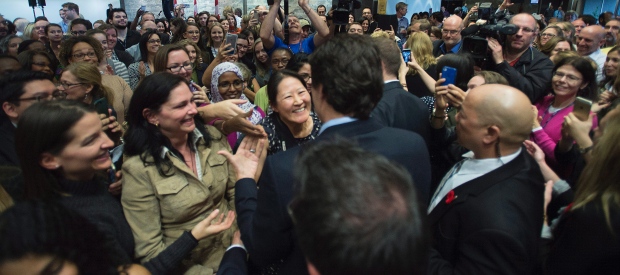
Justin Trudeau joyfully mobbed by federal civil servants

PM Trudeau at the rebranded Global Affairs department. Unprofessional but understandable:

Suddenly there was a buzz and the crowd moved forward.

Trudeau appeared and began to make his way out of the building. He was swarmed. Many took photos and even selfies along the way.

Liberal Cabinet 20151106

Trudeau was mobbed as he tried to leave the Lester B. Pearson building Friday. He told the crowd his government would need the civil service’s absolute best. (Sean Kilpatrick/Canadian Press)

The prime minister was hugged. Cheers erupted. He smiled, waved and stopped by the door.

He thanked the crowd for supporting the members of his cabinet, who had just left.

Then he continued: “We’re going to need every single one of you to give us, as you always do, your absolute best.”

They applauded and cheered some more. Some yelled back: “You’ve got it.”

One longtime staffer nearby said he’d never seen anything like it. Not in all of his years.

And it might not be the only instance of a crowd forming to welcome a minister Friday.

On Facebook, a photo circulated of civil servants at another location waiting to greet Sajjan.

Source: Justin Trudeau joyfully mobbed by federal civil servants – Politics – CBC News

And Donald Savoie puts it into context:

Donald Savoie, a public administration expert at the University of Moncton, said public servants are gripped by “the euphoria” of working for a government that promises renewed respect.

He said many hope they are returning to their “days in the sun” when public servants worked on policy and were listened to. He likened it to when Pope John XXIII opened the Vatican and liberalized the Catholic Church.

As a result, bureaucrats’ heckling and cheering, and unions revelling in their political campaigns, may not be appropriate but isn’t unexpected.

“Don’t try to make sense of this. School’s out and people are beside themselves with joy,” Savoie said. “Stay tuned, it’s too fresh. Wait until things calm down in a few months.

“I wouldn’t get too worked up because what happened today doesn’t define the public service and its non-partisanship.”

Public servants shed cloak of impartiality – at least for the day

#Multiculturalism Transferred Back to Canadian Heritage: Impact

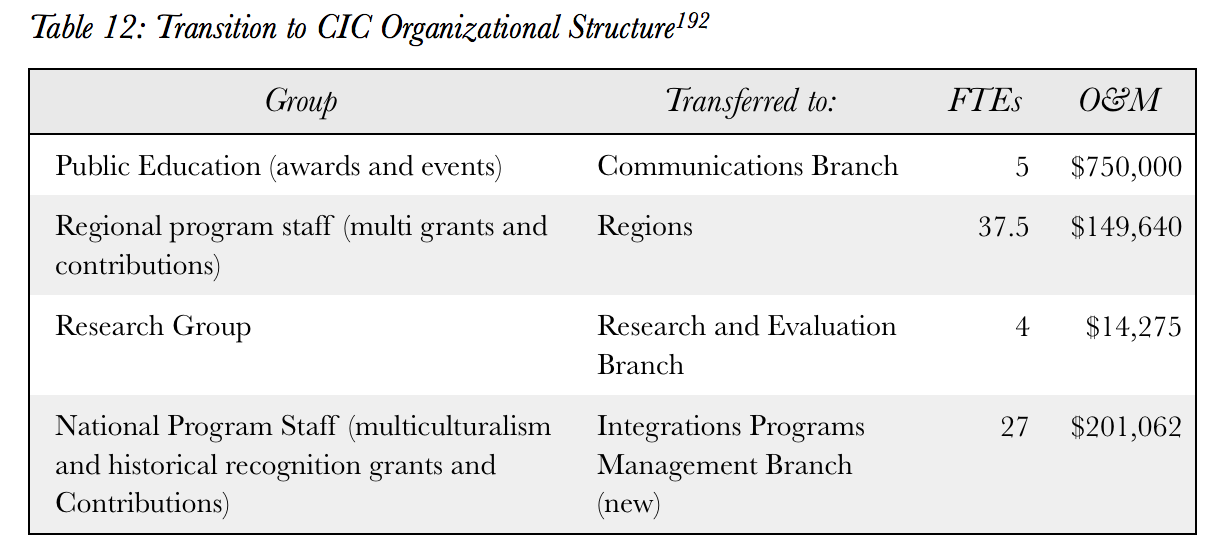
CM_Table_12_Transfer_to_CICThe Order in Council announcing the reversal of the 2008 transfer to CIC as part of then Minister Kenney’s Package:

His Excellency the Governor General in Council, on the recommendation of the Prime Minister, pursuant to paragraph 2(a) of the Public Service Rearrangement and Transfer of Duties Act, transfers, effective November 4, 2015,

(a) from the Department of Citizenship and Immigration to the Department of Canadian Heritage the control and supervision of those portions of the federal public administration in the Citizenship and Multiculturalism Branch within the Department of Citizenship and Immigration that relate to multiculturalism; and

(b) to the Minister of Canadian Heritage the powers, duties and functions of the Minister of Citizenship and Immigration relating to multiculturalism.

The PCO press release indicates that responsibility for the Canadian Race Relations Foundation is also transferred but makes no reference to either the Global Centre for Pluralism or the International Holocaust Remembrance Alliance (the previous government gave the head of the Office for Religious Freedom the lead responsibility).

Personally  interesting,  given that I managed the transfer to CIC in 2008, and have consistently written that multiculturalism was atrophying at CIC given its more operational focus on citizenship and immigration.

As I wrote two years ago in my conclusion to Policy Arrogance or Innocent Bias: Resetting Citizenship and Multiculturalism on the longer-term impact of CIC’s departmental structure and culture on the multiculturalism program:

A functional model like CIC has advantages in creating greater clarity between the policy and operational functions, but tends to reinforce the centre of gravity and allocate resources accordingly. A business line model like PCH provides more focused policy and program integration at the business line or program level, but increases rigidity and coordination issues between business lines. While the PAA structure acts as a counterweight, over time the centre of gravity will dominate. Arguably, for integration, citizenship and multiculturalism, the lines between pure policy and pure operations (e.g., citizenship ceremony design, G&C management) are less clear than for admissibility and immigration selection. Additionally, one of the legacies of the Cullen-Couture agreement transferring immigration selection and integration funding to Quebec meant CIC was largely uninterested in using the levers in citizenship and multiculturalism to highlight federal presence in Quebec. A sharp contrast to PCH which had, and viewed itself as having, a strong role in Quebec.

In many ways, the collective impact for multiculturalism will, over time, become closer to the original Reform Party objective of 1996-97 of abolishing multiculturalism and strengthening a strong, common narrative of citizenship. The Cabinet shuffle of July 2013 and the separation of the political function, which remained under Minister Kenney, from the departmental function, under Minister Alexander, is significant in that context. While political, community-based outreach is central to electoral strategies (the “fourth sister”), as evidenced by Minister Kenney’s ongoing responsibility for this critical outreach, the substantive policy and program focus on long-term integration issues will continue to decline. This is a legitimate policy choice but it is striking just how little debate this change has provoked.

The Liberal government’s decision to reverse the transfer and restore the broader Canadian Heritage identity mandate (and no longer have the file ‘travel’ with a minister), with a strong diversity and inclusion emphasis, will reinvigorate multiculturalism, both within the department and across government more generally.

However, given the dispersal of and reductions to multiculturalism resources at CIC (now IRC), considerable rebuilding will be required.

The above table highlights the FTEs and Operations and Maintennance resources transferred in 2008 (about $12 million in Grants & Contributions funding was also transferred).

Chapter 6 of my book describes the process, resource transfers and impact (available at Lulu.com, direct link My Author Spotlight).

Source: Orders in Council – Search – Privy Council Office

Why it’s not enough to simply restore the long-form census

Kevin Milligan on the longer term questions regarding how we should leverage more administrative data for future Censuses:

But how exactly should we go about repairing the damage? Census questionnaires need to be thoroughly tested, and then they must be printed. You can’t do this in a few months. According to the Huffington Post, for 2016 the government will use the already-tested questionnaire for the planned 2016 National Household Survey and simply make its completion mandatory rather than voluntary. While 33 per cent of Canadians were requested to fill in the 2011 NHS, apparently only 25 per cent will be asked in 2016. Still, if compliance rates go back to 2006 levels, this should yield a larger number of completed surveys. But much more importantly, the sample should be much cleaner because we won’t have the skewed non-completion problems that plagued the 2011 NHS.

This strategy strikes me as sensible battlefield medicine. Time is short, so the government is constrained in what can be achieved in the few short weeks before sending the census forms to the printer. Making the 2016 NHS mandatory solves the largest problem we had with the 2011 NHS. However, I hope this is just the beginning of a new conversation on the census—and data in general—rather than a one-off restoration of past practices.

In the United Kingdom in 2010, the newly-elected Conservative government also had some concerns about their census. But, instead of acting impetuously, they put in place a process to rethink how governments ought to be collecting data in the 21st Century. The initial report of this process came out in 2014, and a new “Census Transformation Programme” is at work on plans for the 2021 UK Census.

What should Canada do next? Well, the main recommendations of that 2014 UK report were to make greater use of existing data already being collected for administrative purposes and greater use of internet-based census forms. Canada was already doing both those things in 2006. But, I believe there is room for much more innovation.

I gave a guest lecture a year ago to a meeting of data librarians outlining my thoughts on the future of data in the social sciences, the notes from which can be found here. I remarked that we have more and more administrative data, such as tax, employment insurance and immigration records, at the same time as surveys (like the census) are becoming harder to conduct. If we move to greater use of administrative data, we need to be sure we properly balance privacy concerns, researcher access, cost, and data accuracy.

Restoring the mandatory basis for the 2016 survey was necessary, but also easy. The true test of the resolve of the new government on data will come in the actions they take as we begin to plan the 2021 census.

Source: Why it’s not enough to simply restore the long-form census

“Because It’s 2015” | Commentary magazine

The neocons at Commentary fret over ‘because it’s 2015’.

Wonder what they would have said if Lincoln had stated when slavery was abolished ‘because it’s 1865’?

On Wednesday in Ottawa, Justin Trudeau was sworn in as Canadian prime minister. He wasted no time in announcing his newly chosen cabinet of exactly 15 men and 15 women, which fulfilled a campaign pledge he’d made about gender equality. One reporter asked Trudeau why the perfect male-female split was so important to him. The prime minster’s response: “Because it’s 2015.”

It sure is. Back in the pre-identity Dark Ages, leaders of representative democracies felt obliged to cite principles or aims in explaining policy to citizens. Today they cite trends.

One problem with trends is that they go as quickly as they come. As Trudeau is sure to find out, his 50-50-gender cabinet is already passé. Where does it leave those Canadians who don’t identify as either male or female? Tell the prime minister the 1990s called. It wants its social justice back.

That’s only a practical challenge. Trudeau can pick up a full-time gendermetrician to carve up the grievance pie and reconfigure his cabinet with each newly pronounced identity.

There are deeper problems. “Because it’s 2015” kills debate, which is the lifeblood of free societies and, ironically, of social evolution. “Because it’s 2015” is a witless claim to absolute prerogative. It dresses up dogma in the finery of historical truth and casts off inquiry as another freshly uncovered offense against progress.

Source: Because It’s 2015 | commentary

The Grits are back in charge, all’s right in Ottawa: Yakabuski

While there are elements of truth in Konrad Yakabuski’s piece (as I covered in Policy Arrogance or Innocent Bias: Resetting Citizenship and Multiculturalism), he over simplifies the reasons for the collective sigh of relief felt by the public service.

It is not driven by an incestuous ‘gene pool’ between Liberal politicians and public servants. It is more driven by education and related experience. We know from polling data that the university-educated are the group that supports the Conservatives the least (government policy analysts are all university-educated). And this support is driven more by small ‘l’ liberal values than big ‘L’ affiliation.

The sharper ideological edge of the Harper government compared to previous Conservative governments, along with a general distrust of evidence in favour of anecdotes and a general less inclusive approach, accentuated the tension between the government and public servants.

Greater alignment between the values of the Liberal government and the public service, along with the latter’s more inclusive approach and support for evidence-based policy, will make for a smoother relationship.

However, the public service needs to be more mindful of its own biases and values in its formulation of policy advice given that it will be less challenged than it was under the Conservatives:

Stephen Harper’s parting thank-you note to the bureaucrats – telling them in a Monday missive that he “will always be grateful for the support of Canada’s world-class public service” – was promptly used by its recipients to line the bird cages of the capital.

The civil servants are already banking on retrieving the sick days the Conservative government had tried to take away from them; the scientists are savouring the prospect of being free to speak out, even if it’s against government policy; the diplomats are yearning to show off a kinder, gentler foreign policy to a world that, Harper critics contend, has been wondering, “What happened to Canada?”

Among public servants, there is a natural preference for Liberal governance. It stems in part from previous long Liberal stints in power during which most of the senior bureaucracy moved up the ranks. In the tiny company town that is Ottawa, decades of intermarriage among bureaucrats, journalists, lobbyists and Parliament Hill staffers have left a gene pool that leans predominantly (L)iberal.

The Ottawa elites share a similar world view, one that squares with Prime Minister Justin Trudeau’s promise of activist government. They also share a bias, acknowledged or not, in favour of a government-driven economy. A bigger state and more regulation enhances the prestige, power and bank accounts of this cozy cohort of Ottawa insiders.

Mr. Harper was not the first outsider to see this. As a candidate for the Progressive Conservative leadership in 1983, Brian Mulroney vowed to hand out “pink slips and running shoes” to a bureaucracy he considered to be infested with Liberal sympathizers. But in Ottawa, he found he needed to get the bureaucracy onside to get anything done.

Though he purged Liberal appointees at government agencies and Crown corporations, Mr. Mulroney trusted, and in turn succeeded in winning the trust of, most of the senior bureaucrats he inherited. His one high-profile ouster of a senior mandarin (Ed Clark, an architect of Pierre Trudeau’s National Energy Program, who went on to become chief executive officer of TD Bank) was an exception to the rule.

Source: The Grits are back in charge, all’s right in Ottawa – The Globe and Mail

The New Cabinet: Diversity, inclusion and achieving parity

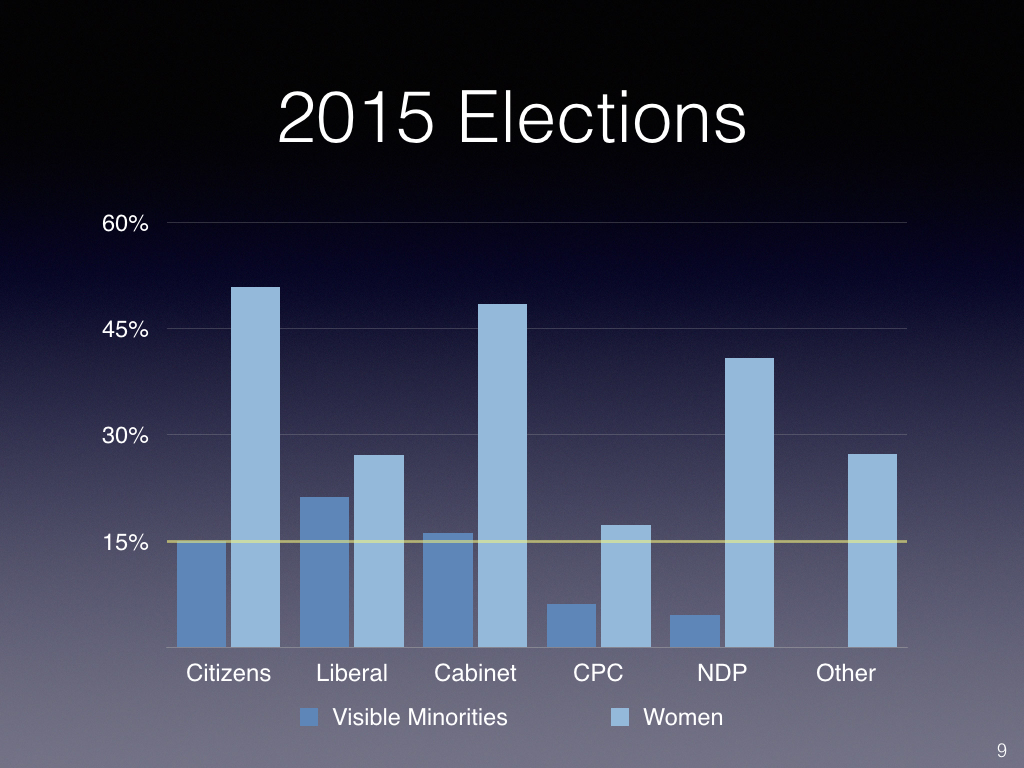
Election 2015 - VisMin and Foreign-Born MPs.002
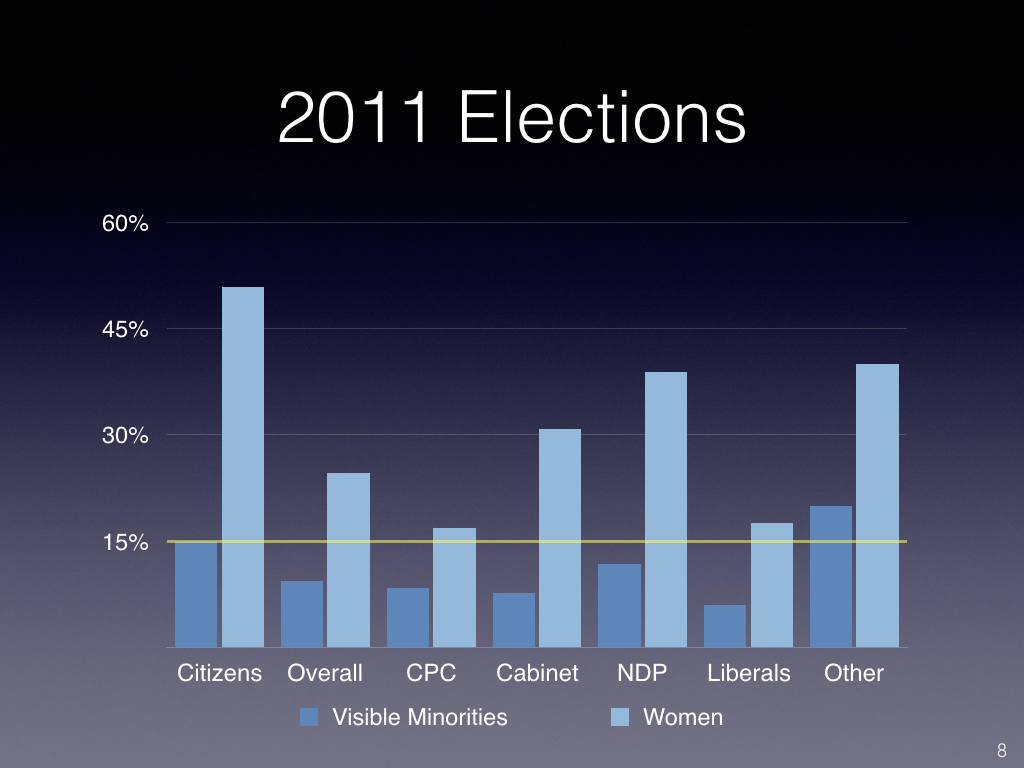
The chart shows the overall representation of Canada’s new Parliament (the 2011 Parliament equivalent is shown below).

Election 2015 - VisMin and Foreign-Born MPs.001

In addition to gender parity, visible minorities are slightly over-represented (16 percent) in relation to their share of the population who are Canadian citizens (15 percent).

However, Canadian Sikhs predominate as four out of the five visible minority ministers are Sikh: Navdeep Bains, Harjit Sajjan, Amarjeet Sohi and Bardish Chagger (the only non-Sikh is Maryam Monsef, an immigrant from Afghanistan). Likely that geographic factors played a role.

Two out of the five are women. Three are foreign-born.

Two have senior portfolios: Harjit Sajjan in Defence, Navdeep Bains in Innovation, Science and Economic Development (the rebranded Industry Canada).

The choice of John McCullum for the renamed Immigration, Refugees and Citizenship department suggests that an experience minister was wanted to move the priority files (in addition to his previous experience in a number of portfolios and was previously the Liberal critic for citizenship and immigration). So very likely that he will hit the ground running.

And the best illustration of how the overall philosophy and approach has changed can be seen in the creation of a Cabinet Committee on Diversity and Inclusion, with a mandate to:

Considers issues concerning the social fabric of Canada and the promotion of Canadian pluralism. Examines initiatives designed to strengthen the relationship with Indigenous Canadians, improve the economic performance of immigrants, and promote Canadian diversity, multiculturalism, and linguistic duality.

New Crop of Immigrants in Parliament Is Seen as Reflection of Canada – The New York Times

New York Times coverage of Canada’s many immigrant and visible minority MPs (and always nice to be quoted!):

Many factors contributed to the sweeping victory last month by the Liberals, whose leader, Justin Trudeau, will take office as prime minister on Wednesday. But several analysts said that one of the most important factors was the immigration and refugee policies of the losing Conservative government.

In a country that generally prizes immigrants as a source of economic growth and officially encourages newcomers to maintain their ethnic identities, the Conservatives and Prime Minister Stephen Harper were widely seen as anti-Muslim, especially after they made an issue of the face coverings worn by some Muslim women.

“The Conservative government tried to use wedge politics, but in the end, it backfired,” said Andrew Griffith, a former director general of the government office that oversees citizenship matters and the author of a book about multiculturalism in Canada. “It should give any political party in Canada food for thought, food for reflection.”

The move was uncharacteristic even for the Conservatives, who assiduously courted immigrant communities even before they first won power in 2006, particularly in two areas that often decide the balance of power in Parliament: the suburbs of Toronto and Vancouver, British Columbia. The Liberals and the New Democratic Party also seek support there, but the Conservatives often found that their more traditional approach to many social issues found an eager audience.

Canadian law makes it relatively easy to move from landed immigrant to citizen, and Mr. Griffith said that many newcomers became politically active once they could vote. Because Canada’s immigration rules favor well-educated and affluent migrants, ethic communities are also an important source of donations to political parties, not least because the country’s campaign finance laws ban contributions from corporations or unions and set a relatively low ceiling for individuals.

“It’s empowering in that there are groups that can no longer be ignored,” said Arif Virani, 43, a newly elected Liberal lawmaker from Toronto who came to Canada with his parents as an Ismaili Muslim refugee from Uganda in 1972. He noted that in some constituencies, all three major parties ran minority candidates.

At times over the past decade, Jason Kenney, a Conservative cabinet minister, seemed to be appearing at just about every ethnic celebration in the country — a butter-chicken circuit that appeared to take a toll on his waistline. But Mr. Kenney’s courtship of ethnic minorities, Mr. Griffith said, was undone when the Conservative government decided to make it harder for recent immigrants to bring in relatives, when it was slow to accept Syrian refugees and when it tried to ban the niqab, or face covering, during citizenship ceremonies. Mr. Harper’s use of the phrase “old-stock Canadians” on the campaign trail made matters worse.

Mr. Griffith reckons that there are 33 electoral districts where a majority of voters belong to what are known in Canada as visible minority groups — people who are not of white European extraction. All 33 districts are in the suburbs of Toronto or Vancouver, and many were held by Conservatives until last month, when Liberals won in all but three of them.

Canada first introduced a policy of official multiculturalism, recognizing the differences in Canadians’ heritage, in 1971 under Pierre Elliott Trudeau, a Liberal prime minister and the father of Justin Trudeau. Initially, the policy provided funds for programs like language classes, but it has since evolved into a broad legal protection of religious and ethnic differences.

Though it was contentious at first, the policy is now frequently cited by Canadians as a defining characteristic of their country — though both Mr. Griffith and Mr. Virani say it has limits.

Canadians tend to think that, where the United States assimilates immigrants’ cultures in a melting pot, Canada allows all cultures to flourish. But Mr. Virani said that the contrast was “a little bit more gray than that.”

Voters appeared to reject Mr. Harper’s plan to ban face coverings during citizenship ceremonies, but Mr. Griffith said there was still widespread unease about the practice of wearing them, which many Canadians believe limits the participation of Muslim women in society.

Still, despite the tenor of the Conservatives’ last campaign, all the major Canadian political parties favor encouraging immigration. New arrivals account for two-thirds of Canada’s population growth, an important factor in a country where there are now more citizens over 65 than under 15. Geography helps form that pro-immigration consensus by making it difficult to slip into the country as an illegal immigrant or a refugee.

“You can’t walk to Canada, apart from the U.S., so we don’t have a neighbor that generates a lot of refugees or immigrants coming across,” Mr. Griffith said. “That helps the discussion.”

Source: New Crop of Immigrants in Parliament Is Seen as Reflection of Canada – The New York Times

Cabinet is not a meritocracy. And it hasn’t been for decades.

Laura Payton provides the best rebuttal to Andrew Coyne’s blather against gender parity in Cabinet (Andrew Coyne: Trudeau cabinet should be based on merit, not gender):

Here’s the thing: Cabinet is not a meritocracy. It hasn’t been, at least as far back as 1968. It’s always been influenced by a range of factors, including where an MP is from and whether he or she is an anglophone or francophone. And while those factors are practical, other selections seem to be made based on someone’s fundraising ability or skill at obfuscating in the House of Commons.

Give me a good merit-based reason why Julian Fantino held three cabinet postsall of them disastrous. What exactly qualified Fantino to be the minister for international development? Or look at Peter MacKay, who held a range of high-profile posts, including Foreign Affairs and Justice. Any time cabinet speculation took over with the Conservatives in charge, it was assumed he would never be excluded from cabinet, simply because he was the PC leader who agreed to merge the party with the Canadian Alliance, thereby allowing Stephen Harper to lead the combined forces to victory. Never mind the bungled military procurement files or his use of a search-and-rescue helicopter to shave a couple of hours off his trip back to Ontario when his vacation was interrupted. And who can forget Chris Alexander’s deft touch with immigration matters?

Given that women are half the population, it’s downright strange that no federal government before this one has striven to put more of them into cabinet. Lots of deserving people are left out of cabinet, simply because there are too many excellent MPs from one region or another, and not all of them will make it. It’s bizarre to argue that Trudeau’s pledge to include more women in cabinet means leaving out qualified men, because the corollary is that so many women have been left out of cabinet to squeeze in men who have better fundraising networks, are better known to Ottawa-based party insiders, or know how to follow orders.

Canada’s federal parties have a long way to go to hit gender parity and to elect a representative number of visible minorities. There are 5o women in the Liberal caucus of 184 MPs, for example. While the NDP led the way with 43 per cent female candidates (rather than quotas, they asked riding associations to look for female or visible-minority candidates), the Conservatives were only able to find enough female candidates to make up 19 per cent of their total. You can’t tell me there aren’t more smart women who would want to run if they didn’t feel the hurdles were too high to clear.

Source: Cabinet is not a meritocracy. And it hasn’t been for decades.