Government uses Access to Information Act as ‘shield’ against openness: czar – Politics – CBC New

Some things appear not to change although I recognize the complexities involved:

Prime Minister Justin Trudeau is failing to deliver on his promise of a government that’s open by default, the federal information czar says.

The law that’s intended to give Canadians access to government files is being used instead as a shield against transparency, information commissioner Suzanne Legault said in her annual report tabled Thursday.

Legault said her investigations reveal the Access to Information Act is failing to foster accountability and trust.

The act allows people who pay $5 to ask for everything from expense reports and audits to correspondence and briefing notes. Requests are supposed to be answered within 30 days and agencies must have legitimate reasons for taking longer.

However, the system has been widely criticized as slow, antiquated and riddled with loopholes that allow agencies to withhold information rather than release it.

A number of key institutions that possess valuable information for Canadians showed declines in performance, said Legault, an ombudsman for users of the law.

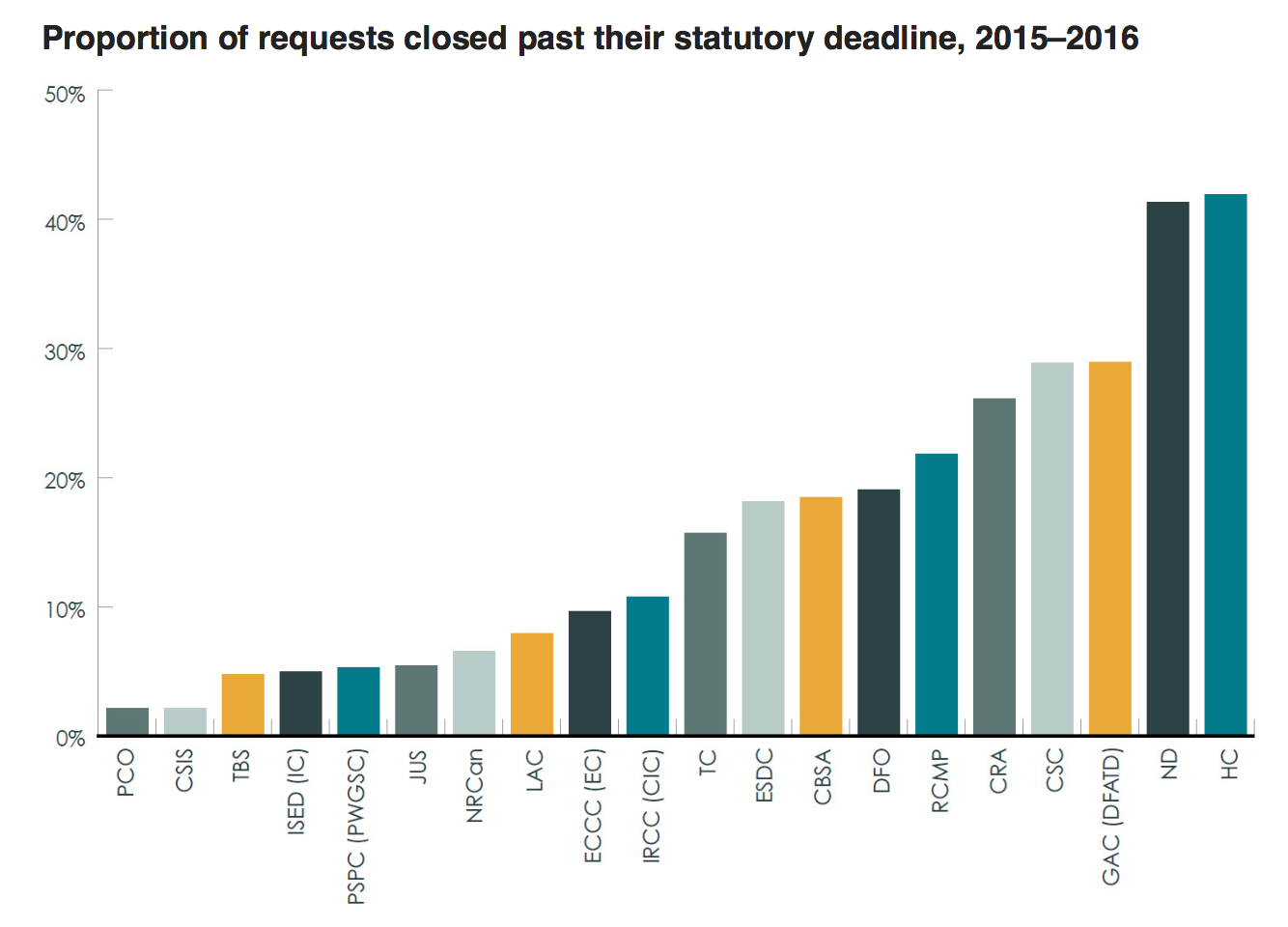
In terms of timeliness, the RCMP, the Canada Revenue Agency, the Correctional Service and Global Affairs received F grades, while National Defence and Health Canada were branded with the even more serious Red Alert status.

Legault’s report says she referred one case to the attorney general last month after uncovering apparent improper deletion of emails by an employee of Shared Services Canada.

Culture change needed on government openness1:21

The latest federal budget contained no funding for transparency measures and there has been no direction from the head of the public service on increasing transparency, Legault said.

Trudeau’s promises of making the government more open and accountable must be accompanied by action, she told a news conference. “I think he needs to do more. And I think he needs to make sure that the bureaucracy does more. It’s not enough to say it.”

The Liberal government recently acknowledged it is delaying planned reforms to the 34-year-old law due to the complexities of the task — changes Legault maintains are essential and long overdue.

The promised amendments include giving the information commissioner the power to order the release of government records and ensuring the access law applies to the offices of the prime minister, cabinet members and administrative institutions that support Parliament and the courts.

Action, not talk, needed

Treasury Board President Scott Brison said Thursday that reforms are coming, though he did not say exactly when. “We agree, actually, with the commissioner about the need to modernize the act.”

New Democrat MP Daniel Blaikie, who sat on a Commons committee that recommended a sweeping overhaul of the law, said Thursday it’s clear what needs to be done. “It’s just a real disappointment for people who took the government at its word in terms of openness and transparency and all the rest.”

Brison did take a first step last year, issuing a ministerial directive to enshrine the principle that federal agencies should be “open by default.”

Legault said the move, on its own, is not sufficient.

“If you want to truly change a whole culture in a very large bureaucracy, you’re going to have to make a concerted effort. There are going to have to be clear messages from the prime minister, the responsible ministers, the clerk of the Privy Council,” she said.

“Sadly, champions for transparency are absent.”

Source: Government uses Access to Information Act as ‘shield’ against openness: czar – Politics – CBC News

StatsCan’s website struggled with software issues for almost a month, emails show

More bad news about Shared Services Canada:

Statistics Canada’s busy website was partially disabled for much longer than previously reported, as technicians struggled for more than three weeks to bring all of its functions back.

The long, slow road to web restoration is documented in a series of emails obtained by CBC News under the Access to Information Act — emails that raise fresh questions about the performance of Shared Services Canada, the government’s controversial IT agency.

The Statistics Canada website was taken offline late on March 9, after the government was alerted the day before that a common web software tool, known as Apache Struts 2, was vulnerable to hackers.

The Canada Revenue Agency site was taken down for the same reason, just as tax-filing season began.

At a March 13 news conference, a government official said the problems had been resolved after three days.

“We are pleased to note that any affected websites have been patched and have been returned to normal operations,” said Jennifer Dawson, of the Treasury Board Secretariat. Officials said at least one hacker got into the Statistics Canada site, but did no damage, and confidential CRA data was never compromised.

The CRA website appeared to operate without further problems after the fix.

But the released emails show the Statistics Canada website remained dysfunctional for weeks as a series of new problems were revealed.

“We received the results this morning and there are still some vulnerabilities so the focus will be to fix them and re-scan them today,” says one March 27 update.

Shared Services Canada, the troubled IT agency now responsible for maintaining Statistics Canada’s website, confirmed to CBC News that there were “intermittent outages” until April 4 — or 26 days after the problems were first identified.

The emails also suggest Statistics Canada was sometimes not in the loop as Shared Services Canada worked to restore the public-facing website, which is virtually the only means for widely disseminating data to Canadians.

Morning after

The decision to take down the website was made by Shared Services Canada, rather than by chief statistician Anil Anora or other senior Statistics Canada officials.

Internal emails suggest that a problem with Statistics Canada’s website was not reported to the current chief statistician, Anil Anora, until the day after Shared Services Canada decided to take down the site.

Anora and the other officials only learned it had come down the morning after, shortly before the Labour Force Survey — a key monthly jobs report — was scheduled to be posted online, emails show.

Wayne Smith, the former chief statistician who resigned in protest last September citing Statistics Canada’s eroding independence, says the incident shows the agency is still beholden to an ineffective IT provider.

“This was the longest outage of Statistics Canada’s website since it began operation,” Smith said after reviewing the released emails. “There is a risk of this type of event becoming ever more frequent, resulting in a serious degradation of service.”

And despite the Liberal government’s efforts to fix Shared Services Canada, the IT agency remains a problem for other government departments as well, he said.

“Still the same crowd, steering the bureaucratic boat that brought us the failed email system, Phoenix, the outrageously expensive integrated government website, and projects spinning out of control that haven’t yet hit the headlines.”

The released emails have numerous redactions, most to protect security information, and Shared Services Canada declined to fill in the blanks.

‘Consulted’ with StatsCan

A spokesperson for Shared Services Canada, Andrée Gregoire, said the agency “consulted” with Statistics Canada before taking the web servers offline, though a released email uses the word “notified.”

Source: StatsCan’s website struggled with software issues for almost a month, emails show – Politics – CBC News

Can Andrew Scheer fix the Conservative Party’s diversity problem?

Former PC staffer Angela Wright on challenges facing Andrew Scheer, particularly with new Canadian and visible minority voters:

In his victory speech, Andrew Scheer touted the party’s commitment to being this big tent as well as the need to communicate conservative values to a greater number of Canadians. However, there were two statements in his speech—statements that garnered the loudest applauses in the convention—that could prove troubling for the party when it comes to minorities: echoing the dangerous threat of radical Islam and a staunch belief in withholding federal funding from universities that attempt to stifle free speech.

Across North America and Europe, political responses to Islamic terrorism have created a political arena where politicians and their supporters have justified both blatant and consequential discrimination towards Muslims. There is significant support amongst Canadians to commit ground troops to the fight against ISIS, but by framing this as a fight against radical Islam, Scheer gives ammunition to people who harbour prejudicial views towards Muslims. Although many argue that the term “radical Islam” highlights this form of terrorism is a warped strain of normal Islam, it nonetheless reminds listeners the culprits are Muslim, thus offering an excuse for people with biases against Muslims to suggest policies that target Muslims as a remedy. And for Muslims, it may give the impression that the party is using them to advance its policies on global security.

“Free speech,” meanwhile, has been used as a cloak by racists and bigots to spout rhetoric that’s harmful, hateful, and disrespectful towards racial and religious minorities. Scheer must take care to clarify his opposition to firing or silencing university professors with controversial views while maintaining an opposition to hate speech.

More than advocacy for justice and equality, this issue also has the potential to cause discord in the party between those who are advocates of unrestricted free speech and those who want the party to be more welcoming to everyone with small-c conservative values, regardless of their race, ethnicity or religion.

That’s why Scheer should rescind his position to withhold federal funding from universities. It’s imperative to be cognizant of how these issues can be used to target minorities as well as the detrimental impact this has on the party’s image—and its chances at electoral victory.

As a young politician with over a decade of political experience, an Ottawa native living in the Prairies, and a Conservative not tied to previous controversial legislation, Andrew Scheer is best-suited to lead the rejuvenation of the Conservative Party into one that will not bring forth policies and communicate them in a manner that forces racial and religious minorities to choose between their values and racism, their values and xenophobia, or their values and self-respect.

The party’s history-making membership numbers and massive voter turnout in the leadership race show an eagerness amongst Canadians to join the conservative movement and a dissatisfaction with other political choices. The Conservative Party has the money and the membership to win in 2019; all it needs is greater support amongst Canadians.

But it can’t be done without support from racial and religious minorities.

Source: Can Andrew Scheer fix the Conservative Party’s diversity problem? – Macleans.ca

U.S. consultants slam Shared Services Canada for failing projects

To the current government’s credit, it engaged Gartner to review the implementation of the shared services initiative.

The question remains whether officials who promoted and supported the previous government’s strategy provided sound advice on the risks and mitigation strategies, and whether or not Ministers and the government accepted it or not.

Complex IT projects are hard, and government by its very nature is not agile, further exacerbating risk:

Ottawa is in way over its head by attempting a massive transformation of its information-technology (IT) systems under Shared Services Canada, says a scathing indictment of the agency’s failings since 2011.

The government of Canada “has vastly underestimated the size, scale and complexity of this effort. … They are attempting the largest and most complex public-sector shared-service implementation ever considered,” concludes a $1.35-million report by international consultants.

“We … lack confidence in the ability of SSC (Shared Services Canada) and the GC (Government of Canada) to successfully execute the plan.”

The Jan. 12, 2017, report by consultant Gartner Inc. was ordered by the federal government last August, after repeated failures of the Phoenix payroll system and complaints from departments about Shared Services Canada’s inability to deliver technology upgrades, including new email systems.

U.S.-based Gartner brought together a five-person expert panel to examine the agency and its projects, a group that included executives experienced in public-sector digital transformations in California, Massachusetts and Northern Ireland, as well as the former IBM executive who handled big projects within that firm.

Shared Services Canada outsourcing

A $1.35-million consultants’ report, obtained by CBC News under the Access to Information Act, says Shared Services Canada is in way over its head trying to manage a massive transformation of technology. (Shutterstock)

The report lauds the project of consolidating the federal government’s information technology, including creation of a single email system, but says “very little progress” has been made in the last six years because of persistent management failures.

“Decision making cannot follow current approaches,” said the document, obtained by CBC News under the Access to Information Act.

“Execution must be based on agile, effective decision making, with clear and singular accountabilities. This is the antithesis of governance today.”

The report repeatedly underscores the enormous scale of the consolidation project, likening it to combining the infrastructure of between 30 and 40 large banks.

Slow-footed

The consultants say Shared Services Canada is slow-footed, partly hobbled by complex procurement rules, so that an email solution it chose in 2011 and still has not completed has since been outmoded by new cloud services.

“The world in 2016 is much different from how it was in 2011, and the expert panel and Gartner believe developments such as cloud services should be given much more prominence in SSC’s future,” said the 198-page report.

Some of the document is redacted, including key financial information. The authors make a series of recommendations, chief of which is the appointment of a deputy minister for IT for all of government, to whom the head of Shared Services Canada would report.

In April 2011, then-prime minister Stephen Harper lauded the project to consolidate the government’s IT systems and data centres, saying on the election campaign trail that year that “we know we can save all kinds of money there.”

‘The project was set up to fail through underfunding, lack of service standards, and poor planning from the previous government.’– Jean-Luc Ferland, spokesperson for Treasury Board President Scott Brison

The new agency charged with carrying out the transformation, Shared Services Canada, was announced on Aug. 4, 2011, after Harper won a majority.

But two projects in particular went off the rails in the early going, one to consolidate cell and telephone services, the other to consolidate email services. Both have been plagued by delays, among other problems.

And the new agency was immediately required to cut costs as part of a government-wide effort to wipe out the federal deficit by 2015.

Shared Services Canada data centre

Shared Services Canada is the department responsible for the federal government’s IT services, including its data centres. A new report says the federal government must create a new deputy minister of IT, to help get the troubled agency back on track. (Shared Services Canada)

Jean-Luc Ferland, a spokesperson for Treasury Board President Scott Brison, welcomed the consultants’ conclusions and recommendations, pinning much of the blame for the bad results on the former Conservative government.

“As the report makes clear, the motivation and objectives behind the creation of Shared Services Canada are even more relevant today than they were when it was conceived in 2011,” said Ferland.

“The report is equally clear that the former Conservative government failed to put in place the basic fundamentals for success at the time SSC was created. The project was set up to fail through underfunding, lack of service standards, and poor planning from the previous government.”

No timeline

Ferland said the government is still reviewing the recommendations, alongside those of the auditor general, House of Commons committees and other consultations. He did not provide a timeline for solutions.

“Our government’s ambition is to provide exemplary service to Canadians while making a seamless transformation to the age of digital government — not booking false savings, arbitrarily hobbling the public service, or cutting corners.”

Source: U.S. consultants slam Shared Services Canada for failing projects – Politics – CBC News

Wayne Smith, former Chief Statistician, continues his critique of Shared Services: Questionable transfers from Statistics Canada to Shared Services Canada


Government accused of hoarding Canadian history in ‘secret’ archives

Hard to know whether deliberate policy or, what I think may be more likely, lower priority and capacity constraints:

Some of Canada’s leading historians say the federal government is putting the country’s historical record at risk by hoarding piles of documents inside secret archives that together would make a stack taller than the CN Tower.

Historian Dennis Molinaro of Trent University discovered ministries and agencies are stockpiling millions of decades-old papers rather than handing them over to Library and Archives Canada for safekeeping and public access. He’s launched a petition to try to convince the government to set them free.

The Canadian Historical Association (CHA) has joined his campaign and is calling on the government to mark Canada’s 150th anniversary by overhauling the laws on access to government records.

“It’s very disturbing that there are caches of documents about which we know very little. We don’t even know the extent of this,” said CHA president Joan Sangster, a colleague of Molinaro’s at Trent in Peterborough, Ont., where she teaches labour and women’s history.

As part of his research, Molinaro has been asking government departments to hand over information about Canada’s Cold War domestic spy and surveillance programs run by the RCMP. Last fall, the federal government initially refused his access-to-information request for the papers (which were never transferred to the national archives) concerning a 65-year-old top secret RCMP wiretapping program dubbed Project Picnic.

One day after CBC News reported on Molinaro’s battle with the bureaucracy, officials notified him they would release the 1951 “secret order” that authorized the wiretapping program targeting suspected Soviet spies and other subversives, signed by Prime Minister Louis St-Laurent.

‘Secret or shadow archive’

Access-to-information officials have told Molinaro the Privy Council Office holds at least 1.6 million more pages from the era, many of which could concern Cold War counter-espionage programs. He’s also learned many more intelligence-related records dating back four, five and six decades are being held by the Communications Security Establishment (CSE) and the departments of Justice and Foreign Affairs.

He’s been told in email exchanges that there’s currently no public list to help him — or any other researcher — understand, let alone access, these mountains of papers kept inside closed government storerooms.

“The government seems to be, in essence, running some kind of secret or shadow archive,” Molinaro told CBC News.

Keeping millions of records from the national archives is “appalling,” he said.

“You’re hiding the historical record from the Canadian people.”

He says the problem extends far beyond his own research interest of domestic surveillance.

“Think of how many events from the Cold War … The Cuban Missile Crisis … RCMP counter-intelligence operations, foreign intelligence operations,” he said. “What else is there on other topics? On Indigenous affairs and relations? What else is in different government institutions on a variety of topics?

“We don’t know.”

CBC News asked various government departments to identify how much historical material they keep that’s more than 30 years old — and why.

The Privy Council Office (PCO) revealed it has “1,430 cubic feet” (40.5 cubic metres) of government records dating back many decades.

docsgraph

PCO says transfer of these cabinet documents, discussion papers and records to Library and Archives Canada (LAC) is “time-consuming” and first requires wide consultation to ensure classified information isn’t released improperly.

The office says it’s looking at recommendations to declassify a large block of “legacy” information from 1939-1959, and considering transferring cabinet minutes and documents from the 1980s to LAC.

The CSE, Canada’s electronic spy agency, acknowledges it, too, is struggling to sort 128 linear metres of boxes of “legacy” records that are more than three decades old before handing them over to LAC.

The Foreign Affairs Department, Canadian Security Intelligence Service and the RCMP all declined to say how much historical material they continue to store.

Source: Government accused of hoarding Canadian history in ‘secret’ archives – Canada – CBC News

Never forget the lessons of Europe’s concentration camps: Justice Abella

Powerful commencement address by SCC Justice Abella:

You see before you a Justice of the Supreme Court of Canada who is deeply worried about the state of justice in the world. I was born right after the Second World War. That was the devastating war that inspired the nations of the world to unite in democratic solidarity and commit themselves conceptually, aspirationally, institutionally and legally to the promotion and protection of values designed to prevent a repetition of the war’s unimaginable human rights abuses.

Yet here we are in 2017, barely seven decades later, watching “never again” turn into “again and again,” and watching that wonderful democratic consensus fragment, shattered by narcissistic populism, an unhealthy tolerance for intolerance, a cavalier indifference to equality, a deliberate amnesia about the instruments and values of democracy that are no less crucial than elections, and a shocking disrespect for the borders between power and its independent adjudicators like the press and the courts.

It is time to remind ourselves why we developed such a passionate and, we thought, unshakeable commitment to democracy and human rights, to remember the three lessons we were supposed to have learned from the concentration camps of Europe: Indifference is injustice’s incubator; it’s not just what you stand for, it’s what you stand up for; and we can never forget how the world looks to those who are vulnerable.

Two hundred thousand European Jews survived the Holocaust. Three of them were my parents and grandmother. My mother’s family manufactured roofing materials. My father graduated with a master’s in law from the Jagiellonian law school in Krakow. My parents spent three years in concentration camps. Their two-year-old son, my brother, and my father’s parents and three younger brothers were all killed at Treblinka. My father was the only person in his family to survive the war. He was 35 when the war ended. My mother was 28. As I reached each of those ages, I tried to imagine how they felt facing an unknown future as survivors of an unimaginable past. And as each of our two sons reached the age my brother had been when he was killed, I tried to imagine my parents’ pain at losing a two-year-old child, and I couldn’t.

After the war, my parents went to Stuttgart, Germany, where the Americans hired my father, who taught himself English, to help set up the system of legal services for displaced persons in the Allied zone in southwest Germany. In an act that seems to me to be almost incomprehensible in its breathtaking optimism, my parents and thousands of other survivors transcended the inhumanity they had experienced and decided to have more children. I think it was a way to fix their hearts and to prove to themselves and the world that their spirits were not broken. I was born in Stuttgart on July 1, 1946, 30 years after Louis Brandeis was appointed to the Supreme Court, and my sister two years later.

My father, who was the head of our displaced persons camp, applied to emigrate to Canada, but was refused because his legal training wasn’t considered a useful skill. He eventually was permitted entry as a tailor’s cutter and as a shepherd. Within days of arriving in Toronto, my father went to the Law Society to ask what tests he would need to take to become lawyer. “None,” they said. Non-citizens could not be lawyers. Waiting the five years it took in those days to become a citizen was impossible. There was a family to feed. So he became an insurance agent for the next 20 years, happily. I never heard him complain.

The moment I heard that story as a child about my father not being able to be a lawyer was the moment I decided to become one. I was four. I had no idea what being a lawyer meant, but I did have an idea that I wanted to carry on what I thought he was unfairly prevented from doing. My father died a month before I graduated from law school, and he never lived to see his inspiration take flight in the daughter he raised to fear only injustice, indifference and cowardice, or in his two grandsons, both of whom became lawyers. And he never had a chance to see the marriage he had exuberantly celebrated with me the year before he died flourish into a miraculously joyful partnership with one of Canada’s most brilliant historians.

But my mother did, and carried me proudly into the future on the shoulders of her unwavering confidence for the next 40 years, until she died in 2010. This extraordinary honour [of an honorary degree] from Brandeis is for me above all a tribute to her unwavering resilience, inspiration and courage.

A few years ago, she gave me some of my father’s papers from Germany that I’d never seen before. In those papers I found the answer to why he always spoke so respectfully and appreciatively of Americans. I saw letters from American lawyers, prosecutors and judges he had worked with in the U.S. zone in Stuttgart. They were warm, compassionate and encouraging letters, either recommending, appointing or qualifying my father for various legal roles in the court system the Americans had set up in Germany after the war. These Americans believed in him, and as a result they not only restored him, they gave him back his belief that justice was possible.

I found one of the letters written to him by an American lawyer in 1947 to be particularly poignant. It said, “Under extreme difficulties, you contributed your share in helping to make life bearable for your friends, co-nationals, and those of other nationalities. It is hard to be a refugee, and it is twice as hard to be a refugee and a lawyer. You were battered, but you did not allow yourself to be beaten. You continued to fight for your human rights and for those of your fellows in fate, like brave fighters for a new society.”

And here I am 70 years later, a member of that new society he fought and hoped for, and the beneficiary of generosity and opportunities he would never have dreamed possible, including, amazingly, an honorary degree from Brandeis, a university he venerated, and all because the phoenix that rose from the ashes of Auschwitz was justice – beautiful, democratic, tolerant, compassionate justice.

My life started in a country where there had been no democracy, no rights, no justice and all because we were Jewish. No one with this history does not feel lucky to be alive and free. No one with this history takes anything for granted, and no one with this history does not feel that we have a particular duty to wear our identities with pride and to promise our children that we will do everything humanly possible to keep the world safer for them than it was for their grandparents, a world where all children – regardless of race, colour, religion, or gender – can wear their identities with dignity, with pride and in peace.

Source: Never forget the lessons of Europe’s concentration camps – The Globe and Mail

Former MP and Minister Roy Cullen on the Service Fees Act (Budget 2017 Bill C-44)

Former Minister Cullen’s submission to the Finance Committee’s hearings on the omnibus Budget Bill C-44 and the User Fees Act/Service Fees Act:

It is disappointing and somewhat disconcerting that C 212, An Act respecting user fees, will be repealed and replaced by the Service Fees Act. It took me roughly two years to steer my Bill through Parliament where it received unanimous consent.

I am told that since C 212 received Royal Assent in March 2004, only roughly nine user fee proposals have followed the process outlined in that piece of legislation. For me it begs the question, did Departments/Agencies not believe their proposal would meet the criteria laid out in C-212, or were the user fee proposals not that important? Some parts of C 212 may be somewhat cumbersome and I support any streamlining that will improve the efficiency of the legislation.

With respect to performance standards, will the Treasury Board and TB Secretariat ensure that the performance standards that are proposed by Departments and Agencies are realistic stretch goals and not unambitious targets? Will these performance standards be benchmarked against jurisdictions with similar fees? While I appreciate that, consistent with C-212, consultations with interested persons and organizations are required (Art. 12) and that complaints will be reviewed by a panel (Art. 13), Bill C-212 calls for the department or agency to “establish standards which are comparable to those established by other countries with which a comparison is relevant and against which the performance of the regulating authority can be measured”. {Art. 4(1)(f)}.

Departments will be inclined to set performance standards that they can meet, and in many cases they will be inclined to argue that comparisons with other jurisdictions cannot be made.

Source: https://www.ourcommons.ca/Content/Committee/421/FINA/Brief/BR8953638/br-external/CullenRoy-e.pdf


Senate changes definition of a ‘caucus,’ ending Liberal, Conservative duopoly

Will be interesting to see how this evolves and how many caucuses, and their respective focuses, emerge:

The Senate has just voted for a major shake-up of how members of the Red Chamber align themselves by allowing nine or more members to form a caucus, a substantial break from tradition that has historically seen the place organized along party lines.

Members of the Senate adopted a key recommendation of the modernization committee’s report — released last fall — which removes the requirement that a caucus only be formed by those who are members of a political party registered under the Canada Elections Act.

Thus, in theory, there could now be a proliferation of caucuses along regional lines, something that has been favoured by Peter Harder, the government’s representative in the Senate, in the past for organizational purposes.

There could also be the creation of more narrowly-focused caucus groups, like senators who support environmental causes, or the military, an Indigenous or women’s caucus. The possibilities are nearly endless as long as there are at least nine senators who agree to band together, and their group is created for parliamentary and/or political purposes, requirements that are not overly stringent. (A senator, however, cannot be a member of more than one caucus.)

The change is a personal victory for Harder, and his reform agenda, as he has sought to dislodge the Conservative and Liberal duopoly in the Senate.

“I think it’s a victory for the Senate. This is the first major, permanent adjustment to the Senate rules and procedures coming out of the modernization committee,” Harder said in an interview with CBC News. “I just think its important for senators to be given the framework … to form affinities [and] I don’t have a road map or expectations or a design here.”

Harder said regional caucuses could form but he isn’t pushing for that type of division now, adding the process will “play out organically.”

When asked if there was demand by senators within the chamber to form new caucuses, Harder said yes. “Why else would it have been accepted by the Senate?”

The motion directs the Senate rules committee to now formalize the changes, and then requests the internal economy committee — which effectively governs the chamber and adjudicates complaints — to draw-up budgets for these prospective new caucuses, to help hire staff for “secretariats” and pursue research projects. The motion was adopted by a voice vote, so it is not clear how much support it had from the existing parties.

Source: Senate changes definition of a ‘caucus,’ ending Liberal, Conservative duopoly – Politics – CBC News

Does Australia’s values test have a future in Canada? Konrad Yakabuski

Yakabuski asks the valid question: could Australian dog whistle politics happen here?

To a certain extent, they already have: the use of the niqab and “barbaric cultural practices” tip line in the 2015 election, the Kellie Leitch and Steven Blaney leadership campaigns. As he notes, survey questions highlight an underlying concern about immigrant values.

That being said, while we naturally enough see the similarities with Australia – immigration-based countries, large number of foreign-born voters, considerable diversity – we often fail to see some of the differences:

  • Indigenous/white settler dichotomy in contrast to the more complex Canadian Indigenous/French settler/British settler background and a history, albeit highly imperfect, of accommodation and compromise;
  • a political system that provides greater opening for far right extremist voices;
  • a political system that results in fewer visible minorities being elected than in Canada; and,
  • a generally harsher political culture.

So while we always have to guard against complacency, we also need to keep in mind that national elections are largely fought in the 905 and BC’s Lower Mainland, where new Canadian voters, mainly visible minority, form the majority or significant plurality of voters.

The Liberal success in these ridings (they won 30 out of the 33 ridings where visible minorities are the majority) suggest that values or identity-based wedge politics are a losing, not winning, strategy:

When Malcolm Turnbull staged an internal Liberal coup to replace an unpopular Tony Abbott as party leader and Australia’s prime minister in 2015, it was hailed as victory of the moderns and moderates over the ultraconservative ideologues and their nasty dog-whistling strategists.

Guess who’s blowing dog whistles now?

The plan Mr. Turnbull unveiled last month to screen immigrants for Australian values (sound familiar?) and make it harder to obtain Australian citizenship represents a crass U-turn for a Prime Minister who only a few years ago attacked a then-Labor government for seeking to cut the number of temporary foreign workers entering the country. “If you support skilled migration and a diverse society, you don’t ramp up the chauvinistic rhetoric,” he tweeted in 2013.

Now, it is Mr. Turnbull’s turn to target the so-called 457 visa, replacing it with a program that puts new restrictions on foreign workers. The Prime Minister says the immigration changes are all about “putting Australians first.” But they are really about exploiting largely, but not exclusively, working-class resentment toward visible minorities, especially if they’re Muslims.

“If we believe that respect for women and children and saying no to violence … is an Australian value, and it is, then why should that not be made a key part, a very fundamental part, a very prominent part, of our process to be an Australian citizen?” Mr. Turnbull asked last month.

Well, for starters, because it demonstrates an astonishing degree of contempt for the very values that liberal democracies such as Australia purport to champion.

Is it really necessary to ask immigrants “under which circumstances is it permissible to cut female genitals” to convey the unacceptability of excision, which is already illegal? You can only answer yes if the real objective of such a measure is to pander to a substantial, but misguided, group of voters who seeks to alleviate their own insecurities by humiliating others.

You’d almost think this cockeyed plan was something cooked up by Sir Lynton Crosby, the Australian political strategist who may or may not have been behind the 2015 election promise by former prime minister Stephen Harper’s Conservatives to set up a “barbaric cultural practices” hotline. But Sir Lynton – the knighthood was bestowed by former British prime minister David Cameron after the so-called Wizard of Oz helped him win the 2015 British election – is currently too busy exercising the political dark arts in aid of Tory PM Theresa May’s election bid.

Sir Lynton’s business partner, Mark Textor, however, happens to be Mr. Turnbull’s chief pollster. And what the polls are telling Mr. Turnbull is that white, working-class voters in Australia are increasingly turning sour on immigration. This is something of a paradox in a country in which 28 per cent of the population is foreign-born, compared with about 21 per cent in Canada, and that has long been held up as a model multicultural society.

The truth is that both the Liberals (who are actually conservatives) and the Labor Party now only pay lip service to multiculturalism. Both are seeking to scratch an itch among white working- and middle-class voters. Labor recently ran an ad in Queensland promising to “build Australia first, buy Australian first and employ Australians first.” All of the dozen or so workers in the ad were white.

Support for the current policy of turning back boats of asylum seekers, or detaining them on islands off the Australian coast, remains strong, even among Labor voters. Hence, the dilemma for Labor Leader Bill Shorten, trapped between his party’s white working-class base and the urban progressives and immigrant voters Labor needs to win elections.

Mr. Turnbull, meanwhile, is looking over his shoulder at a renewed threat from the far-right One Nation party and Mr. Abbott, who appears to be angling for his old job. He just gave a speech denouncing the “cultural cowardice” of the elites, including the folks at the Australian Broadcasting Corporation and their “pervasive ambivalence verging on hostility to our country and its values.”

Does Australia represent the ghost of Canadian politics yet to come? Polls show Canadians from across the political spectrum really like Conservative leadership candidate Kellie Leitch’s idea of screening immigrants for Canadian values. She’s sticking to her guns, no matter how many old Red Tory friends she loses.

Hey, if Australia can go that low, why can’t we?

Source: Does Australia’s values test have a future in Canada? – The Globe and Mail

Don’t be like us, America: resist Trump’s war on the census

Good article by Anne Kingston:

It is never a good day for democracy when the head of the national census bureau quits. Canadians learned that in 2010 when Statistics Canada’s chief statistician, Munir Sheikh, resigned after then-industry minister, Tony Clement, falsely stated that the decision to axe the long-form census came from within StatsCan. Sheikh later said continuing budget cuts undermined the agency’s credibility.

For Americans, that day arrived this week, when U.S. Census Bureau director John H. Thompson, who’d held the job since 2013 and was expected to stay through 2017, suddenly resigned.  The back story remains a mystery. We do know the bureau, ramping up for the 2020 census was cash-strapped and under increasing political pressure. Months ago, insiders predicted a “train wreck” if the bureau didn’t get the resources it needed. Less than a week ago, Thompson stood before a combative congressional committee to request an extra $309 million for IT equipment.

Thompson’s exit, eclipsed by news of FBI director James Comey’s firing the same day, didn’t get the coverage it warranted. Yet his departure signals as potentially as big a blow to democracy.

Since taking office, the Trump administration has shredded data and threatened scientific research with a discipline absent from the general chaos that characterizes the regime. The past is being systemically deleted:  open data sets have been removedArctic climate research erased. Through it all, the president has engaged in 1984double-speak: “Rigorous science is critical to my administration’s efforts to achieve the twin goals of economic growth and environmental protection,” he said on Earth Day.

This all will be déjà vu all over again for Canadians—a warp-speed version of the data erasure witnessed during the decade-long Conservative government lead by Stephen Harper. Government funding of scientific research shrank, libraries were closed, irreplaceable research tossed, government scientists silenced, the long-form census was eliminated and key statistical studies were stopped. (Lest Canadians feel smug now, problems are ongoing even after regime change: in September 2016, Chief Statistician Wayne Smith stepped down, frustrated that Shared Services Canada held effective veto over many of the agency’s operations.)

Like Canadian scientists before them, American researchers raced to save data before the government permanently removed it. U.S. scientists have taken to the streets in protest, as Canadian scientists and citizens did before them. In tiny ways, the backlash has been successful: in January, the Trump administration dialled back its plan to delete climate-change pages on the EPA website, at least for now.

Trump’s proposed budget announced in March, however, called for brutal dismantling of scientific research (a full budget due this month still has to pass through Congress). Cuts of $7 billion in funding are destined to impede research on climate change, energy and health (it included an 18 per cent cut to the National Institutes of Health). The census bureau was one of the only federal agencies outside the Pentagon to get an increase. The $100-million bump only honoured previous commitments, however. The bureau called it insufficient, asking for a  21 percent, or $290 million, increase in 2017.

That’s small change, relatively. A properly executed census is a keystone of democracy, the largest civic action a government undertakes. Data collected provides snapshot of a nation—counting its people, their ages, where they work and live, how much money they earn, whether they live alone or with family, their marital status. It provides a baseline to measure progress or decline, particularly among the most marginalized.  The  information is necessary for governments—helping them to to make informed, fiscally-prudent decisions about where to allocate resources for schools, law enforcement, transportation, housing, social service agencies, even political campaigns. It reveals where to build roads and bridges—the “infrastructure” that was such a beloved cornerstone of Trump’s presidential campaign.

Major fault lines in the U.S. census, undertaken every 10 years, were evident in January. The U.S. Government Accountability Office put it on the “high-risk” list. That month, a leaked draft executive order revealed the government proposed the Census Bureau include a question on immigration status on the “long-form” census, or American Community Survey (ACS). The spectre of the White House using the information gleaned from the ACS and census to track down and deport undocumented immigrants triggered concerns that immigrants would be discouraged from participating.

March brought news that the government wanted to remove the first-ever question concerning sexual orientation and gender identity;  the LGBTQ community responded with accusations the government wanted  to “erase” them.   The fact the 2020 census will be the first conducted online has only ramped up cybersecurity concern amidst #Russiagate—and the need to reassure Americans that their private information will not be hacked.

If you want to thrust a nation into an autocracy, eliminating the data collection that allows it to see itself is a first step. For anyone else, including the business class of which the president remains an active member, it’s a disaster. Business depends on the census to determine where markets exist; where to step up operations and direct marketing. Business also depends on government-funded, pure-science research to stoke innovation.

“Our goal is a complete and accurate census,” Thompson said in March, when he was still director of the census bureau. Now he’s gone. Trump has the power to replace him. Given the explosive developments of the past week, many might see it as a low priority. It’s not. If you don’t measure a nation, its people no longer exist.

Source: Don’t be like us, America: resist Trump’s war on the census – Macleans.ca