Caucus, Cabinet and Official Opposition Critic Diversity

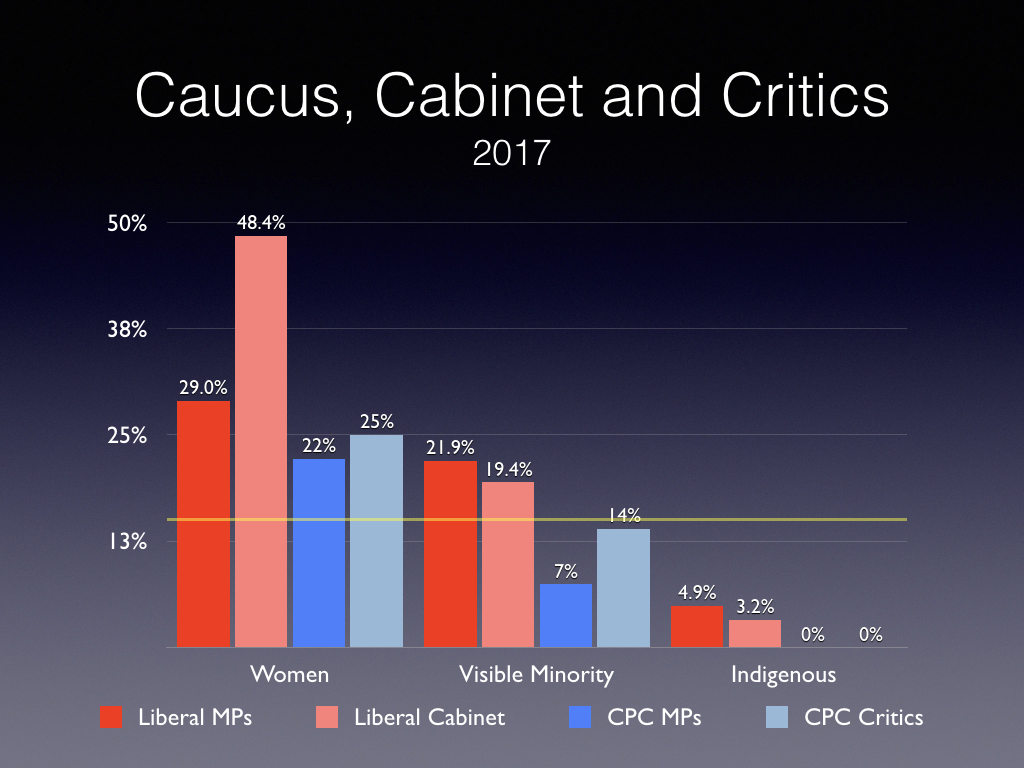
Following the Cabinet shuffle and the appointment of the Conservative shadow cabinet, I did a quick update to my chart showing overall caucus diversity alongside Cabinet and critic diversity.

As many observers have noted in commenting on the new Conservative critics, they may have a “women problem” in terms of the number of MPs  and its translation to the more visible positions (note: the numbers are slightly better when other leadership positions are included – three of the seven are women).

Visible minority Conservative MPs are however well represented.

‘I worry about this’: Trudeau’s move to dissolve Indigenous affairs department prompts concern

While those closer to Indigenous issues are better placed to comment on the substance of the issues, some thoughts from a machinery of government perspective.

  • Changing machinery (i.e., splitting up departments or joining them together) should never be undertaken lightly;
  • In one sense, it is the ‘nuclear’ option to be used when other efforts have failed;
  • While the enabling legislation will have its challenges, the main challenge will lie in the various operational details that follow: organizational, staffing, and resources (as I know from my experience at Service Canada 2004-7 and the transfer of the Multiculturalism Program to then CIC in 2008);
  • These take time and do not necessarily bring out the best in people (e.g., the splitting apart of Trade from Foreign Affairs under the Martin government was particularly toxic);
  • It will be interesting to watch for any changes to the current deputies and associates within the next few months to a year;
  • Given all of the above, and that concrete results are unlikely in the short-term given the degree of internal issues involved, the government is planning already for a second-term.

The basic logic of having a separate services delivery organization makes sense, as service and implementation issues typically are given short shrift in an overall policy development culture:

Source: ‘I worry about this’: Trudeau’s move to dissolve Indigenous affairs department prompts concern – Politics – CBC News

Ethnic Outbidding for White People: A Story About Populism in Canada Versus the United States – NYTimes

http://www.nytimes.com/newsletters/2017/08/23/the-interpreter?nlid=5411894

Not much new but good overview and reminder to NYTimes readers that we too have our dark side:

Breitbart News, the online news site often associated with the alt-right, has grown so powerful that when its former editor, Stephen K. Bannon, lost his White House job last week, it was widely assumed that Breitbart’s influence would only grow.

As this was happening, across the border in Canada, another right-wing media organization known as Rebel Media, which is often compared to Breitbart News, was imploding so severely it was seen as potentially auguring the implosion of Canadian right-wing populism itself.

The shift in Canada reveal something important about one of the biggest stories of the last year, events initially described as a “global populist wave.” Though the wave was later qualified down to just right-wing populism and just in Western countries, it increasingly looks even narrower than that.

The decline of Rebel Media, contrasted with the success of Breitbart, exemplifies something we’ve been saying for a while. The “populist wave” is actually quite specific to individual countries. And, most important, in each Western country where it appears, right-wing populism enjoys support among only about 15 to 25 percent of the population. (Those numbers are based vaguely on a 2016 study by the political scientists Ronald Inglehart and Pippa Norris.)

Whether that fractional support becomes an isolated fringe or a major political power comes down not to anything as fuzzy as culture or values, but to nuts-and-bolts political institutions.

It’s worth running through the sordid details of Rebel Media’s bad week. Faith Goldy, a correspondent, praised Charlottesville’s white nationalist marchers in a live video from the scene. Her video referenced “white racial consciousness” and the “JQ,” shorthand for the “Jewish question.”

A national backlash eventually led the site’s founder, Ezra Levant, to fire Ms. Goldy. But something had changed, maybe for good, with Rebel Media’s place in Canadian politics.

Conservative politicians openly denounced the organization. Andrew Scheer, the leader of the Conservative party, said he wouldn’t give Rebel Media any more interviews until it changed its “editorial direction.”

High-profile staffers and contributors quit. One, Caolan Robertson, released a video accusing Rebel Media of exploiting its supporters for donations it didn’t need. Mr. Robertson also accused Mr. Levant of offering him money to keep quiet. (Mr. Levant has accused Mr. Robertson of attempted blackmail.)

But Canadian journalists see broader forces at work. Jonathan Kay, in an article for The Walrus, wrote that Rebel Media failed in its mission to become the American Fox News or Breitbart because, in Canada, “structural barriers make the creation of this kind of conservative ecosystem impossible.”

Americans generally understand that politics work a bit differently in Canada, but wrongly assume Canadians are simply predisposed to be more liberal. In fact, those “structural barriers” against right-wing populism are more technical, and less particular to Canada, than you might think.

Amanda explained those structural barriers in an in-depth article this summer. The short version: Canadian politicians and civil society groups spent two generations engineering their political system to be highly tolerant of diversity and highly intolerant of something called ethnic outbidding.

Stephen Saideman, a political scientist and friend of the column, has defined ethnic outbidding as “when politicians compete for the support of a particular ethnic group, leading to ever greater demands to protect that group at the expense of others.”

This process can turn politics into a zero-sum competition between ethnic groups who come to see one another as threats. Right-wing populism, in the West, can often function as a kind of ethnic outbidding for white people.

If you want to know how Canada did this and why so many other diverse countries have failed, read Amanda’s story. Of course, we’re not denying that racism and right-wing populist politicians exist in Canada. Rob Ford became Toronto’s mayor after running on a populist platform. But, compared to the rest of the West, the country stands out for its resistance to populism. (And even Mr. Ford cultivated a multi-ethnic voter base.)

That resistance happens through institutions, and you see them working, for example, in Mr. Scheer’s disavowal of Rebel Media. Before any liberal readers rush to award Mr. Scheer a medal of courage, you should know that he was acting within his immediate political interests.

Political norms in Canada are unusually intolerant of overt white nationalism, which has strong and increasingly open support in the United States and much of Europe. The country’s electoral and legislative systems make it very difficult for a party to win power without heavy support from racial minorities.

And Rebel Media’s power, even before this week, was waning. This spring, when some politicians embraced Rebel Media, seeking to reproduce populists’ successes elsewhere, those candidates instead found defeat.

This summer, when reporting for Amanda’s story, we visited a Rebel Media conference in Toronto. Though we had only stopped by for the day, it was clear that this was a movement on the decline.

In a long and thoughtful article on Rebel Media, Richard Warnica of The National Post wrote that Mr. Levant, intentionally or not, is “forcing people to pick a side.”“

Nothing The Rebel did this week, as Conservatives and contributors edged away, was substantially different from what it had done two months ago, or six months ago or last year,” Mr. Warnica added.

What changed is Canada’s conservative establishment, which rejected Rebel Media. That is a marked difference from the conservative establishment in Britain, which embraced populism, or the conservative establishments in the United States and France, which tried to reject populism but instead were overcome by it.

The story of Rebel Media is of course a story of personalities and what unfolded between them. But it is also, like just about every major news story from the last year, a story about institutions.
Federal advertising ‘blacklist’ of websites includes far-right outlets

Makes sense. Alex Marland’s points about more transparency regarding the criteria for inclusion/exclusion are valid, however:

The extreme-right outlets The Rebel, Breitbart and the Daily Stormer are among more than 3,000 websites on an internal “blacklist” to ensure the federal government’s digital advertisements do not appear on sites promoting hate, porn, gambling and other subjects deemed unacceptable.

The expansive list also includes conservative news sites like the Drudge Report, the Washington Times, Gateway Pundit and the National Review, as well as many non-political websites, such as TMZ, Esquire and Cosmopolitan.

CBC News obtained a copy of a recent version of the list, dating from June, via an Access to Information request.

There are 3,071 websites on the current blacklist, which is maintained and regularly updated for the federal government by Cossette Media, the agency hired to place Ottawa’s ads online, on radio and TV and in newspapers. The vast majority of federal ad dollars is now directed to the web.

The released version of the blacklist is non-alphabetical and uncategorized, with no information about the date a website was added nor about the reasons for its inclusion.

“It has evolved consistently since it was established [in 2012], and continues to evolve as the internet landscape and industry trends change and technology advances,” Nicolas Boucher, spokesperson for Public Services and Procurement Canada (PSPC), said in an email.

“Categories have expanded, and sensitivities evolve over time.”

Boucher, whose department co-ordinates federal advertising, declined to respond when asked about the reason for inclusion of particular websites, including some that appear innocuous.

But sites can be blacklisted because they “have consistently underperformed in advertising campaigns,” he noted. “Sites may also be excluded if there have been comments or complaints about the content.”

Breitbart added in December

Breitbart, the U.S.-based ultra-right website to which Steve Bannon recently returned after his departure as U.S. President Donald Trump’s chief strategist, was added to the list last December after complaints.

The move followed a social media campaign by Sleeping Giants, a shadowy activist group that emerged on Facebook and Twitter last November and pressed corporations to pull their ads from Breitbart, which also runs several affiliated websites.

Sleeping Giants focused on the Canadian government after an ad for the Canadian Radio-television and Telecommunications Commission appeared on the site for three days, Nov. 28-30, 2017, before being pulled. Previously, ads for Statistics Canada and Employment and Social Development Canada had also appeared there.

And in May this year, Sleeping Giants launched a campaign urging corporations to pull ads from Canadian ultra-right site The Rebel.

Boucher would not say when The Rebel was added to the blacklist, or why. (The outlet received a letter of support from Environment Minister Catherine McKenna last October when it applied for media accreditationat a climate conference in Morocco, in a press-freedom controversy.)

A Jan. 4 ministerial briefing note for PSPC outlines “brand safety measures” for determining which websites are forbidden when government digital ads are purchased via networks such as the Google Display Network.

“For digital advertising that is purchased programmatically — that is, by a computer, based on a series of parameters — we developed a list of acceptable sites referred to as a whitelist,” says the document, also obtained by CBC News under Access to Information.

‘Ensuring that editorial content does not incite racial hatred, discrimination or the subversion of Canada’s democratic system of government.’– Official criteria for excluding websites from receiving federal government ads

“For maximum safety, the whitelist is used in conjunction with a blacklist filter,” the document says.

“The screening process is based on criteria that the Government of Canada has been using for traditional media. These include ensuring that editorial content does not incite racial hatred, discrimination or the subversion of Canada’s democratic system of government.”

Boucher said that among the screened-out sites are those dealing with crime, death, tragedy, military conflict, “juvenile/gross/bizarre content,” profanity, rough language, sexually suggestive content, sensational and shocking content, gambling and sensitive social issues.

The in-house blacklist is an extra layer of “brand safety” supplementing the exclusion criteria that the Google Display Network and other ad services impose on their own distribution networks for all clients.

Governments should not ‘pick favourites’

An expert on political branding warns that governments too often focus on delivering messages directly to their political bases, and that advertising can be misused as a partisan tool.

Alex Marland, political science professor at Memorial University of Newfoundland and author of Brand Command: Canadian Politics and Democracy in the Age of Message Control (2016). (Memorial University)

“Our governments should not be picking favourites,” said Memorial University of Newfoundland political scientist Alex Marland, author of last year’s Brand Command: Canadian Politics and Democracy in the Age of Message Control.

“And because of the choices of media, you can communicate information to some Canadians, and other Canadians are never contacted.”

Marland said the Liberal government needs to be clear on exactly how and why websites are put on a blacklist, based on public and transparent principles, and how those websites can get off the list.

Among other sometimes surprising inclusions on the blacklist: men’s magazine Maxim, lingerie seller La Vie en Rose, female-targeted blog Jezebel, the promotional site for erectile dysfunction drug Cialis, sports sites SB Nation and Barstool Sports, Auto Trader, India Times, Mayo Clinic.

Source: Federal advertising ‘blacklist’ of websites includes far-right outlets – Politics – CBC News

Federal government still battling chronic backlog of appointment vacancies

Slow progress. Latest numbers:

More than a year after the federal Liberals launched a new process meant to reduce patronage and increase the transparency of the government appointment process, a huge number of positions remain unfilled — affecting everything from refugee appeals to courtroom delays to the independent watchdogs of Parliament.

The new process, announced in February 2016, was meant to create a more arm’s-length method of filling the roughly 1500 positions to which the government appoints its preferred candidates — at federal agencies, on boards, commissions and administrative tribunals, as well as at the head of Crown corporations. Nearly every such position is now advertised online, and committees sort through applications and recommend applicants with a mandate to improve gender and ethnic diversity.

But the introducton of the revamped process caused appointments to virtually grind to a halt for a year. A CBC study in March found the number of vacancies and expired terms had ballooned to nearly 600 — roughly a third of all positions. Things only started moving again in June, when the government made more than 100 appointments. But a National Post evaluation this week found about 300 remaining vacancies and 150 instances where somebody continues to serve in a job beyond the expiration of their term, with hundreds more expiring this fall.

The effects reach far beyond Parliament Hill. In June, immigrations appeals in B.C. and Alberta had to be scaled back because of vacancies on the boards that conduct hearings. Today there are still 41 vacancies, accounting for almost half the appointed positions.

In May, the outgoing head of the Military Grievances External Review Committee complained it was severely restricted in its ability to review complaints from Canadian Forces members due to vacancies, saying “our men and women in uniform deserve better … I deeply regret that the committee could not do more this year.” Three of the four appointed positions remain empty.

The government brought the same new approach to appointing judges, but it took the better part of a year to staff up the judicial advisory committees that make recommendations. A Senate report in June slammed the government’s sluggish pace in appointing judges , saying it was contributing to the court delay crisis. As of July 1, there were still 49 vacancies across Canada .

Liberal officials have said it just takes time to find the right people, and that the delay is worth it in the long run — particularly when it comes to improving diversity. Statistics provided by the Prime Minister’s Office say that as of mid-June the government’s nominees have been 70 per cent women, 12 per cent visible minorities, and 10 per cent Indigenous.

Shared Services Canada to begin talks on allowing federal departments to ‘opt out’ from centralized IT service

Recognition of reality. Will be interesting to see how departments respond over time:

Shared Services Canada is exploring transferring some responsibilities for federal information technology systems back to individual departments and agencies, in the wake of legislative changes weakening the agency’s monopoly on digital services.

Pat Breton, director general of procurement and vendor relations with SSC, said the agency has started reaching out to the 43 federal departments and agencies it counts as clients to discuss potential service improvements, including bringing certain IT operations back in-house, and plans to hold formal talks with departmental chief information officers in the coming weeks.

“We’ve been proactive in telling them that this is a new tool that we’ve got and we’ll be working with them to put it in place, where appropriate,” he told The Hill Times.

“We’re starting from the holistic needs assessment, gap analysis: What is the specific problem and what’s the best way to address it, and reach solutions together?”

The 2017 budget implementation bill, passed in June, made significant changes to the mandate of SSC, which was launched by the former Conservative government in 2011 with the responsibility of delivering email, data centre, and network services in a “consolidated and standardized manner,” and to offer optional technology-related services to government organizations on a cost-recovery basis.

First, it watered down SSC’s authority to consolidate IT systems across the public services by permitting organizations to opt out of using the agency in “exceptional circumstances.” It also restored the ability of individual departments to purchase software and digital hardware themselves, instead of conducting all business through the agency.

The bill, though, doesn’t allow for blanket exemptions from using SSC, with departments only permitted to opt out of using some services, according to Mr. Breton. Parts of departments can be granted complete exemptions from all SSC services.

The decision to grant the authorization is left to the minister responsible for SSC, Procurement and Public Services Minister Judy Foote (Bonavista–Burin–Trinity, N.L.).

When asked, Mr. Breton didn’t disclose if any departments had asked to opt out since the bill passed, noting that the SSC was only at the “starting point” of defining the exceptional circumstances process. However, departments like Global Affairs that work in remote and international locations would be “obvious areas for consideration,” he said, citing stringent restrictions on who can provide SSC services.

Under its mandate, only SSC employees can deliver its services, meaning the agency has to dispatch an SSC employee in every “point of [reference] around the globe,” according to Mr. Breton, who described it as “not efficient” and “not effective.”

He singled out departments providing services in other countries and working in remote and overseas locations as “consistent themes” where operating from a central location “may not be the most beneficial.”

The Hill Times reached out to several departments and agencies that would appear to fit the criteria or have been identified in media reports as encountering challenges with SSC to ask if they planned to seek an exemption from using its services, though none publicly confirmed they would.

Global Affairs Canada will “continue to work together and maintain our existing partnership,” according to a statement from spokesperson Jocelyn Sweet.

Annie Delisle, a spokesperson for the RCMP, said the national police force is “working closely” with SSC to try and find solutions to “fully meet the RCMP’s policing IT requirements, without compromising operations.”

A spokesperson for the Canada Border Services Agency simply said it “supports” the government’s goals and priorities, and will continue to contribute to areas related to its mandate of defending the country’s borders.

Statistics Canada said it values SSC as a “reliable service provider,” but clarified that while the budget implementation bill provides “more flexibility,” it doesn’t allow departments or agencies to opt out.

Source: Shared Services Canada to begin talks on allowing federal departments to ‘opt out’ from centralized IT service – The Hill Times – The Hill Times

Federal government to downsize failing Canada.ca project

Another failing IT project.

As someone who regularly accesses government information, never found Canada.ca terribly user friendly or easy to find the info I was looking for. The old departmental websites were more efficient from my user perspective (although that may reflect my comfort and familiarity with them or the more policy information that I was looking for).

And a bit disappointed the IRCC is one of the sites that will remain as it is one of the sites I consult with the most.

As with the other major IT failures – Shared Services Canada, Phoenix – one has to question the competence of the senior officials who made and prepared the case along with the Ministers who provided oversight and approval:

The federal government is substantially curtailing the multimillion-dollar Canada.ca project, acknowledging that its plan to merge 1,500 departmental and agency websites into a single website is sputtering.

Instead of migrating all departments and agencies to a single platform, the $11.8 million earmarked for the project will be used government wide, with a focus on four of the largest departments offering services most used by Canadians: health, environment, Canada Revenue Agency, and immigration.

Those departments will have until the end of this year to migrate their content to the new platform.

“The 2012 plan to migrate all government web content to the Canada.ca platform under delivered from the beginning in part due to poor project management, planning and underfunding from the outset by the previous Conservative government,” said Jean-Luc Ferland, press secretary to Scott Brison, president of the Treasury Board.

“We are refocusing project funds where they can make the biggest impact to improve Canadians’ online experiences.”

Most telling about the government’s flagging support for the initiative is that remaining departments and agencies will not be compelled to continue.

“Other departments will continue to have the option of migrating content to Canada.ca as resources and technology advances allow,” said Ferland.

Over budget and behind schedule

The Canada.ca initiative was launched with the goal of making it easier for people to find and use government information online. A $1.54-million contract for a new content management system, where all government websites would be moved, was awarded to Adobe in 2015.

But as CBC reported at the end of last year, the project is more than 10 times over budget and more than a year behind schedule, making it yet another failing government IT project, not unlike the Phoenix pay system or the email transformation initiative. It’s also another project the Liberal government is blaming on its predecessor.

A government source not authorized to speak on the record said the decision to pare down the Canada.ca initiative, yet allow it to limp along, was making the best of a bad situation.

“It’s like we walked into the kitchen where the meal is poorly planned and off to a rough start. Some dishes were forgotten, grill is overstuffed … your herbs are wilting on the counter. You don’t freak out and throw everything out. The responsible thing to do is to focus on your guests and make the most of everything you have.”

Tens of millions spent so far

In response to inquiries from CBC, the Treasury Board conceded that as of June, only 230,542 pages were hosted on Canada.ca, up from the 10,000 tabulated six months ago, but still an incredibly slow rate of movement over to the new portal.

There are more than 17 million government of Canada web pages in total.

As well, the Adobe contract has ballooned to more than $14.9 million, according to government figures. That does not include the tens of millions spent by departments and agencies that are responsible themselves for the actual migration of the websites, using existing budgets and staffing.

Since 2015, eight of the largest departments have spent or budgeted nearly $32 million on the project. Those departments include:

  • Employment and Social Development Canada.
  • Immigration, Refugees and Citizenship.
  • Health.
  • Environment.
  • Canada Revenue Agency.
  • National Defence.
  • Fisheries and Oceans.
  • Global Affairs.

A slow migration

“This is great news from a taxpayer’s perspective,” said Joel Brockbank, chief technology officer at OpenPlus, a content archictecture company that had submitted a bid to create the new content management system for Canada.ca

“These large IT renewals have a lot of momentum and it’s difficult to change course if it’s not going as planned. It’s amazing they are not doubling down and putting a lot more money into something that will ultimately fail.”

Experts who have warned against unmanageable, large, one-size-fits-all government IT projects agree.

“To focus the money on key sites which Canadians use most is the right decision,” said Timothy Lethbridge who teaches software engineering and computer science at the University of Ottawa.

The December deadline for the four big departments is probably still unrealistic, according to Lethbridge, but the idea of letting other departments off the hook is smart.

“To slowly migrate, as time permits, is more cost effective than a forced death march to get to an artificial deadline,” he said.

A time to cut losses

A government source with first-hand knowledge of the Canada.ca project, and who was speaking on condition of anonymity, said IT government workers have been told that none of the government’s arm’s-length agencies have been moving their material over to the new site for some time.

“In fact we are not even talking about Canada.ca anymore,” said the source, adding “the vast majority of the content on government sites is not being migrated at all.

“It probably just won’t happen.”

Source: Federal government to downsize failing Canada.ca project – Politics – CBC News

Why the Senate is unpredictable — and its independents not so independent: Éric Grenier

Good detailed analysis, including voting records of individual senators, by Grenier:

The Senate is gumming up the work of the Liberal government, slowing the process that turns bills into law because the government cannot reliably count on a majority of senators lining up behind it, according to an analysis of votes in the upper chamber.

But the numbers also show this isn’t due to the independent senators named to the Red Chamber by Prime Minister Justin Trudeau. In fact, these independent senators have voted closely with the government — more often than the “Senate Liberals” cut loose from the party in 2014.

The Senate is currently divided into three groupings: Conservatives, Liberals and an Independent Senators Group (ISG). There are also a few non-affiliated senators, including Peter Harder, the government representative responsible for guiding the government’s agenda through the Senate.

The Conservative senators form part of the party’s parliamentary caucus, along with Conservative MPs from the House of Commons. But the Liberal senators were ejected from that caucus in 2014 by Trudeau, a move aimed at reducing partisanship in the upper chamber.

Though they still caucus together in the Senate, they no longer co-ordinate with their colleagues in the House.

The ISG is formed of senators who left their former Conservative or Liberal caucuses, as well as those put in the Senate by Trudeau as part of the government’s pledge to appoint non-partisan senators nominated by an independent commission.

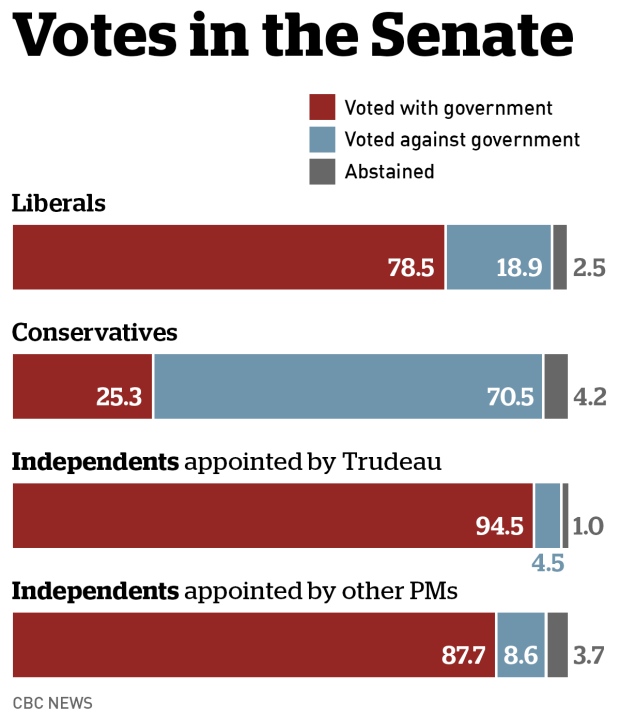
As the opposition in the Senate, the Conservatives have voted against the government’s position the most often, siding with Harder in just 25 per cent of all 48 recorded votes held since Harder took office. (This includes votes on both government and non-government bills and motions.)

But the swing votes in the Senate have not been the gaggle of independents, but rather the Senate Liberals, who have voted with Harder only 78.5 per cent of the time.

Votes in the Senate

The independents, by comparison, have been much more co-operative. Independents appointed by Trudeau’s predecessors voted with Harder 88 per cent of the time, while independents named by the prime minister have stood with Harder in 94.5 per cent of recorded votes.

This makes Trudeau’s independents — as a bloc — the most reliable votes that Harder can count upon in the Senate.

Senate Liberal swing votes

This bloc is not large enough for Harder to easily steer the government’s legislation through the Senate.

With 98 senators — excluding Speaker George Furey and Jacques Demers, who has been away due to poor health — Harder needs 49 votes to pass legislation when all senators are in the chamber.

In addition to himself, Harder can count on the support of his deputy, Diane Bellemare, and government liaison Grant Mitchell. The independents named by Trudeau increase his vote total to 29.

Adding the six independent senators appointed by past prime ministers who frequently vote with the government bumps that number to 35 — still short of a majority.

So in order to pass legislation, Harder needs most of the votes from the 18 Liberals, making them the Senate’s decisive swing votes.

Source: Why the Senate is unpredictable — and its independents not so independent – Politics – CBC News

Stereotypes hurting millennials’ chances of finding work in the public service, says report

Interesting report with reasonably practical recommendations. Government context requires innovation has to be balanced with accountability and stewardship, not to mention the political/PS interface which the recommendations largely acknowledge:

One of the most significant issues with the public sector’s “millennial problem” is the perception that young people don’t want to work in government, according to the report. In fact, says Deloitte, a consulting firm, the public service is attractive to those born between 1980 to 1995: there’s job stability and an opportunity for a work-life balance.

“Research instead shows that, as a whole, millennials want the same things and value the same things as other generations. Where they differ is in the ways they go about achieving their goals,” the report says.

Retaining millennials is also not a problem for the public service. The report found that from 2007-2014, the number of millennials leaving stayed consistently low. People aged 35 and younger were actually more likely to stay in the federal government than leave, according to the numbers.

That’s if, however, they can get hired.

Since the 2008 recession, the government’s Deficit Reduction Action Plan has lowered the number of people hired overall. “The number of external jobs posted in 2008 was about 5,000, but that number dropped to around 2,700 in 2016,” the report said.

Only about 3.5 per cent of applicants were hired during the Recruitment of Policy Leaders initiative which focuses on hiring young top talent into mid and senior level policy roles. In 2016, those who applied through the government’s post-secondary recruitment program had a one-per-cent success rate.

“Recruitment is so selective, the federal government accepts a lower share of applicants than elite Ivy League institutions like Harvard University,” says the report, which points out Harvard’s most recent academic year’s acceptance rate was 5.2 per cent.

The report also raises other issues affecting the hiring of young people, including the older generation in government jobs who are delaying retirement, as well as the length of time it takes to go through the hiring process and the lack of career growth. Younger generations tend to have more debt because of student loans and cannot afford to wait several months to be hired, says the report.

Solutions

The report offered several recommendations to address these issues.

* Streamline the hiring processes: Use more technology for online application forms to reduce printing and scanning, use electronic signatures for online forms and also create an easier process for security clearance.

* Recruitment: Make the hiring process more dynamic and prioritize different skill-sets that may be outside of the usual boxes ticked on application forms. Find new ways to identify top talent, which includes predictive analytics that determine what existing and future skills an applicant meets.

* Mobilizing jobs: Career growth and internal mobility is something millennials want, so offer several different job opportunities within the same organization across different sectors.

* Think outside the cubicle: Break down the barriers that isolate employees in the office to enhance communication, and enhance employees’ overall well-being. Create more dynamic workspaces that include options to work remotely.

* Incentivize innovation: Recognizing and encouraging innovation will benefit the public service. Teams that encouraged diverse perspectives often performed better, says the report. Feeling that creative ideas were recognized and welcomed was important to “would-be innovators.”

Several changes to attract millennials to the public sector are already underway or are being tested in pilot programs, according to the report.

Source: Stereotypes hurting millennials’ chances of finding work in the public service, says report | Ottawa Citizen

Increasingly activist Senate plans amendments to Liberal budget bill — again [Service Fees Act escalator clause?]

Will be interesting to see if the concern over automatic indexing of alcohol excise taxes is followed by the same concern for the automatic indexing of government service fees (Budget bill will increase service fees with less accountability, say critics):

At least two parts of Bill C-44, the omnibus legislation that implements the government’s budget priorities, are likely to see substantial amendments when the bill arrives in the chamber next week. It’s not yet certain they have enough votes to pass, but both have some support in all three groups of senators.

Under an amendment that will come from independent Sen. André Pratte, the section of the bill that creates the Canada Infrastructure Bank — a new agency that would use public funds to help attract private investment for infrastructure projects — would be separated out for further study in the fall.

Pratte said it’s highly unusual for a large financial agency to be created through omnibus legislation, and the Senate must take care to properly consider it.

“We simply lack time, because summer recess is approaching,” he said. “It’s a 3oo-page bill, and the infrastructure bank is a new, complex institution, and an important one. We need to study it in depth to make sure we get it right.”

Many senators also oppose a measure in the bill that creates an annual inflationary increase in the excise tax on alcohol. A special briefing for senators on that aspect of the bill took place on Thursday afternoon.

Sen. Claude Carignan, who sits on the Senate banking committee and was the Conservative caucus leader until recently, said Conservatives will look favourably on both potential amendments.

“If somebody moves a motion to split the bill (to take out the infrastructure bank)…probably, we will support this initiative,” he said.

The alcohol tax is also a concern, he added. “I can confirm that many senators on our side have a problem, first, with raised taxes, but also to do with an automatic system of inflation. We have concerns because it’s something where you raise taxes without Parliament authorization.”

If the whole Conservative caucus votes for the amendments, the support of just a dozen other senators would be needed for passage.

Source: Increasingly activist Senate plans amendments to Liberal budget bill — again | National Post