Suddenly, the Chinese Threat to Australia Seems Very Real

Australia has always been the cautionary tale for Canada and others, with comparable challenges:

A Chinese defector to Australia who detailed political interference by Beijing. A businessman found dead after telling the authorities about a Chinese plot to install him in Parliament. Suspicious men following critics of Beijing in major Australian cities.

For a country that just wants calm commerce with China — the propellant behind 28 years of steady growth — the revelations of the past week have delivered a jolt.

Fears of Chinese interference once seemed to hover indistinctly over Australia. Now, Beijing’s political ambitions, and the espionage operations that further them, suddenly feel local, concrete and ever-present.

“It’s become the inescapable issue,” said Hugh White, a former intelligence official who teaches strategic studies at the Australian National University. “We’ve underestimated how quickly China’s power has grown along with its ambition to use that power.”

Huge pro-India fake news network includes Canadian sites, links to Canadian think tanks

Of interest:

A huge international network of fake local news sites that push a pro-Indian government position internationally has a deep Canadian connection, CBC News has learned.

According to the EU DisinfoLab, a Brussels-based non-profit group whose goal is identifying disinformation targeting the European Union, the network includes at least 265 sites in more than 65 countries.

At least 12 of those sites pose as Canadian news outlets and use names that either mimic current media publications or old media outlets that have folded, such as The Toronto Evening Telegram. CBC has also found evidence of a further 16 sites designed to look like local Canadian news websites, all registered by the Srivastava Group.

Some of the sites have either been taken down in the last week, since some of the EU DisinfoLab’s findings have been reported, or never had content uploaded to them in the first place.

All of the sites are tied to the Srivastava Group, an Indian corporation run by Ankit Srivastava, a self-described entrepreneur based in New Delhi. CBC was able to determine using website data analysis tool DomainTools. Some of the websites were registered to a bungalow in Edmonton.

The network of sites publishes content that is critical of Pakistan.

News sites with Canadian names but little activity

The purported Canadian news sites run by the network have names like the Toronto Mail, the Quebec Telegraph and the Times of New Brunswick. Many borrow the names of defunct Canadian newspapers. In all cases, the “about” section claims that the websites are local Canadian media outlets.

Most of the Canadian websites in the network have generated very little activity on social media, garnering almost no likes and shares, according to social media analytics tool BuzzSumo. Unlike many fake news networks, the sites don’t seem to make money through advertising since they don’t carry ads.

Alexandre Alaphilippe, executive director of the EU DisinfoLab, notes that parts of this network have been active since 2010. “It’s a network that has been operating for a very long time on these questions, promoting India or denigrating Pakistan,” he said. “It’s not only fake media sites. They have think-tanks, NGOs and so on. It’s very organized. It shows that this is something that is planned.”

Controversial visit to Kashmir

The Srivastava Group was also linked to a controversial visit by right-wing members of European Parliament to Kashmir in late October, which included a meeting with Indian Prime Minister Narendra Modi.

The visit to Kashmir took place even though access to the region is extremely restricted by the Indian government, and journalists and NGOs are barred. In August, the Indian government revoked part of the constitution granting the Jammu and Kashmir state special status, instituted a curfew and cut internet and phone connections. The area has been under lockdown for more than 100 days.

According to Julian Schofield, an associate professor at Concordia University in Montreal whose studies focus on South Asia, the visit might be a way for India to promote its handling of the situation in Kashmir and make it look better when compared to its main rival, Pakistan.

“Bringing the Europeans over is saying, ‘Look, we’re a functioning democracy, just like you, we have the same issues as you, and essentially, we’re liberal. We’re multi-ethnic, multi-identity, just like you, not like Pakistan. Come visit Kashmir, we’re doing our best,'” he said.

According to Indian media, that visit was financed and organized by two NGOs with connections to Srivastava: the International Institute for Non-Aligned Studies (IINS) and Women’s Economic and Social Think-Tank (WESTT).

IINS was founded by Srivastava and shares a physical New Delhi address with the Srivastava group. WESTT’s website was registered by M. Srivastava. The director of WESTT, Madi Sharma, is also described as the EU correspondent for the New Delhi Times — an obscure newspaper whose editor-in-chief is Ankit Srivastava.

Its website has 1.2 million followers on Facebook, but almost no interactions with its content, which is extremely unusual given that followers tend to interact with content, and suggests the followers may be fake. Sharma was reported by Indian media to have extended the invitation to the MPs to visit India, and accompanied those MPs during their time in Kashmir.

Several Indian journalists from fact-checking outlets contacted by CBC/Radio-Canada said they had never heard of the New Delhi Times before the controversy over the Kashmir visit erupted.

Schofield said that India’s rivalry with Pakistan is at the centre of its foreign policy and the visit was part of its propaganda effort. “It is viable as a technique against Pakistan. If Pakistan wasn’t there, India would dominate the sub-continent.”

Srivastava has also republished columns from Toronto Sun columnist Tarek Fatah, who describes the two as friends, and also has links to former Liberal MP Mario Silva; the IP address used to register the website of a think-tank that was chaired by Silva is the same as that of the Srivastava group, and the site is hosted on a server administered by Srivastava.

CBC News reached out to Srivastava at multiple phone numbers, and in all cases, the person who answered the phone referred inquiries to an email address. Srivastava did not respond to multiple email inquiries.

Over the past week, Twitter has suspended several accounts linked to the network, including the accounts for EP Today, a purported news magazine centred on the European Parliament, and 4news Agency, a newswire service which served to boost the network’s content. Both these sites were used to push pro-India news items.

Since EU DisinfoLab’s report, all of the articles were also removed from EP Today. All that remains on the site is an apology by the owners for publishing articles from the Russian outlet RT.

Think tank website hosted by Srivastava

One of the Canadians linked to Ankit Srivastava is former Liberal MP Mario Silva.

Silva chaired a group called IFFRAS, the International Forum for Rights and Security, which describes itself as a “non-profit international think-tank” with headquarters in Toronto, Brussels, Geneva and Washington. Silva was the Liberal member of Parliament for the downtown Toronto riding of Davenport from 2004 to 2011, and is currently a distinguished visiting professor at Toronto’s Ryerson University and a board member at Toronto Hydro.

Using DomainTools, CBC found that the website shares the same IP address as the Srivastava Group and EP Today, and that website for the think tank is hosted on Srivastava’s server. The email address used to register the server is a Hotmail address for Srivastava.

Silva has given interviews to Times of Geneva, the New Delhi Times and 4News Agency, some of which were critical of Pakistan.

A YouTube video shows Silva sitting next to Fatah as Fatah gives a talk on Balochistan in Geneva in March of 2014.

A number listed on the IFFRAS.org website is not in service, and another number used by Silva previously in his registration of the site was also not in service.

When contacted by email, Silva said he does not “condone, participate in or support any organization that promotes inaccurate or misleading information and would never be part of any group that acts in such a manner.”

Silva said that IFFRAS, the think-tank, has been inactive for a number of years, and his involvement “was limited solely to advocacy for human rights in a broad sense, fully consistent with my long-standing commitment to the promotion of human rights and equality for all persons across the world.”

Silva further added he was unaware of any connections between Srivastava and the websites and newspapers that CBC had inquired about, and that he “emphatically” does not have “any connection with any group or organization you have referenced.”

Toronto writer’s columns reprinted on site

In an interview with CBC News, Fatah said that he was aware his columns were being republished in the New Delhi Times and said Srivastava paid him a small fee for it, though he declined to specify how much.

“Mr. Fatah is a freelance opinion columnist. Freelancers can generally resell their work after its publication in the Sun to non-competing markets, subject to the terms of their agreements with us,” said Phyllise Gelfand, the vice-president of communications for Postmedia, in an email.

Fatah was also listed as the executive director of an NGO called Baluchistan (sic) House, described as a think-tank focusing on the Balochistan province of Pakistan. The region has seen ongoing insurgencies against the Pakistani government by Baloch groups seeking independence.

The now-defunct Baluchistan House website was registered by Ankit Srivastava, as were other sites seemingly built for Fatah, such as whatthefatah.com and whatthefatah.net, which never published any content.

According to Fatah, the What the Fatah project is a proposed video series featuring him that he’s working on with Srivastava, while the Baluchistan House website registration may have come from an exiled Baloch leader living in London.

“I was merely involved and it never really took off, the Baluchistan House forum,” he said.

Fatah’s Baluchistan House organized a panel in 2017 in Geneva, where he appeared alongside Polish MEP Ryszard Czarnecki  to discuss Balochistan’s economic situation. Czarnecki, a conservative politician critical of Pakistan and supportive of India, was amongst the MEPs who visited Kashmir in October.

Fatah said he was not involved with the visit and did not help facilitate it. He also said that while he had met Czarnecki a few times in UN meetings, he didn’t speak or meet with Czarnecki outside of that.

Fatah said he was not aware that Srivastava was running a network of fake news sites.

“Why would he do that?” said Fatah, adding it must be “some ridiculous Indian bureaucrat’s idea of propaganda.”

Concordia’s Schofield said the network’s promotion of Baloch interests clearly marks it as serving the Indian government’s interests. He says that India has been supporting Balochistan independence as a way to put pressure on Pakistan.

“This is definitely political. It’s basically an open secret that the Indians have been helping the Baloch,” he said. “If [Ankit Srivastava] is doing this type of thing, that’s what you’d call a siren alert,” that he’s in line with the government’s policies.

Fatah said he wasn’t worried about his columns being used to promote pro-India views.

“Oh, I am unashamedly pro-India. If somebody uses my writing to be pro-India, hallelujah. India is the only place that will save this universe. You can quote me on that,” he said.
Source: Huge pro-India fake news network includes Canadian sites, links to Canadian think tanks

A ‘friend of China’ no more: Why a longtime Canadian ally has become one of Beijing’s fierce critics

Good profile and account of her realization that she needed to speak out regarding the need for a reset of Canada-China relations, with Canada needing to take a harder line:

It was 1979 and Beijing was in the midst of its first democracy movement. Margaret McCuaig-Johnston, then a civil servant in the Ontario government opening up after decades of isolation from the outside world.

The Xidan democracy wall, part of a peaceful public outburst against the Communist Party of China, was in full swing and McCuaig-Johnston had been following the story in Canadian media.

“I had never even thought of China. It was not on my radar at all, but this sounded really interesting,” she said. “So, my husband and I went over to China.”

At the time, only group tours were allowed, so she made the trip with the University of Toronto Alumni Association and even managed a trip to see the democracy wall in Beijing, which hosted messages of hope and reform from the mainland Chinese people. From there, McCuaig-Johnston travelled the country and decided to do a master’s degree in international relations focused on China.

For the next 40 years, including working as a civil servant, she collaborated to advance the relationship between Canada and China. Part of her work meant helping China develop its science and technology programs during its reform period.

Eventually, McCuaig-Johnston would become the vice-president of the Canada-China friendship association and consider herself a “friend of China,” a common expression used for those who support partnerships and engagement with Beijing.

But everything changed last December.

That’s when Meng Wanzhou, chief financial officer of Chinese tech giant Huawei, was arrested. She had been passing through Vancouver’s airport when she was detained on a warrant request from the United States. The arrest sparked a firestorm that has torched relations between China and Canada.

McCuaig-Johnston said she’d already had concerns about the direction Beijing was taking on human rights, particularly regarding internment camps for Muslims in the Xinjiang province, as well as the country’s increasing aggression in the South China Sea.

But what galvanized those concerns was the detention without charges of two Canadian citizens, Michael Kovrig and Michael Spavor, who remain in Chinese custody months later. Another two Canadians were sentenced to death for drug convictions, which have not been carried out. Shortly after, Beijing levelled sanctions against Canadian pork and beef.

After decades spent facilitating China’s enhanced ties to Canada, McCuaig-Johnston returned to her hotel room in Shanghai the same week Kovrig and Spavor were arrested to find her locked luggage had been unlocked and rummaged through.

She said she believes it was Chinese authorities because nothing was taken. Then a local business acquaintance told her he had heard authorities had a list of 100 Canadians they could detain and interrogate at any time. McCuaig-Johnston had reached her limit.

“When I came home, I decided to speak out,” she said.

Since then, McCuaig-Johnston has written five editorials in national newspapers critical of China, given 30 interviews and recently published Dragon at the Door through the Macdonald-Laurier Institute. The paper calls for Canada to conduct a reset of relations with Beijing, insisting Ottawa to take a harder line.

“Up until January, I had never done an interview in my life,” she said. “But I feel it’s important that friends of China — former friends of China — speak out about this.”

Her paper suggests pulling out of China’s Asian Infrastructure Investment Bank, using so-called Magnitsky legislation to punish Hong Kong officials who abuse human rights, or sending pandas now living at the Calgary Zoo back to China early. Canada must also pivot to an Indo-Pacific economic strategy, she argued.

Foreign affairs critic Erin O’Toole agreed with measures laid out in the paper, but suggested the Liberal government seems unwilling to take such strong action.

“We are rolling over, we are acquiescing, at a time when Chinese aggression is on the rise,” O’Toole said. “We should be working with like-minded allies to send a real signal that such conduct is not condoned.

If keeping quiet and friendly were going to work with China, Spavor and Kovrig “would have been released months ago,” he said.

On Friday, China’s new ambassador to Canada, Cong Peiwu, urged Canada to not pass legislation similar to the United States’ sanctioning China and Hong Kong officials who abuse human rights. The bill is in support of students in the special administrative region who have been protesting for months. About 300,000 Canadians live in Hong Kong.

Cong said it could cause “very bad damage” if Canada were to use similar legislation.

The Liberal government had issued no response to those comments by press time Friday.

Observers have noted that many advisers around the Liberal government have ties and interests in China, including new ambassador to Beijing, Dominic Barton, and McCuaig-Johnston was once among the ranks of such business people, academics and bureaucrats.

But though “friends of China” may express outrage at China behind closed doors, many have told her they will not do so in public for fear of losing their privileges in the country.

In January, more than 140 academics and diplomats around the world signed a letter demanding China release Kovrig and Spavor. But just six Canadian academics signed while another six former Canadian ambassadors to China also signed.

‘Plain cruel’: Vanuatu stops newspaper chief boarding plane home after China stories

Another reminder of the influence of China:

The media director of a Vanuatu newspaper whose visa renewal was refused this month has been barred from flying home to Vanuatu from Brisbane with his partner.

Dan McGarry, who has lived in Vanuatu for 16 years, applied to have his work permit renewed earlier this year but it was rejected. McGarry believes his visa was refused due to articles he had published about China’s influence in Vanuatu.

In July the Daily Post broke the story of Vanuatu deporting six Chinese nationals – four of whom had obtained Vanuatu citizenship – without due process or access to legal counsel.

McGarry said he was “quite confident” it was that series of reports which had upset the government.

McGarry, who is Canadian, left the country to attend a forum in Brisbane on media freedom in Melanesia, at which leading journalists and the editors from the region spoke about attacks on journalistic freedom in the region and discussed his case in detail.

Tech firm blacklisted in U.S. over facial-recognition allegations invited to Vancouver conference

Yet another story on the obliviousness, wilful blindness and complicity of institutions and individuals with respect to serious human and minority rights violations in China:

A Vancouver conference promoting business links between Canada and China is under fire for inviting a company that’s blacklisted in the United States for its work monitoring the Uighur ethnic group in China.

Jimmy Zhou, executive director of SenseTime, is one of the Chinese corporate leaders invited to speak at the China Forum to be held Nov. 16 and 17 and sponsored by BizChina Club from the University of British Columbia’s Sauder School of Business.

SenseTime is an artificial intelligence startup based in Hong Kong that has worked with Chinese tech giant Huawei to launch a facial recognition program, according to the latter’s website.

In early October, the U.S. Department of Commerce blacklisted SenseTime with other Chinese tech companies for alleged human rights violations against Uighurs in Xinjiang province. Facial recognition technologies from these firms have reportedly been used by the Chinese government to monitor the Muslim minority in the northwestern Chinese province.

Shalina Nurly, youth leader for the Vancouver Uighur Association, said the event at the Vancouver Convention Centre is a disappointment, and the group is considering mounting a protest.

“We have been let down by the UBC community,” said Nurly in an email to CBC News.

“At a time where the world is re-experiencing the Nazi concentration camps [in Xinjiang], we as Canadians should be joining the U.S. as it takes a stand against Communist China for the basic fundamental rights of the Uighur and other Muslim minority groups.”

Promoted as ‘great opportunity’

The event has been promoted by UBC president Santa Ono and George Chow, B.C. minister of state for trade, who describes the two-day conference in a promotional video as “a great opportunity to bridge Canadian and Chinese business and culture.”

The conference has also received support from the Chinese consulate in Vancouver, according to a message on the Chinese instant messaging platform WeChat.

Nurly, a 19-year-old student at Simon Fraser University, also expressed concern about Lina Chen, the chief editor of Sina Weibo, appearing at the conference.

As China’s major social media platform, Sina Weibo has censored topics that Beijing deems politically sensitive, including the animated TV series South Park and the June 4 anniversary of the 1989 Tiananmen Square massacre.

“What is peculiar about Lina Chen is that she is the deputy secretary of the Chinese Communist Party for her company. How that works is in China, every private company has such a committee in place for the party to get control of the private sector,” said Nurly.

According to Hong Kong’s South China Morning Post, 68 per cent of China’s private companies had an internal communist presence by the end of 2016, and that continues to grow.

Business with China carries ‘high risks’

Mabel Tung, the president of the Vancouver Society in Support of Democratic Movement, which organizes the Tiananmen anniversary vigils and rallies in support of Hong Kong protesters, said Canadians should be vigilant about Chinese business ties.

“The recent case of Canada’s two Michaels [Kovrig and Spavor], arbitrarily detained in China since December 2018 without formal charges … serves as a blunt reminder to us Canadians that doing business with communist China carries very high risks that are entirely unpredictable.”

BizChina Club’s president, Michelle Lau, said she was “surprised to hear” about the concerns from local Uighurs, but added that her association “will certainly take these concerns into consideration moving forward.”

A UBC spokesperson said the university is “proud of the initiative and work of all students who are engaging on global issues and ideas.”

Both SenseTime and Sina Weibo have not responded to interview requests.

Source: https://www.cbc.ca/news/canada/british-columbia/ubc-invites-blacklisted-company-1.5355536

Fears of election meddling on social media were overblown, say researchers

Hype versus the reality (perhaps Canada not important enough…). The hype was in both mainstream and ethnic media:

Now that the election is over and researchers have combed through the data collected, their conclusion is clear: there was more talk about foreign trolls during the campaign than there was evidence of their activities.

Although there were a few confirmed cases of attempts to deceive Canadians online, three large research teams devoted to detecting co-ordinated influence campaigns on social media report they found little to worry about.

In fact, there were more news reports about malicious activity during the campaign than traces of it.

“We didn’t see high levels of effective disinformation campaigns. We didn’t see evidence of effective bot networks in any of the major platforms. Yet, we saw a lot of coverage of these things,” said Derek Ruths, a professor of computer science at McGill University in Montreal.

He monitored social media for foreign meddling during the campaign and, as part of the Digital Democracy Project, scoured the web for signs of disinformation campaigns.

Threat of foreign influence was hyped

“The vast majority of news stories about disinformation overstated the results and represented them as far more conclusive than they were. It was the case everywhere, with all media,” he said.

It’s a view mirrored by the Ryerson Social Media Lab, which also monitored social media during the campaign.

“Fears of foreign and domestic interference were overblown,” Philip Mai, co-director of the Social Media Lab, told CBC News.

A major focus of monitoring efforts during the campaign was Twitter, a platform favoured by politicians, journalists and partisans of all stripes. It’s where a lot of political exchanges take place, and it’s an easy target for automated influence campaigns.

“Our preliminary analysis of the [Twitter hashtag] #cdnpoli suggests that only about one per cent of accounts that used that hashtag earlier in the election cycle can be classified as likely to be bots,” said Mai.

The word “likely” is key. Any social media analyst will tell you that detecting bonafide automated accounts that exist solely to spread a message far and wide is incredibly difficult.

#TrudeauMustGo and other frenzies

A few times during the campaign, independent researchers found signs that certain conversations on Twitter were being amplified by accounts that appeared to be foreign. For example, the popular hashtag #TrudeauMustGo was tweeted and retweeted in large numbers by users who had the word “MAGA” in their user descriptions.

But this doesn’t mean those users were part of a foreign campaign, Ruths said.

“It’s very hard to prove that those MAGA accounts aren’t Canadian,” he said. “How can you prove who’s Canadian online? What does a Canadian look like on Twitter?”

Few Canadians use Twitter for news. According to the Digital News Report from the Reuters Institute for the Study of Journalism, only 11 per cent of Canadians got their news on Twitter in 2019, down slightly from 12 per cent last year.

Twitter’s most avid users tend to be politicians, journalists and highly engaged partisans.

Fenwick McKelvey, an assistant professor at Montreal’s Concordia University who researches social media platforms, said he feels journalists overestimate Twitter’s ability to take the pulse of the voting public.

“Twitter is an elite medium used by journalists and politicians more than everyday Canadians,” McKelvey told CBC News. “Twitter is a very specific public. Not a proxy for public opinion.”

In fact, most Canadians — 57 per cent — told a 2018 survey by the Social Media Lab that they have never shared political opinions on any social media platform.

Tweets for elites

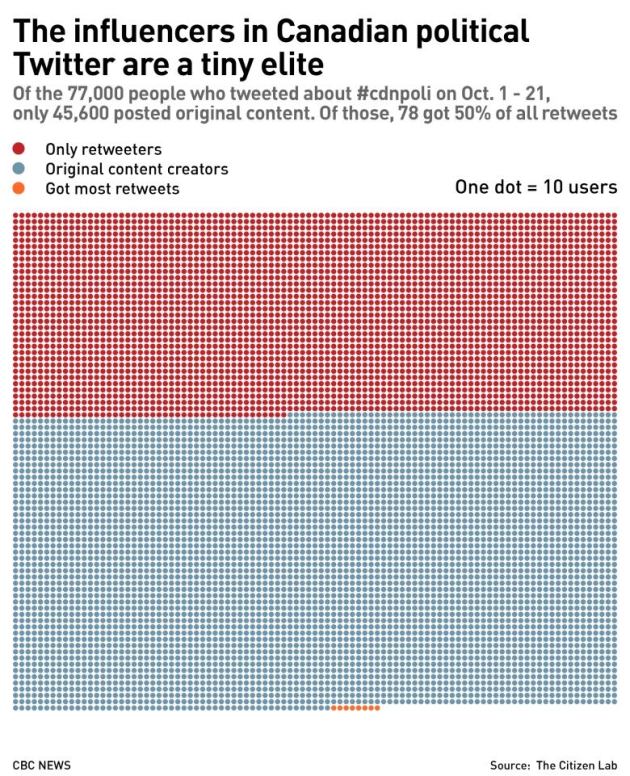
For an idea of just how elitist Twitter can be, take a look at who is driving its political conversations. For some of the major hashtags during the election — like #cdnpoli, #defundCBC and the recently popular #wexit — just a fraction of users post original content. The rest just retweet.

And the users who get the most retweets, the biggest influencers, represent an even tinier sliver of Twitter users, according to data from the University of Toronto’s Citizen Lab, another outfit that monitored disinformation during the campaign.

“What we thought was a horizontal democratic space is dominated by less than two per cent of accounts,” said Gabrielle Lim, a fellow at the Citizen Lab.

“We need to take everything with a grain of salt when looking at Twitter. Doing data analysis is easy, but we’re bad at contextualizing what it means,” Lim said.

So why this focus on Twitter if it’s such a small and unrepresentative medium for Canadians? Because it’s easy to study. Unless a user sets an account to private, everything posted on Twitter is public and fairly easy to access.

On the other hand, more popular social networks like Facebook make it much harder to harvest user content at scale. A lot of misinformation may also be shared in closed channels like private Facebook groups and WhatsApp groups, which are nearly impossible for outsiders to access.

But even taking into account those larger social media audiences, the evidence shows that Canadians are getting their news from a variety of sources, Lim noted.

Although the threat posed by online disinformation to Canadian democracy was overblown in the context of the 2019 campaign, Ruths said he still believes it was important to be alert, just as it’s important to go to the dentist even if no cavities are found.

And he suggests that journalists looking for evidence of bot activity apply the same level of rigour as the people doing the research.

“We saw a lot of well-intentioned reporting,” he said. “But finding suspected accounts is not the same as finding bots. Saying that MAGA accounts don’t look like Canadians’ doesn’t mean they’re not.”

Source: Fears of election meddling on social media were overblown, say researchers

Former Obama adviser urges Canada to scale back exchanges with Beijing and ban Huawei from 5G

Of note. Money quote highlighted:

Canada should scale back engagement with China until two Canadian hostages are released and ban telecom giant Huawei Technologies Co. Ltd. from supplying next-generation 5G mobile technology on national-security grounds, says a member of former U.S. president Barack Obama’s national-security council.

Tarun Chhabra, who was a director on the White House national-security council from 2015-17 and is now a visiting fellow at the Brookings Institute, said Beijing crossed a “red line” in arresting Michael Kovrig and Michael Spavor in retaliation for the detention of senior Huawei executive Meng Wanzhou.

“There still has to be a red line, and arbitrary arrests like the two Michaels have to be the red line,” Mr. Chhabra said in an interview with The Globe and Mail on Wednesday.

He said he had expected Beijing’s use of what he called “hostage diplomacy” to have a chilling effect on engagement between Western countries and China, including unofficial discussions and interaction on a non-official level.

“I have to say, I am somewhat disappointed by the fact that hasn’t been the case,” Mr. Chhabra said. “There’s obviously official government business that has to go on, there’s going to be some commerce … [but] I think all of us should be sending a stronger message to Beijing.”

Mr. Chhabra said countries such as Japan, South Korea and Norway have faced “intimidation and coercion” during disputes with China, and he urged liberal democracies to “inoculate themselves” to withstand this bullying.

The Canadian military was criticized after The Globe reported that Ottawa sent 170 athletes and coaches to an armed-forces sports competition in China earlier this month. China’s embassy in Canada cited this participation in the games as more evidence that Beijing’s conduct is not costing it allies. Small-business minister Mary Ng came under fire for travelling to Beijing this summer, even as the two Canadians remained jailed, and tweeting about the ice cream that a Canadian firm is selling there.

“Beijing is very attuned to opportunities to use symbolic gestures, sometimes ones that are perceived to be routine or that have been long-scheduled … as propaganda weapons,” Mr. Chhabra said. “I think you have to review all kinds of exchanges and think more defensively about the ways in which they could be manipulated against you.”

Mr. Chhabra, who is visiting Canada this week to speak to the Munk School of Global Affairs and Public Policy about China’s growing threat, said the federal government should not allow Canadian telecoms to buy Huawei’s 5G technology.

Prime Minister Justin Trudeau faces a difficult decision on whether to join the United States, Australia and New Zealand in barring Huawei equipment from 5G mobile networks. The United Kingdom and Canada, which with those other three countries form the Five Eyes intelligence-sharing alliance, are conducting security reviews of 5G technology.

“There are serious security concerns with Huawei providing the key components of 5G networks because of cybersecurity concerns that have to do with confidentiality as well as network availability,” Mr. Chhabra said.

This week, Germany’s foreign intelligence service chief warned that Huawei should not be given a significant role in that country’s 5G network because it “cannot be trusted fully.”

Huawei has been fighting U.S. attempts to persuade its Five Eyes partners and other allies to bar the Chinese firm from supplying gear to their 5G networks.

Mr. Chhabra cautioned Ottawa and other Western countries against allowing Huawei equipment because they fear that if they did not, China would punish them economically – as Beijing has done in the case of Ms. Meng, whose father is the founder of Huawei.

China detained Mr. Kovrig and Mr. Spavor only days after Canada arrested Ms. Meng at Vancouver International Airport on an extradition request from the U.S. government.

“Any country that has come under the boot of Chinese intimidation and coercion – why give them more leverage over you?” Mr. Chhabra asked. “Surely the answer cannot be that because we have faced Chinese coercion, we should submit ourselves to far more by making ourselves vulnerable to Chinese control over our telecommunications networks.”

He noted that China itself is wary of allowing foreign telecommunication firms a significant role inside its borders. “Internally, China has always been quite clear about the political power in telecommunications and its absolute insistence that no foreign telecommunication companies be allowed in their networks,” he said.

The U.S. has threatened to curtail sensitive intelligence to countries that allow Huawei into their 5G networks, particularly members of the Five Eyes.

Mr. Chhabra said he wished the Trump administration had not threatened U.S. allies and instead quietly focused on the technical reasons Huawei equipment can’t be trusted.

Source: https://t.co/hLChiPnQPG?amp=1

Beijing says Canadian military participation at Chinese sports competition more proof it’s not losing global support

Another reminder of how the 2020 International Metropolis conference in Beijing will be presented as legitimization of the regime’s repressive policies towards minorities (e.g., “re-education camps” for Uighurs, Tibet) and general human rights abuses.

How DND and others attending didn’t think or consider how this would be presented hard to understand.

If you haven’t already, please consider signing the petition a number of us initiated against the holding of the conference in Beijing: http://chng.it/kfzPmtVk

Beijing’s embassy in Canada says the fact the Canadian military just sent a “big delegation” to a sporting competition in China is more evidence the Asian power is not losing friends.

Canada-China relations are in a deep freeze after Beijing locked up two Canadians in apparent retaliation for Ottawa’s detention of a Chinese high-tech executive on an extradition request from the United States. China banned Canadian pork and beef and severely curbed purchases of Canadian canola seed and soybeans.

China has also come under heavy criticism for how the Beijing-backed administration in Hong Kong is handling unprecedented protests there, and in the mounting scrutiny of the internment of an estimated one million Uyghur Muslims in Xinjiang Province.

But the Chinese government, through its representatives in Canada, wants Canadians to know Beijing is not isolated or losing support.

It posted a statement on the website of its embassy in Canada to criticize a column published in The Globe and Mail last week, titled How China Loses Friends and Alienates People. The guest column by a U.S. academic discussed the backlash from China after Daryl Morey, general manager of the NBA’s Houston Rockets, tweeted remarks in support of the protests in Hong Kong and said bullying is self-defeating behaviour that will cost Beijing support.

The embassy said the list of China’s friends is growing. “More and more countries commend China’s foreign policy and development path. China’s friends are all over the world. This is a fact that can neither be obliterated nor changed by some people’s groundless accusations,” the Chinese embassy said.

“In the future, we will have more and more friends in various fields.”

It highlighted the presence of Canada and other nations in the World Military Games, held in China from Oct. 18 to 27.

International participation in the games, which attracted “9,308 military athletes from 109 countries, including a big delegation from Canada, speaks volumes in this regard,” the embassy said.

Ottawa didn’t issue any news release before or during the games to draw attention to Canada’s participation.

Daniel Le Bouthillier, head of media relations at the Department of National Defence, said Canada sent 114 athletes, 57 coaches and support staff.

Guy Saint-Jacques, a former Canadian ambassador to China, said he’s surprised Canada sent soldiers.

He said Canada must rethink how it engages with Beijing. “Now that we have seen the dark side of China, we have to have a much more realistic approach to China. Yes, we have to engage them … but at the same time we have to take into account they can be very brutal if we do something they don’t like.”

Mr. Saint-Jacques said China’s pressure on other countries and companies to avoid criticism of its conduct is growing: “Their list of red lines is getting longer all the time. It used to be Falun Gong and Tibet and Taiwan. Now it’s Hong Kong and Xinjiang too.”

The Defence Department did not directly answer when asked why Canada sent athletes to China even as Foreign Affairs Minister Chrystia Freeland accuses Beijing of arbitrarily detaining former diplomat Michael Kovrig and entrepreneur Michael Spavor.

The department said Canada “remains deeply concerned by China’s actions, including the arbitrary detention,” added that it hoped the games foster friendship.

“The spirit of the World Military Games is to create a space for friendly competition among armed forces,” Mr. Le Bouthillier said.

China expert Charles Burton, who served in the Canadian embassy in Beijing, said National Defence should not have participated in the military sports games.

“At this time, there shouldn’t be any celebratory activities going on between Canada and China, and I would suggest a major sports competition is about celebrating friendship and therefore I think it was a mistake for our military to go,” he said.

Mr. Burton said Canada’s participation “must be quite offensive” to the families of Mr. Kovrig and Mr. Spavor. The two were arrested and later charged with stealing state secrets after Canada detained senior Huawei Technologies Co. Ltd. executive Meng Wanzhou last December. They have been in prison for almost a year.

Canada’s new ambassador to China, Dominic Barton, undertook consular visits with Mr. Spavor and Mr. Kovrig over the last week.

Mr. Burton, a senior fellow at Centre for Advancing Canada’s Interests Abroad, said he hopes the Canadian government will not send athletes to the Beijing Winter Olympic Games in February, 2022, because that would be signalling “that relations are normal and passively accepting what China is doing.”

Conservative MP Peter Kent said it was inappropriate to send athletes to Beijing.

“It is unacceptable. Basically, the government should be curtailing completely collegial events at a time when Canadians are held hostage and where trade embargoes have been improperly placed on contracted Canadian sectors,” he said.

Mr. Kent also said Canada should also consider boycotting the Olympics.

Source: pointing to

How Assad’s man got a priceless antiquity out of Canada and into Syria

Sometimes, literally following the rules makes governments miss the bigger picture:

Waseem Ramli, the notorious Montreal businessman whose diplomatic status as honorary consul for the blood-drenched Baathist regime in Syria was revoked by Foreign Affairs Minister Chrystia Freeland last month, is being officially heralded in Damascus these days as a selfless and patriotic national hero.

But it’s not because he’d managed to secure diplomatic credentials from Global Affairs Canada this summer, despite being feared and loathed by the Syrian refugee community in Montreal—he’s often seen driving around in a fire-engine-red Humvee with a portrait of Syrian tyrant Bashar al-Assad on a side window. It’s because he pulled off an altogether different and equally dramatic Canadian caper, right under everybody’s noses, in the weeks before the Assad regime appointed him to serve as a diplomat in Canada. And no law was broken.

In broad daylight, Ramli walked out of the Montreal Museum of Fine Arts with a priceless 1,820-kilogram late 5th century Byzantine Christian mosaic. Measuring roughly 3.5 meters by 2.8 meters, the mosaic, originally from the vicinity of Hama on the Orontes River, was unveiled at a glamorous ceremony in Damascus on Monday. At the celebration, Ramli was praised to the skies for having secured the Hama mosaic’s acquisition over the repeated objections of Canadian officials.

But Canadian officials raised no objections at all to surrendering the Early Christian artwork to the Syrian Arab Republic, Maclean’s has learned. The process that led to the ceremonial unveiling of the Hama mosaic in Damascus on Monday was a lot like the cavalcade of official and inadvertent Global Affairs sign-offs that led to Ramli’s authorization to act as the Syrian regime’s honorary consul in Montreal.

Freeland pulled Ramli’s credentials after she learned from a Sept. 23 report in Maclean’s that her own department’s Office of Protocol had authorized and registered Ramli to act on the Assad regime’s behalf. But it’s too late for the Hama mosaic. It’s now at the Syrian National Museum in Damascus.

The massive mosaic came from a shipment of 82 mosaic fragments that the Syrian regime exported illegally in the late 1990s, likely in connivance with the smugglers themselves. The collection was intercepted by the RCMP and Canada Customs officials, and the artifacts were eventually returned to Syria, except for the Hama mosaic. Although it had been cut into two pieces, apparently for ease in transport, the mosaic was so magnificent that McGill University professor John Fossey, the Montreal museum’s curator of Greek art at the time, managed to arrange a loan of the work for display at the museum.

The loan was extended several times, starting in 2004. Assad plunged Syria into a nightmare of mass death and jihadist mayhem in 2011, and after 500,000 dead and more than six million refugees, he’s been winning. On Dec. 29 last year, Ramli walked into the museum, presented a letter from the Syrian government, and demanded that the museum surrender the Hama mosaic to him.

“When he first came in to us in December, I think he expected that overnight we could just take it down and hand it to him,” Hilliard Goldfarb, senior collections curator and curator of old masters at the Montreal museum, told me. But there were forms to be filled out, and proper authorizations to be obtained. Still, last April, Ramli was on hand at the museum to observe the mosaic being carefully taken down from its display mounting and placed in a special crate.

On May 13, the Hama mosaic was placed on an Air France flight to Paris. From Paris it was shipped to Beirut, and then transferred to the National Museum of Damascus where it was unveiled on Monday at a posh gathering of regime officials and diplomats from the few countries that haven’t severed relations with Assad’s rogue regime. At Monday’s unveiling ceremony, according to coverage by Syria’s state news agency, Mahmoud Hammou, the country’s director general of antiquities and museums, praised Ramli as a Syrian patriot who’d managed to acquire the Hama mosaic and arrange for its return to Damascus “at his own expense,” despite successive objections from Canadian authorities “under the pretext of the war on Syria.”

That’s not even close to what actually happened. Between Dec. 29 and May 13, Ramli’s efforts to get the Hama mosaic back into the hands of the Assad regime were dutifully stickhandled by a variety of helpful and perfectly friendly Canadian officials. “We were in touch with both the Ministry of Foreign Affairs and Cultural Heritage in this matter, and we were told, yes, this work can be returned,” Goldfarb said. “We had contact by phone and by email with various parties. Canada was well aware of what was going on.”

There was a bit of a rigmarole, but Ramli’s demands were all met within six months.

“I’m not a politician. I’m an art historian. I don’t for a minute want to be seen as defending the Syrian regime, which I find absolutely horrible, but that’s not the issue we were handling,” Goldfarb said. “We were fully in touch with all the authorities. Really, to my mind, we didn’t have much choice.”

And that’s because Global Affairs Canada didn’t give the museum a choice. Nobody said no. Nobody even said, hold on, maybe we should just say no, this belongs to the Syrian people, not to the criminal regime in Damascus. So Goldfarb and his colleagues had little option but to comply with Ramli’s demands and hand over the Hama mosaic.
“Global Affairs Canada had no role in facilitating its return,” Adam Austen, speaking for Foreign Affairs Minister Chrystia Freeland, told me.

This is, arguably, not untrue. The Cultural Property Export and Import Act requires that property lent to Canadian institutions be returned as the loan contract stipulates, and export permits to return loaned property are automatically approved. Ordinarily, ministerial discretion doesn’t enter into it.

But Syria is no ordinary country.

The reopening of the National Museum of Damascus last year has afforded the Baathist regime several propaganda opportunities in its push to rehabilitate its global reputation and persuade the international community that Assad has won the scorched-earth war he has been waging on the Syrian people. Last Monday’s unveiling of the Hama mosaic at the National Museum was a propaganda victory for the regime. And quite a few Canadian officials, at the highest level, either signed off on the file or just let the transfer proceed without objection.

That is how Ramli ended up registered by Global Affairs Canada as an officially authorized diplomat, too. A Liberal Party donor and proprietor of the Cocktail Hawaii restaurant on Rue Maisonneuve, Ramli calls the heroic first responders of Syria’s White Helmets organization “terrorists” and al-Qaeda operatives. This was a bit much for Freeland, because last year, she led an international rescue operation that brought about 250 White Helmets and their families to settle as refugees in Canada.

Ramli obtained his honorary-consul credentials from Ottawa in August after travelling to Damascus in June, where he obtained his diplomatic appointment from the Assad regime only days after posing for photographs with Justin Trudeau at a Liberal Party fundraiser. He was all set to open a consular office in Montreal on Oct. 1, and he would have been the most senior Baathist official in North America, if Freeland hadn’t furiously intervened and revoked his credentials.

Ramli would have ended up with consular-services power over tens of thousands of Syrian immigrants and refugees across Eastern Canada and throughout much of the United States. That’s because Syrian diplomats were expelled from North America in 2012 in response to Assad’s crimes against humanity, and since then, honorary consulates have operated only in Vancouver and Montreal, and only intermittently. All requests for birth certificates, diplomas, remittance arrangments and so on would have had to run through Ramli.

Canada and the U.S. are among dozens of countries that have cut diplomatic ties with the Assad regime. Suspended from the Arab League in 2011 and the Organization of Islamic Cooperation in 2012, Syria is a pariah state, subjected to United Nations sanctions, European Union sanctions, and U.S. and Canadian sanctions. But in dealing with the Assad regime’s application for diplomatic credentials on Ramli’s behalf, the “vetting” process fell apart. Everybody did their jobs, but nobody noticed the Office of Protocol standards stipulating that honorary consuls should be individuals of standing in the community, and shouldn’t be politically active. Syria was treated as though it were a normal country, like Costa Rica, or South Korea.

And in the matter of Ramli’s determination to retrieve the Hama mosaic on the Assad regime’s behalf, the Cultural Property Export and Import Act was followed as though Syria was France, or India, or Ireland.

Since 2011, when Assad first put the torch to his country, Syria’s cultural patrimony has been looted and traded on the black market by ISIS, pro-democracy rebels, and by the regime itself. The collection of artifacts containing the Hama mosaic had been spirited out of Syria in 1996, apparently by individuals close to the dictatorship of Bashar Assad’s father, Hafez Assad.

After he showed up out of the blue last Dec. 29 at the Montreal Museum of Fine Arts demanding the mosaic’s return, Ramli was politely received, and advised of the proper documentation he’d need to provide. Despite the Assad regime’s claim that the Canadian authorities had refused to return the mosaic “despite successive official demands,” Ramli was treated with every courtesy.

In January, Ramli returned to the museum with a letter from the Syria’s Ministry of Culture. On Feb. 4, Bashar Jaafari, the permanent representative of the Syrian Arab Republic at the United Nations, passed along Ramli’s power-of-attorney documents to Marc-André Blanchard, the former McCarthy-Tetrault chief executive officer and president of the Quebec Liberal Party that Trudeau had appointed Canada’s head of mission at the UN.

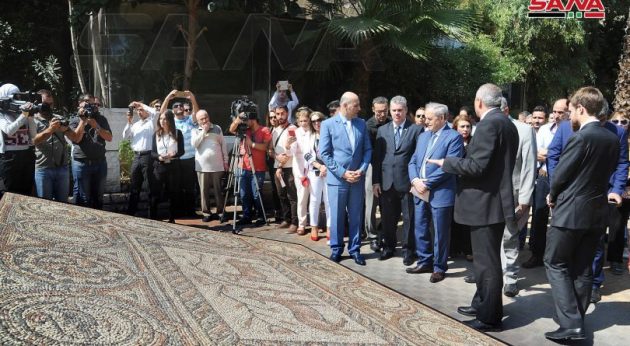
The unveiling of the 1,800-kilogram, late 5th Century Byzantine Christian mosaic at the National Museum on Damascus, as seen on the website of Syria’s state news agency. The mosaic had previously been at the Montreal Museum of Fine Arts. (SANA)

Blanchard handed it up, and on Feb. 12, Freeland’s office was formally advised of the proceedings. Andrew Leslie, the retired general and Orleans MP who served as Freeland’s parliamentary secretary, was brought into the loop in March. Rory Raudsepp-Hearne, Global Affairs’ team lead for Syria and Lebanon, signed off on it. So did senior cultural affairs officials with the Department of Canadian Heritage.

No sanctions lines were crossed because no money changed hands, and Canada’s custody of the mosaic ended in Lebanon. In Beirut. The Canadian embassy there formally handed custody off to Syrian officials for transport to Damascus.

The Hama mosaic is a thing of great beauty. It was excavated from the floor of a church or a convent that was built in the days before the arrival of the conquerer Abu Ubaidah ibn al-Jarrah, when Hama was known in Byzantium as Emathoùs. It is adorned with Christian iconography—the tree of life, a chalice, sheep, fish and birds.

There’s little left of the beauty of Hama. In 1982, Bashar’s father, Hafez, laid siege to the city to quell a rebellion. The Syrian Human Rights Committee reckons 40,000 people died in the slaughter. Since 2011, when Bashar took up his father’s penchant for atrocity, Hama has been bombed, its people massacred over and over and over again.

As for the Hama mosaic: “Everything was done by the book,” a senior official close to Freeland explained to me. “Thank you for bringing this to our attention. This kind of situation repeating itself is highly unlikely.”

Source: How Assad’s man got a priceless antiquity out of Canada and into Syria

Analysis: The Long Arm Of China And Free Speech

More evidence as if we did not know:

Doing business in China comes with major strings attached. This week it became evident that a few provocative words can cause those strings to tighten.

A single tweet by Houston Rockets General Manager Daryl Morey in support of pro-democracy protesters in Hong Kong unleashed massive retaliation from China that put the team and the entire NBA on notice. China’s state TV cut off preseason games and ominously announced it would “immediately investigate all co-operation and exchanges involving the NBA.” Tencent, a major Chinese social media company with a reported $1.5 billion streaming deal with the NBA, said it will no longer stream Rockets games, even though the team is immensely popular in China.

China’s message to foreign companies and their employees is clear: Watch what you say on matters sensitive to our country if you want to do business here. This hardball response to Morey and the NBA fits a pattern of threats and reprisals against foreign organizations wading (even unintentionally) into the country’s sensitive internal politics.

Facing boycott threats this summer, Western fashion brands apologized for T-shirts that suggested that Taiwan and Hong Kong were independent countries rather than territories that are part of China. It isn’t just top executives who have paid a price for speech that offends China’s sensibilities. Last year, a Marriott employee earning $14 an hour used a company account to like a post on Twitter from a Tibetan separatist group. A Chinese tourism organization demanded an apology and urged Marriott to “seriously deal with the people responsible.” The employee was fired. When China threatens a foreign business, compliance typically prevails over resistance.

China’s efforts to impose speech controls on international companies and their workers have largely succeeded. Morey deleted his tweet. The NBA put out a statement saying the tweet doesn’t represent NBA or the Rockets, which led to an uproar in the U.S. and another statement from the NBA.

The league’s initial response provoked a torrent of criticism in the United States; in a rare show of unity, leading Democrats and Republicans rebuked the NBA for caving to China and failing to stand up for Morey’s free speech rights.

American companies have grudgingly accepted all kinds of Chinese rules for years. They may bristle about how they are forced to transfer technology in exchange for access to China’s market and about Chinese cyber spies who threaten their intellectual property. But the potential rewards — all those consumers, a middle class that’s expected to reach 550 million by 2022 — are just too great to spurn. And that means playing by China’s rules.

One notable recent exception: South Park, the sardonic, boundary busting Comedy Central cartoon. Last week’s episode, “Band in China,” appeared to offend authorities so much that all traces of the show — episodes, clips, discussion groups and social media posts — vanished from major platforms in China.

South Park‘s creators, Trey Parker and Matt Stone, seized on the moment to issue a fake apology mocking China’s President Xi Jinping and the NBA:

OFFICIAL APOLOGY TO CHINA FROM TREY PARKER AND MATT STONE.

“Like the NBA, we welcome the Chinese censors into our homes and into our hearts. We too love money more than freedom and democracy. Xi doesn’t look just like Winnie the Pooh at all. Tune into our 300th episode Wednesday at 10! Long live the Great Communist Party of China! May this autumn’s sorghum harvest be bountiful! We good now China?”

In fairness to the NBA, South Park thrives on political agitation. The basketball league has painstakingly built a thriving connection with hundreds of millions of Chinese fans.

The NBA has notably supported players and coaches who express their political views on subjects ranging from police violence to guns and President Trump. But Daryl Morey’s seven-word tweet “Fight For Freedom Stand With Hong Kong” puts the league’s progressive image to its sternest test. On Tuesday, the well-regarded NBA Commissioner Adam Silver sought to clarify the league’s position, saying it would “protect its employees’ freedom of speech,” while at the same time apologizing to the league’s fans in China.

The apology failed to defuse the league’s crisis. China’s state-run television network said it was “strongly dissatisfied” with Silver’s remarks. And it bluntly declared that any speech challenging China’s “social stability” doesn’t fall within the realm of freedom of speech.

The Chinese message is loud and clear: Your free speech ends at the water’s edge.

Source: Analysis: The Long Arm Of China And Free Speech