And one wonders why conspiracy theories take hold:
British government propaganda unit ran covert campaigns across the Middle East for several years at the height of the Cold War, distributing Islamic messages in a bid to counter the appeal of communism.
Recently declassified official papers show that the Information Research Department (IRD), a then-secret division of the UK Foreign Office, commissioned a series of sermons that were reproduced and distributed throughout the Arabic-speaking world.
The papers show that the unit also arranged for articles to be inserted in magazines published by Al-Azhar University in Cairo, “to ensure that every student leaves the University a resolute opponent of Communism”.
In an attempt to reach as wide an audience as possible, the IRD also published and distributed across the region a series of Arabic-language romantic and detective novels, within which anti-communist messages were embedded.
These stressed that Soviet communism was essentially atheistic in philosophy and practice, and claimed that Moscow aimed to sow political disorder and economic chaos in the Middle East.
The papers also shed new light on the way in which the British government covertly controlled or influenced many of the radio stations and news agencies in the Middle East from the 1940s to the late 1960s. Some details of these operations became public after the IRD was shut down in 1977.
However, the latest tranche of declassified papers appear to show the IRD to have been particularly sensitive about what its officials termed “religious operations”, in which they attempted to utilise Islam as a bulwark against communism.
Marked Secret or Top Secret, many of the papers are being declassified after 50 or 60 years; nevertheless, some passages were blacked out by government censors before they were made public at the UK National Archives.
Subterfuge, bribery and sermons
The IRD was set up in 1948 in order to continue the work of a wartime body called the Political Warfare Executive. For the next 29 years it ran a number of newspapers, magazines, news agencies, radio stations and publishing houses, in order to spread unattributed anti-communist propaganda across much of the world.
Its favoured method, however, was to place stories in established newspapers and to covertly brief opinion formers. This was achieved on occasion by subterfuge or bribery, although early on, a senior IRD official, John Peck, warned that bribery might not always work.
“I have serious doubts about the value of bribery as a means of getting anti-communist articles in the press,” he wrote.
“I am told that except in Jordan and possibly in Syria the circulation of those Middle East newspapers which are open to bribery is small and their individual influence negligible.”
In the same memorandum, he summed up the reason for IRD material being distributed without attribution: “However valid our arguments may be, the fact that they are our arguments makes them suspect to the Arabs. We can only overcome this difficulty by presenting the same arguments through an Arab intermediary.”
Despite Peck’s wariness, bribery continued to be used as a means of distributing propaganda material across the region.
Although financed through the same unpublished budget as Britain’s intelligence services, the newly-released papers show that the IRD also received funding from the oil industry.
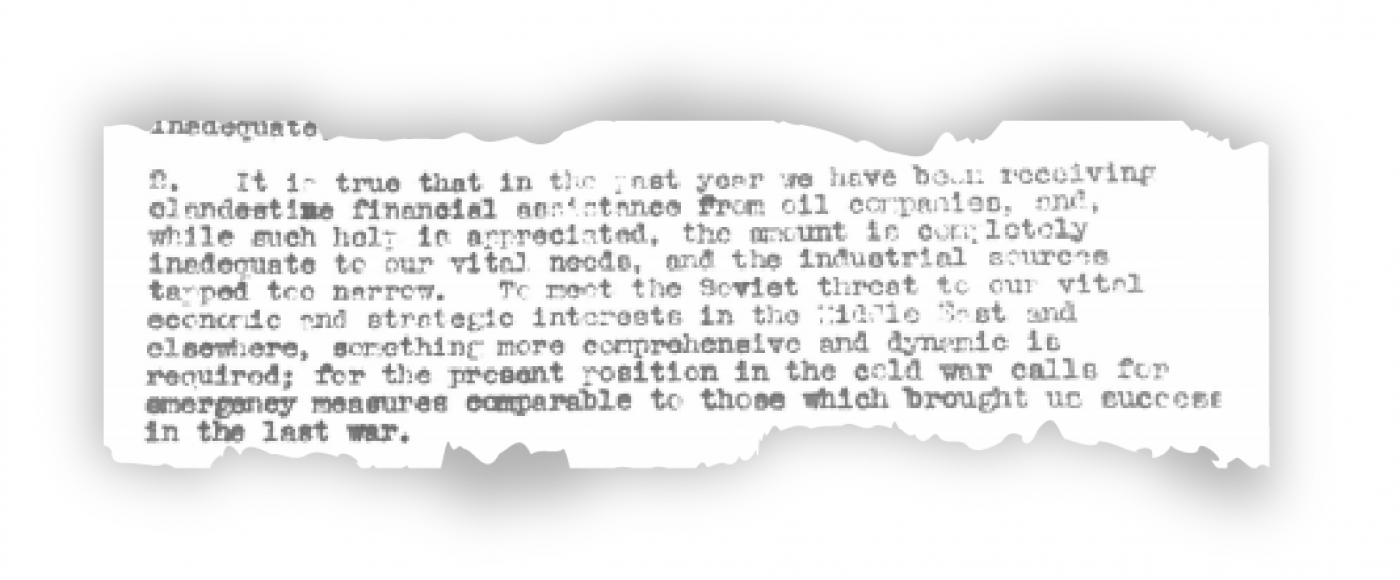
“It is true that in the last year we have been receiving clandestine financial assistance from oil companies,” a memo to IRD director Ralph Murray, marked Top Secret, noted in 1954.
But the Middle East was seeing “the emergence of a state of total ideological warfare”, the author claimed. “And while such help is appreciated, the amount is completely inadequate to our vital needs.”
The newly declassified papers contain a number of references to “religious operations”. Frequently these references are concerned with the financing of such propaganda campaigns, rather than the means of delivery. “You will note that we are including new budgetary provision for £1,000 to cover ‘Religious Operations’” is one typical entry.
Some details of the campaigns do emerge, however. In February 1950, for example, two years after the IRD was set up, its representative at the British embassy in Cairo informed London: “The Friday sermon has always been recognised as one of the most important way [sic] of spreading propaganda in the Moslem world.
“We have now devised a scheme for ensuring that anti-Communist themes are adequately dealt with. A series of sermons has been written here.”
This was still happening 10 years later, as a top-secret memo from Beirut from August 1960 makes clear: “We hope to produce two short pamphlets or sermons a month on religious subjects. They will be written by Sheikh Saad al Din Trabulsi, formerly of the Beirut Moslem Tribunal (sharia) and now of Zahle Moslem Tribunal, who is well-known as a pious Moslem.
“Two thousand copies of each would be distributed unattributably … throughout the Arabic-speaking world (less Iraq). Recipients will be Sheikhs, other leading Moslem personalities, Mosques and Muslim education establishments.”
The intermediary between the IRD and Trabulsi is named in the files as a man called Rivera, although this is possibly a codename.
Another intermediary between the IRD and individuals described as “religious operators” is named in the files as Talaat Dajani, a Palestinian refugee living in Beirut. Dajani later moved to London, where he received a medal of honour from the Queen in 1979, and died in 1992.
The whole Trabulsi operation, the IRD representative explained to London, would cost around 8,800 Lebanese pounds, or around £1,000 sterling, a year.
Although Iraq was excluded from that campaign, the country was on occasion the subject of IRD religious operations. In 1953, for example, IRD headquarters wrote to its man in Baghdad, saying: “We would like to know more about your ‘pilot’ scheme for the covert dissemination of propaganda in the Shia holy places since it may suggest ideas which could be used outside Iraq.
“Is the scheme connected with the working party’s proposal to make Friday sermons prepared in Beirut available to certain Shia divines?”
IRD officials saw another chance to make use of “religious operations” in Iraq following the attempted assassination of the country’s prime minister, Abd al-Karim Qasim, as he was being driven through Baghdad in October 1959.
There had been a “remarkable religious revival” following the attempt, the unit noted. “Workmen engaged in demolition work near the site of the attempted assassination had discovered the tomb of a Moslem holy man; this story had been widely publicized and had given substance to the popular belief that the Premier had been miraculously preserved. It was agreed that there would be an advantage in giving wider circulation to the story.
“Religious stickers have been appearing in Baghdad and the possibility of augmenting them is to be considered.”
Disruption and influence operations
The following April, a conference of Middle East-based IRD officers was held in Beirut. The minutes of what was described as a “restricted session on covert propaganda” show that Ralph Murray “listed the targets at which we should aim to disrupt or influence”.
Those to be disrupted included communist parties and hostile propaganda agencies. This was at a time when printing presses inside Soviet embassies were thought to be producing 10,000 copies of a newspaper entitled Akhbar every day.
Those to be influenced, on the other hand, included young people, women, trades unions, teachers’ organisations, the armed forces and religious leaders.
The representative from the British embassy in Baghdad explained that Iraq “was now an important target for religious material”, at which point, the minutes say, IRD officers based in Amman and Khartoum “also pressed strongly for supplies of sermons and religious articles, which they said they could easily place”.
The files make clear that several governments in the region connived with the IRD and would assist in the distribution of sermons and the placement of newspaper and magazine articles.
The IRD’s man in Baghdad also “emphasised that the Iraqi army was an important target” and suggested that arrangements might be made for selected officers to visit the UK, with the trip appearing to be arranged by bodies with no clear connection to the British government.
He also noted that in Basra, the same press was being used to print both communist and non-communist newspapers, and said that “the judicious use of some financial inducement would probably make it possible to put the Communist paper out of business if that were thought to be desirable”.
Delegates were briefed on the propaganda efforts of other members of the Baghdad Pact: the Cold War alliance of Iran, Iraq, Turkey, Pakistan and the UK that was dissolved in 1979. The IRD enjoyed extensive contacts with Baghdad Pact governments, offering both propaganda materials and technical support.
“In practice,” the delegates were told, “only the Turks are really active, having achieved the publication in the Turkish press of 25-30 articles a month prepared by a writers’ panel.”
Finally, the secret conference was informed that HMG [Her Majesty’s Government] was running two newspapers published in Bahrain: al Khalij and its English-language sister paper, the Gulf Times.
One paragraph in the minutes of the session notes that delegates were told that these newspapers were “exceptional”, in that IRD “preferred to work through staff of established newspapers”.
These minutes are among the papers that have been declassified and handed to the UK National Archives. But, 60 years after the conference, the subsequent paragraph remains blacked out.
Nasser and the Suez crisis
From the end of the Second World War to the late 1960s, successive British governments appear to have used intelligence and propaganda in an attempt to preserve strategic and economic interests in the Middle East at a time when they were struggling to retain influence.
Earlier disclosures about the IRD’s activities have shown that while some senior British diplomats in the region were highly enthusiastic, others were sceptical, fearing that exposure would exacerbate anti-British sentiment.
This is exactly what did happen, at a time and place where the British were about to take their last fling of the imperial dice: in 1956, in Egypt.
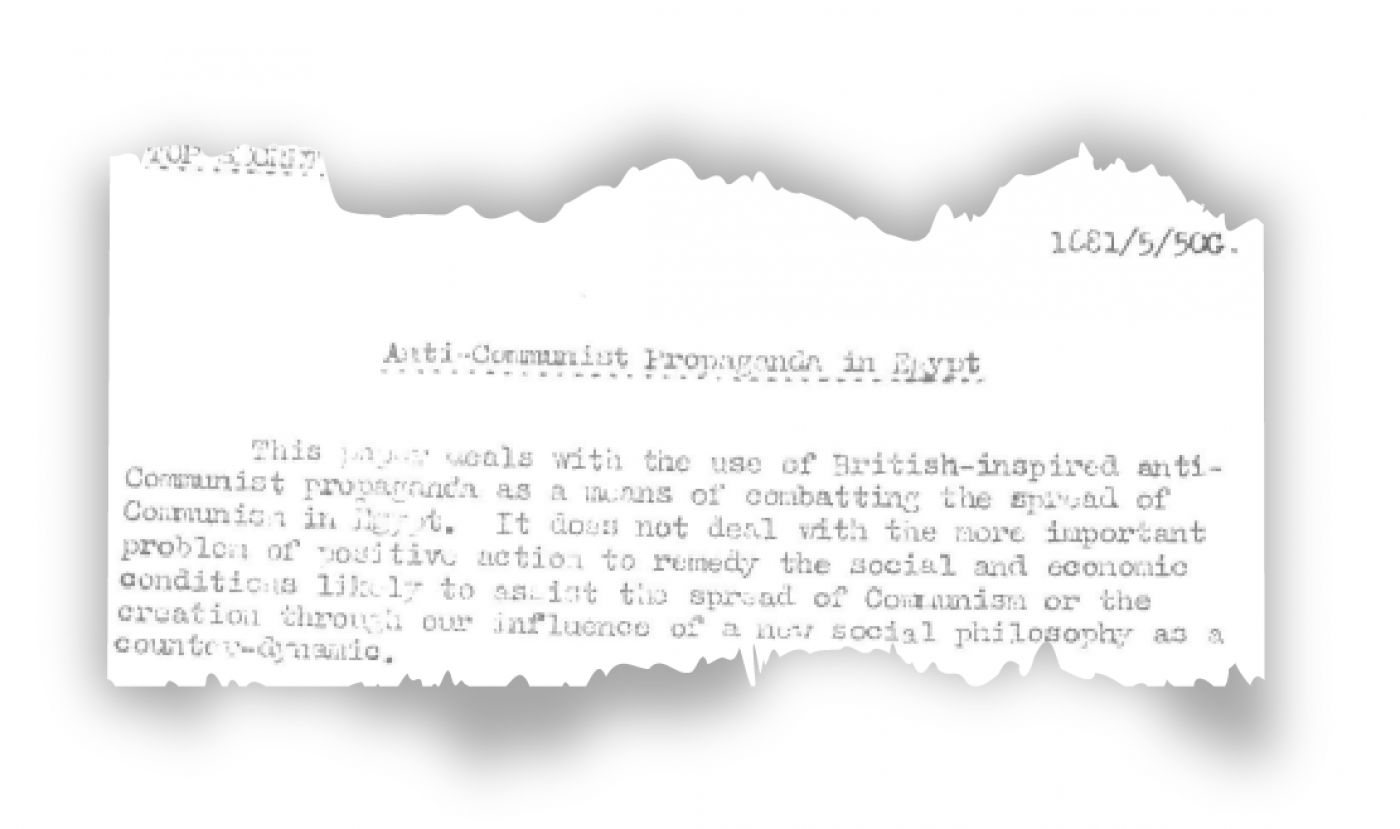
The IRD had been highly active in Egypt from the organisation’s inception. As an IRD paper written in Cairo in 1950 noted: “Conditions in Egypt are such as to make it eminently suitable breeding ground for Communism.”
The author went on to highlight “acute maldistribution between rich and poor” and the concentration of land in the hands of a small proportion of the population.
Nevertheless, he wrote: “This paper deals with the use of British-inspired propaganda. It does not deal with the more important problem of positive action to remedy the social and economic conditions likely to assist the spread of Communism.”
Instead, the author explained, the IRD was targeting the students at Al-Azhar University on the grounds that “from among them come the Imams who preach the Friday sermon in every Egyptian Mosque; the teachers of Arabic in the secondary schools and all teachers in the village schools; and the lawyers specializing in Moslem law”.
The organisation was also arranging for “the production in drafts in English of short love or detective novels, or thrillers, embodying anti-Communist propaganda but following their local counterparts as closely as possible in presentation etc.
“The Information Department, Cairo, would arrange for the drafts to be rewritten in Arabic by local hacks, and for them to be published locally.”
The unit would also “investigate the feasibility of producing short love or thriller magazine stories (of about 2,000 words) with an anti-Communist twist”.
The jewel in the IRD’s crown in Cairo was the Arab News Agency (ANA), one of several media organisations that British intelligence had set up during the Second World War.
Like other news agencies and radio stations that had been established in Beirut, Tripoli, Sharjah, Bahrain and Aden, ANA came under the control of the IRD after that organisation was founded in 1948.
To those on the outside, ANA appeared to be part of Hulton Press, a large company owned by Edward Hulton, a Fleet Street media baron. In fact, Hulton had allowed his company to give cover to the IRD and Britain’s overseas intelligence agency, MI6.
As well as distributing genuine news stories, gathered by Egyptian and British journalists, the agency disseminated propaganda produced by IRD, and became a base for MI6 officers masquerading as journalists.
In March 1956, with relations between the UK and Egypt deteriorating sharply, the UK Foreign Office instructed the IRD to switch its focus away from communism and towards the government led by Gamal Abdel Nasser – who had been engaged in propaganda operations against the British for some years.
The following July, after Nasser nationalised the Suez Canal Company – taking control of the waterway that the British considered to be the jugular vein of their empire – the UK’s propaganda and espionage efforts under the cover of ANA rapidly picked up pace.
Anthony Eden, the British prime minister, had long been convinced that Nasser was under the influence of the Kremlin – although the British ambassador in Cairo, Humphrey Trevelyan, disagreed – and MI6 began considering whether the Egyptian president could be assassinated.
Poison gas was one favoured option; an exploding electric razor was another.
Instead, as the Suez Crisis began to unfold, Eden vetoed the murder plot and the British decided to engage in several months of psychological warfare in Cairo, followed by military intervention.
A powerful new radio transmitter was erected in Iraq, broadcasting programmes from Arabic stations around the region that were covertly under British control, an operation that was for a while given the codename Transmission X.
As the British, French and Israelis plotted to invade Egypt and occupy the area around the canal, a steady stream of IRD and MI6 propaganda specialists began to appear at the ANA’s offices in Cairo.
This had not gone unnoticed by the Egyptian government, however, and in August, just weeks before the invasions, all of the agency’s operations – news reporting, spreading propaganda and gathering intelligence – were brought to an abrupt halt.
Egyptian secret police raided its offices and the homes of several of its staff. Eleven Egyptians were accused of being spies working for MI6 officers based at the agency; one, Sayed Amin Mahmoud, a teacher, was executed, and his son, a naval officer, was jailed for life.
Two MI6 agents who helped to manage the agency were subjected to lengthy interrogation and jailed. Others were tried in their absence, and two British diplomats and four journalists were expelled.
However, the British head of the agency – who was also a correspondent for the Economist and the London-based Times newspapers, escaped arrest: it appears that the Egyptian government may have been feeding him disinformation, and wished to continue.
In the event, IRD simply set up a new Arab News Agency, from offices in Beirut, with staff in London, Cairo, Amman and Damascus.
By 1960, according to one of the recently-declassified files, few people working at the agency’s Beirut headquarters were aware that it was controlled by the British government; IRD staff were warned “therefore to be cautious in their dealings” with them.
In March that year the senior IRD officer at the British embassy in Beirut wrote to London to say: “Of our secret information operations, I … attach the greatest importance to the Arab News Agency. There is no doubt they are doing the most useful work throughout the area and they run a good office here.”
Reuters and the BBC
The recently declassified documents also shed new light on the way in which in the 1960s the British government persuaded Reuters, the international news agency, to take over the operations run by two IRD fronts, Regional News Service (Middle East) and Regional News Service (Latin America). The relationship between Reuters and the IRD was first exposed in the 1980s.
The government funded these Reuters operations through the BBC. It began paying the BBC enhanced fees for its World Service operations, and the BBC in turn paid Reuters extra sums for receiving its news feed.
While the IRD accepted that it could not exercise editorial control over Reuters, the declassified papers show it did believe that it would gain “a measure of political influence”.
Some of the IRD’s Cold War activities in the Middle East and North Africa remain secret, however, with many of its old files remaining classified on national security grounds.
Not all of the papers on Reuters and the Arab News Agency have been transferred to the UK National Archive, for example. One dating from 1960, with the catalogue description “renegotiation of contract between Reuters and the Arab News Agency”, is among the IRD files that remain classified.
Another that has been withheld by the UK Foreign Office is known to contain papers from 1960 and is entitled “Information Research Department: Jordanian television”.
Other withheld files concern efforts to distribute IRD material through the Maghreb Arab Press news agency after it was set up in 1959, or have titles like “Information Research Department: Arab trade unions”.
Many of the titles of the classified IRD files are themselves classified: the UK National Archives catalogue simply lists them as “Title withheld”.
Reputational damage?
The United States was also an enthusiastic purveyor of propaganda in the Middle East throughout the Cold War. Material created and distributed by the US Information Service tended to promote the idea of common western and Islamic values rather than attack Communism.
The recently declassified files are all concerned with British campaigns, however.
With the IRD being shut down in 1977 – in part, because too many people had become aware of its existence and activities – two questions remain.
The first is: did their campaigns have an impact on people’s attitudes and behaviour?
Throughout the Cold War, many British diplomats in the Middle East were sceptical about the IRD’s efforts. Some argued repeatedly that communism had only limited appeal in the region, and that Arab nationalism posed a greater threat to the UK’s interests than Moscow.
‘In our experience, it is barely possible to interest the politically conscious Iraqi in the Communist system at all’
– British diplomat, Baghdad, 1955
Even in Iraq – which the IRD appears to have believed to be more susceptible to communist influence than Egypt – some of Britain’s envoys had their doubts.
One diplomat wrote from Baghdad to the IRD in 1955 to explain: “The Arabs have no means of checking the accuracy of our allegations about the iniquities of the Communist system … but they have the means, as they believe, of checking Russian propaganda about French and British wickedness in the Persian Gulf and North Africa.
“In our experience, it is barely possible to interest the politically conscious Iraqi in the Communist system at all.”
Looking back, a number of historians remain equally sceptical.
Vyvyan Kinross, author of Information Warriors, a forthcoming book about the battles for hearts and minds in the Middle East, believes that Eden’s attempts to demonise Nasser in 1956 left him looking hopelessly out of touch, and propelled Britain into disastrous military action.
The failed propaganda war contributed to “a general collapse of Britain’s reputation for honesty and fair dealing in the region”, Kinross says.
James Vaughan, lecturer in international history at Aberystwyth University in Wales, who has extensively studied western Cold War propaganda in the Middle East, concludes: “The history of British propaganda in Egypt demonstrates how the decline of British influence was a well-advanced phenomenon, several years before Nasser’s decision to nationalise the Suez Canal Company.”
The second question is: what happened after the IRD was closed in 1977?
An intriguing answer to this question was provided by Adnan Abu-Odeh, who served as information minister in the government of King Hussein of Jordan.
Abu-Odeh would have been on MI6’s radar at the time. He was Palestinian who had risen through the ranks of the Jordanian secret police and been handpicked for the job by the king.
At the time the kingdom was going through a major crisis, which became known as Black September, when the Jordanian Armed Forces attacked and expelled the PLO under the leadership of Yasser Arafat from the refugee camps in Jordan.
The crisis was resolved when Palestinian fighters known as the fedayeen were escorted to Syria.
In an interview with Middle East Eye in 2018, Abu-Odeh explained how he was sent to England in the early 1970s, to be trained by the IRD.
‘The king was preparing me to become minister of information, on the advice of MI6. The IRD taught me their tactics and methods’
– Adnan Abu-Odeh
While working as an intelligence officer, Abu-Odeh said, he was approached by the country’s newly-appointed director of intelligence. “He said to me: ‘His Majesty wants you to go on a course in London at the IRD.’
“I said to him: ‘What is the IRD? I didn’t know.”
Later, he was sent back to England to study psychological warfare at a military academy.
“The king was preparing me to become minister of information, on the advice of MI6. The IRD taught me their tactics and methods.
“When I became minister of information, I trained one or two people how to do it.”
Although there is no confirmation in the recently declassified IRD files, it seems entirely possible that before it was disbanded, the organisation trained other government officials across the region.
On Jan. 30, the World Health Organization declared the 2019 novel coronavirus (2019-nCoV) outbreak a public health emergency of international concern. But two days later, an even more surprising statement: Chinese Premier Li Keqiang asked the European Union to provide medical supplies to fight the epidemic unfolding in China.
This was highly unusual – top Chinese officials are not particularly known for their willingness to ask for international aid. But it points to the gravity and severity of the situation.
China is grappling with a severe public health challenge that is now outpacing the deadly SARS outbreak in 2003. As of today, more than 31,000 people in 28 countries and territories have been diagnosed with the new virus. The vast majority of those cases have emerged in China, where more than 600 people have died.
After 2019-nCoV was identified as originating in the city of Wuhan, the Chinese government took extraordinary measures to contain the outbreak. Wuhan and 13 surrounding cities have been locked down since Jan. 23 in a quarantine that affects more than 40 million people. It might be hard for Canadians to imagine this feat, but consider that Canada’s entire population is about 37 million.
However, the biggest challenge China faces is on the front lines. Doctors and nurses are racing against the clock and struggling to treat thousands of patients with dwindling supplies. Somehow, they are standing firm despite a shortage of hospital beds, staff, medicine and protective gear – even for themselves. Many doctors have worked throughout the day without drinking, eating or going to the bathroom simply to avoid replacing their protective suits. One doctor we know wore his son’s goggles to work for protection.
That the Chinese medical community is in mourning only heightens the anxiety. Dr. Li Wenliang, the Wuhan Central Hospital ophthalmologist who was among the first to identify the disease, passed away Friday.
Canada has confirmed five cases of its own – three in Ontario, two in British Columbia – but it has been acting vigorously and vigilantly, monitoring the situation, providing travel advice and evacuating Canadians in China. It’s remarkably brave of Ottawa to follow the WHO’s recommendation not to ban Chinese and other international travellers from China from entering the country. Furthermore, as acts of racism against the Chinese-Canadian community increase, Prime Minister Justin Trudeau has made statements criticizing anti-Chinese sentiments and misinformation about the coronavirus. “This,” he said, “is not something Canadians will ever stand for.”
These are admirable steps. But it is our belief that Canadians will only be truly safe when China wins its battle. And history may offer a good example of what Canada can still do to achieve this goal.
In the late 1930s, Canadian physician Norman Bethune brought modern medicine to rural China. He was credited with saving thousands of Chinese civilians and soldiers during the Second Sino-Japanese War, and for this he is revered even today in China. His story confirms the most effective way to save lives: supplying Canadian medical treatment to China.
Doing so will require three courses of action. First, we would urge Ottawa to continue demonstrating respectful concern and vigorous support as China combats this virus during this critical period. Secondly, we would recommend the Canadian government play a vital role in facilitating the procurement of medical supplies for hospitals in affected regions. Trade-promotion agencies can help by adding a medical-supplies section to their information portals to connect qualified Canadian suppliers with Chinese buyers. Thirdly, we would encourage Canadian health-care professionals and specialists to work with Chinese and international experts in developing treatments and a vaccine.
Ottawa and Beijing have had their differences. A prominent Chinese executive is facing extradition to the U.S., while two Canadian citizens remain in jail in China and a crippling import ban hurts Canadian canola farmers. But Canadians remain highly respected and liked in China – in no small part because of the legacy of people like Dr. Bethune.
There is a Chinese saying: “Friends show their love in times of trouble, not in happiness.” We hope we can focus on our shared humanity and give Chinese medical workers and citizens a hand during this extremely difficult time – for their sake, in the name of selflessness, in the spirit of Dr. Bethune.
Kenny Zhang is a Fudan University alumnus, Jenny Li is a graduate of Hubei University, ChiChi Wang is an alumnus of the University of British Columbia and Zhenyu Cheng is a Wuhan University alumnus. All are residents of Canada.
Just two years ago, Prime Minister Benjamin Netanyahu declared, “I don’t intend to bring a diplomatic plan on the eve of the elections.” He was responding to a reporter who challenged him on saying in 2008 that then-Prime Minister Ehud Olmert, “neck-deep in investigations, has no moral or public mandate to make fateful decisions for Israel” in a quest for political survival. A few days ago, on Jan. 28, Netanyahu did exactly what he said he would not do.
Several hours after “making history” by becoming the first sitting Israeli prime minister to be officially charged with bribery, fraud and breach of trust, Netanyahu took part in the unveiling ceremony of President Donald Trump’s “deal of the century” for Israeli-Palestinian peace, declaring it a “historic day like May 1948,” when Israel declared independence.
Peace is unlikely to emerge from Trump’s plan, but Netanyahu proved once again that all means justify his end of winning the March 2 elections and remaining in the prime minister’s official residence on Balfour Street in Jerusalem. To that end, he mobilized Trump’s help in presenting an alleged peace plan that consists of everything except peace and a Palestinian partner. The East Room ceremony resembled a wedding without the bride, celebrating a deal between Israel and the United States, rather than Israel and the Palestinians.
As expected, the Palestinian leadership rejected the plan. Channel 12 reported that on Jan. 29, Palestinian President Mahmoud Abbas sent Netanyahu a handwritten note informing him, “The Palestinian Authority now sees itself as free to disregard the agreements with Israel, including security cooperation.”
Anyone delving further into the details of the 80-plus-page proposal could not have missed the surprising clause allowing Israel to transfer to a future Palestinian state the populated Arab communities in the so-called Triangle of central Israel: Kufr Qara, Arara, Baka al-Garbiyeh, Umm al-Fahm, Kalansua, Taybeh, Kafr Qasem, Tira, Kafr Bara and Jaljulya.
This is not the first time an Israeli government during the Netanyahu era has tried to trade away its Arab citizens in the Triangle, which borders the West Bank, by moving the border and thereby turning them into nationals of a future Palestinian state. The idea previously arose in 2013 when US Secretary of State John Kerry mediated peace talks between the two sides, with the clear goal of finding a solution to the land swap issue. There also appears to have been a hidden agenda — reducing the number of Israel’s Arab citizens — an estimated 300,000 of who live in the Triangle communities.
“Just as with many earlier initiatives, this one too does not have any hold or acceptance among the Arab Israeli or Palestinian public,” Jamal Mjadlah, a social activist from Baka al-Garbiyeh, told Al-Monitor. “This is an initiative devoid of justice and logic, which will not be accepted and will not be adopted.”
Salah Smara, a high-tech engineer from Tira, asserted to Al-Monitor, “This is an attempt to enhance ideologies espousing population transfer using political tools to get rid of the Arab citizens rather than physically removing people from their homes. The motivations are racial — to preserve demographic superiority.”
The initiative could also have the absurd and tragic impact on many families by tearing them, as in the case of Firas Azam, an attorney born in Taybeh but now living in the coastal Mediterranean city of Haifa. If the land swap goes through, he would remain an Israeli citizen, but his mother and brother’s Israeli citizenship would be revoked.
“‘And we were like strangers in our land.’ This is my headline for this absurd move,” Azam told Al-Monitor. “Our state, where we grew up, went to school, worked, respected its laws and principles, does not want us anymore and is willing to give us up just like that. I would have expected the Jews to understand this better than any other people in the world, but I guess I was wrong.”
Trump and Netanyahu present the idea of exchanging populated lands as targeting communities that “largely self-identify as Palestinians,” according to the plan. A 2019 study by the Israel Democracy Institute found, however, that only 13% of Arab Israeli citizens define themselves as “Palestinians” in terms of their main identity, whereas 65% are “proud to be Israelis.” The study further indicates that 83% of Israeli Arab citizens want to integrate into Israeli society and become full members of it.
The above results do not conform to the premise of the Trump plan, proving yet again that it is nothing more than an attempt by Netanyahu and Israel’s political right to shrink the number of Israel’s Arab citizens, who constitute 21% of the state’s population. That, in turn, would reduce the number of Arab voters, who obviously do not tend to vote for right-wing parties, helping the right perpetuate its rule and prevent the formation of a center-left government.
Shimon Sheves, who served as director general of the Prime Minister’s Office under the late Yitzhak Rabin, shared his thoughts on Facebook about the actual difference between the so-called deal of the century and Rabin’s peace plan. Indeed, there are many similarities between the American blueprint and the one charted by Rabin, who was, as we know, assassinated because of the peace he sought to advance. At the time, it was Netanyahu who led numerous protests against Rabin and addressed rallies at which Rabin was dubbed a traitor and the crowd chanted, “With blood and fire, we will expel Rabin.” The difference is that Rabin did not agree to land swaps, as Ben Caspit explained in a Jan. 29 Al-Monitor article. Perhaps that is what the Netanyahu-led right really wants: to revoke the citizenship of hundreds of thousands of the state’s Arab citizens.
With an effective and well-targeted campaign by the Arab Joint List, currently the third largest Knesset faction, the initiative could backfire against Netanyahu. Such was the case with the so-called Camera Law, a Likud-led initiative to install cameras at Arab polling stations. The alleged idea was to guard against voter fraud, but in reality was devised to intimidate Arab voters. The move ultimately prompted a significantly high Arab turnout in protest in the September 2019 elections. If the current initiative gains ground, Netanyahu will once again be crowned the main campaigner of the Joint List.
President Donald Trump’s national security adviser warned Palestinians on Wednesday that Israeli settlements will continue to expand because rising anti-Semitism around the world means more Jews will immigrate to Israel.
Addressing many hot-button global issues in a speech and discussion with foreign diplomats to the United States, Robert O’Brien also said the president hoped to go to Beijing to talk to the Chinese about a three-way nuclear arms control pact with the U.S. and Russia. He said the president still hopes that North Korean leader Kim Jong Un will resume nuclear talks with the U.S.
O’Brien defended Trump’s Mideast peace plan, which was embraced by Israel but rejected by the Palestinians. O’Brien said the plan is not “perfect,” but urged the Palestinians to negotiate terms of the proposed deal. The deal offers economic benefits that would allow Palestine to become the “Singapore of the Middle East,” he said.
The Palestinians have roundly denounced the proposal, which offers them limited self-rule in scattered chunks of territory with a capital on the outskirts of Jerusalem while allowing Israel to annex large parts of the West Bank. Protesters have burned U.S. and Israeli flags as well as posters of Trump and Israeli Prime Minister Benjamin Netanyahu, who stood with Trump at the White House when he rolled out the plan last week.
“This could be the last opportunity for a two-state solution,” O’Brien said at the Meridian International Center. “The Israeli birth rate is strong and is growing because sadly anti-Semitism in Europe and other places around the world is encouraging more Jews to return to Israel. The settlements are going to continue to expand. If this freeze on settlements doesn’t hold. If this peace process doesn’t work, it may be physically impossible to have a two-state solution.”
It was unusual for a high-level administration official to tie anti-Semitism to the settlements. The Palestinians, as well as much of the international community, view the settlements in the West Bank and annexed east Jerusalem — territories seized by Israel in the 1967 war — as illegal and a major obstacle to peace. But O’Brien’s comments are in line with the Trump administration strongly favoring Israel in the longtime conflict.
O’Brien didn’t note that the Palestinian population is growing too in both the Palestinian territories and Israel, according to U.N. statistics. The Palestinian population is growing at roughly 2.4% a year, 33% higher than Israel’s.
Those demographic shifts have led previous peacemakers to warn that Israel risks losing its ability to remain both a Jewish state and a democracy without a two-state solution that gives the Palestinians enough inhabitable and arable land to accommodate their growing numbers.
Trump’s plan would foresee the eventual creation of a Palestinian state, but would allow Israel to annex all Jewish settlements in the West Bank, as well as the strategic Jordan Valley.
U.S. officials had discouraged Netanyahu from proceeding with plans to immediately annex any new territory and had played down the possibility that the release of the plan would make any such move imminent. But after the rollout, Netanyahu vowed to bring his West Bank annexation plans to a vote at his next Cabinet meeting just days away.
That surprised and frustrated the Americans. In a series of interviews, Trump’s point people on Israel jammed the brakes on annexation, putting greater emphasis on the prospects of Palestinian statehood that Netanyahu was trying to sidestep.
U.S. Ambassador to Israel David Friedman said a U.S.-Israeli committee would need to be formed to ensure that any move matches up with the Trump administration’s “conceptual map.” Jared Kushner, Trump’s son-in-law and a chief architect of the plan, said Israel should wait until after the March 2 Israeli elections before annexing territory.
Any quick move to annex land would galvanize Netanyahu’s hard-line base and shift the focus of his reelection campaign away from his legal woes. But annexation also would likely spark an international backlash, and neighboring Jordan, a key player in Middle East peace efforts, has warned against it. It could also foreclose the possibility of a negotiated two-state solution.
An eloquent, pointed and valid rant by Ian McEwan:
It’s done. A triumph of dogged negotiation by May then, briefly, Johnson, has fulfilled the most pointless, masochistic ambition ever dreamed of in the history of these islands. The rest of the world, presidents Putin and Trump excepted, have watched on in astonishment and dismay. A majority voted in December for parties which supported a second referendum. But those parties failed lamentably to make common cause. We must pack up our tents, perhaps to the sound of church bells, and hope to begin the 15-year trudge, back towards some semblance of where we were yesterday with our multiple trade deals, security, health and scientific co-operation and a thousand other useful arrangements.
The only certainty is that we’ll be asking ourselves questions for a very long time. Set aside for a moment Vote Leave’s lies, dodgy funding, Russian involvement or the toothless Electoral Commission. Consider instead the magic dust. How did a matter of such momentous constitutional, economic and cultural consequence come to be settled by a first-past-the-post vote and not by a super-majority? A parliamentary paper (see Briefing 07212) at the time of the 2015 Referendum Act hinted at the reason: because the referendum was merely advisory. It “enables the electorate to voice an opinion”. How did “advisory” morph into “binding”? By that blinding dust thrown in our eyes from right and left by populist hands.
We endured a numbing complicity between government and opposition. The door out of Europewas held open by Corbyn for Johnson to walk through. In this case, if you travelled far enough to the left, you met and embraced the right coming the other way.
What did we learn in our blindness? That those not flourishing within the status quo had no good reason to vote for it; that our prolonged parliamentary chaos derived from an ill-posed yes-no question to which there were a score of answers; that the long-evolved ecology of the EU has profoundly shaped the flora of our nation’s landscape and to rip these plants out will be brutal; that what was once called a hard Brexit became soft by contrast with the threatened no-deal that even now persists; that any mode of departure, by the government’s own estimate, will shrink the economy; that we have a gift for multiple and bitter division – young against old, cities against the country, graduates against early school-leavers, Scotland and Northern Ireland against England and Wales; that all past, present and future international trade deals or treaties are a compromise with sovereignty, as is our signature on the Paris accords, or our membership of Nato, and that therefore “Take Back Control” was the emptiest, most cynical promise of this sorry season.
We surprised ourselves. Only a few years ago, asked to list the nation’s ills – wealth gap, ailing NHS, north-south imbalance, crime, terrorism, austerity, housing crisis etc – most of us would not have thought to include our membership of the EU. How happy we were in 2012, in the afterglow of our successful Olympics. We weren’t thinking then of Brussels. It was, in Guy Verhofstadt’s famous term, a “cat-fight” within the Tory party that got us going. Those cats had been fighting each other for decades. When they dragged us in and urged us to take sides, we had a collective nervous breakdown; then sufficient numbers wanted the distress to go away and “get Brexit done”. Repeated ad nauseam by the prime minister it almost seemed impolite to ask why.
In the early days of the referendum campaign we learned that “on the doorstep” it was all about migration; but we also learned that it was the UK’s decision, not the EU’s, to allow unlimited migration from the accession countries before the permitted seven years were up; it was the UK’s choice to allow EU migrants to stay more than six months without a job; it was the UK that successfully campaigned to enlarge the EU eastwards; it is the UK, not the EU, that lets non-EU migration continue (and why not?) as EU migration declines. We also learned that the UK, not the EU, opted for our maroon rather than patriotic blue passports. Though, as I look, my old passports seem almost black.
There is much that is historically unjust about the British state, but very little of that injustice derives from the EU. Brussels didn’t insist that we neglect the post-industrial towns of the Midlands and the north; or demand that we let wages stagnate, or permit multimillion handouts to the CEOs of failing companies, or prefer shareholder value over the social good, or run our health service, social care and Sure Start into the ground, close 600 police stations and let the fabric of our state schools decay.
It was the task of the Brexit campaign to persuade the electorate otherwise. In the referendum they succeeded with 37%, enough to transform our collective fate for a generation at least. To cause sufficient numbers to believe that the source of all their grievances is some hostile outside element is the oldest trick in the populist handbook. As Trotsky was for Stalin, as the USA is for the mullahs of Iran and Gülen is for Erdoğan, so Brussels has served its turn.
Hedge fund owners, plutocrat donors to the cause, Etonians and newspaper proprietors cast themselves as enemies of the elite. More magic dust. The claim that the Northern Ireland issue has been settled is a dangerous pretence. We have witnessed reasoned argument’s fall from grace. The Brexit impulse had strong elements of blood-and-soil, with hints of Empire nostalgia. Such spooky longings floated high above mere facts.
We acquired an argot. “Article 50”, “frictionless trade”, “just in time”, “the backstop” – how they tripped off the tongue. We learned to respect an “invisible border”. Before it all began, only a very few knew the difference between the customs union and the single market. Three years on, not much has changed. A survey last year showed that quite a lot of us thought that “crashing out” was the same as remaining. If only.
The Brexit leadership and the leader of the opposition were always in a hurry to start article 50’s two-year stopwatch. They feared that leave voters might change their minds, that those who didn’t vote last time were 2:1 for remaining, and that young voters coming on to the rolls would be mostly pro-EU. The Brexiter generals reasonably feared a second referendum.
At least, we can all agree that we will be a bit poorer. As one of my school teachers used to say, if a thing is really worth doing, it’s worth doing badly. Theresa May could never bring herself to say that Brexit would make us better off. She wouldn’t even tell us if she would vote to leave in a second referendum. We should credit her honesty. By contrast, Boris Johnson, laying his post-Brexit vision before parliament, promised he would narrow the UK’s wealth and opportunity gap between north and south, and make it the home of cutting-edge battery technology. He forgot to mention that the EU never stood in the way of either project.
Redefining our new trade relations with the EU will preoccupy us for years. As for the US position, take a long walk in the American midwest and you’ll go a month across a monoculture desert and not see a wildflower. To compete, our own agriculture would have to welcome the hormone hypodermic. Our farmers will need to divest of inefficient hedgerows, boundary trees and three-metre field margins – museum pieces all. When it was in trade talks with the EU, the US wouldn’t contemplate higher standards of husbandry, food standards and environmental protection, even though they would have granted access to half a billion consumers. American farming corporations will not be changing their ways for a nation of a mere 65 million. If we want a deal, it is we who must downgrade.
We sense damage and diminishment ahead. In a dangerous world crowded with loud-mouthed “strongmen”, the EU was our best hope for an open, tolerant, free and peaceful community of nations. Those hopes are already threatened as populist movements have swept across Europe. Our withdrawal will weaken resistance to the xenophobic tendency. The lesson of our nation’s history these past centuries is plain: turmoil in continental Europe will draw us into bloody conflicts. Nationalism is rarely a project for peace. Nor does it care to counter climate change. It prefers to let tropical forests and the Australian bush burn.
Take a road trip from Greece to Sweden, from Portugal to Hungary. Leave your passport behind. What a rich, teeming bundle of civilisations – in food, manners, architecture, language, and each nation state profoundly and proudly different from its neighbours. No evidence of being under the boot-heel of Brussels. Nothing here of continental USA’s dreary commercial sameness. Summon everything you’ve learned of the ruinous, desperate state of Europe in 1945, then contemplate a stupendous economic, political and cultural achievement: peace, open borders, relative prosperity, and the encouragement of individual rights, tolerance and freedom of expression. Until Friday this was where our grown-up children went at will to live and work.
That’s over, and for now the force is with English nationalism. Its champion is Johnson’s Vote Leave cabinet whose monument will forever be a special kind of smirk, perfected back in the days of the old Soviet Union. I’m lying, you know I’m lying and I know that you know and I don’t give a damn. As in, “The five-week prorogation of parliament has nothing to do with Brexit.” Michael Gove and Jacob Rees-Mogg were masters of the mocking grin. The supreme court’s inconvenient judgment that this prorogation was illegal clearly still rankles. Recently, the ex-home secretary Michael Howard was set on to murmur against the judges. Extending political control over an independent judiciary would be consonant with the Johnson-Cummings project. Victor Orbán of Hungary lights the way.
The remainers held out for a kinder sort of world, but we were always the herbivores in this debate, with our enormous, good-natured and derided marches – “a hate-filled crowd”, the Sun; “an elite”, the Daily Telegraph. If 16 million remainers are an elite, then we may rejoice that the UK is a model of meritocracy.
We were, in truth, the left-behinds. By the grace of Corbyn and his grim lieutenants, we had no effective voice in parliament. On her first day as prime minister, Theresa May promised outside No 10 that she would govern for us all. Instead, she threw half the country to the dogs to appease her party’s right wing. Initially, Boris Johnson’s elevation was decided by a tiny, ageing constituency, the majority of whose members told pollsters that they wished Donald Trump ruled Britain and that they longed for the return of hanging. In similar spirit, Johnson found fresh depths of populist vulgarity when he spoke last June of pitchforking the EU incubus off the nation’s back. He has realised his dream.
As for the outer extremes, the occasional milkshake aside, we never violently assaulted a Brexiter in the street; we only rarely inclined to sending anonymous death and rape threats such as came so abundantly the way of Gina Miller, Anna Soubry and many female MPs. However, the antisemitic emails from within the Labour party were a disgrace. So too was the bullying mob jeering outside the Rees-Mogg home. But we remainers did not slyly exhort our compatriots to riot in the event of a second referendum going against us. Nearly two-thirds of the electorate did not vote to leave; most of business and the trade unions, agriculture, science, finance and the arts were against the Brexit project; three-quarters of MPs voted to remain. But our representatives ignored the evident public interest and shrank behind party cabals and “the people have spoken” – that bleak Soviet locution – followed by “get Brexit done”, the mind-clouding magic dust which has blinded reason and diminished our children’s prospects.
Pertinent advice by our former head of mission to Iran and Saudi Arabia (his cross posting was from Iran to Saudi Arabia, mine at a much more junior level was the reverse, from Saudi Arabia to Iran in the mid-to-late 1980s).
I always felt that one of the most significant aspect of having diplomatic relations and embassies was the ability to provide consular services, both for Iranians in Canadians and Canadians in Iran.
The shooting down of the Ukraine International provides a dramatic illustration of this need:
The plane crash in Iran on Wednesday that killed 176 people, including at least 63 Canadians, was an unimaginable human tragedy. Families and futures were lost in the blink of an eye. The pain will last generations.
For diplomats, dealing with the deaths of Canadians abroad is one of the most difficult challenges. It is also one of the most important. Families are going through the worst time of their lives. It is the role of diplomats to step in and try to facilitate the process of returning their loved ones to Canada, while dealing with the often mind-numbing and incomprehensible bureaucratic realities that inevitably come with it.
Dealing with these events is even more challenging when Canada has no diplomatic presence on the ground or even diplomatic relations with the country where the tragedy occurred. That is the case with Iran.
Canada’s relations with Iran had been fraught from the earliest days of the Islamic Revolution in 1979, given Canada’s role in facilitating the escape of six U.S. diplomats during the hostage crisis. It was an episode that hung over the bilateral relationship for decades – with more than one Iranian official berating me during my time in Iran for helping those “American spies.”
There were a range of additional policy issues and differences that had fractured the relationship in the intervening years. The final break came with the passage of the Justice for Victims of Terrorism Act (JVTA) in March, 2012, and the listing of Iran as a state sponsor of terrorism in September, 2012. The legislation allowed for the seizure and sale of Iranian government properties in Canada.
The JVTA made the security situation for the Canadian embassy in Iran untenable; a point that was driven home only months before when the British embassy was violently attacked by an Iranian mob. We were now about to start seizing Iranian properties in Canada. The embassy was closed the day the legislation naming Iran came into effect.
It wasn’t an easy decision, but it was a necessary one. We knew that Canada’s ability to provide consular services would suffer. Italy stepped up as our protecting power in-country and management of consular services was transferred to the Canadian embassy in Ankara. In normal circumstances, it was a manageable, if inadequate and inconvenient, arrangement.
The system, however, was not designed to handle a crisis situation like the one that occurred on Wednesday. Those kinds of situations cannot be managed remotely.
The Islamic Republic is never an easy partner to deal with, even, sadly, in tragic situations. Foreign Affairs Minister François-Philippe Champagne’s call to his Iranian counterpart, Javid Zarif, was a good start. It’s to be hoped it will pave the way for Iranian co-operation in helping Canada try and ease the suffering of families by letting our officials go to Iran to do what they need to do. That’s the least that can be expected and they deserve the full co-operation of Iranian authorities on the ground. But given the state of our relations (or, more to the point, lack thereof) that cannot be assumed. I do hope, though, that Iran does not use its refusal to recognize dual nationality to argue that Canada has no direct interest in this incident. Sadly, that cannot be ruled out.
There are reports that the Iranian Civil Aviation Authorities have invited Canada’s Transportation Safety Board to join the international team being assembled to investigate the crash and according to Prime Minister Justin Trudeau, consular officials are heading to Iran. In light of Canadian intelligence information that the plane seems to have been shot down by the Iranian military, we can’t be certain Iran will allow Canadian access. The fact that Iran was on the other end of similar event in 1988, when an Iranian commercial aircraft was brought down over the Persian Gulf by an American naval vessel, should enhance willingness to co-operate, but how open they actually will be remains to be seen.
It would be a welcome outcome if this incident provided new impetus to the effort to resume diplomatic ties and a return to Tehran in due course, taking into account the broader geopolitical context. There is no substitute for being on the ground. Canada has been blind to what has been happening in Iran – especially important these past several days – and we have our hands tied in dealing with this tragedy.
But that will require dealing with the JVTA and that will be tough politically. The federal government will be accused of going soft on Iran and denying that Iran is a state sponsor of terrorism. Removing the JVTA says nothing of the sort. The JVTA was a mistake that is hurting Canadian interests and, more importantly, undercutting the government’s duty to serve Canadians. It should go.
Canadians are more exposed to “influence” operations than ever before according to an internal assessment from the country’s electronic spy agency.
A 2018 memo from the Communications Security Establishment (CSE) warned the rise of “web technology” like social media, along with Canadians’ changing habits for consuming media, make the population much more likely to encounter efforts by foreign powers to shape domestic political opinion.
“These new systems have generated unintended threats to the democratic process, as they deprive the public of accurate information, informed political commentary and the means to identify and ignore fraudulent information,” reads the memo, classified as Canadian Eyes Only.
“Foreign states have harnessed the new online influence systems to undertake influence activities against Western democratic processes, and they use cyber capabilities to enhance their influence activities through, for example, cyber espionage.”
“Foreign states steal and release information, modify or make information more compelling and distracting, create fraudulent or distorted ‘news,’ or amplify fringe and sometimes noxious opinions.”
The memo was prepared as Canada’s intelligence agencies were engaged in an exercise to protect the 2019 federal election from foreign interference.
Elections across the democratic world — the United States, France, the United Kingdom, Germany and the European Union — have in recent years been the targets of misinformation and cyberespionage campaigns from hostile countries.
There is no evidence that Canada’s recent federal election was the target of sophisticated cyber espionage or misinformation campaigns.
But another document prepared by CSE makes clear that Canadian politicians have already been targeted by foreign “influence” campaigns.
An undated slide deck prepared by the CSE suggested “sources linked to Russia popularized (then Global Affairs Minister Chrystia) Freeland’s family history” and targeted Defence Minister Harjit Sajjan’s appearance and turban in Russian-language media outlets in the Balkans.
The agency appears to be referring to stories, which were reported by mainstream Canadian news outlets, suggesting Freeland’s grandfather edited a Nazi-associated newspaper in occupied Poland.
The stories were “very likely intended to cause personal reputational damage in order to discredit the Government (of) Canada’s ongoing diplomatic and military support for Ukraine, to delegitimize Canada’s decision to enact the Justice for Victims of Corrupt Foreign Offices Act, and the 2018 expulsion of several Russian diplomats,” the documents, first reported by Global News, state.
The attacks against Sajjan, meanwhile, were “almost certainly” intended to discredit the NATO presence in Latvia, where Canadian forces are deployed as part of a NATO mission to deter Russian expansion after the invasion of Crimea.
“Since Canada’s deployment to Latvia, subtle and overtly racist comments pertaining to … Sajjan’s appearance, particularly his turban, have consistently appeared across Russian-language media in the Baltic region,” the documents read.
“Even ostensibly professional news sources are not above such descriptions. When … Sajjan attended a conference in Latvia in October 2017, he was described by Vesti.lv as ‘a large swarthy man in a big black turban.’”
Compared to some of the attacks on Western democracies, those two influence campaigns were minor in scale and impact. But the intelligence agency suggested that more and more countries are turning to cyber capabilities to further their own goals at the expense of other nations. And CSE’s analysis suggests their willing to play the long game.
“In the longer-term, influence activities, both cyber and human, are likely to challenge the transparency and independence of the decision-making process, reduce public trust (and) confidence in institutions, and push policy in directions inimical to Canadian interests,” the documents, released under access to information law, read.
“Many European states and some private companies have begun to develop countermeasures to malicious activities aimed at democratic processes, including increasing public understanding and resilience. However, little has been done to create robust, institutionalized multilateral responses.”
Parliament’s new national security review committee has completed a review of foreign espionage activities in Canada and submitted it to Prime Minister Justin Trudeau. The classified report detailing their findings is expected to be released early in 2020, once the House of Commons resumes sitting.
The has been a continuing refrain over the last 20 to 30 years that Canada needs a “muscular” foreign service and an infusion of funding to strengthen the foreign service. Yet no government, Liberal or Conservative, has done so given domestic priorities (including trade).
So while it is valid to make these arguments, it would be far better to be more focussed on specific areas where the current foreign service should focus on than pining for something that no government is likely to consider.
And of course, a major factor behind the success and public support for our immigration system is precisely due to it focussed on economic class immigrants, where self-interest comes most into play:
Every October, Canada invades Istanbul in a way that might seem downright crass to Canadian sensibilities. The city’s historic Beyoglu district, one of its richest and most liberal, home to hundreds of bars, restaurants, galleries, clubs and, at one time, the Canadian consulate, transforms into a red and white extravaganza, its cobblestoned alleyways adorned with posters announcing the yearly Canada Edu Days fair.
Now, if the fair feted Canada’s contributions to the world—multiculturalism, cooperation, tolerance—there would be no need for this column. Canada would be, finally, touting all those things that are increasingly, in a world infected by authoritarianism and self-interest, disappearing.
Instead, the fair does what Canada seems to do best in the world: poaching talent. As the name implies, Canada Edu Days is about studying in Canada. Every year, it pairs up Canadian colleges with thousands of young dreamers eyeing a way out of Turkey’s deteriorating economy and its socio-political morass.
That’s great; Canada needs talent, and Turkey’s remarkably talented youth are in desperate need of opportunities. But in and of itself, it’s also a feature of Canada’s failure to act responsibly at a historically critical moment: Rather than bringing what makes Canada great to the world when the world needs leadership, it is capitalizing on the chaos, siphoning off valuable human resources like a war profiteer.
This is the dark side of Canada’s pollyannaish self-image. We are great in large part because we have an immigration system that prioritizes talent over desperation. We can retreat at times of global uncertainty because we have valuable resources and a relatively small population.
But retreat should not be an option in a world where men like Donald Trump, Xi Jinping and Jair Bolsonaro are ascendant. Nor should waiting and hoping that these agents of self-interest will magically disappear and the world will go back to normal. Experts warn that is simply not going to happen. Canada should not be trying to save the world order as it was but helping to shape the world order as it will bewhen the dust finally does settle.
The Liberal government, like past governments, appears unwilling to take on that task. If the Throne Speech was any indication, Canada’s role in the world will figure even less prominently than it has in the recent past. All the pretty words reinforced what has become the defining feature of the Liberal government on the world stage: It talks in the modernist voice about grand narratives—global peace and harmony, equality and justice—but fails to appreciate the postmodern reality of fragmentation and discord.
What we need is boldness. Canada’s foreign service is in shambles; it needs urgent reform and an infusion of funding. The Liberals may not have created the problem, but they have failed to address it and that failure has had consequences. As Jennifer Welsh, the Canada 150 research chair in Global Governance and Security and director of the Centre for International Peace and Security Studies at McGill University, told me in July, the Liberal government’s foreign policy has been “ineffective” in many cases because it lacks the “deep relationships” needed in a world where traditional alliances are unravelling.
“An operating principle of our foreign policy should be that we have to form relationships around particular issues with countries where we believe we have enough common ground to advance things together,” she said. “In the current environment, that is going to require not necessarily the usual suspects.”
Without a muscular foreign service, there is no developing those relationships. Foreign policy becomes what Daniel Livermore, senior fellow at the University of Ottawa’s Graduate School of Public and International Affairs, calls “government by PMO directive”.
“That was very much the case under Harper,” he says. ” The PMO decides something and then says to Global Affairs here’s what we’re going to do. There has been a lot more pushback from Global Affairs under Trudeau but it hasn’t been nearly strong enough.”
The problem, Livermore adds, is fundamental to the department. It lacks the “bench strength” to “offer an entirely different vision of how to do foreign policy.”
For a country like Canada, a middle power with limited heft in the world, knowledge is essential. Middle powers have to carefully pick and choose their moments and identify issues where they feel they can have a measurable impact. But instead of taking up the challenge, the Liberals have retreated into a defensive posture.
Canada should prioritize more engagement with the world at every level, from leadership to the grassroots. Here in Istanbul, it seemed a few years ago that something was about change after the Canadian consulate was shifted to a shiny new office tower in the Levent business district. It was an improvement from the dingy apartment Canada used occupy in Beyoglu, where one woman and her cat would greet visitors with listless stares. It felt as if the new consulate would be more active, more dynamic, more forward leaning.
But the early signs were there of a different kind of shift. Heavy security greeted visitors to the office tower. The C-suite feel also portended the growing Canadian dependence on trade-based diplomacy. Canada would engage with CEOs and business leaders from its perch high above Istanbul’s frenetic streets but at the expense of understanding the mood of the people.
Wouldn’t it be great if instead of a student recruitment fair, Istanbul was painted red red and white with posters announcing the opening of a Canadian cultural centre? Or a multiculturalism festival? Or an art exhibition? Wouldn’t it be great if Canada’s engagement with the world included talking to young people on the streets, the same young people who are now protesting in Hong Kong, Chile and Iraq?
That kind of engagement would mean beefing up our foreign service with people who can speak local languages, who are comfortable leaving the confines of our cozy diplomatic missions and getting their hands dirty. It would mean being bold.
Speaks for itself – petition and involvement more to raise funds than substance – see highlighted text:
Two Canadians arrested by Chinese authorities on trumped-up charges have been in prison for exactly one year on December 10th.
Enough is enough.
We’re tired of the Chinese communist regime bullying Canada.
To anyone paying attention to China, both its grotesque human rights record and its increasingly belligerent foreign affairs, it’s clear that China is no friend to Canada.
It’s time the Trudeau government stand up to China and demand the release of Michael Kovrig and Michael Spavor.
One can only imagine what conditions they’re being detained in.
Always somewhat amusing when a former senior minister (John Baird, shilling for Saudi Arabia) or former senior aide, in Alykhan’s case, works for a Chinese company despite having been part of a government with legitimate concerns over Chinese influence.
And good on the reporter for challenging him for his firm not making representation to free the two Michaels:
One of Huawei’s Canadian bosses says he is concerned about the “politicization” of its CFO’s case south of the border, but dodged questions on why the firm won’t speak out more strongly for the two Canadians arbitrarily detained in China.
In an interview with The West Block‘s Mercedes Stephenson, the executive and former director of issues management for Stephen Harper’s government insisted Huawei Canada respects Canadian laws but did not answer when asked whether the branch would call for the release of Michael Kovrig and Michael Spavor.
“Well, you know, we’re concerned. We’ve said that we want the two governments to work together to find a resolution that can bring them home as soon as possible,” said Alykhan Velshi, vice president of corporate affairs of the Canadian branch of the Chinese company.
“With respect to Meng Wanzhou, obviously she has access to Canadian court, she has lawyers here and we remain confident that she will be found innocent because she is innocent and we remain alarmed by the politicization of her trial down in the United States.”
He would not clearly explain why the domestic branch of the company isn’t saying the same for fellow citizens Michael Kovrig and Michael Spavor, detained by the Chinese government in apparent retaliation for Canada’s observance of its extradition treaty with the U.S.
Under that extradition treaty, Canada honours roughly nine in every 10 requests from the U.S. and it is the courts that decide on the merits of a case for extradition, with the ultimate decision lying at the very end of the process with the Minister for Immigration only in the event extradition is approved.
“If you’re alarmed by that politicization, are you not alarmed that these Canadian citizens are being held on what the Canadian government says are completely specious charges?” Stephenson asked Velshi.
“As I’ve said, we’re concerned. I think all Canadians are concerned by what’s happening over there by their treatment and we want this resolved as soon as possible,” he responded.
“But the solution can only be found by governments working together — by our government here in Ottawa, by the government in China, diplomats working together so we can bring them home as soon as possible. That’s our hope and I think that’s the hope of all Canadians.”
Kovrig, a diplomat on leave from Global Affairs Canada, and Spavor, an entrepreneur, were detained by Chinese authorities last December.
The action came just days after Canadian authorities arrested Meng on a provisional warrant from the United States. Shortly afterwards, the U.S. charged her and her company with allegedly skirting sanctions on Iran and stealing corporate secrets.
Kovrig and Spavor were held without charge until May 2019, when China formally arrested them on accusations of spying.
They have been kept in conditions described as “harsh,” with no access to lawyers and with the lights on 24 hours a day.
They have received only limited consular visits.
Meng, meanwhile, is out on bail and living in one of her Vancouver homes.
She is currently fighting extradition to the U.S., a process that could take years.
Huawei is seeking to bid on the upcoming 5G spectrum auction but faces allegations from intelligence agencies and experts around the world that it poses a national security risk because of a Chinese law that requires Chinese companies to spy for the state if requested.
Canada is currently in the midst of a review on whether to allow Huawei to bid in that auction.
Officials here are under pressure though from the Americans, who have deemed Huawei an unacceptable security risk and implemented a ban on U.S. companies using its technology. However, they have also issued repeated exemptions to that ban, most recently last month.
I wake up every day thinking about the predicament of Michael Kovrig, a great colleague with whom I enjoyed working at the Canadian Embassy in Beijing, and hope that a miracle will happen and free him and Michael Spavor. On this sad anniversary of their first year in detention, the strategy followed by Ottawa has had limited results: Not only have they not been released on bail, but they have not even seen a lawyer!
Since China has warned us that things won’t get back to normal until we return Meng Wanzhou to China, there is no end in sight. Our farmers have lost billions of dollars in sales of canola (exports are down 50 per cent this year), soya, peas and meat. Since the United States created this problem by asking us to arrest Meng, they need to do more to help us resolve the crisis. But knowing Donald Trump’s opinion of our prime minister, can we rely on the U.S.? The message should be that we will be less forthcoming the next time around when the U.S. asks a service from us.
Is it possible to have normal relations with China? As Nicholas Kristof wrote in the New York Times on Nov. 30, it has become more difficult to remain ambivalent after the revelations about China’s campaign in the province of Xinjiang that borders on cultural genocide and its non-respect of the one-country-two-systems agreement on Hong Kong. Assuming that our compatriots would be released next year, I don’t think it is possible to restart the relationship where it was prior to the crisis. Still, we need to look at where we want to be in five or 10 years from now, as China is key to addressing common global problems such as climate change, nuclear proliferation and global pandemics.
The ongoing crisis with China shows the challenges of dealing with a superpower that ignores international rules when they are not to its liking. While Canada is not the first country to be on the receiving end of China’s displeasure and bullying tactics, this is the first time that a targeted country has rallied support from allies. I believe this has taken China by surprise as the reaction affects its image abroad. Our message should be that we are reassessing the relationship and that all official exchanges will be suspended until they release Kovrig and Spavor. After that, we will want to re-engage, but on the basis of reciprocity and mutual respect.
We should start immediately to reassess our engagement strategy with China, recognizing upfront that it has turned into a much more authoritarian state and a strategic competitor since Xi Jinping became secretary-general of the Chinese Communist Party in November 2012. Of course, our capacity to influence China is very limited — our goal is simply to ensure that basic human rights are better protected and that China stops behaving like a spoiled child.
Let’s not abdicate our values. We should react quickly and firmly when we find instances of interference in Canadian affairs, including among Canadians of Chinese origin, espionage activities, or attempts to limit debate on Canadian campuses. The government should look at Australia’s experience and the measures it has taken to deal with Chinese interference. I would also suggest that we undertake a review of ongoing collaboration in the field of high-tech, including artificial intelligence, to ensure that our expertise is not used in China for domestic controls or to limit freedom of expression.
We also have to cultivate expertise on China in all areas of the public service to ensure a well-informed and more sophisticated China policy. This requires supporting universities and think-tanks that study China, but also maintaining contacts in the People’s Republic of China to better understand its objectives and policies, with a focus on the communist party, which has taken over many tasks of the government. We also need programs to entice more young people to learn Mandarin.
As economic opportunities are still available for Canadian companies, the federal and provincial governments and agencies should continue to support Canadian companies in China. There is a need to better integrate information and provide more clarity to companies about assistance available from governments at various steps. In parallel, we also need to diversify our trade by putting more emphasis on other Asian countries to take full advantage of the Comprehensive and Progressive Agreement for Trans-Pacific Partnership and other free trade agreements we have in the region.
Clearly, Canada is not in a position by itself to criticize China much on its trade practices or human rights. Therefore, as Western countries all face similar challenges in dealing with China, the strategy going forward should be to work together on ensuring that the multilateral system is protected with the same rules for all. The message to China should be that we welcome it to play a larger role in international affairs and to join the Trans-Pacific Partnership, as long as it stops bullying countries and becomes a better global citizen.
China has been good at ragging the puck for too long: It’s time to apply reciprocity — i.e. we should allow Chinese companies to invest in Canada when a Canadian company is able to do the same in China.
One day, Michael Kovrig and Michael Spavor will be free. Let’s hope that they can resume their lives as soon as possible.