Will be interesting to see the results in a few years’ time:
Saudi Arabia’s King Salman ordered a royal decree on Thursday granting citizenship to foreigners in fields such as medicine and technology in a bid to diversify the kingdom’s economy.
The changes are part of Crown Prince Mohammed bin Salman’s economic and social reform plans to diversify the economy and steer it away from its reliance on oil.
It aims to attract “scientists, intellectuals and innovators from around the world, to enable the kingdom to become a diverse hub… that the Arab world would be proud of,” Saudi Project, a government platform, said on Twitter.
Experts in the fields of forensic and medical science, technology, agriculture, nuclear and renewable energy, oil and gas and artificial intelligence will be considered.
Individuals in the fields of arts, sports and culture are also included in the order to “contribute and support the enhancement of Saudi competencies and knowledge that will benefit the general public.”
The current Saudi citizenship law allows the naturalisation of foreign citizens who have held permanent residency in the kingdom for at least five years.
But the requirement of a Saudi sponsor has restricted foreigners living in the country from gaining permenant residencies.
Last month, the kingdom issued its first batch of “premium” residence visas for investors, doctors, engineers or financiers who wish to live in the kingdom.
The programme offers foreign nationals and their families long-term visas and privileges that were previously not available to non-Saudis.
The kingdom also announced the launch of its new tourist visas in September that will grant individuals multiple entries to the country.
It’s expected the announcement will create one million new jobs for the country by 2030.
Interesting study from Switzerland that likely reflects in part the particularities of the Swiss immigrant population and the citizenship acquisition process. Makes the case for more facilitative approaches to granting citizenship:
The moment when an immigrant becomes a citizen of his adopted country looks remarkably similar in ceremonies around the world: a hand raised, an oath taken, a flag waved, and a celebration with family and friends. But the road leading to that moment differs widely by country. Some are long and steep and others more walkable, depending on the country’s policies.
Behind this divergence is a kind of chicken-and-egg problem. Is citizenship a prize, something to be won only after considerable striving? Then it should be surrounded by hurdles, like requirements that you’ve mastered the language, lived in the country a long time, and achieved a certain level of economic success. Or is citizenship an invitation to build a future in the country, something that helps immigrants succeed? Then it should be easier to get.
Which side has the better of the argument? A new study from the Immigration Policy Lab at ETH Zurich and Stanford University (IPL) sheds light on the importance of citizenship in immigrants’ trajectories. Looking at more than thirty years of data on thousands of immigrants in Switzerland, IPL researchers found that those who had naturalized earned more money each year than those who hadn’t—and the boost in income was largest for people facing the greatest disadvantages in the labor market.
A Puzzle for Researchers
Considering the benefits usually reserved for citizens, it’s easy to imagine how naturalizing early on could equip immigrants to prosper: access to advantageous jobs, eligibility for scholarships to get education and training, and the assurance that they can stay in the country indefinitely and invest in the future.
But it’s hard to prove that citizenship actually delivers on this promise, because those who get citizenship and those who don’t aren’t similar enough to allow for meaningful comparison. People who jump the hurdles to apply for citizenship differ in many ways from those who hold back, and successful applicants differ from unsuccessful ones. If naturalized immigrants do better in the long run, this could be due to any number of factors—factors that, like work ethic or resources, also account for their ability to successfully navigate the citizenship application process.
“To accurately assess the benefits of citizenship it is essential to compare naturalized and non-naturalized immigrants that are similar in all characteristics but for their passport”, said Dalston Ward, a postdoctoral researcher at ETH Zurich.
This is where Switzerland is a boon to social scientists. Between 1970 and 2003, some Swiss towns put citizenship applications to a popular vote. To become a Swiss citizen, an immigrant would have to receive more “yes” than “no” votes. For applicants who won or lost by only a handful of votes, the decision may as well have been pure chance, enabling an apples-to apples comparison. Combine that with decades of records from the Swiss pension system showing annual earnings, and you have a trustworthy way to determine whether or not citizenship actually improves immigrants’ fortunes.
Long-Term Benefits
After identifying those who narrowly won or lost their bid for citizenship, the researchers looked back at the five years leading up to the vote that would divide them. There, they had similar incomes. But after the vote, the new citizens went on to earn more money than those who remained in permanent residency status, and the earnings gap increased as time went on. At first, they earned an average of about 3,000 Swiss francs more (roughly the same in U.S. dollars), and that increased to almost 8,000 a decade later. In any given year after the vote awarded them citizenship, these immigrants earned an average of 5,637 more than their peers.
“In sum, these findings provide causal evidence that citizenship is an important catalyst for economic integration, which benefits both immigrants and host communities”, said Jens Hainmueller, a professor of political science at Stanford University.
If citizenship was the wedge between the two groups, how exactly did it lift one above the other? The most likely explanation, the researchers thought, was that it counteracted the discrimination that colors immigrants’ lives in the job market. When immigrants apply for jobs in Switzerland, their citizenship status is almost as visible as hair color or height, and individual employers can use it to filter candidates. Immigrants who haven’t become citizens may be seen as less skilled or less likely to remain in the country. On the other hand, because it is relatively difficult to gain citizenship in Switzerland, it may act as a kind of credential.
A closer look at the data bears this out. Citizenship made the greatest difference for immigrants facing obstacles—those likely to be discriminated against for their religion or country of origin, or those in low-wage occupations. When the researchers focused on immigrants from Turkey and the former Yugoslavia, who were often refugees and potentially targets of anti-Muslim sentiment, they found an average yearly earnings gain of 10,721—roughly double that of the new citizens as a whole.
According to Dominik Hangartner, a professor of public policy at ETH Zurich, “the finding that the benefits are disproportionally larger for poorer and more marginalized immigrants speaks to the important role that citizenship policies can play in facilitating more equal access to employment opportunities for immigrants.”
While income is only one element of an immigrant’s life, the persistence of the earnings gap revealed in this study raises an important question about the public purpose of citizenship. We tend to think of citizenship as a private issue, personally meaningful to the immigrant but not necessarily something society or state should invest in.
But if citizenship can counter discrimination, boost social mobility, and act as a stepping stone toward deeper integration, then its benefits reach beyond immigrants themselves. That means that we all have a stake in the debate over whether to obstruct or ease access to citizenship. At a time when cities, states, and countries around the world are reconsidering their welcome to immigrants, it’s all the more important to have solid evidence about the contributions newcomers can make—and the policies that best encourage them.
Weird case and arguments. Unlikely that this would happen in Canada but if anyone knows of any comparable Canadian cases, would be of interest:
Indigenous Australians’ connection to the land is “important but not equivalent” to allegiance to Australia, the commonwealth has argued in a landmark case fighting for the right to deport two Aboriginal non-citizens.
Lawyers for the two Indigenous men, backed up by the state of Victoria, are arguing the Australian government cannot deport Aboriginal or Torres Strait Islanders even though they don’t hold Australian citizenship because the constitutional definition of “alien” can’t be set by the government of the day through citizenship law.
The plaintiffs, Daniel Love and Brendan Thoms, were born in Papua New Guinea and New Zealand, each with one Aboriginal parent, and face deportation due to laws which allow the cancellation of visas on character grounds. Their fight to stay now hinges on a special case arguing that although they are non-citizens, they are also not aliens.
At a hearing on Thursday, counsel for the two men, Stephen Keim, argued that the high court’s second Mabo decision contained an “understanding of the history of European settlement and imposition of the sovereignty of the crown” which should guide the common law in the way it deals with “a multiplicity of legal issues” beyond native title, such as citizenship.
Chief justice Susan Kiefel suggested that Victoria’s submissions had taken the court into the territory of “Mabo No 3” – a “much wider proposition” that could have implications in many other areas of law.
Keim submitted on behalf of the plaintiffs that Aboriginal people are “permanent Australian nationals and not aliens in Australia” unless they abandon that status.
He asked the court to give “weight to Aboriginal Australians as the first people of what is now the Australian community”.
Keim submitted if the court accepted the “harshness” of the commonwealth’s submission that all non-citizens are aliens, people who became Australian citizens by naturalisation – rather than by birth – would be vulnerable to denaturalisation and deportation.
This could be up to one-third of Australians, including dual citizens and those born overseas, he said.
The state of Victoria, represented by Peter Willis, argued that Indigenous Australians have a special relationship with the land and waters of Australia analogous to the concept of allegiance which is the basis of recognising citizenship.
That connection was “sufficiently close and meaningful” that it answers the question of “who belongs here, who is a member of us”, Willis said, and was equivalent to the “airy” notion of allegiance, which most Australians are assumed to have from birth despite never giving it a moment’s thought or consciously affirming it.
Willis said this connection was “qualitatively different” to that of a non-Indigenous Australian such as “someone in [hit film] The Castle’s quarter-acre block”.
Kiefel queried how Indigenous Australians’ connection to particular land could be extrapolated to Australia as a whole then to the polity of the commonwealth, suggesting there “seems to be a few missing premises” in Victoria’s argument.
But Justice James Edelman gave the Victorian arguments more credence, suggesting that Indigenous Australians can have connection to particular land as well as a spiritual connection more generally, so while a native title claim to the former may be lost or extinguished “the latter always remains”.
The solicitor general, Stephen Donaghue, representing the commonwealth, submitted Victoria had invited the court to “jettison” the “core idea” of allegiance, which had always been allegiance to the sovereign or body politic not a place.
But justice Virginia Bell that the notion of the Australian polity may have expanded to recognise that Indigenous Australians’ connection with land “might be inconsistent with seeing an Aboriginal person as alien”.
Edelman suggested both allegiance and connection to land are “metaphysical” and it would be a strange result if a two-year-old born in Australia to two foreign parents was deemed to have allegiance but a two-year-old Aboriginal Australian born overseas did not despite 10,000s of years of Aboriginal people living in Australia.
Several justices queried whether the connection gave rise to a permanent allegiance or could be renounced, and Willis replied that an Aboriginal Australian can disclaim their Indigeneity and become an alien by “personal choice” in the same way anyone could renounce a birthright to citizenship.
Justice Patrick Keane seized on this, asking if an Indigenous Australians could disclaim Australian citizenship but retain membership of an Aboriginal group, which Willis conceded was possible because they are “two different things”.
“Exactly right,” Keane replied. Donaghue later seized on this concession, suggesting Aboriginality was “not relevant at all” to Australian citizenship.
Donaghue argued that the common law draws no distinction between whether Australian citizens or subjects are Indigenous or non-Indigenous.
He argued that Indigenous Australians became British subjects because Britain exercised sovereignty over the entire territory of Australia, and later generations became subjects in the same way as non-Indigenous Australians.
Donaghue submitted that the fact both plaintiffs were born overseas and were citizens of foreign powers was sufficient to win the case, because the constitutional meaning of alien must at least include the common law meaning, which they both plainly fit.
Donaghue concluded by arguing the case had “no general implications for [all] Indigenous people” – only non-citizens – and noted non-Indigenous people would be deported in the same circumstances.
“It’s not Mabo number three – it’s whether two particular people can be treated as aliens.”
Interesting comparison, showing despite the different approaches, the underlying views on citizenship requirements in all three countries were very similar:
In 2018, together with our colleagues in the other Scandinavian countries, we undertook a representative survey in Denmark, Sweden, and Norway. Young people from ages 20 to 36 were interviewed – just over 7500 in total. Individuals from the majority populations, descendants of immigrants from Iraq, Pakistan, Poland, Somalia, Turkey, and Vietnam, were included. Immigrants from Iraq and Somalia also participated in the survey in all three countries, while immigrants from Pakistan, Poland and Turkey were included, in addition, in the Norwegian sample. All respondents were asked what they considered reasonable requirements for citizenship, what they thought of the existing rules in their respective countries, and to what extent they felt they were recognized as members of the national community.
Citizenship is the last stop on the way to formal membership in a new homeland. Before this, immigrants with legal status already enjoy many rights. New members of Scandinavian societies have access to some civil and social rights, from day one in the country. Still, citizenship is regarded as important and attractive, especially among those who come from countries with greater legal, economic, and political uncertainty. Citizenship in Scandinavia protects them from deportation, in principle at least. It bestows help overseas, grants the right to vote in parliamentary elections – and not least, gives access to a Scandinavian passport, with all the rights to travel freely and work in the entire EU region.
In the last few years there has been a trend to implement stricter requirements for citizenship in many European countries, such as knowledge tests (language, history, and society), proof of self-sufficiency, and longer waiting times.
Among researchers, these stricter requirements are often interpreted from either a control or an integration perspective: Recent increases in immigration have made authorities keen on finding legal ways to control access to citizenship. On the other hand, concerns over integration have raised the bar for competence in language and knowledge about society, and those who are permanent residents and seek citizenship are required to meet this higher bar in order to become full members.
Regardless of how one interprets the politics, these laws create indisputably higher barriers. There has been an (implicit) assumption among researchers that the stricter requirements are not in immigrants’ interest, but no empirical research has been done. This new survey is the first to investigate these issues empirically.
The three Scandinavian countries are interesting to compare because they cover the entire scale when it comes to citizenship requirements. Denmark is one of the strictest countries in Europe when it comes to citizenship. Sweden is on the liberal outer edge, while Norway – as is often the case with immigration and integration policies – finds itself somewhere in the middle.
We began our study with the assumption that these marked political differences would be mirrored in the immigrant groups and descendants’ attitudes in the three countries – that immigrants and descendants in Denmark would be more critical of the country’s rules, than corresponding groups would be to Swedish policies in Sweden, for example. We also thought the majority populations would want stricter requirements than the minorities would, especially in Denmark. The results did not meet our expectations though, and in many ways were very surprising.
Overall the survey does not show big differences between the three countries, and when it comes to attitudes toward how the rules are and should be, there are barely differences between the three groups (majority, immigrants, and descendants). The prevailing attitude is that it is legitimate to set requirements for new members of society who become citizens – the majority across groups believe these requirements should include five years of residence, a simple language and society test, an oath, and being part of the work force. At the same time, they think it should be legal to keep one’s original citizenship when naturalizing. In other words, there should be clear requirements to become a full member of a Scandinavian society, but these should be reasonable and possible to meet. The results paint a picture of consensus on what “reasonable” means – a framework that lies somewhere between the extremes represented by Denmark and Sweden.
Other institutions, like the education system, labor market, and health care system are probably more important as a basis for attitudes toward membership in society than citizenship.
How should we interpret these findings? The alignment in attitudes across our survey respondents is a pointer to the fact that life in Scandinavia is not so different across the three countries, despite the respective states’ different policies on immigration. In fact, other institutions, like the education system, labor market, and health care system are probably more important as a basis for attitudes toward membership in society than citizenship.
The survey does not tell us anything about emphasis placed on different institutions’ importance for feelings of membership, acceptance, and belonging. But we do see indications of experiences of both discrimination and of lower levels of trust among minority groups.
The consensus on requirements, nevertheless, suggests that the citizenship institution continues to matter as a framework for togetherness. The survey also indicates that minority members of society are reflected actors, alongside majority society members, when it comes to guarding the last ticket into society – and what should be demanded, in order to ensure the functioning of an increasingly diverse society.
Will likely be other cases as Cyprus is forced to review its citizenship-by-investment program and who it benefitted:
A new rule on dual citizenship by the European Union (EU) may soon leave ‘fugitive’ Kenyan billionaire, Humphrey Kariuki, with no other option but to return home and face the music.
The Kenyan billionaire who owns Africa Spirits and Wines of the World appeared to have fled Kenya with his wife, Stella Nasike, and found refuge in Cyprus while being probed for tax evasion to the tune of KES 41 Bn (USD 410 Mn).
But Kariuki, who holds dual citizenship from Cyprus, may soon have nowhere to run to after Cyprus with pressure from European Union decided to reconsider his Cypriot passport.
Kariuki was in the news for the wrong reasons early this year after the Director of Criminal Investigations, George Kinoti, led detectives in a major raid at his factories located in Thika where over a million bottles of assorted alcoholic drinks and 24,000 counterfeit excise stamps were seized.
However, when a warrant of arrest against him was issued, Kariuki was nowhere to be seen forcing Kinoti to seek Interpol’s help in arresting the billionaire businessman who was out of the country at the time. It later came to the fore, albeit shockingly, that the wanted man also had Cypriot citizenship.
With the Cypriot citizenship, Kariuki was pretty much untouchable. And that’s because a Cypriot passport enables one to do business throughout the European Union since Cyprus is a member.
However, Cyprus’ investor citizenship come under scrutiny of late, drawing criticism from other EU member countries and Transparency International (TI).
The groups fear that the country’s investor citizenship policies could turn it into a “gateway to Europe for corrupt people and money laundering”, as contained in TI’s August report.
Cyprus has been under pressure from the EU to tighten entry of foreigners into the scheme. And it looks like Cyprus is finally bowing to pressure.
As gathered by The Politis, The Kenyan billionaire and his spouse are among 26 investors identified by Cypriot authorities who may lose their Cypriot passports due to strict citizenship rules introduced by the European tax haven as part of a review of the 2013 policy that granted a passport to anybody who invested at least USD 2.2 Mn in the local economy.
According to various news agencies from Cyprus, the crackdown could be effected as soon as the end of this month, leaving Kariuki — who has since 2016 had dual citizenship — to only have a Kenyan passport.
Joining Kariuki on the list of prominent individuals that are soon to be ousted from their haven in Cyprus are Chinese national Zhang Shumin (reportedly linked to a gold scam), and Olag Deripaska (a Russian billionaire with ties to the Kremlin who was once Russia’s richest man).
Ghana has granted citizenship to 126 African-Americans and Afro-Caribbeans as the country marks 2019 as the ‘Year of Return’.
The new citizens were welcomed to the country by President Nana Akufo-Addo during a ceremony on Wednesday.
“On behalf of the government and people of Ghana, I congratulate you once again on resuming your identity as Ghanaians,” said President Nana.
“Your decision to be a Ghanaian citizen means that you have agreed to respect and abide by the laws of Ghana and live in accordance with the tenets of Ghana’s Constitution. You have the responsibility of preserving and promoting the image of the country whose reputation amongst the community of nations is today, high.”
The issuance of citizenship forms part of activities for the ‘Year of Return’ initiative, which seeks to welcome back members of the diaspora to Ghana to celebrate 400 years since the first slaves were taken from the country.
“We recognize our unique position as the location for 75% of the slave dungeons built on the west coast of Africa through which the slaves were transported. That is why we had a responsibility to extend the hand of welcome, back home to Africans in the diaspora,” President Nana added.
Dressed in colorful traditional costumes, the new citizens took oaths of allegiance administered by a judge during the ceremony. Each of them was issued with a citizenship certificate by President Nana during the event.
“The most valuable possession that was taken away from us was our identity and our connection; it was like severing the umbilical cord… But tonight, our identity, the dignity, the pride that has been absent is restored here,” Rabbi Kohain, who spoke on behalf of the new citizens said.
This is not the first time Ghana is granting citizenship to diasporan Africans who have established residency. In 2016, former president John Mahama witnessed a naturalization ceremony where 34 diasporan Africans were granted citizenship.
Another illustration of those most likely to be attracted by these schemes:
Cypriot outlet Politis on Wednesday published a list of 26 foreign investors and their family members from outside the EU whose Golden Visas it says are to be stripped by the Cyprus government. Earlier reports noted the nationality of the investors, but did not name names.
Cypriot passport cover. (Photo: Council of the European Union – PRADO [CC BY-SA 4.0]Perhaps the biggest name on the list is Malaysian Jho Taek Low, a fugitive wanted for his alleged role in the 1MDB scandal — the embezzlement scam uncovered in 2015, when Malaysia’s then-Prime Minister was accused of channelling over US$ 700 million from a government-run strategic development company, to his personal bank accounts. Since then, other players involved in the scheme (including, allegedly, Low) have been pursued by authorities.
Politis’s list adds more detail to the previously reported action the Cyprus government said it would take in light of October’s massive Reuters report on Cambodian elites and their Cypriot passports. The list includes eight Cambodians with political or familial ties to Cambodia’s current ruling party.
Russian businessman Oleg Deripaska, currently under US Treasury sanctions, is also on the Politis list. OCCRP in 2018 reported on his acquisition of Cypriot citizenship.
Also facing revocation of their Cypriot citizenship are multi-millionaire businessman Humphrey Kariuki and his wife. Kariuki has been charged in his home country of Kenya for tax evasion related to his alcohol production and distribution business, according to Kenyan news reports.
As well, there are two Russian bankers on the list who Crime Russia has previously noted are wanted in their home country on corruption charges.
OCCRP reporter Stelios Orphanides noted that the Cypriot government’s original reaction to investigations into the citizenship-for-investment scheme was to “attack the press in response instead of reconsidering this practice.”
He called the latest efforts to revoke the passports “part of an effort to control damage.”
“But now that the genie is out of the bottle, it will take much more than revoking 26 of the thousands of passports they extended to Golden Visa buyers for them to restore their battered credibility, especially given that its economy’s reliance on the sale of passports in the absence of transparency and accountability in all levels has grown stronger than ever,” he said.
As it should. Cost recovery is justifiable (administrative cost), making of government service a money-making enterprise is not:
The Home Office is set to face a High Court challenge over the £1,012 fee it charges to register a child as a British citizen, after a judicial review of the charge was brought by the Project for the Registration of Children as British Citizens.
Amnesty International UK has been supporting the litigation to challenge the profit-making element of the fee, calling for an immediate end to the Government’s “shameless profiteering” off children’s rights. Mishcon de Reya are providing pro bono support to the Project for the Registration of Children as British Citizens on the case.
With the current administrative processing cost at only £372 per application, a profit of £640 is made by the Home Office for the registration of each child.
The landmark case is being brought by two children, known as A and O, and will be heard in the High Court at a three-day hearing on 26-28 November. If successful, the final ruling could have implications for an estimated 120,000 people in the UK.
In a statement submitted as part of the proceedings, O, aged 12, says:
“I was born in England in 2007. I have never travelled to another country. I don’t want to tell my friends that I am not British like them because I’m scared. I worry that if my friends find out, they won’t understand that I really am British like them.
“I enjoy playing netball for my school team. My team have been abroad twice for netball tournaments, but I could not travel because I do not have my British passport.
“I was born here and feel all of me is British. This is my home. I’ve got nowhere else but here.”
Solange Valdez-Symonds, Director at the Project for the Registration of Children as British Citizens, said:
“Tens of thousands of children who were born in this country are being charged exorbitant fees to register their citizenship rights. The futures of these children are slowly and silently being chipped away. Such barefaced profiteering from children by the Home Office is utterly shameful.
“Children’s rights are not for sale. We hope the High Court challenge will rightly bring an end to this injustice.”
Campaigners call on UK Government to stop blocking children’s rights
Ahead of tomorrow’s hearing, campaigners from Amnesty UK’s Children Human Rights Network will hand in 30,000-strong petition to Home Office calling for immediate end to the fee.
The campaigners will be building a wall outside the Home Office with messages of support from activists across the UK [pictures available].
They will be joined by some of the children affected by the profiteering fee, including 16-year-old Daniel, who came to this country with his mother when he was three years-old and was granted his British citizenship last year, he said:
“My mother saved what she could but sometimes she didn’t eat properly so she could do this. At the time we had some support from the council but my mother was not then permitted to work except unpaid as a volunteer with a charity. It has been really difficult for my mother.”
Judicial review
The judicial review claim asks the Home Office to:
i) Set the registration fee at no more than the administrative cost;
ii) introduce a fee waiver for children who cannot afford the fee; and
iii) provide a fee exemption for children in local authority care.
Good overview by Kareem El-Assal, who included the need for a more meaningful performance standard:
A new Statistics Canada study that shows fewer recent immigrants are gaining Canadian citizenship is cause for concern, but improvements are on the horizon.
Becoming a citizen is one of the defining life moments of Canada’s immigrants. It marks the end of their newcomer journey and the beginning of their journey as a Canadian with the same rights as those born in Canada. These include the right to vote, to run for political office, to gain preferential treatment when applying to government jobs, to travel with a Canadian passport, and to travel outside of Canada indefinitely.
Canada takes pride in supporting the citizenship journey of immigrants as the country’s high rate of citizenship acquisition is an important indicator that Canada does a good job of facilitating integration. A 2018 study by the Organisation for Economic Co-operation and Development (OECD) reported that 91 per cent of immigrants who had lived in Canada for at least 10 years held citizenship, compared with the OECD average of 63 per cent. Other top destinations for immigrants such as Australia (81 per cent) and the United States (62 per cent) lag behind Canada by a wide margin.
Citizenship acquisition is down
Statistics Canada’s new study finds that citizenship acquisition stood at 86 per cent at the time of the 2016 Census compared with 82 per cent during the 1991 Census.
This promising finding, however, is overshadowed by the significant decline in citizenship acquisition among more recent immigrant cohorts.
In 1996, for example, 68 per cent of eligible immigrants who had been in Canada for five years were citizens, but this figure fell to 43 per cent in 2016. In fact, Statistics Canada’s analysis found that the citizenship rate for most immigrant cohorts fell in 2016 compared with the 2006 Census. Immigrants with low income, official language proficiency, and education have experienced the sharpest drop in naturalization.
Why has naturalization fallen among recent immigrants?
Statistics Canada’s analysis strongly suggests that citizenship policy changes made by Canada over the past decade have hurt naturalization rates.
In 2010, Canada introduced new language requirements and a new citizenship exam. Immigrants between the ages of 14 and 64 had to demonstrate a minimum language proficiency and obtain a pass mark of at least 75 per cent on their citizenship exam (the previous pass mark was 60 per cent). In 2017, these requirements were reversed to only apply to those aged between 18 and 54.
The rationale for these changes was to ensure immigrants were integrating into Canadian society by demonstrating their language proficiency and understanding of Canada’s history, geography, politics, laws, and economy. The government also introduced multiple versions of the citizenship test to reduce cheating and ensure immigrants had a strong knowledge of the topics that it covered.
In addition, the federal government increased the citizenship application fee from $100 to $300 for adults in February 2014 and then raised it again to $530 in January 2015. The fee for children remained the same at $100. Both adult and child applicants also had to pay an extra $100 “right of citizenship fee.”
The fee hikes were justified on the basis they helped the government recover the costs of processing citizenship applications.
Stricter language proficiency and citizenship test requirements have made it more difficult for immigrants with weak language skills and low education to become citizens.
Moreover, the increase in citizenship fees made it less affordable for low-income immigrants to apply for citizenship. Consider that it currently costs a total of $630 per person to apply for citizenship. A family of four needs to pay $1,500, which may be difficult if they are barely making ends meet.
Citizenship rates should increase
Recent policy shifts could improve naturalization rates in the coming years.
For instance, Canada has increased its economic class selection standards over the past decade, which means more immigrants are arriving with higher levels of language proficiency. Family class immigrants tend to have similar socio-economic characteristics as the Canadian citizens and permanent residents sponsoring them, which means that higher economic class selection standards should result in more family class immigrants arriving with higher human capital.
Reducing language test and citizenship exam requirements for only those between the ages of 18 and 54 will likely also improve citizenship rates since older immigrants tend to have weaker English or French skills than younger ones.
The cost will also no longer be a prohibitive factor in applying for citizenship if the Liberals enact their 2019 federal election campaign promise to waive citizenship fees entirely.
Set better performance standards
One major area for improvement, according to Andrew Griffith, a Canadian citizenship policy researcher, is the introduction of better performance standards that enable the federal government to track how quickly recent immigrants are becoming citizens.
In a recent column, Griffith observes that the federal government tends to measure success based on the total number of eligible immigrants who become citizens, irrespective of when they moved to Canada.
A limitation of this approach is it fails to capture how immigration and citizenship policy reforms and socioeconomic conditions are affecting citizenship uptake of recent immigrant arrivals.
Griffith argues that a more prudent approach to measuring Canada’s effectiveness in supporting integration and citizenship acquisition is by setting performance standards that formally measure the citizenship rates of recent immigrants (those in Canada 5-9 years).
This would enable Canada to make policy adjustments as required to promote higher citizenship rates among this cohort.
40 per cent increase by 2024?
The Liberal campaign platform forecasted they will spend $110 million in 2023-2024 to process citizenship applications compared with the $75 million to be spent over the coming federal government fiscal year.
This 40 per cent increase in spending suggests the government expects a 40 per cent increase in new citizens by 2024.
If this is the case, Canada will reverse its declining rate of naturalization among recent immigrants in the coming years — and that would further cement Canada’s leadership among its OECD peers in facilitating integration.
A British lawyer is accusing the German government of violating the country’s constitution by refusing to restore the citizenship of thousands of people descended from victims of the Nazis. He argues that the law began to be misapplied under the lingering influence of former Nazis in the 1950s and 60s, and that it’s still being misapplied today.
James Strauss has lived all his life in New York but in the 1930s his family ran an inn and butcher’s business in the town of Gunzenhausen, south of Nuremburg. It was here that an event known as the Bloody Palm Sunday pogrom took place in March 1934, with the inn at its epicentre. As Nazis rioted in the town, two Jews were murdered and Julius Strauss, James’s father, was beaten unconscious and locked up in the town’s jail.
The pogrom is recognised by historians as one of the worst anti-Semitic incidents in Germany prior to the Kristallnacht attacks in November 1938.
The ringleader, Kurt Baer, a member of a Nazi paramilitary force known as the SA, was tried and jailed – but soon released by a Nazi-sympathising judge.
He then returned to the inn to take revenge, shooting and seriously wounding the 27-year-old Julius and murdering his father Simon. (Baer was later sentenced to life imprisonment, but pardoned after four years.)
As soon as he was able to, Julius fled Germany in fear of his life and settled in New York, where he met and married another German Jewish refugee. But he never fully recovered from the attack as the lead bullets could not be removed from his body, and he died as a result of his injuries in 1956, on his son James’s ninth birthday.
Almost 60 years later, in 2015, James Strauss decided to make a trip to Gunzenhausen. “There I met lovely young people from the junior high school and local officials who had worked hard to commemorate this terrible incident,” he says. “I was blown away by their knowledge.”
Strauss returned to the USA with “good feelings” about modern Germany and decided that “in honour of his father and the positive work that had been done in Gunzenhausen,” he would claim his right to have the family’s German citizenship restored.
He thought he had a watertight case when he made his application in 2017. “But when I arrived with the papers at the New York consulate, I was advised there was a problem,” he says. Strauss was told he was not eligible because his father became an American in 1940 – before he had been officially stripped of his German nationality.
While legislation was passed as early as 1933 allowing for German Jews to be stripped of their citizenship – simply by publishing their names in a newspaper – in many cases it only happened in the mass denaturalisation of all Jews who had fled the country, in November 1941.
Article 116 of Germany’s post-war constitution says descendants of people deprived of their citizenship during the Nazi era “shall on application have their citizenship restored”, but the German authorities are refusing the descendants of people like Julius Strauss on the grounds that they left “voluntarily”. It’s an argument that flies in the face of historical realities. Had Julius Strauss stayed in Germany he would have perished in the Dachau concentration camp, along with the other Jewish residents of Gunzenhausen.
Strauss is furious and is determined to challenge the rejection. “This is a betrayal of not only my family but the new Germany and the school kids who have worked so hard,” he says.
For the past year, London lawyer Felix Couchman has been working overtime, flying back and forth to Germany and putting together a case to persuade – or force – the German government to stop excluding various categories of Jewish people from Article 116.
James Strauss is one of more than 100 descendants of Nazi victims who have had their applications rejected and have sought Couchman’s help. Scattered across the globe in the UK, Australia, Canada, Colombia, Israel and the USA, they have come to together in Couchman’s pressure group, the Article 116 Exclusions Group, in order to fight their case, if necessary, all the way to Germany’s constitutional court.
While Strauss’s application was spurred on by an admiration for the new Germany, in the UK the 2016 EU Referendum prompted a sharp rise in applications.
In 2018 1,506 applications for German citizenship were made in the UK, compared to 43 in 2015. But Couchman says that while Brexit was the catalyst in galvanising collective action, it is not simply a Brexit issue. Brexit has served only to reveal a practice that is “morally and ethically wrong”, he says.
The way Article 116 has been interpreted has gone against the spirit of the constitution, he argues, and ignores “how much these people suffered under the Third Reich”.
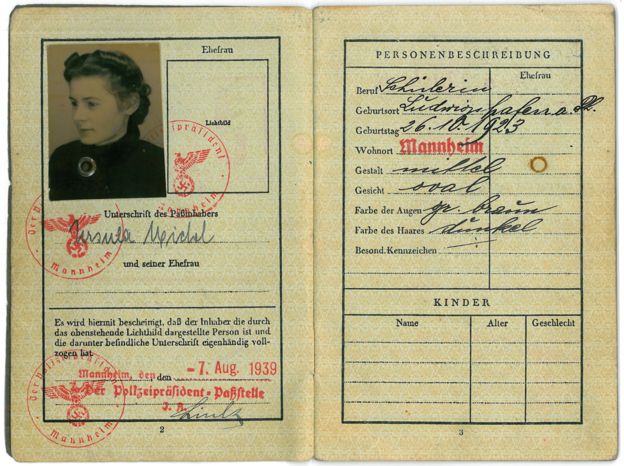
Judith Rhodes’s mother, Ursula Michel, came to the UK in 1939 on the Kindertransport, an operation that brought thousands of Jewish children to safety while their parents remained behind. “Her life was fractured and she never got over the guilt of surviving,” Rhodes says. Her family all perished in the Holocaust.
Rhodes, who lives in Yorkshire, is now active in Holocaust education in her mother’s home town of Ludwigshafen am Rhein – she shows pupils the little suitcase that her mother was allowed to bring with her.
To make it easier to continue doing this after Brexit, Rhodes decided to apply for German citizenship. But she was refused.
Rhodes’s application was rejected on the grounds that she was born before 1 April 1953, to a German mother married to an Englishman. If it had been the other way round and her father had been German it’s likely that her application would have been granted.
“I am furious because I think the ruling discriminates against women. This is the 21st Century and this sort of sex discrimination should not be allowed,” she says.
“I think the attitude of the German government is that Jews should have stayed in the Third Reich and not fled to safety. It is like an insurance company saying to a homeowner they would not pay up as they did not stay in their house as it burnt to the ground, fighting the fire.”
Felix Couchman’s mother also came to the UK on the Kindertransport. He set up the Article 116 Exclusions Group when, like Judith Rhodes, one of his brothers was advised by the German Consulate in London that he would not be eligible to apply for German citizenship. Even though Article 116 says that descendants of Germans deprived of citizenship “shall… have their citizenship restored”, the consulate argued that under German naturalisation law citizenship could only be passed on through the father, up until the 1970s.
Although Couchman had not considered applying for German citizenship himself, and had never been involved in campaigning before, this spurred him into action.
“Although my mother died in 2001, I was acutely aware of what she would have expected me to do,” he says.
“I think the German government started off thinking we were a bunch of little old ladies drinking tea,” he laughs, “but the moral backbone of our campaign means we are not going away. They have been surprised by our determination.”
How the German government interprets Article 116
Automatic right to citizenship is denied to people:
Born out of wedlock, before 1993, to a formerly German father with a foreign mother
Adopted by formerly German parents before 1977
Whose ancestor acquired foreign citizenship before being stripped of German citizenship
Born before 1 April 1953 to a formerly German woman (and a non-German man) who fled Germany before being stripped of citizenship
Born after 31 December 1999
Whose ancestors were Jewish members of German communities annexed by the Nazis during their military expansion, such as Danzig and Czechoslovakia (non-Jewish Germans in these areas were naturalised en masse, but Jews were not)
Interest in the campaign has snowballed. Couchman’s wife, Isabelle, deals with the hundreds of people who have contacted the group. “Some are very elderly and have suffered a great deal,” she says. “Some of them lost their entire families in the Holocaust.”
While Couchman and a Cambridge University PhD student, Nic Courtman, lobby political parties in Germany, Isabelle runs a support network. “People are very emotional and they often cry on the phone when they contact me,” she says. “It can take months for them to decide if they want to pursue their battle.” Some are elderly Holocaust survivors, for example Kindertransport children, who are still traumatised by their experiences.
Central to Couchman’s case against the German government is the atmosphere in which Article 116 was implemented. “We have been told from varying sources of Nazi influence on the way the law was interpreted in the 1950s and 1960s,” he says.
The head of the Interior Ministry department that dealt with residence and asylum was at that time Kurt Breull, a former Nazi who had made his anti-Semitic views clear during the 1930s.
It was in this period that people like Julius Strauss, who had fled the country and taken another nationality before they were stripped of their German citizenship, were deemed ineligible – and also Jews who had lived in eastern territories occupied by Germany, such as Danzig (now Gdansk, in Poland).
“We have to understand how these exclusions arose in order to fix them,” says Couchman.
Nic Courtman has studied the German government’s own investigations into the failure of de-Nazification, finding documents that show the Interior Ministry was aware of controversy surrounding Article 116 in the 1950s, when a commission was set up to examine possible reforms.
That commission was led by Prof Ulrich Scheuner, a former Nazi supporter who, the documents reveal, supported the practice of trying to exclude certain groups. “That influence still filters down and affects decisions today as it set precedents,” Couchman says.
In August, the Article 116 Exclusions Group won their first battle. Two decrees issued by the German government, after pressure from the group, permit some of the descendants of Hitler’s victims to apply for discretionary naturalisation under the Nationality Act.
The German government says the decrees facilitate the acquisition of German citizenship “for those claimants who suffered similar historical injustices to those set out in [Article 116] but are not entitled to restoration under that Article due to legal reasons”.
A statement provided to the BBC, says that the government “highly appreciates” the fact that descendants of victims of National Socialist persecution now wish to acquire German citizenship, and states that the new decrees “provide a swift, directly applicable rule… reducing citizenship requirements for eligible persons to a minimum”.
Judith Rhodes is one of those who might meet the requirements, but only if she takes a series of language and citizenship tests. She says this is still discriminatory and resents “being asked to jump through hoops”.
For Couchman the concessions are “a partial resolution but do not cover all the exclusions”. Adopted children, for example, are still not considered eligible.
“This is a discretionary act that you have to go in begging for,” he says. “What we want is our constitutional right under Article 116.”
Couchman’s group has some powerful allies and has managed to gain the support of opposition parties – the Greens, Die Linke and the FDP – who are leading a parliamentary investigation into the issue. It is still seeking the support of the partners in Germany’s governing coalition, the CDU and the SPD.
Couchman points out that in September Austria’s parliament unanimously ratified a law that extends citizenship to the descendants of Nazi victims who fled Hitler’s Third Reich.
“If Austria is able to pass legislation to rectify the issues over the restitution of citizenship on cross-party lines, I do not see why this cannot be done in Germany,” he says.
The fight has taken over the Couchmans’ lives. The couple work weekends and late into the night. Their two teenage children make sure there is dinner on the table in between studying for their exams.
It is the family’s personal story that drives them forward. Couchman’s grandfather, Fritz Beckhardt, was a German flying ace and World War One hero, but after the Nazis came to power his war record was wiped from the history books.
Couchman’s mother, Suse Beckhardt, was born in 1930 in Wiesbaden. When she was seven, her father had an affair with an Aryan woman, which was a crime under the Nazis, and he was sent to the Buchenwald concentration camp.
“An Air Force chum, a prominent Jewish lawyer, Berthold Guthmann, decided to appeal to Herman Goering, one of the most powerful Nazi leaders, who was one of their wartime colleagues,” says Couchman.
Extraordinarily, Fritz was released from Buchenwald in 1940 and told to leave the country. Before he left, he promised his sister and parents-in-law that he would return. None of them survived the Holocaust. Nor his did his friend, Guthmann, who was sent to Auschwitz.
Beckhardt and his wife arrived in the UK in 1940 but were interned with other German nationals on the Isle of Man. It was not until 1943 that they were eventually reunited with their children, who had fled on the Kindertransport before the war.
Image copyrightFELIX COUCHMANImage captionSuse Beckhardt’s Kindertransport paper (she disliked her first name, Hilda)
Determined to keep his promise to his family, Fritz Beckhardt returned to Germany in the 1950s to fight for the restitution of the family property and their business.
“He fought and fought,” says his grandson, Couchman, whose mother remained in the UK. “The shop was not profitable because people still did not like to shop in Jewish shops in the 1950s but he did not close the business. You fight for what you believe is right.”



 Multicultural Meanderings