B.C. city sees most non-resident births in Canada

More coverage of the latest non-resident birth numbers, including MA graduate Yousif Samarrai’s proposal to use SIN as a gatekeeper for those on visitor visas (in contrast to students and temporary residents who are issued SIN).

Those without a SIN would not be issued a birth certificate by the provincial vital statistics agencies (hospitals would still issue attestations of birth).

Like all proposals, there would be a number of complications, operational, jurisdictional and legal, but if doable, it would be a targeted approach that would reduce collateral impact.

Three hundred more non-resident women gave birth at a handful of Canadian hospitals in 2019 compared with the year prior, with the largest increases occurring at two Toronto-area hospitals and one within Vancouver.

The statistics from the Canadian Institute for Health Information show that Richmond, B.C., still registers the highest number of these births in the country, with 502, or one out of every four babies born last year involving women who are not Canadian residents.

The national tally of births from non-resident mothers represents only 1.6 per cent of all births across Canada last year, save Quebec, but locals in and around Richmond have denounced the practice of “birth tourism” – where women travel to Canada to deliver a baby who will then gain Canadian citizenship.

While municipal, provincial and federal politicians want the practice banned, Andrew Griffith said the data he obtained from the Crown corporation captures those women, as well as students studying in Canada and women who live here but who have not completed the citizenship process.

Mr. Griffith, an Ottawa-based fellow at the Canadian Global Affairs Institute and a former high-level federal bureaucrat, said because of the lack of precise data, the long-term impact of any birth tourists remains unclear.

It is legal for non-residents to give birth in Canada, which then grants the baby citizenship, but Mr. Griffith said changing birthright citizenship probably isn’t worth the effort at this time given the numbers.

“And if you assume that roughly half of those numbers are pure birth tourists, you’re still talking about less than 1 per cent of the total number of live births in Canada, and you’re still talking about less than 1 per cent of the total number of immigrants to Canada,” Mr. Griffith said.

“Are you going to penalize the 99 per cent to address a problem that affects the 1 per cent?”

The data show that after Richmond Hospital, North York’s Humber River Hospital had the next-highest number of these births last year at 329, followed by Mackenzie Health’s facility in Richmond Hill, Ont., with 287. Vancouver’s St. Paul’s Hospital recorded 203 during the 2019 fiscal year, more than double the number recorded five years earlier.

Spokespeople for these various hospitals told The Globe and Mail on Monday they never deny or delay care to anyone based on their residency status, but they do seek compensation for this care from patients without medical coverage, with these fees covering the treatment.

Richmond Mayor Malcolm Brodie said steps need to be taken to prohibit birth tourism, which he said is creating pressure on resources of the city’s lone hospital.

“It is fundamentally not right that people would adopt a strategy to come here and have their babies and then go back without contributing in any meaningful way to the local economy or paying taxes here or any other form of support,” he said in an interview.

In February, Richmond City Council wrote letters to Prime Minister Justin Trudeau and other federal and provincial politicians requesting a change to immigration laws to end “this strategic opportunity taken by people who have no official connection to Canada.”

A year ago, Joe Peschisolido, Liberal MP for Steveston-Richmond East, called on his government to end the practice of birth tourism, telling The Globe that he had spoken with then-minister of immigration, refugees and citizenship minister Ahmed Hussen about the issue.

On Monday, the federal Immigration Minister’s head spokesperson said Ottawa is focused on cracking down on immigration fraud and while “birth tourism is not widespread” the department is researching the extent of the practice to see how many of these non-resident mothers are tourists.

Yousif Samarrai, who recently wrote his master’s thesis in public policy on the issue at Simon Fraser University, said “birth tourism” has become so controversial in B.C. because unlicensed hotel companies in Richmond have been caught marketing packages to expectant Chinese mothers.

He said a simple fix to this issue would be to require a new parent to submit their own social insurance number in order to get a birth certificate – and the resulting citizenship – for their child. Every class of visitor to Canada receives a SIN except tourists, he said.

“The whole idea of changing these laws is you don’t want to impact anybody that’s coming here through legitimate means,” Mr. Samarrai said. “However, if we change the administrative way that people attain a birth certificate, that’s a little more practical.”

Source: https://www.theglobeandmail.com/canada/british-columbia/article-bc-city-sees-most-non-resident-births-in-canada/

Analysis | U.S. Expats Can’t Renounce Their Citizenship Fast Enough

The most in-depth article and analysis of the data regarding Americans renouncing their citizenship:

The swearing in of new citizens often makes news in the U.S., especially if it happens in unusual circumstances such as one party’s national convention. Much less reported are the many citizenship renunciations by Americans, and the travails leading up to these life decisions. Almost all those giving up their U.S. nationality are expats. And for each renouncer going through the ordeal, there are countless others thinking about it. Why?

One recent press release in particular has caused quite a stir. It suggested that, after “a steep decline” in recent years, renunciations in the first half of this year soared to 5,816, more than twice as many as gave up their passport in all of 2019. The implication, as reported breathlessly in the American media, was that expats, already fed up with President Donald Trump, finally despaired over his mishandling of Covid-19 and quit. Other factors were cited as merely secondary.

But these renunciation numbers are notoriously flawed. They’re based on a list of names of renouncers published every quarter by the Internal Revenue Service — experts call this a form of “doxxing.” That list lags in time and jumbles data. In reality, most embassies and consulates stopped making renunciation appointments this spring, owing to the pandemic. And the dip in prior years, according to experts, was due to backlogs and underreporting.

By the best estimates (see chart), renunciations have been rising since 2010, when the Obama administration passed the notorious Foreign Account Tax Compliance Act (FATCA), inflicting misery on U.S. expats everywhere. In 2014, the government raised the renunciation fee from $450 to $2,350. Undeterred, expats kept at it. The American bureaucracy then indirectly slowed the pace with red tape in the first three Trump years. But we’re back on trend in 2020.

Now, it may be true that most expats aren’t crazy about Trump. Americans abroad tend to be cosmopolitan professionals, often married to foreigners or following international career paths. Watching their home country in their host nation’s news, or talking about it at local dinner parties, has stopped being fun. The images occasionally evoke a banana republic succumbing to pestilence while arming for civil war.

But that’s clearly not the reason why so many expats have been trying to drop their nationality for the past decade. Instead, as I described last year, it’s the nightmare of American tax and financial reporting, in which any accounts or assets deemed in Washington, D.C. to be “foreign” are automatically suspect, requiring extra disclosures that can be ruinous in time, expense and peace of mind.

The U.S. is almost unique in the world in taxing based on citizenship rather than residency. It’s also uniquely parochial in being unable or unwilling to distinguish between, say, a rich American living stateside and stashing money offshore and, for example, a middle-class American married to a German and teaching elementary school in Berlin. The hell starts with that conflation.

Before 2010 America’s citizen-based taxation didn’t necessarily disrupt the lives of expats like this school teacher. That’s because few expats even knew about the horrendously complex reporting rules or bothered with them. But FATCA required them to make new and redundant disclosures or face the prospect of tens of thousands of dollars in fines or even prison. It also required their foreign banks, brokers and insurers to report on them to the IRS, or face draconian sanctions.

Unsurprisingly, many foreign banks and brokers therefore stopped taking “U.S. persons” or green-card holders as customers. So American expats have increasingly been locked out of retail finance in their host countries.

Worse, the European Union then started passing laws with bureaucratically sublime names such as MiFID II and PRIIPs that imposed new rules on everything from mutual funds to life insurance. This scared the U.S. banks and brokers of American expats living in Europe, so they also started kicking out their customers with foreign addresses. Many Americans overseas are financially marooned.

In their desperation, several have been taking their struggle to the courts. Fabien Lehagre, a French citizen who is also an “accidental American” because he was born in California, wants to invoke the EU’s data-privacy laws to have FATCA declared illegal in Europe. A U.S.-British dual citizen calling herself “Jenny” is trying to crowdfund a legal odyssey to do something similar in the U.K. Another challenge is underway in Canada. Occasionally, there are even small victories.

But on the whole, Americans abroad feel ostracized by their own country. Like their fellow citizens back home, they’re caught up in the tribal clash between Republicans and Democrats. But when it comes to acknowledging the hardship of expats, the Democrats have mostly refused to listen. The GOP has since 2016 called for the abolition of FATCA and citizenship-based taxation in its platform. But the few Republicans who’ve tried to effect change have so far failed.

If the estimated 9 million Americans living abroad were recognized as a political geography, they would rank ahead of 40 states by population. Their ill treatment by the U.S. tax and compliance regime would be headline news, and probably solved in a bipartisan tweak of common sense. But they’re not a bloc. Like much about American democracy, this discrimination seems unfair. And yet, these millions of voices must be heard.

Austria offers citizenship to the descendants of Jews who fled the Nazis

Of note, the impact of Brexit on citizenship applications:

Tens of thousands of British citizens are among the many descendants of Jewish refugees who can apply for Austrian citizenship from Tuesday under a new law that campaigners say finally delivers a measure of historic justice for their ancestors’ expulsions under Nazi rule.

About 120,000 Jewish refugees fled persecution after the Nazis took power in Austria in March 1938. The second most common destination after the US was the UK, with up to 20,000 refugees registered in 1945.

Most refugees naturalised in their adoptive countries out of necessity, but the postwar Austrian state had a bar on dual citizenship, so considered them to be foreigners.

Obstacles to former refugees reclaiming Austrian citizenship were lifted in 1993, after the country began its first real debate about its culpability for Nazi-era crimes. Around 10% of survivors took it up. But a law extending the possibility of dual citizenship to descendants eluded its advocates in the Austrian parliament, suggesting a lack of interest in restoring the once 200,000-strong Jewish community, even in principle. One rightwing MP reportedly objected: “Enough has been done for the victims already.”

Source: Austria offers citizenship to the descendants of Jews who fled the Nazis

‘Birth tourism’ articles in Vancouver press

Two articles on my recent release of the 2019-20 CIHI non-resident self-pay birth statistics (Birth Tourism: Non-resident births 2019-20 numbers show steady increase).

Starting with Douglas Todd of the Vancouver Sun:

The number of women coming to Canada to give birth, which automatically bestows citizenship on the baby, is expanding much faster in British Columbia than the rest of the country.

Richmond Hospital is the centre of the trend, often called “birth tourism.” New data released this week shows one out of four births in the past year at the hospital in the Vancouver suburb, which features many illicit “birth hotels” advertising their services in Asia, were to foreign nationals.

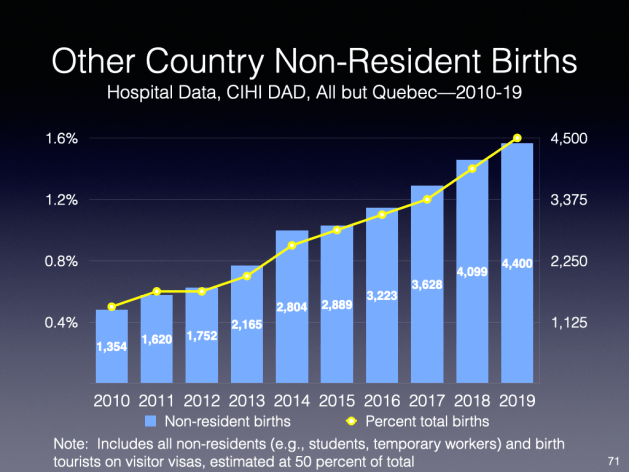
St. Paul’s Hospital and Mount St. Joseph’s Hospital, both in Vancouver, are also fast turning into hubs for birth citizenship, with the two hospitals experiencing a 38 per cent rise in births by non-resident women, one in seven of the total.Virtually no country outside North and South America provides citizenship to babies solely because they’re born on their soil.The newly released figures show there were 4,400 births in Canada in the past year to non-resident mothers, an overall hike of seven per cent. Ontario doctors still preside over the most non-resident births, 3,109, with one hospital in Toronto, Humber River, having a sudden jump of more than 119 per cent.But Ontario’s volume of privately funded procedures has not risen nearly as fast as in B.C., which had a total of 868 non-resident births. That’s a six-fold increase from 2010.

Source: Canadian Institute for Health Information/Andrew Griffith

The new data, compiled by Andrew Griffith, a former senior director of the federal Immigration Department, comes from the Canadian Institute for Health Information, which captures billing information directly from hospitals up until the end of March. It doesn’t include births in Quebec.

Birth tourism has recently been strongly condemned by Richmond Mayor Malcolm Brodie, Liberal MLA Jas Johal (Richmond-Queensborough), former Liberal MP Joe Peschisolido (Richmond East), the head of Doctors of B.C. and others.

Prime Minister Justin Trudeau’s government, which controls immigration policy, has been silent on the matter. Former Conservative party Leader Andrew Scheer said in 2018 he would end birth tourism. NDP leader Jagmeet Singh has accused those who raise the issue of being guilty of “division and hate.”

In February, Richmond council sent letters to Immigration Minister Marco Mendicino, to leading B.C. politicians and to Vancouver Coastal Health. Council called for “permanent changes to immigration laws which would end automatic Canadian citizenship being bestowed on babies born in Canada to non-resident parents who are not citizens of Canada.”Last week, Mendicino’s department finally responded, saying the minister is aware “of the increase in births by non-residents in Canada” and promised to “monitor” it.“All levels of government are trying to pass the buck” on birth tourism, said Au. He acknowledged Richmond was itself failing to combat the dozens of shadowy birth hotels and agents in the city, which help women give birth in Canada for fees in the tens of thousands of dollars.Ads aimed at women in China who want to have babies in Canada tout luxurious accommodation, birthright citizenship in the “world’s most livable country,” 12 years of free public education, university fees just 10 per cent of those paid by foreign students, free health care and eventual family reunification for the parents of the baby who obtains the passport.Au said Richmond officials could be cracking down on underground birth-tourism operations because they don’t have proper business licences. But council and staff, he said, haven’t yet come up with an effective way to do so.

Au is also suspicious that hospital administrators and the few doctors who perform full-fee deliveries for foreign mothers are not countering the problem for financial reasons. “We don’t want our hospitals dependent on this income.”

Source: Canadian Institute for Health Information/Andrew Griffith

In a piece on his website, Multicultural Meanderings, Griffith says figures provided by the Canadian Institute for Health Information show all “non-resident births” in Canada, which includes women who give birth while here as foreign students or temporary workers. Griffith estimates about 50 per cent of the total are full-blown “birth tourists.”

After Griffith wrote a 2018 piece on the subject for Policy Options, three female academics responded by saying those who want to end birthright citizenship are “demonizing pregnant migrant women,“ “encouraging violence against stateless people” and “fuelling discrimination.”

Nevertheless, the academics supported Griffith’s call for better data. He lamented this week, however, that the federal departments that previously promised to link health care and immigration data to monitor non-resident births have “stalled.”

David Chen, the former Pro Vancouver mayoral candidate, has publicly expressed concern about birth tourism. He said Thursday that granting citizenship to anyone born on Canadian soil “poses problems on several fronts.”

As a child of immigrants, Chen, who is now a vice-chair of Vancouver’s NPA party, said it “shortchanges those who went through proper channels only to see people with much more disposable cash jump the line and have an easier route to Canadian citizenship.”

Australia, Britain, New Zealand, France, Germany and South Africa have all, in relatively recent times, altered their citizenship laws to discourage birth tourism. More than 150 nations do not permit it.

While recognizing the issue is complicated, Au, a nine-year member of council, said he believes he understands the views of most Richmond residents, where the fast-changing population is now 53 per cent ethnic Chinese, 24 per cent white, seven per cent South Asian and seven per cent Filipino.“Ethnic Chinese feel the same as everyone else in Richmond,” he said. “They’re concerned.”

Source: Douglas Todd: ‘Birth tourism’ jumps 22 per cent in B.C.

Graeme Wood in Business intelligence for BC:

It was another record year for birth tourism in B.C., according to new data released by health officials.

The province saw a 21.9% spike in non-resident births between April 1, 2019 and March 31, 2020, as 868 non-residents of Canada – the vast majority of whom are understood to be Chinese nationals on tourist visas – paid to give birth in local hospitals in order to garner automatic citizenship for their newborns. The prior year, 712 non-residents gave birth in B.C.

“Vancouver area hospitals continue to have the largest percentages of non-resident births, with an active cottage industry supporting women coming to give birth from China,” said researcher Andrew Griffiths, who first reported the new annual data from the Canadian Institute for Health Information.

The epicentre of the budding industry is Richmond, where an annual record of 502 births to non-residents took place, up from 458 in the year to March 2019 and 474 in the year to March 2018.

Those 502 newborns represent 24% of the 2,094 total newborns at Richmond General Hospital. That is the highest total and share of non-resident births at a hospital across Canada. Meanwhile, Vancouver’s St.Paul’s Hospital is second in the nation, with 14.1% of all births being to non-residents. There, 203 babies were born to non-residents.

Non-resident births also peaked across Canada, with CIHI reporting 4,400 newborns to non-residents in 2019/2020, up 7.3% from the previous year’s total of 4,099, excluding Quebec.

B.C. figures do not include international students, who are enrolled in the public healthcare system. As such, Griffiths said B.C.’s figures are a more accurate indication of birth tourism (those non-residents who fly to Canada for the explicit purpose of obtaining citizenship for their newborns).

Griffiths, a former director general of the Citizenship and Multiculturalism Branch, Department of Citizenship and Immigration, said he estimates about half of the non-resident births outside of B.C. to be tied to parents on tourist visas. However there is no reportable data along those lines, as a federal review of the issue, first announced in November 2018, appears stalled.

“Hopefully, the work to link healthcare and immigration data will resume shortly, not only to provide more accurate numbers with respect to birth tourism but to improve our understanding of healthcare and immigrants more generally,” said Griffiths.

1

Non-resident births by hospital, 2018-2019 and 2019-2020. Figure by Andrew Griffiths

Glacier Media requested information on non-resident births tied to patients on tourist visas but Vancouver Coastal Health Authority said such data does not exist and the task to obtain it from paperwork would be too onerous – although such data is what the federal government stated it would acquire in its review.

Canada is one of two Western countries, along with the United States, to offer birthright citizenship – a concept also known as jus soli – meaning babies born to two foreign nationals on tourist visas are granted automatic citizenship.

It remains unclear exactly what the federal government is doing to enact policies to curb the practice. To date, no enforcement measures have been announced, unlike in the U.S., which has convicted “baby house” operators of money laundering and fraud in 2019.

The U.S. State Department further cracked down on birth tourism in January, with a new rule that “travel to the United States with the primary purpose of obtaining U.S. citizenship for a child by giving birth in the United States is an impermissible basis” for a tourist visa.

The lack of action to address birth tourism, which is widely perceived by the public as an abuse of Canada’s immigration system, has frustrated Richmond community activist Kerry Starchuk, who has documented dozens of “baby houses” in the Vancouver suburb offering accommodation and doula services for Chinese nationals, who typically arrive three to four months prior to giving birth on a six-month or extended tourist visa.

“It’s a joke. It’s so blatant you can see it. They’re advertising this in China,” said Starchuk.

In a written response to Starchuk, dated July 8, 2020, Immigration, Refugees and Citizenship Canada (IRCC) said it was “aware of the increase in births by non-residents in Canada.”

IRCC said, “While statistics indicate that birth tourism is not widespread, IRCC is researching the extent of this practice, including how many of the non-residents are short term visitors.”

Birth tourism is technically legal in Canada, in so much that nothing bars a pregnant woman from entering Canada to give birth, so long as they are honest with border agents.

“Providing false information or documents when dealing with IRCC is considered misrepresentation and has immigration consequences.  However, non-residents giving birth in Canada is not considered fraud under the Citizenship Act,” stated IRCC.

“Additionally, under the Immigration and Refugee Protection Act, a persons are not inadmissible nor can they be denied a visa solely on the grounds that they are pregnant or that they may give birth in Canada,” wrote IRCC.

Starchuk said the federal Liberal government has dragged its feet on the matter.

“I’m not interested in writing any more letters. I want action,” she said.

2

Non-resident births in Canada by year. Figure by Andrew Griffiths

Richmond Conservative Members of Parliament Kenny Chiu and Alice Wong have proposed a hybrid jus soli policy that would bar those on tourist visas from obtaining citizenship for their newborns. Newborns of non-resident international students, for instance, would continue to obtain citizenship under their proposal.

Griffiths said birth tourism businesses in Richmond are at a stand still with COVID-19 flight restrictions and visitor visas from China down 72.2% between January and March, and down 99.79% by June.

A poll from Research Co. in February, 2019 showed almost three in four (73%) believe it is time to end automatic citizenship for people born in Canada (adopting rules used by most Western countries). An Angus Reid poll in March, 2019 showed 60% of Canadians want the law changed.

Immigration Minister Marco E.L. Mendicino declined to be interviewed on this matter.

Source: Record-setting year for birth tourism in B.C. prior to pandemic

Nigeria’s wealthy use Henley in Caribbean passports for cash plan

More on the citizenship-by-investment industry:

A year ago, the office of Citizenship by Investment Program (CIP) in the small Caribbean island nation  of St. Lucia had received no applications from any Africans in its nearly five years of operations.

But in the past few months, it has issued up to 60 passports to Nigerians and is reporting steady increases in applications from the country—still its sole African market.

That sharp rise reflects spiking demand among Nigeria’s wealthy private citizens who are increasingly tapping into “investment migration” programs offered by foreign countries. The programs allow foreign nationals to obtain fast-tracked citizenship and passports or permanent residency permits in exchange for specified amounts of cash investments. The payment for the passports can come in form of direct “contributions” to the development funds set up by the national governments or through investment in real estate projects which offer the promise of not just passports but also possible profits.

With around 40,000 passports believed to have been issued through investment migration programs globally, citizenship by investment is now estimated to be a $3 billion industry. It is often favored by high-net worth individuals from countries with “weak” passports often from countries in sub-Saharan Africa and some Middle Eastern countries.

“What you have is a community of wealthy individuals who cannot travel without visas.”

Henley & Partners, the world’s largest investment migration consultancy, has also set up shop in Africa’s largest economy after seeing a sharp rise in demand from the country over the past three years. The office in Lagos is only Henley & Partners’ third in Africa, in addition to offices in Cape Town and Johannesburg opened six years ago.

“The reason we opened in Nigeria is because we saw significant potential in the market with growth in private wealth without global mobility for high net worth individuals,” says Paddy Blewer, public relations director at Henley & Partners. “What you have is a community of wealthy individuals who cannot travel without visas.”

That reality is best captured by the weakness of Nigeria’s international passport. In fact, Nigerian passport holders can visit two fewer countries now than they could in 2010 without first obtaining a visa. The country also suffered the worst decline in passport power over the past decade, according to rankings on the annual Henley Passport Index.

But even paperwork-intensive visa application processes have also gotten more complicated for Nigerians. Under the Trump administration, for example, US visa application fees for Nigerian applicants have been increased, an interview waiver process  for visa renewals for frequent travelers has been indefinitely suspended while a ban has also been placed on issuing immigrant visas to Nigerians. The net effect of these restrictions resulted in Nigeria recording the largest global drop-off in visitors to the US last year.

In search of improved international mobility, investment migration programs by Caribbean nations offer wealthy Nigerians and other citizens a legal and established workaround that ticks two crucial boxes: price point and access.

For instance, St. Lucia’s lowest-priced program, a “contribution to the national economic fund,” costs $100,000 for individuals and $140,000 for a family of four, as well as $15,000 for each additional family member. “That pricing model has really resonated well with the Nigerian community,” says Nestor Alfred, chief executive of St. Lucia’s CIP office. “A lot of our Nigerian applications consist of families.”

Other Caribbean islands including Dominica as well as St. Kitts and Nevis also offer investment migration programs with minimum costs of $100,000 and $150,000 respectively, a lot less than similar European programs typically cost. The US program issues permanent residence permits in exchange for investment ranging from $500,000 to $1 million.

But in addition to relative affordability, passports of Caribbean island nations also rank much higher than Nigeria’s on a global scale. For instance, St. Lucia passport holders have visa-free and visa-on-arrival access to 145 countries—more than triple Nigeria’s figure. And for extra context, St. Lucia passport holders’ visa free access allows them into the entire European 26-country “Schengen” area, the UK, and Switzerland.

Taking it up

With Nigeria’s oil-dependent economy battered by the pandemic and set for its worst recession in three decades, there are few indications interest in investment migration from Nigeria will slow down.

Nigeria and South Africa dominate demand from Africa and currently account for 85% of Henley & Partners’ business on the continent, with Nigeria growing rapidly with an interest in Caribbean-based citizenship programs.

That momentum will likely remain fueled by Nigeria’s super-wealthy with the country’s population of people with a net worth of more than $30 million—currently at 724 people—forecast to grow by 13%in the next five years.

But as it turns out, interest in emigration is not restricted to Nigeria’s super-wealthy alone. Over the past three years, middle-class Nigerians have also increasingly emigrated through skill-based programs offering legal pathways to residency and citizenship in Canada and Australia. In the last five years alone, the number of Nigerian immigrants issued permanent resident permits in Canada has tripled.

One distinction however is that high net-worth individuals who have earned most of their wealth locally are typically simply looking to boost their mobility options rather than permanently relocate. “What we’re dealing with people whose businesses and largely their wealth is derived from Nigerian investment—they’re not going to leave permanently,” says Blewer. “This is about being able to go where they want at the drop of a hat. It’s not about leaving Lagos.”

Double-checking

For tourism-based economies in the Caribbeans, investment migration programs offer a significant alternative to receiving foreign direct investment. And as recent history shows, with the Covid-19 pandemic paralyzing global travel and tourism, the revenue diversification opportunities these programs offer can prove vital. Indeed, after Hurricane Maria devastated Dominica in 2017, the government sought to shore up tourism deficits by reducing some of its processing fees to make its investment migration programs more attractive and in turn, provide much-needed funds to rebuild and boost the local economy.

But Dominica has also been caught in the crosshairs of a corruption scandal involving its passports program. Last year, an Al Jazeera investigation showed high-powered officials involved in brokering transactions to sell diplomatic passports to foreign business people suspected of corrupt dealings. Diezani Alison-Madueke, Nigeria’s embattled former minister of petroleum who is wanted for alleged corrupt dealings while in office, was identified in the investigation as one of the recipients of a diplomatic passport under questionable circumstances.

The scrutiny from such scandals amplify why investment migration programs claim to place a premium on due diligence. Even though it’s not legally required to, Henley & Partners says it carries out client verification processes, covering sources of wealth, and criminal history.

“We’re not interested in persons involved in military, government officials, or politically exposed persons. Our interest is more in executives and young professionals,” Alfred tells Quartz Africa. As such, the increased applications from Nigeria being primarily from private business executives across sectors, including banking, is ideal for St. Lucia because “it’s easier for us to determine the source of funds,” Alfred says.

Source: Nigeria’s wealthy use Henley in Caribbean passports for cash plan

Birth Tourism: Non-resident births 2019-20 numbers show steady increase

The 2019-20 numbers, obtained from the Canadian Institute for Health Information (CIHI) for all provinces save Quebec, show an overall increase of about 7 percent compared to the previous year, with British Columbia showing an increase of more than 20 percent.

Quebec does not authorize CIHI to release their comparable data, unfortunately.

As non-resident numbers are a broader measure than those on visitor visas coming to give birth (e.g., students, temporary workers), my estimate is that about 50 percent are likely birth tourists.

It appears that the efforts underway by IRCC, CIHI and Statistics Canada to link healthcare and immigration data, that would allow identification of those on visitor visas from other non-residents, has stalled given shifting priorities due to COVID-19.

So these numbers remain the best we have.

Vancouver area hospitals (Richmond General: 24 percent, St. Pauls and Mount St. Joseph: 14.1 percent) continue to have the largest percentages of non-resident births, with an active cottage industry supporting women coming to give birth from China. While awareness of COVID-19 in China was greater and earlier than elsewhere, with a corresponding decrease in visitor visas issued and air travel, this did not impact non-resident births, likely given that plans were set.

2020 numbers, of course, are expected to reveal a sharp decline reflecting travel restrictions, particularly with respect to birth tourists on visitor visas.

Hopefully, the work to link healthcare and immigration data will resume shortly, not only to provide more accurate numbers with respect to birth tourism but to improve our understanding of healthcare and immigrants more generally.

My original article on how non-resident birth data provides a better indication of birth tourists, which provoked the government commitment for the aforementioned study, can be found here An analysis of hospital financial data shows that birth tourism is rising, and not just in British Columbia. Two of the critiques are: Revoking birthright citizenship would affect everyone and Birth tourism and the demonizing of pregnant migrant women.

Citizenship - Slide Gallery 2018.071Citizenship - Slide Gallery 2018.072Citizenship - Slide Gallery 2018.073

In Italy, legal migrants renew fight to be true citizens

Restrictive second generation citizenship policies compared to jus soli:

Inspired by the Black Lives Matter movement, Italy’s second generation of immigrants is renewing the fight for automatic citizenship in a land where migration is at the heart of the political debate.

“Jus soli!”, the Latin term which literally means “right of soil,” or birthright citizenship, has become the new rallying cry among the children of Italy’s 5.3 million legal immigrants.

In early June, thousands of demonstrators marched in Rome in memory of African American George Floyd, who died on May 25 when a white policeman kneeled on his neck for more than eight minutes, triggering an outcry in the United States and around the world.

The march spurred renewed vigour among the children and grandchildren of migrants in Italy, who share the language and country’s cultural references but do not have the right to citizenship until they turn 18.

Even then, it is subject to strict conditions and often gained only after a lengthy and heavily bureaucratic process.

“In this country, citizenship is treated not as a right, but a concession,” said Fatima Maiga, who was born in Italy but is of Ivorian origin.

Legal immigrants say their plight has been overshadowed by the migrant crisis in the Mediterranean Sea, which since 2014 has seen more than half a million new immigrants arriving on Italy’s shores.

They claim their fight for citizenship is also weighed down by anti-immigrant sentiment at home, fomented by the far-right League party, which left government in 2019 after only a year in power.

Of the 5.3 million foreigners living in Italy in 2019, around 1.3 million were under 18 and three quarters of those were born in the country.

Among those most affected are the children of Albanians, Moroccans, Chinese, Indians and Pakistani immigrants.

– Italian/not Italian –

Maiga, 28, co-founded Italiani Senza Cittadinanza, or Italians Without Citizenship, in 2016 to help second-generation migrants — known as the G2 — become Italian.

Under a 1992 law, anyone born in Italy can apply for citizenship at the age of 18, on condition of having legally lived here “without interruption”.

However, the process must be launched before they turn 19.

Up until that point, they are given residence permits.

If that window is missed, people can also become a citizen on the grounds of legal residency for a decade and on the condition of a minimum income of 8,500 euros ($10,000) a year over three years.

Nevertheless, the process can take a long time and involve complicated paperwork.

“I applied when I was 18. I had to wait for four years before getting my papers,” Marwa Mahmoud, 35, told AFP.

“I know what it’s like to live as an Italian in everything but in law,” Egyptian-born Mahmoud said.

Mahmoud and others also worry the ongoing migrant crisis — in which hundreds continue to arrive on Italy’s shores every day — is pushing their own struggle further down the agenda.

The numbers of people arriving in this way have risen by nearly 150 percent over the past year, the majority coming by boat from Tunisia, Italy’s interior ministry said last week.

“Our situation is being passed over in silence,” Mahmoud lamented.

“Since Italy started getting embroiled in the migrant crisis it’s like we’re starting at zero again,” she said, adding that Italians “tend to put everyone in the same basket”.

“But the situation of an unaccompanied minor who arrived yesterday is not comparable with that of an immigrant child born and raised here,” she said.

– ‘Not a priority’ –

During his year-long tenure in 2018-2019 as interior minister, Matteo Salvini, the head of the League party, pushed through new rules extending the waiting time to process Italian nationality applications from two to four years.

“Nationality is not a ticket to the funfair,” Salvini said in 2017.

Supported by the G2 network, Italy’s governing centre-left Democratic Party (PD) is now pushing for reforms — among them, advocating for five-year continuous residency to qualify for citizenship.

But so far, the PD’s coalition partner, the anti-establishment Five Star Movement, has been non-committal.

Still, a fairer birthright citizenship system is under discussion in parliament.

But “it’s not a priority”, said Giuseppe Brescia, a Five Star deputy, who heads parliament’s committee on constitutional affairs.

The G2 movement now plans to hold a demonstration on September 19 in the hope of advancing the cause of what it calls Italy’s “forgotten non-citizens.”

Source: In Italy, legal migrants renew fight to be true citizens

Exclusive: Cyprus sold passports to criminals and fugitives

Not surprising given earlier stories and the kinds of people these programs can attract:

Convicted fraudsters, money launderers and political figures accused of corruption are among dozens of people from more than 70 countries who have bought so-called “golden passports” from Cyprus, according to a large cache of official documents obtained by Al Jazeera’s Investigative Unit.

The Cyprus Papers is a leak of more than 1,400 passport applications approved by the government of the island nation between 2017 and 2019, and it raises serious questions about the Cyprus Investment Programme.

Passports from the Republic of Cyprus can be important for individuals from countries that have restricted access to Europe, as Cyprus is a member of the European Union (EU) and a passport offers its holder access to free travel, work and banking in all 27 member states.

In the coming days, Al Jazeera will reveal the identities of dozens of people who acquired Cypriot citizenship who, according to the country’s own rules, in many cases should not have received a passport.

Security risk

To apply for a Cypriot passport, applicants must invest at least 2.15m euros ($2.5m) in the Cypriot economy, usually by buying real estate, and have a clean criminal record.

However, applicants provide their own proof of eligibility, and although Cyprus claimed to check applicants’ backgrounds, the documents obtained by Al Jazeera prove that this did not always happen.

Since its inception in 2013, the programme has received repeated criticism from the EU, which has called for it to be closed down.

“It’s high value for everyone who comes from a country where there’s a lot of dirty money involved”, German MEP Sven Giegold, a strong critic of the programme, told Al Jazeera.

“You open a bank account, a business relationship and less questions asked, no visa requirements, easier to get access to get everywhere to travel than if you are from Russia, China or even more doubtful countries.”

Since 2013, when the passport programme started, the country has made more than 7 billion euros ($8bn), used to keep afloat the nation’s failing economy.

Burisma and Gazprom officials

Between 2017 and 2019, the countries with the highest number of people applying were Russia, China and Ukraine.

Among the approved applications seen by Al Jazeera was Ukrainian tycoon Mykola Zlochevsky, owner of the giant Burisma energy company.

When Zlochevsky bought his Cypriot passport in 2017, he was already under investigation for corruption in his home country.

In June 2020 Ukrainian prosecutors said they were offered $6m in cash to drop the investigation.

Zlochevsky and Burisma deny any knowledge of the bribe.

Like many on wanted lists in their home country, Zlochevsky’s Cypriot passport allows him to live beyond the reach of Ukrainian law enforcement.

A similar application came from Russian national Nikolay Gornovskiy, former boss of the state-owned energy giant Gazprom.

Gornovskiy was already on Russia’s wanted list for abuse of power when Cyprus approved his passport in 2019 and has so far thwarted all attempts to extradite him.

Other applications were approved even after the applicant had been arrested and sometimes even served their time in prison.

Ali Beglov, a Russian national, bought his passport despite serving a prison sentence for extortion, which should not have been possible according to Cyprus’s rules.

Chinese businessman Zhang Keqiang also received a Cypriot passport, despite having spent time in prison for a fraudulent share deal.

Vietnamese businessman Pham Nhat Vu’s passport was approved a month after he was charged with giving millions of dollars in bribes in a telecoms deal.

He is now serving three years in jail.

According to Laure Brillaud, Senior Policy Officer with Transparency International, an NGO focused on combatting international corruption, these results are worrying but not surprising.

“These programmes bear inherent risks of money laundering, corruption and tax evasion. They were designed to attract people just looking for a fast track to the EU,” she told Al Jazeera.

Stricter rules

In May 2019, Cyprus introduced tougher rules on who was eligible for citizenship, which banned anyone under investigation, wanted, convicted or under international sanctions from buying a passport.

Cypriot parliamentarians in July finally passed a law that gave the country the power to remove citizenship after several scandals involving notorious golden passport investors, but politicians voted against any move to publish the names of those who buy Cypriot citizenship.

The new stricter law applies to anyone who commits a serious crime, is wanted by Interpol or subject to sanctions in the 10 years after they bought their passport.

Cyprus is reviewing all past applications and announced about 30 unnamed people face losing citizenship, but The Cyprus Papers reveal many more may fall foul of the new law.

They include people such as Venezuelan Leonardo Gonzalez Dellan, an ex-banker, who was sanctioned by the United States for laundering millions in illegal currency deals for the Venezuelan government.

Another person who could lose his passport is Oleg Bakhmatiuk, under investigation in Ukraine for embezzlement and money laundering relating to his giant agricultural firm.

He called the charges “a complete fabrication and politically motivated”.

Although Bakhmatiuk told Al Jazeera the proceedings against him had ended with the charges dropped, the country’s official prosecutor confirmed he is still on Ukraine’s wanted list.

Embezzlement and money laundering

Some other examples of passport holders facing serious charges are Russian brothers Alexei and Dmitry Ananiev, who bought citizenship in 2017.

They are accused in Russia of embezzling from the bank they once owned.

Another person who received Cypriot citizenship is Chinese national Li Jiadong, who was sanctioned by the US for laundering $100m in cryptocurrency related to North Korean hackers.

Lastly, there are Maleksabet Ebrahimi and his son Mehdi, who are both on Interpol’s most-wanted list for money laundering and fraud in Iran and facing similar charges in Canada.

Maleksabet Ebrahimi denies the charges against him and says he complied at all times with Iranian and Cypriot laws.

‘Cyprus should be ashamed’

In response to questions from Al Jazeera, Cypriot Member of Parliament Eleni Mavrou said: “The way the programme was implemented the last few years was obviously a procedure that allowed cases for which the Republic of Cyprus should be ashamed.”

“I believe that the new regulations will not leave room for foul play or for stepping over the boundaries that a state should respect,” she added.

The Minister of the Interior, Nicos Nouris told Al Jazeera: “No citizenship was granted in violation of the regulations in force at the given time.”

Source: Exclusive: Cyprus sold passports to criminals and fugitives

UK must restore ISIL bride Shamima Begun’s citizenship

Echoes of previous debates regarding citizenship revocation under C-24, repealed by the Liberal government. Challenge, of course, remains in successfully prosecuting those involved in ISIS.

And of course, given that those involved in ISIS range from immigrants, second generation and “old-stock” citizens, revocation has a broader impact than just immigrants and their children.

Moreover, there is a risk of viewing those involved in ISIS only as victims, without any agency or responsibility:

ISIL bride Shamima Begum, whose British citizenship was revoked in 2019 on national security grounds, can return to the UK from Syria to plead her case to restore her citizenship, according to a UK court. The Court of Appeal ruled on July 16 that Begum had been denied a fair hearing because she could not properly defend herself from Syria. The verdict means that the UK government is now required to find a way to coordinate the return of Begum, who is currently being held in Camp Roj, a refugee camp in northern Syria.

This case could set a precedent for Canada and the rest of the Western world.

At the age of 15, Begum travelled to Syria to marry a Dutch jihadi who had converted to Islam and joined ISIL. After four years with ISIL, Begum, nine months pregnant, revealed her identity to war correspondent Anthony Loyd. “I am a sister from London,” she told him. “I’m a Bethnal Green girl…I’m scared that this baby is going to get sick in this camp…That’s why I really want to get back to Britain, because I know it will get taken care of, health-wise at least.”

By then, Begum’s two other children had died in ISIL territories, reportedly due to malnutrition. Loyd’s story appeared on the front page of The Times and created a social media storm.

In under a week, the UK government stripped Begum of her citizenship. While the Geneva Conventions prohibit making citizens stateless, the government justified taking away citizenship by pointing out that Begum’s mother is Bangladeshi, which means Begum might be eligible for Bangladeshi citizenship. However, in May 2019, the Bangladeshi foreign minister, Abul-Kalam Abdul-Momen, stated that Begum has “nothing to do” with Bangladesh and would be denied entry, and if she did find her way there she would face capital punishment due to zero-tolerance policies for terrorist activities. “The British government is responsible for her,” he said. Three weeks after her citizenship was revoked, Begum’s baby died of a respiratory infection. She continues to be effectively stateless.

Loyd described Begum as emotionless and awkward, with no discernible sympathy. Begum revealed she was not disturbed by the sight of decapitated heads of fighters in a trash can in Raqqa, by other atrocities or by the torture and murder of Western journalists by ISIL. After hearing this, anyone would see Begum as someone who does not deserve empathy. Scholar Lisa Downing has argued that it should not matter how we feel about Begum. Even so, if Begum’s intention has been to return, why has she not at least pretended to be remorseful?

Begum’s statements are precisely what I would anticipate from an indoctrinated child, spending years living within the reach of ISIL’s extreme propaganda machine. Her demeanour and lack of emotion and remorse may be a response to emotional trauma. We don’t know the full story because she has not undergone a proper evaluation with a trauma specialist. Begum’s lack of emotion matches that of many born-again insurgents whom I have interviewed.

In my fieldwork, an ex-combatant with Jundallah, an insurgent group in Iran, told me about the first time he was assigned to execute a hostage to prove his devotion to the cause. “The man was weltering around, fighting for his life, screaming.” It took multiple bullets to kill the prisoner, not the single shot he had imagined. “It killed me inside…After that experience, nothing fazes me anymore…I am dead inside.” The reality of what it means to fight for the cause shook him, and he eventually escaped to Turkey to help with a disillusionment, deradicalization and disengagement initiative. He explained that many foreign recruits want to prove themselves, to be considered insiders. They take their assignments seriously and cling strongly to the ideology to remove any remnant of hesitation, doubt or guilt.

Putting aside Begum’s lack of penitence, the first question should never have been “Where are her parents from?” but rather “What is the right thing to do?” It was much easier to strip her of citizenship and reframe the discussion in the media than to ask the hard question: Why do men and women join extremist organizations? Western-born members often have the opportunity to enjoy comfortable, middle-class lives, with the chance to advance in admired, conventional careers. Instead, they choose terrorism and commit heinous acts of violence against their fellow citizens, often at the price of their own lives. We need to rewind and ask what went wrong.

During my 2018 fieldwork, I met Jabbar, a 32-year-old barbershop owner in Paris. While he disdained acts of terror, he told me that he understood why people join extremist groups. When he was younger, with no job, and “constantly getting harassed by everyone on every occasion,” he internalized vast challenges with his identity and harboured a deep sense of alienation. He was accepted neither in France nor in Algeria, where his parents emigrated from. To be accepted as French, “you have to change your hair, switch your name to Pierre, eat pork, drink wine, and in the end, they still call you a cosmopolitan Muslim.” He was also ridiculed in Algeria and was not considered a true Algerian because of his accent and clothing. He asserted that was why second-generation youths feel alienated and excluded.

Begum’s case is an example of how citizenship, along with other rights often taken for granted by the majority, is variable and portrayed as a privilege for those whose parents or grandparents are immigrants.

In a story that made headlines recently, a sales manager named Mohamed Amghar described being coerced to change his name to Antoine, a traditional French name, at work. He is suing his former firm for 440,000 euros and filing a discrimination complaint. He was pressured into using the name on business cards, conference badges, plane tickets and even performance awards. “If people like me, who did what was necessary to get good jobs, to get training, to live as citizens, are besmirched and denied our rights, where are we going?” Amghar said. “I only have one name, I only have one nationality,” he added. “My name is Mohamed, and I am French.” The systemic nature of micro-aggressions, discrimination, racism and xenophobia has been documented throughout most of Western Europe, the United States and Canada. This narrative was common across my fieldwork and may be applicable for young recruits who have gone on to conduct terrorist activities, recruited by a group that claimed to finally accept them in all aspects of their being.

As part of Western governments’ obligations to fix their counterterrorism strategies, Western countries need to create an effective response for returnees. Begum’s case is an example of how citizenship, along with other rights often taken for granted by the majority, is variable and portrayed as a privilege for those whose parents or grandparents are immigrants. Insurgent groups appeal to this notion. An ISIS magazine  stated, “They never will consider you an equal to the white man,” and claimed you will always be considered second-class citizens. Efforts have continued to “other” Begum for her mother’s immigrant status. All the while, politicians have riled up the public, framing her case as a decision about whether to “welcome back a terrorist.”

I am not saying Begum shouldn’t be held accountable. I firmly believe that she should be subject to criminal prosecution, if appropriate, along with rehabilitation. As I have argued before, bringing back returnees may provide the opportunity to enhance counterterrorism intelligence by drawing upon them as a resource on extremist recruitment and radicalization strategies. Perhaps even more importantly, bringing back returnees would allow the UK and other Western nations to uphold human rights by pursuing justice through the judicial system and by providing the appropriate rehabilitation. Instead, we are seeing an acceleration and cultivation of separate justice for separate peoples. Consider this: Would Begum have lost her citizenship if her parents were from Leeds?

Revoking citizenship based on parents’ immigration status sidesteps the ethical obligations that states have toward their citizens and alienates second-generation immigrants, deepening prejudices they are already well accustomed to experiencing. The UK has the opportunity to change its course and set an example for Canada and the rest of the world. Begum should have a fair trial in the only country where she has ever held citizenship.

Western nations should reconsider their stance on repatriation despite the challenges involved. They should bring home their citizens to demonstrate their commitment to justice for all and prevent the secondary effects of the cycle of alienation, isolation and othering that leads to extremism in the first place. This is part of any proper justice system and could reduce radicalization in youth in the long run. It could foster belonging, which is something the politics of fear cannot do. Western nations must look upstream and deconstruct the systems and policies in place that are riddled with micro-aggressions, structural xenophobia and outright racism to reconstruct an inclusive society that would eliminate the breeding ground for radicalization that currently exists.

Source: UK must restore ISIL bride Shamima Begun’s citizenship

Looming Fee Increase Could Thwart Many U.S. Citizenship Applications

Yet another Trump administration anti-immigration initiative. Cost matters, and fees need not to pose an excessive financial burden on immigrants:

When Guadalupe Rubio, 41, contracted the coronavirus in July, she struggled to make the few steps to the bathroom in the mobile home that she shared with her teenage daughter in Kent, Wash.

The pandemic had already shuttered her small construction business, which also provided for her parents and three children in Sinaloa, Mexico. Now, the virus left her struggling to breathe, trapped inside without any means to support the six family members who depended on her.

Around the time the pandemic hit Washington State, Ms. Rubio became eligible to apply for United States citizenship. She made a bit too much money to qualify for a reduction in the application fee, currently $640, and the economic effects of the pandemic and her illness sapped away her savings. She applied for food stamps, a benefit that could also provide a break on the fee, but has so far been unable to reach the overwhelmed social services agency that could help her.

If she cannot save the money or obtain a fee waiver before the fall, Ms. Rubio’s prospects of becoming a citizen will become more remote. The Trump administration moved late last month to raise the cost of naturalization applications by more than 80 percent and to substantially tighten eligibility requirements for a subsidized application.

The price for naturalization will jump to $1,160 or $1,170 for online applications. The rule will also lower the income threshold to qualify for a fee waiver and eliminate the partial subsidy for the application.

Almost all other exceptions that allowed immigrants to waive the fee will be eliminated, including extenuating financial hardship and means-tested public benefits, like food stamps. Only some protected immigrants, including victims of domestic violence and human trafficking, will remain eligible.

Ms. Rubio is one of many who would no longer be eligible for a waiver. Immigration lawyers across the country are rushing to submit their clients’ applications to the already backlogged agency before the fee increases are introduced on Oct. 2.

“It’s a low blow during a pandemic,” Ms. Rubio said through a translator. “I have worked a lot for this country, and if I’m a citizen, I can — not just contribute more — but I can also better reap the benefits of all of my hard work in this country.”

Advocates for immigrants say the fee increase is intended to stymie legal immigration and deprive immigrants of their right to vote before the election in November.