6 charged in ‘birth tourism’ scheme that cost U.S. taxpayers millions

Medicaid fraud, not the service itself:

Six people were charged in an elaborate “birth tourism” scheme that helped Turkish women secure U.S. citizenship for their children and cost American taxpayers upward of $2 million, federal prosecutors said Wednesday.

The alleged ringleaders, Sarah Kaplan and Ibrahim Aksakal, both residents of Long Island, New York, brazenly advertised their services on Turkish-language Facebook pages and websites with titles like “My baby should be born in America,” prosecutors said.

The defendants are accused of providing expectant mothers a full-service experience: lodging in New York, transportation, help applying for citizenship for their children, and purported “insurance” to cover all medical costs, which amounted to fraudulently-obtained Medicaid benefits.

The cost for these services: roughly $7,500, nearly all in cash, prosecutors said.

Between January 2017 and September this year, the suspects were paid approximately $750,000 in fees, and Medicaid disbursed more than $2.1 million in illicitly-obtained benefits, according to prosecutors.

“The defendants cashed in on the desire for birthright citizenship, and the American taxpayer ultimately got stuck with the $2.1 million bill,” Seth DuCharme, acting U.S. attorney for the Eastern District of New York, said in a statement.

Five of the defendants – Aksakal, Kaplan, Enes Burak Cakiroglu, Fiordalisa Marte and Edgar Rodriguez – were arrested Wednesday morning. They are all residents of Long Island, where they operated seven “birth houses,” prosecutors said.

The sixth suspect, who has yet to be taken into custody, was not identified.

Aksakal, Kaplan and Cakiroglu were charged with conspiring to commit visa fraud, health care fraud, wire fraud and money laundering. Marte and Rodriguez were charged with conspiring to commit health care fraud, wire fraud and money laundering.

It was not immediately clear if they had hired lawyers.

Birth tourism has long brought expectant mothers to the U.S. The benefits are substantial: the child is given American citizenship, granting them a lifelong right to live and work and collect benefits in the U.S. And when they turn 21, they can sponsor their parents’ application for an American green card.

But the six defendants charged Wednesday submitted fraudulent New York state Medicaid benefits applications stating that the Turkish women were permanent New York residents who had no income and who resided in one of the “birth houses” maintained by the suspects, according to court papers.

The suspects submitted at least 99 Medicaid claims for different women, according to court papers. In all, the defendants facilitated the births of approximately 119 children, who now hold U.S. citizenship, prosecutors said.

Two of the defendants, Marte and Rodriguez, used their experience as assistors, people who are trained and certified to help individuals in New York state apply for health coverage, to facilitate the Medicaid part of the scheme, according to court papers.

The $750,000 brought in by the defendants was funneled to bank accounts in Turkey, thereby preventing the government from seizing it, according to court papers.

The defendants allegedly used their web pages to attract customers. A January 2018 post to the “My Baby Should be Born in America” Facebook page reads: “If you believe your baby should be born in the USA and become an American citizen then you are at the right place.”

The post also informed would-be customers that the defendants’ competitors’ fees were higher because of “misguided information that insurance will not cover expensive hospital and birth fees,” prosecutors said.

Source: 6 charged in ‘birth tourism’ scheme that cost U.S. taxpayers millions

New U.S. Citizenship Test Is Longer and More Difficult

One of the better analyses of the test and expected impact that I have seen:

The Trump administration is rolling out sweeping changes to the test immigrants must take to become United States citizens, injecting hints of conservative philosophy and making the test harder for many learners of the English language.

The new citizenship test that went into effect on Tuesday is longer than before, with applicants now required to answer 12 out of 20 questions correctly instead of six out of 10. It is also more complex, eliminating simple geography and adding dozens of possible questions, some nuanced and involving complex phrasing, that could trip up applicants who do not consider them carefully.

Of the 18 questions removed from the previous test, 11 were questions that had simple, sometimes one-word answers.

The new test adds one more hurdle for immigrants who hope to become voting citizens, coming in the waning days of an administration that has imposed substantial new barriers to immigration and limits on the ability of those already in the country to aspire to legal residence and, eventually, naturalization.

One test question that has drawn particular scrutiny provides a new answer to the question, “Who does a U.S. Senator represent?” Previously, the answer was “all people of the state”; on the new test, it is “citizens” in the state.

Singled out for a new question is the 10th Amendment, which reserves to the states all powers not specifically granted to the federal government, a part of the Bill of Rights that is a favorite among conservatives questioning federal authority.

Another new question, “Why did the United States enter the Vietnam War?” has one answer that is considered correct: “to stop the spread of Communism.” The test does not take on the issue of the vehement protests or the huge death toll stemming from the war.

Immigration organizations, including some that have helped thousands of people complete their naturalization applications over the past decade, warn that the new test could make it harder for poor immigrants from non-English-speaking countries to become citizens and ultimately suppress the number of immigrants who vote.

Critics also said the new test could create even more backlogs in a system already plagued with delays.

“It’s a last-ditch effort on their way out the door for the administration to keep people from realizing their dreams of becoming citizens,” said Eric Cohen, executive director of the Immigrant Legal Resource Center in San Francisco, a nonprofit group that helps permanent residents apply for citizenship.

“There is no legal reason, no regulatory reason to do this,” said Mr. Cohen, noting that the citizenship test had remained unchanged since 2008. “They decided on their own that they have to change it for political reasons.”

Dan Hetlage, a spokesman for U.S. Citizenship and Immigration Services, the agency that oversees the naturalization process, said in a statement that the test was revised “to ensure that it remains an instrument that comprehensively assesses applicants’ knowledge of American history, government and values and supports assimilation.”

President-elect Joseph R. Biden Jr. has the option of reversing the changes, though that likely could not occur, if at all, until several months into the new year.

The new test will be required of all applicants who apply for citizenship after Dec. 1, though there is often a lag of several months between when candidates apply and when they are scheduled for an interview with a U.S.C.I.S. officer, meaning that some candidates may still be taking the old test.

The current pass rate for the citizenship test, according to U.S.C.I.S., is 91 percent. An analysis of the new test by the Catholic Legal Immigration Network suggested that 40 questions out of the original 100 remained unchanged from the previous version; the rest were reworded or newly introduced.

Already, some immigrants were expressing nervousness about changes to the test.

Nefi Reyes, an electrician from El Salvador who took the earlier test this year, passed with a perfect score. It had been 30 years since he had crossed the border into the United States to escape the civil war in El Salvador, and he voted in the United States for the first time in November.

“I feel lucky that I got it done,” Mr. Reyes said of the changes to the test. He had had difficulty memorizing the names of the colonies, he said, and the new test requires applicants to name not three of the original 13 states, as he had managed to do, but five.

Luz Gallegos, executive director of Todec, a nonprofit group that assists immigrants in Southern California, said her organization had seen a rush in immigrants applying to take the citizenship test, not only so they could vote in the November election, but because many hoped to avoid the new test. “As it is, it’s difficult for them to memorize all the answers to the civics test,” she said.

Immigrants are not alone in finding the citizenship test, even in its previous form, challenging. About one in three Americans could pass a multiple-choice test consisting of items taken from that version, according to a 2018 national survey by the Woodrow Wilson National Fellowship Foundation. Most of the respondents did not know how many justices serve on the Supreme Court or which countries the United States fought in World War II.

Citizenship tests have gone through various incarnations since being introduced around a century ago, replacing an earlier system, broadly criticized at the time, in which naturalization judges evaluated immigrants’ knowledge of civics and the English language as they saw fit.

“There was absolutely inconsistency and unfairness in the way that prospective citizens were examined by naturalization judges,” said Jack Schneider, an assistant professor of education at the University of Massachusetts, Lowell, noting that such hearings resulted in the rejection of large numbers of applicants.

The test has changed considerably over time. Decades ago, the test asked how tall the Bunker Hill Monument is, missing, critics said, the more important issue of what it stands for. Another question, “How many stars are there on a quarter?” was deleted after it was noted that the right answer depended on the quarter.

The new citizenship test is one of a number of moves made under the Trump administration to not only halt unauthorized immigration but restrict legal immigration as well. The administration has made it harder for people to obtain asylum, increased the costs of applying for citizenship and, under the cloak of the coronavirus pandemic, suspended the issuance of green cards to immigrants seeking temporary work in the country.

Taken together, these moves amount to a break from what historically had been bipartisan support for naturalization for immigrants who lived and worked in the United States and embraced the opportunity to become citizens.

Applicants must already fill out a 20-page application, pass background checks, submit a bevy of documents and pass civics and English tests during an interview. The government moved this year to raise fees for naturalization from $725 to $1,170, or $1,160 if the application was filed online, but a federal judge in California blocked the increase in September.

Organizations that offer citizenship classes to help immigrants study for the test are scrambling to revamp their lesson plans to respond to the new questions.

Lynne Weintraub, who trains citizenship instructors and was involved in the design of the 2008 test, said the revisions were adopted without outside professional input that might have helped ensure that the test was a fair and valid measure of applicants’ knowledge of civics.

“You can’t even imagine the turmoil that this has created,” Ms. Weintraub said. The new test, she said, presents additional problems for many English language learners by clustering abstract concepts into one phrase in some questions, “making them impossible for immigrants with low English proficiency and less education to follow.”

128 Tricky Questions That Could Stand Between You and U.S. Citizenship

One of the better commentaries on the new test, designed to exclude, not include:

Take it from me, a noncitizen, there is much to learn from the naturalization test, one of the final hurdles an immigrant must clear to become a citizen.

It’s pretty tough actually, particularly the new and expanded version of the civics test that is to go into effect on Dec. 1. To those of us living under The Stephen Miller School of Exclusion, this is one more barrier to an immigrant’s quest to live here. The questions and answers are online now. I’ve been practicing in a variety of American accents.

The latest test has 128 civics questions about American government and history. Just getting to take the test usually means you’ve made it through an obstacle course involving reams of paperwork, thousands of dollars in lawyer and government fees, years of legal residency, a biometrics appointment and an English proficiency test. The questions come in the form of an oral test where an officer from U.S. Citizenship and Immigration Services, U.S.C.I.S., asks the would-be citizen to answer 20 of the 128 civics questions; if she gets 12 right, she passes. After that, all she needs to do is pick up her paperwork. Then she can pledge allegiance to the flag and decide which season of “Real Housewives” to watch to truly understand this complex nation.

The latest test is a jump from the current one, which requires you to study only 100 questions, and answer 10 of them, with 6 correct answers, to pass. The Trump administration has left almost no part of the immigration system untouched. It made changes large and small, from thundering bans of entire nationalities to insidious but potent administrative changes like this one. However innocuous some changes may seem, they illuminate the end goal: curbing legal immigration.

As with many Trumpian ideas, the seeds were there all along. The Naturalization Act of 1906 first decreed that citizens-to-be must speak English, and while English is not the official language of the United States, most immigrants today still have to pass an English proficiency test. The civics test is carried out only in English.

I’m a native English speaker, but I still find some questions difficult to understand. And unlike the study guide online, the questions are not multiple choice. That means that one day, if I get to take the test, I will have to try to keep a straight face as I look into another human being’s eyes and try to answer the question, “Why is the Electoral College important?”

Some people have an easier ride. If you are 65 or older and have 20 years of permanent residency under your belt, you are required to answer fewer questions. This makes me feel better about the substantial errors made by the 66-year-old senator-elect from Alabama, Tommy Tuberville. In an interview this month in The Alabama Daily News, Mr. Tuberville got the three branches of the federal government wrong and misidentified the reason the United States fought in World War II. To be fair, Mr. Tuberville played football for a long time. It is my understanding that this extremely American game involves repeated bashes to the head, one of which is bound to knock out some civics knowledge.

Speaking of senators, one of the more sinister changes to the civics test is the answer to the question, “Who does a U.S. Senator represent?” The only acceptable answer has been changed from all people of their state to citizens of their state. I’m just a person, not a citizen. Am I not worthy of representation? There was a whole kerfuffle about taxation without representation back in the day, I believe.

Simone Hanlon Shook is worried about these changes. “It’s just really punitive to people that don’t have advanced degrees and it’s not in their first language,” she told me. She said she was not worried about passing her own test when she took it on Oct. 7. It was the shorter and simpler one. Plus, she is a high school history teacher. Originally from Ireland, Ms. Hanlon Shook lives in Poughkeepsie, N.Y., and in past years used the U.S.C.I.S. questions to quiz her high school students as she waited her turn to take the real thing. “The idea was: if you weren’t a citizen, would you pass this test? And a lot of them wouldn’t.”

Her turn finally came during a pandemic, so the U.S.C.I.S. officer brought her into a room with an iPad, and then he went to the room right next to hers and conducted the interview virtually. She got 100 percent of the questions right and on Oct. 23 she was presented with her citizenship papers and a small American flag during a drive-through ceremony in a parking lot beside the Albany airport. The next day, she told me, she voted in the presidential election.

One day I hope to do the same, so I’m taking practice questions when I can. This one caught me out. “What is Alexander Hamilton famous for?” He’s famous for his cool ponytail and for being a breakout star on Broadway, right? Wrong. Apparently he’s famous for being “one of the writers of the Federalist papers.” Not sure what those are, but they sound serious.

Another one is “Name one example of an American innovation.” Voodoo-flavored Zapp’s chips spring to mind, as does unearned confidence. However, neither is included in the list of acceptable answers. Instead: light bulbs, skyscrapers and landing on the moon.

Hernan Prieto is the citizenship program coordinator at Irish Community Services, a nonprofit in Chicago that provides immigration and social services to immigrants of any nationality in the Midwest. Part of his job is preparing immigrants for the civics test. Unlike Senator-elect Tuberville, his students usually get the question about the branches of government right. They are also familiar with some of the names on the test, he told me. They know who Martin Luther King Jr. is and why he is important. Dates trip them up, though.

A green card holder from Argentina, Mr. Prieto hopes to apply for naturalization next year, and he told me he appreciates what he learns alongside other immigrants. Most crucially, studying civics informs would-be Americans of what they stand to gain and what they need to give if they hope to live up to this nation’s earliest motto. They learn that motto too; it’s “E Pluribus Unum” or “Out of many, one.” They learn that equality is promised by the Constitution, that nobody is above the law and that it is a civic duty to vote.

Mr. Prieto treasures that knowledge, but is not convinced that the test itself is helpful. “I don’t know that we need to have a formal test, with 128 questions that you need to learn, and get 12 of them right,” he said. “Do we really need that? What is important for a new citizen is to know their rights and their responsibilities. That is what levels them with other citizens.”

Source: https://www.nytimes.com/2020/11/30/opinion/us-citizenship-test.html

Citizenship tests set to resume online after 8-month suspension

Better late than never:

The immigration department is resuming citizenship tests that were put on hold more than eight months ago due to the global pandemic, with safeguards in place to ensure proper identification of those taking the tests online.

Immigration, Refugees and Citizenship Canada (IRCC) is launching a new virtual platform today for the citizenship tests, which will be offered online to a small group at first – the roughly 5,000 people who had dates scheduled before the pandemic that were subsequently cancelled, and other priority cases.

IRCC said the platform will be tested over the next few months and more people will be invited to use it — likely early in the new year — after performance monitoring proves it works reliably.

Before beginning the test, participants will be asked to confirm their identity through personal information, and they will have to take a photo of themselves and their ID documents with a webcam before the test can begin.

The system will take photos of participants during the test — a process that has been used to ensure the integrity of other tests that moved online due to the pandemic, such as bar exams or law school admissions tests.

20 questions, 30 minutes

The format of the online test will be the same as the in-person test, with 20 questions and 30 minutes to complete them. 

IRCC said in a notice provided to CBC news that that people do not need to reach out to the department — those invited to take the online test will be notified by email.

People can also wait to take the test in-person, but no date has been set yet for resuming that process. 

IRCC cancelled all citizenship tests, re-tests, hearings and interviews on March 14 due to the pandemic. Citizenship ceremonies were also halted at that time but have resumed since as virtual events.

Before COVID-19 struck, a citizenship modernization program was in the works that included plans for online tests.

Lives in limbo

Today’s development likely will come as welcome news to thousands of newcomers whose lives were in limbo because of the suspension.

All citizenship applicants aged 18 to 54 must pass the test to become Canadian citizens. Citizenship allows a newcomer the right to vote and obtain a passport, and also gives many a sense of security and permanence.

Many argued that if schools and universities can operate virtually, citizenship tests should be offered online as well. But some lawyers have warned that an online process could allow people to cheat the system.

IRCC says people can take the test whenever it’s convenient for them, while offering the test online will help to prevent the spread of COVID-19 by limiting in-person gatherings.

Source: https://www.cbc.ca/news/politics/citizenship-tests-immigration-pandemic-covid19-1.5815945

IRCC Citizenship Evaluation: Uptake and Fees

Given my earlier work highlighting a recent decline in naturalization, a study guide and test written at more advance language levels, and the possible link with the increases in citizenship fees, found these sections of the recent evaluation of the citizenship program to be of particular interest, providing a nuanced analysis of recent trends and impact of the citizenship fee increases.

Found it somewhat amusing that the evaluation included a similar trend chart to one I shared a number of years ago to provoke some needed discussion, and one that I refined to provide a more accurate picture thanks to the advice of some former IRCC colleagues.

Interestingly, in the management response to the fee issue, no mention was made of the government’s election platform commitment to waive citizenship fees entirely but softer commitments to:

Action 1a: As part of IRCC’s review of citizenship fees, bring forward a plan to EXComm to address affordability.

Action 1b: Bring forward a plan for a free or low-cost option citizenship-specific language test based on the Canadian Language Benchmarks and work toward adding it to the list of acceptable evidence.

There is a wealth of data and analysis contained in the evaluation, including application data which is not published as part of the monthly operational statistics on opendata along with informative surveys on reasons for applying for citizenship:

4.1.1 Overall uptake

Canada has one of the highest naturalization rates among Western countries. Citizenship research based on census data shows that Canada’s naturalization rate (i.e., the proportion of PRs who become citizens) increased from about 81.6% in 1991 to 86.3% in 2016. However, the rate among more recent immigrants (five to nine years in Canada) declined, suggesting that immigrants are taking longer to become citizens.

Research based on Census data allows for the study of citizenship uptake over a longer period of time (30 or more years), but is less robust as it is based on self-reporting, and does not consider the immigrant’s decision to apply for citizenship as part of uptake process. The decision to apply is also a valid proxy of desire for citizenship. It does not exclude individuals with an interest whose applications are refused, or those who may be delayed in obtaining it due to limitations with IRCC’s application processing capacity. With this in mind, the evaluation examined citizenship uptake using administrative data from GCMS, and looked at the initial uptake of PRs admitted to Canada between 2005 and 2015, who had obtained or applied for citizenship by the end of 2018.

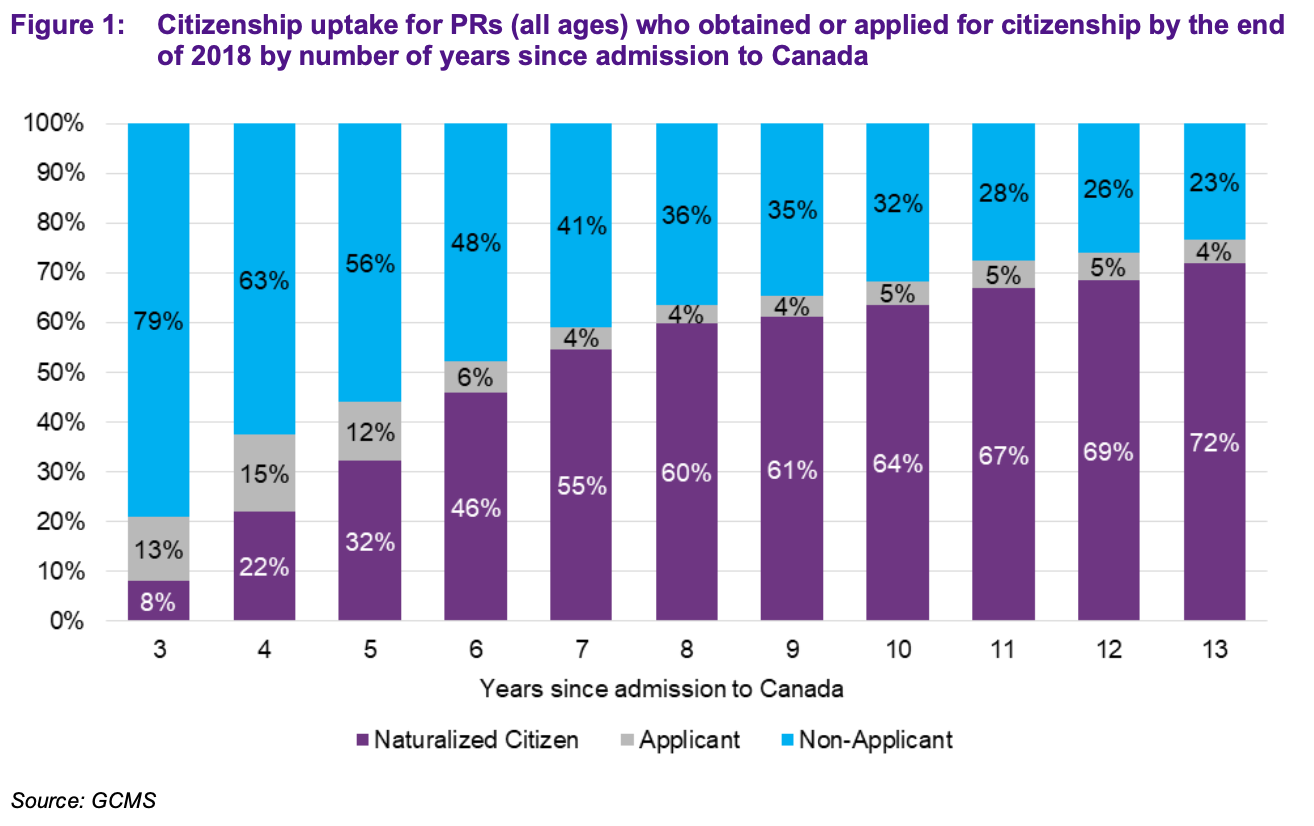
Overall, the analysis found that citizenship uptake was 57% for this population, with 50% of PRs having become citizens, and 7% having applied. The analysis also showed that the more years in Canada, the greater the percentage of PRs who had obtained or applied for citizenship (Figure 1). Citizenship uptake ranged from 21% after 3 years in Canada as a PR (2015 cohort) to 76.5% after 13 years in Canada as a PR (2005 cohort).

4.1.2 Challenges related to fees

Finding: The citizenship application fee is a common challenge for permanent residents, particularly refugees, families and those with lower income.

Sections 31 and 32 of the Citizenship Regulations deal with the structure of two fees related to citizenship: the Fee for Right to be a Citizen, and the Fee for Application to be a citizen. The Fee for Right to be a Citizen is payable only by applicants aged 18 years or older, at a cost of $100. The Fee for Application varies from $100 for minor grant applications, to $530 for adult grant applications.Of note, these fees do not account for extraneous costs related to applying for citizenship that applicants may incur.

The adult grant application fee increased twice during the evaluation period.A review of citizenship grant application data did not reveal a significant decrease in the volume of applications received after these changes were implemented.Interviews also suggested little to no impact of these changes overall, but pointed to possible challenges for vulnerable people, like refugees.

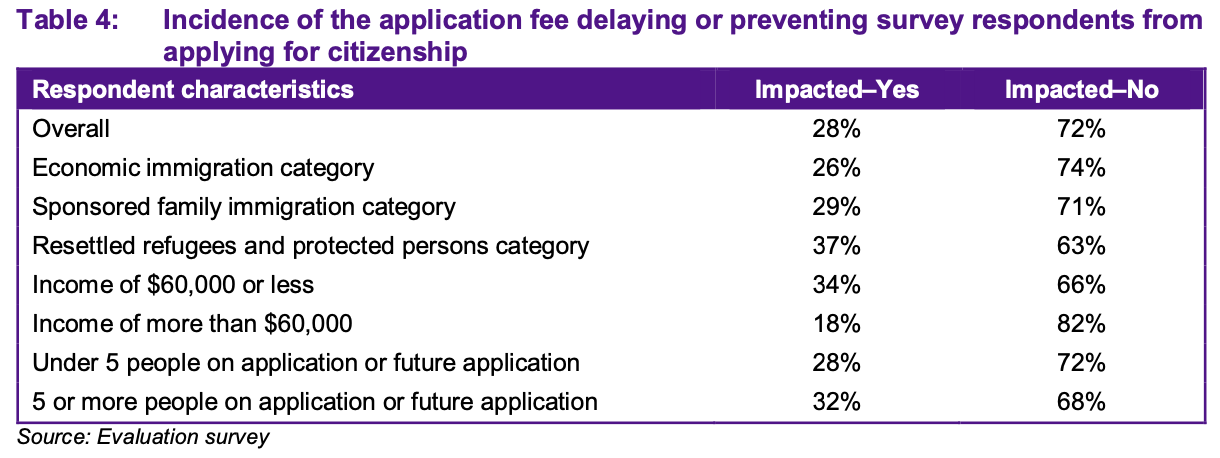
Evaluation survey results were consistent with interview findings. While many respondents did not indicate a problem with the application fee, 28% indicated that it had delayed or was preventing them from applying for citizenship at the time of the survey. This percentage was greater for resettled refugees and protected persons, respondents with a personal income of $60,000 or less, and those with 5 or more people on their application (or future application) (Table 4). Moreover, about half of evaluation survey respondents who had not applied for citizenship felt a lower application fee would encourage them to apply.

Census-based research also showed evidence of a more pronounced decline in naturalization among recent immigrants (5 to 9 years in Canada) with low family income. Findings from the interviews and focus groups with PRs suggested that economically disadvantaged newcomers, such as those who are unemployed, are not able to afford the costs associated with applying (e.g., costs associated with third-party language testing). Moreover, the fear of being unsuccessful in an application (e.g., not passing the knowledge test) and losing the applications fees (or paying to reapply) was also noted in the focus groups with PRs and program-led consultations on Discover Canada.  The impact of the fees was also thought to be amplified for larger families with multiple applications.

Citizenship test and study guide:

Interviews generally noted that the test is efficient, easy-to-grade, and objectively scored. However, the language level of the test and study guide was viewed as higher than the language requirement. Moreover, the evaluation observed that the two requirements involve different skills. The official language criteria are based on oral communication skills (speaking and listening), while the knowledge test is generally written and requires reading skills. Although applicants can access an audio version of the study guide and an oral knowledge hearing, this does not address comprehension challenges related to language level.

Program-led consultations on Discover Canada (to update the study guide) also found that the language level can be difficult for many newcomers. Similarly, research findings suggested challenges with the approach, as the knowledge test pass rate dropped sharply for applicants (18- 54) after the Discover Canada study guide was introduced – from about 96% to 83.5% in 2011. Consultation findings highlighted a need for the wording and tone to be more inclusive and easier to understand, and included suggestions for the use of plain language and definitions, having less text and more visuals, and providing additional tools and support to increase accessibility and effectively communicate the information in the study guide. As a result of these consultations, a new approach, including a new guide and additional tools, is being developed to help address these concerns, but it had not yet been implemented at the time of the evaluation.

Source: https://www.canada.ca/content/dam/ircc/documents/pdf/english/corporate/reports-statistics/evaluations/e1-2018-citizenshipprogram-eng.pdf

Green: Canada should revive the investor immigrant program and fix its past failures

Not aware of any studies that show meaningful benefits from investor immigration programs in OECD countries. Green is notably vague with respect to how he proposes to “fix its past failures” beyond increasing the investment threshold. The IRCC evaluation was devastating (https://www.google.com/url?sa=t&rct=j&q=&esrc=s&source=web&cd=&cad=rja&uact=8&ved=2ahUKEwjN2Z6D2qDtAhX8GFkFHWXyCD4QFjAAegQIAxAC&url=https%3A%2F%2Fwww.canada.ca%2Fcontent%2Fdam%2Fircc%2Fmigration%2Fircc%2Fenglish%2Fpdf%2Fpub%2Fe2-2013_fbip.pdf&usg=AOvVaw2KiDUWqxbDR2xBXtujZnYm) and census data indicates the median incomes based on tax data to be minimal and lower than refugees. Quebec’s comparable program largely serves as a backdoor entry to other parts of the country:

From the earliest days of Confederation, immigration has been essential to Canada’s evolution and identity as a country. The labour – and tax dollars – of successive waves of people from around the world have supported universal health care, pension plans, education, national infrastructure, and the creation of small businesses and employment.

The economic stress caused by a global pandemic, on top of the dual realities of an aging population and a slow-growing population, make immigration more important than ever. It is also an opportune time for Canada to revive the investor immigrant program that was terminated in 2014, with a view to integrating it into our long-term economic strategy.

The federal government has clearly flagged that expediting immigration to Canada is a priority over the next several years.

In addition to setting a target to welcome 401,000 permanent residents in 2021, Ottawa recently made it easier for Hong Kong students and youth to quickly come to Canada on work and study permits, as well as offering new ways to stay permanently. The new permanent residence rules will also benefit people from Hong Kong already in Canada under existing work and study permits.

Then there’s the 300,000 Canadian citizens living in Hong Kong, many of whom, in light of recent political developments there, may be contemplating a return.

Also consider that although many applications were delayed by COVID-19, most are already well down the approval pipe and will proceed quickly once embassies and visa agencies fully reopen. Ottawa has already flagged that it will work to fast-track increased admission to Canada in 2021.

For all of that, there is much more that can be done for both prospective immigrants and Canada. At the top of that list is a practical reassessment of the investor immigrant class.

In 2020, the practical benefits of reviving the program far outweigh any misplaced concern about those “buying” Canadian citizenship.

Let’s not be hypocritical: Those of us already fortunate enough to live here stand to benefit as much as anyone who is new to the country.

The key to making it work this time around is to be clear-eyed about past failures, to refine the tax structure and better manage the five-year deposits required by these immigrant investors. It does not seem excessive to increase the $800,000 fee that was required before the Harper government cancelled the program. But in the past, those deposits were directed to provinces to foster the growth of small and medium-sized enterprises – a well-intentioned initiative that never took shape.

By learning from that disappointing experience, Canada can win on several counts.

It can seize opportunity to create a COVID-19 fund to help offset the economic cost of the coronavirus and attract immigrants who have the means to make a big difference in short order.

It can also attract a group of educated and financially secure immigrants who, along with their families, will make a lasting contribution to our economy. It is also an opportunity to bring regional and local governments into the process to ensure the funds are put to the best use.

Nowhere would that difference be felt more immediately than in the stabilization of the domestic residential real estate market, small business and employment, something of great importance to all Canadians and their families.

For some time now, there have been claims that housing markets, especially condominiums in urban centres, are threatened by an imbalance of supply and demand.

That’s a tough prospect for municipalities and provinces that have already been economically ravaged by the effect of the coronavirus.

Higher immigration levels – especially in the economic class – address this on a number of levels.

Furthermore, while much has been made of the pandemic-driven urban exodus, new Canadians tend to gravitate to and revitalize our cities.

Immigration is an important way for Canada to build long-term economic, social and cultural bridges around the world. Does anyone think it will be anything but beneficial to our relations with Washington that vice-president-elect Kamala Harris had such a positive experience as a student in Montreal?

We have always been justifiably proud of being a country of immigrants. Clearing the 2020 backlog, expediting new permanent residency applications and reinstating the investor immigrant class is both timely and strategic at a time when we need to reinforce our country as seldom before, and to ensure the long-term prosperity of all Canadians.

Green is a Managing Partner at Green and Spiegel and past chair of the Canadian Bar Association, National Section, Citizenship and Immigration

Source: https://www.theglobeandmail.com/business/commentary/article-canada-should-revive-the-investor-immigrant-program-and-fix-its-past/

Apex Capital Partners Launches Discounted Citizenship by Investment Program for Concerned Citizens Following Flood of Inquiries from Conservative Americans Looking to Relocate Abroad After Biden’s Presidential Victory

Almost funny but reflects a certain mindset (don’t recall any similar pitches from citizenship-by-investment firms targeted at Democrats following Trump’s election (the Cape Breton site encouraging Americans was more a welcome site):

 Apex Capital Partners, a boutique financial advisory firm specializing in advising international individuals and governments on Citizenship by Investment Programs (CIPs), today announced the availability of its “American Second Passport Program,” a new option intended for US citizens who are concerned with the country’s direction under President-Elect Joe Biden, and are now serious about moving abroad. Ultimately, CIPs provide individuals and their families with the legal means for acquiring second citizenships, passports and permanent residency in other countries, often in the Caribbean or Europe.

Apex Capital Partners typically receives approximately five inquiries from American citizens per year but is now hearing from numerous concerned citizens on a daily basis, experiencing a 650% increase in interest since the November 3rd election alone, when compared to 2019. This comes as no surprise, as leading up to the election the team has been inundated with requests from high net worth individuals, particularly conservatives, seeking to relocate abroad should now President-Elect Biden emerge victorious. Now, the Company is offering 35% off its American Second Passport Program until January 20, 2020 – Inauguration Day.

Many Americans are now very concerned about proposed significant increases to their income tax payments, as well as continued social unrest. Further, this year’s “American nightmare” fueled by COVID-19 has resulted in very restricted travel for Americans, limiting recreational or business trips for anyone possessing just a US passport. For these reasons, citizenship by investment in other parts of the world is widely considered a safe, financially secure passport diversification option.

Americans concerned by a Biden administration are turning to Apex Capital Partners, a leading, internationally recognized Company that works directly with both international governments and those pursuing citizenship abroad to implement strategies needed to acquire foreign citizenships. These alternative citizenship opportunities are made possible through CIPs, a legal transaction in the form of a real estate or infrastructure investment in exchange for citizenship, in countries such as the Caribbean and Europe – with popular examples such as St. Kitts and Nevis, Saint Lucia, Dominica, Grenada and Montenegro.

“CIPs are especially valuable now for three key reasons. One, with an alternative to a US passport, travelers and business executives can bypass the current travel COVID 19 restrictions in place. Two, people can reside in a safe, unthreatened place amid shaky US social and political conditions that they perceive are dangerous. Lastly and right now the most popular reason, is that citizenship abroad enables for more financial security and often reduced taxes – a concern felt by many conservatives and HNWI,” said Nuri Katz, Founder of Apex Capital Partners.

Interest to leave the country after Biden’s victory has also been expressed publicly to the nation by none other than President Trump himself, who recently suggested “maybe I’ll have to leave the country.” Prior to the outcome of the 2016 Election, many liberal individuals and families across the country threatened to leave if Trump was elected. Some people left, while many more turned to social media to state their displeasure with Trump’s administration. Four years later, the same trend came during the first 2020 presidential debate, when Google searches for “move to Canada” greatly spiked.

“Talk about leaving the country after an election outcome is certainly not new, but we’re now seeing it become a reality after such a difficult year. In 2017, around 5,000 people internationally obtained CIPs, but this year I estimate it to be 25,000,” said Katz. “Despite all the potential and personal reasons for wanting to leave the United States, it is still a very difficult decision and should be conducted with an experienced team of migration advisors as well as tax and legal professionals. Using a network of legal advisors, our team informs investors on viable options to seek citizenship and evaluate all financial consequences. Throughout this process, we’re here to help answer any and all questions.”

About Apex Capital Partners

Apex Capital Partners is a full-service advisory firm specializing in investment consulting and wealth management for a multinational, high-net-worth clientele. APEX provides services with end-to-end execution in areas such as second citizenship and immigration, wealth and asset management, financial services, and international real estate sale and development.

For more than two decades, APEX consultants have guided affluent individuals and their families through the complexities of foreign investing, and of obtaining second citizenship and residency. The APEX team also advises governments in establishing Citizenship by Investment programs, and provides support services to financial institutions, law firms, and family offices representing the interests of high-net-worth investors. For those interested in pursuing a citizenship by investment opportunity, please contact Apex Capital Partners by visiting http://apexcapital.partners/

Source: Apex Capital Partners Launches Discounted Citizenship by Investment Program for Concerned Citizens Following Flood of Inquiries from Conservative Americans Looking to Relocate Abroad After Biden’s Presidential Victory

Advocates calling on Canada to resolve citizenship application backlog

No surprise. The requests are largely reasonable (greater transparency on status of applications, resumption of tests but not waiving them). Given the government’s campaign commitment to abolish the fees, understandable that they request a reimbursement of the fees (to date, no sign of IRCC acting on that commitment):

Citizenship-applicants and their supporters are calling on the federal government to address the backlog that is preventing thousands from becoming Canadian citizens.

A group called Advocates for Resumption of Canadian Citizenship Tests held demonstrations in Toronto and Montreal on November 7. The group was formed in response to the backlog in citizenship applicants waiting to get approved for a test, or for a citizenship ceremony. Their next demonstration will be in Ottawa on November 28.

Canada’s immigration department, Immigration, Refugees and Citizenship Canada(IRCC), cancelled all citizenship tests, interviews, and ceremonies on March 14 in response to the pandemic. IRCC began offering online citizenship ceremonies in April, at a rate of about 2,500 to 3,000 per week, significantly down from the 4,700 they were processing per week in 2019.

Citizenship applicants must demonstrate basic knowledge of Canada, as per the Citizenship Act. Applicants now must meet this requirement by doing the citizenship test, which is currently not available online. Though some in-person retesting has resumed, this means for many that they are unable to get Canadian citizenship. As of September, there were about 85,000 people waiting to take the citizenship test.

As a result, they are unable to vote, work in certain government jobs, or get a Canadian passport.

“It worries us, when we receive several messages in our group from people describing how this is affecting their mental health, relationships, their ability to travel home, their government job prospects, the need to unnecessarily extend their PR status etc.,” wrote a spokesperson from the citizenship tests advocates in a media release.

Nael Asad is one of the co-founder of the advocacy group, and one of thousands waiting for an invitation to take the citizenship test. He has had his permanent residency since 2008, and applied for citizenship in April 2019. Before the pandemic, IRCC’s average processing time for citizenship applications was about one year, so Asad was expecting an invitation for around the time when the pandemic hit in March.

“It’s very disrespectful to leave 85,000 people or more out there in limbo without any kind of update,” Asad told CIC News. “Tell us, ‘OK we’re not going to open up until this pandemic are over,’ but for eight or nine months now they’re saying the same thing ‘We’re monitoring the situation, check our website for updates.’ So people are going every single day on the website to check for updates.”

He also described how being a citizen comes with a sense of security, especially for people who fled war zones to come to Canada.

“When you are a citizen, you are a citizen,” he said. “Nothing is gonna happen to you this is your home country, but technically it is not our home country until we become citizens.”

The advocacy group’s online petition now has over 9,000 signatures. They are making three calls to action for IRCC: transparency on what the immigration department has been doing with the applications since March; the resumption, or wavier, of citizenship tests; and the reimbursement of the citizenship application fee, which runs about $630 for adults.

CIC News reached out to IRCC on updated numbers of citizenship files processed, but did not receive a response in time for publication.

Source: Advocates calling on Canada to resolve citizenship application backlog

Trump administration revives talk of action on birthright #citizenship | TheHill

Last gasps, supported by the usual groups. Executive orders can for the most part be easily undone by the Biden administration:

The Trump administration has revived discussions around taking executive action targeting birthright citizenship in its final weeks before leaving office, according to two people familiar with the discussions.

President Trump has spoken throughout his first term about ending birthright citizenship. Drafts of a possible order have been circulating for some time, and there is now internal discussion about finalizing it before the Biden administration takes over in January, sources said.

The administration is aware the order would be promptly challenged in court, but officials would hope to get a ruling on whether birthright citizenship is protected under the 14th Amendment, according to one source familiar with the plans. Many lawmakers and experts have argued it is protected, but the courts have not definitively ruled on the issue.

“Since taking office, President Trump has never shied away from using his lawful executive authority to advance bold policies and fulfill the promises he made to the American people, but I won’t speculate or comment on potential executive action,” White House deputy press secretary Judd Deere said in a statement.The Department of Justice has been consulted about a possible birthright citizenship order given it would deal with the legal implications of the new policy. A spokeswoman for the department did not immediately respond to a request for comment.

The birthright citizenship measure is being discussed as one of multiple executive actions the Trump administration could take on its way out the door. White House chief of staff Mark Meadows told aides following Election Day to come up with possible policy priorities to push through in the two months before Inauguration Day.

Others in the works include additional reforms to the H-1B visa program, regulatory reforms and measures targeting China. The president earlier Friday announced two major actions aimed at lowering the price of prescription drugs.

The wave of action reflects how many in the White House are attempting to cement their agenda before the Biden administration takes over in January, even as Trump refuses to concede the race and has pursued thus far unsuccessful legal challenges in key battleground states.

The president first proposed ending the practice that grants citizenship to those born in the United States during his 2016 presidential campaign. He revived the idea in 2018 during an Axios interview, saying he would sign an executive order to enact the change.

Trump in August 2019 again said his administration was “very seriously” considering a measure to end birthright citizenship.

In each instance, lawmakers and legal experts have pushed back on the idea and cast doubt on Trump’s ability to unilaterally end birthright citizenship. They have asserted that birthright citizenship is protected under the 14th Amendment, which states, in part, that “all persons born or naturalized in the United States, and subject to the jurisdiction thereof, are citizens of the United States and of the State wherein they reside.”

Some outside groups and allies of the administration have wondered why Trump has waited until his final weeks in office to follow through on a birthright citizenship order that he has talked about for years.

“The Citizenship Clause of the 14th Amendment was clearly intended to guarantee that emancipated slaves would properly be recognized as U.S. citizens,” said RJ Hauman, government relations director at the Federation for American Immigration Reform. “It is a fundamental misapplication of this clause that U.S.-born children of illegal aliens are granted automatic citizenship, much less the offspring of people who come here to simply give birth on American soil.”

“If the president finally issues a long-awaited executive order limiting birthright citizenship, it will be up to the Supreme Court to resolve this issue once and for all,” Hauman added.

Source: Trump administration revives talk of action on birthright citizenship | TheHill

Evaluation of the Citizenship Program

Reasonable findings and recommendations and findings covering some of the issues I have written about over the past few years: high citizenship fees, greater support for knowledge acquisition (including the long delayed revision to Discover Canada) and better and more coherent citizenship promotion. Helpful.

This report presents the findings of the evaluation of Immigration, Refugees and Citizenship Canada’s (IRCC) Citizenship Program. The evaluation was conducted in fulfillment of requirements under the 2016 Treasury Board Policy on Results, and considered program performance with a focus on the citizenship grants line of business and program management. The evaluation covered the period from 2013 to 2018, with some consideration of earlier years to better understand the implications of policy changes, uptake trends and program developments.

Overview of the Citizenship Program

The Citizenship Program administers citizenship legislation and promotes the rights and responsibilities of citizenship, impacting both newcomers who wish to become citizens as well as current Canadians. Broadly, the Citizenship Program consists of citizenship awareness, citizenship acquisition, confirmation and revocation, and program management.

To obtain Canadian citizenship, individuals must first meet eligibility requirements, complete and submit an application, and attend a ceremony where the oath of citizenship is recited before a citizenship judge. Applicants pay a fee for the grant application ($100 for a minor grant application and $530 for an adult grant application), and applicants aged 18 years and older pay a $100 fee for the Right to be a Citizen. Naturalized citizens are conferred legal status in the country and receive rights, namely the right to vote, hold public office and the right to remain in Canada. For many, citizenship is a significant milestone of their integration. Of the 2,826,300 permanent residents admitted to Canada between 2005 and 2015, 50% were naturalized citizens by December 31st, 2018, and a further 7% had applied for citizenship.

Broadly, the Citizenship Program expects to contribute to eligible permanent residents becoming Canadian citizens by ensuring that Canadian citizenship involves active engagement and is a valued status, that citizenship is accessible to all who meet eligibility requirements, including vulnerable groups; and that client service standards are predefined and maintained. In doing so, the department must also ensure that newcomers and Canadians are aware of the responsibilities and privileges associated with Canadian citizenship, that newcomers to Canada have a desire to become citizens, and that the integrity of Canadian Citizenship is protected through a robust processing and policy framework.

Conclusions and recommendations

Overall, the evaluation found that, with time, most permanent residents (PR) become Canadian citizens. However, the citizenship uptake rate can vary for different populations, and has declined among more recent immigrants, suggesting that newcomers are taking longer to become citizens. While there are many reasons for obtaining citizenship, evidence suggested that wanting to feel fully Canadian and to make Canada their permanent home are primary motivators for PRs. It was observed that the grant application approval rate is very high, and recent changes to eligibility under Bill C-6 have generally been facilitative. Furthermore, increases to the application fee over the evaluation period did not have a major impact on overall uptake.

Nevertheless, while most PRs do eventually obtain citizenship, accessing it comes with significant challenges for some, specifically those from more vulnerable groups.

Evidence showed that meeting the language and knowledge requirements can be difficult, particularly for refugees, as well as for those with low official language proficiency and less education. While the Citizenship Act has built in some discretion to waive these requirements on compassionate grounds, compassionate considerations are not well defined, and waivers are typically predicated on a medical opinion. Moreover, waivers have to be requested by applicants, but the waiver process is not well known and difficult to navigate. Evidence showed very few waivers requested or granted during the evaluation period. However, given the issues noted, it was unclear whether these numbers reflected an appropriate level of use of this mechanism.

In addition, the application fee was found to be a common challenge, particularly for refugees, families and those with lower income. The Citizenship Program does not currently offer any flexibility around grant application fees. The fee structure is set out in the Citizenship Regulations, and provides individual rates for adult and minor grants.

With this in mind, there is a need to re-examine the waiver process and fee structure in order to ensure that sufficient mechanisms are in place to facilitate equitable access to citizenship and to better serve and support prospective applicants who may be facing socio-economic challenges, as well as families with multiple applications and fees to pay.

Recommendation 1: IRCC should review the costs associated with applying for citizenship and implement a strategy to address the affordability of citizenship for prospective applicants facing economic challenges.

Recommendation 2: IRCC should implement and promote a clear and transparent process for knowledge and language waivers to ensure consistent access and decision-making for prospective applicants who need them.

The evaluation also found that the citizenship eligibility requirements related to physical presence, language and knowledge are largely set at an appropriate level. While there are various tools and methods in place to support the assessment of these requirements, findings were mixed in terms of their effectiveness, highlighting important challenges to be addressed.

It was observed that while the requirement for physical presence is clearly defined, it can be difficult for applicants to prove, as well as for IRCC officers to verify, without entry-exit information. For language, it was noted that the range of evidence accepted is very broad and does not always reflect the applicant’s actual language ability. When there are concerns, it can be difficult for IRCC officers to assess language ability, as the tools in place are subjective and officers are not formal assessors. For knowledge, it was noted that the test and study guide have a higher language level than that of the language requirement, and there is a need for more tools and support for applicants.

At the time of the evaluation, implementation of a new Entry/Exit Program was already underway, which was expected to address issues related to tracking and verifying physical presence in the future. In addition, a new approach for the knowledge assessment tools was being developed, with a new study guide and supporting materials, but had not yet been implemented at the time of the evaluation.

Thus, while a strategy is being implemented to improve the tools and methods available to assess physical presence in Canada, there is still a need to address outstanding challenges with respect to the tools and methods in place to assess the language and knowledge requirements.

Recommendation 3: IRCC should review the language verification process and put in place a strategy to ensure that IRCC officers are more effectively equipped to validate language evidence and better supported to assess language ability when needed.

Recommendation 4: IRCC should move forward with its plan to implement a new approach for the knowledge requirement, which could include a revised study guide and additional tools, to improve the accessibility of the required information and enhance supports for prospective applicants studying for and taking the knowledge test.

Overall, integration outcomes were positive for naturalized citizens. It was observed that many feel a sense of belonging to Canada, their province or territory and to their community. They have social connections in Canada and confidence in Canadian institutions. Moreover, many are performing well economically, and some are volunteering and participating in groups, organizations or associations.

It was also observed that many PRs, particularly those intending to apply for citizenship, feel a sense of belonging, have social connections and confidence in Canadian institutions, suggesting that newcomers with stronger feelings of connection to Canada have a desire to become Canadian. In addition, while a difference in employment earnings was found between PRs and naturalized citizens, this difference was not attributable to citizenship, but rather to the socio-economic characteristics of those obtaining it, largely previous earnings and length of time in Canada.

Differences between PRs and naturalized citizens were also found for volunteering and group membership. They were found to be more prevalent among naturalized citizens, followed by PRs intending to apply for citizenship, and lowest among those not intending to apply. The rates of volunteering and group membership also varied based on socio-economic characteristics.

Thus, evaluation results highlight the relationships between integration and engagement in Canadian society, and some of the dynamics of decision-making around citizenship. Becoming Canadian and active engagement are at the core of IRCC’s Citizenship Program objectives. While these objectives are generally seen as relevant and appropriate, the program has limited mechanisms and resources to influence them. At present, IRCC’s citizenship promotion activities are largely newcomer-focused and tied to the citizenship grant process or funded by the Settlement Program, which excludes citizens from its eligibility.

With this in mind, there is a need to ensure that the department’s objectives for citizenship promotion are aligned with the activities, mechanisms and resources in place to achieve them.

Recommendation 5: IRCC should review its objectives for citizenship promotion, and the corresponding activities, mechanisms and resources available, and develop and implement a plan to better support the achievement of its expected outcomes.

View or download the evaluation:
Complete report: https://www.canada.ca/content/dam/ircc/documents/pdf/english/corporate/reports-statistics/evaluations/e1-2018-citizenshipprogram-eng.pdf