Citizenship Program: Results Highlights

A quick look at the IRCC citizenship program results posted on the TBS site indicates the following:

  • 95 percent satisfied with the service received;
  • Only 65 percent of applications processed within the 12 month service standard (target is 80 percent). Don’t believe IRCC has ever met this standard, reflecting perennial structural and financial issues with the program.
    • Departmental explanation: “In 2019–20, a total of 65% of citizenship grant applications were processed within the 12-month service standard. The absolute volumes of citizenship applications continue to increase year after year. The number of citizenship applicants who became Canadian citizens has increased by 118%, from 112,969 in 2017–18 to 247,139 in 2019–20. Growing application volumes have strained the operational processing model causing increased processing times. The citizenship applications process is heavily paper-based and relies on manual data entry. The program is also facing a large increase in demand and the current funding levels are outpaced by application volumes. The program is exploring ways to transform the processing model to increase speed and efficiency and develop digital tools for improved client service.”
  • 86 percent of eligible permanent residents have become Canadian citizens. As I have mentioned repeatedly, the performance measure is based upon the total number of immigrants who became citizens, whether they arrive 5 or 50 years ago, and hence is meaningless as a performance indicator. A real performance indicator would use the percentage of recent immigrants who have become citizens, those who immigrated to Canada in the past Census period (5 to 9 years):
    • “Rationale: Canada’s immigration model encourages newcomers to naturalize (become citizens) so that they can benefit from all the rights of citizenship and fully assume their responsibilities, thereby advancing their integration. Take-up rates are considered a proxy that illustrates to what extent permanent residents value Canadian citizenship. Calculation / formula: Numerator: Permanent residents in Canada who are eligible to acquire Canadian citizenship and self-report on the Census that they have acquired Canadian citizenship. Denominator: Permanent residents in Canada who are eligible to acquire Canadian citizenship. Data Source: Statistics Canada’s Census Baseline: 2016: 85.8% Definitions: Naturalization: The Census instructs individuals who have applied for, and have been granted, Canadian citizenship (i.e., persons who have been issued a Canadian citizenship certificate) to self-report their citizenship as “Canada, by naturalization”. Notes: In the performance narrative, IRCC administrative data could be used to tell the story of citizenship from an operational and policy perspective. Information on age, gender, immigration stream, and country of origin of new citizens would be considered in order to explain changing trends. It is also important to note that calculations using IRCC’s administrative data will be based on the number of people admitted as permanent residents who took up citizenship. Figures from Statistics Canada indicate that in 2011, about 6,042,200 foreign-born people in Canada were eligible to acquire citizenship. Of these, just over 5,175,100, or 85.6%, reported that they had acquired Canadian citizenship. This naturalization rate in Canada was higher than in other major immigrant-receiving countries. In telling the story of the naturalization rate, it will be important to explain the reasons why some people choose not to naturalize.”

Source: https://www.tbs-sct.gc.ca/ems-sgd/edb-bdd/index-eng.html#orgs/dept/123/infograph/results
Sweden proposes language requirement for would-be citizens

Pretty standard requirements elsewhere:

Justice and Migration Minister Morgan Johansson presented details of an inquiry into the proposals on Wednesday morning.

“Language is the key to work, but also the key to society,” said Johansson as he outlined why the government thought it needed to find “a better balance between rights and responsibilities” for would-be citizens.

Foreign nationals applying to become Swedish would need proof of Swedish skills at A2 level for speaking and writing, the second lowest out of six levels on the Common European Framework of Reference, and B1 for reading and listening.

To take the test, it would cost 500 kronor ($60) for the section relating to civil society and 2,000 kronor for the language component.

Citizenship applicants could alternatively provide proof of passing Grade 9 in a Swedish high school, or a course at upper secondary school, or the highest level of the Swedish For Immigrants (SFI) course.

The language requirements would apply to people aged between 16 and 66 who apply for Swedish citizenship, but certain exceptions are proposed, including for people with certain disabilities or those who are from a vulnerable background – for example being stateless or illiterate – who can prove they have tried to reach the required knowledge level but been unsuccessful.

Citizens of other Nordic countries who live in Sweden would also be exempted, as they are subject to a different process and are only required to notify authorities, rather than apply, in order to receive citizenship.

The proposals were put together based on reviewing the processes in place in other European countries, of which only three including Sweden do not currently require a language test.

But the details aren’t finalised yet. The next stage is to send the proposals out for consultation from relevant authorities, and they may be adapted depending on the responses received. Then a proposal would need to be passed by parliament and work to begin on putting together the tests.

“This is a reasonable proposal and we hope that it can be put into place as soon as possible, but of course this is a large organisational challenge,” said Johansson.

The government committed to investigating language tests for citizenship applicants in the cross-bloc deal struck with the Centre and Liberal parties, whose support the Social Democrat-Green coalition needed to form a government.

Separately, the government is looking into whether language skills should be required for permanent residence in Sweden.

Source: https://www.thelocal.se/20210113/sweden-proposes-language-requirement-for-would-be-citizens

Pro-establishment figure calls for curbs on Hongkongers obtaining dual citizenship

Further crackdown if reflects Beijing’s view and implemented:

Hong Kong’s former security chief has called on Beijing to effectively forbid obtaining dual nationality by revoking the right to live and vote in the city for any resident who acquired foreign citizenship after a “specified cut-off date”.

Pro-establishment lawmaker Regina Ip Lau Suk-yee’s proposal came as the city government hit back at the foreign ministers of the United States, Canada, Britain and Australia, who had jointly voiced serious concerns over last week’s mass arrest of 55 opposition politicians and activists in Hong Kong under the Beijing-imposed national security law.

Even before the arrests, Hong Kong was already bracing for a surge of emigration after London created a new route to citizenship for locals eligible for British National (Overseas) status. The new visa scheme was envisioned as a lifeboat for Hongkongers in the wake of the imposition of the security law, which Britain has deemed a breach of the Sino-British Joint Declaration.

Describing Britain’s offer as “a slap in the face of Chinese authorities”, Ip said it might be time for Beijing to end its special treatment of Hongkongers and enforce its own nationality law in the city.

“This could be done after a specified cut-off date. Thereafter, Hong Kong Chinese who acquire a foreign nationality of their own free will, will be deemed to have lost Chinese nationality, in strict accordance with Article 9 of the Chinese Nationality Law,” Ip, a government adviser on the Executive Council, the city leader’s de facto cabinet, wrote in an opinion piece in the Post on Sunday.

“If that happens, Hong Kong Chinese who acquire a foreign nationality by emigration or other means voluntarily would automatically lose their right to hold concurrently a Hong Kong Special Administrative Region passport. They could also lose the right of abode in Hong Kong and the attendant right to vote in Hong Kong elections.”

Source: Pro-establishment figure calls for curbs on Hongkongers obtaining dual citizenship

Egyptians in exile fear losing citizenship

Of note:

Egypt’s Prime Minister Mustafa Madbouly recently issued a decision to revoke the nationality of Ghada Naguib, an opposition political activist and the wife of well-known artist Hisham Abdallah, both of whom have lived in Turkey for several years.

The decision, published in the official gazette Dec. 24, reads that Naguib’s Egyptian nationality was withdrawn based on the grounds that she was convicted of a felony to harm the Egyptian state’s security while residing abroad. The decision also stated that Naguib is a Syrian national.

Naguib left the country in January 2016 along with her husband, who works as a TV host at the Egyptian opposition al-Sharq channel in Turkey, after Abdallah was accused of a number of political issues. They have been residing in Istanbul since then.

Speaking to Al-Monitor virtually, Naguib rejected the decision to revoke her nationality, saying it is a mere political decision that will not make her a non-Egyptian citizen, adding that she will continue to oppose the regime of Abdel Fattah al-Sisi.

Commenting on the claims of being a Syrian national, Naguib said, “It is not true that I hold Syrian citizenship. It is true, however, that I have Syrian origins. But the only citizenship I hold is the Egyptian one.” Naguib added that the decision to strip her of her nationality, which rendered her stateless, took her by surprise, saying it is designed to terrify her and any other Egyptian opposition activist.

Meanwhile, other Egyptian opposition activists fear their nationality will be revoked in light of a lawsuit brought before the State Council, which is Egypt’s highest judicial authority that rules on administrative matters.

On June 20, the Administrative Judicial Court of the State Council decided to delay the lawsuit filed by Samir Sabry, a lawyer known for his support of Sisi’s regime. The lawsuit calls for the withdrawal of the nationality of 11 Muslim Brotherhood officials and journalists residing in Turkey over terrorism charges. A date for a court session to decide on whether to move forward with the lawsuit will be decided after the court’s expert committee gives its opinion on the case. If accepted, the lawsuit would entail the withdrawal of the nationality of all those involved in the case.

The lawsuit involves journalists, former ministers and senior Muslim Brotherhood leaders. These are, namely, Moataz Matar, Mohammad Nasser, Hussam Shorbaji, Hamza Zawbaa, Medhat al-Haddad, Ayman Nour, Mahmoud Ezzat, Mohammad Abdel Azim al-Bashlawi, Ayman Ahmed Abdel Ghani and Abdel Aziz Mohamed Abdel Aziz, as well as Yehia Hamid, the former investment minister in the Brotherhood government.

In September 2017, Egypt’s government approved new amendments to the Egyptian nationality law, expanding the government’s ability to issue decisions stripping citizenship. One of the amended articles allows the government to revoke the citizenship of those convicted of belonging to a group seeking to harm the public order, or undermine the states’ social, economic or political regime by force, or any other illegal means. And that also includes any association, party, organization, gang, or any other entity regardless of its legal status, form or nature, and regardless of whether or not it is based in Egypt, with the same goal.

A human rights lawyer residing in Egypt told Al-Monitor that amendments to the Egyptian nationality law “point to the Egyptian regime’s desire to terrify the opposition whether inside or outside Egypt, and to threaten them of stripping them from citizenship if they oppose the regime.”

The source added, “These amendments are authoritarian. They could result in tens of thousands of Egyptians in prisons or at risk of losing their citizenship. It only requires a court ruling convicting a person of being affiliated with any political group. Thus, it would be easy to issue a decision to withdraw citizenship from that person without even having to wait for the appeal against the court ruling, although the appeal could acquit that person.”

The source believes the regime’s goal in revoking Naguib’s citizenship is to test the waters before similar decisions are issued against other opposition activists living abroad. If no reactions are observed, it will be possible to see similar decisions against tens of thousands without any deterrent, he added.

Source: Egyptians in exile fear losing citizenship

France Fast-Tracks Citizenship for Frontline Workers

Broader in scope than Canadian measures. Something for Canadian policy makers and politicians to consider:

Nine months after its president declared “war” against the coronavirus, France announced Tuesday that it has fast-tracked hundreds of citizenship applications from foreign frontline workers who have distinguished themselves in the battle.

“Foreign workers gave their time and swung into action for all of us during the Covid crisis,” said Marlène Schiappa, France’s junior minister for citizenship. “It is now up to the Republic to take a step toward them.”

The beneficiaries include not just health care workers but also garbage collectors, housekeepers and cashiers, Ms. Schiappa said.

The fast-tracking measure is a notable departure for a country that has adopted increasingly tight immigration rules. Caught in the clog of paperwork, citizenship applications can take years to complete, and the number of naturalizations has been decreasing over the years.

Some 48,000 people acquired French nationality through naturalization last year, or about 18 percent fewer than in 2015, according to statistics from the National Institute of Statistics and Economic Studies.

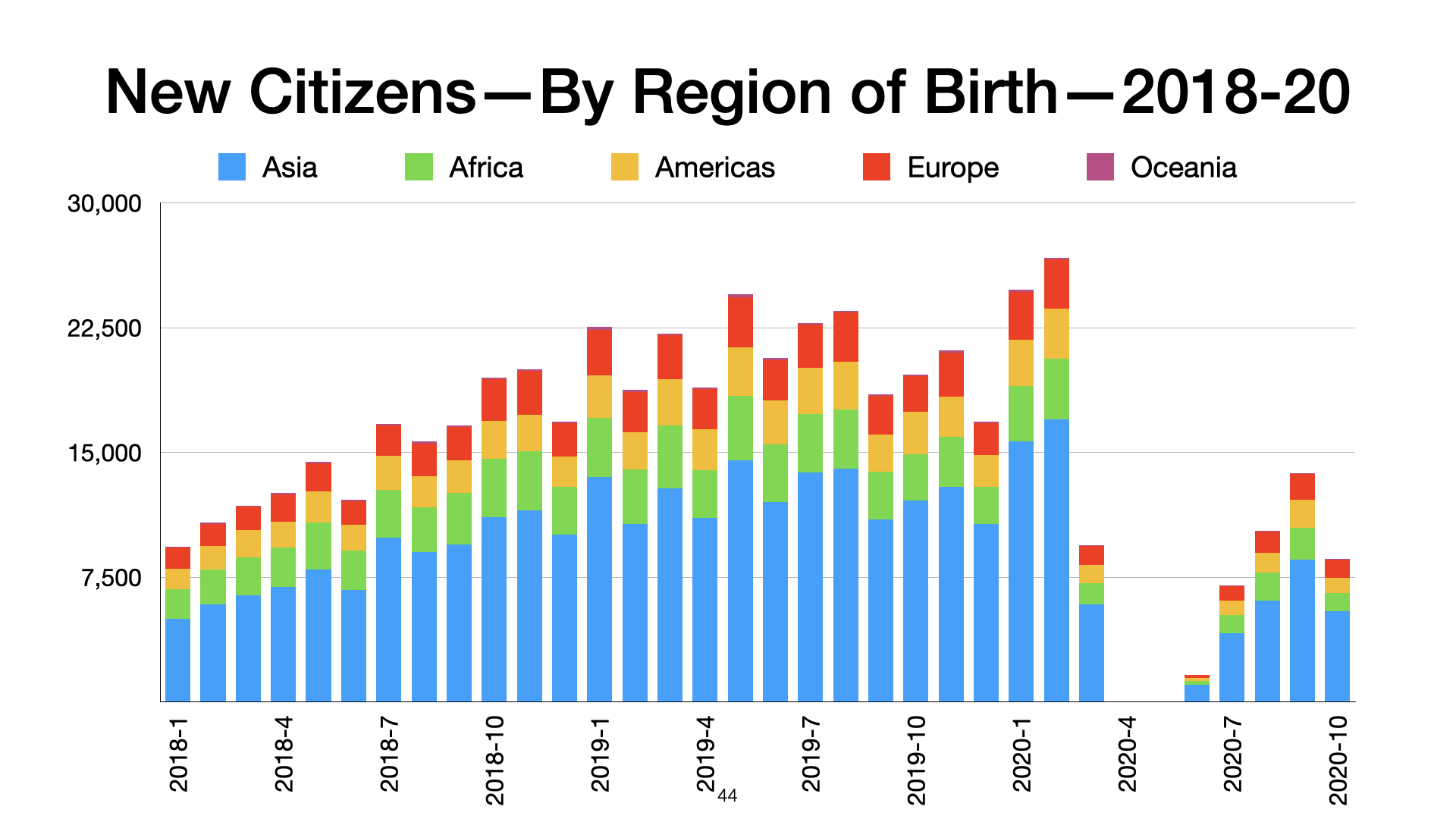
#Citizenship October numbers, year-to-date down 51.8 percent

The open data citizenship numbers, previously only up to June, have now been updated to October like most of the other datasets. No particular surprise, given media coverage, and it appears that IRCC has been working through existing applications given that testing was suspended until recently with only some piloting on online testing.

Country variations year-to-date are largely comparable whereas the October 2020 to 2019 variations are much greater, with France having the lowest impact, Iraq the highest.

Triadafilopoulos: Are Canadians really open to more migration in the future?

A useful warning against assuming getting back to normal:

How are we to make sense of Canadian immigration policymaking during the COVID-19 pandemic? On the one hand, the Trudeau government has pledged to increase both its already ambitious admissions target for 2020 and its annual immigration levels in the next three years. The government’s expansive immigration strategy has earned the praise of immigration boosters while generating little in the way of skepticism (let alone criticism) from opposition parties. For the most part, public opinion has also fallen into line. Yet, paradoxically, the Government of Canada’s open approach to migration of all kinds has been marked by unprecedented territorial closure.

The same contradiction is evident among Canadians: their ongoing support of official multiculturalism has also coincided with increases in racist discrimination. A frank appraisal of Canada’s immigration policy must acknowledge the juxtaposition of aspirational openness, on the one hand, and de facto closure and growing hostility, on the other. Doing so makes it clear that any hope of returning to business as usual after the pandemic may be misplaced.

Canada has earned a global reputation for administering an expansive immigration policy. Bucking the global trend toward greater restrictiveness in the years following the global economic crisis of 2008-09, annual admissions rose steadily under Conservative Prime Minister Stephen Harper’s right-of-centre governments from 2008 to 2015. Prime Minister Justin Trudeau’s centre-left Liberal Party governments have introduced even more ambitious targets. These significant increases in immigration levels have been supported by all of Canada’s major political parties. Canadian governments, regardless of their partisan orientation, have also stood firm in their support of Canada’s policy of official multiculturalism, even as leaders of other liberal democracies have cast multiculturalism as a failed and dangerous experiment. Recent efforts to strike a more restrictive stance on immigration, notably by the populist People’s Party of Canada in the 2019 federal election, have come to naught.

Any hope of returning to business as usual after the pandemic may be misplaced

Public support appears to have held, despite the challenges raised by the pandemic. The most recent iteration of the Environics Institute for Survey Research’s long-running “Focus Canada” survey (published in October) revealed that,

[S]trong and increasing majorities of Canadians express comfort with current immigration levels, see immigrants as good for the Canadian economy and not threats to other people’s jobs, and believe that immigration is essential to building the country’s population … By a five-to-one margin, the public believes immigration makes Canada a better country, not a worse one, and they are most likely to say this because it makes for a more diverse multicultural place to live.

In their commentary for this series, the Environics Institute’s Andrew Parkin and Keith Neuman note that this increase in support for immigration “may in part be a counter-intuitive response to the pandemic itself: rather than focusing inward, Canadians are expressing a greater sense of social solidarity in recognition that, in the face of the crisis, ‘we are all in this together’.”

As we move into the second wave of the pandemic, the fragility of this solidarity is clear. Spikes in infections have led to new lockdowns, which, in turn, have slowed the summer economic recovery. Although the national unemployment rate has come down from a high of over 13% in April 2020, it remains stuck at about 9%. Employment growth has stalled and long-term unemployment has increased. Canadians find themselves living through a period of profound economic dislocation, unlike any in recent memory.

Moves aimed at containing the pandemic have also transformed Canada’s approach to migration. Canadians live in a country that has effectively shut itself off from the world. Despite the announcement of ambitious immigration targets, actual admissions shrank by 64% in the second quarter of 2020. The admission of resettled refugees and protected persons declined by 83%. Trips by residents of countries other than the United States to Canada fell by almost 96% from September 2019 to September 2020.

The current status quo is one of extraordinary closure, marked by popular support for strict controls and increased racism

A majority of Canadians appear to support strict border controls. According to a Nanos Research poll, 81% of Canadians “believe the Canada-US border should stay closed for the foreseeable future.” A 29 October 2020 report by the Association for Canadian Studies noted that 52% of Canadians would prefer to maintain currently low levels of immigration over the next twelve months. Only 24% supported “gradually [increasing] immigration levels” over the same period. An August 2020 survey by researchers at McMaster University and Dynata Research arrived at similar results.

Canada’s embrace of territorial closure has coincided with a spike in xenophobia and racism. A July 2020 poll by IPSOS Global Public Affairs revealed that nearly 30% of Canadians reported that they had “personally been a victim of racism, up five points since [2019].” A survey by the Angus Reid Institute noted that 50% of 500 respondents of Chinese descent had been “called names or insulted as a direct result of the COVID-19 outbreak … [A] plurality (43%) further say they [had] been threatened or intimidated.” A Statistics Canada report drawing on responses submitted from “more than 43,000 Canadians … to a crowdsourcing data collection [research project] on the impacts of the COVID-19 pandemic on Canadian’s perceptions of safety” found that

The proportion of visible minority participants (18%) who perceived an increase in the frequency of harassment or attacks based on race, ethnicity or skin colour was three times larger than the proportion among the rest of the population (6%) since the start of the COVID-19 pandemic. This difference was most pronounced among Chinese (30%), Korean (27%), and Southeast Asian (19%) participants.

My fear is that aspirational openness may lead to misplaced confidence in a relatively painless return to business as usual once the pandemic has lifted. This is not to say that the reasoning underlying the decision to expand Canada’s immigration program in the coming years is not compelling. It is to draw our attention to the fact that the current status quo is one of extraordinary closure, marked by popular support for strict controls and increased racism. The pandemic has amplified tendencies that have long been present in Canadians’ opinions on immigration: support for mass immigration has depended on the strict policing of irregular flows; and favorable views on multiculturalism have always included demands that immigrants adopt “Canadian values.” This reality needs to be acknowledged and dealt with if Canada is to successfully resume its immigration program in a post-pandemic world.

A new ranking is giving Canada’s approach to immigrants top marks, with a notable exception

Good summary of the report and findings. MIPEX is policy-based and evaluates policies, not how effectively they have been implemented or the actual socioeconomic outcomes.

For that reason, I prefer the OECD’s integration indicators approach as they compare outcomes such as unemployment, educational attainment, low-income etc. Have not yet updated this table with selected OECD indicators yet but unlikely that these have changed significantly.

And I remain to be convinced that access to municipal voting is that important in Canada given that we have a relatively straightforward citizenship path, one that will become even more facilitative should the Liberal government implement its election commitment to eliminate citizenship fees.

Nevertheless, policy comparison indices like MIPEX are useful policy tools given their comprehensive nature to understand differences between countries as long as one also looks at the actual socioeconomic indicators:

Canada has been ranked fourth in the world when it comes to integrating immigrants, after it fell out of the top five nations under the former Conservative government in the previous survey.

The country jumped two spots in the latest Migrant Integration Policy Index (MIPEX) computed by an international network of experts in recognition of policies that emphasize equal rights, opportunities and security for newcomers.

The index, last released in 2015, puts Canada ahead of the world’s major immigration destinations: Australia, New Zealand, the United Kingdom and the United States.

“Since the last edition of MIPEX, Canada returned to its traditional path to citizenship and strengthened its commitment to equal rights and opportunities,” said the 2019 MIPEX profile on Canada to be released Wednesday.

“Over the past five years, Canada improved policies on access to basic rights and equal opportunities.”

Some improvements cited in the MIPEX profile of Canada include the 2017 Citizenship Act, by which the Liberal government removed obstacles for immigrants to meet residence and language requirements created by its Conservative predecessor; and the restoration of health care for asylum seekers.

“Five years ago, we were sixth and now we’re fourth. It’s worth saying that when you’re already so high up, it’s difficult to get an improvement,” said Anna Triandafyllidou, the Canada Excellence Research Chair in Migration and Integration at Ryerson University.

“I think the improvement should be valued significantly. Overall, we should congratulate ourselves.”

Basing their ranking on numerous indicators, researchers survey international government policies as to how well they treat migrants in eight areas: labour market mobility, family reunification, education, health, political participation, permanent residence, access to nationality and anti-discrimination efforts.

The index is peer-reviewed and released every five years to identify government policies that support or hinder newcomers in their integration. The number of countries covered has increased to 52 nations from 38 in the previous edition.

Top 10 countries

CountriesImmigration integration score
Sweden86
Finland85
Portugal81
Canada80
New Zealand77
USA73
Belgium69
Australia65
Brazil64
Ireland64

Source: Migrant Integration Policy Index 2020 Get the data

pastedGraphic.png

Scoring 86 points out of 100, Sweden has remained the top ranked country, followed by Finland (86) and Portugal (81), with Canada being awarded 80 points. New Zealand, the U.S., Norway, Belgium, Australia and Brazil round up the top 10.

“Among English-speaking countries, Canada is becoming a more attractive and inclusive global destination,” said Thomas Huddleston, director of research for the Migration Policy Group, lead author of the European Union-funded index.

“Canada, along with New Zealand, is taking the place of previous top-ranking countries such as Australia, the U.K. and the United States, which all go down in the MIPEX rankings this round under pressure from populist political forces.”

The index credits Canada for overall policies that encourage the public to see immigrants as their equals, neighbours and potential citizens.

“These policies matter because the way that governments treat immigrants strongly influences how well immigrants and the public interact and think of each other,” it noted.

“Integration policies emerge as one of the strongest factors shaping not only the public’s willingness to accept and interact with immigrants, but also immigrants’ own attitudes, belonging, participation and even health in their new home country.”

Bottom 10 countries

CountriesImmigration integration score
Bulgaria40
Poland40
Croatia39
Slovakia39
Latvia37
Lithuania37
China32
Russia31
Indonesia26
India24

Source: Migrant Integration Policy Index 2020 Get the data

pastedGraphic.png

As the world sees the rise of nationalism, populism and xenophobia, Triandafyllidou said Canada fortunately has very well established public support for immigration, with all major political parties recognizing the importance of pro-immigration policies.

But it’s not to say Canada doesn’t have room to improve on its ranking.

MIPEX found the political participation of immigrants in Canada “halfway favourable.”

While immigrants can become active in local civil society and become full citizens, it said Canada, unlike other major destinations, does not experiment in local democracy by expanding voting rights or consultative structures.

“Canada’s score is relatively lower in (newcomers’) political participation. The reason is there are no political rights for non-citizens,” said Triandafyllidou.

“It has not been part of the objective of different governments, including the current Liberal government, to open up channels for local political participation (as in) voting rights and to be a candidate.”

Source: https://www.thestar.com/news/canada/2020/12/09/a-new-ranking-is-giving-canadas-approach-to-immigrants-top-marks-with-a-notable-exception.html

IMC Defends Sovereign and Societal Value Creation of Investment Migration Programs [citizenship-by-investment]

Of note. The international lobby group for citizenship-by-investment programs argues (unconvincingly) its case. No Canadian firms that I recognized:

The two-month deadline set by the European Commission for the governments of Cyprus and Malta to reply to the letters of formal notice regarding their citizenship-by-investment pathways is approaching. In advance of this date, the Investment Migration Council (IMC) wishes to engage with all relevant stakeholders and remind them of a number of salient points.

The legal case

The right to assign citizenship is very clearly the sole competence of a sovereign state. This analysis of the European Commission’s legal case has nothing to do with whether one agrees with the concept of citizenship by investment. The vast majority of EU legal experts argue that the Commission has no legal right to become involved in how sovereign states define citizenship law.

The IMC has sought the opinions of several legal scholars, including Professor Dr Daniel Sarmiento, a leading specialist in EU competence law, and Professor Dr Carl Baudenbacher, the former president of the EFTA court. The conclusion is clear: The EU has no competence in the area of citizenship. Moreover, the concept of ‘genuine link’ that was invoked by the EU is both vague and arbitrary. The European Court of Justice already found in earlier decisions that it is not relevant.

It is therefore unlikely that the European Court of Justice would rule in favour in the matter at hand, as this could have very serious secondary consequences, and could open the way for the EU to encroach on the power of granting nationality, which is reserved, in EU Law, for Member States.

As rightly noted by the European Parliament, “Nationality is defined according to the national laws of that State.”

Strong governance and due diligence

The IMC however understands and shares the concerns of both the EU and wider stakeholders around the question of proper due diligence on applicants to such programs. This is why it has developed, in cooperation with international anti financial crime firms BDO, Exiger and Refinitiv, a common best practice framework and developed a blueprint for good governance through due diligence standards to uphold the highest levels of integrity and transparency. [Download the ‘Due Diligence in Investment Migration: Best Approach and Minimum Standard Recommendations’ Report]

Nevertheless, the IMC suggests that there has been a significant exaggeration of the risks. Working in partnership with Oxford Analytica, the leading geopolitical risk analysis and advisory firm, it has identified that for all the publicly voiced concerns, the due diligence and governance in place already acts as a powerful deterrent. [Download the ‘Due Diligence in Investment Migration: Current Applications and Trends’ Report and the ‘Citizenship by Investment Programmes: An EU Risk Assessment’ Report]

Oxford Analytica found that the operational reality is that investment migration risks are primarily theoretical in nature. This assessment is broadly shared with the intelligence, security, and law enforcement professionals involved in managing investment migration. Potentially nefarious activity is a negligible percentage and compares very favourably to other legal migration pathways.

There are, of course, enhancements that should be made at corporate, sovereign state, and intragovernmental information sharing levels. The IMC and its membership community are committed to the highest of standards. We want to work in partnership with the relevant stakeholders to devise a formal regulatory system that mirrors those of financial and professional services providers and that will ensure the necessary protection. That system should be based on an objective and knowledgeable analysis of the reality of investment migration, not one that is based on scare stories and rumour.

A creator of societal and sovereign value

Investment migration is a vital lever for sovereign nations to raise debt-free capital, attract talented individuals, and deliver benefits to society as a whole. In Malta, to mention but one example, the Individual Investor Programme attracted EUR 1.4 billion directly into the island nation’s economy following the damaging Euro crisis. This liquidity has had profoundly positive consequences. There has been significant employment creation across all levels of society, and the Maltese government has greater autonomy to invest in vital infrastructure projects, some of which involve critical care for cancer patients.

Bruno L’Ecuyer, CEO of the IMC commented: “Investment migration pathways are now a well-established, normalised wealth management advisory practice. As is the case with other established financial and professional services practitioners, we want to work in partnership with all relevant stakeholders to ensure that sovereign and societal value can be maximised through prudent, responsible, and objective regulation.”

For this to happen, all investment migration advisors must run operations to the highest possible standards and be prepared to face the consequences if they are found wanting. Equally, stakeholders must understand that the privilege of granting citizenship and residence rights is solely the domain of a sovereign state, and that significant sovereign and societal value can be created through investment migration, particularly in the Covid era, which moreover in many instances is aligned with the UNs Sustainable Development Goals.

ENDS.

About the Investment Migration Council

The Investment Migration Council (IMC) is the worldwide association for Investment Migration, bringing together the leading stakeholders in the field and giving the industry a voice.

The IMC sets the standards on a global level and interacts with other professional associations, governments, and international organisations in relation to investment migration.

The IMC helps to improve public understanding of the issues faced by clients and governments in this area and promotes education and high professional standards among its members.

The IMC is constituted as a not-for-profit association under Swiss law. Based in Geneva, it has representative offices in New York, London and the Cayman Islands. Managed by a Secretariat under the direction of a Governing Board, the IMC also has a non-executive Advisory Committee, in which the most important industry stakeholders are represented. The IMC is funded by membership fees, donors and income from activities such as events, education, training, and publications.

(Membership list can be found here: https://investmentmigration.org/members-directory/ )

Source: IMC Defends Sovereign and Societal Value Creation of Investment Migration Programs

Canadian Citizenship: Practice and Policy – Library of Parliament Paper

Good and useful overview:

Canadian citizenship can be obtained through birth on Canadian soil, by descent through birth or adoption outside of Canada to a Canadian citizen, or through naturalization (the process by which citizenship is obtained by a foreign national). Requirements related to citizenship are laid out in the Citizenship Act, as well as in the Citizenship Regulations and Citizenship Regulations, No. 2.

Responsibility for implementing the Citizenship Act lies with the Minister of Immigration, Refugees and Citizenship, who is supported by Immigration, Refugees and Citizenship Canada (IRCC) in managing the citizenship application process. The Citizenship Commission – an administrative body under IRCC that is made up of citizenship judges – also plays an important role, with duties including assessing citizenship applications to ensure they meet certain requirements under the Act and administering the Oath or Affirmation of Citizenship.

To become a Canadian citizen through naturalization, an individual must first obtain permanent residency in Canada and then apply for citizenship after meeting residency and other requirements. Applicants between 18 and 54 years of age must also complete a written test based on the official citizenship study guide (Discover Canada: The Rights and Responsibilities of Citizenship) and attend an interview to test their abilities in English or French and to discuss their application. Successful applicants attend a citizenship ceremony and take the Oath or Affirmation of Citizenship, through which they swear or affirm their allegiance to the Queen of Canada.

Loss of citizenship can occur if it is revoked (for example, due to citizenship being acquired or retained through false representation) or it can be renounced voluntarily (for example, if an individual chooses to become a citizen of a country that does not allow dual citizenship).

Several issues are currently at the forefront of discourse on citizenship policy. For example, census data show that the rate of citizenship among eligible immigrants declined between 2006 and 2016. The citizenship rate varies for different groups, with contributing factors including income level, education level and country of origin.

Another key issue is that of “lost Canadians,” which refers to individuals who were born before the 1977 Citizenship Act came into force and who should have been Canadian citizens under that Act but were deprived of Canadian citizenship because of outdated or obsolete provisions in the Canadian Citizenship Act of 1947. Many of the problems associated with “lost Canadians” have been addressed through amendments made to the Citizenship Act since 1977. Those whose cases are not covered by legislative amendments may be granted citizenship on a case-by-case basis at the minister’s discretion.

Finally, the concept of birth tourism refers to the practice by foreign nationals of coming to Canada to give birth for the sole purpose of securing Canadian citizenship for their child. While data suggest an increase in non-resident births in the past decade, it is difficult to determine how many non-resident births are cases of birth tourism. The federal government has recognized the need to better understand the extent of this practice and has commissioned further research on this topic.

Source: https://hillnotes.ca/2020/12/07/executive-summary-canadian-citizenship-practice-and-policy/

Full report link: https://lop.parl.ca/sites/PublicWebsite/default/en_CA/ResearchPublications/202064E