Not all of these are on the same level and have embedded comments. Needless to say, agree on the oath:
Last week, the House of Commons debated the Liberal move to play down the in-person citizenship ceremony and allow more newcomers to become Canadians by the click of a laptop key.
This technological technique for fulfilling a solemn oath is startling to many, even past governor general Adrienne Clarkson, who is long associated with liberal-left values. She is among those saying the ceremony is essential to building healthy pride in Canada.
We shouldn’t, though, be surprised by Ottawa’s latest diminishment of citizenship.
Even while many joke about Prime Minister Justin Trudeau’s 2016 musings to the New York Times that Canada is the world’s first “post-national state,” he keeps finding ways to convince the world he actually means it.
Trudeau and his backers often reveal their support for almost an open-border policy, as would fit with someone who believes, as he does, that there truly is ‘‘no core identity, no mainstream in Canada.’’
By his fruits shall you know him. The most recent sign is the 15-percentage point drop, since Trudeau was elected, in new arrivals taking Canada’s oath of citizenship.
More people in the immigration process are not bothering with Canadian passports. They’re hanging in on work or study visas or going no further than permanent resident status, which provides full social services and economic advantages.
Fewer are choosing to take the oath of Canadian citizenship
It was announced Thursday that Canada accepted a record one million new immigrants in 2022, the kind of milestone that can bring out Trudeau’s often-confusing rhetoric about pride in being Canadian. But what values does he expect Canadians, native-born and naturalized, to uphold?
As a former immigration department director, Andrew Griffith, notes, one quarter of young adults who immigrated tell pollsters they will probably leave Canada in two years. Like Canadian-born people, they’re frustrated by the cost of living and home ownership, which Liberal policies have worsened.
In addition to the Liberal effort to make optional Canada’s identity-affirming citizenship ceremony, here are nine further developments that, in different ways, undermine the value of citizenship:
Urging non-residents to vote
[Agree, although important to note while the number tripled once the change was implemented, only a total of about 30,000 expatriates voted in 2019 and 2021]
: few did so in One early indicator the Liberals were reducing the meaning of citizenship occurred in 2018, when Bill C-76 allowed any passport holder who doesn’t live in the country to vote federally. While most countries that accept immigrants expect them to maintain a meaningful relationship to their new nation, Senator Linda Frum criticizes the push for non-resident citizens to vote regardless of how long they’ve been away or whether they ever intend to return.
Buying citizenship
[Don’t have the sense that the Quebec program is that active recently.]
The Conservatives in 2014 cancelled the national immigrant investor program, by which rich offshore nationals could, in effect, buy Canadian citizenship. But the Liberals basically allow it to continue, including through provinces’ nominee programs and especially Quebec’s investor scheme, which former Quebec immigration director Anne Michèle Meggs said last year admitted 5,000 multimillionaires.
Foreign nationals can vote for political candidates
[Two schools of thought here, one that it is part of the integration process, the other that it provides more opportunities for foreign interference.]
is ripe for abuseIt’s telling the Liberals and NDP allow not only non-citizens — but non-permanent residents — to become party members and vote in nomination battles. Sources told Global News recently that CSIS investigators alleged international students from China, who are on study visas, were bused in to support one Liberal candidates’ nomination.
Pushing for permanent residents to vote
[Agree, given that Canadian citizenship relatively easy (if costly) to acquire.]
Many Liberal and NDP politicians, as well as Vancouver city council in 2018, have pushed to give permanent residents the privilege to vote in elections, especially municipal. That is arguably the only significant right permanent residents do not have.
Reduced immigration requirements
[Largely just a reversal of Conservative changes in 2014 and reversion to previous requirements.]
The Liberals have lowered the bar for citizenship, by cutting expectations on how much time would-be immigrants need to spend in the country, and by reducing requirements for skills in an official language.
Don’t have to pay foreign-buyers tax
[Haven’t seen evidence of that being a major factor.]
Mortgage brokers are quick to tell newcomers to Canada they only need to be permanent residents to avoid paying provincial and federal taxes on foreign buyers of Canadian land. Immigration specialists say it’s leading to shrinking interest in citizenship.
Dual citizenship remains
[Largely a practical measure, as some countries require immigrants to use their country of origin passport when visiting. The dual citizenship ban of China affects Canadian naturalization more than that of India.]
Ottawa continues to celebrate dual (or multiple) citizenship. Despite few Canadians calling for the policy to be changed, it’s the opposite of China and India, which do not recognize dual citizenship. One reason arrivals from those countries are shunning Canadian citizenship, say specialists, is to avoid giving up their original passports.
Permanent residents can become Canadian soldiers
[This change essentially adopted a long-standing USA policy.]
Last year, says Meggs, the Liberals made it OK for those with only permanent resident status to serve in the Canadian military.
The slogan sends a “mixed message” about whether to commit to hard-won common Canadian values or to highlight differences, says Meggs. It mostly seems like in-vogue identity politics, which declares the most crucial thing about any Canadian is their gender, ethnicity, religion or sexual orientation.
While some can claim there are benefits to these 10 actions, it’s more than fair to also question whether they diminish citizenship.
Left-wing perspective on problems with the citizenship program, with most of the issues pertaining more to immigration, particularly temporary residents, than citizenship save for perhaps fees and some of the language and learning requirements. Dual nationality prohibitions are more of an issue for Chinese nationals than Indian nationals.
And a bit silly to say the problem that the problem reflects that political and bureaucratic institutions are “disproportionately composed of men of primarily European descent discounting the earlier changes that were made by the same group and while political institutions continue becoming more diverse.
Surprising in his catalogue of issues, Carlaw failed to mention the long-promised revision of the citizenship study guide, Discover Canada, to a more contemporary and inclusion narrative:
The release, headlined Newcomers falling out of love with Canadian citizenship generated a number of other media headlines.
Concerns over how and whether those living and working in Canada are attaining citizenship and important rights — including to vote and run for office — are of course well placed. But love of country by immigrants is not the primary problem.
Individual choices and sentiments are a relevant factor, but there are observable structural explanations. Beyond Canada’s control, not all countries permit dual citizenship. That includes major source countries China and India where many immigrants to Canada are from. It is understandable that some permanent residents prefer not to renounce the citizenship of their country of origin.
But within Canada’s control, there are troubling shifts in our overall citizenship and immigration model. Inequalities connected to its colonial nature have left growing numbers of residents without citizenship or even a pathway to it.
Annual immigration levels, for example, only represent those accepted as permanent residents and obscure the number of those admitted to Canada under less secure conditions.
These shifts can be obscured by focusing primarily on the naturalization process and the sentiments some attach to it rather than the larger settler colonial landscape of migration and immigration and its relationship to citizenship and belonging at each stage.
Unkept promises and unlearned lessons
In recent years, Canada has apologized for past discriminatory immigration measures and its treatment of Indigenous Peoples. And there have been recent symbolic advances recognizing First Nations, Inuit and Métis communities and Canadians’ treaty responsibilities in the citizenship oath.
However, social exclusions in modern forms related to the project of Canadian nation-building, citizenship and belonging persist. They are even intensifying in important respects.
These realities also remind us that the terms and hierarchies of citizenship and societal membership in Canada shift over time. They are subject to social struggle. And apologies and symbolic advancements do not relegate mistreatment to the past.
These entrenched institutional and demographic dominance by white settlers. Europeans immigrating to Canada in earlier periods had ready access to permanent residence and eventual citizenship, unlike many of their contemporary racialized counterparts.
Institutional racism continues to be felt in the country’s immigration system and political life as tiers of citizenship and belonging continue to be practiced in old and new forms.
Canada adopted official multiculturalism in 1971, yet two years later it entrenched migrant worker programs, primarily for racialized workers from the Global South. As with past exclusions, these workers still have to navigate programs and realities that prevent or make it difficult for them to access permanent residence and citizenship.
This is particularly the case for those working in what are deemed to be “low skill” positions. Many such workers become “permanently temporary” despite ongoing demands for their labour.
Today, Canada’s political institutions are still disproportionately composed of men of primarily European descent. And they continue to set and enforce problematic terms of citizenship and societal membership.
Today’s more difficult pathways to citizenship
Today’s immigrants — who mostly come from the Global South — face a system of complex chutes and ladders when it comes to their status in Canada. That system leads many migrants to remain stuck in an immigration purgatory, far away from pathways to permanent residence, let alone citizenship.
Even those often characterized as the perfect immigrants — international students who pay vast sums that subsidize our post-secondary education system — face limited and precarious pathways to permanent residence and citizenship.
As economist Armine Yalnizyan recently noted, today for each person granted the security of permanent residence, there are two migrant workers or international students who have uncertain or no access to permanent status.
This could prove an obstacle to attracting and retaining workers. When it comes to citizenship and societal membership, it hinders inclusion by creating an exploitable class of workers who lack full political and social rights.
To return to the later stages of the process of becoming Canadian by adopting citizenship, under the former Conservative government, citizenship became harder to get and easier to lose by design.
Unfortunately, amidst the last decade’s battles between more exclusionary Conservative and rhetorically warmer Liberalvisions of citizenship, tougher and more expensive procedures than previously existed remain under both.
The costs of applying for citizenship increased significantlyunder the Conservatives, and have remained prohibitive for many. The Trudeau government has made some positive reforms, such as reversing changes that made it take longer to become a citizen. But it has failed to follow through on its election promises to eliminate citizenship fees.
One recent study argues that it is likely that fee hikes and tougher, often expensive language requirements negatively impact a significant number of applicants.
For those who can reach the end of the process, some find it distasteful to continue to have to declare an enforced oath to a colonial figure, a reminder of the structures and hierarchies discussed in this article.
Given this context, the significant decline in Canada’s naturalization rate should be less surprising, though no less alarming as Canada continues to foster and even intensify inequalities of societal membership in its citizenship and immigration regime.
Citizenship ceremonies are emotional and personal experiences, especially for those of us New Canadians who had the privilege of participating in one. Now the Department of Citizenship and Immigration has given notice that they were contemplating an end in-person citizenship ceremonies in favour of a “secure online solution.” In-person ceremonies could still be arranged upon request, but subject to a delay.
I still remember the citizenship ceremony that I had to attend when I proudly became a Canadian citizen in 1975. Dressed in my Hugo Boss suit, I was with my wife and son, all of us dressed up in our finest, lined up with New Canadians of all backgrounds, happily showing off the Canadian flags.
When the time came to sing the newly memorized national anthem, I was so emotional that my eyes welled up with tears. Every Canada Day, I still have visions of my touching and heart-breaking citizenship ceremony experience, and thankful prayers to Canada for providing a happy, wonderful, and prosperous life. Yes, Canada, I haven’t been disappointed.
I am horrified the government is proposing to abolish this special welcoming in-person citizenship ceremonies with an administrative online box and do away with a group singing “O Canada.” The government brief also notes that the new system will prevent the inconvenience of new citizens having to book time off work to make the ceremony. What a concession!
The fact that Canada, the most friendly and welcoming nation in the world, would resort to a computer-oriented system to announce that immigrants are now citizens is appalling and upsetting. Ceremonies in everyone’s life, be it a birthday or a retirement party, play an important part, signifying a milestone in their lives.
A former minister of immigration under then Prime Minster jean Chretien, himself an Argentinian immigrant to Canada, was so upset that he wrote an op-ed in the Toronto Star, calling it “an insult.” “For years, my parents would recount how momentous and meaningful (the ceremony) was. Why would government want to rob future citizens of this feeling of attachment?”
Another prominent defender former Governor General Adrienne Clarkson who came to Canada as a refugee from Japanese-occupied Hong Kong and presided over a few citizenship ceremonies herself as an Officer of the Order of Canada, said she was “horrified” by the proposed change.
Tareq Hadhad, a Syrian refugee famous for founding the Nova Scotia-based chocolatier Peace by Chocolate, described Canadian citizenship ceremonies as “the magical rituals that bring together everyone (new and old citizens) to celebrate the true meaning of the Canadian dream.”
“We cannot afford to lose the significance of this celebration of belonging nor can we diminish the value of Canadian citizenship,” he added.
Credit should, however, be given to the government for moving a notch forward towards truth and reconciliation of indigenous peoples by officially recognizing First Nations, Inuit, and Métis, and the obligation of all citizens to respect the treaties between the Crown and Indigenous nations.
The new oath now includes “Indigenous, Inuit and Métis rights, and will help new Canadians better understand the role of Indigenous peoples, the ongoing impact of colonialism and residential schools and our collective obligation to uphold the treaties.”
“Canada’s Oath of Citizenship is a commitment to this country—and that includes the national project of reconciliation. This new Oath now includes Indigenous, Inuit and Métis rights, and will help new Canadians better understand the role of Indigenous peoples, the ongoing impact of colonialism and residential schools and our collective obligation to uphold the treaties. This is an important step on our shared journey of reconciliation,” said Carolyn Bennett, Minister of Crown-Indigenous Relations.
“The new language in Canada’s Oath of Citizenship is a concrete step forward on rebuilding relationships with Indigenous peoples as it responds to Call to Action 94 of the Truth and Reconciliation Commission. It is so important that new Canadians understand the rights and significant contributions of First Nations, Inuit, and Métis.”
The new language of the oath reads: “I swear (or affirm) that I will be faithful and bear true allegiance to Her Majesty Queen Elizabeth the Second, Queen of Canada, Her Heirs and Successors, and that I will faithfully observe the laws of Canada, including the Constitution, which recognizes and affirms the Aboriginal and treaty rights of First Nations, Inuit and Métis peoples, and fulfil my duties as a Canadian citizen.”
All Canadians and would be citizens should protest the proposal to replace citizenship ceremonies with something tantamount to “dial a citizen” method. Becoming a citizen by ticking the “Make Me A Canadian” box from anywhere is an impolite method of becoming a citizen of one’s country.
Mansoor Ladha is a Calgary-based journalist and author of three nonfiction books: Off the Cuff, Memoirs of a Muhindi: Fleeing East Africa for the West and A Portrait in Pluralism: Aga Khan’s Shia Ismaili Muslims.
Interesting they left out the oath of citizenship.
The government’s proposal to allow self-administration of the oath (“citizenship on a click”) was raised at CIMM 20 March by the Conservative vice-Chair Redekopp, who requested that the Minister and officials be invited to the committee to explain the reasons for the change.
Redekopp also called for in-person ceremonies to be the default, with virtual only in limited circumstances.
Hopefully this broader discussion at the political level, along with the almost universal opposition in most media and social media to date, will result in the government abandoning this ill-advised proposal.
My apologies for using this post as a means to raise the citizenship oath again!
Occasionally, the Oath of Allegiance to the sovereign enters the news cycle. Most often, it is raised in the popular debate of whether Canada’s constitutional ties to the monarch as a head of state are anachronistic. For some office holders it’s cast as a kind of “conscientious objection” to the concept of a monarchy. But these views are grounded in confusion.
What’s in an oath?
Privy Councilors, Supreme Court Justices, the Canadian Armed Forces, the Canadian Security Intelligence Service, among others, all take an oath of allegiance to the King or sovereign, the person who embodies the Crown. But when an officeholder swears allegiance to the monarch, they aren’t committing to a personal, or even a political, belief in the principle of hereditary office. Taking the oath is an acceptance of the legitimacy of our constitutional system – one in which the Crown heads each branch of government: legislative, executive, and judicial.
Like it or not, the monarch is the legal repository of all authority of the Canadian state (although most of his powers are exercised by the Governor General). A minister is a minister of the Crown and exercises power only in its name. In formal terms, prime ministers and their cabinets are merely advisors to the Crown, such that decisions of Cabinet acquire the force of law only as acts of the Governor in Council. If nothing else, this puts prime ministers in their place.
Does an oath matter in practice?
It’s easy to think of the oath of allegiance as something purely symbolic and as such dispensable. Our prime minister sometimes appears to think so. But oath takers put their integrity on the line, and a blithe attitude towards such “symbols” contributes to the toxic cocktail of declining trust in our public institutions and legitimacy.
Recent revelations of China’s interference into Canada’s last two federal elections as well as related intelligence leaks by unnamed intelligence sources to the Globe and Mail and Global News have shown how vulnerable our institutions can be, including the public service tradition of speaking truth to power.
One of the extraordinary things about the system to which a Canadian officeholder swears allegiance is the deep well of conventional, which is to say mostly unspoken, rights and obligations that it taps into.
To take one example of these deep historical roots, when William Cecil, principal counsellor to Elizabeth I for 40 years, entered her service she required three commitments from him:
that you will not be corrupted with any manner of gift, that you will be faithful to the state, and that without respect of my private will, you will give me that counsel that you think best.
In less than one sentence Elizabeth required a commitment to honesty and avoidance of conflict of interest, to acting in the public interest, and to speaking truth to power. Much of the content of our public service code and conflict of interest act is a less pithy and eloquent codification of these three centuries-old principles.
Incidentally, Elizabeth committed herself to a reciprocal confidentiality, such that what Cecil confided in her he should “assure yourself I shall keep taciturnly therein.”
Truth to power: A reciprocal commitment
Elizabeth’s commitment to her counsellor reminds us that oaths by office holders can carry reciprocal, if unspoken, commitments on the part of the Crown. Being obliged to speak truth to power, for instance, implies a commitment by the Crown not to mete out punishment for truths it doesn’t want to hear.
Unlike whistleblowing protections that afford those who risk personal career harm or injury by bringing to light unlawful behaviour for fraud by governments, the oath requires its keeper to give fearless advice even when the receiver is likely not asking for it.
In the case of alleged leaks of intelligence information to the media by unnamed officials, there is much we do not know. We do know that the RCMP is investigating and will determine if the Secrecy Act has been breached. We also may never know the granularity of the information provided to the prime minister and officials in his office. We can assume, however, that the office holders providing the intelligence briefings were obligated to provide “fearless advice” on the nature of the threat and likely means to mitigate such threats.
A key question is, was the information leaked to media materially the same or different from the material used to brief the prime minister and his office? How thorough was the advice? Did the Prime Minister’s Office acknowledge receipt and take a different course than was recommended (which is their democratically elected prerogative). Alternatively, was the information and advice provided limited or perhaps even diluted?
If the latter, then “fearless advice” is being undermined. The intelligence sources who leaked the information may be prime candidates to test the level of reciprocity that comes with an oath of allegiance: To serve faithfully, honestly and fearlessly and to be shielded (protected) from potential political or career reprisal.
Acknowledging the authority, you seek to exercise
Many people think the Westminster system, including the concept of the Crown, is one of humanity’s greater achievements. Readers are under no obligation to agree. But if you want to participate in the exercise of the Crown’s authority – even for the purposes of seeking its abolition – you must acknowledge it. Legally speaking, when and if the monarchy is ever abolished in Canada, it will be by and with the assent of the monarch.
When we dismiss oaths, we blithely toss away the richness and gravitas of the Canadian state, for the sake of a glib confusion.
Stephen Van Dine is the former Assistant Deputy Minister of Northern Affairs for Indigenous and Northern Affairs Canada. Karl Salgo is Executive Director of Public Governance at the Institute on Governance.
Canada not the only country to have processing and service standards challenges, along with effective implementation of automation:
The average time it takes to become a citizen is continuing to rise.
But Internal Affairs (DIA) said it had brought down a backlog of applications by 10,000, with 26,483 applications on hand this week, compared to 36,417 at the same time last year.
Average wait times for residents applying to become citizens have risen to 188 days, up from 27 days in 2017.
Decisions are quicker for applications where many decisions can be made via automated checks, DIA said in a statement.
“Our teams have been working hard to reduce the decision timeframes on citizenship applications,” said DIA general manager of services and access Julia Wootton.
“During 2022, we completely caught up on pending decisions for applications which could be assessed with the maximum number of automated checks. These types of applications are now being decided on within one to three months.
“The remaining applications we are working through require more intervention, but we are working to increase the number of these applications that can be processed with automated checks.”
The longest applications now take more than two years, compared to almost four years in 2016, when people had to make an appointment to see a citizenship officer. Some took longer because of automated checks failing or information being sourced from overseas, she said.
“Reducing the decision timeframes on citizenship applications continues to be a priority for us, and we’ve been able to do that by establishing automatic checks when possible. We are taking several other measures to further reduce decision timeframes, including more training, investing in technology changes to speed things up, and recruiting more staff.
“Based on current trends and the additional measures detailed above, we expect to continue to reduce average wait times and the number of applications awaiting allocation.”
Slow liberalization, but decision of the King, not public servants:
Saudi Arabia has announced it will grant citizenship to certain to selected foreign nationals, following the passing of a law, allowing Prime Minister and Crown Prince Mohammed bin Salman to do so, upon the proposal from the Minister of Interior earlier this year.
The decision was made public on the official Twitter account of the Makkah Al-Mukarramah, quoting the Ministry of Interior. The amendment was published in the official gazette Um Al Qura on Friday. In January, a royal decree was issued to approve the amendment of Article Eight of the Saudi Nationality Law, becoming law on 13 March.
According to the amendment, a person born to a Saudi mother and a foreign father may apply for citizenship upon meeting the following criteria: they must be over the age of 18, must be fluent in Arabic language, must have “good conduct and behaviour”, and should not have been imprisoned for a period of more than six months.
However, some activists have already expressed concerns over the changes to the law, arguing that it will make it even more difficult for Saudi women to attain naturalisation for their children with more legal hurdles. Currently, children whose father is a Saudi national are automatically granted citizenship, which is the case for most states in the region.
In November 2021, the kingdom passed a royal decree granting citizenship to “experts and exceptional global talents,” becoming the second Gulf state after the UAE to introduce a formal naturalisation programme for foreigners with specialised skills.
Further interest by conservatives on self-administered citizenship oaths, along with concerns over declining naturalization rates, the latter reflecting a longer-term trend, the steep increase in citizenship fees under the Harper government, and the shutdown and slow recovery of citizenship in 2020 and 2021. Dual citizenship prohibitions appears to be less of a factor except for Chinese immigrants.
Understandably, but unfortunately, Shawn Taylor then argues that it is more the “sense of self loathing” and negative narratives that explains the decline with little to no evidence (no public opinion research that I have seen substantiates this claim). He then praises the existing citizenship guide, Discover Canada, developed under the Harper government, which was a vast improvement over its predecessor but overly reflected the ideological bias of that government:
New Canadians may soon face a brand-new obstacle on their path to citizenship. Beyond interminable delays and hefty fees, by June they could also find themselves having to prove they’re not a robot by clicking on every image that contains a motorcycle. Or a parking meter. Or a horse
Last month Ottawa announced plans to eliminate the long-standing requirement that citizenship applicants publicly swear (or affirm) Canada’s Oath of Citizenship at an official ceremony before receiving their citizenship papers. Such oath-taking ceremonies have been a requirement since 1947. And while they went virtual during Covid-19, they’ve always been public events overseen by a citizenship judge or other designated Crown representative.
Now, with massive waiting times afflicting the entire immigration system, the federal Liberals are proposing to speed up this last stage in the process via a “secure online solution.” Immigrants will simply have to left-click their computer mouse to complete their oath and thus become citizens of Canada. It seems an uninspiring culmination to what should be an important, if not life-changing, event.
Prime Minister Justin Trudeau’s government unveiled this time-saving proposal quietly in the Canada Gazette on February 25, but it has since attracted plenty of high-profile outrage from Canada’s Liberal elite. Former Governor-General Adrienne Clarkson said she was “horrified” by the idea of doing away with citizenship ceremonies, calling them the “mark of a civilized society.” Sergio Marchi, federal immigration minister during the Jean Chrétien years, called it “a misguided idea” that would add “insult to injury!” (Exclamation in original.) Former Calgary mayor Naheed Nenshi added that it was “a terrible idea.”
“Becoming a Canadian citizen is a transformational event,” explains Daniel Bernhard, CEO of the Institute for Canadian Citizenship (ICC), in an interview. “This is truly a special ‘once in a lifetime’ occasion – you can get married more than once, you can have more than one child but you can only become a Canadian once. We should celebrate it as such.” Bernhard worries that turning the final stage of citizenship into a “box you tick” will degrade its significance by making it indistinguishable from any run-of-the-mill online transaction.
The ICC, founded by Clarkson and her husband John Ralston Saul in 2005, is an advocacy group focused on integrating and celebrating new Canadians. To this end, it hosts lavish citizenship ceremonies in iconic locations, such as Toronto’s Pearson International Airport or in national parks, and encourages existing Canadians to attend in order to create a broader sense of community engagement. “Everyone is invited to the party,” Bernhard says. “We want to extend a collective welcome and make it a moment for reflection and celebration. Citizenship isn’t just something on your passport. It should exist in your heart as well.”
Immigration, Refugees and Citizenship Canada is actually over-staffed when it comes to processing immigration applications. ‘IRCC is estimated to have 65% more staff than would be required to meet the goal’ of its own service standards, the PBO reports.Tweet
It is, of course, impossible to know what exists in Ottawa’s heart. But the federal government appears determined to make the citizenship process dramatically less special – downright banal, in fact. And for reasons that are of its own creation. While the federal government’s current service standard states that a citizenship application will be processed in 12 months, new applicants are currently being told it will take two years to complete, including a three-month wait to schedule a citizenship ceremony.
What’s causing the delay? Waiting times have exploded across the federal bureaucracy, and it can’t be blamed on a lack of resources. According to a recent report from the Parliamentary Budget Officer, Immigration, Refugees and Citizenship Canada (IRCC) is actually over-staffed when it comes to processing immigration applications. “IRCC is estimated to have 65% more staff than would be required to meet the goal” of its own service standards, the PBO reports.
Set against such evidence of bureaucratic ineptitude, it seems downright satirical for Ottawa to suggest that new Canadians will “enjoy time savings…[of] approximately 90 minutes” by not having to sit through a formal citizenship ceremony they would likely have remembered for the rest of their lives. “This government has a problem providing the basic service of immigration applications,” snaps Bernhard. “The ceremony is not the problem.”
An Even Bigger Citizenship Problem
When it comes to the state of Canadian citizenship, however, Bernhard has bigger worries than the mere loss of public formalities. Top of the list is the fact new arrivals to this country appear to be falling out of love with the idea of becoming Canadian in the first place. Earlier this year, ICC asked Statistics Canada for an update on the rate at which immigrants become citizens.
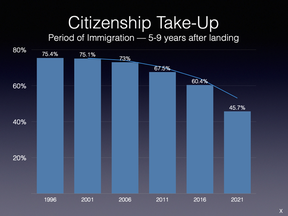
In 1991, 68.6 percent of immigrants holding a permanent residency card achieved citizenship between five and nine years of arriving. (Permanent residents can apply for citizenship after spending five years in Canada.) This figure rose above 75 percent in the next two censuses. It has since fallen dramatically. In 2016, only 60.4 percent of permanent residents became citizens within the stated time period. And according to the latest 2021 census data provided by Statcan, it’s now down to 45.7 percent. In other words, fewer than half of recent immigrants are choosing to become Canadian citizens once they’re eligible.
Falling out of love with Canada? According to recent Statistics Canada data, fewer than half of recent Canadian immigrants choose to apply for citizenship after their five-year wait period is up.
“The figures are shocking,” says Bernhard. He considers the trend a fundamental blow to Canadian identity: “One of the ways Canadians see themselves as being unique in the world is in how we welcome immigrants. It is a tradition that goes back to before the founding of Canada.” As proof, he cites an 1840 speech by pre-Confederation Quebec politician Louis-Hippolyte Lafontaine, who declared that Canada’s strength lay in welcoming “various populations which come from diverse portions of the globe” and making them “like ourselves, Canadian.”
Now, however, the data suggests a decided lack of interest among new arrivals in joining what Bernhard calls “the team that is Canada.” If immigrants decide they don’t really care about signing up for membership in Team Canada, “then we’ve got a big problem.”
Mobile Free Agents or Pressure from Communist China?
Canada has a lot invested in immigration. Earlier this year, the Trudeau government announced new targets for in-migration that are unprecedented in the modern era. After accepting fewer than 200,000 permanent immigrants in 2020, the Liberals now plan to increase intake to 465,000 in 2023 and 500,000 by 2025. Such a tidal wave of new residents clearly is already straining the capacity of the housing market and likely fuelling inflation as well. Nonetheless, immigration enjoys strong support across all political parties and regions, if somewhat tempered in Quebec. This national consensus appears to be holding because the needs of the labour market are so great. But if all these newcomers feel no particular attachment or affection for their new country, then the economic argument for immigration becomes much weaker.
Chinese immigrants must now choose one passport or the other when they arrive in Canada. If they can’t have both, it appears most are deciding to remain Chinese citizens even after they settle permanently in this country.Tweet
Bernhard admits he doesn’t have an answer to why new arrivals seem to be increasingly disenchanted with becoming Canadian, and he’s hoping Statcan will soon offer more clarity on the issue. From his perspective, the worst-case scenario is if these ambivalent immigrants are mostly highly-educated, high-income “free agents” who are prepared to pull up stakes and move to another country as soon as something better comes along.
Bolstering this fear is a recent poll conducted by ICC of new Canadians showing that nearly one-third of 18-34-year-olds and one-quarter of those with a university education considered themselves likely to move elsewhere in the next two years. As these potentially wealthy – and wealth-creating – individuals offer a substantial economic advantage to whichever country they settle in, Canada has a strong incentive to retain them. Getting them to become citizens seems the surest way to lock them down.
Partly easing this fear of mobile free-agent immigrants is a 2019 Statcan study using earlier data that found the decline in citizenship uptake to be largely driven by immigrants with low education and low income. Further, almost the entire drop between 1996 and 2016 was attributable to migrants from one country in one region. “Most striking was the large decline in citizenship take-up among immigrants from East Asia – mainly China,” the Statcan report states. Naturalization rates for all East Asian immigrants fell from 83 percent to 45 percent over this time.
Communist China’s increasingly strident prohibition on dual citizenship may be to blame here, since it means footloose Chinese immigrants must now choose one passport or the other when they arrive in Canada. If they can’t have both, it appears most are deciding to remain Chinese citizens even after they settle permanently in this country. And if government policy in China is the principal factor behind the precipitous decline in citizenship uptake, then there’s little Canada can do to correct the situation
An international perspective is also useful. According to the Organisation for Economic Cooperation and Development’s (OECD) International Migration Outlook 2022 Canada remains near the top of the immigration leaderboard despite recent concerns. We stand third overall in terms of total immigrants accepted, trailing only the United States and Germany. (While the U.S. is often painted as unwelcoming, it has long been the world’s dominant recipient of permanent, legal immigrants. Under President Donald Trump, for example, it admitted more than 1 million immigrants annually until Covid-19 hit in 2020; last year it welcomed over 830,000.)
As well, the average annual rate at which foreign-born residents become citizens across all OECD countries is just 2.2 percent. In Canada, it’s 4 percent – nearly twice as high. While the OECD also notes Canada’s citizenship rate has fallen significantly in recent years, this global perspective does not reveal any grave threat to Canada’s way of life or its ability to attract immigrants. Among the top five immigrant-accepting countries (Spain and the United Kingdom complete the set), all have substantially larger populations than Canada; our status as a generous, welcoming and desirable country appears solid.
The Horror Stories We Tell Ourselves
The evident decline in Canada’s citizenship rates may say more about the attitudes and habits of existing Canadians than those of newly-arriving immigrants. The federal bureaucracy’s failure to meet its own published service standards is certainly a self-inflicted wound. As is the proposal to solve this problem by eliminating much-loved citizenship ceremonies. The effect of both situations is to debase the perceived status of Canadian citizenship by emphasizing the transactional over the transformational. Then there’s the Roxham Road debacle, which offers migrants the opportunity to illegally sneak into our country via a dead-end road rather than at a regular border crossing and still be recognized as refugee claimants, with all the official support and standing this entails. If Canadian citizenship is supposed to be so valuable, it seems foolish to further cheapen the reputation of the entire immigration system in this way.
Beneath these obvious failures of governance and policy, however, lurks an even deeper and more insidious problem. As Bernhard explains, becoming a citizen is akin to joining a team with all other Canadians. A “club,” so to speak, that is exclusive to those who wish to be identified as Canadian and who intend to participate in its promotion and maintenance by voting and performing other civic duties. If we accept such an analogy, then it clearly matters how we advertise and promote this club to new members. So what sort of stories do Canadians tell about their own country these days? And do they amount to an effective marketing strategy?
“The story of Canada that our major institutions tell has increasingly become one that focuses on only the most negative aspects of our country, such as oppression, racism, discrimination and dispossession,” observes Christopher Dummitt, an historian at Trent University’s School for the Study of Canada in Peterborough, Ontario. Common examples of this new tendency are factually-dubious claims, often from officially sanctioned sources, that Canada has committed and continues to commit genocide against the Indigenous population, is systemically racist towards black people, was once a slave country, and on and on. “It is a deliberate distortion of our actual history,” says Dummitt in an interview.
This sense of national self-loathing has become so encompassing that official multiculturalism, once billed as an unquestionable Canadian value, is now considered evidence of an “unjust society premised on white supremacy,” as two University of Calgary education professorsabsurdly argued last year. Even professed supporters of Canadian identity, such as ICC co-founder Ralston Saul, now casually declare that “Canada has failed on many fronts.” As for how such a perspective might work as a branding exercise, Dummitt says, “If the story about Canada is that it was an institutionally corrupt nation beset by the original sin of colonialism, then why would anyone want to become a citizen of that?”
Dummitt has been pushing back against the now-pervasive narrative that Canada is, at its core, morally bankrupt. In 2021 he organized a rebuttal signed by many eminent Canadian historians condemning the Canadian Historical Association’s (CHA) unilateral declaration that Canada’s treatment of Indigenous peoples was “genocidal.” In making such a claim, Dummitt’s rebuttal stated, the CHA was “insulting the basic standards of good scholarly conduct.” He has also spoken out against the practice of tearing down statues honouring Canada’s founding fathers, and is currently fighting Toronto’s plans to scrub the name of 18th century British parliamentarian Henry Dundas from its streets and public squares on the (entirely bogus) assertion that he was an ally to the slave trade. “We need to call out these nonsensical claims,” Dummitt states determinedly. “And we need politicians who are willing to celebrate the Canadian nation in diverse ways.”
If there is a piquant irony to how Canadian history is currently being told by and to Canadians, it’s that new immigrants are actually more likely to receive a fair, balanced and generally uplifting vision of their new country than native-born residents. That’s because immigrants must still study for their citizenship test using a guidebook written by the Conservative government of Stephen Harper before our current historical miasma took effect.
“Discover Canada,” unveiled in 2011 by former Citizenship and Immigration minister Jason Kenney, was widely recognized for its nuanced treatment of Canada’s history, governance and culture. It explicitly acknowledges the low points in our past – including the Indian Residential School system and racist policies towards Chinese immigrants – but never claims such events represent the totality of the Canadian experience. The overall (and entirely honest) message is that Canada has always been a remarkably tolerant and welcoming country with a proud heritage of accommodation, democracy and the opportunity to achieve prosperity for all. As a result, Dummitt observes, immigrants who read the guidebook may actually have a better understanding of the true nature of Canada than Canadian students who’ve been force-fed a litany of horror stories about our past in high school and university classrooms.
Precisely because of the guidebook’s even-handedness and generally upbeat tone, however, many groups are demanding it be replaced with something grimmer and much less complimentary about Canada and its past. When the CBC tried to foment outrage over the continuing existence of the Harper-era citizenship guide in 2019, Janet Dench, then-executive director of the Canadian Council for Refugees, called the situation “incomprehensible” and demanded a new version that “acknowledges the problems in Canadian and current reality, and how that affects Indigenous and racialized people.” In other words, Dench wanted Ottawa to tell newcomers a much more negative – and almost certainly much less accurate – story about the country they were coming to. With this sort of self-hatred being expressed by current citizens, is it any wonder immigrants are having second thoughts about joining Club Canada?
Discover Canada, the Canadian citizenship study guide introduced by the Harper government in 2011, is one of the few remaining official documents that offers an evenhanded and generally uplifting vision of Canada’s history by celebrating our legacy of democracy, accomodation and prosperity.
If we want to make Canadian citizenship more attractive to newcomers, the first order of business should be to project a more uplifting story about what Canada means. And to do that, says Dummitt, “we need to stop telling lies about our past.”
Peter Shawn Taylor is senior features editor at C2C Journal. He lives in Waterloo, Ontario.
Nice to see the opposition raising the issue as this change requires a political discussion. Sent my Canada Gazette submission to both the Conservatives and NDP, with no reaction from the NDP to date.
Hard to take Minister Fraser’s assertion that “they will still have an opportunity to participate in an IRCC-organized citizenship ceremony shortly after they complete their citizenship” seriously when the main rationale is to reduce the number of ceremonies to save a minuscule portion of the cost of the citizenship program. The inclusion arguments are more of a smokescreen than substantive.
Clearly Minister Fraser doesn’t understand and appreciate how powerful the ceremonies are to new Canadians (and many existing Canadians) in terms of meaningfulness and sense of belongin:
The Conservative immigration critic says a proposal to allow people to become a Canadian citizen with the click of a mouse “cheapens” an otherwise special moment for newcomers.
“Citizenship by click is not citizenship,” said Calgary MP Tom Kmiec.
“They’re really cheapening citizenship purely for political motivation, to reduce their backlogs.”
The federal government is seeking feedback on a plan to let people take the Oath of Citizenship online, rather than attend an officiated ceremony.
Immigration Minister Sean Fraser first floated the idea in January 2022 as a way to speed up processing times, which would have someone “self-administer a digital oath by signed attestation, and celebrate their citizenship at a later date.”
Yet the proposal published in the Canada Gazette late last month would instead allow someone to skip the ceremony entirely.
Fraser did not specify why the proposal had changed, nor who came up with the idea. But he said COVID-19 created a backlog that even virtual ceremonies can’t quickly clear.
“For those people who choose to do an online self-attestation, they will still have an opportunity to participate in an IRCC-organized citizenship ceremony shortly after they complete their citizenship,” Fraser said on Friday, in his first public comments on the proposed regulatory change.
Fraser added that those who have waited years for citizenship would be able to take their oath faster under that process, and he rejected claims it would cheapen the moment.
Kmiec said the ceremonies are a big deal for people like him who were not born Canadian. Kmiec, who immigrated from Poland, still recalls taking his oath in 1989, and said the tradition shouldn’t be diminished as a way to deal with an administrative backlog.
“These are very low-cost events; these are mostly retired civil servants, serving judges and ex-judges who do the actual ceremony,” he said.
“The way they’ve done this tells me that they’re embarrassed by it, because I’d be embarrassed by it too.”
Kmiec argued the backlog stems from Liberal incompetence in administering programs, rather than the pandemic. He is also critical of the lag after newcomers they take the oath, at which point they relinquish their permanent-residence card and await their citizenship certificate in the mail, which can be used to apply for a passport.
“There are some process changes they could do to actually make people’s lives easier,” he said.
In any case, Canada’s former director-general of citizenship and multiculturalism, Andrew Griffith, said the department should have issued a press release about the proposed change instead of “trying to slip it by.”
Griffith retired after a career with Immigration, Refugees and Citizenship and Canada’s foreign service, and said the phrasing in the regulatory proposal and the lack of public-opinion research suggests it’s aimed at reducing costs rather than making things more convenient for applicants.
“It’s driven by the desire to reduce, if not eliminate, ceremonies, virtual or physical. And it’s pretty explicit,” he said.
“One gets the impression as a former bureaucrat that maybe the officials who had to draft the stuff weren’t really that keen.”
Griffith noted that the 1946 Citizenship Act explicitly called for ceremonies that instil the responsibilities and privileges of citizenship, as Canada carved out an identity separate from Britain following the Second World War.
“It’s really an abuse of the process, because it goes against the grain of what the Citizenship Act was designed to do,” he argued. “It really goes against one of the fundamental objectives of citizenship.”
The comment period on the proposed change closes on March 27.
If approved, the changes to the citizenship regulations would come into effect at early as June, at a cost of about $5 million.
More commentary. Haven’t seen any supporting the change apart from some tweets:
Having been born in Canada, I’ve never had to participate in a citizenship ceremony to affirm my Canadianess. I have partaken in the process in other ways. I’ve been privileged to write letters to the government on behalf of friends who were on the path to becoming Canadians. I’ve attended ceremonies both personally and professionally, and always felt proud to have been there to welcome our newest citizens.
So when I read last week that the Department of Citizenship and Immigration was considering moving away from the in-person swearing in as a way to reduce a three-month backlog for ceremonies, I was suitably aghast.
While it may be old-fashioned, there is power in ceremony and in this ceremony in particular. It’s a tangible moment that marks a transition, whether it’s a conversion of convenience or the fulfilment of a lifelong dream. It’s an experience shared with all those who’ve become citizens since 1947. It’s about becoming something new, something different. It’s about belonging, about knowing that Canada can be your home now and forever. You are now a part of Canada, and no one can take that away from you.
I get that it can be inconvenient to take time off work and drag the kids out of school to attend. I get that for some, acquiring Canadian citizenship is no more momentous than buying a new toaster. I get that swearing an oath of citizenship in your living room is no less binding than doing it in a nondescript government office. I get all that, but by ditching the in-person ceremony, something important would be lost — something that a tick box on a computer screen could never replace.
At the ceremony, you’re surrounded by strangers who’ve come to this country from all across the globe. They may be refugees fleeing war. They may be migrants seeking a better life. They may be family members of those already here. It’s entirely possible that the only connection that you have with these people is that you all happened to be in the same room on the same day.
Then something magical happens. You all recite the oath and all become fellow Canadians.
The rituals around becoming a citizen aren’t some bureaucratic nonsense like getting your driver’s licence renewed. They are something with real meaning. It’s meant to be special. It’s meant to be an occasion. It’s meant to shared with the community.
So if the government really wants to clear the backlog, it can do what’s been done in the past — deputize Order of Canada recipients to preside over these ceremonies. Who better to welcome new Canadians to the family than some of our country’s best and brightest?
Sometimes traditions need to change or evolve because they’re no longer fit for purpose. That’s not the case with the citizenship ceremony. Joining Canada is a special moment and deserves to be treated as one.
Gordon Cameron is the group managing editor for Hamilton Community News, The Sachem and The Glanbrook Gazette.
From rural Alberta, another voice opposing the change. Too much anti-Trudeau vitriol but fundamentals on oath administration sound:
The greatest gift any country can confer is citizenship.
So why is it any surprise, given the ongoing ineptitude involving virtually every branch of our federal administration, that Canada is considering turning such a remarkable moment into something akin to tying your laces?
In fact, if a proposal by the Department of Citizenship and Immigration is accepted, becoming a citizen will take even less time than needed to actually fasten your shoes. All it would entail is ticking an online box on a federal website.
No longer would you swear a solemn oath before a judge alongside other assembled proud recent immigrants from across the globe. Nope, you can get it done during a commercial break while watching a hockey game on TV. Won’t that feel oh-so special?
Maybe that’s how our current government sees this country. After all, Justin Trudeau’s administration has spent years apologizing for all sorts of perceived wrongs committed by Canada over the past century. It might therefore reckon becoming an actual citizen of such a dubious land shouldn’t be cause for public celebration.
Well, they’re wrong. So wrong they should hang their collective heads in shame.
Becoming a Canadian citizen, 38 years ago, remains a major highlight in my life: the poignancy of that day in Edmonton, following the required three years as a landed immigrant, remains a proud memory. It’s doubtful I’m alone in that sentiment.
Of course, given the recent track record of our federal government, this sad ‘tick-the-box-and-become-a-Canuck’ plan arises from yet another virtue-signalling boondoggle – one guaranteed to end in confusion and disarray once exposed to the light of day.
OK, according to the latest government figures, there are 358,000 citizenship applications outstanding, with some of those folk waiting more than two years for a ceremony.
Why such a backlog? Well, in his usual preening manner, our prime minister announced immigration levels to Canada would be boosted to such an extent that by 2025 we’ll accept 500,000 newcomers a year.
No doubt Trudeau gets some figurative gold star from the UN for this: yet the fact we can’t process such huge numbers remains an unmentionable and inconvenient truth.
Therefore, is it any wonder fewer and fewer immigrants even bother becoming citizens at all? According to Statistics Canada: in 2021, about 45 per cent of permanent residents in Canada for less than 10 years hadn’t taken citizenship. In 2001, it stood at a much lower 25 per cent.
So, why are more newcomers unwilling to commit to Canada? After all, they picked up sticks and came here in the first place – a huge, life-altering choice to make.
Is Canada becoming simply a country of expediency? Or are those continuing assaults upon our good name and once-stellar reputation, from those supposedly representing us, eroding our national brand?
Add in the organizational chaos facing enthusiastic would-be Canadians resulting in years of delay and it becomes a toxic mix of disengagement.
The official response is promoting a ‘tick-the-online box’ solution.
Such crass make-do is shameful. This is the best country on the planet, populated by a diverse bunch of Homo sapiens, somehow finding joy under sunny skies, even if it’s -20 C outside.
This remains, as always, next year country: the horizon beckons and the past is exactly that: the past. Leave it at the entrance door.
It’s time the federal government realized becoming a Canadian citizen isn’t akin to finding some loose change down the sofa. It’s a remarkable gift to bestow and one that should be suitably celebrated.


 Multicultural Meanderings