New Canadian babies born via birth tourism less than one per cent of all births

More on birth tourism based upon the Alberta study, Canadian doctors say birth tourism is on the rise. It could hurt the health care system, with data from Guelph (not a centre).

Reference to Richmond only refers to 2022, rather than pre-pandemic years when Richmond General was the epicentre of birth tourism in Canada, with almost one-quarter being birth tourism, supported by a cottage industry of birth tourism hostels:

“Birth tourists being specifically people who are coming in specifically to have a birth then go back to their original country,” said Colin Birch, a Calgary obstetrician gynecologist.

They probably come to give birth for the advantage of birthright citizenship for future gains whether it be for themselves or their family, said Birch. “There are still immense advantages of living in a place like Canada,” he said.

“Is it a big problem? Well if you look at the numbers, absolutely not. It’s small.”

“Is it big enough to be a problem? I actually think it is,” he said.

FROM OUR ARCHIVES: Birth Tourism: Rhetoric Ahead of Evidence [my opinion has changed since writing this in 2014]

Reason being Canada is in a healthcare crunch, “every bed is sacred,” said Birch.

As a healthcare system we are suffering from a capacity point of view and the expectation is to do more with less, he said.

“Canada is not really set up because of its socialized healthcare system for private pay patients and the demands that come with private pay patients,” said Birch.

The expectations from paying patients to patients covered by provincial health care are different.

“Not saying their care is different. Care is care,” he said. 

Health care is expensive and when it comes to neonatal care it is astronomical if a baby needs to be in the ICU, he said. 

The unpaid bills of the hospitals are massive, he said.

Calgary has taken a different approach to hospital bills associated with birth tourism. Birch confirmed the Calgary system requires a $15,000 deposit.

“It’s a very honest and upfront system,” said Birch. “It doesn’t pay the hospital fees no. It’s a deposit which pays basically physician fees.”

From the deposit what doesn’t get spent goes back to the patient, he said.

“We wanted to discourage the practice because it was becoming a bigger burden in Calgary,” said Birch. “The potential problem with that is the patients will then start moving to practitioners who are outside the city limits.”

It isn’t a perfect process but it’s an attempt to implement some sort of order, he said.

Prior to the deposit process birth tourism had impacts on the capacity of the hospital and ability at times to care for Canadian patients, he said.

Canada and the U.S. are the only countries in the G7 to offer birthright citizenship according to canadianimmigrationexperts.ca.

“What we need to debunk is the idea that all people who are not insured are not necessarily birth tourists,” said Birch.

“There’s a large undocumented population in the country,” he said. They are contributing members of society but are not documented, Birch said.

He wanted to make it clear undocumented folks who are uninsured are not birth tourists.

Birth tourism is not just a medical issue but a social issue that should be addressed, he said.

In the fiscal year of 2021 to 2022 Guelph General Hospital had a total of 1,707 deliveries, 11 were people from out of country. This breaks down to 0.6 per cent of deliveries were out of country.

Between April 2022 to February 2023 there were 1,543 deliveries and 18 were people from out of country who gave birth at the GGH. This is 1.2 per cent of the deliveries were out of country. 

At the other end of Canada in Vancouver much of the same occurred at Richmond Hospital, in 2022 there were 22 nonresident deliveries. This number accounts for 1.5 per cent of the total deliveries at the hospital.

“All maternity patients coming to Richmond get the care they require to deliver their child safely. Care is always triaged according to the safety of the mother and baby – it is never delayed based on residency,” stated in an email from Vancouver Coastal Health (VCH).

VCH also said it does not support marketing of maternity tourism. Births from nonresidents have not led to disruptions of maternity services, said in the email.

“VCH will never deny urgent and emergent care based on ability to pay or where a patient is from, but we do expect to be compensated as we are accountable to B.C. residents for hospital and health care services. We are committed to collecting compensation from non-residents who use our medical services,” said in the email.

Source: New Canadian babies born via birth tourism less than one per cent of all births
FIRST READING: Canada’s massive (and easily fixed) birth tourism problem

Second article in the National Post in a week. Hopper forgot to mention that the Conservative government did make a push to end birth tourism in 2012 (see my What the previous government learned about birth tourism):

Last week, Macleans’ published an interview with Simrit Brar, a Calgary OB-GYN who is one of Canada’s few medical researchers to actually look into the issue of birth tourism.

It’s something that’s long been an accepted fact within Canadian birthing hospitals: Hundreds of non-resident women each year are coming to Canada in the final weeks of pregnancy, having their baby in a Canadian hospital and then immediately returning home. The purpose of the excursion being to ensure that the child has Canadian citizenship by virtue of the country’s jus soli laws.

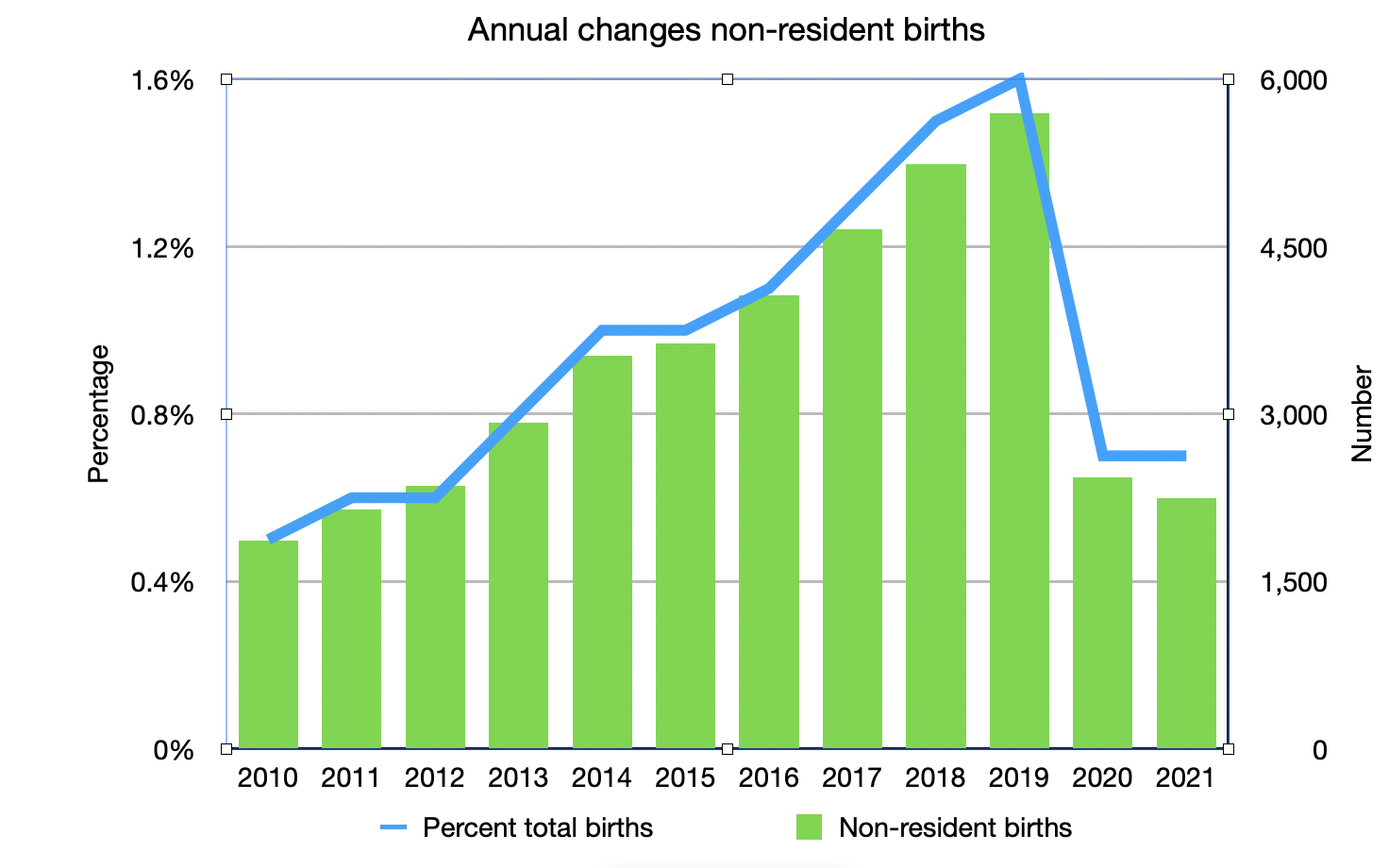
There are companies openly advertising their services as “birth hotels.” Online forums include questions as to the “cheapest” Canadian hospital for a non-resident to give birth. In the last full year before the COVID-19 pandemic, a single hospital in Richmond, B.C. had 502 non-resident births — nearly one quarter of total babies born.

Figures from the Canadian Institute for Health Information show that Canada hosted a record 4,400 foreign births in 2019 — up from 1,354 just nine years prior.

Vancouver’s first baby of 2023, in fact, was born to a birth tourist: Mother Salma Gasser had only recently arrived from Cairo, Egypt, on her first-ever trip to Canada, and told local reporters she did it to secure a Canadian passport for her baby girl.

There’s nothing illegal about birth tourism and birth tourists are all paying handsomely for the service (it costs between $6,000 and $10,000 for an uninsured non-resident to give birth at a Canadian hospital). But for a Canadian health-care system that is constantly on the verge of crisis, the phenomenon is having an impact.

In a two-tier system like Australia, the U.K. or the U.S., an influx of non-residents seeking health-care beds could safely exist on the sidelines without affecting overall health-care access: The system could simply grow organically to accommodate the increased demand.

But Canada rations its supply of doctors and health-care workers, meaning that any extra patient is going to be adding to wait times.

“So even if a birth tourist does pay their bill, if we allow people who have the opportunity to pay to preferentially access beds … that displaces people here,” Brar told Maclean’s.

She added that birth tourism is a “social structure issue.” Ultimately, wealthy people from abroad are able to supplant scarce Canadian health-care resources, with negative results for “disadvantaged” Canadians.

“The system is too strained for us to ignore these questions,” she said.

Brar’s research examined 102 cases of birth tourists who had their babies in Calgary between July 2019 and November 2020. A plurality (24.5 per cent) were Nigerian and all told, the 102 paid $694,000 to Alberta Health Services in hospital fees.

Notably, most of Canada’s birth tourists are coming from countries that do not offer birthright citizenship. Almost all of North and South America grants automatic citizenship based on birthplace — a principle known as “jus soli,” or “right of the soil.”

In most of the rest of the world, citizenship is determined based on the nationality of one’s parents — known as “jus sanguinis,” or “right of the blood.” If a visiting tourist gave birth in Nigeria, for instance, that child would not be considered Nigerian unless they had a Nigerian parent or grandparent.

It would be remarkably easy for Canada to ban birth tourism, or at least make it less easy.

Provincial health-care systems could dramatically raise fees on “other country” birth services in order to discourage patients not insured under the Canadian system.

Some minor tweaks to the Citizenship Act could nullify instant citizenship if a baby is born to a parent temporarily visiting Canada on a tourist visa.

Refugees, asylum-seekers and other newcomers would still have guaranteed full, automatic citizenship for their Canadian-born children.

Or, Canada could simply begin denying visas to foreign nationals booking short trips to Canada at the tail end of a pregnancy. This is what the United States did in order to curb its own rising rates of birth tourism.

In early 2020, the U.S. Department of State issued an order to deny certain classes of recreational visas to foreign nationals if a consular official believed they were doing it just to give birth.

“The Department does not believe that visiting the United States for the primary purpose of obtaining U.S. citizenship for a child, by giving birth in the United States — an activity commonly referred to as “birth tourism” — is a legitimate activity for pleasure or of a recreational nature,” reads a statement from the time.

U.S. officials have also prosecuted California-based “birthing houses” for counselling foreign nationals to misrepresent their intentions on visa forms in order to enter the U.S. for the purpose of giving birth. Similar charges are feasibly possible in Canada, given that it is illegal under Canadian law to misrepresent one’s intentions for visiting.

Although birth tourism is not addressed or even acknowledged at the federal level, it’s long been deeply controversial in the immigrant-heavy Vancouver communities where it’s most visible.

Jas Johal, MLA for Richmond, has repeatedly denounced birth tourism for turning local hospitals into “passport mills.” Longtime Richmond city councillor Chak Au has often gone on record saying that his constituency — the most Chinese-Canadian in Canada — supports a legislated end to birth tourism.

In 2018, Richmond’s Liberal MP Joe Peschisolido tabled a petition in the House of Commons calling birth tourism an “abuse of Canada’s immigration and citizenship system.”

“The government should say birth tourism is bad. Let’s quantify it and let’s fix it,” he said at the time.

As recently as 2016, Vancouver-area Conservative MPs Alice Wong and Kenny Chiu even led a drive to overturn Canada’s system of birthright citizenship altogether in order to combat birth tourism — although both had reversed course by 2019, when the Conservatives prepared for that year’s election with a platform that mostly side-stepped immigration policy.

Source: FIRST READING: Canada’s massive (and easily fixed) birth tourism problem

Appeal court overturns ruling directing Ottawa to repatriate 4 men detained in Syria

Of note and, IMO, correct decision:

The Federal Court of Appeal has overturned a high-profile ruling ordering Canada to bring home four Canadian men detained in northeastern Syrian prisons for suspected ISIS members.

In January, Federal Court Justice Henry Brown ruled the four men were entitled to have the federal government make a formal request for their release “as soon as reasonably possible.”

But three appeal court judges disagreed with Brown’s decision and overturned it on Wednesday.

In their ruling, the judges wrote that Brown’s decision interpreted the right to enter Canada too broadly.

“[The previous ruling] took the right of Canadian citizens ‘to enter … Canada’ and transformed it into a right of Canadian citizens, wherever they might be, regardless of their conduct abroad, to return to Canada or to have their government take steps to rescue them and return them to Canada,” Wednesday’s ruling says.

“The right to enter, remain in and leave Canada, is not a golden ticket for Canadian citizens abroad to force their government to take steps — even risky, dangerous steps — so they can escape the consequences of their actions,” the ruling says.

The men travelled to northeastern Syria against the travel advice of the Canadian government and have been held in prisons for those suspected of ISIS affiliations. The camps in northeastern Syria are run by the Kurdish forces that reclaimed the war-torn region from the extremist group.

Canada not responsible for men’s detention: judges

In his January decision, Brown cited the conditions of the prison and the fact that the men haven’t been charged and brought to trial.

“The conditions of the … men are even more dire than those of the women and children who Canada has just agreed to repatriate,” Brown’s decision reads.

“There is no evidence any of them have been tried or convicted, let alone tried in a manner recognized or sanctioned by international law.”

But Wednesday’s appeal court ruling said the Canadian government is not responsible for the men’s detention in Syria.

“Canadian state conduct did not lead to the respondents being in northeastern Syria, did not prevent them from entering Canada, and did not cause or continue their plight. The respondents’ own conduct and persons abroad who have control over them alone are responsible,” the ruling reads.

Public Safety Minister Marco Mendicino said the government will take time to “absorb” the court’s ruling.

“Our priority first and foremost is that we safeguard the country and our borders from any potential terrorist activity,” he told reporters Wednesday.

Jack Letts, who has been imprisoned in Syria for more than four years after allegedly joining ISIS, is among the four men.

Sally Lane, Letts’ mother, said the appeal court decided to “to perpetuate the arbitrary detention and torture” of her son.

“The decision is nothing but victim-blaming and narrow legalese that stands in utter contempt of human rights law and fails to rise to the challenge of the moment,” Lane said in a statement provided by the family’s lawyer, Barbara Jackman.

Letts admitted in a 2019 interview to joining ISIS in Syria. His family says he made that admission under duress and there is no evidence that he ever fought for the group.

Jackman told CBC that they are considering taking the case to the Supreme Court, but a final decision hasn’t been made yet.

Lawrence Greenspon, a lawyer for the other applicants, also told CBC that his clients are considering an appeal.

In the past, Greenspon has argued that if there is any evidence the Canadians took part in terrorist activities, Canada should put them on trial here.

But former CSIS analyst Phil Gurski said he fears that any trial likely would end in an acquittal because the witnesses and evidence are located in Syria.

“I’m just not confident that the Canadian court system would have the resources to locate the witnesses … and the evidence to bring forward a successful trial,” he said.

Family members of Canadians detained in Syria — including the four men — have been asking the federal government to arrange for their return to Canada.

Prior to the January ruling, the government agreed to repatriate six women and 13 children from northeastern Syria.

At least three of those women have returned and were taken into police custody upon arrival. They have all been released pending terrorism peace bond applications.

A terrorism peace bond allows a judge to order a defendant to maintain good behaviour — sometimes with conditions such as a curfew — or face a prison sentence.

Source: Appeal court overturns ruling directing Ottawa to repatriate 4 men detained in Syria

German citizenship: Record number of naturalizations

Of note, along with the planned policy changes:

A record 168,545 applicants with 171 different nationalities received German citizenship in 2022. That was 28% more than in the previous year, the Federal Statistical Office in Wiesbaden reported this week.

Twenty-nine percent of people who adopted German nationality in 2022 were from Syria, their average age was 24.8 years, and two-thirds of them are male. Many of them had fled their homeland when the civil war broke out in 2014 and have since found a new home in Germany. Before naturalization, they had been in Germany for an average of 6.4 years.

Syrians topped the list, followed by Ukrainian, Iraqi and Turkish nationals.

“Almost half of all Syrians who received their German passports did so after only six years. That’s because they were able to demonstrate exceptional integration achievements,” Jan Schneider, of the independent Expert Council on Integration and Migration, told DW.

“In fact, we can expect the number to rise further this year,” Schneider said, as the ruling center-left coalition of Social Democrats (SPD), Greens and neoliberal Free Democrats (FDP) has comprehensive plans for changing and simplifying the citizenship law.

High hurdles so far

Currently, the requirements for naturalization include language skills (B1) and a secure income, and candidates must have lived in Germany for a minimum of eight years.

People who want to become German citizenship have not only had to pay the fee of €255 ($272) but also need to be able to document their identity and pass a written test in German, which consists of 33 questions on German customs and society and the law. Applicants must also declare their support for democracy and the German constitution, the Basic Law.

Anyone who has been convicted of a criminal offense does not stand a chance. Neither do applicants who have no income or savings and rely solely on state support.

But, now, Germany sees a labor shortage across its economy, ranging from IT specialists to medical staff to food servers. Labor market experts have estimated that Germany needs 400,000 immigrants per year to close the widening gap. Currently, only 60,000 are attracted each year by the government’s skilled immigration program.

A fundamental change in the citizenship law, the government argues, could be an incentive for people to come and for those already living here to integrate better.

Plans to simplify the citizenship law

Legislation proposed by Interior Minister Nancy Faeser will make dual citizenship easier, as well as naturalization for non-EU citizens. It boils down to three main changes.

Immigrants legally living in Germany will be allowed to apply for citizenship after five rather than eight years. This shall go down to only three years if the applicant can show special integration achievements.

Children born in Germany of at least one parent who has been living legally in the country for five or more years will automatically get German citizenship.

Multiple citizenships will be allowed.

So far, only EU and Swiss nationals, and those whose country of origin does not allow people to renounce citizenship such as Iran, Afghanistan and Morocco, for example; refugees who are threatened with persecution in their home countries; and Israelis are generally permitted to hold on to their original passports when they get a German one.

Schneider believes that, for some of the approximately 1.3 million Turks who are living in Germany, “the dual passport may well be an incentive for naturalization.”

Opposition to reform

The new record figures for naturalizations have triggered another storm of protest among critics, especially from the largest opposition group, the center-right Christian Democrat Union and the regional Christian Social Union (CDU/CSU). Their parliamentary group’s spokesman, Thorsten Frei, told the daily newspaper Die Welt: “The plans of Interior Minister Nancy Faeser increase the risk that more people will be naturalized who are not sufficiently integrated.” He said there were no convincing reasons to lower the requirements for a German passport.

Currently, about 6 million foreign citizens have been living in Germany for over eight years. If the minimum period of residence for naturalization is set at five years, migration expert Schneider pointed out, most of them will meet the criteria for naturalization.

Although it is not possible to predict today whether parliament will approve the government’s bill, “a massive increase in naturalization applications” is to be expected, Schneider said. “Applications for naturalization are already piling up in many Citizens’ Offices,” he added.

Source: German citizenship: Record number of naturalizations

Trump vows to end birthright citizenship for children of unauthorized immigrants if he wins in 2024

Usual floating to get media attention. Will be interesting to see if CPC picks up on change to Canadian birthright citizenship (former Minister Kenney tried in 2012):

Former President Donald Trump on Tuesday pledged to challenge a long-standing interpretation of the U.S. Constitution in an attempt to end birthright citizenship for children of unauthorized immigrants if he defeats President Biden in the 2024 election.

If he secures a second presidential term, Trump said he would issue an executive order during his first day back at the White House in January 2025 instructing the federal government to deny citizenship to children with parents who are not American citizens or legal permanent residents.

Under a decades-long interpretation of the Constitution, children born on U.S. soil are automatically bestowed American citizenship, even if their parents are not themselves citizens or legally present in the country. Some immigration hardliners have long criticized the policy, saying it encourages parents to come to the U.S. illegally. While he was in the White House, Trump repeatedly floated the idea of challenging the interpretation, but never took action.

In his announcement Tuesday, Trump portrayed the move as part of a broader crackdown on unauthorized immigrants and asylum-seekers that he has promised if he returns to the White House. He has also vowed to launch the largest immigration roundup and deportation operation in U.S. history.

“My policy will choke off a major incentive for continued illegal immigration, deter more migrants from coming and encourage many of the aliens Joe Biden has unlawfully let into our country to go back to their home countries. They must go back,” Trump said in a video message on Tuesday.

If Trump wins the 2024 presidential election and follows through on his promise, the move to end birthright citizenship for children of immigrants living in the U.S. without legal permission is all but certain to face significant legal challenges.

Is birthright citizenship in the Constitution?

The 14th Amendment of the Constitution, adopted following the Civil War, declares that all “persons born or naturalized in the United States” are “citizens of the United States and of the State wherein they reside.”

“Any executive action that a president might try to end birthright citizenship would be challenged in court and would be likely struck down as unconstitutional,” said Stephen Yale-Loehr, an immigration law professor at Cornell University.

While the move would likely not pass legal muster, Yale-Loehr added, it could be a beneficial campaign tactic for Trump, especially during the Republican primary.

“I think it’s pretty clear that, for political purposes, he thinks that this kind of announcement will appeal to his base. It shows that he has anti-immigration credentials. And most of his voters don’t know or don’t care about whether such an executive order would be legal,” Yale-Loehr said.

Ron DeSantis’ immigration policies

Florida Gov. Ron DeSantis, the 2024 Republican presidential candidate currently Trump’s closest challenger in the polls, has also sought to make immigration a top issue of his campaign.

A measure championed by DeSantis that was recently passed by the Florida legislature will be among the strictest state immigration laws in American history. Among other things, it will invalidate driver’s licenses other states provide to unauthorized immigrants, require hospitals to document whether patients are in the country legally, fund efforts to relocate migrants to “sanctuary jurisdictions” and impose fines for employers who don’t verify the immigration status of workers.

In addition to sharply criticizing the Biden administration’s handling of the record number of migrant crossings reported along the southern border in recent years, Trump and DeSantis have feuded over which candidate has the toughest immigration platform.

DeSantis recently accused Trump of supporting “amnesty” by endorsing a bipartisan proposal that would have traded border barrier and security funds in exchange for the legalization of some unauthorized immigrants, including those brought to the U.S. as children.

Source: Trump vows to end birthright citizenship for children of unauthorized immigrants if he wins in 2024

A No-Nonsense View of Birth Tourism

National Post picks up on this useful Alberta study:

Last week, Maclean’s magazine published an interesting little one-interview piece featuring Simrit Brar, an OB-GYN physician at Calgary’s Foothills Hospital. Author Liza Agrba had caught wind of an interesting and overlooked study, published in January 2022, on the contentious topic of “birth tourism” — i.e., pregnant foreigners who visit Canada for the purpose of having their babies be born with Canadian citizenship. Past attempts to count birth tourists required some statistical inference, but Dr. Brar led a groundbreaking local effort to enumerate them directly and learn whatever could be discovered about their health outcomes and their effects on Calgary hospital capacity. 

This opportunity was provided through what the economists might call a “natural experiment.” In July 2019, the Calgary health region, which was not quite sure how much birth tourism the region was actually seeing, created a “Central Triage” office designed to capture all prenatal referrals for uninsured maternity patients. 

As Brar et al. describe it, this administrative creature was instituted with a number of goals. It allowed hospitals to distinguish situationally uninsured patients — refugees, persons with expired visas and undocumented residents — from intentional tourists. It established a process for getting full consent from the uninsured, who might have had a nebulous legal status otherwise, and it allowed Alberta Health Services to impose some order on chaotic physician-service pricing. And patients placed in the “birth tourist” category were given pamphlets explaining, basically, “We don’t want you here, although we can’t chase you away,” and were required to hand over a refundable deposit of $15,000. 

The study describes the traffic experienced by this unique Central Triage (CT) system. Of 227 pregnant patients sent to CT without Canadian health insurance over a period of 15½ months, 102 were labelled tourists and 125 were uninsured residents. A few of the birth tourists were lost to follow-up for various reasons (a few went home or gave birth outside Calgary, perhaps as a way of evading the cash deposit), but 83 were treated in Calgary hospitals. About a quarter of the tourists were from Nigeria, 18 per cent were from the Middle East and 11 per cent were from China. 

Calgary has about 15,000 childbirths in a typical year, so those 83 patients represent an added burden on maternity services of about half a percentage point — all other things being equal. But the first thing to note is that the study period ran up to Nov. 1, 2020. About two-thirds of it thus coincided with the COVID pandemic, and doctors did observe a decline in tourism visits when world air travel basically shut down. 

Moreover, Calgary was the only place in Canada where birth tourists were, and are, being discouraged by means of a deposit. (Dr. Brar told Maclean’sshe is concerned that the Central Triage system may be diverting tourism patients to suburban and rural hospitals that are even more overmatched than the city’s.) 

Most of the birth tourists ended up using less than the $15,000 deposit and received refunds, but the study reveals that even in a city determined to address birth tourism consciously, it might create external problems. Birth tourists often arrive in Canada late in pregnancy, when air travel is risky, and some arrive with health problems from the Third World. One tourist was diagnosed with HIV in Calgary and three needed to have cervical cerclagesremoved. Since uninsured patients are on the meter while in an Alberta hospital, they may leave against medical advice. Nine birth-tourist babies required time in the neonatal intensive care unit, including a pair of twins who were in the NICU for 50 and 63 days at the worst conceivable time. 

The kicker is that collecting hospital fees from birth tourists can be tricky if the cost of their care goes over the deposit. During the 15½ months of the study, the tourists ran up about $700,000 in Alberta health bills that are still unpaid. Brar takes a surprisingly unsentimental view of the birth-tourism phenomenon in her Maclean’s interview, emphasizing the “finite” nature of Canadian health care and the affluent nature of the tourists. Her team’s paper suggests making the Central Triage setup province-wide, and perhaps it ought to be imitated even more widely.

Source: A No-Nonsense View of Birth Tourism

German Plan Would Ease Path to Citizenship, but Not Without a Fight

Of note and encouraging government is moving ahead:

Young, educated and motivated, José Leonardo Cabrera Barroso is just the kind of immigrant the government says Germany needs.

Originally from Venezuela, he settled into Germany, learned the language and got his German medical license. At 34, he is specializing as a trauma surgeon, working at a hospital in the northern port city of Hamburg. It took him a full six years — and because of his expertise, he was allowed to apply for citizenship sooner than the eight years required for most others.

“For me, this date was a must,” he said at the champagne reception in Hamburg after his citizenship ceremony in February. “After all the work I did to get here, I finally feel like I can celebrate.”

But if his path to becoming a German citizen was not easy, neither has been the effort to simplify that process for others who want to realize the same dream.

After months of political wrangling, the government presented a plan this month to make it easier and faster for employed immigrants to become citizens, shortening the time, for people with special skills like Dr. Cabrera Barroso, to as little as three years.

The changes, supporters argue, are urgently needed to offset an aging population and a dearth of both skilled and unskilled workers. Given the majority that Chancellor Olaf Scholz’s three-party coalition government holds in Parliament, the new law is expected to pass this summer.

But before then, even within the government — and certainly for its conservative opponents — the proposals have set off a wrenching debate over a fundamental question: Is Germany a country of immigrants?

On the ground, the answer is clear. Germany is more populous than ever — an additional 1.1 million people lived in the country, now of 84.3 million people, at the end of 2022 — thanks to migration.

One in four Germans have had at least one of their grandparents born abroad. More than 18 percent of people living in Germany were not born there.

In Frankfurt and a few other major cities, residents with a migration history are the majority. People with non-German sounding names run cities, universities and hospitals. The German couple that invented the Pfizer Covid vaccine have Turkish roots. Cem Ozdemir, a German-born Green politician whose parents came from Turkey, is one of the current government’s most popular minsters. Two of the three governing parties are run by men born in Iran.

Many of those changes have only accelerated since reunification 33 years ago, but many Germans still do not recognize the diversification of their country.

“The opposition does not want to accept or admit that we are a nation of immigrants; they basically want to hide from reality,” said Bijan Djir-Sarai, who came to Germany from Iran when he was 11 and is now the secretary general of the Free Democratic Party, which is part of the governing coalition.

The changes to the citizenship law are part of wider set of proposals that will also make it easier for skilled workers to settle in Germany and for well-integrated immigrants to stay.

Besides reducing the time an immigrant must live in the country to apply, the plan will allow people to keep their original citizenship and make language requirements less onerous for older immigrants.

The proposals are the most sweeping since 1999, when, for the first time in modern German history, people who were not born to German parents could get German citizenship under certain conditions.

Before then, it was virtually impossible to become German without proving German ancestry, a situation that was especially fraught for the nearly one million Turkish citizens who started coming to Germany in the 1960s to help rebuild the economy as “guest workers” and their descendants.

Since the government announced its plans in November, the conservative opposition has staunchly resisted easing citizenship requirements, criticizing them as giving away the rights accorded German citizens too easily to people who are not integrated enough.

Those arguments have resonated with some Germans at a moment when migration remains a fixation of the anti-immigrant Alternative for Germany party, which has risen in polls, pulling the mainstream opposition Christian Democrats farther right with it.

“Hocking citizenship does not promote integration, but has the opposite effect and will have a knock-on effect on illegal migration,” Alexander Dobrindt, the parliamentary leader of the Bavarian Christian Social Union, told the mass-market tabloid Bild.

Not all of those who have already gone through the longer, arduous process, agree with lightening the requirements, either.

“I think you have to make sure it’s not given away too easily,” said Mohammed Basheer, 34, who came to Germany from Syria eight years ago and was among the roughly 200 immigrants who received their citizenship this year at the ornate Renaissance-revival City Hall of Hamburg. “I had to fight really hard for it.”

Over the months of negotiations, the smallest and most conservative of the parties in the governing coalition fought for changes to make sure applicants are self-sufficient and — apart from few exceptions — did not rely on social security payments.

“If we want society to accept immigration reform, we also have to talk about things like control, regulation and, if need be, repatriation,” Mr. Djir-Sarai said, acknowledging the opposition’s concerns. “It is simply part of it.”

Still, surveys show that more than two-thirds of Germans believe that changes making immigration easier are needed to alleviate rampant skilled-worker shortages, according to a recent poll. Industry; employers, like the German association of small and medium-size enterprises; and economists welcome the changes, seeing them as a way to attract skilled workers.

Petra Bendel, who researches migration and integration at the Friedrich-Alexander-University in Erlangen-Nurnberg, thinks that in addition to attracting new workers, the changes are crucial for integrating those immigrants already living in Germany.

“The problem is that we exclude a very large number of people who have long been part of us, but who still do not have full citizenship and are therefore also excluded from full political participation,” she said.

Although it naturalized the fifth largest number of people in the European Union in 2020, the most recent year for which such numbers are available, Germany ranks comparatively poorly in naturalizing permanent residents: 19th out of 27 E.U. member states, one spot lower than Hungary.

“Other European countries,” Professor Bendel noted, “naturalize much faster, namely mostly after five years and not after eight years, and that is why we ended up in the bottom third.”

In the coming weeks, the bill will be presented to Germany’s 16 states for comment before returning to the cabinet for approval. The government hopes to get it to Parliament for discussion and a vote before lawmakers break for the summer in early July, though the vote could be delayed until they meet again in September.

For some, like Bonnie Cheng, 28, a portrait photographer in Berlin, the changes are welcome, if too late. She had to give up her Hong Kong citizenship status when she became German last year.

Ms. Cheng is happy that others will not have to face the same choice. If she ever had any doubts about becoming German, she said, it was when she realized she would be the only one in her family with a different citizenship.

“If you want make people to feel integrated,” she said, “you should not tear apart their identities.”

Source: German Plan Would Ease Path to Citizenship, but Not Without a Fight

Canadian doctors say birth tourism is on the rise. It could hurt the health care system. [Alberta study]

Interesting Alberta study that broadens awareness of the issue with some qualitative analysis (Alberta has some of the most active medical academics working on birth tourism and I haven’t seen much from the other large provinces). Medical professionals are much more realistic than some social scientists and lawyers on the issues and implications:

Every few years, the phrase “birth tourism” seems to re-emerge in the news cycle. It refers to non-residents giving birth outside of their home country to gain citizenship and, occasionally, health care for their newborns. Birth tourism isn’t illegal in Canada, but it’s a fraught issue that tends to kick up discussions about who deserves access to the country’s health care system, especially in times of low bandwidth. Like now.

Simrit Brar, an OB-GYN at Calgary’s Foothills Medical Centre, is one of many Canadian doctors who claim to have noticed a recent spike in the number of birth tourists arriving out west. But because that data isn’t routinely collected by hospitals, it’s been impossible to understand the real scope of the issue. Last year, Brar was part of a research team that conducted the country’s first in-depth study on birth tourism in Alberta, and this year—for the first time—the Society of Obstetricians and Gynecologists of Canada is forming a working group to study its impact country-wide. Here, Brar reveals what we know so far.

What prompted you to study birth tourism?

Anecdotally, my colleagues and I noticed an increase in the number of cases we were seeing in Calgary hospitals over the past decade or so, but it’s been difficult to draw any real conclusions about the motivations, health outcomes or financial situations of birth tourists. We know they don’t have Canadian health coverage, but sometimes they have their own private insurance plans that reimburse their care costs. Canadian doctors were struggling to provide timely care for our baseline population even before the pandemic. Birth tourism is far from the only factor straining the health care system, but we knew it was an additional cost, and that we didn’t have the data to understand it. We saw an opportunity.

So how do birth tourists differ from other uninsured pre-natal patients in Canada?

Based on our research, birth tourists are typically middle to upper-middle class, with the means to support themselves while in Canada. The people we looked at weren’t necessarily disadvantaged. I want to be clear: refugees, asylum seekers, undocumented migrants and those in similarly precarious situations—like patients whose provincial health insurance has lapsed, for whatever reason—are not birth tourists. A birth tourist makes the conscious decision to travel and give birth here, and generally they have no intention to stay. Piling everyone under the same umbrella misses those crucial nuances and prevents us from making informed decisions, both at the policy level and in day-to-day care.

If you’re right that there’s been an uptick in birth tourism, what do you think is causing it?

It’s hard to say. We saw it slow a bit during the pandemic, given travel restrictions, and now it seems to be picking up again. I think the availability of information via social media is one factor; that spreads awareness that this is even an option. There are also companies that specialize in facilitating the birth-tourism process. They seem to market themselves online and through word-of-mouth.

What did your study reveal about why birth tourists are coming to Alberta? And where are they typically coming from?

About a quarter came from Nigeria, probably because there’s an established Nigerian community in the Calgary region. Birth tourists tend to go where they have friends or family. Smaller portions came from the Middle East, China, India and Mexico. The vast majority arrived with tourist visas, and based on our interviews, they weren’t facing particularly precarious situations back home. Again, I can only speak to the population we studied, but in general, these are women with resources.

What were they seeking?

That majority said their goal was to get Canadian citizenship for their newborns. Many saw it as an easier route to citizenship for their kids than applying through the typical process. Others either wouldn’t tell us their motivations or said they wanted to somehow benefit from quality Canadian health care.

When birth tourists get off their flights, what is the extent of their health needs?

Many travel here late in their pregnancies and arrive close to 38 weeks, which can lead to complications. I’ve seen patients with pre-existing high blood pressure get off a plane with numbers that are through the roof. Often, they’ll show up at a family doctor’s office, who sends an urgent hospital referral. I’ve also seen patients with pre-term twins literally get off a plane and go straight to an emergency room to deliver. Even somebody who might be otherwise low risk but shows up with no medical imaging or other records of pre-natal testing can have adverse birth outcomes, like unchecked pre-eclampsia and gestational diabetes. These aren’t isolated incidents, either.

When you crunched the numbers, what was the total cost incurred by the province to take care of these people?

For the 102 people we studied, the total amount owed to Alberta’s health care system was $649,000. That may not sound like a lot, but this is just one small study. If you were to add up the costs across Canada, you would end up with a significant amount. I also want to emphasize that this is not just about money. Canada’s health care system isn’t like the States’, which is not only fee-for-service but has a much larger population—and accordingly a larger number of health care providers. Our public system has a finite number of doctors, nurses, and anesthetists. Every province has a lengthy surgical waitlist, and we’re struggling to care for insured patients. So even if a birth tourist does pay their bill, if we allow people who have the opportunity to pay to preferentially access beds (and finite human resources), that displaces people here.

Have any solutions been proposed? If birth tourism isn’t illegal, but it is draining resources, how do we move forward?

We’ve discussed developing a standard charge and different systems for collecting it. In Calgary, we’ve established a central triage system, where patients identified as birth tourists are charged an upfront deposit of $15,000 to cover physicians’ fees. They’re refunded whatever part of that doesn’t end up being used. It’s the only measure of its kind in Canada. Transparently, that number is meant to be a deterrent.

Conversations on this topic occasionally lean toward a xenophobic—and even racist—lens, particularly in the States. Media coverage can sometimes paint pregnant women of colour as a national security threat. What are the biggest misconceptions about this issue?

I say this as a woman of colour: in my opinion, this is not a race issue. It’s a social-structure issue. It’s about access to care. When you have money and you have the ability to get on a plane and choose where to go, your options are different. The issue here is the use of a limited public health care resource. It’s about what it means for patients in disadvantaged communities here. Birth tourists have the ability to choose where they want to go, whereas somebody in a marginalized community may not have that ability. If we open the floodgates, we are further limiting people with very limited options.

Birth tourism highlights some really interesting philosophical tension around the Canadian health care system, the spirit of which is to make sure everyone is taken care of. Here, we see the limits of that thinking. Has studying birth tourism changed your perspective?

You hit the nail on the head. I would love nothing more than to have unlimited resources and help anyone and everyone. That would be dreamland. I would love to not have to fight to get things done. And to be clear, I would never deny care to a patient. But the reality is that we operate within a finite system, and even though the conversations around the allocation of those resources are difficult and complex, we have to have them. I would identify wanting to help as many people as possible, and in the best way possible, as a fundamentally Canadian value. But the system is too strained for us to ignore these questions.

Source: Canadian doctors say birth tourism is on the rise. It could hurt the health care system.

COVID-19 Immigration Effects – March 2023 update

Latest monthly update. Of particular interest, percentage of TR2PR of permanent resident admissions continues to remain around 60 percent for the first quarter. Two-step immigration as the norm.

If you are in trouble abroad, will Canada come get you?

Good realistic explainer featuring the former ambassador to Lebanon:

It was Louis de Lorimier’s first posting as an ambassador for Canada when he arrived in Lebanon in September 2005, after almost a quarter-century in the foreign service.

His appointment came just a few months after then Lebanese prime minister Rafic Hariri was assassinated in a truck bombing, and the relationship between Israel, the militant group Hezbollah and neighbouring Syria was tense.

Political and military skirmishes between the various forces in the region were not uncommon, but de Lorimier didn’t foresee he would be caught at the centre of Operation LION, Canada’s largest international evacuation effort of its citizens to date.

“You did have violence to a certain extent on the border but nothing could suggest that it would go so far,” recalls the retired career diplomat, now a fellow at the Montreal Institute of International Studies.

“Lebanon was a turning point. I think they really got the (evacuation) system much better organized after that.”

In July 2006, after Israel’s military attacked Hezbollah forces in Lebanon to retaliate for the killing and kidnapping of its soldiers, Ottawa came under heavy fire for what some criticized as chaotic and slow response to bring home its citizens stranded in the war zone. By the end of that August, 14,000 Canadians had been evacuated.

Nearly 17 years later, after a civil war erupted in Sudan between the ruling government and a paramilitary group, the Canadian government’s evacuation effort has once again raised the questions of its responsibilities to its citizens abroad and its readiness to save its people from harm’s way.

Last Saturday, Canada ended its evacuation flights to bring Canadians home from Sudan amid escalating violence and deteriorating safety conditions. Over two weeks, of the 1,728 Canadians in Sudan who had registered with the government, more than 400 had been evacuated, with hundreds of others still looking for assistance.

“Canada continues to monitor the situation actively and will continue to provide assistance to Canadians and permanent residents wishing to depart Sudan,” Global Affairs Canada said in a statement on Friday.

“Our officials will keep in contact with those who call on us for help. We will keep in touch using whatever is the most effective way to help them stay safe, be it phone, e-mail or text message.”

De Lorimier said taking care of Canadians abroad has always been a top priority for consular staff, who constantly monitor conditions on the ground and report them to Ottawa.

“One of our responsibilities is to have a plan in place to deal with social unrests and major events of that nature, or it could be earthquakes or natural disasters, and it goes as far as war,” said de Lorimier, who headed the Lebanese mission until 2008 and then served as ambassador to Belgium and Mali before he retired in 2015.

“But what is obvious is that Canada doesn’t have the assets in the region to deal as quickly as we have to deal with a huge crisis.”

There are many variables in an evacuation effort and officials have to constantly negotiate with the local security authorities to seek safe pathways for both Canada’s personnel and citizens alike.

“I think most people do have unreasonable expectations. Sure, your government is there to protect you in every way possible. Obviously, it’s what we try to do. But the government also tells people, ‘Well, you’re responsible for your own safety first and foremost,’” said de Lorimier.

“If you go to a place where there’s social unrest, or even war, well, there could be consequences. There’s only so much we can do. That’s why we have these warnings that in certain countries, you’d better be careful. It’s not that the government doesn’t want to take care of people. But sometimes you have situations where you just can’t.”

The operation in Lebanon was certainly unprecedented in terms of the scale. At the onset of the war, only 1,000 Canadians registered with the embassy, which quickly ballooned to 30,000 a week into the conflict.

Although Lebanon was under complete blockade by the Israelis who bombed the main runway at the airport and blew up its fuel depots, Canada’s strong diplomatic relationships with both countries assured safe pathways to bus its citizens to an evacuation spot and then repatriate them via Cyprus.

In Sudan, however, de Lorimier said Canadian officials are dealing with two warring parties declaring ceasefires that never hold, and there’s a complete breakdown in the rule of law. The only blessing is the main airport in the capital Khartoum seems to be working of late, letting Canada shift its emergency evacuation efforts toward assisted departures through commercial transportation to exit the country.

Still, de Lorimier said there still could be a lot of uncertainty.

For example, on the first day of the Lebanese evacuation, the Canadian government had initially secured six ships to each carry 250 people out of the Lebanon’s main port. However, at the last minute, the Turkish company that loaned the boats was not satisfied with the security assurances and decided to send just one ship.

“We had prepared more than 1,000 people to evacuate. That’s when the press reported in Canada that the operation was a mess. We got really bad press. Some people were complaining that we left them out in the sun and they didn’t have water and they didn’t have food. It was quite something,” recalled de Lorimier, who didn’t sleep for weeks then and was running on his adrenalin.

“We almost had a catastrophe because we had this 1,000 people that were waiting in a room. We weren’t expecting to give them room and board for a night. So you can imagine kids running around and older people, and we didn’t even have enough restrooms.”

Canada recognizes dual citizenships and dual citizens are treated equally as their Canadian-born peers, but the Lebanese evacuation led to a public debate about whether these individuals’ birth country or adopted country is actually responsible for them.

“If there’s a problem, is it not logical that he be supported by his birth country before being supported by the consular service of Canada, his country of adoption?” asked de Lorimier. Yet in the end, “anyone that had Canadian papers was evacuated.”

The evacuation effort would end up costing Canada $94 million, which also prompted prime minister Stephen Harper’s Conservative government in 2009 to restrict the passage of Canadian citizenship by descent to the first generation of Canadians born overseas.

In its post-mortem of the Lebanese operation, the Canadian Senate, made many recommendations, including urging Foreign Affairs officials to review and ensure adequate resources to missions in countries where the size of the Canadian population and regional risks are high.

In hindsight, de Lorimier said he felt the Lebanese operation was provided with proper resources, with 200 Foreign Affairs staffers redeployed from outside Lebanon to assist with the evacuation, along with additional immigration and military personnel.

“People will always say there’s not enough resources. That’s a tricky question. We evacuated 15,000 people and everybody made it … no casualties,” he noted.

“The first responsibility lies with you. You have to know what you’re getting into and where you’re going in terms of security, military and war and even tsunamis or earthquakes. There’s so many risks that you have to figure out and decide if you want to take the risk.”

Source: If you are in trouble abroad, will Canada come get you?