Proposals on citizenship of independent Scotland to be published

Of note. Will be interesting to note if any reverberations in Quebec:

The Scottish Government is to publish policy proposals on who could become a Scottish citizen if the country becomes independent.

The proposals will be published on Thursday and will highlight how non-Scots can qualify for citizenship.

They will also detail who would automatically be considered a citizen if Scotland leaves the UK.

The proposals are the fifth Building a New Scotland paper, which will also cover proposals on Scottish passports and assistance for Scots travelling, living or working abroad if the nation becomes independent.

Migrants’ rights, freedom of movement and citizenship fees will also be discussed in the paper.

Source: Scottish Government to launch proposal on citizenship in an …

What we all lose when we lose the citizenship ceremony

Couldn’t have said it better myself.

Timing is interesting, one day after Themrise Khan’s op-ed dismissing the ceremony and oath, almost being used as a foil for this editorial:

The federal government will at some point this year allow new citizens to skip the ritual of mass swearing-in ceremonies and instead let them take the citizenship oath alone at home, on a secure website, with no authorized individual overseeing them, simply by ticking a box on their computer screen.

It’s a move Ottawa says will help eliminate a backlog of 358,000 citizenship applications (as of last October), reduce by three months a processing time that can stretch two years – double the published service standard – and spare low-income working people the difficulty of taking an unpaid day off in order to be present at a ceremony.

It’s part of a broader government effort to accommodate a surge in citizenship applications. In a fractious world, a Canadian passport is increasingly desirable. Ottawa says applications more than doubled between fiscal 2017 and fiscal 2022, rising to 243,000 from 113,000.

With immigration surging under the Trudeau government to as high as 500,000 people a year, the demand is only going to keep growing. Immigration, Refugees and Citizenship Canada is hoping to process 300,000 citizenship applications this fiscal year, a 34 per-cent increase over the previous year.

To do that, it has already moved the application process online. And it has made the oath of citizenship an almost entirely virtual experience. Of 15,457 swearing-in ceremonies involving 549,290 applicants since April, 2020, Ottawa says 15,290 were video calls.

And now the government wants to go one step farther and reduce the final step to becoming a Canadian – taking the oath of citizenship – to something akin to agreeing to the terms of service on a smartphone app.

That’s one step too far. While it is obvious that the case can be made to allow some applicants in urgent circumstances to take the oath online, gaining Canadian citizenship is too important to be voided of all ceremony for the sake of convenience.

Ceremonies and rituals matter. They unite communities around various milestones – momentous days on the calendar, births, graduations, marriages, anniversaries and deaths – and in doing so reinforce shared values.

The moment of becoming a new citizen is among those milestones. Arguably, gathering to mark it is as important as the taking of the citizenship oath itself.

For new Canadians, the ceremony signals the end of a long and at times arduous journey from emigration to permanent residency to taking the citizenship test to becoming a full citizen. It’s a chance to celebrate with friends and family. Many who’ve been through it will tell you how much it meant to them to sing the national anthem as a citizen for the first time, in a room surrounded by others like them.

The ceremony is just as important for the host country. An in-person ceremony is a chance for the federal government to show its appreciation for the people who’ve chosen Canada. It also serves as palpable recognition of the immense value that immigration holds for this country, and signals to those already here how welcome the newcomers are.

Above all, the in-person nature of the ceremony reinforces the idea of Canada as a community of people who share the same values – something that won’t happen in the cold isolation of the internet.

Ottawa absurdly hopes that its proposal will reduce the demand for in-person and online ceremonies (which will still be optional), and thereby save it a few dollars.

That is a robotic, unthinking cost-benefit analysis. So is Ottawa’s argument that its plan will cut a few months off the waiting time for taking the oath.

If Ottawa wants to speed up the citizenship process, it should find ways of doing it without eliminating the citizenship ceremony. It is trying to save a small amount of money at the expense of a critical moment of human connection.

Ottawa should instead limit the click-here-to-officially-become-a-Canadian option to specific exceptions. The same goes for the online video option. The government needs to get citizenship judges out of their basements and bring back the in-person ceremony for the vast majority of cases.

Canadian citizenship is precious. So is the willingness of people to seek it out.

These are things that deserve a sense of ceremony and grandeur. They should not be reduced to the equivalent of checking a box to add fries to your order.

Source: What we all lose when we lose the citizenship ceremony

Yakabuski: Cliquer pour devenir Canadien

Good column in Le Devoir (only commentary to date in French media that I have seen):

La fête du Canada ne se déroule pas de la même façon partout au pays. À l’extérieur du Québec, dans la plupart des communautés, les cérémonies de prestation du serment de citoyenneté sont organisées dans le cadre des célébrations locales planifiées pour accueillir des immigrants récents dans la grande famille canadienne. Ces cérémonies, remplies d’émotion et de patriotisme, servent à rappeler aux natifs du Canada la chance qu’ils ont d’être nés ici. Certes, des cérémonies de prestation ont aussi lieu au Québec. Mais elles sont rarement aussi médiatisées que dans le reste du Canada, où les journaux et les bulletins de nouvelles télévisés en parlent abondamment.

Beaucoup d’experts en immigration considèrent que la cérémonie de prestation du serment constitue une étape indispensable dans la formation de tout bon citoyen et dans la création, chez ces nouveaux venus, d’un sentiment d’appartenance au Canada. En 2021, le serment a été modifié afin d’inclure une obligation de la part des nouveaux citoyens de reconnaître et de respecter les droits ancestraux issus des traités signés avec les peuples autochtones, en conformité avec l’une des recommandations de la Commission de vérité et réconciliation. « Le serment de citoyenneté du Canada est un engagement envers ce pays — et cela comprend le projet national de réconciliation », avait expliqué le ministre de l’Immigration de l’époque, Marco Mendicino.

Les nouveaux Canadiens doivent aussi jurer d’être fidèles au roi Charles III. Contrairement à l’Australie, qui a modifié son serment de citoyenneté en 1994 pour enlever toute référence à la Couronne britannique, le Canada continue d’exiger que les nouveaux venus promettent d’être loyaux au locataire du palais de Buckingham. En 2015, la Cour suprême du Canada a refusé d’entendre l’appel de trois résidents permanents qui avaient prétendu que l’obligation de prêter serment au monarque violait leurs droits à la liberté d’expression et de religion. Ils avaient été déboutés devant la Cour d’appel de l’Ontario, qui avait déclaré que la référence au monarque était purement « symbolique », celle-ci évoquant notre « forme de gouvernement et le principe non écrit de démocratie » qu’il sous-tend.

Or, voilà qu’Ottawa s’apprête à permettre aux résidents permanents de prêter leur serment de citoyenneté en cliquant simplement sur une case en ligne sur le site Web d’Immigration, Réfugiés et Citoyenneté Canada (IRCC). Plus besoin de prononcer le serment à voix haute devant un juge. Cliquez ici, et vous deviendrez Canadien.

La proposition, dont on n’a presque pas parlé au Québec, a créé un tollé ailleurs au Canada. « L’idée selon laquelle le Canada, qui est peut-être le pays au monde ayant eu le plus de succès en matière d’immigration, pourrait recourir à un moyen automatisé pour dire “vous êtes maintenant citoyen” est odieuse », a déclaré plus tôt cette année l’ancienne gouverneure générale du Canada Adrienne Clarkson, elle-même arrivée au pays comme réfugiée en 1942. L’ancien maire de Calgary Naheed Nenshi, fils d’immigrants musulmans d’origine tanzanienne, tout comme l’ancien ministre libéral de l’Immigration Sergio Marchi, né en Argentine, ont dénoncé publiquement la démarche d’Ottawa.

Andrew Griffith, un ancien haut fonctionnaire à IRCC, a même lancé une pétition — parrainée par le député conservateur Tom Kmiec, lui-même immigrant polonais — qui somme le gouvernement de Justin Trudeau de « renoncer à permettre l’auto-administration du serment de citoyenneté » ainsi que de « rétablir la primauté des cérémonies en personne et de réduire à 10 % la proportion de cérémonies virtuelles ». Ces dernières ont pris leur envol durant la pandémie. Mais certains experts, comme M. Griffith, croient qu’elles ne devraient se substituer aux cérémonies en personne qu’en cas d’exception.

La continuation postpandémie des cérémonies virtuelles tout comme la proposition de permettre l’auto-administration du serment sont des réponses aux arriérés à IRCC. Le ministère n’arrive plus à traiter les demandes d’immigration et de citoyenneté dans des délais raisonnables. Des résidents permanents approuvés pour devenir citoyens doivent attendre environ 19 mois avant d’être convoqués à une cérémonie de citoyenneté.

Le ministre de l’Immigration, Sean Fraser, vise à réduire l’attente en autorisant l’option de l’auto-administration. Mais M. Griffith se demande si une partie du problème ne découle pas du fait que les seuils d’immigration sont déjà trop élevés pour l’appareil gouvernemental. Plus de 1,2 million de nouveaux résidents permanents sont arrivés depuis trois ans, alors qu’Ottawa cherche à hausser le seuil annuel à 500 000 ou plus dès 2025. Si la plupart de ces nouveaux résidents permanents ont pour objectif de devenir des citoyens canadiens, l’auto-administration du serment deviendra incontournable. IRCC peine déjà à répondre à la demande. Imaginez ce que sera la situation dans cinq ans.

Ce n’est là qu’une des raisons pour lesquelles la politique d’immigration du gouvernement semble déconnectée de la réalité. Dans une étude publiée cette semaine, l’économiste chez Desjardins Randall Bartlett avance qu’il faudra encore plus d’immigrants pour contrer les effets du vieillissement de la population canadienne dans les années à venir. Mais il ajoute un gros bémol. « Comme la croissance démographique continue de faire grimper les prix des maisons et de miner l’abordabilité à court terme, le gouvernement fédéral doit tenir compte de cette situation dans sa politique d’immigration, en particulier en ce qui concerne les résidents non permanents. Sa politique d’immigration doit s’accompagner d’actions immédiates pour augmenter l’offre de logements. » Or, rien n’indique qu’Ottawa s’apprête à agir en ce sens.


Après tout, on ne peut pas construire des maisons en un clic.

Source: Cliquer pour devenir Canadien

Khan: Citizenship is about more than just a click, a ceremony or an oath

An activist, linking citizenship to her “white saviour complex” perspective or ideology, largely disconnected from how the vast majority of immigrants feel about the ceremony who consider it a celebration, not just a “mandatory administrative task.”

Her reasoning essentially extends the government’s proposals to its logical conclusive, purely an administrative procedure to provide security and facilitate travel, with no impact on inclusion and sense of belonging. While anecdotes and the imperfect evidence we have suggests the opposite.

On the oath, of course, she has a point.

One of the better reader views in the comment section:

Can a feeling of national belonging be delivered with just a click of a mouse? That’s the question at the heart of the controversy around Immigration, Refugees and Citizenship Canada’s plan to allow new citizens to tick a box online rather than take a verbal or in-person oath. The aim, the government says, is to reduce the backlog and simplify processing.

But a former senior immigration official has presented a petition to the minister, calling for Ottawa to revert to in-person citizenship ceremonies as the default, arguing that they “provide a unique celebratory moment for new and existing Canadians.” The more than 1,000 signatories worry that one-click citizenship will undermine new Canadians’ sense of belonging, as in-person ceremonies are meant “to enhance the meaning of citizenship as a unifying bond for Canadians.”

I too was excited for my own citizenship ceremony, having seen many colourful and happy pictures of Mounties, members of Parliament and a burst of Canadian flags before my day arrived. The reality, though, was underwhelming: an assembly-line process and a boring speech in a staid government building, followed by an oath to a monarch, before we were rushed out so the next batch of new Canadians could be shepherded in. There were no Mounties or MPs, as is the case with the majority of such ceremonies, making it less celebratory and more administrative.

I felt greater elation when I finally held my passport in my hands. The Ethiopian guard at the passport office gave me a knowing smile as he saw me holding back my tears. I’ll always remember that smile. The ceremony, not so much.

But both approaches – the “one-click” and the in-person – are problematic in the context of today’s immigration regimes. One reason is that these “ceremonies” often feel like expressions of a white-saviour complex, by which all systems in former colonial countries – even ones that have become more diverse, like Canada – are influenced by their white colonizer origins: it is the white-saviour host that decides who gets in, when and how. In a postcolonial world, the assumption within the host society is still that anyone seeking a new life here will be “saved”, but only if it deems it appropriate. This attitude is more about making the host country feel good, than it is about the significant sacrifices that immigrants must make in creating a new life for themselves.

We should celebrate the culmination of what is often a hard journey from permanent residency to citizenship. But when the celebration denies the daily reality of the lives of racialized Canadians and the discrimination they face, an hour-long state-sponsored festivity is hardly a solace in the long run.

The oath is also controversial. Much has been said about how it reaffirms a monarchy that engaged in destructive colonial practices in Canada and around the world. Many Canadian immigrants come from such former colonies. Why should they have to profess loyalty to Britain’s hereditary leaders?

And the notion of belonging that is at the core of citizenship means different things to different people. What those objecting to the one-click approach may not realize is that immigrants have to take the oath to receive our passports. As such, it doesn’t feel like a celebration – it feels like a mandatory administrative task. That the government is suggesting digitizing the oath also confirms this; that approach may help simplify IRCCs bureaucratic complexities, but why even include it, if its value is largely superficial?

Canada’s immigration policies, procedures and practices are hardly perfect; they have faced flack for their modern-day inefficiencies, historical discrimination and the department’s self-admitted racial bias. While Ukrainian refugees have been able to enter Canada quickly, with a fast-track for citizenship, the same cannot be said for Afghans, Syrians or Haitians also fleeing conflict, but made to wait in life-threatening circumstances, or left without any shelter or support on the streets of Canada. In this context, it feels almost impossible to celebrate.

There is actually no need for a ceremony, or even a symbolic oath of citizenship, verbally or through a click; we become citizens once we have cleared the highly cumbersome administrative process. By that point, new Canadians have paid their dues, with interest, to prove we belong in this country, and most of us do it with genuine respect because we see Canada as our home. Celebrating that sacrifice and achievement doesn’t happen in a citizenship ceremony or with an oath. Instead, it would be more worthwhile to focus on a more pragmatic, inclusive and equitable approach to immigration in Canada.

Themrise Khan is an independent policy researcher in global development and migration, and the co-editor of White Saviorism in International Development. Theories, Practices and Lived Experiences.

Source: Khan: Citizenship is about more than just a click, a ceremony or an oath

Petition e-4511 – Opposing self-affirmation of the #citizenship oath “citizenship on a click” – Signatures to date

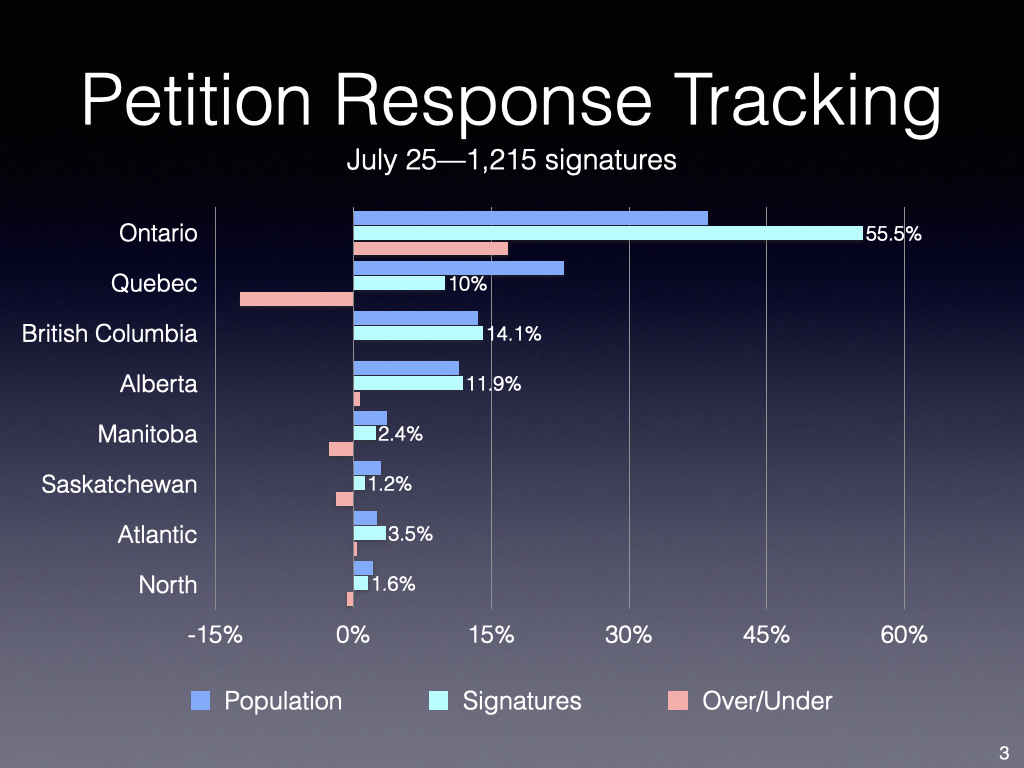
The chart below breaks down the 1,012 signatures as of 18 July by province, highlighting Ontario over representation and Quebec under representation. British Columbia and Alberta in line with their share of the population but Manitoba and Saskatchewan under represented. These numbers may reflect the various networks involved in the initial launch so will be interesting to see how the regional numbers vary over time.

And if you haven’t yet considered signing the petition, the link is here: https://petitions.ourcommons.ca/en/Petition/Details?Petition=e-4511

John Ivison: The Liberals are too eager to erode the singular power of the citizenship oath

Powerful commentary against the proposed change permitting self-administration of the citizenship oath:

I have vivid memories of taking the oath of Canadian citizenship 18 years ago, a humbling, life-changing experience.

The day before the ceremony, I was looking down on the House of Commons from the press gallery with vaguely anthropological interest in a curious but distantly related species.

The day after being welcomed to the Canadian family with a roomful of wide-eyed new arrivals, the sense of detachment was gone, replaced by a common purpose, summed up in the citizenship certificate that bound me to uphold “the principles of democracy, freedom and compassion which are the foundations of a strong and united Canada.”

That is the experience that the government wants to deny to a future generation of Canadians, who will be asked to take the oath of citizenship by clicking a box online in order to save a few bucks.

In January, Immigration, Refugee and Citizenship Canada (IRCC) Minister Sean Fraser said his department would begin making the necessary changes to allow self-administration of the oath. This would replace the requirement to take the oath in person before a citizenship judge, along with a room full of other new Canadians, which has been the law since 1947.

The reason, according to the government’s explanation in the Canada Gazette, is that citizenship applications have doubled in recent years to around 243,000 in 2021/22, and are set to keep rising as we move towards the Liberal immigration target of 500,000 newcomers in 2025. During the pandemic, citizenship tests migrated online, which, in the second half of last year, accounted for around 90 per cent of all ceremonies. In April, Fraser said his department was holding 350 virtual ceremonies a month.

The government has been delighted by the time and cost savings and says self-administration will save people roughly three months between taking their citizenship test and officially becoming Canadian.

The Liberals say that they will always maintain in-person ceremonies. The government says it doesn’t track how many people asked for an in-person ceremony and didn’t get one. But if self-administration of the oath is adopted, it says it expects fewer people to attend a ceremony and for there to be fewer ceremonies overall.

Andrew Griffith, a former director general at IRCC, said the anticipated savings of $5 million is only a small portion of the cost of administering the oath. Much greater savings in time and money could be made by focusing on administration and processing efficiencies prior to the citizenship ceremonies. “This actually does matter,” he said of “the rare positive celebratory moment in the immigration journey.”

There are some things that transcend bureaucratic efficiencies, and the citizenship ceremony is one of them. It is about a sense of participation and belonging, the culmination of a long and often difficult immigration process.

The minister’s press secretary said in an email that the intention is to make public ceremonies available for those who request them. “Those who choose to do an online attestation will still have an opportunity to attend an IRCC organized citizenship ceremony,” said Bahoz Dara Aziz.

But it is clear that the government would be happy to let the ceremonies wither on the vine.

The minister and his department are starting to get a sense of a backlash as prominent Canadians, including former governor general Adrienne Clarkson, ex-Calgary mayor Naheed Nenshi and former Liberal immigration minister Sergio Marchi, have argued that the government is robbing future citizens of a deeply meaningful moment. Nenshi said the reasons are “bureaucratic and puerile.”

The public comments during the consultation process, which were overwhelmingly hostile, suggest many Canadians agree. “This proposal takes what should be one of the most meaningful things a person will ever do in their lives and equates it with ordering a new pair of underwear from Amazon,” wrote one person (commenters’ names were removed before the feedback was made public).

A petition has been launched in Parliament (petition e-4511), where people can sign up and urge the government to support the in-person ceremony as a unifying bond for Canadians.

The petition urges the government to reverse the trend of moving the oath online by limiting virtual ceremonies to 10 per cent of all citizenship events.

Fraser can hardly be immune to the power of the argument in favour of in-person ceremonies. He swore in nine new Canadians on Canada Day in front of 41,813 baseball fans at a Toronto Blue Jays game at the Rogers Centre this year, with the crowd joining in a noisy rendition of the national anthem.

There is a magic to the tradition that goes beyond a pledge of allegiance to the King and the Constitution.

Before becoming a citizen, I remember feeling it was vaguely treasonable to forsake the land of my fathers and adopt the common sympathies of another nation.

Yet, it was strangely comforting to be in a room with 50 or so others from all over the world, who were, in all likelihood, wrestling with their own doubts.

Qualms quickly turned to elation on being called to receive my citizenship certification in front of friends and family.

There was something extraordinary about watching all those newcomers experience true patriot love for the first time as citizens by singing O Canada.

I feel sorry for my future countrymen and women if that time-honoured tradition is replaced by the click of a mouse.

Source: John Ivison: The Liberals are too eager to erode the singular power of the citizenship oath

Why Canada’s ‘citizenship on a click’ is proving controversial

Star coverage of the petition opposing self-administration of the citizenship oath:

Andrew Griffith says he used to drop by a citizenship ceremony whenever he felt depressed or frustrated at work.

The former director general at the federal immigration department says seeing new citizens walking the stage, being greeted by a uniformed RCMP officer and congratulated by a citizenship judge, reminded him of the importance of his work at the citizenship and multiculturalism branch.

“This is the one time that you actually get recognition for all that hard work and all that patience. Most people remember their citizenship ceremony,” he said.

“It’s like graduating from high school or university or other such moments. I think it really helps people have a sense of belonging and attachment to Canada.”

It’s why Griffith says he finds it troubling that the federal government is going to allow new citizens to take their citizenship oath online and on their own with a click on the keyboard rather than having to declare their loyalty to Canada before a citizenship judge.

In February, the federal government published the proposed change in the Canada Gazette. It is part of the modernization and digitalization of immigration processing in this country.

It said the online self-administration of the oath is expected to reduce the current citizenship processing time by three months and make it more accessible, because ceremonies are currently scheduled mainly on weekdays during working hours. According to the immigration department website, there are currently 308,000 citizenship applications in the system and the processing time stands at 19 months.

A chorus of prominent Canadian leaders, including former governor general Adrienne Clarkson, former Liberal immigration minister Sergio Marchi and former Calgary mayor Naheed Nenshi have voiced their opposition to the plan.

It has also prompted Griffith to start a petition to the Parliament, sponsored by Conservative immigration critic Tom Kmiec, demanding the government abandon the proposed change permitting what he calls “citizenship on a click.”

“There’s something meaningful about becoming a citizen. Citizenship is more than just sort of the paper process of having a Canadian passport and all the rights and responsibilities of Canadians,” he said. “It actually matters to the country. It matters to social inclusion, and I think it matters to all immigrants.”

During the pandemic, citizenship processing time doubled from the prior 12-month service standard. Officials brought in virtual citizenship ceremonies as of April 2020.

Since then, more than 15,290 of the ceremonies have been held online in front of an authorized official, generally a citizenship judge.

Kmiec, MP for the Calgary Shepard riding, said the government is trying to eliminate the backlog, but doing it at all costs.

“You click a button and you click your terms of reference the way you do it on your iPhone or on your Samsung. There’ll be no application that would be delayed, right? That’s why they’re doing it,” said Kmiec, who came to Canada from Poland with his family in 1985 and became a Canadian citizen in 1989.

“Why should these new citizens who pass their test and have all the time be robbed of having a special symbolic ceremony that’s required under the Citizenship Act?”

If the goal of the change is really to improve flexibility and accessibility for new citizens, Kmiec said, immigration officials should consider holding more citizenship ceremonies after hours or on weekends. An in-person ceremony should be made the default option, and virtual ceremonies are used only as a last resort, he added.

“You only get to swear an oath once in your life to Canada. That should be done in person. It should be a special ceremony. The government should honour you in this way,” said Kmiec. “I’ve never had anyone complain to me that they had to appear at a citizenship ceremony to become a citizen of Canada. Never.”

More than 700 comments were left on the notice of the citizenship change published in the Canada Gazette during the consultation period that ended in March.

Jenny Kwan, immigration critic for the NDP, says she, too, recognizes the significance of the in-person ceremonies but said people should have the option to do it online and that the proposed change would strike a balance.

An immigrant from Hong Kong, Kwan came to Canada with her family in the 1970s when she was nine. While she recalled the family’s excitement at their citizenship ceremony, she also saw the stresses her working-class parents experienced to make it to the event.

“They had to take time off work and we were a low-income family. For them to have missed work, it meant that they lost a day of income. And for a family of eight who’s struggling to survive, and for my parents to put food on the table, that was a big deal,” said Kwan, whose mother worked as a dishwasher and father did multiple part-time shift jobs to support the family.

“In offering alternatives for people to have their citizenship oath taken, I think this is an important consideration. I think that should be offered for new Canadians so that they can choose what is the best option for them.”

However, both Griffith and Kmiec say they fear many new citizens would simply opt for the self-attestation option given the convenience to do so.

“Of course, that’s the easiest thing to do. If they told you you’re going to have to wait maybe a few weeks and we’ll send you a paper copy, before you accept it, you’d say, ‘No, give me the digital,’” said Kmiec.

“You’re not going to pay much attention to it. You’ll just click the button and you’ll carry on.”

The online petition is open until Oct. 10 and must collect at least 500 signatures during that period. The Clerk of Petition would then validate the signatures and issue a certificate so it can be presented in the House. The government must then respond to the demand within 45 days.

“Depending on the quality of the response, I’m going to follow up with the minister. I’m not going to let this go,” Kmiec said.
Source: Why Canada’s ‘citizenship on a click’ is proving controversial

Petition e-4511: Opposing self-administration of the citizenship oath (“citizenship on a click”)

As readers are aware, the Government has proposed allowing the oath of citizenship to be self-administered rather than in front of other new and existing Canadians as it currently the practice. 

In my view, this seriously diminishes the meaning and impact of citizenship and the ceremonies, a rare positive celebratory moment in the immigration journey. 

Opposition to the change has been voiced by former governor general Adrienne Clarkson, former minister of immigration Sergio Marchi, former Calgary mayor Naheed Nenshi and a number of former citizenship judges. The Conservatives opposed the change in Parliament. 

And of the nearly 700 comments on the notice during the consultation period. Of them, two-thirds disapproved (A one-click citizenship oath isn’t the way to go provides the details).

Most new Canadians find the ceremony to be a major moment for them and their families, marking an end to their immigration journey and strengthening their sense of belonging to Canada.

I initiated this petition to ensure that this weakening of the citizenship ceremony and meaning does not pass unnoticed and hopefully, with enough signatures, will prompt the government to reconsider.

Please consider signing the petition and encouraging family, friends, colleagues and social networks to sign the petition. We need at least 500 signatures in order for the petition to be presented to the House.

Link: https://petitions.ourcommons.ca/en/Petition/Details?Petition=e-4511 

Thanks, Andrew

Text of petition below:

Petition to the Minister of Immigration, Refugees and Citizenship

Whereas:

  • The government has published a notice in the Canada Gazette permitting self-administration of the citizenship oath;
  • Affirming the Oath of Citizenship in the presence of other new Canadians was the will of Parliament when the original Citizenship Act was approved by Parliament in 1947 and has been central to citizenship since Canadian citizenship ever since;
  • One of the fundamental objectives of the citizenship program is “to enhance the meaning of citizenship as a unifying bond for Canadians;”
  • Citizenship ceremonies mark the end of an often lengthy and difficult immigration journey and provide a unique celebratory moment for new and existing Canadians;
  • Most citizenship ceremonies should be in-person rather than virtual given their greater impact on new Canadians;
  • The stated cost and time savings in the notice are unlikely to be realized and are minimal in relation to total processing time and overall cost of the citizenship program; and
  • Two-thirds of submissions opposed the proposed change.

We, the undersigned, citizens and residents of Canada, call upon the Minister of Immigration, Refugees and Citizenship to: 

1. Abandon plans to permit self-administration of the citizenship oath;

2. Revert to in-person ceremonies as the default, with virtual ceremonies limited to 10 percent of all ceremonies;

3. Focus on administration and processing efficiencies prior to citizenship ceremonies, where most frustrations are; and

4. Explore evening and weekend ceremonies to improve accessibility along with more flexible scheduling management.

Grenada’s passport-selling boom offering rich Russians a Caribbean shortcut to US visas could be over

Incredibly low amount with virtually no meaningful restrictions:

Grenada is one of the five Caribbean islands offering a “golden passport” in return for an investment in the country.

Its “Citizenship by Investment” (CBI) program offers people the chance to purchase citizenship for a $150,000 donation to the country’s National Transformation Fund, which was set up to boost its economy by financing areas such as tourism and agriculture or a $220,000-minimum investment into real-estate development.

Applications to the program soared following the outbreak of the Russia-Ukraine war in 2022, as wealthy Russians looked to flee abroad, Richard Hallam, who helped develop the program, told Bloomberg. There was a striking uplift in numbers following Putin’s mobilization announcement in September 2022 — Russia’s first such decree since World War II.

The total number of applications in 2022 hit 1,251 — an increase of around 87% from 2020. That trend continued into the first quarter of 2023, with 576 applications to the program, up from just 164 in the first quarter of 2022, according to statistics from Grenada’s Ministry of Finance.

The “Isle of Spice” welcomed 980 new citizens in the first quarter of 2023, far above the 391 it had in Q1 2022.

Fleeing Russians seeking to evade the war in Ukraine were likely enticed by the access to travel that the Grenadian passport provides, as it enables holders to visit over 100 countries without visa restrictions, including the UK and all EU member states.

The anonymous process also requires “no interview, education, or management experience,” and there is no obligation to live in Grenada “before or after citizenship is granted.”

It may also have hinted at the increasing number of Russians aiming to move to the US. Grenadian citizens are entitled to apply for an E-2 visa, a nonimmigrant visa that lasts a maximum of five years but can be renewed indefinitely, to get to the US — something which Russians are currently unable to do.

Irina Batrakova, the founding attorney for the Batrakova Law Office, previously told Insider that her firm had mainly been dealing with inquiries from Russians seeking to move to the US.

But Grenada has flip-flopped on its decision to allow Russians to take part in the program. It initially banned Russian nationals from applying after the war with Ukraine broke out, Bloomberg reported. It then reversed the ban in June, before once again imposing it from April 2023.

While the new ban may stem the tide of applications to the program, Grenada’s favorable tax policies and the global mobility offered by the passport will likely ensure that it remains popular.

The office for the Grenada Citizenship by Investment program did not respond to Insider’s request for comment.

Source: Grenada’s passport-selling boom offering rich Russians a Caribbean shortcut to US visas could be over

Nepal implements new citizenship law, but long road ahead to end discrimination, statelessness

Of note (gender and wedlock discrimination), being addressed in part:

Growing up in Nepal, Neha Gurung hoped to become a doctor, but her dreams were shattered when she was barred from medical school because the country she called home did not recognise her as a national.

Gurung was raised by a single mother, but Nepal does not let women automatically pass citizenship to their children. With her father untraceable, she was left stateless – a fate she likened to “being a prisoner in my own country”.

Hundreds of thousands of people in the Himalayan nation exist in a similar limbo for a host of complex legal, social and historical reasons, but a long-awaited law could now transform their lives, providing access to jobs, education and healthcare.

The reforms could also spur other countries to take action ahead of a 2024 deadline for ending statelessness worldwide, which is way off track.

Certificates of citizenship are the key to basic rights in Nepal including formal employment. But legal experts say flawed laws – rooted in patriarchal and xenophobic attitudes – have left many shut out.

“The feeling of exclusion is very strong,” Gurung told Context.

“I couldn’t study, get a driving licence, open a bank account or travel. Without citizenship, I couldn’t even get a SIM card for my phone.”

Stateless people – who are not recognised as citizens of any nation – typically rely on informal, low paid jobs and cannot buy property, legally marry or vote.

Deprived of opportunities and legal protections, they are at risk of exploitation and easy prey for criminals.

Gurung, 28, who acquired citizenship in 2017 following a five-year legal battle, said laws that left people stateless not only had tragic consequences for individuals, but also held back development and entrenched poverty.

“Once a person is stateless, their children will be stateless – generation after generation. And that’s a huge loss to the country.”

After qualifying as a lawyer, Gurung joined the Forum for Women, Law and Development, a human rights non-profit which worked with parliament on the reforms.

The Forum anticipated that more than one million people could benefit.

They include an estimated 400,000 to 500,000 people whose parents were granted a form of citizenship that they could not pass on to their children, and many others whose mothers are Nepali but whose fathers cannot be traced.

However, campaigners said the law was still discriminatory and many people would remain stateless, including some Dalit communities in the southern plains that have been stateless for generations.

Politicised issue

As the authorities began releasing citizenship certificates, many newly recognised Nepalis shared their joy on social media, posting photos of themselves holding their prized identity documents.

Those celebrating included activist Indrajit Saphi, 31, who had spearheaded a national grassroots campaign for reforms, organised protests and helped thousands lodge applications.

Saphi hopes to become an engineer while his three brothers will now be able to apply for passports to take up jobs overseas.

“I am very happy. My entire family is very happy (that) we are now citizens of our country,” he said.

Perbej Alam’s lack of citizenship drove him to the brink of depression, but the 21-year-old now hopes to study public health.

“This has opened a path for my future,” he added.

The Nepal Citizenship (First Amendment) Act effectively came into force on June 22 following a long and tortuous legislative process and repeated challenges by populist politicians.

A last-minute delay sparked protests in the capital Kathmandu last month with one man trying to set himself alight after dousing himself in petrol.

Citizenship is a highly politicised issue in Nepal, a small country of 30 million sandwiched between the world’s most populous countries, China to the north and India to the south.

It shares a long open border with the latter allowing millions to cross both ways for work.

The number of people without citizenship is particularly high in the south where mixed marriages are common.

Campaigners said years of marginalisation had left many with mental health issues.

Forum for Women, Law and Development executive director Sabin Shrestha said some people were considering suing the government for compensation over lost opportunities due to the protracted delays.

Ending statelessness

There are no reliable data for the number of stateless people worldwide, but some estimates have suggested there could be 10 to 15 million.

In 2014, the UN launched a global campaign called “#Ibelong” to end statelessness in a decade, but progress has been extremely slow with only about 450,000 acquiring citizenship.

Monika Sandvik, head of the UN refugee agency’s statelessness section, said Nepal’s reforms could inspire other governments to follow suit and would bring broad benefits to the country.

“How many doctors, have they lost by not giving people citizenship? How many engineers? This reform now opens doors for people to fulfil their potential.”

Giving people a legal identity and access to jobs would also boost Nepal’s tax revenues, she added.

Subin Mulmi, a Nepali lawyer and executive director of Nationality For All, an organisation working to end statelessness in Asia, welcomed the reforms, but said there was still a need to address underlying discrimination in the country’s constitution.

Campaigners are particularly concerned about a provision in the new law requiring mothers submit a declaration that their child’s father is untraceable, with the threat of a three-year jail term if the information later proves false.

They said the stigma attached to making a statement in Nepal’s strongly patriarchal society combined with the threat of prosecution would act as a deterrent to many women.

Nepali women will also not be able to apply for citizenship for children born abroad, with serious implications for many migrant workers who give birth overseas, often as a result of rape, and for victims of trafficking.

“This is definitely not the end of the reform process,” Mulmi said. “There’s a lot of work still to be done.”

Source: Nepal implements new citizenship law, but long road ahead to end discrimination, statelessness