OECD: Misuse of Citizenship and Residency by Investment Programmes

Likely more effective not to have these programs at all given this misuse:

Citizenship and residency by investment (CBI/RBI) programmes are government-administered programmes that grant citizenship or residency to foreign investors by expediting or bypassing normal migration processes. These programmes can help spur economic growth through foreign direct investment, but they are also attractive to criminals and corrupt officials seeking to evade justice and launder the proceeds of crime reaching into the billions of dollars. This report highlights how CBI programmes can allow criminals more global mobility and help them hide their identity and criminal activities behind shell companies in other jurisdictions. It highlights the vulnerabilities of these complex and international investment migration programmes, including the frequent use of intermediaries, involvement of multiple government agencies, abuse by professional enablers and lack of proper governance of the CBI/RBI programmes. The report proposes measures and examples of good practice, that can help policy makers and those responsible for managing the investment migration programmes address these risks. These include an in-depth analysis and understanding of how criminals can exploit CBI or RBI programmes and incorporating risk mitigation measures, such as multi-layer due diligence, in the design of the investment migration programme.

Source: Misuse of Citizenship and Residency by Investment Programmes

Removing Shamima Begum’s citizenship is a cruel, politically-motivated policy has done nothing to keep us safe

Revocation, without considering statelessness or “ownership” of problematic citizens, is indeed more politically motivated than justified.

As the case of “Jihadi Jack” illustrates, it also allows countries to export their problems to other countries in cases of dual citizens.

That ministers are prepared to do this to British kids shocks me every time I go there.

It is also where Shamima Begum has been imprisoned without charge or trial for the past five years.

Former Home Secretary Sajid Javid deprived her of British citizenship when she was 19 years old and mourning a third child, and she has been stuck there, stripped of all her rights, ever since.

Yesterday a group of United Nations legal experts weighed in on her case. “There is a credible suspicion that Ms Begum was recruited, transferred and then harboured for the purpose of sexual exploitation,” they said.

Last month, Britain’s own Court of Appeal referred to “the likelihood that she was a child victim of others who wished to exploit her for sexual or extremist reasons”.

It is well-documented that ISIS targeted vulnerable British girls and young women and that UK institutions failed in their duty to protect them.

Remember, Shamima was 15 years old and studying for her mock GCSEs when she was groomed. The idea that she should be sent into exile for the rest of her life because she was targeted by a trafficking gang runs contrary to good sense and basic humanity.

Former Supreme Court Justice Jonathan Sumption has made the point that depriving Ms Begum of UK citizenship leaves her stateless. The United Nations legal experts agreed.

The Government’s claim that she could be a citizen of Bangladesh, a country she has never visited and that has publicly stated it will not accept her, reveals a racist, two-tier citizenship regime.

Britain is alone among G20 nations in stripping citizenship in bulk. Only Bahrain and Nicaragua have deprived more people of citizenship in the last two decades.

This cruel, politically-motivated policy has done nothing to keep us safe – in fact security experts agree that the detention camps are ticking timebomb. That’s why every one of our allies is repatriating families from North East Syria.

Maya Foa is the Director of Reprieve

Source: Removing Shamima Begum’s citizenship is a cruel, politically-motivated policy has done nothing to keep us safe

Canadian Citizenship in Transition: Trends, Debates, and Challenges

Looking forward to this timely discussion given recent trends and issues, and the need to maintain and strengthen meaningfulness and belonging of citizenship process, requirements and ceremonies.

Hope some of you can attend in person or virtually.

Please join our panel of experts to discuss trends, debates, and challenges in Canadian citizenship. Topics will include (but not be limited to) the precipitous decline in Canada’s naturalization rate; the suitability of self-administered online naturalization ceremonies and citizenship oaths; concerns over citizenship acquisition through birth; impediments to new Canadians’ access to licensed professions and position of economic, social, and political power; conflicting ideas of what constitutes ‘good’ citizenship and Canadian national identity (as reflected in citizenship guides and courses, government pronouncements, and public discourse); and the consequences of changing immigration policies for newcomers’ access to citizenship. This is a timely and important event that will be of interest to anyone interested in Canadian citizenship both now and in the future.

Source: Canadian Citizenship in Transition: Trends, Debates, and Challenges

Is the ‘market value of becoming Canadian’ dropping? Fewer immigrants are becoming citizens

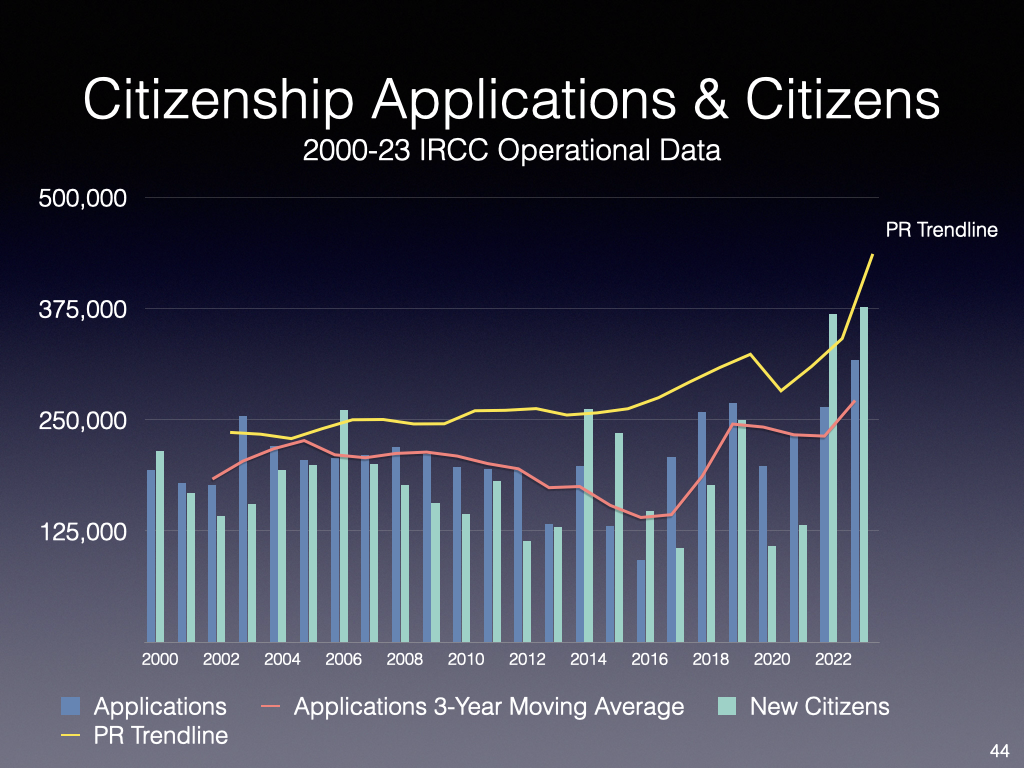
One discussion point that has arisen in social media is the extent that Harper-era changes, making citizenship “harder to get and easier to lose,” are responsible for the decline.

The 2021 study is based upon the 2011-15 period, when all immigrants have met the residency requirements (5-9 years since landing). So while the Conservative government changes to language and knowledge were implemented in 2010-11, increased residency requirements and fees were not implemented until 2015, thus not impacting this study.

One area that needs to be considered is for the settlement sector to provide citizenship test preparation courses, given that the study confirms that lower levels of language fluency and education attainment correlate with lower naturalization.

It is unlikely that the current government will implement its 2019 and 2021 election commitment to eliminate citizenship fees (virtue signalling) but there is a case to waive these fees, at least partially, for lower income applicants.

… The findings confirm the worrisome trends identified by the research of the Institute for Canadian Citizenship that found a strong decline in the “market value of becoming Canadian.”

“This study shows that some of the people who are most likely to naturalize are the wealthiest and best educated,” said the institute’s CEO, Daniel Bernhard. “But we saw just a few weeks ago from Statistics Canada that the (recent) immigrants who are most likely to leave the country are exactly those.

“No matter which way you look at it, it’s clear that Canada’s appeal in the eyes of immigrants is fading. And if our growth strategy continues to be dependent on immigrants, that’s a real problem for our future viability.” 

Although office lockdowns and public health restrictions have caused backlogs and contributed to the disruptions of citizenship application processing, Statistics Canada said that only accounted for 40 per cent of the decline between 2016 and 2021.

The study compared the citizenship takeup among recent immigrants who arrived in Canada five to nine years before each census. It found that 75.4 per cent did so in 1996 and it gradually declined from 2006, when the Conservatives took power.

In the decade with the Tories at the helm, the “knowledge of Canada” test was strengthened, language requirements increased, citizenship application fees rose and the physical presence requirements for citizenship were changed from three of four years preceding application to four of six years. The naturalization rate subsequently dropped to 60 per cent.

After Prime Minister Justin Trudeau’s Liberals came into power, the federal government restored the residency requirement to three of five years, and moved the upper age limit for the exemption to the language and knowledge test from 64 back to 54, the report notes. The citizenship fee for minors was also reduced in 2018.

However, these changes have failed to reverse the trends, with the citizenship naturalization rate falling a further 14.7 per cent between 2016 and 2021, said Statistics Canada, which, in an earlier report, also found a significant number of immigrants are leaving the country after initial arrival.

“Other more global events also likely play a role,” said the report. “Significant economic development in some source countries, such as China and India, could encourage immigrants from these regions to maintain their source-country passports and reduce their motivation to become Canadian citizens.”

The study also found the fall in citizenship rates over the past 25 years varied by demographics:

•Families with household income between $10,000 and $30,000 annual saw a 35.9-percentage-point drop, compared to a 13.5-point decline among those making over $100,000 a year;

•Those who did not complete high school saw a 39-percentage-point drop compared to 29 points for those with a university degree;•Newcomers whose mother tongue was not an official language registered a 32-percentage-point decline in naturalization rate versus just a 19-point fall among those with English or French as first language;

•Before 2006, StatCan calculated that the group of immigrants with all three characteristics of low income, education and language skills was more likely to acquire Canadian citizenship than the most advantaged group, but the pattern reversed after that; in 2021, the citizenship rate was 1.5 times higher among the most advantaged group than among the disadvantaged. 

•Immigrants from some non-western countries who traditionally were more likely to acquire Canadian citizenship now more closely resembled their counterparts from developed nations in citizenship uptake.

Bernhard said the report speaks to the need for greater policy intervention to address the question of why people want to become Canadian, as well as their experience here and commitment to the country, and what they’re getting from and giving to Canada.

Some advantages that used to be reserved for citizens such as jobs in the federal government and military are now open to permanent residents, which removes the incentive for some to acquiring citizenship, said Bernhard, adding that immigrants need to have positive experiences and strong connections to feel belonged.

“That’s the difference between residency and citizenship,” he said. “That’s the difference between, you know, Dubai and Canada, both of which have large foreign-born populations. Only one of them allows you to be an owner of the society.

“That’s Canada, where citizenship remains very accessible. And if that ownership is no longer desirable, that’s a really shocking signal to the rest of us that we have deeper issues to reflect upon and resolve.”
Source: Is the ‘market value of becoming Canadian’ dropping? Fewer immigrants are becoming citizens

The decline in the citizenship rate among recent immigrants to Canada: Update to 2021

A valuable update to the earlier Statistics Canada study of 2019.

As someone who raised concerns over a declining naturalization rate since 2015, having these detailed studies confirming the trend with detailed breakdowns and analysis provides a basis to assess whether this simply reflects a global trend, given changing economic opportunities changing its value proposition, and/or, are there specific Canadian policies that had an impact (beyond the pandemic period).

There has always been a balance between the meaningfulness of citizenship, as seen through language and knowledge requirements, the Discover Canada study guide, the oath, and citizenship ceremonies, and facilitating citizenship through the same instruments (harder or easier language assessment, harder or easier citizenship test, a more or less rigorous citizenship study guide, in-person or virtual citizenship ceremonies).

The former Conservative government emphasized meaningfulness, the current Liberal government less so, as seen in its virtue signalling 2019 and 2021 election commitments to eliminate citizenship fees, its failure to issue a revised citizenship study guide announced four ministers ago, its proposal to allow self-affirmation of the citizenship oath (“on a click”) and the less meaningful virtual ceremonies for about 80 percent of new citizens. The government did, however, revise the oath to include reference to Indigenous peoples.

However, compared to most other countries, the current requirements compare favourably in terms of access to citizenship. But proposals like self-affirmation of the citizenship oath or the massive shift to virtual ceremonies undermine one of the few celebratory moments for immigrants, and arguably reduce their sense of being welcomed to the “Canadian family.”

Having experienced in-person ceremonies, both in my former official capacity, as well as celebrating with friends and family as they became citizens, their impact on new citizens and existing citizens is significant.

Citizenship should not be viewed simply as a government service (although it needs to ensure a quality service experience) but in the more fundamental sense of welcoming and belonging new citizens and assisting their integration journey.

One last detail. This Statistics Canada study will force IRCC to address its current performance standard of 85 percent of all immigrants, no matter their period of immigration, become Canadian citizens, given that the rate in 2021 was only 81.7 percent. While the pandemic shutdown clearly had an impact, IRCC should revised its performance standard to refer only to recent immigrants, five to nine years after landing (90 percent of immigrants do so within that period), as it is the recent immigrant rate that is the meaningful benchmark, not those immigrants who arrived many years ago.

This article examines the trends in citizenship rates among recent immigrants who have been in Canada for five to nine years, based on census data from 1991 to 2021. The citizenship rate among recent immigrants has decreased significantly, dropping from 75.4% in 1996 to 45.7% in 2021, a decline of 29.7 percentage points. Almost half of this decline occurred from 2016 to 2021, with approximately 40% of the most recent decrease possibly related to COVID-19 pandemic restrictions. However, even after accounting for the pandemic effect, the citizenship rate declined at a faster rate from 2016 to 2021 than during any other five-year intercensal period since 1996. The decline in citizenship rates among recent immigrants from 1996 to 2021 was larger among those with lower levels of education, lower family income and lower official language skills. The decrease was also more substantial among recent immigrants from East Asia, Southeast Asia and West Asia than among their counterparts from the United States, Western Europe and Southern Europe. This article discusses possible explanations for these trends.

Source: The decline in the citizenship rate among recent immigrants to Canada: Update to 2021

Mito: Canada needs to end repatriation of Islamic fighters

Understandable perspective of a Yezidi survivor. But revocation is problematic as countries will export their problems to other countries, as the UK revocation of Jack Letts, a former UK citizen who spent his life in the UK before becoming “Jihadi Jack,” became the subject of efforts by his parents to use his Canadian citizenship by descent to allow him to return to Canada.
I hope the courts are sensible in affirming the limits to repatriation:
As a Yezidi survivor of the 2014 genocide committed by the Islamic State (IS), I have serious concerns regarding public safety as Canada repatriates former IS terrorists. Since the IS’s defeat in Syria in 2019, the Canadian government has been grappling with cases involving Canadians who left to join the group. Some of these citizens have been repatriated, while others remain in IS camps under the control of Kurdish forces in Syria.
In 2015, the Conservative Party of Canada passed Bill C-24, a law allowing Canada to revoke the citizenship of Canadians who joined the IS. Some legal scholars oppose such laws, likening the revocation of citizenship to historical practices of exile and banishment. Countries, including Australia and the U.K., that have implemented similar laws have encountered legal challenges, as these laws can either render a person “stateless” (without any citizenship) or establish disparate treatment between individuals with dual citizenship and those with only one.
As a solution, the Liberals revoked the portion of Bill C-24 that allowed the stripping of citizenship from dual citizens who joined a terrorist organization. Without the power to strip citizenship, the government has opted not to repatriate Canadian citizens held captive by Kurds in IS camps. Government lawyers claim it would be “unprecedented and unprincipled” to assist these detained suspects and assert that “there is no legal obligation, under the Charter, statute or international law for Canada to provide consular assistance, including the repatriation of its citizens.”
However, a lawsuit has led the Federal Court to order the government to repatriate at least four men accused of being IS fighters. These individuals, who allegedly participated in crimes against humanity, knowingly left Canada to join IS. However, due to their use of false names and a pervasive lack of evidence, it remains doubtful that they will face justice in Canada or at the International Criminal Court if they return home for trial. The CBC quotes a former CSIS analyst as saying he “doubts any of the adults returning would face justice for any crimes they may have committed,” because “the witnesses aren’t here, the evidence isn’t here.”
Repatriating former IS members without prosecution is an injustice to Yezidis and all others who survived their crimes against humanity. The only path left for justice is for the government to reimplement Bill C-24 in full, allowing Canada to strip the citizenship of suspected IS members, leaving them in the prison camps where they belong. Further to that, Canada should pass a new law that does not require a legal conviction but rather a hearing in something equivalent to a closed tribunal. A legal process has too high a burden of proof in a war zone, such as the conflict in Syria and northern Iraq.
The situation Canada faces, whether to bring IS fighters back home, is not just about politics; it’s about real people who have suffered unimaginably. Canada must find a way to bring justice to survivors like the Yezidis and to protect its citizens. Putting Bill C-24 back into action and creating a special court-like system could help ensure IS members are held accountable without legally complicating things, given our government’s limited evidence against these fighters.

As someone who has experienced IS cruelty first-hand, I ask Canada to make careful and strong choices. We must ensure that those who cause suffering cannot just walk away, and we must remember and honour all the people who were hurt or lost.It is a tough path, but it’s the right thing to do.

Saif Mito is a Mount Royal University student in Calgary and a Yezidi survivor.

Source: Opinion: Canada needs to end repatriation of Islamic fighters

Government misses deadline for online passport renewals by fall 2023

Yet another operational failing. Always better to under promise and over deliver and striking government tends to the opposite:

…The government processes anywhere between 2.5 million and five million passport every year and as far back as 2020 a review of the system has recommended an online option to streamline the process. Canada’s passport system was overwhelmed in 2022 as people returned to travel following the pandemic, with people waiting months to get a passport or standing for hours outside passport offices for emergency travel.

The government has largely cleared that backlog, but Krupovich said the department’s hope is that an online renewal process will allow the department to better manage volumes.

“This tool will also help us to better manage fluctuating application volumes and help ease the pressure on front-line staff, thereby improving client access to passport services,” he said.

The new proposed system would allow people to renew their passports, upload a new photo and pay any fees all online without going to a passport office. Anyone applying for a new passport would still have to go to an office in person.

Krupovich didn’t give a new deadline for when the online renewal might be made available, saying only that any developments would be announced.

Source: Government misses deadline for online passport renewals by fall 2023

COVID-19 Immigration Effects – December 2023 update

Regular monthly data update.

Highlights on slide 3.

Canadian Immigration Tracker December 2023

In Bid to Curb Immigration, France to Scrap Birthright Citizenship in Mayotte

Always found French overseas territories odd and suspect that other overseas territories may also be vulnerable to losing this birthright, despite the official denial:

Children of immigrants born in Mayotte, the French overseas territory situated between Madagascar and the African mainland, will no longer automatically become French citizens, Interior Minister Gerald Darmanin said late on Sunday.

“It will no longer be possible to become French if one is not the child of French parents”, Darmanin told journalists upon his arrival on the island, announcing the scrapping of birthright citizenship there – a first in recent French history.

Located close to the impoverished Comoro islands off the East African coast, the former French colony has become the centre of fierce social unrest, with many residents blaming undocumented immigration for the deteriorating conditions.

Much poorer than mainland France, Mayotte has been shaken by gang violence and social unrest for decades. The situation has recently worsened amid a water shortage.

Since January, island residents have been staging strikes and erecting roadblocks to protest against what they say are unacceptable living conditions, paralyzing large parts of local infrastructure.

The reform, which Darmanin said was the idea of French President Emmanuel Macron, will require a change of the constitution.

It comes less than three weeks after France’s highest court scrapped large parts of a new immigration law designed to toughen access to welfare benefits for foreigners and curb the number of new arrivals into the country.

Immigration is a hot-button issue in France, one of Europe’s strongholds for far right anti-immigration parties.

Darmanin said, however, that “there is no question of doing this for other territories of the Republic.”

Source: In Bid to Curb Immigration, France to Scrap Birthright Citizenship in Mayotte

Stop Granting U.S. Citizenship to Children of Foreign Diplomats

Interesting distinction that the USA makes between diplomats and administrative and consular staff. Canada does not make that distinction and any child of a representative of a foreign government is not entitled to Canadian citizenship. The only exception, likely rare, if one of the parents is also Canadian citizen or Permanent Residents when the child is born.

However, the Vavilov case indicated that undeclared foreign representatives such as spies, can obtain citizenship for their offspring, based on what was an overly narrow interpretation by the Supreme Court. Any future change to the Citizenship Act should address this gap.

Likely CIS overstates the the risks and the extent of the practise given their overall orientation:

…Under State Department’s complicated rules, babies born in this country to blue-list diplomats are not considered U.S. citizens, while white-list offspring, born from parents who are typically administrative or consular staff, are deemed full Americans. This strange outcome ignores the fact that, in both cases, the foreign parents are temporarily in our country, employed by another government or international organization, and enjoying unique diplomatic privileges or immunities. The State Department’s Office of Foreign Missions (OFM) is charged with keeping up with the distinctions and managing this dubious system.

Categorizing foreign officials on one list or another can be a tricky matter, often manipulated by unscrupulous foreign missions that seek to help a pregnant female staffer birth an American citizen. As the Sobhani case demonstrates, OFM’s important function, if not done right, can result in wrongly handing out U.S. passports.

For years, my colleagues at the Center for Immigration Studies (CIS)have monitored and analyzed this poorly conceived and run system, calling out the vulnerabilities in managing it. No one at the State Department really takes full ownership of supervising the diplomatic lists, as the Sobhani case illustrates, with its administrative headaches and processing confusion. Moreover, it all rests on a fundamentally flawed interpretation of the 14th Amendment’s citizenship clause. CIS has rightly called on the State to change the system.

At any given time, there are some 100,000 foreign diplomats and their dependents living in the United States. These officials are accredited to bilateral embassies and consulates as well as a plethora of international organizations, most significantly the United Nations and its satellite entities. Keeping up with these people is a major challenge.

Although many, perhaps most, foreign officials are professionals not interested in exploiting their diplomatic presence, a significant number are out to game their privileges, including scoring U.S. passports for relatives and friends.

Source: Stop Granting U.S. Citizenship to Children of Foreign Diplomats