Canadian citizen sparks outrage with claim that Indian women fly to Canada for free births, citizenship at taxpayer cost

This is getting a lot of coverage in Indian media despite being more an anecdote than buttressed by data. Expect to have updated non-resident self-pay data from CIHI, the best approximation of birth tourism data available shortly.

Unfortunately,this does not capture country of origin and there is no equivalent to Richmond General which had a highly visible cottage industry catering to birth tourists for Chinese women:

A video by Canadian citizen claimed pregnant Indian women were flooding Canadian maternity wards to secure citizenship for their babies, sparking heated debate.

Amid growing diplomatic tensions between India and Canada, a viral video has added fuel to the fire, further igniting the ongoing debate about immigration and healthcare policies. The video, shared by Canadian user Chad Eros on X, claims that Canadian maternity wards are being flooded by pregnant Indian women who are flying to Canada to give birth and secure Canadian citizenship for their babies. This provocative statement has captured the attention of many, adding another layer to the already heated discourse surrounding the two nations.

A heated rant over healthcare and citizenship

In his video, the Canadian citizen expresses frustration over what he perceives as an abuse of Canada’s healthcare system. He claims that these women are taking advantage of the country’s maternity services to ensure that their children are granted Canadian citizenship, all at the expense of Canadian taxpayers.

Chad goes on to share a personal story about his niece, who recently gave birth in a Canadian maternity ward. According to Chad, a nurse told his niece that the ward was full of foreign Indian women coming to Canada for the sole purpose of delivering their babies. Chad argues that while Canadian hospitals are obligated to provide care to all, these women are occupying valuable space in maternity wards that could be used by Canadian citizens.

Source: Canadian citizen sparks outrage with claim that Indian women fly to Canada for free births, citizenship at taxpayer cost


COVID-19 Immigration Effects – September 2024 Third Quarter

Highlights (some data not yet posted on open data)

  • Permanent residents admissions: Increase January-September from 370,000 in 2023 to 379,000 in 2024 or 2.3 percent.   
  • TR2PR (Those already in Canada): Increase January-September from 199,000 in 2023 to 205,000 in 2024 or 3.3 percent. 
  • TRs-IMP: Decrease January-September from 681,000 in 2023 to 584,000 in 2024 or -14.2 percent.
  • TRs-TFWP: Decrease January-September from 160,000 in 2023 to 153,000 in 2024 or -4.0 percent.
  • Students: Decrease January-September from 544,000 in 2023 to 428,000 in 2024 or -21.3 percent. 
  • Asylum Claimants: Increase January-September from 100,000 in 2023 to 135,000 in 2024 or 34.6 percent.
  • Citizenship: Increase from 33,179 in June to 36,070 in July. July year-over-year change (change from 2022): 15.4% (25.0%). Year-to date 2024 compared to 2023 increase of 16 percent OPEN DATA NOT UPDATED FOR AUGUST AND SEPTEMBER
  • Visitor Visas: Increase from 118,402 in June to 127,399 in July. July year-over-year change (change from 2022): -19.7% (37.6%). OPEN DATA NOT UPDATED FOR AUGUST AND SEPTEMBER

https://www.slideshare.net/slideshow/canadian-immigration-tracker-key-slides-september-2024/273373580

Canada’s Supreme Court ’signed my son’s death warrant,’ mother of alleged ex-ISIL member says

Letts was UK’s problem and its not accepting of that responsibility led to Letts’ family understandably advocating given that he is a dual citizen by descent (born and raised in UK). “Canadian of convenience” in one sense:

The mother of a Canadian man detained in Syria says the Supreme Court of Canada has signed her son’s death warrant by closing the door on a plea to hear his case.

“I’ve been screaming about this for 7 1/2 years now,” said Sally Lane, the mother of Jack Letts. “I’m exhausted. I just want my son back.”

The Supreme Court had already declined to hear a challenge of a Federal Court of Appeal ruling that said Ottawa is not obligated under the law to repatriate Letts and three other Canadian men.

In a fresh notice filed with the court in March, lawyers for the men said exceedingly rare circumstances warranted another look at the application for leave to appeal.

A letter to the lawyers, dated last Friday, says the motion for reconsideration cannot be accepted for filing, leaving no further remedies in the top court.

“I have reviewed your motion for reconsideration and your affidavit in support,” says the letter from the court registrar. “I regret to inform you that, in my opinion, your motion does not reveal the exceedingly rare circumstances which would warrant reconsideration by this Court.”

The detained Canadian men are among the many foreign nationals in ramshackle detention centres run by Kurdish forces that reclaimed the war-ravaged region from militant group Islamic State of Iraq and the Levant….

Source: Canada’s Supreme Court ’signed my son’s death warrant,’ mother of alleged ex-ISIL member says

Calls for changes to Australia’s citizenship test after Thai migrant fails five times

Don’t have comparable Canadian data on test fail rates but did do this long term analysis on the citizenship processing times and overall approval rates, highlighting contrast between previous conservative government’s tightening and then relaxing operational aspects. What citizenship applications tell us about policy implementation. One of the issues in Discover Canada and the related test questions was the overly high language level but current numbers suggest that is less of an issue. Strongly believe that the test must be written in an official language but case can be made for study guide to be available in other languages:

…More people failing test since 2020

In 2020 the government updated the test for the first time in a decade — introducing five questions on Australian values such as freedom of speech and equal opportunity.

To pass the test, applicants must answer the five values questions correctly.

Since then, more applicants have been failing at the first attempt.

Data from the Home Affairs Department indicated in the year prior to the changes, around 94 per cent of applicants passed on their first attempt.

In the 2023–24 calendar year that had dropped to around 84 per cent, equating to more than 25,000 people failing at the first try.

Ultimately, 96 per cent of 2023–24 applicants passed, but those who made multiple attempts sat the test an average of four extra times.

Advocates, including the Refugee Council of Australia, argue the values questions, because of their more complex wording, are unfair to people without formal education, particularly the elderly and women.

In August, an independent review of the state of Australian multiculturalism recommended the federal government consider offering the test in languages other than English.

But in 2020, the then-Coalition government said ensuring new citizens had a strong grasp of English would make it easier for them to get good jobs.

A spokesperson for Assistant Citizenship Minister Julian Hill said the current government had no plans to make the test available in languages other than English.

“People can seek special assistance with the test, and it is regularly reviewed to ensure the language and questions are clear, fair, and accord with the legal standard of basic English,” the spokesperson said.

Source: Calls for changes to Australia’s citizenship test after Thai migrant fails five times

What citizenship applications tell us about policy implementation

My latest in The Hill Times. Password protected so here is the analysis (tables simplified in the HT):  

Analysis of citizenship applications between 2005 and 2023 reveals how the previous Conservative government’s pledge to make citizenship “harder to get and easier to lose” resulted in significant delays and reduced approval rates before political realities resulted in mitigating those impacts. The Liberal government reversion to previous residency and other requirements cemented a return to historic approval rates and processing times.

This analysis looks at four periods, roughly aligned to Census periods:

  • 2005-10: During this period, the new Discover Canada citizenship study guide was introduced in 2009 with more detailed content and more complex language, along with a more rigorous knowledge test based upon the guide and more objective language assessments. The policy intent was in part to reduce the previous approval rate of approximately 95 percent to between 80 and 85 percent (“harder to get”).
  • 2011-15: The impact of these 2009-10 operational policy changes was felt during this period. In addition, the Conservative government passed C-24 (Strengthening Canadian Citizenship Act) in 2014, expanding knowledge testing and language assessment to those between 14 and 64 years old compared to the previous 18 and 54. Fees increased from $200 to $630 per adult or over $1,400 for a family of four in 2015. The fee increases may have been a Treasury Board condition in order to obtain funding to address a processing backlog.  Revocation provisions for “treason and terror” were included.
  • 2016-20: The election of a Liberal government resulted in the reversal of knowledge and language assessment to those between 18 and 64 years old and removed the revocation provisions, among other changes. The Liberal party’s 2019 and 2021 election platforms committed to waiving citizenship fees but were not implemented. Similarly, successive ministers of immigration have noted plans for a revision to Discover Canada but the current version remains in effect.
  • 2021-24: The citizenship oath was updated with a reference to indigenous treaty rights in 2021. The pandemic resulted in the virtual shutdown of citizenship ceremonies for a number of months and a shift to the majority of ceremonies taking place on line. The proposed repeal of the first generation limit in C-71 and replacement by a time-unlimited residency requirement would result in an unknown number of additional Canadian citizens.  

 Application data by gender, immigration category or country of birth highlights the dramatic initial impact of the policy changes of the Conservative government and how these were relaxed by the Conservatives themselves before having virtually no impact after a number of years under the Liberals. The same pattern applies no matter what the variable, the 2011-15 period was the worst period in terms of delays and approval rates.

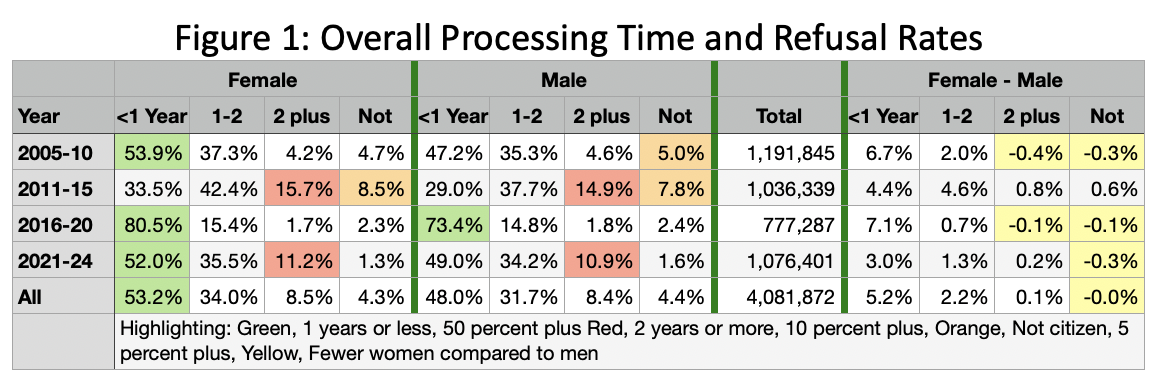
Figure 1 provides the overview by period highlighting that in general, women applicants were granted citizenship faster than men and had higher approval rages, save for the 2011-15 period. The percentage not granted citizenship rose to over ten percent in 2012 and 2013, before recovering to just over seven percent in the last years of the Conservative government. Moreover, only about 20 percent of applications were processed within the service standard of one year 2010-13. Apart from the pandemic years 2021-22, service standards were met close to 80 percent of the time.

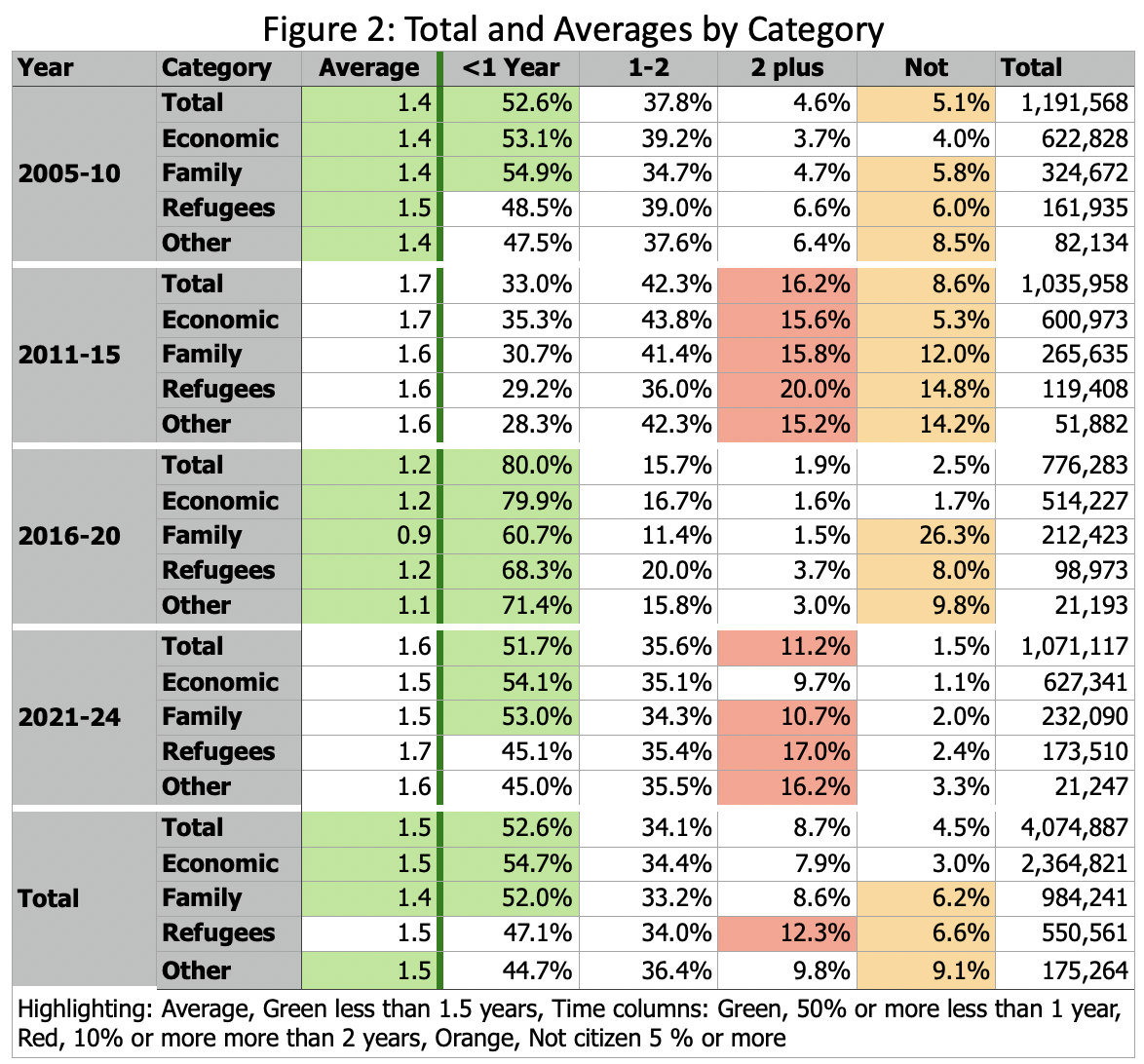
Figure 2 provides the category comparison, highlighting lower refusal rates for economic class and particularly relatively higher refusal rates immigrants for family and refugee class during the first years of the Liberal government, given that legislation reversing the Conservative age range requirement for knowledge and language assessment only came into force October 2017. But since then, refusal rates are negligible, less than three percent, or lower than 2005.

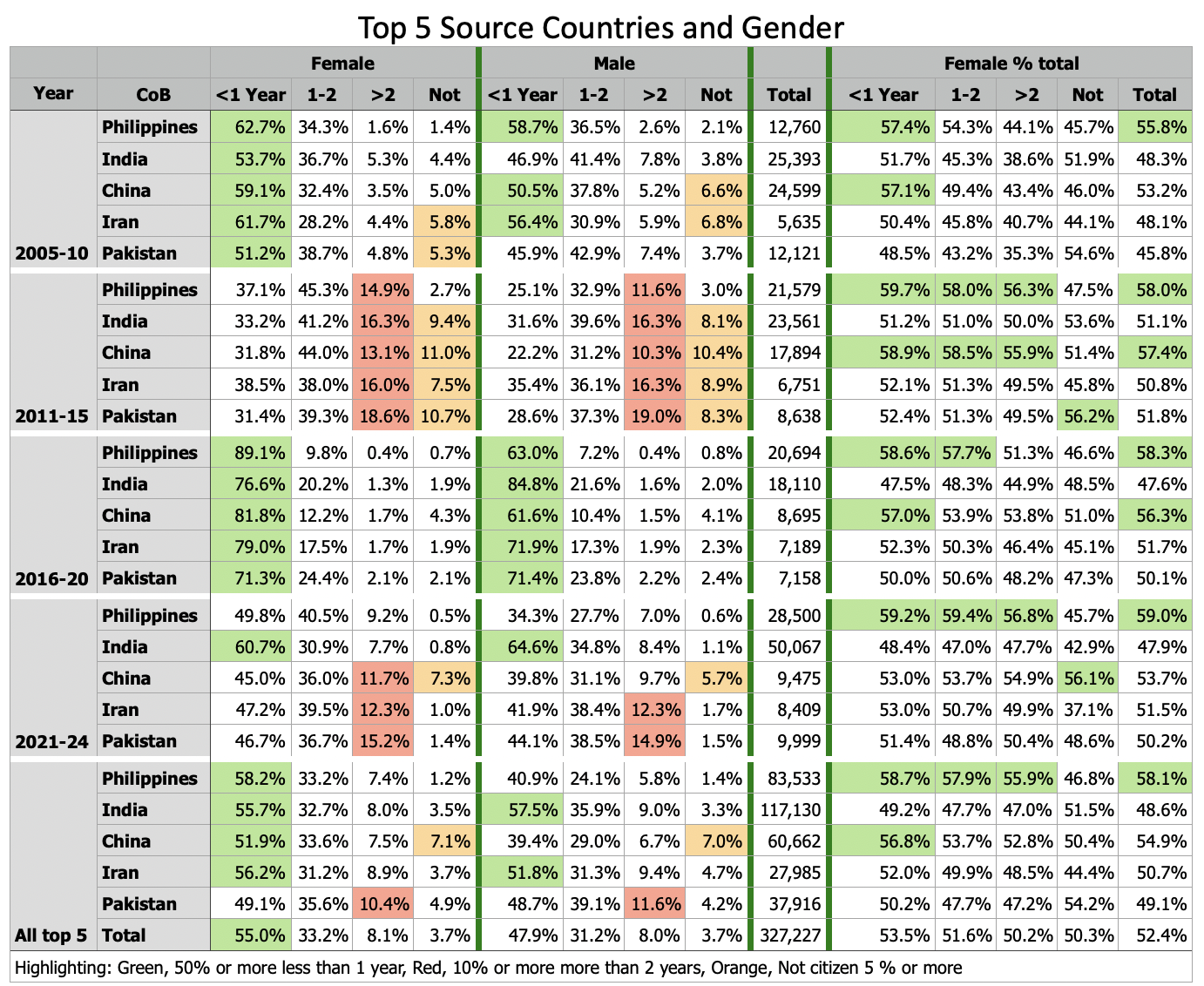
Figure 3 shows the impact on the five largest immigration source countries, showing again the same overall pattern. Of particular note is the higher rate of Chinese rejections across most periods which may reflect weaker language fluency compared to the other large source countries. 

Concluding observations

This analysis highlights the impact that operational policy changes can have on citizenship, making naturalization harder or easier, particularly for family class and refugees. The effective relaxation of knowledge and language assessment in 2014-15 reflects high refusal rates were not politically tenable, particularly in the lead up to the 2015 election.

Application data suggests that immigrants delayed submitting applications 2016-17 once the Liberal government announced it would return to the previous 18 to 54 age requirements. The data also shows a drop in applications in 2020 reflecting applicants waiting for the government to implement its 2019 election commitment to eliminate citizenship fees.

Citizenship applicants pay attention to operational and legislative policy changes and adjust their application timing accordingly. 

It is unclear whether or not citizenship changes would be a priority for an expected Conservative government and whether it would want to revert to Harper-era policies. However, citizenship changes would likely be a lessor priority than immigration changes given changing public sentiment on immigration that reflecting debates and discussion on immigration’s impact on housing and healthcare. 

Moreover, the fact that the previous government had to soften its “harder to get” approach may provide a cautionary tale in terms of what may or may not be acceptable to immigrant-origin communities. 

Methodological notes

Data provided by IRCC, 2005 to April 2024.  This partial 2024 data included in overall 2021-24 numbers.

 Source: What citizenship applications tell us about policy implementation

Articles of interest over the past month

Need to get a life as during my vacation break monitored Canadian media and collated these articles that I found of interest. Likely missed some.

The ones I found most interesting:

Donald Wright: We are not going to build our way out of the housing crisis. The harsh reality… Along with Donald Wright: When it comes to where people want to live, Canada is a very small country, Donald Wright: Urban densification is not going to solve our housing crisis, Donald Wright: The first step in solving Canada’s housing crisis? Implement a non-delusional immigration policy. “I calculate that Canada will need to limit the number of new PRs and net increase in NPRs to an average of 175,000 per year between now and 2031. This is a significant reduction from the 640,000 per year average over the past five years.”

Jason Kenney’s biggest worry about the U.S. election: A potential deportation program. “If he was still immigration minister, Mr. Kenney would make changes such as beefing up the Safe Third Country Agreement and increasing the Canada Border Services Agency’s resources. “I would make it clear that Canada is an open and welcoming country, but you have to go through the normal legal process.”’ His overall take on the Liberal record in this interview: Trudeau has ‘catastrophically mismanaged’ immigration: Jason Kenney

Laura Wright | Canada’s fertility rate has plummeted. Maybe we shouldn’t care. Good call to recognize demographic realities and focus on how to re-examine existing programs in light of this trend, rather than merely trying to delay it through immigration.

Simpson: Blame the four fatal ‘I’s of Justin Trudeau for the lacklustre state of the Liberals. On immigration: “Historians of this period will look at cabinet records to figure out why the Liberals took the decisions they did that turned public opinion against immigration and the incumbent government. Was it the old Liberal reflex that immigrants usually vote Liberal so the more the merrier? Was it a response to those who proposed that Canada should become a country of 100 million people? Was it a response to business leaders who wanted more cheap labour? Was it the Liberal/liberal reflex to want to do good rather than to be smart? Was it a response to higher education institutions whose budgets were stressed by inadequate provincial funding and so needed foreign students whom they could charge higher fees? Was the push for record-high immigration needed to fill the gap of a declining birth rate? Was it that a party that had wrapped itself in self-virtue could not believe that a variation of what had happed in other Western democracies could not and would not happen here? Was it blind incompetence not to appreciate that driving up immigration and refugees to unprecedented numbers would produce a myriad of negative side effects and destroy what had been close to a consensus in favour of previous levels of newcomers?”

Clark: Marc Miller and a mea culpa makes a rare success. “Yet Mr. Miller has taken steps that have turned around the trend. It’s hard for governments to claim credit for acknowledging their big, bad mistakes, and fixing them. But in politics, that should be rated as a rare success.”

‘Alarming trend’ of more international students claiming asylum: minister. Belated recognition of the perverse incentives at play and the likely need for further corrective actions. Marc Miller Strikes Again provides HESA’s critique of federal actions and that fed-prov consultations should have possible to achieve comparable results. This will be the next shoe to drop in our broken immigration system, Tony Keller on Miller’s admission and the further increases in asylum claimants and overstays.

Schools Make Millions Offering Degrees That Double as Work Visas (USA). Not unique to Canada. “A record 24,000 foreign graduate students were enrolled in schools offering Day 1 CPT — or curricular practical training — as of fall 2022, according to a Bloomberg News analysis of the most recent available Department of Education data. At typical prices, tuition probably topped $240 million, Bloomberg estimates.”

Waterloo’s international graduates outearn Canadian-born students, paving the way for immigration policies, experts say. Coverage of Skuterud’s case study for University of Waterloo international students.

Urback: Canada is sleepwalking into a refugee crisis. We need to act now. Another highlighting of the consequences of lack of foresight and likely not listening to public service advice. “It’s not ideal that those legitimately seeking refuge in Canada may be denied the opportunity, but it’s a consequence of this government ignoring years of warnings. It cannot ignore these next ones.”

Lisée | Les difficultés temporaires de François Legault. “François Legault avait promis de mieux gérer l’immigration et d’y arriver dans le cadre fédéral. Force est de constater que, loin d’avoir réussi à « en prendre moins », son gouvernement a activement exacerbé la situation pendant plusieurs années, avant de réaliser, penaud, dans quel pétrin il avait contribué à plonger le Québec.”

Most Canadians say citizens who stay in high-risk conflict zones don’t deserve government protection: Leger poll. Not surprising and understandable. “Canadians of convenience.” Also Flight leaves Lebanon with about one-third of seats reserved for Canadians filled.

Chris Selley: For anti-Israel protesters, October 7 anniversary is an unofficial citizenship test. Yep. 

Combatting hate in Canada. Announcement of expanded funding for a variety of programs and initiatives ($273.6 million over six years, and $29.3 million ongoing) without, it would appear, any substantive change from the INSERT evaluation. Likely will be significantly cut back under a Conservative government.

Robert P. George: A Princeton Professor’s Advice to Young Conservatives. “Grievance identitarianism — be it of the left or the right — impedes the very thing a student is attending university to do: namely, think and learn. It turns a person into a tribalist, someone who, rather than thinking for oneself, outsources one’s thinking to the group.”

Allen | The wounds of October 7 cannot heal until there is peace. “I yearn for a Canada whose citizens can hold in their hearts sympathy and understanding for all those killed and maimed during this period. I wish that students on campus and Canadians more generally understood that both sides view themselves as victims and that each side bears some blame for the current crisis. I acknowledge that Palestinians have been under the yoke of an illegal occupation for over five decades and that this must end. Unfortunately, the fears and hatred generated by the Oct. 7 attack have made the task harder.”

John Ivison: Flag-burning Islamists in our streets would kill us with our own tolerance. “Hostilities may not have been declared, but if you don’t think Canada is in a fight for all it holds dear, you should watch the forces of radical Islam calling for the death of Canada on the streets of Vancouver, while holding the remnants of a burned Maple Leaf flag.”

Gopnik: The tragedy of our time is that antisemitism rises equally from the left and right. “Every person is a world in an agonizingly literal sense. Let’s recall that one of the few texts that passes complete from Jewish scripture to Islamic scripture is the injunction that “Whoever kills a soul, it is as if he had slain mankind entirely. And whoever saves one – it is as if he had saved mankind entirely.”

The Functionary: Interview with Peter Wallace. Thoughtful discussion between Kathryn May and Wallace. Some of my favourite quotes, good reading for those preparing for a Conservative government:

“We want people to trust government, but they really should be skeptical about what government does with authority and they really should push back on that.”

“We’re mystified (as to) why people can be upset with government, and I don’t think we should be. The reality is governments are often times incredibly intrusive.”

“It’s incredibly important to remember that today’s dissidents are often tomorrow’s heroes. We must be cautious about shutting people out of the policy process.”

“The public pays for what we do, and they have a right to see our work. We need to demonstrate our value and show that we are thoughtful and competent. So, let’s embrace that scrutiny.”

“We’ve got to have metrics to help us understand individually at a gut level what we’re doing with that money. We have to be satisfied before we advise an expense that it’s actually worth the opportunity cost, worth the fiscal cost.

Full list attached:

COVID-19 Immigration Effects – July 2024 update

Highlights:

  • Permanent residents admissions: PR Admissions: Increase from 44,530 in June to 47,770 in July. July year-over-year change (change from 2022 in parentheses): Economic – PNP 34.9% (15.0%), Economic – Federal 11.7% (0.7%), Family 2.8% (-2.1%), Refugees 14.4% (30.8%)
  • TR2PR (Those already in Canada): Increase from 19,170 in June (43% of all PRs) to 22,100 in July (46.3% of all PRs). July year-over-year change (change from 2022): 10.6% (32.5%)
  • TRs-IMP: Decrease from 70,435 in June to 61,510 in July. July year-over-year (change from 2022): Agreements: 205.6% (-32.8%), Canadian Interests: -27.7% (29.9%), Other IMP Participants -56.1% (430.3%), Not stated -18.0% (-17.7%)
  • TRs-TFWs: Decrease from 19,230 in June to15,330 in July. July year-over-year change (change from 2022): Caregivers -18.8% (0.0%), Agriculture -23.0% (-19.5%) and Other LMIA -9.4% (79.4%).
  • NEW: TRs by occupation code (June, will be updated quarterly): 58 % low-wage (D), year-over-year change (change from 2022) 18.5% (571.3%): 
  • Students: Increase from 29,420 in June to 35,105 in July. July year-over-year change (change from 2023): -35.4% post-secondary -41.5% (-5.1%). Year-to date 2024 compared to 2023 decline of 4 percent 
  • Asylum Claimants: Stable, from 14,485 in June to 14,825 in July. July year-over-year change (change from 2022): 23.4% (90.1%)
  • Citizenship: Increase from 33,179 in June to 36,070 in July. July year-over-year change (change from 2022): 15.4% (25.0%). Year-to date 2024 compared to 2023 increase of 16 percent
  • Visitor Visas: Increase from 118,402 in June to 127,399 in July. July year-over-year change (change from 2022): -19.7% (37.6%).Slide 3 has the overall numbers and change.

https://www.slideshare.net/slideshow/canadian-immigration-tracker-key-slides-july-2024-pdf/271760138

Kuwait revokes citizenship of more than 10,000 people with dual nationality

Of note (mainly from neighbouring countries):

Kuwait’s Central Agency for Remedying Illegal Residents’ Status (CARIRS) has revoked the citizenship of more than 10,000 people with dual nationality between 2011 and last month, the KUNA news agency has reported.

According to the agency, the step is the result of a full decade of Kuwaiti efforts to address the dual nationality file, and comes as a culmination of a campaign that began last year to confront those who obtain Kuwaiti citizenship illegally. Almost 1,000 such people have been detected to date. Kuwait does not recognise dual nationality and children with dual nationality have two years after reaching the age of 18 to decide whether to retain Kuwaiti nationality or keep their other nationality.

The Director of the Situation Amendment Department in CARIRS, General Muhammad Al-Wahib, told KUNA that 6,054 residents’ status had been changed to Saudi nationality; 1,188 to Iraqi nationality; 868 to Syrian nationality; 131 to Iranian nationality; 53 to Jordanian nationality; and 1,962 to other nationalities.

Al-Wahib pointed out that these statistics include individuals who have parents or relatives who own documents from different nationalities and do not include those who have other relatives with proven nationality.

He called on those wishing to amend their status to visit CARIRS in the Eastern Region, to settle their residencies and regularise their status according to the residency laws in force in Kuwait.

The Gulf state has in recent years intensified efforts to amend the status of those residing illegally in the country.

Source: Kuwait revokes citizenship of more than 10,000 people with dual nationality

Are noncitizens really voting in US elections?

Spoiler alert. This detailed review indicates they are not:

With illegal immigration one of the top issues on voters’ minds heading into the 2024 election, Republicans are making a nationwide push to require proof of citizenship in order to vote. The GOP-run House of Representatives passed a bill that would do just that, the SAVE Act, in July – with support from five Democrats.

Former President Donald Trump has also repeatedly urged such measures, including in Tuesday night’s debate, alleging that his opponents are irresponsibly encouraging undocumented immigrants to vote. “A lot of these illegal immigrants coming in, they’re trying to get them to vote, they can’t even speak English, they don’t even know what country they’re in practically, and these people are trying to get them to vote,” he said.

Now Speaker Mike Johnson is saying that unless the House and Senate agree to the SAVE Act, he’ll shut down the government when the fiscal year ends Sept. 30 – though it appears he lacks the support within his own party to do so.

But Democrats, citing a lack of documented cases of noncitizen voting, say the law is unnecessary since it’s already illegal for noncitizens to vote. Moreover, they argue, it would result in disqualifying eligible voters. They accuse Republicans, including former President Donald Trump, of pushing this issue to lay the groundwork for claiming the election was stolen if they lose in November.

Is proof of citizenship currently required to vote?

The short answer is, citizenship is required in federal elections, but proof of citizenship generally isn’t, although some voters may provide that while establishing their identity and residency.

Sixteen municipalities allow noncitizens to vote in local elections, according to Ballotpedia. But elsewhere there’s pushback to the idea. Amendments to bar noncitizen voting are on the ballot this fall in eight states: Idaho, Iowa, Kentucky, Missouri, North Carolina, Oklahoma, South Carolina, and Wisconsin.

Source: Are noncitizens really voting in US elections?

Religious and Visible Minority Intersectionality: Education and Income

For the data nerds among us:

This short article continues my analysis of citizenship by examining the intersectionality between visible minorities, religious minorities and gender in terms of citizenship acquisition, education and income, 15 years old and higher.

Overall, the percentage of non-citizens is greatest among South Asian Hindus and Sikhs, likely reflecting India’s prohibition of dual citizenship. Black and Arab Muslims have higher rates of non-citizens than Christians save for Black Christian men. For the most part, being a university graduate does not appear to affect this overall pattern. None & secular have the largest median after-tax income across most visible and religious minority groups. Male non-citizens have significantly lower levels of government transfers than female non-citizens, again across most visible and religious minority groups. However, there are relatively few gender differences in poverty rates across most visible and religious minority groups.

To provide context on immigrant visible and religious minorities, Tables 1 and 2 provide the overall national and provincial percentages for all immigration periods.

Table 1 highlights the percentage of the various visible minority groups at the national and provincial levels. Overall, 53 percent are female immigrants. The higher percentage of female immigrants applies to most groups with the exception of Arabs and West Asians, where women form less than 50 percent of all immigrants.

Visible minorities form 69 percent of all immigrants but this percentage has increased to 83 percent in the most recent census period, with more Black and Filipino immigrants than Chinese, and more West Asians than Southeast Asians.

Similarly, Table 2 provides a similar breakdown for religious minorities for all immigration periods, national and provincial. Overall, women form 52 percent across all religions, with Buddhists and Christians having higher percentages of women, while Muslims being the only group with a marginally smaller percentage of women.

Religious diversity is increasing. While non-Christians formed 53 percent across all immigration periods, they formed 60 percent of immigrants in the 2016-21 census period. The percentage of Muslim immigrants has increased from 13 to 20 percent, Hindus from 6 to 11 percent, Sikhs have increased marginally from five to six percent. Both Buddhists and Jews have declined; the former from 3 to 1.5 percent, the latter from one to 0.5 percent.

Religious diversity varies among visible minority groups.

Some visible minority groups have greater religious diversity than others, notably South Asians, Blacks, Southeast Asians and to a lesser extent Arabs, West Asians and Japanese. The percentage of None & secular is highest among Chinese and Japanese. I have not included traditional given the small overall numbers and minimal numbers among visible minorities.

Table 3 highlights the overall contrast between those who have naturalized and those who remain non-citizens. Overall, the percentage of non citizens is greatest among South Asian Sikhs and Hindus, Black and Arab Muslims, Latin American and Korean None & secular, along with all religions among Japanese. The greater percentage of non-citizens among South Asian Hindus and Sikhs may reflect India’s prohibition of dual citizenship; however, China’s similar prohibition does not appear to have impacted naturalization to the same degree. Fewer women than men are naturalized among Buddhists, Southeast Asian and Korean None & secular, and all Japanese religions.

Education

Table 4 provides the population numbers by religious affiliation of visible minorities for all education levels and bachelor’s degree or higher, along with the percentage of bachelor degrees, ordered by group size. University degrees vary significantly by visible minority group, with Blacks, Latin Americans, Southeast Asians having lower rates than non visible minorities. With respect to religious minority groups, Buddhists and Sikhs have lower rates than Christians, who in turn have lower rates than Hindus, None & secular, Jewish and Muslims.

Table 5 contrasts non-citizen rates for the university educated. Highest rates for non-citizens are Japanese Buddhists and Christians, South Asian Hindus and Sikhs, followed by Black and Latin American Christians and Muslims. Overall, more women remain non-citizens than men among Buddhists, Sikhs and None & secular with exceptions for South Asian and Black women None & secular. The greatest gaps are with Southeast Asian, Korean and Japanese all major religions, and West Asian Christians.

Income: After-tax, government transfers, poverty rate

Table 6 compares median after tax income, government transfers and poverty rates by visible minority, religious minority and gender. With respect to median income, the overall pattern shows that non-citizen visible minorities, regardless of their religious affiliations, have lower median incomes than visible minority citizens, with gender varying by group. Chinese and Southeast Asian women, all religions have higher incomes than citizens, as do Arab Muslims and no religion secular.

Most racialized/religious women citizens have significantly lower median AT income save for Black Christians, Black Muslims and no religion, secular. While overall gender differences are generally small, Buddhist non-citizen women are doing relatively better than Buddhist non-citizens men and Jewish women relatively worse.

Women have higher levels of government transfers then men across all groups save West Asian Christian non-citizens, reflecting child benefits, CPP, OAS, survivor benefits, GIS supplement and possibly social assistance with the exception of traditional overall and all Japanese men, among non visible minorities, only Christian men have a lower percentage.

Table 7 compares the after-tax median income of religious minorities compared to Christians for naturalized citizens and non-citizens. Among the visible minority population, Hindu men citizens and non-citizens have higher median income than Christians, as do Jewish women citizens and Jewish men non-citizens and Arab Muslim women citizens and non-citizens. For most visible minority groups, None & secular citizens and non-citizens have higher median incomes than Christians, with the exception of South Asian women non-citizens, Black citizens and non-citizens, Chinese citizens and non-citizens, Filipino non-citizens, and Southeast Asian men citizens and all non-citizens.

The positive income gap between citizens and non-citizens is greatest for None & secular for most groups. Conversely, the positive income gap for non-citizens compared to citizens is for south Asian Hindu and Muslim men, Chinese Buddhists and None & secular, and Japanese Buddhists and None & secular.

Concluding observations

In general, visible minority group affiliation is more significant in education and income differences than religious affiliation. However, the variation within visible minority groups by religious affiliation is significant, particularly for Buddhists, Muslims and Sikhs.

Overall, the percentage of non-citizens is greatest among South Asian Hindus and Sikhs, likely reflecting India’s prohibition of dual citizenship. Black and Arab Muslims have higher rates of non-citizens than Christians save for Black Christian men. For the most part, being a university graduate does not appear to affect this overall pattern. None & secular have the largest median after-tax income across most visible and religious minority groups. Male non-citizens have significantly lower levels of government transfers than women, again across most visible and religious minority groups. However, there are relatively few gender differences in poverty rates across most visible and religious minority groups.

Just as there is diversity within visible and religious minority groups, largely reflecting country of origin, this analysis highlights the need for ongoing disaggregated data to better understand the dynamics behind immigrant integration and citizenship.