Bill C-24 is wrong: There is only one kind of Canadian citizen – Globe Editorial

Globe’s Canada Day editorial:

Citizenship and Immigration Minister Chris Alexander has defended his bill by arguing citizenship is a privilege, not a right. He is wrong. It may come with responsibilities, but it is a right. And once legitimately acquired, by birth or naturalization, it cannot be taken away. Bill C-24 gives the government the kind of sweeping power that is common in dictatorships, not in a democracy built upon the rule of law, where all citizens are equal. The changes to the Citizenship Act erode those basic principles, creating a two-tier citizenship that dilutes what it means to be Canadian.

Bill C-24 is wrong: There is only one kind of Canadian citizen – The Globe and Mail.

Rick Salutin in the Star:

Why did they do it? Here’s my guess: It’s not enough for them to merely run Canada. They want to define it, and they don’t want any backchat. Some people need to be right, not just powerful. So they’ve turned citizenship into a privilege, not a right, and since someone has to grant a privilege, it’ll be them.

But here’s my biggest problem. I don’t think loyalty — in any particular version — should have a thing to do with citizenship. The democratic core of citizenship is you get to challenge the values of the moment and can’t be shut up. It’s a license to disagree and debate which direction your nation takes, no matter what the majority thinks. Is that unpatriotic? It depends on how you see things. For many patriots, not going along has been the essence of patriotism. I’d say put people in jail for life if you insist — but don’t touch their citizenship.

Hello, you must be going: government waters down Canadian citizenship: Salutin

Canadian expatriates should never lose the right to vote

The problem with Semra Sevi’s argumentation like that of others is that it relies on anecdotes and generalizations:

Canadians abroad are connected to global networks that Canada can benefit from. Instead of using derogative labels like “Canadians of convenience” or “Foreigners holding Canadian passports,” Canada needs to take a proactive approach to engage Canadians living abroad. People have many different reasons for moving away, and to label them as less Canadian for doing so is troublesome. There are many cases of Canadians studying in the United States who find work in the United Kingdom before coming back to Canada a decade later yet under the current system they would be disenfranchised after five years. Many of these Canadians working abroad do so for Canadian companies, yet these businesses are not facing the same dilemma as Canadians abroad.

Immigrants who decide to leave Canada for whatever reason and return to their native countries are not less Canadian as their compatriots who live in Canada. They may not be residing in the country but they are nevertheless subject to Canadian law and foreign policy decisions. Many of them actively retain connections to Canada. Questions like are expatriates “real” Canadians, is unconstitutional and un-Canadian in themselves. Canadians living abroad are significant global assets who deserve the same rights as those living in Canada. The world is as interconnected as ever, and is only becoming more so. Isolating citizens based on their current geographic placement, which is based on many factors, runs counter to the way the world operates in the twenty-first century.

The reality if varies by community, it varies by individual, and it varies by country of residence. My anecdotal experience with Canadian expatriates when I worked in the foreign service was mixed; some maintained a strong ongoing connection, others did not.

We do not have enough survey and other information to know, beyond the usual anecdotes, how many expatriates have a meaningful ongoing connection to Canada.

Generally speaking, the longer the time outside of Canada, the looser the bond as family, work and local connections become more meaningful.

I suspect if we applied the US approach of taxation based on citizenship, some of the enthusiasm for unlimited voting rights (no representation without taxation) would decrease.

Canadian expatriates should never lose the right to vote – The Globe and Mail.

U of T prof still waiting for citizenship after three years | Toronto Star

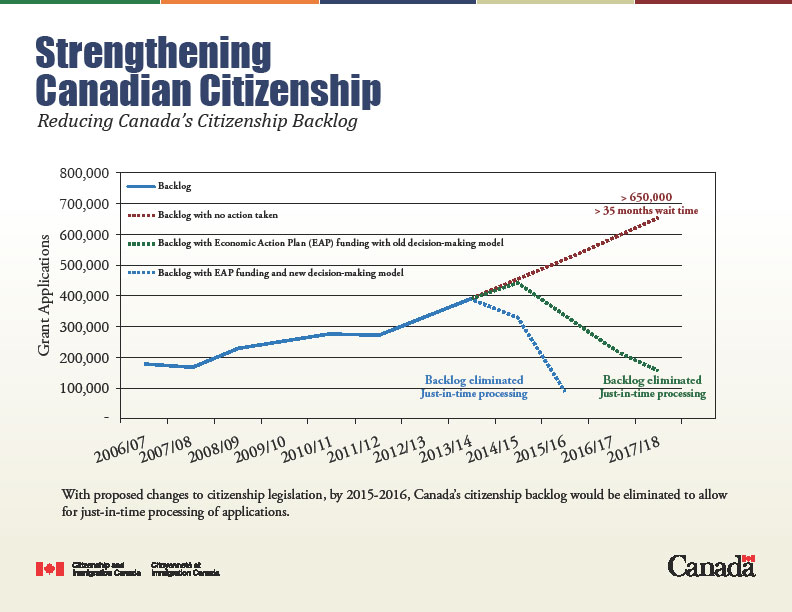
An example of some of the problems in the citizenship program. C-24 streamlining will address some of these, but we will only know in 2016 when the backlog has been cleared and, more significantly, additional incremental funding ends:

Lemmens submitted his application to become a Canadian citizen in February 2011 after living and working in Canada since 1991. The native Belgian had come to Canada as a student. After completing his doctorate in 1997, he began teaching health law and bioethics at the University of Toronto — first through a joint appointment at the law faculty and the Centre for Addiction and Mental Health, and in 1999 just at the law faculty. Married to a Canadian, he had permanent resident status and didn’t immediately apply for Canadian citizenship.

He looked into it a couple of times but didn’t meet the residency requirement because he had been out of the country twice — once for a research leave and once for a sabbatical year. He was told he could be out of the country for only a maximum of 400 days out of four years. So he waited and counted.

When he finally applied for citizenship, he thought it would be a simple matter. But the process was difficult.

After preparing his initial application and writing his citizenship exam, he was required to fill out a very detailed questionnaire for which he had to piece together not only the exact dates he was out of Canada, but also where he stayed and the reason for his absences. He also was required to produce documentation showing home and family ties as well as employment and contributions to Canadian society.

This request surprised him.He has yet to be told why he was required to fill out an additional questionnaire or why his application has taken so long.He believes it may have something to do with the fact he was missing some entry stamps when he returned to Canada from journeys abroad. ….

Lemmens believes the government has purposely made the application process complicated and bureaucratic to discourage people from applying for Canadian citizenship.

“It’s really irritating and makes me think, if my file appears difficult to evaluate, how tough must it be for people from ‘suspect’ countries, or people who don’t necessarily have the same stable employment.”

U of T prof still waiting for citizenship after three years | Toronto Star.

Citizenship law changes irk new Canadians | Toronto Sun

During C-24 Citizenship Act hearings, both opposition parties were arguing against the increased residency and related requirements. Seems that some new Canadians share these concerns.

Will be interesting to see if this becomes an issue in the 2015 election in the suburban new Canadian communities.

Manishkum Prajapati, his wife Ragini, and their daughter, Dharitri, 7, came to Canada from India in 2007. They were among those Monday who sat holding small Canadian flags as they were greeted by Citizenship and Immigration Minister Chris Alexander during a ceremony at Pearson International Airport.

Prajapati said his family came to Canada to “move forward” with their lives. And while he and Ragini are excited about their futures here, they worry others having a tougher time becoming citizens.

“Right now, it’s OK, it shouldn’t be made harder,” said Prajapati, an aircraft technician. “We think about them and … right now, it is safe, easy and convenient.”

Aber Abdelmessih, her husband, and their three daughters also became citizens on Monday. They came to Canada from Egypt

.“I’m very worried, this is very bad,” said Abdelmessih of the immigration law changes.

She insisted the new rule of having to be present in Canada a certain amount of time during the run-up to citizenship is unfair, as some would-be citizens need to travel back and forth to their countries of birth to see family.

Citizenship law changes irk new Canadians | Home | Toronto Sun.

Happy Canada Day – Bonne Fête du Canada

Canada Day Flag

Case of Mohamed Fahmy shows failing of new citizenship rules | Macklin and Waldman

More from Macklin and Waldman on C-24 Citizenship Act revocation provisions and the possible implications for cases like Mohammed Fahmy’s, and the discretion it gives the Minister (Government has indicated they will not revoke Fahmy’s citizenship):

These cases are simply three examples that show why the new citizenship law has been condemned as fundamentally flawed and why several organizations have indicated they will challenge it under the Charter. The law will create two classes of citizens: dual citizens who are vulnerable to revocation and those who are not. But the bill is also problematic in other ways. Naturalized citizens unlike citizens by birth will not be able travel and live abroad for extended periods without fear of jeopardizing their citizenship. Other provisions will make citizenship more inaccessible to those who need it most — refugees.

Instead of listening to the legitimate concerns of those who criticized the legislation, the government attacked the messengers and impugned their motives. Undoubtedly the government thinks that this new law will be well received by its conservative base. We think that when most Canadians come to realize the implications of this new legislation they will reject it. Canada is a big country, but there is no room for second-class citizenship.

Case of Mohamed Fahmy shows failing of new citizenship rules | Toronto Star.

Five bills likely to stoke Harper’s conflict with Supreme Court

On the list:

C-24, the “Strengthening Canadian Citizenship Act,” received royal assent and became law June 19.

The government billed C-24 as a once-in-a-generation overhaul of citizenship law, but some of its provisions proved deeply divisive. Foremost among those is a clause that allows the government to strip citizenship from Canadian-born citizens if they’ve been convicted of treason, espionage or terrorism and have citizenship in another country.

Toronto lawyer Rocco Galati launched a legal challenge against the provision on June 25, saying the government doesn’t have the constitutional authority to make the change. That was after several earlier warnings during committee consideration of the bill.

“It appears to be against the Charter, and I expect there will be significant litigation,” Barbara Jackman, a member of the Canadian Bar Association’s National Immigration Law Section, told a Senate committee considering the bill.

The CBA also took issue with a change in the bill that asks applicants to declare an intent to reside in Canada. Citizenship and Immigration Minister Chris Alexander has brushed aside concerns, saying Canadians aren’t required to stay in the country, but critics have pointed to provisions in the bill that allow citizenship-stripping in cases of fraud, and asked whether the “intent” clause could be considered in a fraud case. The CBA said the provision is “likely unconstitutional.

”Mr. Alexander assured a committee studying the bill that it was constitutional, a point put to Ms. Jackman by the committee.“I would remind the committee that [government has] passed other legislation that, again and again, the Supreme Court of Canada has struck down just recently. So the fact that the Department of Justice and the minister say it is constitutional doesn’t mean it is,” she replied.

Audrey Macklin, a professor and Chair in Human Rights Law at the University of Toronto, echoed many of the warnings on Charter compliance but also said that under C-24, those about to be stripped of citizenship are given the onus to prove they do not hold citizenship elsewhere – which would stop the process, as Canada won’t leave someone stateless – rather than making the government prove that person does hold citizenship elsewhere. Prof. Macklin warned that such a “reverse-onus provision” also violates the Charter.

The Canadian Civil Liberties Association also has raised warnings about the constitutionality of C-24.

“CCLA is seriously concerned that Bill C-24 has created a second tier of citizenship that is incompatible with equality principles,” General Counsel and Executive Director Sukanya Pillay said in an e-mail. “…We must remember that citizenship includes rights, and to strip individuals of citizenship is to re-introduce archaic punishments such as exile and banishment – the possibility of statelessness is also a serious concern. Any arbitrary loss of citizenship is incompatible with democratic values and fundamental rights.”

Five bills likely to stoke Harper’s conflict with Supreme Court – The Globe and Mail.

Denying dual citizenship is a double-edged sword | The Australian

The Australian debate on citizenship revocation. Similar to that on C-24 revocation provisions. Commentary by Ben Saul, an international law professor at University of Sydney:

Finally, stripping citizenship is unnecessary because Australia has enough laws to deal with the threats. Since 9/11, the Australian parliament has been among the most hyperactive counter-terrorism lawmakers on the planet.

Australians who fight overseas can be prosecuted for innumerable offences, including terrorism, war crimes, crimes against hum­anity and foreign incursion. Prosecution takes terrorists off the streets altogether, and does not ­irresponsibly shunt them on to other countries. It also ensures ­decisions are made based on evidence with judicial safeguards. Stripping citizenship based on untested intelligence about what a person is doing overseas risks miscarriages of justice.

Instead of prosecution, federal police can apply for control orders to prevent terrorism by restricting a person’s freedoms. In emergencies, preventive police detention is available, and ASIO has questioning and detention powers. Other powers range from surveillance to passport cancellation.

Governments are often tempted to reach for new laws when ­security is threatened. Intelligence agencies never say they have enough power or stop asking for more. Giving more power to the government, and making citizenship more provisional, is not the answer.

The answer lies in ­better intelligence and action to prevent people leaving, and in bringing them home to prosecute them.

Denying dual citizenship is a double-edged sword | The Australian.

Rocco Galati launches lawsuit over Citizenship Act changes

No surprise:

Toronto lawyer Rocco Galati is suing Gov. Gen. David Johnston, Immigration Minister Chris Alexander and Justice Minister Peter MacKay over changes to Canada’s Citizenship Act.

In documents filed Wednesday morning in Federal Court, Galati asks the court to invalidate key provisions included in a new law that gives the government the power to revoke the citizenship of Canadian-born citizens convicted of “terrorism, high treason, or spying offences” if they hold dual citizenship.

Rocco Galati launches lawsuit over Citizenship Act changes – Politics – CBC News.

Should non-resident Canadians get the vote? – Globe Editorial

Globe has it basically right:

In a procedural decision in this case this week, Justice Robert Sharpe of the Ontario Court of Appeal, put the issue clearly: Is the five-year limit “necessary to sustain our geographically determined, constituency-based system of representation?” The highest court will eventually have to answer that question. We think it can reasonably answer “yes.”

Parliament, especially the Commons, since its beginnings in medieval England, has been a body that consents to – or rejects – taxes. But Canadian expatriates pay their taxes in the country where they live, and receive the benefits of government there, too. They do not pay taxes here, or receive most public services. It is reasonable for the law to say that, if you live outside Canada for a sufficiently long time, after some number of years you can no longer exercise the right to vote for members of the House of Commons. You do not lose Canadian citizenship – that can never be taken away. And no matter how long someone lives abroad, they have the absolute right to return to Canada whenever they wish.

The five-year limit is not strictly necessary. But there’s a compelling logic to placing some limit on how long one can live abroad and still vote in Canada. It makes it more likely that Canadian voters will have a strong, living connection to Canada.

Should non-resident Canadians get the vote? – The Globe and Mail.

Tim Harper in the Star takes the contrary view:

The numbers may not be huge, but the symbolism from this government is massive.

The Canadian diaspora numbers about 2.8 million and has been called the “missing province.”

About a million of them have been out of the country for more than five years; most of them live in the U.S.

About seven in 10 expats, according to a 2009 study by the Asia Pacific Foundation of Canada, said they intended to return home. Two out of three left the country for work reasons and one in three worked for a Canadian company, the government or a Canadian non-governmental agency.

Non-resident Canadians paid about $6 billion in taxes to the Canadian treasury in 2008-09, according to the APF study.

The five-year cutoff is a product of the 1993 Progressive Conservative majority government which for the first time provided a mechanism for Canadians living outside the country to vote.

In 2005, following a recommendation by then-Elections Canada chief John-Pierre Kingsley, a parliamentary committee recommended the five-year limit be removed. All four party leaders endorsed the committee decision. Nothing ever happened….

Suppressing vote of expats latest Conservative court battle: Tim Harper