Harper government to make revoking of passports from suspected extremists quicker

Not surprising. Unlike revocation of citizenship, which applies different treatment to dual nationals compared to Canadian nationals only (the latter cannot have their citizenship revoked), applies equally to both:

As it struggles to stop Canadians from joining terrorist groups in Syria and Iraq, the government is introducing measures allowing officials to more quickly revoke passports from suspected extremists, the National Post has learned.

A senior government source said the policy expediting passport revocations on national security grounds would be announced Thursday by Public Safety Minister Steven Blaney and Citizenship and Immigration Minister Chris Alexander.

The change comes two weeks after Canadian Security Intelligence Service director Michel Coulombe told the Senate national security committee the number of Canadians who had left for Syria and Iraq had jumped 50% in the past few months.

To prevent them from leaving, police have been alerting officials to cancel the passports of “extremist travellers,” but the government source said the current procedure was too time-consuming and that authorities needed to be able to act more speedily.

“With the growing number of radicalized Canadians travelling abroad to fight with ISIL, this government will take action to ensure our national security agencies can swiftly and urgently revoke the passport of any threat to Canadians and our allies,” the source said.

Harper government to make revoking of passports from suspected extremists quicker

PM Tony Abbott Denies Australia Will Sell Citizenship, Reiterates Refusal Of Asylum

Not surprising as this goes so much against the grain of Australian immigration and citizenship policy, not to mention identity. Australia is not Malta which does sell citizenship (Malta Offers Citizenship and All Its Perks for a Price).

Hard to know what members of the Productivity Commission were thinking when they proposed this bone-headed scheme:

Prime Minister Tony Abbott denied allegation on Monday, May 4 that the government’s inquiry on immigration system would mean his administration is selling citizenship in a bid to cut down on budget deficit and close down its door to asylum seekers.

Mr Abbott said in a press conference that his government’s request was for Productivity Commission to review proposals in amending the immigration system. But in doing so, Mr Abbott insisted the commission should take into consideration different perspectives and the commission’s statement to make immigration a finance-focused system is unlikely because the coalition government would not allow migrants to earn their permanent residency visas simply by paying entry fees.

The prime minister argued that Australia’s immigration policy is unequivocally and justly based on the country’s best values and interests and as such, Mr Abbott assured the public the policy will remain as it is.

Productivity Commission announced on Friday, May 1 the Australian government is contemplating on adopting a radical system of immigration that centres on the applicant’s financial capacity. At the present, Australia looks at the applicants’ family connection and the nature and level of their skills in allowing access.

The commission contended that should Australia adopt a price-based immigration policy, it will earn several billions which can help curb the country’s budget deficit. In addition, the scheme will also slash down the number of employees involved in the immigration system.

PM Tony Abbott Denies Australia Will Sell Citizenship, Reiterates Refusal Of Asylum.

When dual citizenship becomes conflict of interest | TheHill

Making the case for disclosure in the US political system of dual nationality and potential conflicts of interest:

Current entries on the Internet contain a number of undocumented assertions as to which members of Congress and senior officers are dual citizens.  Without reliable data, however, Americans can only speculate on which senators and representatives may have divided national loyalties.

The lack of transparency regarding citizenship erodes trust in government, raising credibility doubts where there should be none, and allowing some apparent conflicts of interest to continue undetected.

When a senator, representative or senior U.S. official speaks out, submits bills or determines policy on an issue of importance to a foreign country of which that member or official (or judge) has the tie of citizenship, their constituents and the U.S. public at large should at least be able to assess whether such views or actions are influenced by the divided loyalty.

Since they don’t involve national loyalty, religion and ethnicity seldom raise conflict issues.  Moreover, they are generally matters of public record.

By contrast, dual citizenship creates conflict of interest through divided loyalties. Thus it would seem reasonable to require that dual citizen members of Congress, the judiciary and the executive  be required to renounce citizenship in another country as a condition of public service.

Both Sen. Ted Cruz (R-Texas) and former Rep. Michelle Bachman (R-Minn.) recently received wide press coverage when they renounced their Canadian and Swiss nationalities, respectively.

Yet the media and government watchdog organizations have largely ignored the potential conflict of interest inherent in dual citizenship.  Why the neglect of this issue?  Shouldn’t members of Congress (and federal judges and executive branch officials) at least be required to disclose their citizenship in another country?

Even if our legal system continues to allow dual citizens to serve in high positions of the U.S. government, it should require them to recuse themselves from participating in decisions or policy debates that relate to their second country.

As a first step, the Congressional Research Service of the Library of Congress should begin to include citizenship (along with the current listings of party breakdown, age, occupations, education, Congressional service, religion, gender, ethnicity and military service) in its published profiles of each new Congress.

Americans can then decide whether our legislators (and possibly federal judges and senior government officials as well) should be required to renounce their citizenship in another country as a condition of public service.

A bit simplistic to assume that dual nationality always means dual loyalties. In some cases, it is merely pragmatic (travel to country of origin may require citizenship), in others it is to provide additional opportunities for their children (e.g., EU citizenship).

It is more the specific behaviours that call into question loyalty.

Serving in another military, running for office in another country are more substantive than formal citizenship of another country.

When dual citizenship becomes conflict of interest | TheHill.

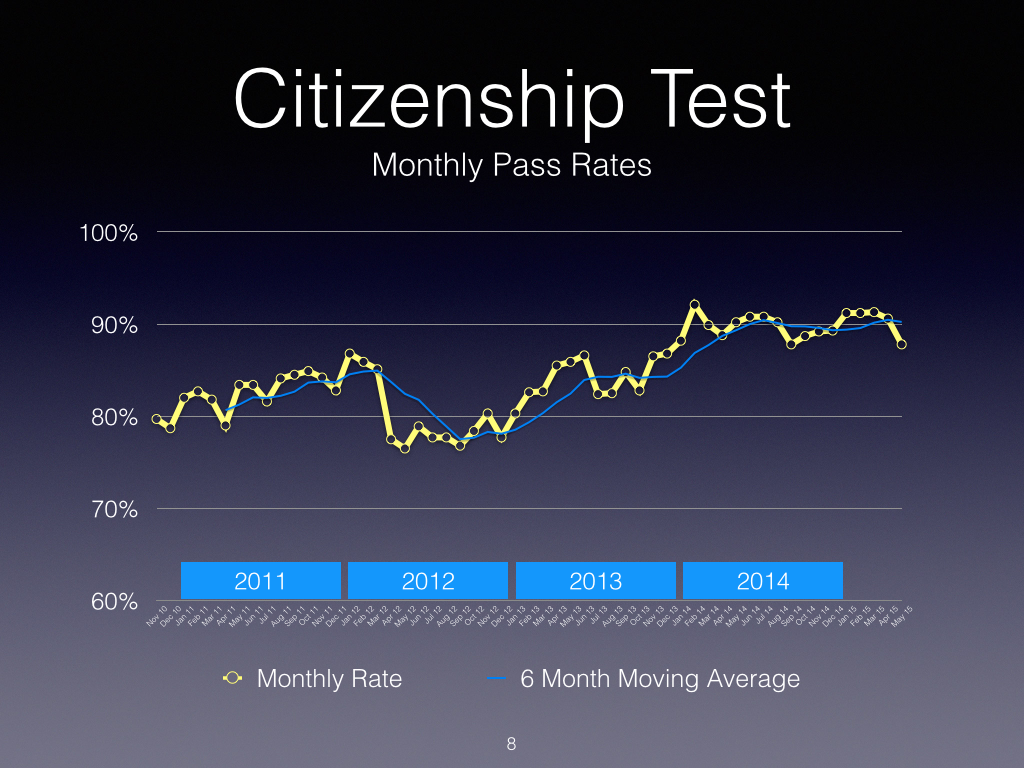
Canadian Bar Association Immigration Law Conference: My Presentation – Citizenship: “Harder to Get, Easier to Lose”

Impact of Citizenship test changes.001I will be presenting this deck on citizenship at the plenary session May 8th. Looking forward to a good discussion with David Manicom of CIC and the audience, moderated by Carter Hoppe.

Citizenship – CBA 8 May 2015 – Final

Malta Offers Citizenship and All Its Perks for a Price – NYTimes.com

One approach to citizenship (the mercenary kind):

As wealthy foreigners rush to get citizenship in Malta under a new program, the residency requirement is taking many forms.

Russians rent high-end villas, then stay in five-star hotels when they visit.

An American financier plans to live in Switzerland but occasionally vacation in Malta.

One Vietnamese businessman, eager to start the clock ticking on the 12-month timetable for residency, sent the necessary paperwork on his private jet to expedite renting a property he had never seen.

“They come twice, once to get a residency card and once to get a passport,” said Mark George Hyzler, an immigration lawyer at a firm here.

Malta’s citizenship program, which offers a passport to those willing to pay 1.2 million euros, about $1.3 million, has been controversial since it was introduced more than a year ago. But the residency requirements, meant to make the program more palatable, are only increasing the consternation among critics, who say the program has resulted in the sale of citizenship to the global 0.1 percent.

“They come twice, once to get a residency card and once to get a passport,” said Mark George Hyzler, an immigration lawyer. Credit Darrin Zammit Lupi for The New York Times

Applicants must show they have rented a property in Malta for 12 months. But they do not necessarily have to spend any time in this Mediterranean island nation, raising the question of what genuine links they are establishing.

“It is questionable how the residency requirement is being applied,” said Tonio Fenech, a member of Malta’s Parliament

Lawyers, accountants and real estate agents say the citizenship program has catapulted Malta onto the radar of the global elite. Applications are pouring in, and the program aims to raise €2 billion, more than a quarter of Malta’s gross domestic product.

Malta Offers Citizenship and All Its Perks for a Price – NYTimes.com.

UK: Anjem Choudary claims all Muslim MPs and voters are ‘apostates’ sinning against Islam

Hardly representative of most Muslims in the UK, and sharp contrast to Canadian Imams who call for Muslims to vote (Ontario imams to urge Muslims vote in federal election):

Hard to know why someone like that remains in a liberal democracy rather than choosing to living in a Muslim majority country. But for ideologues and fundamentalists like him, no country will be “pure” enough in its application of Islamic practices:

Radical preacher Anjem Choudary has claimed that all Muslim MPs and voters are “apostates” as the general election approaches.

Writing on Twitter that voting is a “sin” against Islam, he argued that Parliament violated religious law because Allah is “the only legislator”.

Mr Choudary wrote: “The only excuse is for a new Muslim or someone totally ignorant about voting and also what’s known from Islam by necessity.”

In a stream of messages using the #StayMuslimDontVote hashtag, the cleric called Muslims who vote or run as an MP are “apostates”, meaning they have abandoned their beliefs.

Anyone doing so does not believe that Allah is the “only, exclusive legislator and commander” and is therefore a “kaafir” (disbeliever), he claimed.

Mr Choudary, who has headed banned groups including Islam4UK and al-Muhajiroun, instructed his followers not to follow any imams who tell them voting is religiously permitted.

It comes after his group released a series of videos as part of the campaign discouraging British Muslims from taking part in the democratic process, while other organisations encourage them to vote.

Anjem Choudary claims all Muslim MPs and voters are ‘apostates’ sinning against Islam – General Election 2015 – UK Politics – The Independent.

A fighter for immigration, inclusion and diversity: Ratna Omidvar

Good profile and interview:

Another crucial field that needs far more analysis, she said, is the immigrant path to entrepreneurship – a route that many take when they find it hard to break into the corporate world.

“It is fascinating how certain communities have begun to put their stamp on certain sectors,” she said. “The Koreans in the corner-store industry, the Somalians with the dollar stores, and you can’t take a limo to the airport without coming up against someone who is from Brampton who originally came from the Punjab.” What needs particular study, she adds, is “the pathway, and what we can do to support the immigrant entrepreneur.”

One diversity initiative that is already well advanced is the effort to get more immigrants and visible minorities on boards of directors. The DiverseCity onBoard program – which Ms. Omidvar helped launch at Maytree and is now housed at GDX – has helped place more than 700 people from underrepresented communities on the boards of public agencies, charities and non-profits in Toronto. It has now expanded to Montreal, Ottawa, Hamilton, London, Ont., Calgary and Vancouver. In the long run this will produce a “pipeline” of experienced individuals, Ms. Omidvar said, some of whom will end up on corporate boards where minorities are still highly underrepresented.

Ms. Omidvar has managed to recruit many top business leaders to her vision. Dominic D’Alessandro, former chief executive of Manulife Financial Corp., worked with Ms. Omidvar to promote mentoring programs for immigrants at the insurance company and other large corporations. “She made converts of everybody,” Mr. D’Alessandro said. “I can’t think of anybody we called on who wasn’t responsive to the vision that she was setting out, about a more inclusive community.”

Still, many barriers to immigrant integration remain, Ms. Omidvar acknowledges, and she is acutely aware of the backlash and bad feeling that sometimes bubble to the surface in Canada. When she wrote a commentary in The Globe and Mail in 2013, suggesting that the citizenship oath of allegiance to the Queen should be replaced with an oath to “Canada, its laws and its institutions,” a slew of ugly online comments appeared. Many of these said essentially: Go home if you don’t like it here.

To see these kind of views expressed – even in the dodgy underworld of online commentary – was disheartening for Ms. Omidvar, whose accolades include the Order of Canada and the Order of Ontario.

She also finds it unfortunate that the Conservative government is using issues such as the wearing of the niqab in citizenship ceremonies as a means to divide Canadians. “That has been picked on by the Prime Minister as a wedge issue that speaks to their base, and divides other bases,” she said.

Still, Ms. Omidvar is confident that, in time, it will be easier for immigrants to become integrated in Canadian society and for established Canadians to accept newcomers with open arms. She is heartened by the views expressed by her daughters – one of whom is a lawyer and the other a market researcher – that diversity is now a given. “What is wonderful about their lives is that they are so used to everyone being different, and they just accept it as the norm.”

And over all, she said, most Canadians see the value in welcoming newcomers. “One of the wonderful things is that most Canadians understand that we need immigration,” she said. “We will argue about who the immigrant is, and how they should come … and whether they cover their hair. But we don’t, as a country, argue about the fact that we need immigration. And we don’t have any political party that is explicitly against more immigration. That is very unusual.”

Essentially, she said, “we are creating a new world here.”

A fighter for immigration, inclusion and diversity – The Globe and Mail.

ICYMI: Government changes course, promises to help CFL quarterback Henry Burris obtain citizenship

Another reminder of the complexities of life running against more clear-cut program design:

But the 39-year-old Spiro, Okla., native’s citizenship application was rejected under Ottawa’s recently overhauled immigration policy.

The Express Entry program classified his CFL career as “part-time work” because the season lasts only six months, from June to November.

“Our job doesn’t qualify as a full-time occupation since it’s not year-round,” Burris said. “But trust me, due to the fact of what we do on and off the fields, it’s more than just a full-time job.”

In a statement sent to CTV News Sunday, Kevin Menard — spokesperson for Citizenship and Immigration Minister Chris Alexander — said the government would “work with” Burris to help him obtain citizenship.

“Mr. Burris has shown a great commitment to Canada over many years, and his community work through his foundation is an example for Canadian youth and all Canadians,” Menard said. “We will work with the Ottawa RedBlacks and Mr. Burris to ensure he can remain in Canada.”

Government changes course, promises to help CFL quarterback Henry Burris obtain citizenship | CTV News.

CRRF Launches Directions: Call for Submissions

For those interested in contributing, CRRF’s new publication, Directions, opens its call for papers for the Winter 2015 Issue:

Published in print and online December 2015, The Power of Words speaks to the importance of reviewing and evolving science terminology in response to changing demographics and settlement trends. The concept of hyphenated Canadians, terms such as ‘visible minorities’ and ‘newcomers,’ and even the idea of ‘race relations’ require ongoing reassessment, and are being challenged and re-examined in the context of our changing society.

Directions provides a space for established and emerging scholars, community organizations and race relations practitioners to publish their research. It also offers a forum for important dialogue and debate on race-related issues and best practices, and practical recommendations for policy development and change. Directions is curated to promote social cohesion amongst all individuals and groups living in a harmonious Canada.

Research Questions

How do language and lexicon in policy, in the media, and in daily interactions influence our experiences, identities, attitudes, and relationships? How can discourse create and perpetuate unbalanced power relations, marginalizing certain groups and individuals? How can we use language to promote positive race relations in a harmonious Canada?

These dynamic questions represent the types of issues that CRRF intends to explore in the upcoming issue of Directions in Winter 2015.

Yours truly is one of the members of the Editorial Advisory Board so I, along with the others, have a vested interest in encouraging thoughtful and provocative submissions.

Directions Journal.

Three ways Liberals and NDP can win over conservative voters: Michael Adams on citizenship

Michael Adams on citizenship, immigration and multiculturalism in the context of the coming election:

Civic education and pride in citizenship were once rather conservative ideals. They were connected to the patriotism and loyalty to country that right-leaning people have often claimed as special virtues. Recently, however, Canada’s immigration program has taken on a more transactional character. It has become more strongly associated with short-term labour trends than with long-term nation-building. And indeed, a recent analysis has indicated that the rate at which immigrants become citizens has declined.

Despite some concerns about cultural integration (a process that citizenship and belonging only help), Canadians remain positive about immigration and take pride in multiculturalism. Shifting the immigration frame away from this quarter’s want ads and toward meaningful citizenship, civic participation, and inclusive nation-building might just appeal to some Canadian patriots who believe countries and their citizens do best when their responsibilities toward each other are durable and deeply felt.

Three ways Liberals and NDP can win over conservative voters – The Globe and Mail.