New language and residency rules for Canadian citizenship kick in next week 

The coming into force of these changes within six months of Royal Assent is faster than the almost one year period for the C-24 changes that C-6 undoes. These will have an impact on the number of applications and new citizens.

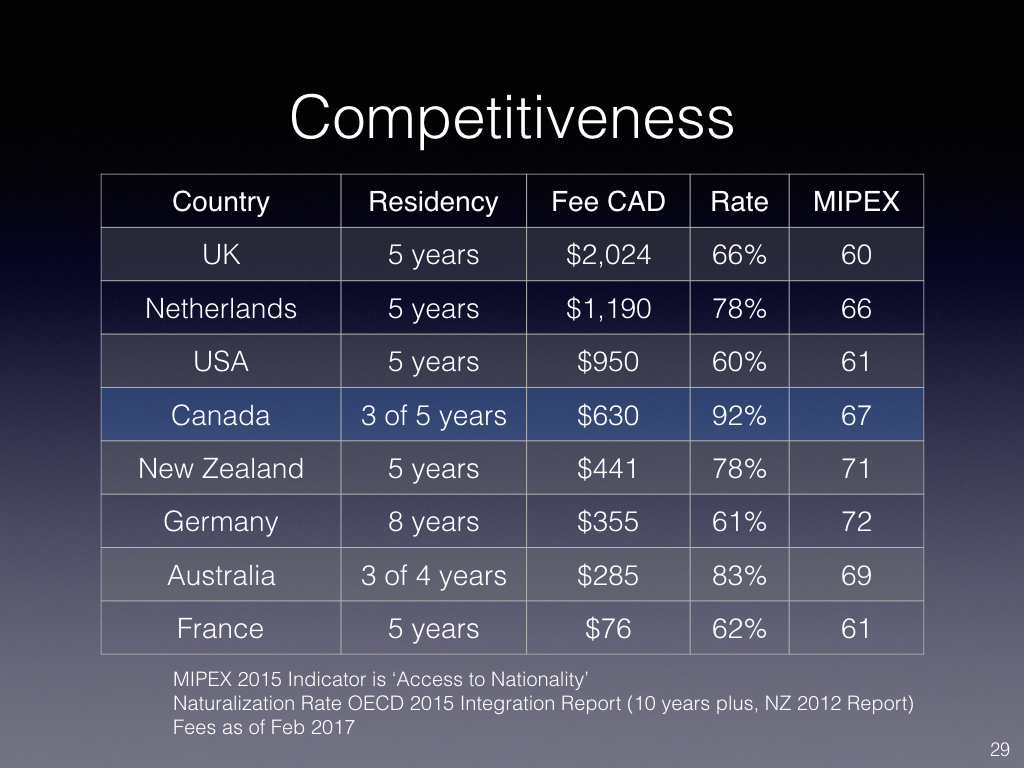
  • The changes to residency requirements (from four out of six to three out of five years) will have a one-time impact, but with likely a small ongoing one.
  • The changes to testing ages are unlikely to have much of an impact with respect to 14-17 year olds given their time in the Canadian school system.
  • With respect to 55-64 year olds, there will be an ongoing impact. About seven percent (2013 numbers) of all applications were from this age cohort. So there will likely be both a significant one-time bump of those who have not applied over the last two and a half years given testing concerns (more than seven percent), as well as an ongoing impact of up to seven percent.
  • Fees will remain a significant barrier for lower-income immigrants, including of course refugees, and the Minister’s lack of flexibility remains of concern.

The impact of these changes in terms of any sense of pent-up demand will likely await first quarter 2018 data, with early signs from fourth quarter 2017 data:

Starting Oct. 11, permanent residents will be eligible to apply for Canadian citizenship if they have lived in the country for three out of the previous five years.

Also, applicants over 55 years of age are once again exempt from the language and knowledge tests for citizenship under the amended citizenship regulations to be announced by Immigration Minister Ahmed Hussen on Wednesday.

The changes will be welcoming news for the many prospective applicants who have been holding off their applications since the newly elected Liberal government introduced Bill C-6 in March 2016 to reverse the more stringent changes adopted by its Conservative predecessor to restrict access to citizenship.

Citizenship applications are expected to go up, reversing the downward trend observed over the last few years after the Harper government raised the residency requirement for citizenship — requiring applicants to be in Canada for four years out of six — and stipulated that applicants between the ages of 14 and 64 must pass language and citizenship knowledge tests.

Immigrant groups and advocates have said the more stringent rules discouraged newcomers’ full integration and participation in the electoral process.

“Citizenship is the last step in immigrant integration. Those unnecessary obstacles put in place by the previous government are hurting us as a country,” Hussen told the Star in an interview Tuesday. “We are proud of these changes and are excited about it.”

Another Liberal reform that takes effect next Wednesday is granting one year credit to international students, foreign workers and refugees for time spent in Canada before becoming permanent residents toward their residency requirements for citizenship.

Despite the anticipated surge in citizenship applications as a result of the relaxed requirements, Hussen said the department will ensure resources are in place to respond to the increased intake. However, he insisted there is no plan to reduce the current $630 citizenship fee for adults and $100 for those under 18.

The changes announced Wednesday are part of the amendments that received Royal Assent in June, including repealing the law that gave Ottawa the power to strip citizenship from naturalized citizens for crimes committed after citizenship has already been granted as well as handing over the power of citizenship revocation to the Federal Court from the immigration minister.

According to government data, 108,635 people applied for Canadian citizenship in the year ended on March 31. Historically, citizenship applications received have averaged closer to 200,000 a year. 

Source: New language and residency rules for Canadian citizenship kick in next week | Toronto Star, Government Bill C-6 Backgrounder

Proposed citizenship oath change prompts some to call for more education about Indigenous people: Consultations

Good account of the results of the consultations:

A revised oath of citizenship that will require new Canadians to faithfully observe the country’s treaties with Indigenous people is nearly complete.

The proposed new text was put to focus groups held by Immigration, Refugees and Citizenship Canada in March, following months of consultation by departmental officials.

The language comes from the 94th and final recommendation of the Truth and Reconciliation Commission, which examined the legacy of Canada’s residential schools.

Implementing that recommendation was one of the tasks given to Immigration Minister Ahmed Hussen when he was sworn into his portfolio in January 2017, but work on it began soon after the commission delivered its recommendations in late 2015, briefing notes for the minister suggest.

Focus groups mixed on proposed changes

The notes, obtained by The Canadian Press under the Access to Information Act, show the government also wants to modify the script delivered by those who preside over citizenship ceremonies. The proposed notes say the script should refer to ceremonies on traditional territories, and include remarks on the history of Indigenous people.

When it comes to the oath, the inclusion of a reference to treaties is the only proposed change.

Changing the wording requires a legislative amendment to the Citizenship Act. The Liberals are in the process of overhauling the act in a bid to make citizenship easier to obtain.

When the proposed text was put to focus groups composed of both recent immigrants and longtime Canadian residents, reaction was generally positive, according to a report posted online by the Immigration Department this week.

But there was a caveat: “Participants only agreed with the modifications insofar as newcomers are adequately educated about Indigenous Peoples and the treaties,” the report said.

“Many felt that they themselves would struggle with this new formulation, given their own limited knowledge of the treaties.”

Some wondered about the need for changes at all.

“A few participants took it upon themselves to question the need to modify the oath and that it might represent a precedent whereby other groups in Canada will want to be represented in the oath,” the report said.

The new oath comes along with a major overhaul of the study guide used for the citizenship exam. A draft copy obtained by The Canadian Press earlier this year revealed it, too, will include extensive references to Indigenous history and culture.

The Liberals had originally been aiming to unveil both the new guide and oath around Canada Day, but work is ongoing.

It reads: “I swear (or affirm) that I will be faithful and bear true allegiance to Her Majesty Queen Elizabeth II, Queen of Canada, her heirs and successors, and that I will faithfully observe the laws of Canada including treaties with Indigenous Peoples, and fulfil my duties as a Canadian citizen.”

Source: Proposed citizenship oath change prompts some to call for more education about Indigenous people – Politics – CBC News

Pope gets political in Italy’s debate on citizenship for immigrants

Not totally surprising:

While in the United States, the concept that the Vatican might influence public policy is outrageous, in Italy, the relationship between politics and the Catholic Church is like a well-made cappuccino: The espresso and milk foam may seem separated at first, but once you drink it, they blend into one.

Popes theoretically handed in their temporal power almost 150 years ago, but their voice and opinions still hold considerable weight in public discourse, which, in Italy as well as in many parts of the world these days, is centered around the immigrant crisis.

In the past, Pope Francis has been hesitant, if not downright opposed, to using his hefty popularity to intervene directly in matters of Italian public policy. But while the pope remained quiet as Italy’s parliament passed a law on de facto-couples, which critics say opened the road towards gay marriage, he was vocal on a recently proposed law concerning citizenship to the children of long-term immigrants.

The legislation is based on the concept of ius soli, which establishes citizenship depending on where you are born and not ius sanguinis, requiring a blood lineage, and would offer citizenship to the children of immigrants born in Italy who have completed at least five years in the Italian school system.

Under Italy’s current ius sanguinis system, it’s difficult and somewhat rare for the children of immigrants to the country to acquire citizenship. Under a ius soli standard, it would become much easier.

The country’s senate is currently at a standstill on the law, with opposing parties entrenched in a battle where no political blows are spared.

At the weekly general audience Sep. 27, Francis extended his arms wide toward St. Peter’s square and called faithful to welcome migrants and refugees.

“Just like this,” the pope said, “arms wide open, ready for a sincere, affectionate, enveloping embrace.” He then praised the work done by the civil organizations involved in collecting signatures in order to push the ius soli legislation forward.

This wasn’t the first, nor most adamant time the pope publicly expressed his support for the legislation, causing distress and outrage on the part of those who strongly oppose it. Matteo Salvini, leader of the populist right-wing party Northern League tweeted that if the pope “wishes to apply the law in his State, the Vatican, he can go ahead. But as a Catholic, I don’t believe Italy can welcome and sustain the entire world. To God what is of God and to Caesar what is of Caesar. Amen,” to which he added his staple hashtag ‘stoptheinvasion.’

The pope had used the same quote from the Gospel in an interview with sociologist Dominique Wolton, where he stressed how “the lay state is a healthy thing,” but Francis’s recent statements on the ius soli show that when the topic is close to his heart, he is not willing to back down.

…A chorus of priests, bishops and cardinals joined in their support of the ius soli legislation, with Bishop Nunzio Galantino, secretary general of the Italian Bishop’s Conference (CEI), saying that if a way was found to accelerate things with regards to the rights of same-sex couples, “the same attention should be given to the rights of Italians left without citizenship.”

“The Vatican doesn’t vote,” the bishop clarified, “but the Church is bound to call out the heart of the matter.”

On Sep. 25 the president of CEI, Cardinal Gualtiero Bassetti, also joined the ranks in favor of the controversial law, adding that while welcoming immigrants is an important first step, “there is another responsibility, promulgated over time, that has to be tackled with prudence, intelligence and realism.”

Many reporters spotted a difference of expression between Francis’s “open arms” approach and CEI’s call to caution, but Vatican Secretary of State, Cardinal Pietro Parolin, quickly shot them down.

“You can welcome people with open arms, but also with prudence,” Parolin told reporters Sep. 27, before taking part in Rome’s Lateran University’s conference sponsored by the pontifical organization Aid to the Church in Need on the situation facing Christians in Iraq’s Nineveh Plains area.

“The fundamental thing is welcome, because they are our brothers and sisters,” Parolin said. The prelate said that in the context of this “very intense Italian political debate,” it’s best if the Vatican sticks with “recalling principles.”

“What’s important is that these people not just be welcome but integrated, so that they can be inserted in a positive way into the fabric of our society,” Parolin said.

Source: Pope gets political in Italy’s debate on citizenship for immigrants

Making a home on native land: Adrienne Clarkson on the welcoming way to be Canadian 

Always worth reading her reflections as the 6 Degrees Citizen Space 2017 begins:

It was Robert Frost who told us in The Death of a Hired Man that “Home is the place where, when you have to go there, they have to take you in.” Home is the ultimate refuge, the place of obligatory belonging, the destination of the spirit. The idea that, ultimately, there is a place where you belong, a place which is acknowledged, is a compelling one. We all want to feel that we have a home: security, trust, understanding – all are a part of what we feel our personal home is.

In this time of increased migrations, it’s worth considering once again the notion of home: the kind of home that Canada has been, is, and will be, for many.

Canada’s original residents gave an introductory lesson in “home,” as they welcomed newcomers – Europeans – to their land, and helped them learn how to survive. In a tragic irony, it is their First Nations descendants who now find themselves exiled from a sense of belonging, often literally homeless as well as uprooted from a sense of this land as home.

We would do well to reflect on what we have – or haven’t – carried forward of their welcoming legacy, and on what kind of home we offer to newcomers who come after us.

In the 1948 United Nations’ Declaration of Human Rights, Article 12 says “No one shall be subjected to arbitrary interference with his privacy, family, home or correspondence, nor to attacks upon his honour and reputation. Everyone has the right to the protection of the law against such interference or attacks.”

Home is a feeling as well as a shelter. It is what makes the phrase “feeling at home” or ” chez soi” meaningful. Those of us who were lucky enough to have parents until we were adults identify home as where we grew up, where, hopefully, we were loved and cared for until we could face the world ourselves. In the fortunate industrialized world, this means we went from our parents’ care to our own homes, modelling our futures on our past.

Even though I came to Canada as a refugee, I came with my family intact – mother, father, and brother. We had suffered serious trauma, having to abandon our home under bombardment, hiding in basements and watching an enemy, the Japanese army, occupy and destroy.

My family’s house in Hong Kong was looted and my mother saw our household furniture, the baby grand piano, the hand-painted heirloom china, and the silver tea and coffee service sold on the street. Our dog, a borzoi called Snow White, who had run away during the bombing, returned to us with human entrails in her mouth. Our home in Happy Valley was taken away from us and defiled.

When we made our way toward Canada on that Red Cross ship with one suitcase apiece, we had lost all our tangible bearings. But what was within us could not be destroyed. What was in us was the will and energy to begin again – in a new place, no matter how tough.

Despite the Chinese Exclusion Act, an active law intended to keep Chinese immigrants out of the country, we managed to settle in Ottawa, which was then a city of 90,000 people.

Here, the only Chinese either owned restaurants or laundries. But it was the Anglican church that welcomed us and made us feel at home, and that gave my mother, who was Hakka – and whose family had been Anglican for four generations – help and confidence. Coming from Hong Kong, we all spoke English, as good colonials should.

I often think of this when I think of the surge of people around the world, the millions on the move, swelling the refugee camps where they languish for not months, but years, waiting for the opportunity to leave. In Canada, our challenge is to make immigrants feel that they have found the place where, when they had to come here, we had to take them in.

Integration isn’t always a matter of getting lost in the crowd. Sometimes a sense of home can be built in places that may seem insular at first – not Toronto or Vancouver but Moose Jaw or Red Deer. As governor-general I went to Red Deer 15 years ago because they wanted to show me that their population mosaic was as great as Toronto’s. They had jobs to offer there and they were welcoming newcomers.

Among the 300 people who greeted me, 24 countries were represented. Filipinos, Chinese, Kenyans – all got up and spoke about the advantages of coming to what was at that time a city of 75,000 people. Initially, they said, they stood out as foreigners – they were stared at, but they found they could live through that, and if someone directed a racist epithet at their child, someone else would say, “I know his mother – she works at my local Tim Hortons.” And so they felt they quickly became part of a community. They all said that if they had known that they would have to go to a small city to find work, rather than settle in Calgary or Edmonton, they would have said, “No thanks.” In a big city, you can find others like you – whether you like them or not – but you will never be a novelty or different, in the best sense of the word.

People of my generation remember being the only South Asian family in London, Ont. or the only Chinese in St. John’s. It’s not possible to hide in communities of that size, and I’m of the belief that this isn’t such a bad thing. I have a leaning toward the “So I am different. Let’s get that over with now” school of integration. It will cause discomfort for newcomers, but is being stared at in a street or in a store too high a price to pay for establishing yourself in a country in which you are free to choose where you want to live and how you want to live?

My parents would emphasize to me that, in Hong Kong, they would not have been able to afford the kind of education we were getting for free in Ottawa – wasn’t it worth enduring some gawking on the first day of school for that? We must never interpret social awkwardness as an insurmountable barrier to belonging, nor bad manners as an ultimate form of rejection.

True, ugly racism manifests itself in other ways which we can address and combat as a society within our legal system. Some personal suffering, some loss of dignity, some sense of being excluded – all can be steps in a kind of Calvary that leads to acceptance and feeling at home. So many of us who are Canadians now have had to go down this road in the past.

Those of us who came to Canada like me, a refugee, or those who chose to leave their birth countries and chance something different, something more, have risked that we can go somewhere and be taken in. In Canada, we are in a position to take people in. And they will arrive to our cities and to our towns and communities. There will be room made for them. Or, they will make viable room for themselves in what The Globe’s Doug Saunders has described so vividly as “arrival cities”: What looks like disorder and distress can actually be an organic chaos leading to the innovative organization of a home.

We are supposed to be a healthy and prosperous country – one that is known to shelter and provide for its citizens. Unfortunately, despite this, we have the stigma of unacceptable homelessness and poverty in our country. We know that 235,000 Canadians experience homelessness each year, and that 35,000 are homeless on any given night. Twenty per cent of our homeless population is made up of people between the ages of 16-24. It is shameful that our Indigenous peoples are overrepresented in our homelessness population: One in four people who experience homelessness identify as Aboriginal or First Nations. We want to welcome newcomer families to our country, and yet somehow Canadian children and families are the fastest-growing demographic experiencing homelessness today. All this is a national disgrace.

We must adhere to the values that make this country a desirable place to settle in: “So the last shall be first, and the first last,” as the Bible says. We have means enough to focus our resources on the people who need them most, wherever they may be from.

What we have to do in Canada is assure that the place that has to take people in can offer a real home to them and to the people who are already living here. We must be certain that we are always working toward an egalitarian standard of living. We must give ourselves the goal of eliminating the blight of homelessness, the institutionalizing of food banks, the disgrace of filthy water on our reserves.

Over 40 years ago, in 1976, when we started the CBC’s investigative news programme the fifth estate, we opened a working file on bad water at Grassy Narrows. Several months ago, there was a story on bad water in Grassy Narrows in The Globe and Mail. We do have to wonder, What the hell is going on? For our Indigenous peoples, a home must be the place where they are cared for and valued, just as much as we cared for the strangers who arrived and needed to be taken in.

We must never forget that the Indigenous peoples took us all in as strangers, opened their land to us, and shared their skills and their knowledge so that we could live in a country with a rude, difficult climate and impossible terrain. Through the waterways and in their canoes, we mastered this land and called it home. It is our duty and obligation – and a part of being a citizen – to make sure that home is bountiful for all of us.

Source: Making a home on native land: Adrienne Clarkson on the welcoming way to be Canadian – The Globe and Mail

Yes, the Quebec ‘language police’ does serve a purpose: Konrad Yakabuski

Good balanced commentary:

In 2013, Quebec’s language-enforcement agency made a global fool of itself by attempting to crack down on a Montreal restaurant’s failure to translate the names of well-known Italian food items on its menu into French. Thus was born Pastagate, which was so embarrassing that it forced the normally hardline (on language) Parti Québécois government of the moment to rein in the Office québécois de la langue française. The head of the OQLF even lost her job.

Since then, the agency charged with promoting French and applying the dispositions of the province’s 40-year-old Charter of the French Language, otherwise known as Bill 101, has kept a low profile. The former PQ government freed it of the obligation of having to investigate every complaint it receives, allowing the agency to use its judgment and, hence, avoid future Pastagates to the best of its ability. This rankles some French purists who think the agency, often referred to derisively by anglophones as the Quebec language police, has been neutered.

The news this week that the OQLF will no longer “systematically” reject the use of widely accepted English terms – forcing businesses to use a French alternative proposed by the OQLF on signage, in advertisements or in the workplace – won’t make it any new friends among those who think that opening the door even a crack to les anglicismes is inviting trouble. Purists argue it is the OQLF’s job to counter the use of English terms in Quebec French, not countenance it.

Indeed, it was not that long ago that Quebec French was saturated with English terms simply because the local parlance contained no handy alternative. Francophone Quebeckers would trek to their local Canadian Tire to pick up des spark plug, des wiper or un block heater. Before the advent of official bilingualism federally and Bill 101 in Quebec, market forces were such that North American manufacturers and retailers had no incentive to come up with French names for their products.

The OQLF’s work to come up with French terms was once described by one former head of the agency as “an enterprise of decolonization.” That may be a bit overdramatic. But it did allow francophone Quebeckers, especially unilingual ones, to name their reality with words they actually understood.

It’s easy for anglophones to have a blasé attitude toward the introduction of the odd French word into English. They might feel differently if they were confronted with French terms everywhere they turned, if they had to use French expressions to describe everyday occurrences in their lives, because no English ones existed.

But in a world where English is the lingua franca, that’s not a problem anglophones generally face. English tends to get the naming rights to every new scientific discovery, invention or social trend. It’s not because English is a particularly inventive language. It’s just the globe’s dominant one. But who knows? With China’s rise, that may change.

The OQLF’s move to adopt new criteria for determining whether it is acceptable to use a so-called anglicism is simply an acknowledgment of the fact that certain French alternatives will never take hold. Grilled cheese is so ubiquitous, and so universally understood, that it is senseless to force restaurants to replace it with sandwich au fromage fondant on their menus. Besides, that’s precisely the kind of overkill that subjects the OQLF to ridicule.

It’s much better for the OQLF to focus its scarce resources on creating French neologisms for the hundreds of English technical terms that are introduced every year, particularly in the high-technology sector. That is the OQLF’s main 21st-century challenge.

Canada accounts for only 7.2 million of the world’s 220 million francophones – though that latter figure includes so-called partial French-speakers, largely in Africa. The point is that, just as British and Canadian English differ in many ways (what we call a truck they call a lorry), Quebec French differs from the French spoken on other continents. The OQLF has been a leader in modernizing the French language and the French themselves have taken note.

“To remain alive, a language must be able to express the modern world in all its diversity and complexity. Each year, thousands of new notions and realities appear that must be understood and named,” notes the mission statement of France’s Commission d’enrichissement de la langue française, which was created in 1996 and modelled after the OQLF. “The creation of French terms to name today’s realities is a necessity.”

Source: Yes, the Quebec ‘language police’ does serve a purpose – The Globe and Mail

Australia: Peter Dutton concedes he will need to rethink English test in citizenship overhaul| The Guardian

Proposed bill continues to be in trouble:

The immigration minister, Peter Dutton, has admitted he will need to overhaul the English-language test in the government’s citizenship package to have any hope of getting the legislation through the parliament.

But the critical parliamentary powerbroker on the controversial citizenship overhaul, the Nick Xenophon Team, is signalling the rework will need to be more broad-ranging than just the language test.

“There are so many components of this whole package that are a problem,” the NXT senator Stirling Griff told Guardian Australia on Tuesday. “Our position hasn’t changed at all.

Australia offers to pay Rohingya refugees to return to Myanmar
Read more
“Peter Dutton needs to go back to the drawing board.”

Last week, the Senate gave Dutton four sitting days to put his controversial citizenship bill up for debate, otherwise it would be struck from the notice paper.

The procedural pincer movement in the parliament came less than a week after the Nick Xenophon Team derailed Dutton’s attempt to enact the citizenship package, saying it could not support it in its current form.

The government does not currently have the numbers to get its citizenship overhaul – which has been badged politically as a national security measure – through the parliament.

It has been unclear how the government would respond to the current parliamentary deadlock – whether it would pull the whole package, or negotiate – but Dutton on Tuesday signalled for the first time he was prepared to negotiate.

Asked whether he was prepared to overhaul the English-language test, which currently requires a university standard of language fluency, Dutton told Sky News: “Of course we are flexible.”

The minister said he was talking with Nick Xenophon in an effort to reach a compromise. Dutton described the dialogue with the NXT as “constructive”.

The government needs the NXT bloc because both Labor and the Greens are opposed to the package.

Dutton said the government’s objective was to ensure would-be citizens had a functional level of English, and improved their language proficiency over time.

The citizenship changes in their current form would increase the waiting times for permanent residents before they could apply for citizenship (from one year to four years) and force new applicants to complete a tougher English-language test (and achieve a pass mark of 75%) equivalent to level 6 of the international English language testing system (IELTS).

The package also gives Dutton significant power to overrule decisions on citizenship applications by the Administrative Appeals Tribunal (AAT).

As well as raising broad-ranging concerns about the practical implications of the package, the NXT has expressed particular objection to the enhanced ministerial powers over tribunal decisions.

Griff said on Tuesday the government needed to go back to the drawing board and consult more widely about the implications of the changes.

Source: Peter Dutton concedes he will need to rethink English test in citizenship overhaul | Australia news | The Guardian

USA: Fast Track to Citizenship Is Cut Off for Some Military Recruits – The New York Times

This US program inspired a comparable preference in Canada for citizenship applicants who had enrolled in the military in C-24:

Mohammed Anwar enlisted in April 2016 in the United States military through a program that promised him a fast track to citizenship. His ship date for basic training, expected within six months, was postponed twice. “It was common knowledge that there were delays because of new security checks,” said the 27-year-old Pakistani national, who lives in Jersey City.

Each month he donned a uniform and, as required, attended drill training with his Army Reserve unit in Connecticut.

Last week, Mr. Anwar got a call from his recruiter informing him that his enlistment had been terminated. “I was shocked, confused and angry that the United States government didn’t keep up with its commitment to me,” said Mr. Anwar, who was to work as a nurse.

The reason behind the decision to cut Mr. Anwar from the military remains unclear to him.

In the last week, recruiters have rescinded contracts for an unknown number of foreign nationals who had signed up for Military Accessions Vital to the National Interest, or Mavni, a program introduced in 2009 to attract immigrants with certain language and other skills that are in short supply into the armed forces.

More than 4,000 Mavni recruits have been in limbo since late last year, when the Department of Defense began introducing additional vetting. The protracted process has indefinitely delayed basic training for many enlistees, making it more difficult for recruiters to meet their targets. Recruiting stations are flooded with calls from many concerned that their lawful presence in the country could lapse while they await clearance.

“Emotionally, I can’t move forward with my life,” said Mr. Zhu, 27, who has master’s degrees in engineering from Columbia University and the University of Wyoming. “I am sure my contract is on the verge of being rescinded,” he added, because enlistees must report to training within two years of signing a contract.

Paul Haverstick, a Pentagon spokesman, confirmed that the Army must discharge recruits who have not shipped to initial military training within two years.

“Unfortunately, some Mavni recruits have been unable to complete the increased security screening required by the Department of Defense to ship to training within two years of enlistment,” he said, adding that the Army is still seeking ways to help those who have been affected.

“The Mavnis have become a huge problem for the recruiting command because they can’t ship out to their training until they complete mandated background checks,” said Margaret Stock, a retired lieutenant colonel in the Army Reserve who helped create the program. “If they can’t ship out, they aren’t doing the Army any good.”

Ankit Gajurel, a Nepalese mechanical engineer who enlisted in the Army Reserve in May 2016, recently had his training date postponed for the second time. But several of his references had been contacted by security officials, and he had been told by his recruiter that his “counterintelligence interview,” one of the last steps in the vetting process, would be scheduled for November.

President Donald Trump debuts his videotaped message to new U.S. citizens at the National Archives Friday morning – The Washington Post

Same shift in tone from integration to assimilation as noted earlier (Trump Administration Changes Focus of USCIS Immigrant #Citizenship Training to Assimilation – Breitbart):

President Trump, in his first official video message to newly minted U.S. citizens, welcomes them into the “American family” and exhorts them to “help newcomers assimilate to our way of life,” according to a copy of the video requested by The Washington Post.

The video will debut Friday after a citizenship ceremony at the National Archives in Washington. Thirty immigrants, from Mexico, Eritrea and other countries, will take the oath of citizenship.

A recorded presidential message has been played for new citizens at naturalization ceremonies since the administration of George W. Bush. Presidents also typically issue congratulatory letters.

What Trump would say in his video has been a point of curiosity for immigration advocates and others since he took office in January and began acting on campaign promises to dramatically reduce legal and illegal immigration. Citizenship applications soared last year, which some liberal groups said was a response to Trump’s candidacy and his tough talk on immigration.

In his 1 minute, 37 second video — one second longer than President Barack Obama’s — Trump lauds the “devotion to America” that he believes the new citizens will feel.

“No matter where you come from or what faith you practice, this country is now your country,” Trump says in the video. “You enjoy the full rights, and the sacred duties, that come with American citizenship — very, very special.”

“You now share the obligation to teach our values to others, to help newcomers assimilate to our way of life,” he adds.

That phrase could serve as a reminder of controversial claims Trump made last year on the campaign trail: that Muslims and other immigrants were failing to adapt to an American way of life.

Trump also signals that the United States should be the only home for American citizens. While new citizens take an oath renouncing allegiances to foreign states, many maintain dual citizenship if their countries of origin allow it.

“America is our home. We have no other,” Trump says in the video. “You have pledged allegiance to America. And when you give your love and loyalty to America, she returns her love and loyalty to you.”

Trump tells new citizens that Americans are “your brothers and sisters,” with “one American heart and one American destiny.”

In addition to unveiling the video Friday, acting Homeland Security Secretary Elaine Duke will deliver a keynote address to immigrants from Benin, Bangladesh, Cameroon, Canada, Colombia, Côte d’Ivoire, El Salvador, Eritrea, Ethiopia, France, Guyana, India, Italy, Liberia, Mexico, Nigeria, Pakistan, Romania, Senegal, Slovakia, Togo and Vietnam.

The event marks U.S. Citizenship and Immigration Services’ annual celebration of Constitution Day and Citizenship Day and kicks off a week of citizenship ceremonies nationwide. More than 30,000 green-card holders will officially become citizens at more than 200 ceremonies through Sept. 22.

Source: President Donal Trump debuts his videotaped message to new U.S. citizens at the National Archives Friday morning – The Washington Post

Latvian lawmakers divided over president’s citizenship initiative – Xinhua

Different take from most European countries (but in process of being rejected):

Latvian President Raimonds Vejonis has put before lawmakers a new bill that would allow non-citizens’ children to become Latvian citizens at birth, but one of the partners in Latvia’s center-right government coalition has already promised to block its passage in parliament, local media reported.

The rightist National Alliance has said it will exercise its veto rights under the coalition agreement to prevent the draft law from being adopted.

Vejonis proposes to stop registering non-citizens’ children, born after June 1, 2018, as non-citizens and grant them Latvian citizenship unless their parents choose to register them as citizens of some other country. The president believes that this would help consolidate the Latvian nation on the basis of common values.

The president reminded that non-citizenship status was introduced in Latvia and its neighbor Estonia as a temporary solution in the early 1990s. At present, however, babies born to non-citizens are only registered as non-citizens in Latvia.

“Ending the registration of children as non-citizens is a symbolic step that would end the divisions purposefully created between various groups of Latvia’s society,” Vejonis said, adding that doing away with non-citizenship would enable consolidation of Latvia’s society, allowing to devote all efforts to the country’s development.

If the bill is adopted, it would apply to approximately 50 to 80 newsborns a year. Last year, 52 babies born in Latvia were registered as non-citizens.

Although the president’s initiative has already been endorsed by the opposition leftist Harmony party, Edgars Tavars, the leader of the ruling Green Party, a group of lawmakers who recently left the ruling center-right Unity party to form a new liberal party, as well as Ombudsman Juris Jansons, its future is quite uncertain because the National Alliance’s resistance, which can threaten the coalition’s stability.

Latvian Prime Minister Maris Kucinskis said Tuesday morning that he would not risk a disintegration of the current government coalition and that the president’s citizenship proposal would therefore be rejected.

Under the current legislation, effective since 2013, non-citizens’ children can be registered as Latvian citizens if at least one of the parents has expressly declared such a wish.

Since the mid-1990s when non-citizens made up 29 percent of Latvia’s population, their share has contracted to 11 percent, according to the data of the Latvian citizenship and migration authority.

Source: Latvian lawmakers divided over president’s citizenship initiative – Xinhua | English.news.cn

Brexit in Germany: ′Citizenship is not a panacea′ for Brits | DW | 13.09.2017

People having to make choices and the instrumental nature of citizenship:

Along with financial settlement and trade, the rights of citizens are a crucial part of the divorce talksbetween the UK and EU. But progress has been slower than many had hoped. In the meantime, anxiety grows among many of the three million EU citizens in the UK and 1.2 million Brits living and working in the EU. Chancellor Angela Merkel has sought to reassure the 100,000 Britons living in Germany that no one will be sent home, but with an election on the horizon, future conditions are anything but clear. Merkel’s advice? Go for German nationality, as she told one British expat: “to put yourself on a completely safe track.”

In Germany, Brits have been scrambling to get citizenship, which they seem to see as an insurance policy, not only to be able to remain in the country but also to retain the broader palette of rights they enjoy as EU citizens. Germany’s Statistics Office released figures in June revealing an “extraordinary increase” in the number of British citizens granted German passports in 2016. Overall naturalizations increased by 2.9 percent in comparison to 2015, whereas the number of Brits granted German citizenship soared by 361 percent to 2,865. While the agency does not specifically gather information on motivation to acquire citizenship, it did note that the surge was “quite obviously due to Brexit.”

For those who are well settled in Germany, applying is an administrative burden, but the requirements are not especially onerous: Those who have lived in the country for eight years (seven, if they pass a German-language integration test) — or for three years and been married to a German for two — are eligible to apply. Other requirements include proof of language proficiency, financial independence, a clean criminal record and a fee of 255 euros ($304).

Time limit for dual citizenship

Nick Wolfe, 29, a lawyer in Munich, says his recent application is “purely pushed on by Brexit” as well as the tight timeframe: “If you want to take German citizenship, you have to renounce your previous one, unless you are an EU citizen. What the relevant authorities here have been saying is that if you actually receive your German citizenship before March 2019, you’re okay. If you receive it afterwards, you will have to give up your British nationality to take up your German one.”

…And if it came to it, Wolfe would find it hard to give up his British nationality: “There’s a very emotional connection to it. So that’s why it’s obviously best if you can have both.”

Indeed, time is running out to submit a citizenship application. The city of Munich received 271 in the first six months of this year and granted 88. But each local authority handles applications separately, and requirements and processing times can vary wildly. In some places applicants wait up nine months just for an initial appointment, a further few months for an appointment to submit their application and then six to 12 months for processing, taking the amount of time to receive citizenship beyond the March 2019 deadline.

“It’s really complicated and there’s no one that gives you any real guidance on it,” Nick Wolfe said. “So you’re kind of at their mercy.”

Brits abroad as bargaining chips

Ingrid Taylor heads the Bavarian branch of the “British in Germany” campaign, which along with the broader “British in Europe” coalition represents UK citizens in the EU, and is awaiting the outcome of a citizenship application she submitted last November.

She speaks scathingly of the lack of support from the British government: “Because we are disenfranchised no one cares about us,” she says, referring to the fact that Brits lose their right to vote in Britain after 15 years of residence abroad. “They’re not going to look after our interests — because we can’t vote, there’s no gain in it for them.”

But fast-track citizenship cannot be the sole solution, according to Jane Golding, chair of the British in Europe: “Citizenship is not a panacea for all the issues. What we’ve had as EU citizens is a really complex bundle of interlinked rights: your right to free movement; to residence; to equal treatment; to work; to have your qualifications recognized; all sorts of rights about pensions and healthcare, all in one bundle. And you need all of them in order to live and work and have a life in another country.”

For Golding, it’s now crunch time: The bargaining-chip status of Brits in the EU must end, and rights must be guaranteed.

“We are a finite group of people who in good faith, and with legitimate expectations, thought that our rights were for life. What we are asking is that all of our rights, our complex bundle of rights are simply guaranteed.”

And as the withdrawal agreement is taking much longer to draw up than hoped, they are also asking for citizens’ rights to be ring-fenced for the rest of the negotiations: “Because we are people, these are people’s lives, and we have been living in limbo and uncertainty for all this time.”

Source: Brexit in Germany: ′Citizenship is not a panacea′ for Brits | Germany | DW | 13.09.2017