TRUMP WANTS TO SELL CITIZENSHIP TO RICH PEOPLE. TAKE IT FROM OTHER COUNTRIES — IT’S A BAD IDEA

Indeed:

In his agonizingly long recent address to Congress, President Trump floated a plan to create a new “gold card” visa. For the low price of $5 million, immigrants would be able to buy a pathway to citizenship.

Of course, Trump cannot create a new visa without the help of Congress. But just as importantly, this is a bad idea. It’s not only been tried before — it’s also failed to a degree that has made dozens of countries roll back similar policies in recent years.

A Global Phenomenon

The rich have long enjoyed access to so-called “golden visas” or “golden passports,” schemes where foreigners are given access to residency or even citizenship in exchange for purchasing property or making investments in a new country.

Upwards of 100 countries have offered similar investment migration deals in the past, but in recent years that number has begun to dwindle.

One of the main reasons countries are phasing out these programs? To tackle rising housing prices. Critics argue that the wealthy migrants who take advantage of these visas distort housing markets by paying far over market value for living spaces.

Spanish Prime Minister Pedro Sánchez announced last year that the program that allowed non-European Union citizens to obtain residency by investing $540,000 in cash in real estate would be eliminated explicitly to tackle skyrocketing housing prices.

The phenomena of residency by investment programs first appeared in the late 1980s as a way to attract foreign investment. The United States, for example, adopted the EB-5 visa in 1990, offering permanent residence to foreigners who invest between $1 and $2 million in job-creating businesses.

Some of the most popular programs are the ones in Europe — primarily because of the benefits that residency or citizenship in the region can grant, like ease of travel within the Schengen Zone and access to top-notch medical treatment and education. Over 130,000 people have received residency or citizenship in the European Union through similar programs.

These investment schemes — offered at one point or another by Cyprus, Estonia, Greece, Hungary, Ireland, Italy, Latvia, Luxemburg, Malta, the Netherlands, Portugal, and Spain — sprung up at the beginning of the 2010s as a way to bring in foreign investment to overcome the financial crisis.

The world’s ultra wealthy obliged.

Former Google CEO Eric Schmidt quietly applied for Cypriot citizenship in 2020, allowing him free movement around a Europe that was largely shut down for outsiders during the pandemic. Cyprus shuttered its program mere months afterwards and ended up stripping citizenship from 222 investors, including many Russian oligarchs linked to the conflict in Ukraine.

Spain issued an estimated 6,200 visas in exchange for property investments between 2013 and 2023. Portugal has issued12,718 since 2012. In both countries, the most visas were granted to Chinese citizens.

Even European countries without explicit golden visas brokered similar deals with the wealthy — Snapchat founder Evan Spiegel became a French citizen in 2018 for contributing to the country’s “influence.”

And the rich haven’t limited themselves to European deals.

The most infamous is the case of former PayPal CEO and reactionary political activist Peter Thiel, who in 2011 was grantedcitizenship in New Zealand after only 12 days in the country.

More recently, Open AI CEO Sam Altman was given Indonesia’s first ever “Golden Visa.” In a press release, the government said they expect Altman to “contribute to developing artificial intelligence in Indonesia.”

Rolling Back the Tide

But have countries benefited from this influx of wealthy investors?

New research has suggested that the economic gains are minor. A 2022 report from the Melbourne-based Grattan Institute found that investors granted residency in Australia brought limited benefits to the country because they tended to be older and didn’t contribute much in taxes. Many of them ended up costing the state more in public services than they pay in taxes. Australia axed its investment program, launched in 2012, earlier this year.

There may also be negative knock-on effects, like inviting and even encouraging the wealthy to snap up properties,crowding out working residents from the housing market — think gentrification on a country-level. Lawmakers in Spain and Portugal both cited the role of investment for visa programs in spiking housing prices when scrapping and revising their programs this year, respectively. Research on the Portuguese case backs up the link to housing stocks.

To be clear, migrants writ-large have minimal impacts on rising housing prices. The issue is with exorbitantly wealthy newcomers, who distort markets and force working-class people out of their homes. The problem isn’t restricted to foreign billionaires — investors in the U.S. have also driven up prices by treating the housing stock like a commodity.

Rethinking Migration Restrictions

Governments worldwide appear to be wising up on the reality of golden visas. Spain, Portugal, Australia, and Cyprus have all recently modified or scrapped their investment for residency or citizenship schemes.

Ireland shut down its program after 11 years in 2023, citing concerns that it could be facilitating Russian money laundering. The United Kingdom did the same the year prior.

Greece raised the investment needed to qualify for residency from €500,000 to €800,000 in popular areas in response to spiking housing prices. Cyprus and Bulgaria scrapped their programs at around the same time over concerns about Russian oligarchs abusing the rules for money laundering and tax evasion.

Instead of creating a new “gold card” scheme in the United States, we should rethink restrictions on movement in general.

That ease with which the world’s wealthy can traverse borders should be expanded to the rest of us. Freedom of movement is a right we should all have, a right that people had for tens of thousands of years before the rise of the modern nation state. Reducing barriers to migration will only become more important as climate change and resource depletion make regions inhospitable.

A just immigration system should neither reward you for being rich nor punish you for being poor.

Source: TRUMP WANTS TO SELL CITIZENSHIP TO RICH PEOPLE. TAKE IT FROM OTHER COUNTRIES — IT’S A BAD IDEA

Lisée: Identité canadienne, après l’éclipse [change of emphasis and tone, citizenship ceremonies]

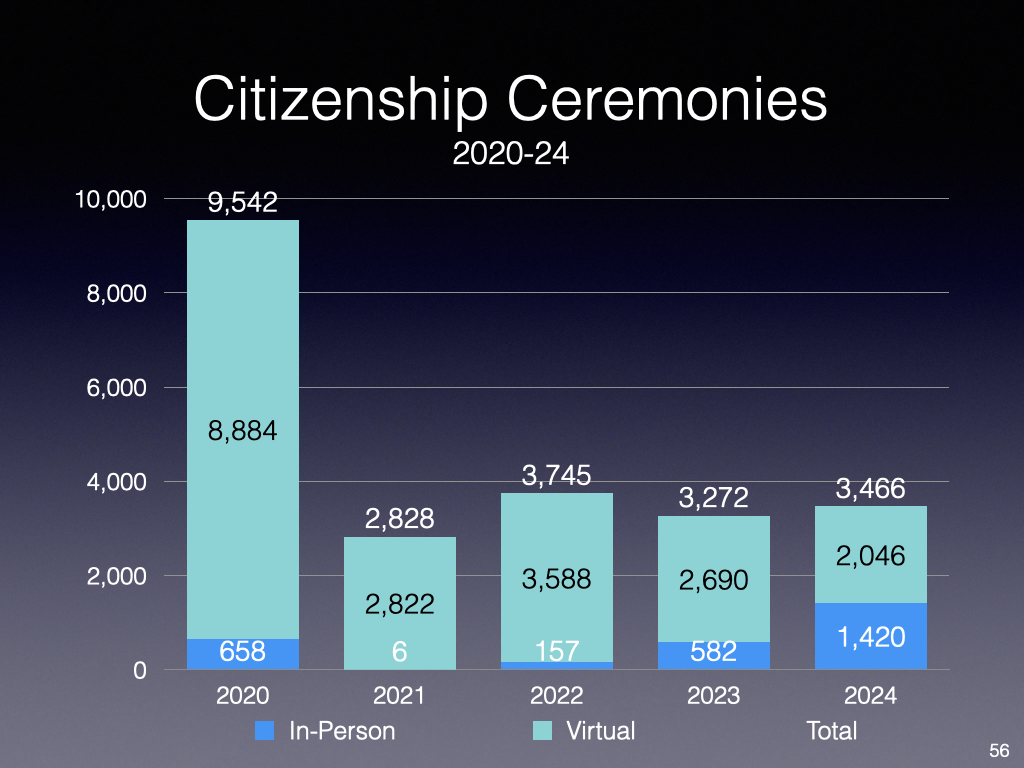
Lisée also notes Poilievre’s commitment to restore in person citizenship ceremonies, a welcome change given that the vast majority are virtual:

….Poilievre a dégainé le premier, dans son discours de refondation de ses thèmes électoraux, le 15 février, sous le slogan « Canada d’abord ». Il fut question de pipelines et de baisses d’impôt, mais pas seulement de ça. Il a annoncé la fin de « la guerre contre notre histoire », en particulier la guerre contre le fondateur du pays, John A. Macdonald, qui a eu le grand mérite d’être conservateur. Son successeur, s’il est élu, veut « renforcer les sanctions contre ceux qui détruisent ou dégradent nos symboles ». Il annonce aussi le retour des héros et des symboles canadiens sur les pages de notre passeport, évincés comme on le sait par l’équipe postnationale de Justin.

Il peste, avec raison, contre l’introduction par le désormais ancien régime de cérémonies d’assermentation à la citoyenneté à distance. Non seulement il rétablira l’obligation de se présenter en personne, mais il ajoutera un passage au serment. Le voici : « Je témoigne ma gratitude à ceux qui ont travaillé, se sont sacrifiés et ont donné leur vie pour défendre la liberté dont je me réjouis aujourd’hui et pour bâtir le pays que j’appelle maintenant mon chez-moi. Comme eux, je m’engage à remplir mes devoirs de citoyen canadien. »

Pour mémoire, car c’est difficile d’y croire, le serment actuel est : « Je jure que je serai fidèle et porterai sincère allégeance à Sa Majesté le roi Charles III, roi du Canada, à ses héritiers et successeurs ; que j’observerai fidèlement les lois du Canada, y compris la Constitution, qui reconnaît et confirme les droits ancestraux ou issus de traités des Premières Nations, des Inuits et des Métis, et que je remplirai loyalement mes obligations de citoyen canadien. »

Avouez que cette simple lecture fait douter de l’existence d’une identité canadienne, du moins autre qu’indigène et royale.

Mark Carney n’a pas voulu être en reste. Dès son premier jour, il a créé un ministère de l’Identité canadienne. Pour un pays qui n’en avait officiellement aucune la veille, la chose est immense. Parmi ses premiers mots prononcés, notre nouveau chef de gouvernement a affirmé que « notre identité bilingue et la langue française enrichissent notre culture », car le Canada est « un pays construit sur le roc de trois peuples : indigène, français et britannique ». Le mot « multiculturalisme » ne fut pas prononcé. C’est à peine si fut mentionnée, au passage, la diversité. On sent donc une réelle volonté de se recentrer sur les fondamentaux. D’autant que Carney a de suite pris l’avion vers les trois pôles identitaires désignés : Paris, Londres et Iqaluit.

Mais à part nous annoncer que nous avons désormais une « identité bilingue », en quoi consiste celle-ci ? Il a choisi un Québécois, Steven Guilbeault, pour chapeauter le nouveau ministère, qui n’a pas dans son intitulé la responsabilité des langues officielles, mais qui y gagne au change, car il obtient la gestion des parcs du Canada. Le lien avec l’identité vous échappe ? Pas au premier ministre, qui explique que « la question de l’identité canadienne est beaucoup plus large que seulement les langues officielles. C’est beaucoup plus que notre héritage. Nous construisons l’identité canadienne, et c’est vraiment la clé ». Oui, car, dit-il, elle « inclut la nature ». Le ministre Guilbeault est chargé de « mettre ensemble toutes les responsabilités qui concernent la nature, les océans, la biodiversité, et de s’assurer que toutes ces choses sont protégées et promues ».

Résumons. Notre identité est bilingue, assise sur un roc, alliage de riches veines françaises, britanniques et indigènes, mais inclut la nature, les océans et la biodiversité. Cela fait un peu bouillabaisse, convenons-en. Mais on campe résolument dans l’anti-postmoderne, ce qui est archinouveau, non ? Reste à insérer le tout dans le serment.

On sent que Steven Guilbeault va bientôt s’ennuyer d’un dossier bien plus simple : rendre vert un pays producteur de pétrole.

Source: Identité canadienne, après l’éclipse

…. Poilievre drew the first, in his speech of refoundation of his electoral themes, on February 15, under the slogan “Canada first”. There was talk of pipelines and tax cuts, but not only that. He announced the end of “the war against our history”, in particular the war against the founder of the country, John A. McDonald’s, who had the great merit of being conservative. His successor, if elected, wants to “strengthen sanctions against those who destroy or degrade our symbols”. He also announces the return of Canadian heroes and symbols on the pages of our passport, ousted as we know by Justin’s post-national team.

He rightly plagues against the introduction by the now old regime of ceremonies of oathing to remote citizenship. Not only will he reinstate the obligation to appear in person, but he will add a passage to the oath. Here it is: “I express my gratitude to those who worked, sacrificed themselves and gave their lives to defend the freedom I look forward to today and to build the country that I now call my home. Like them, I am committed to fulfilling my duties as a Canadian citizen. ”

For the record, because it is hard to believe, the current oath is: “I swear that I will be faithful and pledge sincere allegiance to His Majesty King Charles III, King of Canada, to his heirs and successors; that I will faithfully observe the laws of Canada, including the Constitution, which recognizes and confirms the ancestral or treaty rights of First Nations, Inuit and Métis, and that I will faithfully fulfill my duties as a Canadian citizen. ”

Admit that this simple reading makes us doubt the existence of a Canadian identity, at least other than indigenous and royal.

Mark Carney didn’t want to be left behind. From his first day, he created a Canadian Ministry of Identity. For a country that officially had none the day before, the thing is immense. Among his first words, our new head of government said that “our bilingual identity and the French language enrich our culture”, because Canada is “a country built on the rock of three peoples: indigenous, French and British”. The word “multiculturalism” was not pronounced. It is hardly if diversity was mentioned, in passing. We therefore feel a real desire to refocus on the fundamentals. Especially since Carney immediately flew to the three designated identity poles: Paris, London and Iqaluit.

But apart from announcing that we now have a “bilingual identity”, what does it consist of? He chose a Quebecer, Steven Guilbeault, to oversee the new ministry, which does not have responsibility for official languages in its title, but which wins in exchange, because it obtains the management of Canada’s parks. Does the link with identity escape you? Not to the Prime Minister, who explains that “the issue of Canadian identity is much broader than just official languages. It’s much more than our legacy. We’re building Canadian identity, and that’s really the key.” Yes, because, he says, it “includes nature”. Minister Guilbeault is responsible for “putting together all the responsibilities that concern nature, the oceans, biodiversity, and ensuring that all these things are protected and promoted”.

Let’s summarize. Our identity is bilingual, sitting on a rock, an alloy of rich French, British and indigenous veins, but includes nature, oceans and biodiversity. It’s a little bouillabaisse, let’s agree. But we camp resolutely in the anti-postmodern, which is arch-new, right? It remains to insert everything into the oath.

We feel that Steven Guilbeault will soon get bored of a much simpler file: making an oil-producing country green.

‘Lost Canadians’ legislation delayed once again

Really have to wonder about Justice Akbarali given only a month or so extension when Parliament prorogued and a likely imminent election call. Her seeing “no evidence” flies in the face of Bill C-71 that died because of prorogation and could quickly be revived, ideally with the residency requirement needing to be met within the same five-year period as for permanent residents:

A court has granted another reprieve for the federal government to make the country’s citizenship law Charter-compliant so children born abroad to Canadian citizens won’t be discriminated against under the current second-generation cut-off rule.

On Thursday, the Ontario Superior Court of Justice gave Ottawa until April 25 to pass legislation that grants citizenship to the so-called “lost Canadians,” who are denied automatic citizenship because their parents also happened to be born abroad.

It was a fourth extension to a court-mandated deadline — most recently set for March 19 — since Justice Jasmine Akbarali ruled in late 2023 the law unconstitutional and initially gave Ottawa six months to fix it. The Liberal government introduced Bill C-71, which died when Prime Minister Justin Trudeau suspended Parliament in January.

Earlier on Thursday, the government had sought a further 12-month extension, arguing it intended to continue and expand the interim measures in place right now “to mimic, to the extent possible, the framework established in the remedial legislation” introduced in that bill.

But Akbarali said that wasn’t good enough.

“I have nothing in the evidence on this motion other than broad, aspirational statements from the respondent about what it intends to do to mitigate the impact of the unconstitutional legislation,” the judge wrote in a three-page decision.

“There is no evidence of what policy will be adopted to implement its intention. There is no evidence about how any such policy will be communicated to people affected by the unconstitutional legislation.

“There is nothing to allow me to evaluate how effective the expanded interim measures will be in attenuating the impact of the ongoing rights violations that the respondent proposes.”

Instead, Akbarali ordered the government to file additional evidence of its “expanded interim measures” by April 2 and any further legal argument by April 4. The parties will reconvene on April 11.

“I am prepared to grant the respondent some additional time to adduce the necessary evidence and place it before the court, so that I am able to properly consider all relevant factors in determining whether a further suspension ought to be granted, and if so, its length,” she said in her ruling….

Source: ‘Lost Canadians’ legislation delayed once again

What are Canadians’ perceptions on race relations? Here’s what a national survey found

Always useful to have tracking over time. Encouraing:

Canadians are more optimistic about race relations than they were three years ago, despite a world that’s increasingly defined by inter-group conflict and social divisiveness, says a national survey on racism, race relations and discrimination.

The survey shows that those who view race relations as generally good outnumber those who think otherwise by a three-to-one ratio — with many believing that people from different groups get along with one another and have equal opportunity to succeed, said the report by Environics Institute and the Canadian Race Relations Foundation.

The 2024 survey found that most Canadians acknowledge the reality of racism, prejudice and hate, recognizing these issues both from personal experience and through their understanding of broader societal trends.

Keith Neuman, senior associate at Environics and the report’s lead author, said that compared to racialized people surveyed in 2021, the experiences of those surveyed this time didn’t worsen, and their perceptions of race relations improved slightly. “That, I think, is a point of optimism,” he said.

The survey comes at a time when Canada’s immigration policy is at a crossroads, with anti-immigrant sentiment rising, most recently directed at South Asians here as international students and foreign workers, scapegoated for the housing crisis and socioeconomic challenges. The ongoing war between Hamas and Israel has also led to tensions in Canada

This was the third wave of a national survey that started in 2019 to monitor the attitudes, perceptions and experiences of race relations among Canadians. The second survey in 2021 was in the wake of the racial reckoning from the Black Lives Matter Movement and surge of anti-Asian racism amid the pandemic….

Source: What are Canadians’ perceptions on race relations? Here’s what a national survey found

USA Immigration ‘gold card’: What is it, and how could it impact our immigration system? 

Of note:

The Bush Institute is a proponent of increasing legal immigration pathways to the U.S., including raising or eliminating per-country caps on green cards. Will the gold card help? 

While the devil is in the details, right now it seems as if the gold card could be a new legal pathway for potential immigrants. But it could also make it harder to qualify for the existing EB-5 program, making a current legal pathway more difficult.  

There are two major policy issues with this proposal. First, while investment and job creation are great, this program doesn’t bring in the workers the U.S. economy needs to fill the open jobs it already has. Even if you assume that a company would pay a high fee to keep, attract, or retain a foreign worker, that’s not a sustainable model to fill the nearly 8 million open jobs in the U.S. The current EB-5 program doesn’t either. Job creation is a wonderful policy goal, but we still need millions of workers to fill open positions.  

Second, similar visa programs around the world have been criticized for being easy targets for corrupt individuals looking to buy their way into countries. Any investor visa program, whether the proposed gold card or the current EB-5, will need to have appropriate vetting and safeguards built in to protect against this possibility.  

Source: Immigration ‘gold card’: What is it, and how could it impact our immigration system?

Trump administration asks Supreme Court to partly allow birthright citizenship restrictions

Will see if SCOTUS accepts application first or decides to shut it down immediately (SCOTUS has accepted application):

The Trump administration is asking the Supreme Court to allow restrictions on birthright citizenship to partly take effect while legal fights play out.

In emergency applications filed at the high court on Thursday, the administration asked the justices to narrow court orders entered by district judges in Maryland, Massachusetts and Washington that blocked the order President Donald Trump signed shortly after beginning his second term.

The order currently is blocked nationwide. Three federal appeals courts have rejected the administration’s pleas, including one in Massachusetts on Tuesday. 

The order would deny citizenship to those born after Feb. 19 whose parents are in the country illegally. It also forbids U.S. agencies from issuing any document or accepting any state document recognizing citizenship for such children….

Source: Trump administration asks Supreme Court to partly allow birthright citizenship restrictions

Census 2021 and IRCC Data: Citizenship

This deck is based on work I did for the Institute for Canadian Citizenship, using Census and operational data to contrast citizens and non-citizens by demographic (eg. CoB, age, gender) and socioeconomic (e.g. income, labour force participation, education).

Website sells Canadian birthright for $35K to foreign moms 

One of the problems of alternative media and TikTok influencers is their lack of capacity and knowledge.

The number of suspected birth tourists (non-resident self-pay) has been published annually (by me) and the British Columbia data is no longer the highest given the large drop pandemic and post-pandemic of Chinese birth tourists at Richmond General and other British Columbia hospitals (see Birth tourism has doubled since the pandemic lull):

A suspicious website is advertising would-be mothers from around the world the opportunity to have anchor babies in Canada, ensuring their children become naturalized citizens.

The Russian-language website “CanadaMama consulting” is advertising their services at fees ranging up to $35,000 for migrant women interested in baby-tourism. The website promises a “safe birth” and a “life full of opportunities.” 

Potential clients are being lured by the prospect of free education, healthcare, employment opportunities and international travel for their children. The website’s default language is set to Russian, but also has built in English, Ukrainian, Chinese and Spanish translations.  

Canadian TikTok influencer Mario Zelaya was the first to bring attention to the website.

Among the services offered to those interested include property rentals, immigration consultation, visa support, medical service advisory and even newborn photography. 

Akin to airline companies, the website has multiple package options ranging from economy, to optimal to comfort, with additional services such as food delivery, hospital tours, shopping advice and interpretation services offered to those willing to pay extra.

CanadaMama also claims to operate “under contract” and work alongside Canadian hospitals – an unverified claim. 

The company claims to have operated for more than five years, carrying out dozens of successful births

Unconditional birthright citizenship in Canada is attracting many birth tourists, especially in British Columbia–where some hospitals have reported non-citizens making up a quarter of their maternity ward patients.

A Calgary-based obstetrician gynaecologist, Dr. Colin Birch, said in a CBC interview that birth tourism had the biggest impact on cities that had international airports, with trends slowing down after air travel was shut down during the pandemic. …

Source: Website sells Canadian birthright for $35K to foreign moms

Trump’s ‘Gold Card’ Visa Idea Not a Hit With Voters

Can recognize a scam when they see one, at least in this particular immigration space:

President Donald Trump’s suggestion to replace an existing visa program for foreign investors with a $5 million “gold card” visa hasn’t won majority support.

The latest Rasmussen Reports national telephone and online survey finds that 41% of Likely U.S. Voters approve of Trump’s “gold card” visa plan, including 22% who Strongly Approve. Forty-seven percent (47%) disapprove, including 33% who Strongly Disapprove. Another 13% are not sure. (To see survey question wording, click here.)

Source: Trump’s ‘Gold Card’ Visa Idea Not a Hit With Voters

The Citizenship of Elon Musk and his Brood

Recently, petition e-5353 (Citizenship and immigration) was launched, advocating revocation of Elon Musk’s Canadian citizenship. The petition struck a chord with many Canadians (over 300,000 signatures as of February 26). 

While there are no legal grounds for revoking his citizenship under current legislation or under the previous revocation provisions of the Harper government, Musk and his families provide an interesting illustration of how citizenship by descent works in practice for three countries: Canada, USA and South Africa.

Musk was born in South Africa, obtained Canadian citizenship through descent by his Canadian mother, and become an American citizen after living and working in the USA. Three of the mothers of his children are Canadian-born, the most recent mother is US-born. All of his children were born in the USA.

The previous first generation cut-off for Canadian citizenship meant than none of Musk’s children would have been Canadian citizens were it not for the fact that the first three mothers were born in Canada and thus able to transmit their citizenship. However their children (second generation) would not be able to do so. 

The proposed revision of the Citizenship Act in Bill C-71, likely to be revived in some form, would allow these children to obtain Canadian citizenship provided they met the residency requirement of 1,095 days in Canada, within a time limit of five years or without a time limit as C-71 proposed.. 

It is likely that all of his children would have been entitled to South African citizenship, provided that Musk did not renounce his South African citizenship and registered the birth with South African authorities. However, there is no indication that Musk has registered their births in South Africa.  

With respect to American citizenship, some media commentary has made a linkage between Musk’s offspring and the Trump administration’s executive order to curtail birthright citizenship, just as some have highlighted that Musk may have worked illegally for a brief period in the USA (Musk has denied). However, it is hard to see how Trump’s executive order, even in the unlikely event courts rule in its favour, would impact on Musk’s offspring given his American citizenship.