ICYMI: Sajid Javid ‘taking UK down dangerous road’ by expanding citizenship stripping

Further undermining of citizenship through expanded revocation beyond terror or treason:

The home secretary, Sajid Javid, is taking the UK down a “very dangerous road” with plans to expand powers to strip dual citizens of their British citizenship, a leading human rights group has warned.

Suspected terrorists have previously had their UK citizenship taken away – most often while they are abroad – and the move does not require prior approval from a judge or parliament.

In his speech at the Conservative party conference, Javid proposed extending the reach of the power to cover serious criminals, citing child grooming gangmasters as an example.

Corey Stoughton, acting director of Liberty, the human rights and civil liberties group, said: “The home secretary is taking us down a very dangerous road. Few will sympathise with the people this power has been used against – but making our criminals someone else’s problem is not responsible, effective policymaking. It’s the government washing its hands of its responsibilities.

“Accepting citizenship stripping as a legitimate punishment could see us all sleepwalking into a future where the list of ‘serious’ crimes gets ever longer and the government uses this extreme measure more and more frequently. Banishment belongs in the dark ages and has no place in the UK in 2018.”

From 2010 to 2015, 33 people were stripped of their British citizenship, all of them dual nationals, on terrorism grounds. Figures for 2015 onward have not been made available.

Javid has made tackling child sexual exploitation a key issue for his department. He recently announced an extra £21.5m to help investigators who say they are facing a “constant uphill struggle” to track down offenders.

A Home Office spokesperson said: “Any British citizen may be deprived of his or her citizenship if the secretary of state is satisfied that it would be conducive to the public good. It is a power used for extreme and exceptional cases.

“Deprivation on conducive grounds can be used where individuals pose a threat to national security, or have been involved in war crimes, serious and organised crime and unacceptable behaviours such as extremism or glorification of terrorism.”

Diane Abbott, the shadow home secretary, said citizenship stripping was discriminatory against minority communities. “Stripping dual nationals of British citizenship is inherently discriminatory and risks creating yet another ‘hostile environment’ not for illegality but for Britain’s many minority communities,” she said.

“The Conservatives’ inability to learn from past mistakes beggars belief, even when mealy mouthed apologies are barely dry on the page. Why not punish Britons according to their crimes rather than their origins?”

In his conference speech, Javid said: “The home secretary has the power to strip dual citizens of their British citizenship. It is a power used for extreme and exceptional cases. It should be used with great care and discretion – but also determination.

“In recent years we have exercised this power for terrorists who are a threat to the country. Now, for the first time, I will apply this power to some of those who are convicted of the most grave criminal offences. This applies to some of the despicable men involved in gang-based child sexual exploitation.”

Source: Sajid Javid ‘taking UK down dangerous road’ by expanding citizenship stripping

How Canada became an international surrogacy destination [another form of birth tourism]

Just as I am working on my article on birth tourism, another example of “reproductive tourism” emerges.

The same issues larger apply in terms of abuse of birthright citizenship.

In addition, given that Canadian surrogate mothers use Canadian healthcare, there is an effective subsidy to foreign parents engaging a Canadian surrogate. Not right (and appears Canada is one of the few countries that allows intended parents living outside the country.

Hard to understand the rationale for continuing this other form of birth tourism:

Here’s an arresting statistic: Almost half of the babies born to Canadian surrogates in the province of British Columbia in 2016 and 2017 were for intended parents who lived outside the country. That’s 45 of the 102 babies born to surrogates there – 44 per cent.

What’s the national tally on such outbound babies? We don’t know. Rather, we aren’t told. The number could presumably be calculated, since individual physicians carry out the procedures and bill for them, and provinces issue birth certificates. But the information is not publicly available. Then again, we should hardly be surprised: In Canada, we don’t even know the total number of babies born to surrogates for any parent, Canadian or otherwise. I and others have been asking around for some time now.

Those B.C. numbers come to us thanks to the hard work of Pamela White, at the Kent Law School in Britain, who had to put in an access to information request with the B.C. government. She tried the province of Ontario, too, but they said they don’t collect data on residency. In the United States, such information is collected by law and published by the Centers for Disease Control and Prevention.

Prof. White, a former Statistics Canada director and data analyst, argues that Canadians deserve that level of transparency, too. She is absolutely right. Without real data, available for scrutiny, how can we make informed public policy decisions? We can’t.

Anecdotal reports and incomplete data suggest that the number of intended parents (IPs) from outside Canada has been growing in recent years. At the annual meeting of the Canadian Fertility & Andrology Society (CFAS) last month, Karen Busby, a professor in the faculty of law at the University of Manitoba, who co-authored a forthcoming paper on the topic with Prof. White, discussed why Canada is becoming an international surrogacy magnet and whether it is desirable.

The backdrop, Prof. Busby says, is that worldwide demand is huge. Many people want to be parents and can’t do so without surrogacy, but they live in countries where surrogacy is either prohibited entirely, or prohibited for them. China, Japan and many European and predominantly Muslim countries have restrictions, she says. People in such places who decide to pursue surrogacy must look beyond their own borders.

Coupled with this growing demand is shrinking supply. In the last few years, India, Nepal, Thailand and Mexico – former international surrogacy hotspots – have closed their doors to non-residents.

So why Canada? For one thing, Prof. Busby says, Canada is one of the few jurisdictions left in the world that both allows surrogacy and allows foreign participation in it. Countries such as Britain, South Africa and Israel, she says, permit surrogacy, but not for foreigners. The only other places that allow foreigners to access surrogacy within their borders, apart from a couple of completely unregulated jurisdictions, are Greece, Ukraine, Russia, Georgia and a few U.S. states.

For a number of reasons, Canada stacks up well against these others. Russia and Ukraine, for instance, only allow married heterosexual couples to participate. Canada, by contrast, does not allow discrimination on the basis of marital status or sexual orientation, Prof. Busby says.

Canada is also fairly efficient about granting legal parental rights. It varies by province, but generally speaking, IPs can be declared legal parents without a lot of hassle in just a few days, and they can be issued a birth certificate within weeks. Also, any child born in Canada has the right to citizenship, so a passport can be issued, and in short order, the families can head home and start their new lives.

Financially, Canada also compares well. Women in Canada enjoy high quality, publicly funded health care throughout the pregnancy, during the delivery and after the birth. This is as true for a woman carrying a baby for someone from France or China as it is for a woman carrying a baby for herself. Our neonatal care is also top-notch – and also publicly funded. Another perk, Prof. Busby says, is that if a Canadian surrogate has a job, then she may also qualify for employment insurance benefits following birth – to a maximum of $6,500.

Here’s another interesting twist. In Canada, it’s illegal – a criminal offence, according to the Assisted Human Reproduction Act – to pay a woman to carry a baby for you, or to pay someone else to arrange for her to do so. Since the law first passed in 2004, this prohibition has caused enormous hand-wringing for Canadian would-be parents looking to form their families with the help of a surrogate. They rightly fear that they could be prosecuted for paying a surrogate, and the penalty is steep: up to 10 years in prison and $500,000 in fines. The prohibition has reportedly driven some Canadian families to leave the country to seek surrogates elsewhere.

Ironically, this prohibition, which was designed to deter commercial surrogacy, may actually be stimulating it – and may favour foreign IPs over domestic ones. Domestic IPs may be reluctant to offer money or will only offer it under the table, but because the law is not applied to acts committed outside the country, Prof. Busby says, foreign IPs can offer money openly, so long as it changes hands somewhere else. It’s conceivable that, given the choice between being paid and not being paid, Canadian surrogates – who are legally allowed to accept the money – may opt to be paid. So foreign IPs may actually be more attractive to Canadian surrogates than domestic IPs. (There’s no data on that, of course, since there’s no data.)

It is true that foreign IPs coming to Canada will still be subject to our other prohibitions, such as paying for local egg or sperm donations or performing sex selection. But, as Prof. Busby points out, most Canadians live near the U.S. border and have easy access to the services offered there. This ability to enjoy the best of both systems only adds to Canada’s appeal.

All of these factors help to explain why Canada has become a go-to place for surrogacy. I’ll add one more that Prof. Busby did not explicitly mention: There are Canadian doctors, lawyers and agencies who actively recruit IPs from around the world. If foreign parents weren’t already aware of Canada’s considerable merits, representatives of the industry are more than happy to point them out. In fact, the newly minted president of the CFAS himself, alongside the CEO of the country’s top surrogacy agency, was recently in London, promoting Canada as a premier surrogacy destination.

And they are right: For all of the above reasons, Canada is a great place to do surrogacy. Loads of people already want to come here and we can only expect that number will grow.

Not everything about this picture is rosy, however. A big question is whether Canadians need to think about recovering medical costs. Pregnancy care, even for an uneventful pregnancy, costs money. So does birth. The average uncomplicated birth in Canada rings in at between $3,000 and $6,000, depending on whether it’s a vaginal or surgical delivery. Complications can increase that figure considerably. Neonatal care can also be pricey. For instance, according to the Canadian Institute of Health Information, care for a baby born at 29 weeks weighing less than kilogram costs an average of $91,946. One baby.

“I am pretty sure that if you asked the average Canadian whether or not the Canadian health-care system should pay for any of the health-care costs incurred in order to produce a child for a non-resident IP, the answer would be no,” Prof. Busby told the CFAS meeting. “In fact, I think it would be an emphatic no.” I suspect she’s right.

As far as Prof. Busby is aware, no province has put in place laws or policies to recover the cost of surrogate pregnancy care from foreign IPs. (A few Ontario hospitals have started charging for infant care, if the infants are for out-of-province parents.) Prof. Busby says governments could consider measures such as asking IPs for money up front or not issuing a birth certificate or passport until the bill is settled.

That’s a lot of work. It would involve co-ordination across departments and even, in some scenarios, levels of government. Another option, she says, would be to follow the lead of other countries and create residency restrictions, stipulating that only people who live in Canada can work with a surrogate here. That option would, in one fell swoop, alleviate the shortage of surrogates available to work with Canadians and eliminate the cost-recovery conundrum.

That would be a tidy solution, and, all things considered, maybe the most workable one. The cost-recovery issue is challenging. Access to surrogates by Canadians is challenging, too. There are other problems. Our country is struggling under a 14-year-old law that still hasn’t rolled out the meat of its regulatory details. We are woefully lacking in transparency about surrogacy – and assisted reproduction in general. Finally, although preliminary findings are reassuring, we have not yet done nearly enough research to establish that Canadian women who act as surrogates are not exploited.

I am not hopeful, given Canada’s track record in this sphere, that we will crack these tough problems any time soon, or ever. But let’s imagine we did – no cost to the Canadian public, adequate numbers of surrogates to work with Canadian families, effective laws for and public scrutiny of the process and confidence that women were treated fairly. Then, it seems to me, Canada would be an excellent place for international surrogacy. Surely the ideal is for surrogates and babies to have quality medical care, for IPs to be free from discrimination, for parentage issues to be resolved quickly.

If we did somehow get our house in order, I’d be the first to ask: If you believe that surrogacy is a legitimate way of achieving parenthood, what would be the argument against welcoming it here?
Source: How Canada became an international surrogacy destination: Alison Motluck

One year later, Citizenship Act improvements lead to more new citizens – The numbers

Almost one year after the changes to residency requirements (from 4 to 3 years) and fewer applicants having to be tested for language and knowledge (from 14-64 to 18-54), the number of applications has increased.

As noted before, the residency requirement change is a one time impact, with this year being a “double year” with 3 and 4 year cohorts combined. The reduced testing requirements, primarily the 55-64 year olds, has both a one-time impact (those who put off getting citizenship) as well as ongoing.

The new “normal” will be known with the 2019 numbers:

This year, Citizenship Week (October 8 to 14, 2018) will be celebrated with 72 special citizenship ceremonies across the country. Citizenship Week also marks the 1 year anniversary of Bill C 6, which brought in important changes to the Citizenship Act, helping qualified applicants get citizenship faster.

The changes from Bill C 6 came into effect on October 11, 2017, and provided those wanting to become Canadian citizens with greater flexibility to meet the requirements. In particular, the changes reduced the time permanent residents must be physically present in Canada before applying for citizenship from 4 out of 6 years to 3 out of 5 years.

By the end of October 2018, an estimated 152,000 people will have obtained Canadian citizenship since the changes came into effect, an increase of 40%, compared to the 108,000 people who obtained citizenship in the same period the year before.

Bill C 6 has allowed more permanent residents to apply for citizenship. In the 9 month period from October 2017 to June 2018, Immigration, Refugees and Citizenship Canada (IRCC) received 242,680 applications, more than double the 102,261 applications that were received in the same period the year before. Despite the increase in applications, processing times for routine citizenship applications remain under 12 months.

Source: Taking Canadian Citizenship to New Heights This Citizenship Week

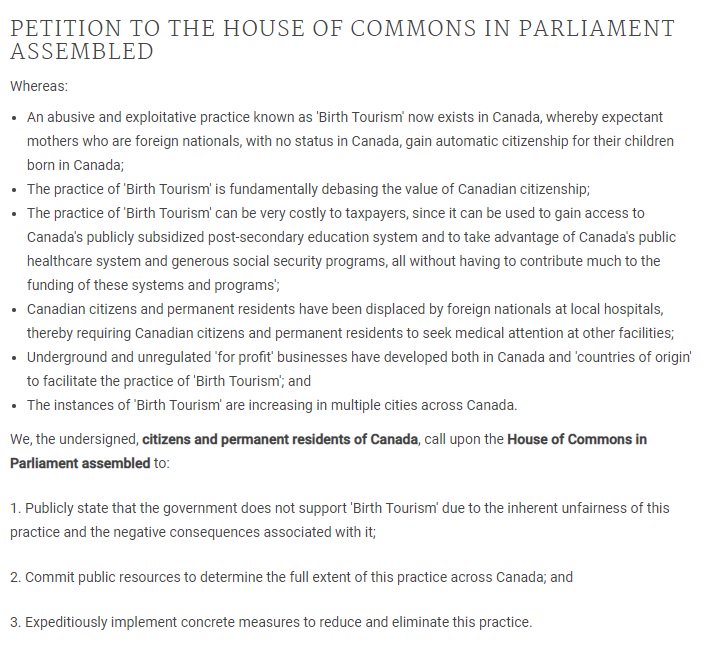
Yet another petition on birth tourism

Likely a political response to the tensions in Richmond, where over 20 percent of live births are to non-resident mothers and positioning given the Conservative party resolution calling to limit birthright citizenship to offspring of Canadian citizens or permanent residents.
Working on an article with more accurate and. spoiler alert, higher numbers which should be out later this month or early November:

US seeks to reduce waivers for immigration fees

Consistent with other restrictive measures (Canada does not offer a waiver to lower income immigrants despite the 5 fold increase in citizenship fees in 2014-15):

United States Citizenship and Immigration Services is proposing changing the eligibility for fee waivers for lower-income immigrants on the path to legal permanent residency and U.S. citizenship.Immigration advocates say the move is like building an “invisible wall.”

USCIS announced the change Friday in the Federal Register. Receiving means-tested public benefits from the states would no longer result in automatic USCIS fee waivers, the proposal states. Instead, fee waivers would only be tied to two criteria: the federal poverty threshold or particular financial hardships.

The change is necessary, USCIS said, because “eligibility for these benefits can vary from state to state, depending on the state’s income level guidelines,” meaning that “individuals who would not otherwise qualify under the poverty-guideline threshold and financial hardship criteria have been granted fee waivers.”

In 2017, USCIS approved 285,009 fee waiver applications, totaling $173 million.

The new proposal restricts waivers only to applicants who are at or below 150 percent of the federal poverty threshold or financial hardship.

“It’s a significant narrowing of those who would be eligible for the fee waiver. Our estimates indicate that this would reduce the total population of those eligible for a fee waiver by two-thirds,” said Jill Marie Bussey, advocacy director for the Catholic Legal Immigration Network. “It’s an extremely troubling proposal for our network.”

CLINIC’s 330 affiliates provide pro bono immigration services to thousands of low-income immigrants across the United States. Bussey said 95 percent of CLINIC’s affiliates assist with fee waiver applications.

In California, where 20 percent of the population is foreign born, the federal poverty threshold to claim state benefits is 200 percent.

For 2018, a four-person family in California is eligible for means-tested state benefits with a household income at or below $50,200. Thus, an immigrant household at that income level and receiving state means-tested benefits are currently eligible for a USCIS fee waiver.

But with the proposed change, that same four-person Californian household would only be eligible for the USCIS fee waiver if household income was at or below $37,650.

USCIS is like the U.S. Postal Service in that most of its funding comes from fees paid for its services, rather than from U.S. taxpayers.

USCIS fees for immigrants to use its services can run into the thousands. The application for a “green card”, formally known as the “application to register permanent residence,” costs $1,140. The application for naturalization to become a U.S. citizen costs $640.

The waiver proposal is an attempt to reverse a change to immigration policy under President Barack Obama. In 2011, USCIS standardized a process of using means-tested benefits as a way to prove eligibility for its fee waivers.

“When this agency waives fees, it’s hurtful to the quality of the agency and it pushes fees off from one population to another. If you can’t get fees from group A, then you have to run up the fees for groups B, C, and D. So there is a reason to be careful with waivers,” said David North, a fellow at the Center for Immigration Studies, a Washington, D.C., think tank advocating for low immigration.

“The change works against and secures some fee money from the near poor while leaving the poor untouched. So this is not a program that rolls back benefits for the really poor people, it rolls back benefits for some of the working poor and the income level above that,” North said.

CLINIC’s Bussey said the proposal is like an “invisible wall,” “a back-door way of limiting family immigration and reunification.” She fears it will suppress naturalization rates

“And that hurts us all. Studies really show that low-income immigrants are able to improve their financial status through naturalization. They have access to better jobs, educational opportunities and resources,” she said. “So limiting access to naturalization through limiting this fee waiver creates a poverty loop.”

North said the fees make sense because U.S. legal status brings “admission to the labor market, for instance, where you can make as much money as you want or can.”

The proposed change is open for comment until Nov. 27. Public comments have to be taken into consideration when finalizing a federal government rule change but may not necessarily be incorporated into its outcome.

Source: US seeks to reduce waivers for immigration fees

Sajid Javid is right – the British citizenship test is a bad pub quiz. So what is he going to do about it?

Good comments on the UK citizenship test and the “values” question that apply more broadly than the UK:

Speaking at his party’s conference this week, the home secretary Sajid Javid criticised his own government’s British citizenship test, describing it as like “a pub quiz” that is not fit for its intended purpose.

Javid is not the first to realise this. In 2013, I published what is still the only comprehensive report into the citizenship test, in which I criticised it in those terms – and this was discussed in parliament. So it is pleasing to see my campaign for changing the test has the home secretary on board.

It’s about time. The test is a key part of the immigration system for permanent settlement. Over 2 million tests have been sat since it launched in 2005. Immigrants sit a multiple choice exam with 24 randomly selected questions and must get 18 or more correct to pass the exam. It costs £50 for each attempt – and one person was known to take it 64 times.

The test’s intended purpose is to help confirm that an immigrant has successfully integrated into British society. This might be thought best achieved by checking for any criminal record or tax arrears over an extended residency period (which are also part of the process), but the test is supposed to add something extra beyond this. And here it categorically fails.

If you pour over the roughly 3,000 facts covered by the test questions, including about 280 historical dates spread over 180 pages, it is difficult to see what practical use the citizenship test has. Its handbook does not say how to contact emergency services, register with a GP or report a crime. There is no mention of 999 or of how many MPs sit in the House of Commons. But you must know how many elected representatives sit in the Welsh Assembly, Scottish Parliament and Stormont in Northern Ireland. The handbook requires memorising the height of the London Eye and the age of Big Ben. And while you must know about starting a free school, there is no mention of the national curriculum.

Unsurprisingly, the test is regularly seen as the test for British citizenship that few British citizens can pass, with many migrants seeing it as an opportunity by the Home Office to extract increasingly more expensive fees through a test of random trivia meant to make more fail.

Instead of ensuring new and old citizens were coming together, my research found the test was actually moving them apart – and doing more harm than goodat confirming integration.

In June this year, a House of Lords select committee on citizenship and civic participation agreed with me, endorsing seven of my recommendations, including the need for a new test and an advisory group engaging with the public to close the gap between public expectations and what any such test should cover. While Javid’s remarks acknowledge the citizenship test’s problems that the Lords select committee and I raised, it is unclear what he proposes to do about it. He says the test is not enough, but then promises to bring in “a British values test” as something new.

My concern arises from one difference that I have with the home secretary: I have sat the citizenship test and know it firsthand. If Javid examines the test, he will see that it already does ask immigrants about “the liberal, democratic values that bind our society together”. So if he wants the UK citizenship test to do this, the good news is it already includes it.

It would be a mistake to rush towards launching a new values test or revising the current one without engaging with the public. There are concerns about immigration and how well it is managed that have remained strong for several years. An edict based on guesswork won’t build confidence, especially for those most anxious about immigration levels. One problem shouldn’t lead to something worse.

Now is the time to foster healing for a country divided many different ways beyond the Remain and Leave split. An advisory group, preferably led by a naturalised British citizen who understands the process firsthand, could play an important role in bringing citizens together to discuss what British values we have, what they mean to people and how they can help rebuild a post-Brexit immigration system. Such work could be done over a few months, serving as a useful means for fostering confidence while dispelling immigration myths that might remove some of the toxicity from the debate and move the conversation on.

But it would take courage to make such a new start – and we can only hope such a plan is in mind.

Source: Sajid Javid is right – the British citizenship test is a bad pub quiz. So what is he going to do about it?

FM Klimkin proposes to discuss dual citizenship in Ukraine

Will be interesting to see how this debate progresses:

Ukrainian Foreign Minister Pavlo Klimkin says there is a need for a debate on dual citizenship in Ukraine.

“We all understand that tens or hundreds of thousands of people in Ukraine have passports of neighboring countries. And this is not only ethnic Hungarians. I think we should hold a discussion about the state’s attitude to this large group of our compatriots,” he wrote in an article for European Pravda.

Klimkin believes it is possible to find a solution that will not harm people with dual citizenship, but, on the contrary, free them from the need to conceal it.

“The discussion is not about worsening their situation or branding them as traitors, but rather reasonably resolving the legal limbo, and not only that,” the minister said.

He stresses the problem of dual Ukrainian-Russian citizenship should be considered separately in the context of Russian aggression against Ukraine.

“I personally consider it fundamentally unacceptable. As a matter of fact, the decision on single citizenship in Ukraine was once made, first of all, as a fuse against Russia’s possible influence on the newly declared independent Ukraine. Today, when Moscow is waging armed aggression against us, such motivation is leveled: if Ukraine wants to consider the possibility of limited application of dual citizenship, this should not concern Russia in principle,” Klimkin said.

Source: Klimkin proposes to discuss dual citizenship in Ukraine

Trump Administration Asks SCOTUS To Block Top Officials From Explaining Census Citizenship Question

Will be interesting to see how the SCOTUS rules:

The Trump administration is asking the Supreme Court to step in and block two top officials from having to speak under oath in a lawsuit challenging the administration’s decision to add a question about citizenship to the 2020 Census.

In a petition filed Wednesday, the Justice Department asked the high court to prevent Commerce Secretary Wilbur Ross and John Gore, the acting head of DOJ’s Civil Rights Division, from having to sit for depositions in the case. A coalition of activist groups, cities and nearly 20 states, led by New York, say the Trump administration was predisposed to adding the citizenship question, and say it violated federal law by not following the proper procedure for doing so.

Getting information from Ross and Gore is crucial to the lawsuit because Ross, who oversees the Census, has said he added the question at the request of the Justice Department. DOJ said it needed the question, which has not been asked on the decennial survey since 1950, to get better citizenship data so it can better enforce the Voting Rights Act. But documents disclosed as part of the litigation show that Ross wanted to add the citizenship question even before the Justice Department requested it, and that it was Ross who initially approached DOJ officials about making the request.

Critics say adding the citizenship question will depress the response rate among immigrants who fear sharing their immigration status with the Trump administration. Data collected by the Census is strongly protected by federal privacy laws and must be kept confidential.

A lower court in New York has ordered depositions of Ross and Gore, saying they possess unique and relevant information that can’t be obtained from other sources. In its Wednesday filing, the government said the lower court’s ruling was incorrect, and that the case should be evaluated based on an “administrative record” of documents compiled by the government detailing why it made its decision.

“The court thought Secretary Ross’s testimony uniquely vital because he was personally involved in the decision to reinstate a citizenship question and the decision is of great importance to the public,” U.S. Solicitor General Noel Francisco wrote in the brief. “The Secretary’s personal involvement in a significant policy decision is not exceptional, and the importance of the Secretary’s decision in this case does not distinguish it from many other decisions of national importance that Cabinet Secretaries make.”

The information that the government has disclosed in the lawsuit so far has raised significant questions about the decision to add the citizenship query. The documents show Ross and top aides discussing the addition of the citizenship question, and a memo in which the bureau’s top scientist advised against adding it.

Justice Department lawyers have been fighting to block the plaintiffs in the case from gathering information beyond the documents that government officials voluntarily compiled about the decision. However, they have been largely unsuccessful. On Sunday, U.S. District Judge Jesse Furman, the trial judge overseeing the case, said the government’s most recent request was “particularly frivolous — if not outrageous.”

The U.S. Court of Appeals for the 2nd Circuit is also considering whether to block Ross from having to sit for a deposition, but said last week that Gore could be deposed. A trial in the case is scheduled to begin at the start of November.

“The Trump administration has repeatedly tried to block discovery in our suit ― and courts have repeatedly rejected their attempts. You have to wonder what they’re trying to hide,” said Amy Spitalnick, a spokeswoman for New York Attorney General Barbara Underwood (D). “We’ll get to the bottom of how the decision to demand citizenship status was made, as we continue our case to ensure a full and fair Census.”

Source: Trump Administration Asks SCOTUS To Block Top Officials From Explaining Census Citizenship Question

Sajid Javid backs plans for stricter citizenship rules after Brexit

Values tests play more heavily to the base and public rather than being effective as applicants can simply provide the desired response without believing in it.

Fact-based tests are more objective and do not encourage dishonesty:

The government has announced stricter immigration and citizenship rules to come into place after Brexit, with Sajid Javid later telling the Guardian’s editor-in-chief Katharine Viner that he was unworried by the suggestion such rules would have prevented his own father entering the UK.

The home secretary used his speech to the Conservative party conference to say people seeking British citizenship would face tougher English-language requirements, part of an immigration overhaul that will include the end of free movement from the EU.

In a broad speech set to intensify speculation about his leadership ambitions, Javid unveiled plans for a beefed-up “British values test” to replace the Life in the UK test for those looking to settle in the country.

Overnight, he and Theresa May had announced proposals for a single immigration system that treats people from EU countries the same as those from non-EU countries. Highly skilled workers who want to live and work in Britain would be given priority, while low-skilled immigration would be curbed.

Speaking later in an interview on the conference fringe with Viner, the home secretary said he was not concerned by the thought that under such a regime his father, who arrived from Pakistan in 1961 with £1 and no skills, would be barred from entry.

When his father came, Javid said, the entry system was very different as the governments of the time “wanted, needed, a route for low-skilled migration”.

Asked if it made him sad this would no longer be the case, he said: “No, it doesn’t make me feel sad. Actually, with today’s policy it makes me very optimistic about our future. Because what I have also set out is that we will remain the global-outlook nation that welcomes people from across the world, no matter where they’re from.”

In his speech, Javid announced plans aimed at improving integration and described the current Life in the UK test as a “pub quiz”.

“It’s about integration, not segregation,” he said. “And I’m determined to break down barriers to integration wherever I find them. Take, for example, the most basic barrier of all: language.”

Javid said 700,000 people living in the UK could not speak English.

“As home secretary, I will apply these principles to those who arrive in our country. So not only will there be a new values test but we will also strengthen the English-language requirements for all new citizens.”

Highly skilled migrants coming to the UK on a work visa will not face tougher language requirements than those already in place, the Guardian understands.

Javid said earlier he would consider scrapping the cap on the number of highly skilled migrants as part of the post-Brexit plan. The limit is currently 20,000.

Applicants will need to meet a minimum salary threshold – for highly skilled migrants this currently stands at £30,000 – but Javid has hinted that this will be reviewed.

In his speech in the main hall, the home secretary said: “Thanks to the [Brexit] referendum we now have a unique opportunity to reshape our immigration system for the future.

“A skills-based, single system that is opened up to talent from across the world. A system that doesn’t discriminate between any one region or country. A system based on merit. That judges people not by where they are from, but on what they can do.

“What people want – and they will get – is control of our own system. With a lower, and sustainable level of net migration. And, above all, that has to mean one thing: an end to freedom of movement.”

The government has said it intends to publish a white paper this autumn and a bill the following year, meaning it is highly unlikely MPs will get to vote on the legislation before the UK leaves the EU in March.

In the interview with Viner, Javid, who has previously spoken about how his mother did not learn to speak English until more than decade after she arrived in the UK, talked about his anger at the unfair targeting of people from the Windrush generation by immigration enforcement.

“The first thing that went through my mind is that it could have been my parents,” he said. “Imagine if this was my mum or my uncle, someone who had lived in Britain their whole life, contributed so much, being detained or, worse, removed from the country.”

But Javid vehemently rejected that the post-2010 Conservative government had been primarily responsible for the Windrush crisis with the so-called hostile environment policy, saying a lot of it had begun under Labour.

“If people portray this as a problem that happened under a Tory government, it’s incorrect. It’s either bad reporting or a deliberate attempt to twist the fact,” he said.

Javid, who again spoke about a range of subjects well beyond his official brief, was similarly blunt about Labour’s interventionist economic policies, saying: “The trouble is, Jeremy Corbyn really believes what he says. And he’s completely deluded.”

Elsewhere in his speech, he announced a package of new measures to tackle forced marriage, including proposals to refuse spousal entry to the UK where there is evidence a marriage is forced.

Source: Sajid Javid backs plans for stricter citizenship rules after Brexit

To increase immigration, allow dual citizenship

Correlation, not causation. Many immigrants to Canada come from countries which do not formally permit dual citizenship but largely turn a blind eye:

Countries that allow dual citizenship experience higher migration flow. They attract more migrants to their countries, and see more citizens emigrating elsewhere.

To discover this, researchers from the University of California, Irvine examined the migration patterns in 184 countries where migrants left and 24 countries where they arrived between 1981 and 2006. The paper that resulted from their work was published in the journal Comparative Political Studies in 2016.

They found that migrants are more likely to move to countries that share a common official language, share colonial roots, are closer to their home country, have higher pay, lower unemployment, and a larger foreign population. Controlling all these factors, the ability to carry multiple citizenships correlates with higher migration flow for both origin and destination countries.

When one or both countries forbid multiple citizenships, the results change considerably.

People are most likely to emigrate, when both the origin country and the destination country allow them to take more than one citizenship. They are least likely to leave their home country when both forbid it. Moving to a multiple-citizenship-forbidding country is more likely than away from one, according to the research.

For the country looking to attract talented workers, allowing dual citizenship is clearly a place to start.

Source: To increase immigration, allow dual citizenship