On Saturday morning, Farid Ali, a farmer dressed in his best sky-blue kurta and a white prayer cap, walked quietly into his village headquarters and received devastating news.
His name wasn’t on the list.
He looked, he waited, his legs began to shake, his dry lips began to move and he prayed there had been a mistake. But his name wasn’t anywhere.
Mr. Ali’s citizenship in India, where he has lived all his life, was now in question, and he could soon be separated from his family and hauled off to a prison camp.
He is one of nearly two million people in northeast India who were told Saturday that they could soon be declared stateless in a mass citizenship check that critics say is anti-Muslim. The news arrived in small, sunlit offices across the state of Assam, where citizenship lists were posted that drew huge crowds. Many walked away shocked and demoralized; others were joyous.
Seems like an oversight given the many signs of Chinese government interference with Chinese Canadians:
The office of Democratic Institutions Minister Karina Gould chose not to include a popular Chinese-language app in discussions it had with major social media platforms about protecting the upcoming federal election.
Gould unveiled her government’s plan to protect the upcoming federal election from interference at a press conference in January. One aspect of the four-pronged plan was entrusting social media platforms “to act.” In a practical sense, the government has asked platforms to ensure they’re not being exploited to spread disinformation and that they adhere to the new election laws introduced by the Liberals in Bill C-76, which pertain to them.
“As the Minister has said, we expect social media platforms to take concrete actions to help safeguard this fall’s election by promoting transparency, authenticity and integrity on their platforms,” Meg Jacques, spokesperson for Gould, told iPolitics in an email last week.
In the lead up to the election, the government has had back-and-forth dialogue with the companies that operate many of the major platforms. In letters dated June 21 and obtained by iPolitics through an access to information request, Gould wrote to companies including Snap Inc. (which owns Snapchat), Google, Microsoft, Twitter and Facebook, reiterating her expectation that they “ensure the 2019 election is free and fair.”
Gould has also previously said she had been in touch with Reddit and Pinterest. She never reached out to WeChat.
Asked for a reason why her office didn’t communicate with WeChat like it did with others, Jacques said that the minister’s office chose to work with major social media platforms that had “an established corporate presence in Canada.”
WeChat does not have company offices in Canada. Reddit does not list an office in Canada on its website, either.
In the June 21 letters, Gould requested each of the companies to affirm their commitment to the “Canada Declaration on Electoral Integrity Online.” Announced by Gould about a month earlier in the House of Commons, the declaration includes a dozen measures for platforms to follow to ensure democratic precesses like the election aren’t meddled with.
Gould also wrote to the companies asking that they respond with a description of the actions they’ll be taking during the writ and newly introduced pre-writ period. The letters also outline to the companies who in each of the government’s law enforcement bodies are their point people in cases where they may identify potential nefarious actors attempting to exploit their platforms.
WeChat
WeChat is a Chinese messaging, social media and e-commerce app. It’s widely used by Chinese speakers around the world, with approximately 1.1 billion monthly active users. By comparison, Facebook reported 2.7 billion monthly users across its apps — which include Messenger, WhatsApp, Instagram and, of course, Facebook — during the first quarter of this year.
WeChat is a popular platform for Chinese-language news, but the company has been previously criticized for censoring certain news. In December, StarMetro Vancouver reported that the app had been blocking stories about Huawei executive Meng Wanzhou’s bail hearing, before once again allowing readers access to stories once she was released on bail.
The recent 30th anniversary of the Tiananmen Square massacre was another instance when pictures and keywords related to an event were kept off WeChat.
The app was thrust into the Canadian political spotlight earlier this year because of an incident during the Burnaby South byelection. Liberal Party candidate Karen Wang was the source of a controversy for posting on the app, urging voters to support her because she was Chinese, instead of NDP Leader and byelection candidate Jagmeet Singh, who she described as being “of Indian descent.” Wang resigned as the Liberal candidate shortly after.
Earlier this year, all MPs were warned to be wary about conducting official business on WeChat because of concerns that the House of Commons cybersecurity team had with the app.
At that time, iPolitics reached out to the offices of all MPs who represented ridings where the Chinese population made up at least 30 per cent of the riding’s total community, according to data collected in the 2016 census. Three MPs, Liberal Jean Yip and Conservatives Alice Wong and Bob Saroya, said at that time they used or had used the app in the past, in their role as a federal representative. Yip and Wong both planned to continue using the app. Each of the MPs described using it similarly to how they used other social media platforms.
iPolitics attempted to contact WeChat for this story by reaching out through multiple points of contact. The company did not respond.
Jacques said government officials “continue” to communicate with social media platforms in the lead up to the election.
“(Officials) are encouraged by their efforts to date to address online disinformation,” she said.
Like the platforms that Gould’s office has maintained a dialogue with, WeChat is bound by online advertising rules introduced by the Liberals in Bill C-76, which, among other things, require it to keep political ads displayed in a registry, if they’re shown on the platform.
Election Advertising
On Tuesday, Braeden Caley, spokesperson for the Liberal Party, wouldn’t say whether or not the party would use WeChat to advertise ahead of the election. The People’s Party hadn’t yet made a decision about whether or not it will advertise on WeChat, according to its executive director Johanne Mennie. The other three parties that are expecting to run candidates in all 338 ridings did not get back to iPolitics about whether or not they plan on advertising on the app, by the time this story was published.
As part of the change to limiting transmission of Canadian citizenship to the first generation abroad in 2009, the Conservative government initially applied the same limitation to the children of “crown servants” born abroad (e.g., diplomats and military), largely I believe given that the government thought that a carve-out in this case would make it politically harder to sell a significant change that applied to all Canadians.
In 2014, the exemption for crown servants was included in C-24:
Children born abroad to certain United States service members and other federal employees will no longer be granted automatic citizenship under a Trump administration policy set to take effect in October.
Parents of those children, including those born on military bases, will have to apply for citizenship on the children’s behalf before they turn 18, according to a United States Citizenship and Immigration Services policy released on Wednesday.
The policy appeared to be aimed at military families who have not lived in the United States for years. According to the immigration agency, the change would not affect the children of families with at least one parent who is an American citizen and has lived in the United States for at least five years.
It was unclear how many families the change would affect.
A spokeswoman for the Pentagon said the impact would be small, without specifying how many parents would be required to apply for citizenship for their children under the change. A spokeswoman for the citizenship and immigration agency, which oversees legal immigration, also declined to provide the number of families who would be affected.
Local land developers but also service sector professionals are becoming concerned by reports that Greece’s new government is planning to launch a citizenship by investment scheme similar to that of Cyprus.
The scheme provided by Nicosia in recent years has substantially contributed to the recovery of the Mediterranean island’s economy.
The new right-wing government under Kyriacos Mitsotakis is drafting its own citizenship by investment programme which resembles the Cypriot one and, thus, will be quite competitive, according to informed sources.
One source told Phileleftheros that the new programme is expected to be implemented after the first quarter of 2020 and may involve investments of €2.5 million. Cyprus’ investment limit is €2 million, plus VAT. In the case of Greece, the plan is for VAT payment to be deferred for a period of three years. This basically means that at the time of the investment the cost will essentially be the same as that in Cyprus.
Undoubtedly, the implementation of such a programme by Greece will create strong competition for Cyprus. Greece, as a brand name, is stronger and more versatile. So are some of its areas or islands as well. This means that far more investment opportunities will be on offer, especially in the sector of land development. The areas that will fall under the scheme’s criteria have not been disclosed yet.
At the same time, as a larger country that has been in recession for many years it offers more investment opportunities, plus connectivity is also an important factor for foreign investors. Another advantage of Greece taken seriously in consideration by foreign investors is that one does not need a visa to travel to the US.
As about 50 people became Canadians at a special citizenship ceremony held at the Horticultural Building at Lansdowne Park Thursday morning, 25-year-old Roksana Hajrizi and her mother, Celina Urbanowicz, looked on from the just outside the area cordoned off for officials, volunteers, celebrants and their friends and families.
They watched as Bibiane Wanbji, who six years ago left her husband in Cameroon and brought her four children to Canada to find a better life, smiled at the vastness of the world that had just opened up to her. Having a Canadian passport, Wanbji explained, means she can travel just about anywhere. She hasn’t seen her extended family and friends back in Cameroon since coming to Canada, so that’s a definite destination. So, too, are the U.S. and Cuba, and “the city of love” that she’s always wanted to visit: Venice. “It’s like a passport for the world.”
And although she’s been in Canada for six years already, Thursday’s ceremony left Wanbji feeling a bit different, she said, that she has “more to give in this country, to contribute to build the country.”
Hajrizi and her mother watched, too, as 50 new Canadians, including Haguer Abdelmoneim and her children, Mahmoud, 10, and Youssef, 5, sang their new national anthem. They and Abdelmoneim’s husband came from Egypt in 2014 “for a better education for the kids” and “for a better community to grow in.”
They didn’t just choose somewhere other than Egypt, she added; they specifically chose Canada. “We like the values. It’s a very inclusive country, very welcoming to newcomers.”
Another “new” Canadian, Saiful Azad, who arrived on Canada’s shores from Bangladesh 21 years ago, agrees. “A lot of people don’t understand how important it is to be a Canadian citizen and the opportunities that are given to you here,” he said. “I don’t believe the U.S. is the land of opportunity; I believe Canada is.”
Like Wanbji, Azad, who operates a Greek on Wheels franchise in Hunt Club, cherishes his new-found ability to travel as much as his right to vote. “When you’re a Canadian citizen, people look at you differently and treat you differently. Everyone thinks that Canada is a great country, and I think they’re right.
“People who live here and want to be Canadian citizens should pursue that.”
Thursday’s event was unlike most citizenship ceremonies in that it was one of about 75 sponsored each year by the Institute for Canadian Citizenship, a national not-for-profit charity that promotes active and inclusive citizenship. As at other ICC-hosted citizenship ceremonies, this one opened with intimate roundtable discussions at which soon-to-be Canadians were engaged in conversations with other community members.
A lot of our soon-to-be Canadians have had long journeys and long stories in getting here,” said ICC chief executive and former Ottawa-Centre Liberal MPP Yasir Naqvi just prior to the start of the ceremony, “so we want to talk a little about that. But most importantly we want to talk about what the journey is going to be like after they become Canadian citizens. How are they now going to contribute to the building of Canada? We want to promote active citizenship.”
Thursday’s ceremony was also co-hosted by Capital Pride, a first for both organizations.
“It’s an opportunity for our community and the candidates for citizenship to engage in dialogue about what our community is about and what the experience of being 2SLGBTQ is,” said Capital Pride founding director Sarah Evans. “A lot of newcomers, and even established immigrants, don’t always know a lot about the 2SLGBTQ community, so it’s a good opportunity to build that awareness.”
As she watched from the sidelines, Roksana Hajrizi was keenly aware. Describing herself as a “proud lesbian,” she attended Thursday’s ceremony partly in support of Capital Pride, and also to congratulate those being sworn in as new Canadians. “I am proud and happy for those who are Canadians today,” she said, “and I hope that one day my family and I could be citizens of this great country.”
Truth be told, Hajrizi already feels very much Canadian. She was just three years old when she and her family — her mother, father, Ismet Hajrizi, and younger sister, Camila, arrived in British Columbia from war-torn former Yugoslavia almost 23 years ago. She even has two brothers born in Canada: Sebastrijana, 22, and Daniel, 19.
But she, her mother and sister are living in Canada without official status, in constant anxiety that they will be deported. They are Roma — her mother a Polish Catholic Roma, her father a Yugoslavian Muslim one. Romas are not welcome in most places, she says, and gay ones even less so.
The United Nations’ Office of the High Commissioner for Human Rights has noted the discrimination that Roma people face worldwide, an Anti-Gypsyism expressed by “violence, hate speech, exploitation, stigmatization and the most blatant kind of discrimination.”
Hajrizi’s family was denied refugee status, and now she fears for her life and the lives of her sister and mother if they’re forced to leave the country. In 2008, her family, except for her brothers, was scheduled for deportation but was given a reprieve.
Still, Hajrizi’s father, she says, despite being a Serbian citizen, was deported in June to Kosovo, where he lives in a garage with no papers. She, with no birth documents herself, worries that it’s just a matter of time before she and her mother and sister will suffer similar fates, that she will never get to be on the other side of Thursday’s ceremony, that despite living in Canada for very nearly her whole life, she will never know what citizenship is like.
“I believe in my heart that I’m Canadian. I believe in my heart that my sister is Canadian. I believe my mother and farther are also Canadian. We’ve been here for 23 years and our roots have spread through Canadian soils. We have given our time, our compassion, our love, our kindness to our community, to our city. People who know us know that we are a good family.
“My family is being ripped apart,” she said. “My father was taken from us, and now my mother is next. But we will fight to stay in Canada.”
Largely anecdotal at this point in time but credible:
As riot police clashed with protesters in Hong Kong in recent days, it focused attention on the estimated 300,000 Canadian passport holders — most of them Hong Kong-born — who live in the port city and fuelled speculation of a surge in “re-return migration” back to Canada.
Hong Kong observers say they had already begun to see an uptick in the phenomenon of so-called “re-returnees” — those who moved from Hong Kong to Canada in the 1980s or 90s, returned to Hong Kong and are now back in Canada — beginning around 2014 and expect the recent political turmoil will accelerate it.
“Back in the 1990s, their parents moved to Canada because they worried Hong Kong one day would be a city of China. Right now, their worries have been actualized. … China has undermined the autonomy of Hong Kong. The next generation are making the same decision as their parents did,” said Kennedy Wong, co-investigator of an unpublished UBC study on re-returnees.
Hong Kong serves as a key trading hub in Asia for Canadian products and ranks third as a destination for Canada’s export of financial, engineering and other professional services.
In addition to shared business interests, Canada also has deep-rooted historical ties with Hong Kong. During the Second World War, the then-British colony was the first place Canadian troops fought a land battle. They suffered great casualties against the Japanese — 290 died in combat, nearly 500 were wounded and another 264 died as prisoners of war.
“There has been a long and strong ties between Canada and Hong Kong,” said Leo Shin, a professor of Chinese history at UBC.
While there was some migration from Hong Kong to Canada in the 1950s and 60s, the numbers swelled to about 380,000 from the mid-1980s to mid-1990s in advance of the handover of Hong Kong from British rule back to China. Many families did not, however, completely cut off ties to their homeland as evidenced by the “astronaut family” phenomenon, in which the breadwinner — typically the father — spent the bulk of his time overseas.
In the handover’s aftermath, fears subsided as China established a “one country, two systems” model of governing that allowed Hong Kong to maintain its economic and political autonomy. As a result, there was an outflow of migration of these now-naturalized Canadian citizens back to Hong Kong in the 1990s through the mid-2000s.
Many of those returning to Hong Kong had Canadian university degrees, weren’t married yet, and had the luxury of mobility. From their point of view, going back to Hong Kong was a no-brainer — the economy was booming, opportunities for climbing the corporate ladder were plentiful, and their Canadian schooling and English skills meant higher salaries. Many Canadian-born citizens of Chinese descent joined this outflow to Hong Kong — driven not only by job prospects but also a desire to connect with their ancestral homeland.
The fact they all carried Canadian passports offered peace of mind, Wong said. If things went sideways in Hong Kong, they could always come back to Canada.
“You can pick Canada or Hong Kong,” he said.
In 2011, the Asia-Pacific Foundation released a study that estimated the number of Canadian citizens in Hong Kong to be around 300,000 but possibly as high as 500,000 — making the Canadian diaspora in Hong Kong the largest outside of the United States. Most were naturalized Canadians; only 16 per cent were thought to be Canadian-born.
The study was based on the results of a phone survey of more than 500 Canadian citizens in Hong Kong.
Forty-six per cent of respondents said they considered Canada home “sometimes” or “all the time,” while 37 per cent said they “never” consider Canada home. Reflecting the push-pull dilemma facing many of these residents, about one-third said they would most likely return to Canada within five years.
And that’s what started to happen, experts say, citing a number of triggers.
In 2012, an idea was floated to introduce in Hong Kong’s public school curriculum civics courses intended to promote greater patriotism and identification with mainland China. The idea was panned by critics who worried about “brainwashing” and was ultimately scrapped.
But it sowed fear, observers say, about growing influence of Chinese politics in education, the economy and other sectors.
“They started to be more sensitive and aware of these things,” Wong said.
As part of his study on re-return migration to Canada, Wong interviewed about 20 people who had decided to settle in Vancouver and Toronto. One interviewee said the decision was tactical. “After 2008, the whole political situation has been getting worse. … And you can see how they (the government) wanted our children to be raised … to learn about something that is nonsense, or to learn to be a robot.”
That sort of fear intensified in 2014 when Beijing was accused of trying to interfere with the electoral process in Hong Kong, sparking protests that came to be known as the “Umbrella Movement.”
On top of the changing political climate, many in Hong Kong have been returning to Canada for personal reasons. Some are raising young families or nearing retirement age and prefer the quieter Canadian lifestyle over the chaos of Hong Kong, which has become notorious in recent years for overcrowding in hospitals and kindergarten classes. Some also have aging parents living in Canada.
“I told myself clearly that (if I make this decision), I am at a point of no return. Because I want to get settled in a place,” said another interviewee in the study.
While there is no hard data to show the number of re-returnees, there is anecdotal evidence to suggest it is on the rise. When the UBC alumni association in Hong Kong held a paid seminar at the start of this year titled “Thinking of Moving Back to B.C.?” more than 70 people showed up, higher than expected.
In June, the South China Morning Post cited census data to show that the number of Hong Kong-born people in Canada had been steadily declining since 1996 but then increased from 209,775 in the 2011 census to 215,750 in the 2016 census. The newspaper attributed the increase to the new phenomenon of “double reverse migration.”
In recent weeks, as violent clashes between police and pro-democracy demonstrators — upset over a proposed bill that would’ve allowed for the extradition of Hong Kongers to face trial in China — have intensified, observers have speculated that the turmoil is likely to fuel more departures.
“We can tell obviously people are not just worrying about democracy. They’re worrying about the freedoms that Hong Kong people have been enjoying,” said Miu Chung Yan, a UBC professor of social work who worked with Wong on the re-return migration study.
Wong said he has friends who have lived in Hong Kong all their lives but who have recently expressed interest in having a “working holiday” in Canada. “The push factor is much higher,” he said.
Migration consultants in Hong Kong have similarly been reporting sharp increases in young people inquiring about emigrating to other parts of Asia, Australia, the United States and Canada.
One of them, John Hu, told Global News this week the number of inquiries he’s received has doubled.
“Before June, when we answered calls, they were thinking about immigration,” he said. “But now, we are taking calls from people who are already determined to migrate.”
President Donald Trump said Wednesday he was looking “very seriously” at ending the right to citizenship for babies born to non-U.S. citizens on American soil.
Trump spoke to reporters as he departed the White House for a speech in Louisville, Kentucky. He said birthright citizenship was “frankly ridiculous.”
“We’re looking at it very, very seriously,” he said.
This isn’t the first time Trump has claimed he’d do away with it — he said something similar in October.
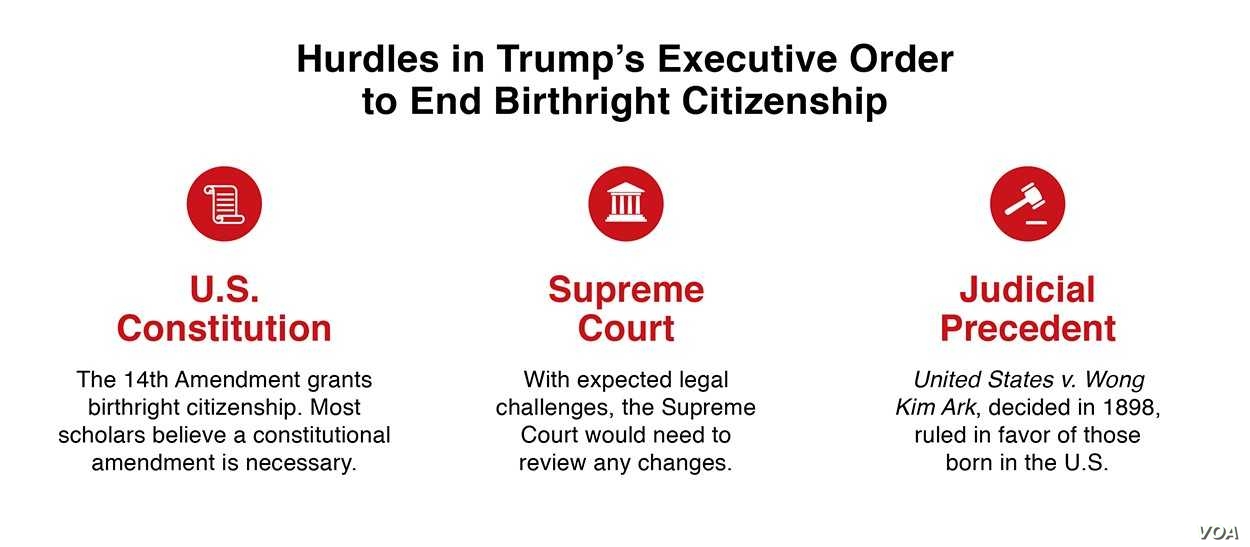
But the citizenship proposal would inevitably spark a long-shot legal battle over whether the president can alter the long accepted understanding that the 14th Amendment grants citizenship to any child born on U.S. soil, regardless of a parent’s immigration status.
Hurdles in President Trump’s executive order to end birthright citizenship
Executive order
James Ho, a conservative Trump-appointed federal appeals court judge, wrote in 2006, before his appointment, that birthright citizenship “is protected no less for children of undocumented persons than for descendants of Mayflower passengers.”
But Trump has said he was assured by his lawyers that the change could be made “just with an executive order” — an argument he has been making since his early days as a candidate, when he dubbed birthright citizenship a “magnet for illegal immigration” and pledged to end it.
There are no figures on how many foreign women travel to the U.S. specifically to give birth. The Center for Immigration Studies, a group that advocates for stricter immigration laws, estimated that in 2012 about 36,000 foreign-born women gave birth in the U.S., then left the country.
Places like Florida have seen in a boom in so-called “birth tourism.” Every year, hundreds of pregnant Russian women travel to the United States to give birth, paying from $20,000 to more than $50,000 to brokers who arrange their travel documents, accommodations and hospital stays. Sizable numbers of women from China and Nigeria also come to the U.S. for the same reason.
Immigrant detention
Trump’s comments Wednesday came as the administration continued to make immigration changes pushed by his hard-line advisers that have been in the works for months. On Wednesday, the Department of Homeland Security announced it had moved to end a longstanding federal agreement that limits how long immigrant children can be kept in detention. The decision will almost certainly lead to a legal battle over the government’s desire to hold migrant families until their cases are decided.
The rule also follows moves last week to broaden the definition of a “public charge” — a burden to the U.S. — to include immigrants on public assistance, potentially denying green cards to more immigrants. There was also a recent effort to effectively end asylum altogether at the southern border.
Understandably, Macklin is the most quoted expert on citizenship revocation:
The British government has just stripped Islamic State recruit Jack Lettsof his United Kingdom citizenship.
In one sense, the move was unsurprising. The U.K. has been the undisputed leader in reviving banishment as punishment for “crimes against citizenship,” deploying it primarily against those deemed threats to national security.
The mildly surprising feature of the U.K.‘s decision is that it has opted to make Letts Canada’s problem. Letts is currently being held in a jail in northern Syria after being captured by Kurdish forces in 2017.
Letts’ father is a Canadian citizen and, therefore, his son is a Canadian citizen by descent. As a result, the U.K. can deprive him of citizenship without rendering Letts stateless because he will remain a citizen of Canada.
With limited exceptions, international law prohibits rendering people stateless, though the U.K. plays fast and loose on that front. It strips citizenship from those who are dual citizens as well those who are not, but whom the Home Secretary speculates could, in the future, possibly obtain citizenship from some other country.
It doesn’t much matter to the U.K., really. Once discarded, the former citizen might be executed by drone strike, transferred elsewhere for prosecution or persecution or detained indefinitely by non-state armed forces. Wherever they go, it won’t be back to Britain, and whatever happens to them, they are someone else’s problem. That’s what makes citizenship deprivation, in the language of the British law, “conducive to the public good.”
No espionage or treason
Why another country should bear sole responsibility for a citizen that the U.K. disavows is an interesting question. These are not classic instances of espionage or treason, where the historic narrative underwriting stripping citizenship was that the individual betrayed one state in the service of the other state.
Shamima Begum, a British citizen who joined the Islamic State as a 19-year-old in 2015, was not working for Bangladesh in Syria. Jack Letts was not a Canadian spy.
I speculate that the British government has, until Letts, traded on a tacit understanding that British Muslims with brown skin inherently “belong” less to the U.K. than to some other country where the majority of people are Muslims with brown skin — even if they were born in Great Britain and have never even visited the other country of nationality.
On this view, stripping citizenship merely sends the targets back to where they “really” come from. Citizenship deprivation thus delivers an exclusionary message to all non-white, non-Christian British citizens that their claim to U.K. membership is permanently precarious, however small the literal risk of citizenship deprivation.
But Letts is white, his parents are middle class and Christian in upbringing (though secular in practice). His other country of citizenship, Canada, is also predominantly white and Christian in origin.
Canada is a staunch British ally, an important diplomatic and trading partner and a G7 member. Queen Elizabeth remains the formal head of state in Canada.
The illogical underpinning of citizenship deprivation now emerges clearly, shorn of implicit appeals to racism, Islamophobia and colonial arrogance. Letts is no more or less a risk to national security in Canada than the U.K. In no sense does Letts “belong” more to Canada than to the U.K., the country where he was born, raised, and that formed him.
The world is not made safer from terrorism when the U.K. disposes of their unwanted citizens in Canada, Bangladesh or anywhere else. The very phenomenon of foreign fighters testifies to that.
Claims that “citizenship is a privilege, not a right” or that the undeserving citizen forfeits citizenship by his actions is flimsy rhetoric intended to distract from the grubby opportunism that motivates citizenship revocation.
The U.K. does this not because it enhances the value of citizenship or makes the world safer from terrorism. It does it because it can.
If the British government thinks stripping citizenship is a good way for a state to respond to the challenges of national security, it must think it’s a good idea for all states. So imagine that Canada also had a citizenship revocation law. In fact, Canada’s Conservative government did enact such a law in 2014 (inspired by the U.K.), though it was repealed by Prime Minister Justin Trudeau’s Liberal government in 2017.
Here is the scenario: Letts, ISIS foreign fighter, is a citizen of the U.K. and of Canada. Neither country wants to claim him. Each has the possibility of revoking his citizenship as long as Letts is not rendered stateless.
The result?
Race to the bottom
An arbitrary race to see which country could strip his citizenship first. To the loser goes the citizen — maybe Canada, maybe the U.K.
This every-state-for-itself race to the bottom is the antithesis of co-operation in a global struggle against radicalizaton and terrorism; one need not be schooled in game theory to recognize it as counterproductive parochialism. Once states contemplate the possibility of being on the receiving end of citizenship stripping, the tactic doesn’t look quite so clever.
Until now, the U.K. has targeted individuals whose other state of nationality lacked the resources or diplomatic heft to challenge the British practice under international law. Maybe it’s time for Canada to step up, and to work with other countries, to pressure the U.K. and other states to abandon citizenship revocation as a means of disavowing “bad citizens.”
The Letts case reminds us that citizenship revocation policies can bite back. Any country that seeks to dispose of their citizens in this way may some day be a disposal site for other countries. If human rights aren’t enough of a reason to abolish citizenship revocation, and undermining global co-operation isn’t enough either, perhaps self-interest can tip the balance.


 Multicultural Meanderings