Senate Hearings on C-6: Minister Hussen and Witnesses March 1

Summary: Senate committee hearings on Bill C-6 finished March 1 with the last set of witnesses, including Minister Hussen and officials, with the clause-by-clause review taking place this morning. The Minister was challenged particularly on the lack of procedural protections in the cases of revocation for fraud or misrepresentation. While he stated his general willingness to consider improvements, the overall tenor of his responses and those of his officials was to defend the current process. Conservative senators questioned the rational for the elimination of knowledge and language assessment for 55-64 year olds, probed the protections of the current revocation process for misrepresentation and expressed their disagreement with the repeal of revocation in cases of treason or terror. Senator Eggleton, just as he had during C-24, expressed his concern over the impact of the increase in citizenship fees, with the Minister and officials defending the increase and arguing it did not cause the decline.

The clause-by-clause review this morning may see a number of observations (greater flexibility for those applicants who have difficulty in knowledge or language assessment, the impact of citizenship fees). An amendment to improve procedural protections is expected to be introduced at third reading.

External witnesses

Robert Watt, a former Vancouver-based citizenship judge 2009-15 focussed his remarks on his experience in reviewing thousands of applications. While the majority clearly demonstrated the desire to stay and contribute, a basic competence in language and understanding of Canada, a small number had a more instrumental interest in having a Canadian passport and the benefits of medicare and tax credits, or being “citizens of convenience. He believed strongly that the intent to reside should remain given the clear signal it sends that a new citizen should centre her of his life in Canada; that the current residency requirements of four to six years should not be reduced and the need for the department to have “robust audit procedures” to check the validity of third-party language assessment.

Lorne Waldman of CARL, and Josh Patterson of BCCLA spoke on to restore procedural protections for revocation in cases of fraud and misrepresentation, either reverting to the previous access to the Federal Court or some other procedure that involved the right to a hearing, the right to disclosure, an independent decision-maker and reversion to permanent residence status rather than foreign national.moan independent

Main questions

Revocation for fraud or misrepresentation and procedural protections: Most of the time was taken up by this issue, with questions and witnesses noting the contrast between the solid procedural protections for permanent residency misrepresentation and refugee determination and the limited protections for citizenship misrepresentation. Patterson and Waldman repeatedly noted the dubious constitutionality of the provision. In terms of which option was preferred, they noted their preference for an expansion of the IRB to handle such cases, given their experience and expertise. However, as there was no reference to a possible IRB role, that was beyond the scope of what could be considered and thus some variant of a process providing an oral hearing before the Federal Court was provided. There was relatively low risk of cases being appealed beyond the Federal Court level. A number of examples were cited highlighting the limitations of the C-24 approach.

Smart Permanent Resident Cards to track entry and exit (raised by Julie Taub in last set of hearings): Watt noted that pending technological developments, applicants should present their travel documents to CBSA (but was unclear how that would work). Waldman noted that unlike the EU, Canada does not control on leaving the country. This would be a significant change and would be expensive to implement. While it would work for airports, it would not be practical for land crossings given the resulting delays.

Fees: Senator Eggleton continued to press on fees, noting the dramatic increase in fees and that applications had taken a “real nose dive,” noting the points made in my brief (https://sencanada.ca/content/sen/committee/421/SOCI/Briefs/C-6_A_Griffith_e.pdf). He noted that the press on full cost recovery did not take into account that those applying for citizenship were taxpayers too, and they would be contributing for many years. Waldman confirmed the impact on immigrants, that the costs to families, including external language assessment, was in the $1,000s and that the government had to look at costs as a barrier if Canada wants to encourage people to become part of the fabric of society. Watt noted the fee increases came near the end of his term but he had seen instances of individuals and families struggling even with the previous fees, and a “good case” can be made to balance accessibility and cost recovery.

Language proficiency and age requirement: Watt was probed further on what he meant by the need for a robust audit on whether or not language requirements were met. He responded by noting the wide range of organizations offering assessment services and that random audits were needed to ensure that the level had been attained. He noted that some applicants may lose proficiency in the period between getting assessed and becoming citizens (but also noted that the reverse could occur). Patterson noted there was no issue with respect to 14-17 year olds as they would learn in schools or the workforce. For 55-64 year olds, economic class immigrants already would have met language requirements, and the issue was with respect to family class, particularly parents and grandparents. He referred to Avvy Go’s earlier testimony regarding the barriers faced by low-income immigrants and refugees and believe a better approach was increased resources for language training.

Residency requirements: Watt was challenged whether one more year or less made a difference in terms of integration. He responded by noted the importance that the clarity that residency meant physical presence provided given previous Federal Court jurisprudence. He never saw any evidence from IRCC that an additional year would be burdensome and did not believe it was. Waldman confirmed the helpfulness of the physical residency definition but noted that the change to three out of five years was particularly helpful to refugees as they had no other citizenship. The restoring of part-time credit for time spent in Canada prior to becoming a Permanent Resident was also a welcome improvement.

Minister Hussen and officials

Minister Hussen opened by noting that the previous government’s changes had created barriers to citizenship. C-6 would repeal some of the changes and facilitate citizenship, and send a clear signal of Canadian inclusivity, fairness and diversity (“diversity is our strength”). C-6 was part of implementing the Speech from the Throne commitment to make it easier for immigrants to participate.

Repeal of the national interest revocation provision (terror treason) was to ensure that Canadians, whether single, dual or multiple nationality were treated equally and the government did not support treating people differently, noting the positions of organizations such as the CBA and CCR along with focus groups “much troubled” by this distinction. Those convicted of terrorism or treason will face the Canadian justice system and will “go to jail for a long time.” Revocation for fraud or misrepresentation was different.

Other measures in C-6 removed barriers. Repeal of the intent to reside provision would reassure citizens that they were not at risk of losing citizenship. Physical presence was maintained but citizenship could be attained one year earlier. Providing part-time credit for pre-permanent residency time provided greater flexibility for those such as international students who had “started building connections.” The return to the previous 18-54 age requirements for testing recognized that 14-17 year olds would meet these through the school system while easing the burden for55-64 year olds.

He also reiterated the government’s commitment to program integrity, noting the provision that would allow the government to seize fraudulent documents.

Main questions

Revocation for fraud or misrepresentation and procedural protections: As in the previous session, the absence of procedural protections was the main focus. Minister was repeatedly challenged along the earlier testimony by legal experts, and was reminded that his predecessor had indicated he would welcome an amendment in this regard. The Minister repeatedly stated that he believed that the present process has safeguards and is sound, but he was open to proposals that would improve protections.

A number of questions served to clarify the steps in the process and the criteria used by officials to assess whether revocation was warranted. Factors included: age of applicant, extent of ties to Canada, whether they were primarily living in Canada or not, and the health of an individual. The process was completely delegated to officials.

Some questions concerned the assertions of CARL/BCCLA:

  • no right to disclosure: unanswered by Minister unless I missed it
  • no H&C consideration: Minister replied party can provide under personal considerations
  • no right to counsel: Minister replied absolute right to counsel (in preparation of documents)
  • no right to appeal: Minister said not correct (seek leave which is not the same thing)

Minister resorted at one point by noting that C-6 only dealt with some issues – dual national revocation and removing barriers – and that the appeal mechanism was “not central” to C-6. He was, however, “committed” to procedural fairness.

Officials confirmed that the majority of cases pertained to residency, with other cases related to identity or not disclosing criminality.

Revocation (terror or treason): Conservative senators challenged Minister on the rational to repeal the revocation provisions of C-24 and he reiterated the equal treatment arguments. He confirmed that the one person whose citizenship which had been revoked under the C-24 provision would have his citizenship reinstated.

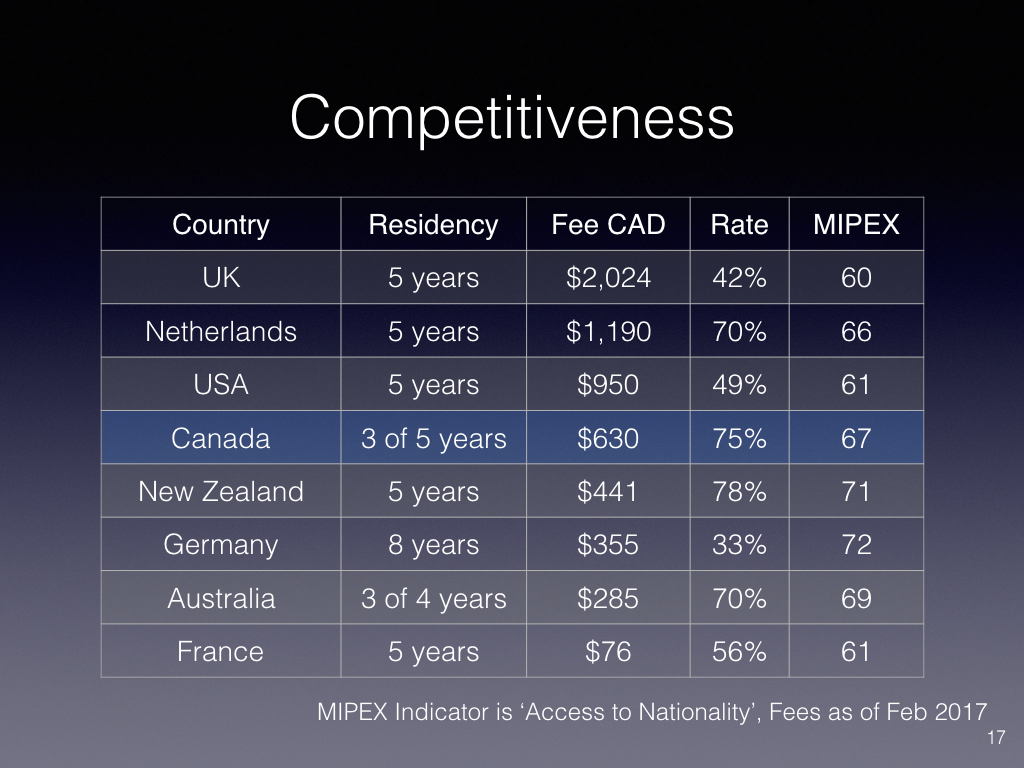
Fees: Senator Eggleton raised the same questions as before. Minister replied that the drop was more attributable to the barriers contained within C-24, primarily the longer residency requirements. Fees were much lower than many countries, citing the USA and UK (comment: correct, but not mentioning Australia and NZ which are lower). Officials reiterated the direct correlation between the extended residency requirement, noting the sharp drop after June 2015 when the four-year minimum came into effect.

Comment: The one-year transition effect ended in June 2016. The final 2016 numbers, due out any day now, will confirm a sharp decline. The July-September numbers – the first quarter after this transition period – do show an increase (from 11,970 to 20,329) but one far short of the historical number of applications (about 200,000 per year or 50,000 per quarter). Hence fees matter!

Language proficiency and age requirement: In response to questions regarding the number of applicants 55-64, officials provided some useful data. 7.7 percent of all applicants were in this age category (not clear which year – I have a pending request for this data). Officials noted that the numbers of this age group had dropped from 15,243 last year to 2,317  (believe it referred to mid-year comparisons 2016 to 2015), with total applications of 67,000 (not clear which period she was referring to). Minister indicated his confidence in language assessment process.

Officials noted that applications were not accepted if the applicant had little or no language. Settlement programs provided language training and applications would be accepted following successful completion. Officials also noted the various steps to ensure the integrity of the citizenship test. On the citizenship study guide, officials confirmed that the current guide was written higher than CLB-4 (the formal requirement) and that it would be re-written to be more aligned to the requirement: not to “simplify but in clearer language.”  Officials were also looking at including more language on Indigenous peoples, given TRC recommendation number 93.

Minister reiterated that it was important for 55-64 year olds to obtain citizenship, that it contributed further to their integration and they contributed to Canadian society (e.g., providing child care) and this restored what “has worked in Canada for more than 40 years.”

Integrity: In addition to points in opening remarks, Minister noted that the department had agreed with all recommendations in the OAG audit of the citizenship program, with all either acted or being acted upon.

Only media coverage I have seen is in the National Post (Immigration minister defends legislation that prevents convicted dual nationals from losing citizenship), largely unbalanced as it focuses mainly on the testimony of one witness, Julie Taub, and her critique of C-6)


Canadian citizenship must be a constitutional right: Chapman misses the mark

While I have a great deal of respect for Don Chapman and other advocates who successfully pushed the previous government to address the issue of “lost Canadians” in C-37 (2009) and C-24 (2014), I find his latest op-ed misses the mark, arguing for opening up the constitution to add citizenship as a right in the Constitution.

Apart from the fact that no government in their right mind would open up the Constitution given the divisive process that would result (been there, done that!), their column makes assertions about numbers (“many”) without any real serious look at the data.

The data we have primarily consists of the demand for citizenship proofs. The 2009 and 2014 changes to the Citizenship Act addressed the majority of the potential cases; however, the number of annual proofs did not change significantly, suggesting less demand than Chapman and other advocates claimed.

citizenship-proofs-2010-15

That is not to say that some cases remain, but that they are best dealt with individually through consideration for a discretionary grant of citizenship (s 5(4) of the Act).

Moreover, as one of my former colleagues noted:

mark-on-chapman

Chapman also engages in fear mongering with respect to Canadian dual nationals living in the US being forced to renounce their US citizenship in order to avoid potential revocation in cases of acts of terrorism or treason. C-6, currently in the Senate, will repeal this provision and thus address the major Charter violation that treats dual nationals separately from “mono-nationals”:

The practical implication is that the more than 100,000 Canadian casualties from the First and Second World Wars never lived to become citizens, and many of their children have spent decades fighting for their right to citizenship, denied them simply because their fathers did not survive the war. The hallmark of former minister of citizenship and immigration Jason Kenney was the consistency with which he denied these applicants. Although many of these Canadians eventually regained their citizenship through parliamentary victories, too many died as they were simply waited out by Ottawa.

Particularly heinous is the untold number of Indigenous Canadians that are currently stateless because their parents never registered their births, rightfully fearing their children would be sent to a residential school. Now adults, these Canadians have no rights or benefits. They are citizens of nowhere, unable to legally work, marry, attend school, buy a home, get a loan, drive a car or even take a bus, train or plane without identification. They are ghosts in their own land, forced to live in the shadows.

Even recent amendments that reinstated citizenship to some have left many others stateless, and did nothing to prevent that reinstated status from being stripped in the future.

Former prime minister Stephen Harper’s policies further complicated citizenship rights, making second-class citizens of anyone with dual-citizenship status. With the current political turmoil in the United States, thousands of these dual citizens – especially targeted professionals such as journalists and human-rights workers – now face the painful option of renouncing their U.S. citizenship, fearing their second-class status in Canada could, on a whim from our leadership, force them to live in Mr. Trump’s United States.

Our national identity has no foundation if we have no inherent rights, and Mr. Trump’s idle threats against his own people prove how urgent it is to give serious thought to our Canadian citizenship – what it actually is, how we get it and how it’s lost.

As we approach our 150th birthday, this is the perfect time to focus on defining and protecting our identity. It is time to make citizenship a constitutional right. Pierre Trudeau gave us the Charter of Rights and Freedoms. Wouldn’t it be fitting for the Prime Minister to take the final step to true nationhood: an inviolable, constitutional right of citizenship.

Source: Canadian citizenship must be a constitutional right – The Globe and Mail

High fees blamed for sharp decrease in Canadian citizenship applications | Toronto Star

Another article on the impact of the increase on citizenship fees, just before Minister Hussen testifies before the Senate committee studying the bill:

The number of immigrants applying for citizenship has plunged by a whopping 50 per cent at the same time as Ottawa has stripped a record number of Canadians of their citizenship.

According to the latest data from the Immigration Department, only 56,446 new citizenship applications were received in the first nine months of last year, a sharp decline from the 111,993 during the same period in 2015.

The number of new citizens approved also dropped by 48 per cent from 198,119 to 111,435 over the same period, said Andrew Griffith, a retired director general of the department who obtained the data.

While the tightened language proficiency and longer residency requirements have contributed to the decline, the steep increase in citizenship application fees under the former Conservative government is a key factor, Griffith said.

The processing fee was raised from $100 to $300 in February 2015 and again to $530 later that year, with an additional $100 right-of-citizenship fee required once the application is approved. Historically, citizenship applications have averaged close to 200,000 per year.

“The fee hike is a huge part. When you increase the price, you are not going to be able to afford it,” noted Griffith, a fellow at the Canadian Global Affairs Institute. “The fee is a significant barrier. If you are a professional, you can pay it with no problem. But if you are low-income, it becomes a burden.”

The federal Liberals have tabled Bill C-6 to amend the Citizenship Act, which would make citizenship less restrictive by reducing the residency requirement to three out of four years from four out of six and limiting the language and knowledge tests to applicants aged 18-54, instead of 14-64. However, there is no mention of a fee reduction in the bill.

Toronto lawyer Avvy Go, who spoke at Senate hearings into the bill, said the fees are a problem for the low-income households she serves at the Metro Toronto Chinese & Southeast Asian Legal Clinic.

The legal clinic organized a number of workshops in 2015 to urge eligible immigrants to apply for citizenship before the changes by the Tory government came into effect. Many attendees to the workshops said they were not able to afford the fees, Go told the Star.

“When you look at who the poor are, they are people from racialized communities, women and the disabled, who are bearing the consequences. You are going to further disenfranchise the vulnerable,” said Go.

“Many of my clients work long hours in restaurants and are paid minimum wages. They have to choose between putting food on the table and applying for citizenship. Many have no choice but choose to put food on the table first.”

Source: High fees blamed for sharp decrease in Canadian citizenship applications | Toronto Star

Senate Hearings on C-6: Witnesses February 15-16

The Senate’ Social Affairs, Science and Technology (SOCI) committee started hearings this week on Bill C-6 repeal and other changes to the previous government’s C-24 legislation that made citizenship “harder to get and easier to lose”

Witnesses reflected a balance of views on the proposed changes with few surprises compared to the House Citizenship and Immigration Committee hearings last year, or for that matter, much of the discussion around C-24 in 2014.

The changed composition of the Senate compared to the 2014 C-24 review (more non-affiliated senators, Trudeau appointments) was reflected in the selection of witnesses and questions.

As expected, discussion focussed on the main elements of C-6:

Revocation (terror or treason): Witnesses from the CBA, Quebec Bar, Audrey Macklin, and Craig Forcese all supported repeal of this provision, Reis Paghtakan opposed its repeal but only for terrorist convictions in Canada, and CIJA and Julie Taub opposed its repeal in all cases. Questioning by Senators included the legal and constitutional aspects of revocation, whether or not this acted as a deterrent, and the possible impact this could have with respect to war crimes.   There was a useful discussion on the difference between revocation for misrepresentation and for crimes of terror or treason; the former pertaining to crimes committed before being granted citizenship, where misrepresentation was the issue, and crimes committed after being granted citizenship, where the issue was whether the criminal system was sufficient to handle such cases or a supplementary punishment through revocation was warranted. Needless to say, the issue of differential treatment for dual nationals and Charter rights was raised repeatedly. Forcese and Macklin noted the negative impact such differential treatment had with respect to integration and countering violent extremism.

Revocation (misrepresentation): While not part of C-6, the absence of procedural protections – paper process, no right to a hearing, no right to an appeal – was raised repeatedly with virtually all witnesses indicating this remained an issue. Most favoured a return to the previous system of appeals to the Federal Court. Taub, however, emphasized how easy it was to commit residency fraud and misrepresentation, the need for smart Permanent Resident cards to track entry and exit, but did not comment on the need or not for protections. CIJA acknowledged the need for some procedural protections but wanted to ensure that these did result in endless appeals as happened in the Oberlander case.

Language and knowledge assessment: All agreed language was important to integration. No witnesses disagreed with the proposed removal of language and knowledge testing for 14-17 year olds. Metro Toronto Chinese & Southeast Asian Legal Clinic (MTCSALC) noted time, money and educational challenges for their low-income and refugee clientele, the need for expanded language training and related supports such as child care and income support and greater flexibility to waive requirements on humanitarian and compassionate grounds. The cost of language assessment was also mentioned. CBA noted that writing the knowledge test in english or french imposed a double requirement and they would have been happy with keeping the testing requirement for 55-64 year olds but with the flexibility to do the test with an interpreter.

The most interesting recommendation was from Paghtakan, where he continues to advocate for scrapping language assessment as is a pre-requisite for economic class immigrants for permanent residency status. Duplication meant more expense to the government and more costs to immigrants. Most family class immigrants are parents and grandparents who would thus be exempt given the proposed change in age requirements while refugees could wait until they attain 55.

Chair noted earlier work by committee that showed 55-64 year olds formed about one-third of the active workforce.

Residency: Taub questioned the change in residency from four out of six years to three out of five, arguing that it was more generous than other countries and that this and other measures would increase the number of citizens of convenience. Paghtakan, while he had supported the four of six requirement of C-24, had no issue with the change to three of five given the maintenance of physical presence. The strength of Taub’s intervention on residency-related questions prompted Senator Petitclerc why all Taub’s points were so negative without mentioning the positive benefits of citizens contributing abroad. Taub cited citizens who install their family and return to the Gulf or Hong Kong where they can make more money and not pay Canadian income tax.

Intent to reside: Only Taub supported maintaining the intent to reside provision given its symbolic importance. The other lawyers testifying noted that situations can change following applying for citizenship and the consequent risk of misrepresentation cases and thus supported its repeal.

Pre-Permanent Residency time partial credit: Again, only Taub opposed restoring this pre-C-24 provision for Temporary Foreign Workers and international students, stating that this facilitated citizens of convenience.

Other issues

Oath: Paghtakan endorsed the TRC recommendation to amend the citizenship oath by adding the words “including Treaties with Indigenous Peoples” to assist new Canadians appreciate and understand this aspect of Canadian history and society.

Parental passing citizenship to children with no genetic link (in vitro): Quebec Bar raised gap in current legislation which based parental status on the genetic link (save for adoptions) rather than the relationship as in case of in vitro children.

Religious accommodation language testing: CIJA noted that many language testing centres only provided this service on Saturday (Sabbath), with extensive delays in accommodation.

Smart permanent resident card (chip or magnetic strip): Taub argued strongly that the PR card should be a smart card like any gym card that would allow tracking of entry and exit and make it easier for applicants to prove they met the residency requirements without having to search through documentation. (Comment: sounds good in theory but not a simple change, compounded by government challenges in managing complex IT projects as seen with Phoenix and Shared Services Canada.)

Fees: MTCSALC noted that the increase in citizenship processing fees from $100 to $530 made it prohibitive for many low income and refugee immigrants. The recent CBC article on the impact of citizenship fees on the number of applications was cited by Senator Eggleton. Taub argued that reduction was not just related to the increase of fees, that other factors — change in residency requirements, language testing — were also factors. She supported full cost recovery but with subsidies for low-income applicants.

Canadian citizenship applications decline after processing fees triple

citizenship-metropolis-2017-017

Citizenship Country Comparisons

Article based in part on my brief, C-6 Senate Hearings: Expected Impact on the Naturalization Rate.

The IRCC comment that the government has no plan to reduce fees is notable and surprising, given its diversity and inclusion agenda and expanded Immigration levels.

Equally notable that the IRCC spokesperson is incorrect on the level of Australia’s citizenship fee, our most appropriate comparator country (above comparison chart). He also cites that the increase in citizenship fees was not raised in recent consultations on immigration levels despite there being no questions in the consultation document on citizenship (IRCC Discussion guide on immigration: What about citizenship?):

A sharp fee increase has helped fuel a dramatic drop in the number of immigrants applying to become Canadian citizens, according to immigration advocates.

In the first nine months of 2016, there were 56,446 applications filed for citizenship, a decrease of nearly 50 per cent from the same period a year earlier, when 111,993 applications were submitted.

The figures are included in a briefing by former Immigration and Citizenship director general Andrew Griffith prepared for the Senate social affairs, science and technology committee, which begins hearings this week on Bill C-6, a law to amend the Citizenship Act.

Griffith, an author on immigration issues and fellow at the Canadian Global Affairs Institute, calls it an “alarming” trend that can be linked directly to a steep increase in fees.

The processing fee jumped from $100 to $530 in 2014-2015, which amounts to a tripled price tag when the additional $100 “right of citizenship” fee is added.

“If you’re a professional doing reasonably well, you may not like it, but you pay it. It’s important to you,” Griffith told CBC News. “But if you are a struggling immigrant or refugee, suddenly $630 may become prohibitive, and especially if you’re talking about a family of four or more.”

Newcomers face other costs associated with the citizenship process, including language testing, he said. He recommends cutting the processing fee to $300, abolishing the right-of-citizenship fee, and considering a waiver for refugees and low-income immigrants.

Financial and other barriers

Griffith’s brief points to a broader pattern of declining naturalization rates. He warns that a growing part of the population may not fully integrate by becoming citizens due to financial or other barriers and that could lead to marginalization.

“We’ve always prided ourselves where we have a model where we don’t just encourage immigration, but we encourage immigrants to become citizens so they be fully part of society. They can take part in political discussions, they can vote and do all the things that are part of it,” he said.

Bill C-6 reverses reforms brought in by the previous Conservative government and takes steps to streamline and strengthen the integrity of the citizenship process. Those include reducing the time permanent residents have to live in Canada to become eligible for citizenship, counting time for work or study in residency requirements, and reducing the language proficiency requirements for younger and older immigrants.

Oath

A man raises his hand while taking the Oath of Citizenship at a ceremony in Mississauga, Ont. (Jonathan Castell/CBC)

But the government does not appear prepared to reverse the fee hike brought in by the Conservatives.

Bernie Derible, a spokesman for Immigration Minister Ahmed Hussen, said citizenship fees in Canada are “significantly less” than other comparable countries such as the U.K., Australia and New Zealand. Throughout the cross-country consultations last summer, there was little discussion or concern raised about the fee, he added.

Dory Jade, CEO of the Canadian Association of Professional Immigration Consultants, said he has heard from plenty of clients who are delaying citizenship because they can’t afford the fees.

Make process ‘accessible and easy’

“If we want to bring immigrants, especially under a Liberal government which believes in nation builders, making it accessible and easy to become members of your society is a big, big issue,” he said.

Jade has met with officials from Immigration, Refugees and Citizenship Canada to propose a way to address the financial burden.

He said he was told by officials that the current fees are not cost-recovery, which means they are still financed in part by the tax base despite the increase. [Note: IRCC costing study indicated processing cost $555, about the same as the current fee of $530.] But he suggested the government could ease the cost barrier by adopting a tax-like formula based on income, developing a loan program, or capping the total fee for a family.

Stephen Green, a Toronto-based immigration lawyer, said he has not heard of the fee being a significant factor in seeking citizenship. He said many of his firm’s clients who don’t currently qualify under the existing law are anxiously awaiting C-6 to become law so they can apply for citizenship.

The Senate social affairs committee hearings will be held Wednesday and Thursday this week, with a number of immigration and refugee lawyers and academics scheduled to testify.

Dramatic increase in people having Canadian citizenship revoked since Trudeau elected

Not a new story – see McCallum doesn’t want to let fraudsters ‘off the hook’ through moratorium on citizenship revocation.

The increase in numbers reflects largely the results of investigations initiated under the previous government, combined with the removal of previous procedural protections (recourse to Federal Court).

citizenship-data-slides-2015-026

IRCC Data Number of Investigations

But encouraging that a procedural protections fix looks likely judging by comments by Senator Omidvar on the eve of C6 committee hearings:

Josh Paterson, executive director of the association, told the National Post an assurance of due process should’ve been part of Bill C-6. “People readily grasp that when you take away someone’s citizenship, they ought to be entitled to a hearing if they want one.”

Paterson said he has been talking to senators about amendments. So has NDP MP Jenny Kwan, who tried amending the bill in a House of Commons committee but had her amendments ruled out of scope.

“It was frankly astounding to me that (the Liberal government) neglected to fix that critical part in the bill,” she said. “Virtually all of the witnesses came forward to say that we need to restore due process.”

The Senate sponsor of Bill C-6, independent senator Ratna Omidvar, confirmed there are plans to table such amendments in the Senate, likely at third reading.

“Everyone was open to an amendment,” she said in an interview, adding she’s “fairly positive” it will prove uncontroversial, since the argument for due process “would win over any ideological argument.”

Former immigration minister John McCallum had told senators in October he would “certainly welcome” the amendment, and told the Commons he believed “people should have a right to a proper appeal.” Bernie Derible, director of communications for new minister Ahmed Hussen, said “it would not be appropriate” for the minister to comment while the Senate deliberates.

Saying the bill’s passage is long overdue, Omidvar predicted things could wrap up in March. But its passage through the Senate will come with controversy, especially as Tory senators are expected to assert their belief that citizenship should still be revoked from convicted criminals.

It’s a sentiment shared by many. More than half of Canadians, 53 per cent, would rather have kept Bill C-24 as-is, according to an Angus Reid Institute poll from March 2016, which questioned 1,492 people and had a margin of error of 2.5 percentage points, 19 times out of 20.

In a speech to the chamber in December, Conservative Daniel Lang noted measures in Bill C-24 have already been used to revoke citizenship from several people — part of the “Toronto 18” — who were involved in Toronto terror plots in 2006.

“Dual national Canadian terrorists are not like every other Canadian, and they don’t deserve the same rights and privileges as every other citizen,” Lang argued. “Why do you think that perpetrating an act of terrorism is of less gravity than someone who commits a fraudulent act by signing a false affidavit?”

Explaining increases in citizenship revocation, Caron said immigration workers have been prioritizing “the most serious cases such as those involving serious criminality or organized fraud.” Examples include assuming a fraudulent identity, producing doctored documents to conceal criminality, or falsifying residence records.

Since November 2015, 14 people have had citizenship revoked for hiding crimes they committed while they were permanent residents of Canada, and another five had citizenship revoked for hiding crimes committed before they immigrated.

In the former case, if their citizenship is revoked, people revert back to being foreign nationals, while in the latter case, people revert back to being permanent residents.

Revocation doesn’t necessarily result in a deportation order, but depending on the situation, the Canada Border Services Agency sometimes takes “enforcement action such as removal,” according to papers submitted to parliament.

A document tabled in response to a question on the order paper says an additional 100 people, at least, had their citizenship applications rejected due to misrepresentation between November 2015 and November 2016.

Source: Dramatic increase in people having Canadian citizenship revoked since Trudeau elected | National Post

C-6: My brief to the Senate on the declining naturalization rate

For those interested, my full brief to the Senate’s Social Affairs, Science and Technology (SOCI) that will be reviewing Bill C-6 changes to the Citizenship Act can be found here: C-6 Senate Hearings: Expected Impact on the Naturalization Rate.

The summary is below:

  • Bill C-6 appropriately maintains and strengthens the existing integrity and business process measures introduced in the 2014 major rewrite of the Citizenship Act (C-24).
  • Beyond the specific changes proposed in Bill C-6, there is a broader issue of fewer immigrants applying for citizenship, primarily a result of the steep increase in the processing fee (from $100 to $530 in 2014-15).
  • Five non-legislative recommendations are proposed to ensure that all immigrants have a more equitable opportunity to become citizens. One legislative recommendation is proposed to ensure a clear and transparent process for future citizenship fee changes:
  • Non-Legistlative
  1. Reduce the current citizenship processing fee of $530 to $300, abolish the right of citizenship fee of $100, with consideration for a partial waiver for refugees and low income immigrants;
  2. Review the impact of the additional cost of language competency pre-assessment (about $200) and develop lower-cost alternatives;
  3. Ensure that any revisions to the citizenship study guide, Discover Canada, and related materials are written in plain language as close to the level required (CLB-4), and preferably focus-group tested;
  4. Consider dedicated citizenship preparation classes targeted towards those groups that appear to be having difficulty passing the test; and,
  5. Set a meaningful naturalization benchmark rate that 75 percent of immigrants will take up citizenship within a six- to eight-year period.
  • Legislative
  1. Repeal the exemption to the User Fees Act with respect to the setting of citizenship fees to ensure full public review and consultation for future changes.

The Evolution of Citizenship: Policy, Program and Operations

There are comparatively few articles on the history of Canadian citizenship, particularly with respect to the administrative and operational aspects.

This article, being published in installments by the Canadian Immigration Historical Society (CIHS), aim to fill that gap and provide useful historical context to some of today’s policy and public debates.

I would like to thank the CIHS for their encouragement and support, particularly Valerie de Montigny, whose critical review and careful editing helped enormously.

The first instalment: Bulletin 78 – September 2016

Given that this history may provide context for some of the upcoming debates over the amendments to the Citizenship Act in Bill C-6, currently before the Senate, the full article can be found at the following link:

The Evolution of Citizenship: Policy, Program and Operations

Trudeau government revoking citizenship at much higher rate than Conservatives

The lack of procedural protections for citizenship revocation in cases of fraud or misrepresentation, flagged as a concern in both hearings on the Harper government’s C-24 and the Trudeau government’s C-6, continues to draw attention, given both the increased number of revocations and the Monsef case (although I would argue misrepresentation of her birthplace by her mother is not material in the way that misrepresenting residency).

And while the Trudeau government continued use of this power is questionable, the higher rate reflects in part the increased number of investigations following implementation of this provision in C-24 on 28 May 2015.

IRCC data shows 24 investigations initiated before this provision came into force, and 324 in the seven months after. The number of cases in the pipeline increased, and thus normal that more revocations would result, as the government applies the law:

The Trudeau government used powers granted by the Harper government’s controversial citizenship law to make 184 revocation decisions without legal hearings between November 2015 and the end of August. About 90 per cent of the decisions resulted in a negative finding and the loss of a person’s citizenship.

The numbers show that the Trudeau government has used the law far more aggressively than the Harper government itself.

But in a Federal Court filing late Friday, the government said it would not grant a moratorium on revocation cases, and added that claims by some that the system was revoking large numbers of citizenship are speculative.

Liberal Leader Justin Trudeau made the sanctity of citizenship an issue in last year’s federal election.

“A Canadian is a Canadian is a Canadian,” Trudeau said in a leaders’ debate three weeks before storming to victory.

He used it to dress down Stephen Harper for passing Bill C-24, a law that aimed to strip dual citizens of their Canadian passports if they were convicted of crimes of terrorism, treason or espionage against Canada, or took up arms against Canada.

Immigrant communities rallied to the Liberal Party, concerned that Canadians born overseas would be reduced by C-24 to an insecure second-class status.

Once elected, one of the Liberals’ first acts was to repeal the parts of C-24 that applied to those convicted of terrorism-related crimes, ensuring that they can keep their Canadian passports.

But the Trudeau government left intact other parts of the law that allow the government to strip citizenship from other holders of Canadian passports for misrepresentation.

The 184 revocation decisions of the first 10 months of the Trudeau government nearly match the total number of decisions over a 27-year period between 1988 and the last month of the Harper government in October 2015.

Revocations increase as Trudeau takes office

Although the powers being used come from a law passed by Stephen Harper’s Conservatives, the law has been used much more aggressively under Trudeau.

In the first full month of the law’s operation, June 2015, only three revocation decisions were made. None were made in July or August, two in September and two more in October.

The Trudeau cabinet was sworn in on Nov. 4, 2015. That month saw 21 revocation decisions. The following month there were 59. The year 2016 averaged 13 decisions a month up to Aug. 31, the latest data CBC News has been able to obtain.

The monthly average under the Harper government from 2013 to 2015 was only 2.4 cases a month, some under the auspices of C-24 and some under rules that existed previously.

Citizenship revocation decisions by year (in persons)

2013 2014 2015 2016 (8 months)
January 13
February 4 7 25
March 17 7
April 5 14
May 5 16 18
June 4 1 3 7
July 10
August 10
September 4 2
October 1 2
November 4 21
December 7 59
Total 15 15 132 104

Source: Immigration, Refugees and Citizenship Canada

Liberals accused of hypocrisy

In recent days, following revelations that the birthplace of one of its own cabinet ministers was misrepresented on her passport documents, the government has said it is open to reforming the system.

But in the preceding months, it had used the revocation measures at an unprecedented rate.

“The Liberals criticized these provisions when they were in opposition,” says Laura Track of the B.C. Civil Liberties Association. “They said they were going to fix it. And yet they have been using it even more than the Conservatives did.”

The government says the revocation decisions are being taken to protect the integrity of the citizenship system and are aimed at cases of fraud.

Nancy Caron of Immigration, Refugees and Citizenship Canada said “many cases that are being processed for revocation are as a result of large-scale investigations into possible residence fraud.”

The department carried out those investigations with Canada Border Services Agency and the RCMP. Investigations led by those agencies have resulted in the conviction of immigration consultants who helped individuals obtain citizenship illegally.

“The revocation process is then undertaken to determine whether the individuals associated with these investigations, fraudulently obtained their Canadian citizenship through having intentionally misled the government of Canada about key aspects of their citizenship application such as concealing past criminal activities or submitting false documents to demonstrate residence in Canada when in fact they were not living in Canada‎. Many of the decisions to revoke citizenship that have been made since May 2015 directly result from those investigations,” Caron said in an email to CBC News.

Source: Trudeau government revoking citizenship at much higher rate than Conservatives – Politics – CBC News

Ottawa softens stand on stripping citizenship over false papers

More on revocation for fraud and misrepresentation, and the Minister’s openness to suspend revocation pending changes to the Citizenship Act that restore some measure of greater procedural protections to those accused of fraud:

Immigration Minister John McCallum says he is open to granting a moratorium on the revocation of citizenship from Canadians who misrepresented themselves in their applications, an issue that has been thrust into the spotlight by the circumstances of cabinet minister Maryam Monsef’s citizenship.

Mr. McCallum’s comments come a week after the British Columbia Civil Liberties Association and the Canadian Association of Refugee Lawyers filed a legal action with the Federal Court asking the government to put a stop to all revocations until it could fix a law that allows citizenship to be stripped without a hearing.“I will consider that moratorium. I won’t rule it out unconditionally,” Mr. McCallum told Senate Question Period on Tuesday. “What I am saying is that we would welcome a reform to the system.”

The Federal Court application made headlines when lawyers on the case said that Ms. Monsef, Democratic Institutions Minister, could have her citizenship revoked under the current law for having an incorrect birthplace listed on her citizenship papers. Ms. Monsef said she only learned that she was born in Iran, not Afghanistan as she had believed, after an inquiry from The Globe and Mail last month. She said her mother never told her and her sisters they were born in Iran because she did not think it mattered.

While Ottawa is considering the moratorium on revocations, the government says it is committed to eventually reinstating the right to a hearing for Canadians who face losing their citizenship because they misrepresented themselves in their citizenship and permanent residency applications.

Independent Senator Ratna Omidvar said she is going to propose an amendment to the government’s citizenship Bill C-6 to reverse the Conservative law that took away the long-standing right.

“I am hopeful that they will allow this amendment to be tabled,” Ms. Omidvar said. “Everybody’s hoping they’re able to do it in this bill at the Senate. But if not, I’ve been told that it will be fixed through legislation.”

MPs tried to table the amendment to Bill C-6 at the House immigration committee earlier this year, but was it declared to be out of scope by the committee chair. Ms. Omidvar noted that the Senate procedure rules are different, so the amendment still has a chance in the Red Chamber.

Source: http://www.theglobeandmail.com/news/politics/ottawa-softens-stand-on-stripping-citizenship-over-false-papers/article32254296/