Woman outraged CIBC job application suggests traditional regalia for video cover letter

Interesting case. CIBC engaged an Indigenous consultant, who in turn consulted other Indigenous community leaders and experts, in order to encourage Indigenous recruitment and recognize Indigenous identities.

So clear intent to be inclusive but can understand why the “regalia” reference in particular provoked Paquette’s response.

Would have been interesting, of course, to know the reactions of other applicants:

Christine Paquette was scrolling through an online job site when she came across a posting looking to recruit Indigenous people for customer service jobs at CIBC.

The 21-year-old Ojibway and Métis woman works as a part-time receptionist at an esthetics salon and was hoping to find a second job, one that could lead to a possible career.

“It seemed kind of like a good way to get my foot in the door,” Paquette said in an interview with Go Public from her home in Winnipeg.

Her fluent French and work experience made Paquette think that a banking job could be a good fit for her — until she started going through the questions in the online application.

“It said along the lines, ‘Please explain, like, your favourite tradition or your favourite story,'” Paquette said. “I was like, ‘Huh, that’s a little odd thing to be asking.’ … How is a traditional story going to help me excel in, like, the role of a bank teller?”

Paquette continued with the application, even though that question didn’t sit well with her. But she didn’t get very far after that.

“That was, like, the appetizer,” she explained.

The questions continued: “How would you describe your communication skills? TIP: Why don’t you show us instead?” the application read.

It went on to encourage Indigenous applicants to let their personality shine in a video cover letter and “to write a song, poem, dress in traditional regalia or bring in back-up dancers!” as part of the video submission.

“I was like, OK, that’s enough, that’s all I need to see,” Paquette said.

“I want you to prove to me how Indigenous you are,” she said. “That’s how I took it.”

Like many businesses across Canada, CIBC told Go Public that it is committed to taking steps to ensure its workforce reflects the communities where its employees live and work. But experts in the field of Indigenous recruitment strategy say the bank’s job application — and Christine’s experience — is a good opportunity for companies to learn better practices when pursuing diverse workplaces.

The sacredness of regalia

Paquette says that the question asking her to share her “favourite Indigenous tradition/story” brought up a wide range of emotions.

She says her grandmother went to a residential day school and was made to be ashamed of her heritage, so she didn’t pass down any traditions to her daughter, Christine’s mother — who in turn couldn’t teach Christine.

“How are you going to go on and ask me to share my favourite story or tradition when … settlers and, like, residential schools taught us that it’s not OK?” Paquette said. “To be asking Indigenous people to share their favourite story or their favourite part of their culture that they don’t even have access to anymore is really insensitive.”

Paquette also thought it wasn’t appropriate for CIBC to suggest that she dress in traditional clothing as part of the application.

Go Public showed the CIBC application to experts in Indigenous recruitment work.

Patricia Baxter is a member of Sheguiandah First Nation and a board member with Indigenous Works, a non-profit organization that promotes inclusion and engagement of Indigenous people in Canadian workplaces. The group consults with a wide variety of companies across the country, including McDonald’s, Bell Canada and the Canadian Broadcasting Corporation.

Baxter says that for a professional position within a financial institution, she doesn’t see the purpose of the question.

“What many Canadians don’t realize is that regalia isn’t just traditional clothing,” she said. “It’s a right to wear that clothing, and it’s a responsibility on how you use that clothing…. It’s very sacred and it’s attached to ceremony. So it’s not something you just put on.”

CIBC consults Indigenous group

Paquette says she was so upset by the questions that she decided to post her concerns to CIBC on Twitter.

She says she was surprised by the response. The bank said it has been working with a not-for-profit Indigenous organization, Our Children’s Medicine (OCM), and that the questions that offended Paquette had actually been designed in consultation with Indigenous community leaders and elders.

“The purpose of these questions is to help remove barriers that may exist as part of a traditional job application process by showcasing transferrable skills and potential, while giving Indigenous candidates the opportunity to share stories that are important to them,” CIBC said in a Twitter response to Paquette.

“We encourage candidates to simply say ‘prefer not to answer’ if they … don’t feel comfortable with any specific questions.”

After Paquette shared her thoughts on social media, the regalia reference was removed from the CIBC application.

Go Public contacted the bank to ask more about the thought process behind the questions.

“At CIBC we are committed to taking steps to ensure our workforce reflects the communities where we live and work and to removing barriers that may exist through traditional job application processes,” Trish Tervit, CIBC’S director of public affairs, wrote in an emailed statement.

Tervit said CIBC’s relationship with OCM has been instrumental in creating relationships with First Nations, Métis and Inuit job-seekers and that the bank has hired more than 70 Indigenous people through its Indigenous recruitment program.

What CIBC didn’t say is that OCM wrote the questions on the application.

Go Public contacted OCM. In a statement, the organization confirmed that the questions were created “in consultation with Indigenous elders, knowledge keepers and other members of the community.”

The statement, sent to Go Public from one of the group’s managers, Kelly Hashemi, said that OCM’s application process “is crafted to allow hiring managers to identify lived, cultural and transferable skills which get lost during a traditional ‘corporate’ application and interview process.”

OCM said it’s a registered charity in Toronto that works with employers to “implement our hiring process at their companies and create action plans to learn from, engage with and attract talent from the Indigenous community.”

‘A learning experience’

An expert who spoke to Go Public says the situation is an opportunity for all businesses in Canada — not just non-Indigenous groups — to learn something and to recognize that any organization can make a mistake.

“Just because you’re an Indigenous person, Indigenous organization or Indigenous company doesn’t mean you’ve got some magical perspective on everything,” said Kelly Lendsay, who is Cree and Métis, and president and CEO of Indigenous Works, based in Saskatoon.

Lendsay says recruiters should ask open-ended questions, such as, “Tell me something you’re proud of,” and then leave it up to applicants to bring up stories about their culture or experience if they choose.

“Someone might say, you know, ‘I’m really proud of the fact that I chair the food bank,'” Lendsay said. “Another person says, ‘I’m really proud of the fact that I’ve reconnected with my culture to learn powwow dancing. I’m a fancy dancer.'”

While he commends the efforts of CIBC and OCM to help Indigenous people enter the banking sector, Lendsay says there’s room to grow.

“They’re obviously making good efforts here. But we have to listen to this, to Christine, and take that feedback and make the changes,” Lendsay said. “We don’t want employers to be turned off by … these stories. Let’s use it as a learning experience.”

Strategy in action

More than a decade ago, Calgary-based organization ECO Canada consulted with Indigenous Works — then called the Aboriginal Human Resource Council — to create a concrete strategy to break down barriers faced by Indigenous people looking to enter the workforce, particularly in the environmental sector.

The organization launched a weeks-long program called BEAHR, available to Indigenous community members looking to learn new skills in order to boost their chances of finding employment in that field. More than 4,000 participants from over 250 Indigenous communities across Canada have graduated from the program since its inception, and it’s caught the attention of employers across the country looking to develop their own recruitment policies.

“It’s a very complex issue, and it’s an issue where cultural sensitivity is very important,” said Yogendra Chaudhry, ECO Canada’s vice-president of professional services. When it comes to job applications, Chaudhry says, the process should have a consistent set of questions for both Indigenous and non-Indigenous groups.

“If you design two separate sets of questions … then you’re not looking at the inclusion part,” he said. “You’re still working with two separate systems and then trying to integrate the workers.”

Chaudhry says his organization is focused on creating meaningful and long-term employment, rather than looking at plans to create a diverse workplace as one-off opportunities or PR strategies.

As for Paquette, she says she supports the idea of companies, like CIBC, investing in diversifying their workforce. But she says the only questions related to an applicant’s Indigeneity should be whether the person identifies as First Nations, Métis or Inuit. The rest, she says, should be left out of the hiring equation.

“I think it’s great to encourage Indigenous people to show off their culture and be who they are,” Paquette said.  “But to … ask them to do it just for you to land an interview, I don’t think that was appropriate at all.”

Source: Woman outraged CIBC job application suggests traditional regalia for video cover letter
Watt: Elections Canada failed to guarantee access for Indigenous voters during the 2021 federal election

Not good:

You likely didn’t hear about it, as the issue hardly made a splash in the news: during our September federal election, 205,000 mail-in ballots were uncounted. This issue is especially troubling for its outsize impact on Indigenous communities, and stacks on other, similar failures.

There are 274 First Nations communities in Canada that lack access to an on-reserve polling station. This adds to the importance of accessible mail-in ballots. However, the relatively short writ period, combined with the pressing demands of a pandemic election, created a flurry of issues on this front.

Ridings in northern Ontario were especially problematic. In Kenora, election day arrived during multiple First Nations’ traditional hunting season, meaning a wide swath of those communities would be absent. To accommodate this, Elections Canada provided advance polling for fly-in communities to ensure access. But when election day arrived, there were no polling stations provided — and what’s more, multiple voters were issued voting cards with incorrect information.

It is straightforward enough to chalk this up to a failure of communication, but the entire episode speaks to systemic issues in the way Indigenous communities are engaged. First Nations, Métis and Inuit represent priority communities for Elections Canada’s work — and this failure to guarantee the most fundamental of civil rights is a direct affront to the spirit and process of reconciliation.

In the last year, Indigenous peoples have had to contend with the painful discovery of unmarked burials at former residential schools, a lengthy court dispute over Canada’s discriminatory child-welfare system, and persistent challenges accessing the necessary infrastructure so that drinking water advisories can be lifted.

Given our unambiguous failings in these areas, it’s worth pausing to consider the stakes of this past election, and the particular importance for every Canadian voter, including Indigenous people, to have their voices heard.

When Justin Trudeau’s government came to power in 2015, the new prime minister ensured that each incoming minister received notice in their mandate letters that “no relationship is more important to me and to Canada than the one with Indigenous peoples.”

But the Elections Canada failure demonstrates an important reality that Indigenous people contend with every day: political will and good intentions alone cannot uproot the problematic systems that define Canada’s relationship with Indigenous people.

We are lucky to live in a country where elections are managed independently — but given the widespread nature of oppression elsewhere in Canada, is it any surprise that independent bodies are marked by the same?

And while Parliament has no role in the day-to-day operations of Elections Canada, our political leadership bears accountability.

In October 2020, Stéphane Perrault, Canada’s chief electoral officer, provided a series of recommendations to Parliament that would strengthen Elections Canada’s ability to execute a fair, safe election. While these changes were considered in Bill C-19, it was abandoned before passage. Ultimately, calling the election was given higher priority than ensuring its fairness.

This issue is not a partisan one, nor is it a unique flaw of this current government. This case is emblematic of systemic racism and the failure to listen to Indigenous voices — from our political leadership, our bureaucracy, and yes, from Elections Canada.

No doubt, the political will for Indigenous reconciliation is strong, even if it may not always translate into effective action. But what needs to change at an equal pace is the way our machinery of government accounts for and engages with Indigenous people.

Elections Canada has vowed to conduct a review, but the problem is clear and has been known for some time. A 1991 Royal Commission explained that Indigenous communities cannot be engaged only once the writ has dropped. Rather, they need to be consulted on an ongoing basis.

Enfranchisement is the most fundamental of civil rights, and work needs to happen now to make certain that it is shared equally by all Canadians at the next election. For those championing reconciliation, this would be a good place to start.

Source: Elections Canada failed to guarantee access for Indigenous voters during the 2021 federal election

Exploring the hidden history of Indigenous relations with Ukrainian settlers

Of interest:

Leah Hrycun has been wrestling with a mystery for much of her academic career. Hrycun’s Ukrainian grandmother used to tell her there were no Indigenous people in the part of Alberta where she grew up.

But Hrycun wondered why there were stories of First Nations and Métis families with grandfathers knowing some Ukrainian, and grandmothers passing down recipes for poppy seed cake.

To find the answer she devoted her research to uncovering these relationships and kinship connections — a hidden history often forgotten and sometimes erased.

“There’s a lot of stories about Indigenous folks reaching out to Ukrainian settlers to help them through their first winters, to guide them through the new lands,” said Hrycun, a researcher and Ph.D. candidate at the University of Alberta.

“On the other hand, I’ve also heard really heartbreaking stories about First Nations and Métis people who were shunned by their Ukrainian families.”

Over the last few weeks, Indigenous people have shown solidarity with Ukraine during the ongoing Russian invasion — which began with a full-on assault on Feb. 24 — by wearing “kookum scarves” and posting pictures online.

The scarves have come to symbolize the commonalities and cultural exchanges between the groups. Ukrainian settlers began flooding the Prairies in the late 19th century, not long after the numbered treaties were concluded.

These were the early days of the Indian Act when the racist law was at its most restrictive, assimilative and oppressive.

Ukrainian settlers
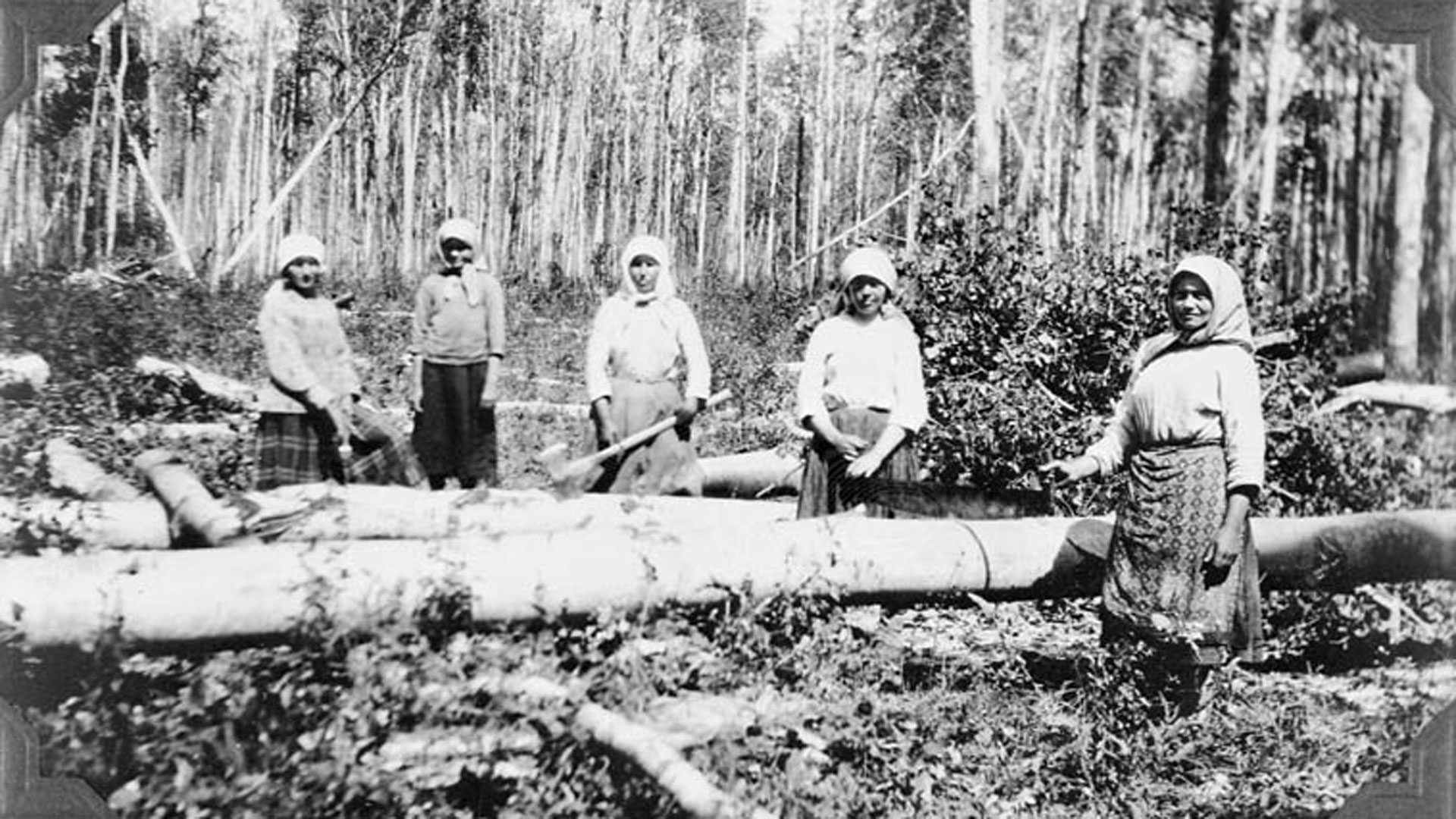
Ukrainian women cutting logs near Athabasca, Alta., in 1930. Photo: Library and Archives Canada

Hrycun told Nation to Nation Ukrainians also faced discrimination from the predominantly Anglo-Saxon community when they arrived.

“In the early days, they really sympathized with Indigenous folks because they shared a lot of the same struggles,” she said.

But as time went on — and particularly in the 1960s and 1970s during the growth of ideas about multiculturalism — the Ukrainian-Canadian population started to find its place among the country’s larger, white settler society.

“It was around that time that they really started to adopt the same mindset as the rest of settler Canada. They were part of that large group now of white settlers,” Hrycun explained.

“They often then reverted to othering Indigenous peoples, just as mainstream Canada had done.”

This adoption of the dominant colonial mentality eventually combined with a form of settler mythmaking common not just to Ukrainians but settlers across the globe. The result is displaced people displacing others.

That’s why her grandmother came to believe there were no Indigenous people in the region of Alberta where they lived — not because it was true, but because the truth had been manipulated over time.

“They created these myths and sort of benched the truth. Over the generations it got easier and easier to bend the truth,” said Hyrcun. “It was necessary for them to think that these lands were empty, to think that they were the first peoples on these lands, because otherwise you have to start considering that you are displacing people.

“And that concept, I think, for a lot of people is a very tough one to grapple with.”

Source: Exploring the hidden history of Indigenous relations with Ukrainian settlers

The long fight for Freedmen citizenship continues in Oklahoma tribal nations

Long standing issue that pops up in my news feeds from time to time:

In 2016, LeEtta Osborne-Sampson, a council representative of the Seminole Nation who is Black, approached some colleagues about a disturbing picture hung on the wall of the Mekusukey Mission, which is used as the Seminole Nation council house and courthouse.

“It was a Black man sitting under a tree,” Osborne-Sampson said. “This Black man had a cloak over his head, a noose around his neck and his hands bound and his feet bound.”

Osborne-Sampson went to the Seminole Nation chief at the time, Leonard Harjo, and asked for the painting to be removed.

“You can’t get that removed,” she says Harjo told her. “It’s history.”

Osborne-Sampson is one of four members of the Seminole Nation General Council who are Freedmen — descendants of enslaved people brought to Oklahoma by tribal nations that were forcibly relocated here in the 19th century. The Seminole Nation grants Freedmen only limited citizenship rights, and three of the other five largest Oklahoma tribes don’t recognize their Freedmen as citizens at all.

Though Freedmen were guaranteed tribal citizenship by treaties signed in 1866, many of those rights have been chipped away or revoked entirely over the years. But Freedmen in all five tribes have been fighting to reclaim their status as tribal citizens, with mixed success. Despite setbacks, their efforts have gained momentum and are even the subject of a bill currently before Congress.

The history of disenfranchisement still surfaces today, Osborne-Sampson said, recalling incidents in which racist slurs and other insults were hurled at her and the other Freedmen council members. She also recalled stories of discrimination that her grandfather, Sam Osborne, who also served on the Seminole Nation General Council, used to tell her.

“To hear my grandfather tell us these things over the years I grew up, and he sat on Council as well — nothing has changed,” Osborne-Sampson said. “Racism is very high in the Seminole Nation.”

‘Their blood didn’t count’

In 1866, the United States signed treaties with the Cherokee, Muscogee, Choctaw, Chickasaw and Seminole tribes which granted reservation land to each tribe and abolished slavery within the tribal nations. According to those treaties, former slaves were to be recognized as full tribal citizens.

Today, however, only the Cherokee Nation recognizes Freedmen as full citizens. The Muscogee, Choctaw and Seminole nations have since amended their constitutions in ways that exclude Freedmen, and the Chickasaw Nation never enrolled Freedmen into the tribe at all, despite treaty stipulations.

The 1866 treaties declaring citizenship rights for Freedmen are the same ones cited to reaffirm the five tribes’ reservations following the U.S. Supreme Court ruling in McGirt v. Oklahoma. Cheryl Phifer, a Chickasaw Freedman, said she sees the tribes’ unwillingness to accept Freedmen while claiming the jurisdictions given them by the McGirt ruling as hypocritical.

“They want the United States to uphold the treaty, but they don’t want to uphold the treaty either,” Phifer said.

Full citizenship in tribal nations would allow Freedmen to vote, run for office, and benefit from tribal services such as housing, education and health care, many of which are heavily funded by the federal government.

The exclusion of Freedmen goes all the way back to the institution of the Dawes Rolls in 1907, just months before Oklahoma was granted statehood.

The Dawes Rolls are a list of Native American people compiled by the federal government as part of the Dawes Act, which divided millions of acres of communal tribal land into individual allotments (which also violated the 1866 treaties). Those who accepted the divided tribal lands were allowed to receive U.S. citizenship.

“The purpose of the land allotment was to teach a concept of private land ownership, because the tribes prior to that all owned land in common,” said Angela Walton-Raji, a Choctaw Freedman author and genealogist. “Now once all the land allotments were finished, the purpose of [the Dawes Rolls] was to then open up the remaining millions of acres of land for white settlements, so Oklahoma could join the union.”

The Dawes Rolls included three categories: natives by blood, whites who had married into the tribe and Freedmen. Although many Freedmen had native ancestry, they were listed only as Freedmen, essentially erasing their blood relation to their tribe.

“They didn’t write down any blood quantum if they were Black. It was an application of the concept of a one-drop-of-blood type of thing,” said Walton-Raji. “The result was that any native blood that people who had been classified as Freedmen had, basically, their blood didn’t count. It was never recorded.”

So when the Cherokee, Muscogee, Choctaw and Seminole nations each barred Freedmen from tribal citizenship decades after the Dawes Rolls were finalized, many descendants of biracial natives were disenrolled from their tribes entirely, Walton-Raji said.

Cherokee Nation decision a victory for Freedmen

Among the five tribes, the Cherokee Nation is the only one that recognizes Freedmen as full citizens today. Freedmen had enjoyed citizenship rights until the 1980s, when the nation began excluding those not classified as “by blood” on the Dawes rolls. leading to a number of court battles. The “by blood” restriction was officially passed in a 2007 special election, and removed only recently by a unanimous ruling of the Cherokee Nation Supreme Court on Feb. 22, 2021.

On May 12, 2021, Secretary of the Interior Deb Haaland approved a new constitution for the Cherokee Nation which explicitly ensured the protection of Freedmen’s rights and citizenship.

“We encourage other tribes to take similar steps to meet their moral and legal obligations to the Freedmen,” Haaland said.

The decision to remove “by blood” was in response to a 2017 U.S. District Court ruling in Cherokee Nation v. Nash, which determined that Freedmen descendants are entitled to full citizenship rights.

Marilyn Vann — who was appointed by Principal Chief Chuck Hoskin Jr. to the Cherokee Nation’s Environmental Protection Commission in September 2021 and is the first Freedman to hold a governmental office in the tribe — was a plaintiff on the case. Vann is also the president of the Descendants of Freedmen of the Five Civilized Tribes.

Vann said the legal change has not transformed everyone’s thinking, however.

“It’s true that the Cherokee Nation since Judge Hogan’s ruling in the Cherokee Nation v. Nash and Vann case has tried to live up to its treaty rights and treaty obligations,” Vann said. “But myself, as a Freedman tribal member, I’m aware that there are persons in the Cherokee Nation who oppose Freedmen’s citizenship.”

In a December 2019 interview with NonDoc, Hoskin said he and his administration have worked hard to improve relationships with Cherokee Freedmen.

“I’m very mindful that we need to make sure all of our services and all of our accessibility to the government is done based on that core principle of equality, and that even if overt or hostile discrimination is wiped away, there can sometimes be inadvertent acts that exclude people based on their descendancy, and I want to make sure that doesn’t happen in our government,” he said.

‘I’m not sure it will ever happen. Not in my lifetime.’

In 1979, the Muscogee (Creek) Nation adopted a constitution that restricted tribal citizenship to descendants of people listed as “Indian by blood” on the Dawes Rolls.

Muscogee Freedmen have made efforts over the years to regain citizenship rights. The Muscogee Creek Indian Freedmen Band even filed an unsuccessful petition in 2011 to register as an independent, federally recognized tribe.

The group also filed a lawsuit against the Muscogee Nation and U.S. Department of the Interior in July 2018, challenging the tribe’s constitution, but the suit was dismissed in May 2019 because the plaintiffs did not provide records showing they had applied for citizenship and had been rejected within the preceding decade.

Ivory Vann (no relation to Marilyn Vann), a Muscogee Freedman and a member of the Muskogee City Council, said the 2018 lawsuit was the best shot Muscogee Freedmen have had at regaining citizenship.

“That was the closest we’ve ever been towards doing the right thing,” Vann said. “I’m not sure it will ever happen. Not in my lifetime.”

Muscogee Nation communications director Jason Salsman said in a July 2021 interview with NonDoc that Muscogee Nation Principal Chief David Hill believes Freedmen citizenship is an issue that should be left to a vote of the people, and it could even be placed on a ballot this year. Salsman also said Hill was considering a string of town hall meetings on the issue.

Walton-Raji was skeptical of the idea of town halls to discuss Freedmen citizenship.

“Imagine having a town hall issued to discuss what is right,” Walton-Raji said. “Let’s have a discussion, shall we treat these Black people right?”

Asked about 2022 updates on the Freedmen question in the Muscogee Nation, Salsman provided a statement Thursday that community forums surrounding are expected to begin this spring:

We expect this spring to discuss the timing and logistics of community forums for Muscogee (Creek) Nation citizens to engage on the topic of citizenship eligibility for Creek Freedmen descendants.

Since we first brought up the idea of community discussion the nation has installed a new speaker of our National Council, we have navigated the issues presented by COVID and we have necessarily directed resources to not only implement McGirt, but, importantly, to protect the nation’s interests in an onslaught of legal challenges from the state.

This is a deeply personal and highly emotional issue that goes to the heart of identity for both Creek citizens and the descendants of Freedmen. The issue of citizenship eligibility also is a fundamental component of our Constitution, which can only be changed through a deliberative process that concludes with a vote of Muscogee (Creek) citizens.

Ivory Vann believes the only way Freedmen will be able to claim citizenship rights is through monetary pressure. He is a proponent of House Resolution 5195, a bill proposed by U.S. Rep. Maxine Waters (D-CA43) which would tie federal funding for tribal housing and infrastructure to compliance to the 1866 treaties.

“If you take their money, they will come to the table,” Vann said.

However, the language regarding 1866 treaties has proved controversial, and HR 5195 is in danger of stalling, while a similar bill that does not include that language was passed by the U.S. Senate Committee on Indian Affairs on Feb. 16.

‘Voting privileges only’ in the Seminole Nation

In 2000, the Seminole Nation voted to restrict citizenship to those who had one-eighth Seminole ancestry based on the Dawes Rolls, disenrolling nearly 2,000 Freedmen from the tribe.

Freedmen believe that a complicated 2002 court case regarding voting rights — Seminole Nation v. Norton — effectively upheld the Seminole Freedmen’s 1866 treaty rights, but the Seminole Nation has not granted them full citizenship as a result.

“When the Seminole Nation lost Seminole Nation v. Norton 20 years ago, they were directed by the BIA that the Seminole Freedman are members of a federal tribe, that we’re entitled to federal services,” Marilyn Vann said. “What did they do? They reissued the people’s tribal membership cards to say ‘Freedmen’ on the front, ‘00 blood quantum,’ ‘voting privileges only’ on the back.”

Today, the Seminole Nation grants only limited citizenship to its Freedmen, allowing them to vote, sit on governmental committees and hold office on the tribe’s General Council within the tribe’s two Freedmen bands. They are not eligible to hold senior leadership positions or to receive a number of services.

In October 2021, the federal Indian Health Service announced that Seminole Nation Freedmen are eligible for health care, after months of reports that the tribe was denying Freedmen COVID-19 vaccines.

Osborne-Sampson said relatives of hers who lived near Wewoka, where the IHS has a clinic, struggled to get health care early in the pandemic.

“Since COVID started in 2020, I have 17 family members that died of that, in that area,” Osborne-Sampson said. “There’s no doctor. You had to go 50 miles out just to get help, but that clinic sat right there.”

In November 2021, Osborne-Sampson met with Seminole Nation Chief Lewis Johnson and Assistant Chief Brian Thomas Palmer, who were elected in July and August respectively, to discuss the future of Freedmen in the tribe.

“They told us that they wouldn’t do anything different than the former chiefs, because they’re only going to go by what the Council says,” Osborne-Sampson said. “We took that as, you’re not trying to pull the nation together as one.”

Now, Osborne-Sampson and other Seminole Freedmen are preparing to pursue legal action by reopening Seminole Nation v. Norton.

“We are looking to take them back to court, to Washington federal courts and reopen that case to ask for our citizenship to be recognized and given,” said Osborne-Sampson. “The judge already granted us this, but we need to open it again to show that [the Seminole Nation leaders] have not done anything.”

A spokesman for the Seminole Nation said Chief Lewis Johnson had no statement regarding the citizenship question for Freedmen at this time.

Will the Choctaw Nation have a ‘meaningful conversation’?

In 1983, the Choctaw Nation created a new constitution that said tribal citizens must be descended from “by blood” citizens on the Dawes Rolls.

On July 1, 2021, Choctaw Chief Gary Batton wrote an open letter announcing an initiative to consider membership for Choctaw Freedmen.

“Today we reach out to the Choctaw Freedmen. We see you. We hear you. We look forward to meaningful conversation regarding our shared past,” Batton wrote.

Walton-Raji said the Choctaw-Chickasaw Freedmen Association (of which she is a member) and other Freedmen groups have inquired about starting the promised discussion but have not heard back.

“We have not heard anything as of yet, and perhaps it was never received. We don’t know,” Walton-Raji said. “But we wrote a letter immediately to Chief Batton’s office.”

What Walton-Raji does know is that members of Freedmen organizations have been following tribal council meetings since Batton’s open letter, and Freedmen have not been discussed so far.

“It’s not a discussion, it’s not on any of the agendas,” she said.

So, while the open letter is encouraging, Walton-Raji said she is not sure if there will be any further action from Batton.

“He’s maybe considering it, but it might just be a private thought. It’s never come up officially,” she said. “At least, it doesn’t seem as if there’s any action to go beyond the open letter.”

Randy Sachs, director of public relations for the Choctaw Nation, said tribal leaders had no further comment on the Freedmen question as they are “still evaluating the situation.”

‘Eventually, right is going to come’ in the Chickasaw Nation

The Chickasaw Nation jointly signed a Reconstruction treaty with the Choctaw Nation in 1866 but never enrolled its Freedmen as full citizens, as required in the treaty.

“In the Chickasaw Nation, it’s just a bunch of frustrated people who know they were never given citizenship,” Walton-Raji said.

Because the tribe never enrolled its Freedmen in the first place, Chickasaw Freedmen have a worse chance at winning a lawsuit regarding their citizenship, Walton-Raji said.

“They failed to do their judiciary duties for us,” said Verdie Triplett, a Chickasaw Freedman and Choctaw by blood.

Because they were never brought into the tribe, Chickasaw Freedmen were left without a nation until Oklahoma joined the union, in 1907, and without U.S. citizenship until Congress enacted the Indian Citizenship Act in 1924.

“They broke the treaty and have been allowed to continue business as usual since that time,” Walton-Raji said.

In response to Secretary of the Interior Deb Haaland’s asking tribes to uphold their “moral and legal obligations to the Freedmen,” Chickasaw Nation Gov. Bill Anoatubby said in a statement that “Chickasaw citizenship is a matter of sovereignty and is clearly defined in the Chickasaw Constitution.”

Triplett said he is not sure what the path toward citizenship entails, but he remains optimistic that Chickasaw Freedmen will eventually receive citizenship.

“I really don’t know what it’s going to take. I don’t know if it’s going to happen in my lifetime,” Tripplett said. “But eventually, right is going to come, it’s going to become reality. These tribes cannot continue to do what they’re doing because what they’re doing is wrong, and wrong is not going to prevail.”

Source: The long fight for Freedmen citizenship continues in Oklahoma tribal nations

Black and Indigenous people’s confidence in police and experiences of discrimination in their daily lives

Of note, even if not particularly surprising:

Black and Indigenous people are twice as likely as others to report that they have little or no confidence in police

The everyday experiences and perceptions of Indigenous and Black people in Canada differ from those of the non-Indigenous, non-visible minority people in many ways. Recently, social movements seeking racial and social equity in response to injustice—both current and historical—have demonstrated the importance of measuring and monitoring the perceptions and experiences of diverse populations. In particular, inequities among First Nations people, Métis, Inuit, and racialized groups regarding public safety measures, victimization, and the criminal justice system have been a key focus.

Two Juristat articles, released today, contain detailed analysis of the perceptions and self-reported experiences of diverse populations in Canada, with a particular focus on Black and Indigenous people: “Perceptions of and experiences with police and the justice system among the Black and Indigenous populations in Canada” and “Experiences of discrimination among the Black and Indigenous populations in Canada, 2019.” 

Black people twice as likely as non-Indigenous, non-visible minority people to report that they have little or no confidence in police

Black people have experienced and continue to experience various forms of racism, discrimination and unfair treatment in Canada, many of which are specific to the criminal justice system. On the whole, Black people living in Canada reported being less confident in police. According to the 2020 General Social Survey (GSS) on Social Identity, one in five (21%) Black people aged 15 and older reported having little or no confidence in police, double the proportion reported by non-Indigenous, non-visible minority people (11%).

Among non-Indigenous, non-visible minority people, 7 in 10 (70%) said that they had either some or a great deal of confidence in the police, compared with approximately half (54%) of Black people.

Chart 1  
Confidence in police, by population group, provinces, 2020

Chart 1: Confidence in police, by population group, provinces, 2020

Black people reported having lower general confidence when it comes to specific elements of police performance. Specifically, close to one in three (30%) Black people said that police were performing poorly in at least one part of their job, a higher proportion than non-Indigenous, non-visible minority people (19%).

Compared with the overall population, Black people had particularly negative perceptions of the police’s ability to treat people fairly and to be approachable and easy to talk to. For instance, 20% of Black people said that they felt that police were doing a poor job treating people fairly, compared with 7% of non-Indigenous, non-visible minority people.

Experiences of discrimination more common in the daily lives of Black people

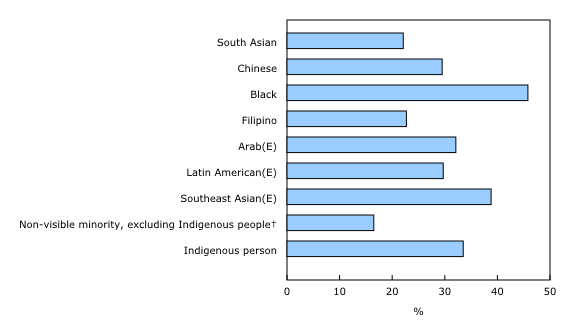
In daily life, Black people were more likely to report experiencing discrimination in a variety of circumstances, including in banks, stores or restaurants, and when dealing with the police. According to the 2019 GSS on Canadians’ Safety (Victimization), nearly half (46%) of Black people reported experiencing discrimination in the past five years—aproportion that was nearly triple that of the non-Indigenous, non-visible minority population (16%).

Chart 2  
Experiences of discrimination in the past five years, by population group, Canada, 2019

Chart 2: Experiences of discrimination in the past five years, by population group, Canada, 2019

Specifically, 4 in 10 (41%) Black people said that they had experienced discrimination based on their race or skin colour.

According to the GSS on Victimization, experiences of discrimination in the five years preceding the survey were more commonly reported in 2019 than in 2014. This was particularly the case among the Black population, with 46% of Black people reporting discrimination in 2019, compared with 28% in 2014.

Indigenous people are significantly more likely than non-Indigenous people to report little or no confidence in the police

Similar to the Black population, Indigenous people reported lower rates of confidence in the police, compared with non-Indigenous, non-visible minority people. Specifically—according to the 2020 GSS on Social Identity—2 in 10 (22%) Indigenous people reported having little or no confidence in the police. This proportion was double that reported by non-Indigenous, non-visible minority people (11%).

Chart 3  
Confidence in police, by Indigenous identity, provinces, 2020

Chart 3: Confidence in police, by Indigenous identity, provinces, 2020

As noted, 7 in 10 (70%) non-Indigenous, non-visible minority people reported having either some or a great deal of confidence in the police. This proportion is much higher than the proportion reported by First Nations people (48%) and Métis (54%). Estimates for Inuit from the 2020 GSS on Social Identity are not releasable because of the sample size.

When looking at indicators of police performance, Indigenous people were more likely than non-Indigenous, non-visible minority people to state police were doing a poor job at the following: enforcing the laws (10% versus 5%), promptly responding to calls (16% versus 7%), providing information on crime prevention (16% versus 9%), ensuring the safety of citizens (11% versus 5%), and treating people fairly (15% versus 7%).

According to the 2019 GSS on Canadians’ Safety (Victimization), one-third (33%) of Indigenous people reported experiencing discrimination in the past five years—a proportion well above that of the non-Indigenous, non-visible minority population (16%). More specifically, experiences of discrimination in the five years preceding the survey were reported by 44% of First Nations people, 24% of Métis, and 29% of Inuit.

Chart 4  
Experiences of discrimination in the past five years, by Indigenous identity, Canada, 2019

Chart 4: Experiences of discrimination in the past five years, by Indigenous identity, Canada, 2019

Often, Indigenous people reported experiencing discrimination based on their ethnicity or culture (15%), or their race or skin colour (14%). These proportions were notably higher than among the non-Indigenous, non-visible minority population (2% and 3%, respectively).

Indigenous people were also more likely than non-Indigenous, non-visible minority people to perceive discrimination or unfair treatment because of their physical appearance (14% versus 5%), physical or mental disability (7% versus 2%), and religion (5% versus 2%).

As was also the case for the Black population, discrimination was more common among Indigenous people in 2019 (33%) than in 2014 (23%). Among the non-Indigenous, non-visible minority population, discrimination also increased, albeit to a lesser extent (from 12% in 2014 to 16% in 2019).

Source: Black and Indigenous people’s confidence in police and experiences of discrimination in their daily lives

Museums Never Fully Explored the Story of American Art. That’s Why They’re Recruiting Native Curators to Change the Narrative

Similar to the National Gallery’s 2017 integration of Western and Indigenous art. More interesting that the usual period rooms:

As a tidal wave of racial reckoning has forced the museum industry to confront its dismal record on diversity, curators of American art are beginning to reassess galleries devoted almost exclusively to Hudson Valley landscapes and Rococo portraits by dead white men.

With the aid of curators and artists from Native American backgrounds, curators across the U.S. are broadening narratives, questioning stereotypes, and collapsing categories.

In Indianapolis, for more than 30 years since the Eiteljorg Museum was founded, the old ethnographic framework dividing Indigenous objects by region has ruled the rationale behind its permanent collection.

But curators at the institution now expect the space to look radically different when it reopens in June after Native American curators and advisors collaborate on new displays focused on themes of relation, continuation, and innovation.

“My motivation is making more Indigenous people feel welcome,” said Dorene Red Cloud, a curator who joined the Eiteljorg in 2016, and an enrolled member of the Oglala Sioux Tribe of Pine Ridge, South Dakota. “For the longest time, museums have been thought of as ivory towers where native people couldn’t see themselves.”

And her institution is not alone. The Seattle Art Museum is undergoing a similar update; its previous emphasis on “masterworks” resulted in galleries predominantly filled with paintings by white men. Those demographics are expected to drastically change when the rehang is finished later this year, with nearly a quarter of the galleries displaying Indigenous works.

Native American artists like Wendy Red Star, Nicholas Galanin, and Inye Wokoma also served as curators for the project, the first reimagining of the space in 15 years.

And in New York over the next year, Brooklyn Museum curators will engage outside advisors for a reinstallation project of their own. It has become a priority for the institution’s leadership, which has recognized the need to have diverse Native American participation in how galleries tell Indigenous stories.

Stephanie Sparling Williams, a curator of American art at the museum, said that the main change will be a shift from a singular story to a “dynamic, multiplicitous, and historically complex constellation of narratives” told through never-before-seen works from the collection while old favorites get recontextualized.

“All viewers stand to benefit from more depth and breadth in an American art collection,” Williams said.

Inside the Delaware Art Museum, conversations about a gradual reboot of the American galleries began in 2017, according to Heather Coyle, the institution’s chief curator and curator of American art.

“We have not collected Native American artists in our collection, but there were works that we were anxious to reinterpret,” she explained.

Coyle recalled walking through the galleries with Dennis Coker, principal chief of the Lenape Indian Tribe of Delaware, when they stopped at an 1840 painting by Hudson River School artist Robert Walter Weir titled Indian Captives, Massachusetts 1650.

“Before, we built context by saying that it was painted nearly 20 years after The Last of the Mohicans was written, but we would not say this was when the Trail of Tears was happening,” Coyle said, explaining how Coker brought new analysis by drawing out the symbolism of a sawed log featured in the work.

“This is what’s happening to native people, their hunting grounds are being cut down,” Coker observed.

“It’s just not something I would have seen looking at the painting,” Coyle said, explaining how collaboration with local Indigenous communities has enriched the museum’s understanding of its collection.

And as these conversations have progressed, many museums are throwing out the old orthodoxies of chronological organization in favor of themed groupings.

“Chronology is something that is imposed onto history,” said Theresa Papanikolas, curator of American art at the Seattle Art Museum. “It gets to be a little deterministic.”

Papanikolas said that viewers can expect a very different kind of gallery experience. She is particularly excited for Red Star’s installation, which is still being completed but will “conjure ideas of portraiture, landscape, and Seattle” while also “literally bringing Indigenous voices into the gallery.”

But before contacting artists for the project, Papanikolas consulted an advisory panel of the museum consisting of 11 paid experts, with three being Indigenous.

“I learned so much about my blindspots,” Papanikolas explained, adding that she hadn’t previously considered how Native artists might feel when they’re approached by museums for collaboration out of the blue.

“They also urged us not to think in terms of comparisons,” she added, saying that institutions often present Indigenous heritage as mere influences on Western culture. “Why can’t these pieces stand equally?”

Financing its two-year overhaul, the Seattle Art Museum received a $1 million grant from the Mellon Foundation and another $75,000 from the Terra Foundation for American Art. (The Brooklyn Museum has also received the same amount of funding from the Terra Foundation, in addition to a $40,000 grant from the National Endowment for the Humanities.)

Although the majority of museums are consulting Native American communities and scholars on their reinstallations, very few have Indigenous curators on staff who are leading the rehangs.

For example, the Brooklyn Museum has two American art curators working on its project, but the institution has not brought an Indigenous curator on staff to help with the project; instead, a spokeswoman said that three Native American humanities consultants are assisting the museum.

Critics worry that a lack of structural changes within the museums will leave their new American galleries feeling like empty gestures toward multiculturalism. And some nonprofit analysts have cautioned that museums ignoring systemic racism and inequality will find themselves irrelevant with contemporary audiences. Others point to a historic lack of investment in people of color within leading cultural organizations.

“If institutions want to invest in Indigenous art then they also need to invest in Indigenous curators,” said Joseph Pierce, a professor at Stony Brook University who frequently writes about Indigenous erasure in American culture.

“I have been in some of these conversations and what I keep on saying is that museums have to engage with Indigenous art and artists on the terms that are set by Indigenous peoples,” he added.

“You have to rethink what the space means, and that means hiring people to do the long-term labor.”

In the meantime, curators hope that audiences will get a new perspective on Native arts.

“For the longest time, Native American art has been considered craft,” Red Cloud, the Eiteljorg curator, said. “But this is an opportunity to learn from past mistakes and to look at a future that involves native peoples.”

Source: Museums Never Fully Explored the Story of American Art. That’s Why They’re Recruiting Native Curators to Change the Narrative

Women, visible minorities make up larger share of latest Order of Canada appointments

My working deck highlights more of the findings of my analysis of the close to 1,700 appointments made over the past 9 years, looking at representation of women, visible minorities and Indigenous peoples, broken down by level, province and background. Given that most appointments reflect a long-term contribution, there is a gap between the population and visible minority appointments:

Working on a more detailed analysis but this provides the highlights:

Women, visible minorities and Indigenous people accounted for a larger share of the latest Order of Canada appointments than in recent years — a sign that Rideau Hall’s quest to diversify one of the country’s highest civilian honours is making progress.

Of the 135 people recently inducted into the Order of Canada, 40.7 per cent (55) are women, 12.6 per cent (17) are visible minority and just over eight per cent (11) are Indigenous.

The numbers are higher in all three categories than in the previous three years. Last year, most of the inductees were white men, and in 2019 well under a third were women.

Retired public servant Andrew Griffith, who served as Canada’s director general of citizenship and multiculturalism, said that while the numbers represent a “significant improvement,” it’s too soon to say whether it’s a trend.

“I’m always wary of claiming victory on the basis of one year,” he said. “So what I look at, whether I’m looking at these kind of numbers or other diversity numbers, is are you seeing a sustained change, a sustained increase.

“What I would like to see is two to three years from now comparing, let’s say, the previous three year period to the next three year period, and see if the needle has been moved.”

The Governor General makes appointments based on recommendations from the Advisory Council for the Order of Canada, which advises her based on nominations suggested by members of the general public.

Griffith said this process means Rideau Hall doesn’t have as many options to diversify the Order of Canada as other institutions.

The newest appointees include entreprenuer and philanthropist Mohamad Fakih and former senator Murray Sinclair, who chaired the Truth and Reconciliation Commission.

The Order of Canada relies on public nominations. The Office of the Secretary to the Governor General encourages people to nominate individuals who are reflective of our diversity, including Indigenous peoples and persons from diverse cultural and ethnic backgrounds,” a spokesperson for the Office of the Governor General said in a statement to CBC.

“As of 2019, the OSGG has asked new appointees to the Order of Canada to complete a voluntary self-identification questionnaire. We look forward to identifying trends as we gather data in the coming years.”

‘Perpetually vigilant’

Sarah Kaplan, director of the Institute for Gender and the Economy at the University of Toronto’s Rotman School of Management, said the numbers show improvement but still don’t reflect Canada’s demographics.

“It seems to me that if your population is made up of about half women, or people of diverse genders, and you’re not representing that same proportion in the country’s most prestigious honours, then you are doing a disservice to the community,” she said.

She said she’d like to see Rideau Hall and the advisory council reach out to communities for suggestions rather than rely solely on nominations.

“Who’s going to know about that process and figure out how to navigate the nomination system?” she said. “It’s going to be people who are already in the centre of power, and that’s a pretty closed set of folks in the Canadian context.”

She also said the Office of the Governor General must keep pushing to make the Order of Canada better reflect Canadian society.

“The thing about improving representation in a society that has historically privileged just one group of people is that you have to be perpetually vigilant,” she said.

“And so one year’s progress does not mean that we have now fixed the problem, and that it will naturally trend upwards in subsequent years.”

Source: https://www.cbc.ca/news/politics/representation-better-order-of-canada-2021-1.6302725

The Conversation: Native nations are the experts on citizenship

Interesting discussion regarding elements of Indigenous identity and citizenship. Would be interesting to know how these vary by First Nation and how differences are resolved:

There is a growing movement to identify and call-out people who have fraudulently held positions by claiming indigeneity like Cheyanne Turions, Joseph Boyden, Michelle Latimerand Carrie Bourassa. 

The fraudulent claims of indigeneity are so widespread that the term “pretendians” has become part of regular vocabulary. 

On the surface, this seems to align with the interests of Indigenous Peoples, but with the call-outs come underlying components of colonialism. Namely, that Indigenous nations are not being recognized as the authorities when determining indigeneity. 

Genealogy as the only factor

Those quick to call-out are often not clamouring for Indigenous nations’ jurisdiction over citizenship, nor are they demanding “pretendians” be held accountable to Indigenous nations. 

Instead, people like non-Indigenous genealogists are being held out as “experts” on what does or doesn’t make a person Indigenous. 

The result of having genealogy as the only factor is that the dialogue is not centred on Indigenous people as socio-political groups, but racial purity which perpetuates colonial stereotypes of Indigenous identity. 

Understanding what makes a person Indigenous is complex. There are the obvious sources of indigeneity, such as kinship and receiving cultural teachings from Elders and knowledge keepers, that are established at birth and strengthen throughout a person’s life. 

Other customs and traditions include adoption of non-Indigenous people by Indigenous families. Adoption is a long-recognized practice across many nations that has resulted the adoptees learning the language, cultural teachings and values necessary to be a part of that nation. 

Whether an adoption is valid is an issue for the nation into which the person has been adopted in to decide. 

There are also examples of communities who have granted non-Indigenous people full membership, based on criteria that the First Nation has established. Fort Williams First Nation in Ontario made Damien Lee a full member, which means he is entitled to vote in elections, run for office and to benefits provided by the First Nation. 

He grew up on reserve, and while he is non-Indigenous and therefore does not have status according to the Indian Act, the First Nation has exercised its legal jurisdiction over identity and recognized him as a member.

The critical question at the heart of this issue is how to distinguish between fraudulent claims and legitimate ones. The answer lies with the nations. 

Jurisdiction as a human right

As self-governing nations with constitutionally recognized Aboriginal rights, Indigenous people should be the only authority when determining who is part of their nations. It should be based on their own criteria, as it was before the imposition of the Indian Act. And nations should have the jurisdiction to enforce the laws they develop.

With that in mind, Article 33.1 of the United Nations Declaration on the Rights of Indigenous Peoples (UNDRIP) recognizes that “Indigenous peoples have the right to determine their own identity or membership in accordance with their own customs and traditions.”

Now that Canada has passed legislation setting out a framework for implementing UNDRIP, Indigenous nations need to be recognized as the authority for determining who is Indigenous. UNDRIP does not automatically remove Canadian authority over identity, so the government will need to take action to ensure existing legislation recognizes Indigenous jurisdiction in this area.

Both the Canadian government and non-Indigenous experts need to relinquish the authority they have assumed. A failure to do so will continue the discrimination and systemic violence faced by Indigenous people.

Assimilative policies

Since Confederation, Canada’s assimilative policies have actively worked to strip Indigenous Peoples of their identity and deny Indigenous jurisdiction.

The federal government has dictated who is an “Indian” through the status definition in the Indian Act and recognizes “the Indian Registrar [as] the only authority under the Indian Act who can determine a person’s eligibility for Indian status.”

These policies are discriminatory and have led to the denial of indigeneity based on blood quantum and other arbitrary criteria such as marriage, university education or joined holy orders to the forceful removal of Indigenous children from their families into non-Indigenous homes and residential and day schools.

The result is thousands of Indigenous Peoples being traumatized by not knowing who their families or communities are, making it extremely difficult to reconnect.

The funding policies of the federal government — whereby resources and service delivery are concentrated to status Indians living on-reserve — serve to create and maintain a scarcity mentality that reinforces colonial approaches to identity and undermines self-governance.

If the current trend continues, whereby individuals’ claims to indigeneity are going to be interrogated by non-Indigenous people, based on criteria established by non-Indigenous perspectives, Indigenous Peoples are going to face even greater barriers in reconnecting with their families and communities, and decolonizing efforts will suffer.

A better solution to the issue of fraudulent claims is to support Indigenous nations and their jurisdiction over identity.

This approach aligns with the UNDRIP and supports the right to self-government. Indigenous nations have been the authority on who they are for thousands of years, it is time their jurisdiction over this be recognized. The Conversation


Cheryl Simon is an Assistant Professor in Aboriginal and Indigenous Law at Dalhousie University. Prior to joining Schulich School of Law, Cheryl worked with a rights-implementation organization in New Brunswick and has taught classes on colonizing Mi’kmaw identity.

Source: The Conversation: Native nations are the experts on citizenship

Contrasting pre- and post-pandemic public service survey results

For the data nerds among you, you might this analysis of the Public Service Employee Survey organizational and harassment/discrimination indicators, broken down by visible minority and Indigenous group of interest, comparing the pre- and post-pandemic periods.

Conclusion:

There has been comparatively little change between the pre- and post-pandemic period but noteworthy that Black satisfaction with resolution of harassment and discrimination complaints is less than other visible minority groups.

While it appears that the experience of visible minorities is worse than Indigenous peoples, PSES data supports the view that the government has considerable work to improve the workplace organizational culture to reduce harassment and discrimination for both visible minority and Indigenous groups. This needs to take place at the general and the specific group levels by each department given the variances between the individual groups.

As in the case of disaggregated data with respect to employment equity groups, the increased granularity of the PSES provides a richer evidence base for managers and human resources to develop measures to improve inclusion in the public service at the departmental and organizational levels.

Full article:

Charts colour coded to show variations:

Long suppressed and forcibly assimilated, Sámi people in Sweden get an apology 30 years in the making

Of interest and the influence of and parallel with Canadian experience:

In Uppsala Cathedral, the heart of Swedish Christianity, Archbishop Antje Jackelén sat this week before a circle of Sámi leaders in traditional dress and the television cameras of Sweden’s state broadcaster, listing the past crimes of her church.

“You have told us about forced Christianization and Swedish colonialism. Sámi culture was denied,” Jackelén said, in Swedish. “Today, we acknowledge this and, on behalf of the Church of Sweden, I apologize.”

Wednesday’s apology service in Uppsala, the culmination of more than 30 years of discussions and advocacy, marked a major step forward for reconciliation in Sweden, where the Indigenous Sámi people continue to fight for self-determination and recognition of past wrongs committed by church and state.

Having studied the Canadian experience of reconciliation, church and Sámi figures alike emphasized that the apology must be followed by concrete actions, and came with no expectation of forgiveness.

“As we apologize to you today, we cannot determine how you will receive this apology. It is not our place to demand to know when a response will be given,” Jackelén said in her speech.

“While we wait, we pray to God … that we do not repeat past mistakes.”

As one of its commitments, the church pledged to acknowledge the importance of Sámi spirituality, and even incorporate it into Christian worship after centuries of exclusion and demonization.

Ingrid Inga, the chair of the church’s internal Sámi Council, called it “the starting point of a new relationship between the Church of Sweden and the Sámi people.”

Crimes of assimilation

The Sámi are indigenous to the vast forests and tundra of Arctic Europe, traditionally herding reindeer, hunting and fishing across Norway, Sweden, Finland and parts of northern Russia. For centuries, they have been divided by the borders of those countries, which all embarked on differing programs of forced assimilation.

Though the earliest Christian missionaries are believed to have visited Sápmi, the traditional territory of the Sámi, in the 11th century, Sámi say the church’s process of forced Christianization truly began some 500 years later, when the Reformation unified church and state.

In an 1,100-page anthology produced for the Church of Sweden in 2019 — seen as an essential precondition to the apology — historians documented the way the church supported the state in the process of erasing and suppressing Sámi identity.

Christian preachers condemned Sámi religion as devil worship, banning the joik, a form of spiritual singing used by noaidi, or Sámi shamans, to communicate with the spirit world.

The 17th century saw a wave of puritanical witch trials, in which Swedish church and state authorities waged an intense campaign against Sámi worship, which they branded as sorcery. One noaidi, Lars Nilsson, was burned at the stake, and many others were tried for witchcraft.

In pursuit of converts, the Swedish church produced the first writing in the Sámi languages, in translated bibles. But by the 20th century, it was actively suppressing the Sámi languages in church-run schools.

Reindeer herders were segregated to subpar “nomad schools,” which sought to “protect” them from civilization as an “inferior race.”

As in Canada, these church-run schools became theatres for humiliating scientific experiments and clerical abuse. Racial biologists also conspired with bishops to dig up the remains of Sámi children and elders — many of which still sit in museum collections across Europe.

Other Sámi, deemed not sufficiently nomadic by Swedish authorities, were forced to assimilate, driving divisions in the community that exist to this day.

Christianity an ‘Indigenous religion’

Yet today, many Sámi are still devoutly Christian. A 19th-century revival movement produced an Indigenous form of Lutheranism that transformed communities damaged by the suppression of traditional activities.

“Many Sámi think that Christianity is their Indigenous religion, because the Sámi have for centuries been dealing with Christianity,” said Helga West, a Sámi theologian who studies the reconciliation processes underway in the three Nordic countries. (Her Sámi name is Biennaš-Jon Jovnna Piera Helga.)

“Yet… there are many Sámi who don’t want to be involved with these churches at all.”

Thomas Colbengtson, originally from Tärnaby, was raised in the Lutheran Church and attended a nomad school. He says the experience left him with a “mixed feeling” about his own identity.

“In a way, you’ve got double guilt — guilt [for] being Sámi, guilt [for] being Swedish, guilt [for] perhaps not practising Christian religion, guilt [for] being Christian…. That’s the sensitive thing to talk about.”

In a former glass factory in the suburbs of Stockholm, Colbengtson wrestles with that tension as a Sámi artist. His most recent work, based on a noaidi drum, will be displayed near the altar of the Swedish church.

“Part of it is provocation,” he said, “and … part is to visualize Sámi presence in the area, and Sámi culture that [they have] tried to erase.”

Spiritual destruction — and renewal

Guided by the Canadian truth and reconciliation process, the church has largely focused on documenting historical wrongs. But West says it has not yet come to terms with how it has forever transformed Sámi spirituality.

“Christianity in general brought this hierarchical and linear view of the world that was very different from the Sámi cosmic vision, that was pluralistic,” she said. “They were forced to think differently of the world, of their ancestors, of their practices, that were labelled as pagan and backward.”

Some Christian Sámi have managed to reconcile these identities within themselves. Nilla and Nik Märak, two sisters from Jokkmokk, learned from their father, Johan, a renowned Sámi priest, who broke barriers by bringing joiking into the church for the first time.

“He used to say, ‘God was with the Sámi before the church,'” Nik said with a laugh.

“He knew that by … being a minister in the church, and bringing the two worlds together, he could, just by his presence, actually go quite a long way [toward] reconciliation,” Nilla said.

For Nilla, who handed out communion wafers at Wednesday’s service in Uppsala, the church’s recognition of past wrongs is an important step in and of itself.

“A huge part of reconciliation, and the healing that will come, we hope … is to realize that there has been damage done,” she said. “The Sámi religion has been damaged, and the Sámi soul has been damaged.”

Wednesday’s service included eight concrete commitments to reverse the historic erasure of Sámi culture, meant to counter early perceptions among Sámi that public apologies, like those in Canada, would be merely performative.

Among them are pledges to preach in the Sámi language, educate congregations about past crimes and make Sámi traditions a more visible part of Christian worship.

“I hope that the Sámi people really trust the Church of Sweden, that it’s for real, that we want Sámi spirituality as part of the church,” said Bishop Åsa Nyström, whose Luleå diocese covers the northernmost third of Sweden and includes many Sámi communities. “It is so important the Sámi people can have priests and deacons … from their own people.”

State absent

Some say there is still more the church could do. Northern dioceses like Nyström’s derive income from vast forests they manage. But Åsa Larsson Blind, vice-president of the transnational Saami Council, says they do not pursue international certifications that would require co-management with the Sámi.

To critics, the greatest shortcoming of Wednesday’s church apology may be that the Swedish government was nowhere to be seen.

“It’s only the church doing the work,” said Nilla Märak. “The Swedish government is doing nothing. They’re barely even recognizing that there is a need for a reconciliation process.”

Many of the crimes documented by the church were committed in service of a colonizing Swedish state, which sought to push Sámi people off profitable land and divide them with borders.

Yet the state’s own reconciliation process has barely begun. First discussed more than 15 years ago, the Swedish government only this month announced a truth commission, which will be focused primarily on fact-finding over its four-year mandate.

“It’s very, very important, but it isn’t a reconciliation process,” said Nyström.

Meanwhile, the Swedish government continues to fight Sámi reindeer herders in court for the right to build mines and power plants on their lands. It has refused to ratify international conventions recognizing the rights of Indigenous people.

A landmark Supreme Court decision in the Sámi village of Girjas appears to have established a duty to consult with Sámi people. But the government continues to interpret it narrowly.

“They are dodging the whole issue,” said Larsson Blind. “And by not addressing the issues, they are letting business as usual … just go on.”

As part of its evidence in court, the government’s representative read an 1884 statement that said Sámi herders live “on a less cultured level” and must “give way to the more civilized people.”

Two ministries within the Swedish government responsible for Sámi issues declined CBC requests for comment.

Making an ally of the church

Many of those present at Wednesday’s service hope the apology will be a turning point for the church, making it a crucial ally in the push for restitution from the government.

“I think that the church having the platform and the voice in Sweden that they have, they can actually play a huge part in this,” said Larsson Blind.

Within the church, meanwhile, the long and difficult work begins to regain trust with Sámi Christians and their communities.

“In some time … the [Sámi people may] take this apology and forgive the church,” said Inga, the Sámi church council’s chair. “But this is not the right time for that.”

Source: Long suppressed and forcibly assimilated, Sámi people in Sweden get an apology 30 years in the making