AFN: First Nations Voters can Decide the 2025 Federal Election Outcomes

Of interest. Not a bad way to encourage Indigenous peoples voting:

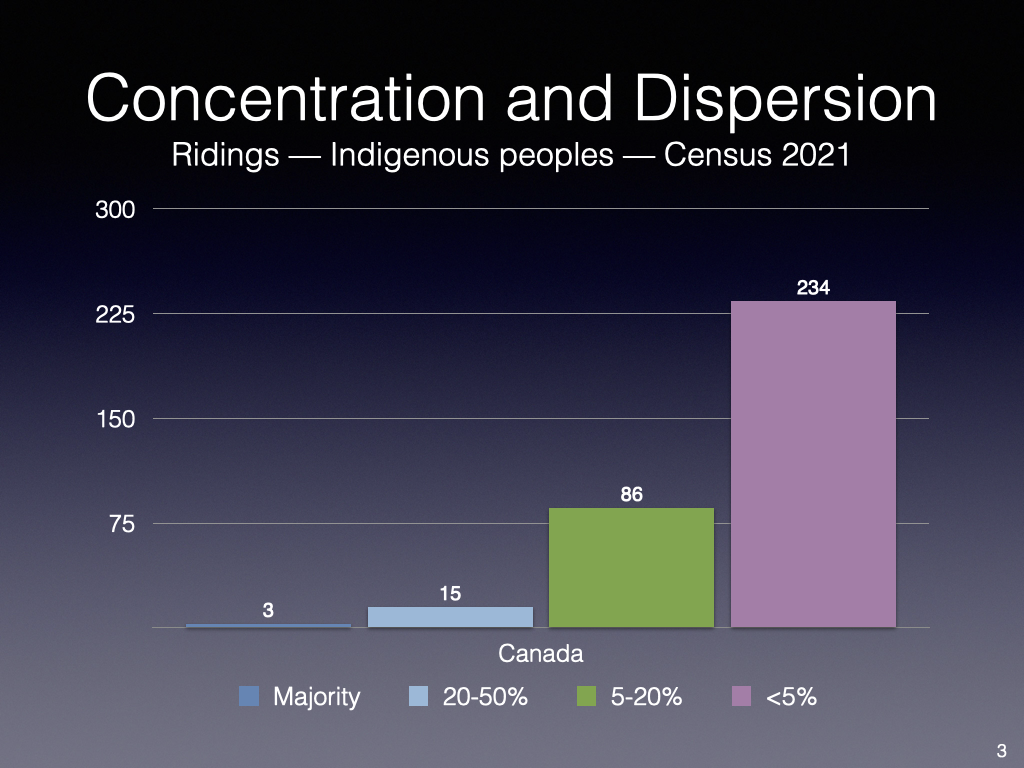
The Assembly of First Nations (AFN) has analyzed Census 2021 population data and Election
Canada’s voting results from the 2021 Canadian federal election and has highlighted 36 electoral
districts across Canada (“ridings”) where:


a. The representation of First Nations electors in a riding (%) was higher than the margin of
victory MOV for the winning candidate in 2021 1; or


b. First Nations electors represent at least 5% of electors in a riding and the difference
between the margin of victory [MOV] for the winning candidate in 2021 and the
representation of First Nations electors was less than 5%; or


c. The representation of First Nations electors in a riding is 10% or greater.


All parties should consider the role that First Nations priorities and electors will play in shaping
the outcomes of the upcoming April 2025 election. In this list, 14 seats are currently held by
Liberals, 13 by Conservatives, 7 by New Democrats, and 2 by the Bloc Quebecois

Source: First Nations Voters can Decide the 2025 Federal Election Outcomes

Four Years. Zero Graves. Now What?

Valid question regarding lack of investigation and follow-up. Wouldn’t go as far as Kay calling it a “sacred myth”:

….No one has any idea what underground banalities gave rise to those 215 soil dislocations, because the Tk’emlúps te Secwépemc First Nation, as the Indigenous community in question is officially known, has refused to show anyone all of the data; and has now gone silent on the issue, after having pocketed more than $12-million CAD from the federal government, about $8-million of which was supposed to have been directed toward researching those supposed graves. The few reporters who’ve dared ask for more evidence have been denounced by activists as ghouls, and instructed that such inquiries represent a new form of colonial trauma.

The registered on-reserve population of the Tk’emlúps te Secwépemc First Nation comprises just 543 people. So the federal outlay works out to about $22,000 per person—enough to employ literally the entire community for many months to investigate graves that supposedly lie in precisely identified locations just a few feet from the earth’s surface.

But after four years, not a single grave has been found in Kamloops. It’s impossible to disprove the idea that one or more graves might be found at some point in the future. But the idea that there are 215 of them, much less that they contain murdered children, has become a grim farce.

Yet it is a very strange kind of farce, insofar as almost no public figure in Canada has had the courage to candidly revisit the apocalyptic pronouncements made during the initial unmarked-graves social panic of 2021.

During that period, the idea of these 215 little Indigenous martyrs being killed off by the priests and nuns who ran the Kamloops Indian Residential School became a sacred myth. And no one in the Canadian political and media establishment has any idea how to stand down from this myth now that it’s been debunked. Most members of polite society have simply stopped talking about it, apparently in hopes that the issue will fade into obscurity with the passage of time….

Source: Four Years. Zero Graves. Now What?

Kay: Explaining Canada’s Cult of ‘Decolonial Futurity’ to Americans

Does appear to be a waste of time compared to more practical training with respect to indigenous health and needs of Indigenous patients:

Last month, I received a tip from a nursing student at University of Alberta who’d been required to take a course called Indigenous Health in Canada. It’s a “worthwhile subject,” my correspondent (correctly) noted, “but it won’t surprise you to learn [that the course consists of] four months of self-flagellation led by a white woman. One of our assignments, worth 30 percent, is a land acknowledgement, and instructions include to ‘commit to concrete actions to disrupt settler colonialism’… This feels like a religious ritual to me.”

Canadian universities are now full of courses like this—which are supposed to teach students about Indigenous issues, but instead consist of little more than ideologically programmed call-and-response sessions. As I wrote on social media, this University of Alberta course offers a particularly appalling specimen of the genre, especially in regard to the instructor’s use of repetitive academic jargon, and the explicit blurring of boundaries between legitimate academic instruction and cultish struggle session.

Students are instructed, for instance, to “commit to concrete actions that disrupt the perpetuation of settler colonialism and articulate pathways that embrace decolonial futures,” and are asked to probe their consciences for actions that “perpetuate settler colonial futurity.” In the land-acknowledgement exercise, students pledge to engage in the act of “reclaiming history” through “nurturing…relationships within the living realities of Indigenous sovereignties.”

My source had no idea what any of this nonsense meant. It seems unlikely the professor knew either. And University of Alberta is not an outlier: For years now, whole legions of Canadian university students across the country have been required to robotically mumble similarly fatuous platitudes as a condition of graduation. It’s effectively become Canada’s national liturgy….

Source: Explaining Canada’s Cult of ‘Decolonial Futurity’ to Americans

DuVal: Enough With the Land Acknowledgments

One USA perspective. Sympathetic as they seem largely performative:

…My colleague Amanda Cobb-Greetham, the founding director of the Chickasaw Cultural Center in Sulphur, Okla., and a citizen of the Chickasaw nation, told me that instead of lengthy discussions about whether and how to write land acknowledgments, institutions should engage in active and meaningful relationships with the Native nations that are now or were on the lands those institutions occupy. Florida State University and the Seminole Tribe of Florida have established such a relationship, which started with the tribe’s involvement in designing the mascot’s regalia but now extends to other partnerships, including creating a Native American and Indigenous Studies Center.

Cities, counties and states could share jurisdiction of some of their lands and projects to tribes and work as partners. The Covid-19 virus hit reservations particularly hard in the early months of the pandemic, but because in the past few decades many tribes took over the management of their public health systems from the Bureau of Indian Affairs, many tribal governments ultimately had better outcomes than neighboring non-Native-majority counties. Tribes already partner with the federal government in areas such as land and resource management, marking the 250th anniversary of the American Revolution and cleaning up Superfund sites. Rather than mourn the past through land acknowledgments, institutions should expand these more practical efforts and work with modern Native nations as true partners.

Kathleen DuVal is a professor of history at the University of North Carolina, Chapel Hill, and the author, most recently, of “Native Nations: A Millennium in North America.”

Source: Enough With the Land Acknowledgments

Order of Canada Appointments: 2024 Update

This analysis, conducted over the past decade, examines the diversity of Order of Canada appointments. Appointments are contingent upon nominations and typically reflect contributions over an extended period. This updates the analysis in my analysis of last year, How diverse are Order of Canada appointments? Key findings include:

  • Women are significantly underrepresented across all periods.
  • Visible minorities are underrepresented, while Indigenous peoples are slightly overrepresented relative to their population share.
  • Visible minority representation has increased over time.
  • Contributions to the arts have generally constituted the largest share of appointments, followed by health, business, public service, and activism.
  • The share of appointments by rank and group follows the typical pattern in most diversity analyses, where diversity decreases with increasing rank. However, this pattern is only observed for women. In contrast, the share of Indigenous companions is higher than for officers, which in turn is higher than Indigenous members. The share of visible minority officers is greater than the share of visible minority members.

Ibbitson: Sir John A. Macdonald & The Apocalyptic Year 1885 places the former PM’s many imperfections within the context of the times

Of note. The importance of historical context:

…First Nations in the West were starving in the 1870s and 80s. The bison on which they depended had been hunted almost to extinction. Many native people fled into Canada to escape a hostile American government that provided no aid.

Macdonald, Dutil demonstrates, did everything in his power to prevent starvation, making himself minister of Indian affairs to co-ordinate relief efforts. He provided supplies and instructors to encourage Indigenous farming and offered rations to thousands in need.

“The whole theory of supplying the Indians is that we must prevent them from starving,” Macdonald declared. Spending on relief efforts became one of the largest items in the federal budget – twice what was spent on agriculture, immigration, penitentiaries or the post office.

“There is no evidence that food was withheld to kill Indigenous people, as some would charge 150 years later,” Dutil concludes. The very opposite is true: “Even with the financial crash in the fall of 1883 and the economy in deep depression, Macdonald spent aggressively on food.” His government was harshly criticized by the Liberal opposition for what that party considered lavish overspending on First Nations relief.

The Macdonald government initiated the infamous residential-school system. There is no question that the prime minister sought to assimilate First Nations within the settler culture. There is also no question that this attitude enjoyed near-unanimous support among non-Indigenous Canadians. Macdonald and his peers believed assimilation offered the most hopeful future for the first peoples.

“Canada joined the rest of the American hemisphere as it opened a shameful chapter in its history, despite its good intentions,” Dutil writes….

Source: Sir John A. Macdonald & The Apocalyptic Year 1885 places the former PM’s many imperfections within the context of the times

SCOTUS ruling on citizenship proof for new voters has an outsized impact for Native voters

Interesting wrinkle:

With the recent U.S. Supreme Court ruling that now requires potential voters to provide proof of citizenship with their state-created voter registration forms, Indigenous voting rights advocates want Indigenous people to know that they can still register to vote as tribal citizens.

Patty Ferguson-Bohnee said that Indigenous people living in Arizona who are enrolled in a federally recognized tribe can use their tribal identification numbers to prove their citizenship.

“As long as a tribal member is an enrolled member of their tribe, they can use that tribal ID number to register on the state form, and that will prove citizenship for purposes of voter registration,” she said, adding that it’s because all Indigenous peoples were declared citizens of the United States in 1924.

Ferguson-Bohnee is the Director of the Indian Legal Clinic and a Clinical Professor of Law at the Sandra Day O’Connor College of Law. She also coordinates the Arizona Native Vote Election Protect Project, which focuses on protecting the right to vote for Indigenous voters in Arizona.

“If you prove you’re a Native American through using your enrollment number, your citizenship is verified,” she said because there is a space for Indigenous peoples to include that specific information on the state voter registration form.

“The people who are registering voters need to know that we can’t leave that blank because if you do not provide that on your state form, they will reject it,” Ferguson-Bohnee added.

The U.S. Supreme Court ruled on Aug. 22 that Arizona can enforce part of a voter registration law being challenged in federal court, allowing the state to bar legal voters from registering weeks before the election.

Ferguson-Bohnee said the law will cause some confusion among organizations and people out in the community trying to register voters, and it may discourage voters from registering.

“The goal of the law was to create barriers to the ballot box,” she said. “And even to prevent eligible voters from registering to vote.”

Lower courts initially blocked the Arizona law in 2022, but in a 5-4 order, the Supreme Court reinstated a portion of the law that allows the state to stop accepting state-created voter registration forms from Arizona residents unless they provide proof of citizenship.

The ruling means that potential voters who register to vote in Arizona using the state-created voter registration forms will need documentation proving citizenship for the registration to be valid. If no proof is provided, the state will reject the form — without informing them.

Ferguson Bohnee said there is no option to correct the form once it gets rejected, so she suggests that people register with the federal forms first. Then, when they have all the documentation readily available, their registration can be promoted to full-ballot voters.

“It’s very discouraging because it’s making a change right in the midst of the election process when people are registering people to vote,” Ferguson-Bohnee said. “This decision by the court is revising the playing field for election law.”

Not all Indigenous peoples may have their enrollment numbers available, but that shouldn’t discourage them from trying to register to vote. Ferguson-Bohnee said that is when they should register using the federal voter registration form.

She said that registering with a federal form only requires people to affirm their citizenship, not provide document proof, so people will be registered to vote in federal elections, including the presidential and senate races.

However, Ferguson-Bohnee said that if the voter can provide documentary proof of citizenship later, their status will be moved to a full ballot voter, which includes state elections — but that has to be done the Thursday before Election Day.

The court ruling has left some voting organizations baffled about their best course of action because it disrupts the plan of action that has been in motion within Indigenous communities for months.

Arizona Native Vote Executive Director Jaynie Parrish said it has left her team in limbo.

“We’re waiting to hear more directions on what our team needs to do,” Parrish said, adding they haven’t been provided a clear path forward on how this impacts Indigenous voters in Arizona.

Source: SCOTUS ruling on citizenship proof for new voters has an outsized impact for Native voters

Gee: It’s time to bring John A. Macdonald out of his confinement

Yes. And charge people for any defacing or vandalism along with a plaque or display on his role in residential schools. Same should be done for Ryerson:

…If it’s wrong to lionize our national champions, glossing over their failures and their crimes, it is equally wrong to villainize them. Most of them are neither complete heroes nor utter rogues. A true understanding of history demands we view them in the round, considering all their human complexity.

John A. Macdonald expressed some vile – and, sadly widespread – opinions about Indigenous peoples. He had many other flaws and made many mistakes in his long tenure as Canada’s dominant political leader. But as one of his leading biographers, Richard Gwyn, argued, all of this must be set against his accomplishments, among them the creation of the transcontinental railway and the North-West Mounted Police. Before he died, said Mr. Gwyn, Macdonald made sure that “Canada had outpaced the challenge of survival and had begun to take the shape of a true country.”

Here is how the Canadian Encyclopedia summarizes him: “Macdonald helped unite the British North American colonies in Confederation and was a key figure in the writing of the British North America Act – the foundation of Canada’s Constitution. He oversaw the construction of the Canadian Pacific Railway (CPR) and the addition of Manitoba, the North-West Territories, British Columbia and Prince Edward Island to Confederation. However, his legacy also includes the creation of the residential school system for Indigenous children, the policies that contributed to the starvation of Plains Indigenous peoples, and the ‘head tax’ on Chinese immigrants.”

The past few years have seen an overdue reckoning with the tremendous and lasting harms done to Indigenous peoples during European colonization. But there are other remedies than erasing names and pulling down statues. One is to raise memorials to the victims of those times. Mount Vernon has a slave memorial close to the tombs of George and Martha Washington. Another is to explain and educate. A few years ago the foundation that runs Thomas Jefferson’s plantation at Monticello, Va., unveiled a series of nuanced exhibits about Sally Hemings, the enslaved woman who bore several children by the man who drafted the U.S. Declaration of Independence.

Instead of hiding Macdonald away, why not install a display at Queen’s Park about residential schools and his role in their story? Putting the statue of our first prime minister in a wooden box achieves nothing and satisfies no one. It is time to bring Sir John A. into the light.

Source: It’s time to bring John A. Macdonald out of his confinement

Terry Glavin: B.C. doesn’t need to atone for its origins

Useful reminder that history and context have nuance:

…British Columbia’s origins owe little to even the most conventional narrative lines that have explained Canadian history.

While the HBC was a pivotal player in B.C.’s early years, it was never much about beaver pelts and furs. The HBC trade was concentrated in tierces and hogsheads of salted salmon. While the Métis were key players in the HBC brigade trails, a third of the HBC workforce west of the Rockies were Hawaiians.

The westward expansion of the Dominion of Canada involved the establishment of provinces by federal law, but that pattern stopped at the Rockies. B.C.’s story runs mostly north-south, and like Newfoundland, B.C. was a self-governing Crown colony that joined Confederation, for good or ill, on its own.

The story of B.C’s colonial survival against the backdrop of overwhelming American military and population pressure is a story written almost entirely by Douglas’s sheer will and force of personality. Douglas was himself a “coloured” person, the son of Martha Ann Ritchie, a free Creole from Barbados, and John Douglas, a Scottish merchant and planter from Glasgow. James’s wife, Lady Amelia Douglas, was the daughter of a Swampy Cree woman and an Irishman from Lachine, Que.

In 1858, when a war broke out between the Nlaka’pamux people and American miners in the Fraser Canyon, Douglas unilaterally annexed the mainland as a British colony in advance of London’s formal declaration. That’s one of history’s ironies. Far from being about stealing Indigenous land, B.C. was established in order to protect Indigenous people from heavily-armed American marauders and to secure to the Indigenous people of the Fraser River all the rights of British subjects.

In 1859, when an American military regiment occupied one of the Southern Gulf Islands in a clear violation of the boundary provisions in the Oregon Treaty, Douglas told the HBC’s Angus McDonald that if the Americans didn’t stay put, he would mobilize “fifty thousand Indian riflemen at Victoria.”

After the American Civil War broke out in April 1861, Douglas suggested to the colonial office in London that he would be glad to lead an expeditionary force to take back the Columbia territory that had fallen to the Americans 20 years earlier, and to keep on going, all the way to San Francisco Bay.

A great part of the success of British Columbia’s early settlement was owing to Douglas’s largely cordial relations with the Indigenous peoples within the colonial ambit. For one thing, Douglas and the Royal Navy were formidable allies to the Coast Salish people against the slave-raiding tribes from further up the coast. For another thing, the Indigenous leadership was fully aware of what had happened once the Americans moved into what would become Oregon, Washington and Idaho.

There was the Cayuse War, the Klamath War, the Salmon River War, the Yakima War, and the Nisqually War.

In Douglas’s vision of a successful colony, the tribes would be not be disturbed in their customary laws, their villages and enclosed fields would be protected along with their rights to hunt and fish “as formerly,” and there would be no removals to reservations. Indigenous people were to have the same rights as any settler and would be full participants in the emerging economy.

It was only because of the insistence of the Colonial Office in London that funds for treaty-making had to be raised locally that Douglas managed to secure only 14 treaties with First Nations on Southern Vancouver Island. It wasn’t until the 1990s that Victoria and Ottawa secured another treaty — with the Nisga’a people of the Nass Valley. Most of B.C. remains without benefit of treaty even now.

Despite the perilous challenges Douglas faced in his day, for the most part, peace prevailed.

In his articulation of how a proper colony should be managed, Douglas made clear that medical care would be denied no one on the basis of race or status, child labour would not be tolerated, common-law marriages should be recognized and public charity should be encouraged. Importantly, slavery, which was a commonplace Indigenous practice, would not be tolerated.

And so, for a time, a peaceable kingdom prevailed on what was to become Canada’s West Coast. Its multiculturalism emerged organically more than a century before it was conjured in the Canadian imagination as the invention of Pierre Elliott Trudeau, later mutating into the “diversity, equity and inclusion” regime strictly enforced by his son, Justin.

It’s why James and Amelia’s children were baptized in several Christian traditions — Catholic, Anglican and Methodist. It’s why the Congregation Emanu-El on Victoria’s Blanshard Street is the oldest continuously-occupied synagogue in Canada. Its cornerstone was laid in 1863. Many if not most of the synagogue’s original fundraising subscribers were gentiles.

When Lumley Franklin was elected mayor of Victoria in 1865, he became the first Jewish mayor in North America. In 1871, the year B.C. joined Confederation, Victoria voters sent Wharf Street merchant Henry Nathan to Ottawa. He was Canada’s first Jewish member of Parliament.

This is not a history that requires atonement, penitential reflection or some “long overdue reckoning.”

It’s certainly not entirely a happy story. But it’s nothing to be ashamed of, either.
Source: Terry Glavin: B.C. doesn’t need to atone for its origins

Statement by Minister Miller on Canada Day

Quite a good statement and video IMO. Curious to hear views of others:

“On Canada Day, we celebrate our freedoms and reflect on our rights and responsibilities as Canadian citizens. We remember and honour the shared history, symbols and values that define us as Canadians. A critical part of being Canadian is understanding the histories and realities of Indigenous Peoples, who have been caretakers of this land since time immemorial, and recognizing their integral role in this country’s past, present and future.

“Every Canadian has a responsibility to advance reconciliation with Indigenous Peoples. It is important that we all understand the rights and significant contributions of First Nations, Inuit and Métis. As part of our ongoing commitment to advance reconciliation, Immigration, Refugees and Citizenship worked with Indigenous creators to share the voices and experiences of Indigenous Peoples directly with new Canadians. I am pleased to share that the video ‘Welcome, there is room’is now being used at every citizenship ceremony across the country.

“This morning, I am honoured to attend a special citizenship ceremony being held at the Rogers Centre before the Toronto Blue Jays annual Canada Day game. This is one of the many citizenship ceremonies taking place across Canada today. The moment when newcomers take their oath of citizenship is a very meaningful and moving experience for everyone involved. I consider this to be one of the best parts of my job! If you wish to experience the sense of pride in being Canadian, I encourage you to participate in an upcoming citizenship ceremony in your area.

“To learn more about Canada Day celebrations near you, you can also visit the Canadian Heritage website.

“I hope today’s celebrations renew your pride in being Canadian and inspire you to give back to your community, to learn more about Indigenous Peoples and cultures and to welcome those who have chosen Canada as their home. Our diversity, equity, inclusivity and multiculturalism are what sets Canada apart.

“Whether you’ve recently chosen to work, study or build your life here—or you’ve always called this country home—today is about celebrating what unites us: our love and respect for Canada.

“Happy Canada Day!”

Source: Statement by Minister Miller on Canada Day