‘We know who our people are,’ Ontario First Nations draft citizenship law

A very different approach than governments, with no generation limits and bloodline only:

First Nations in Ontario are encoding their traditional citizenship laws to fight back against the “genocidal” policies of the Indian Act, says the Grand Chief of the Anishinabek Nation.

E-dbendaagzijig, which means ‘those who belong’ in Ojibwe, is a draft citizenship law for 39 Anishinabek First Nations, representing approximately 60,000 people in Ontario.

The recent Daniels decision from the Supreme Court of Canada on the rights of Metis and non-status Indians continues to muddy the waters of First Nations citizenship, Anishinabek Nation Grand Chief Patrick Madahbee said.

“It’s up to our people to decide who has lineage to our territory,” he  said. “We know who our people are.”

The draft citizenship law recognizes a citizen as anyone who can trace their lineage, through at least one parent, to a First Nation within Anishinabek territory.

Madahbee said distinctions between status and non-status are part of the “genocide” inherent in the Indian Act and that First Nations leaders are prepared to take responsibility for Anishinabek citizens who live off reserve.

“The government has been very skillful at divide and conquer tactics,” he said. “Our chiefs have been saying, particularly in the Anishinabek territory, when we talk about E-dbendaagzijig, those who belong, we say we are responsible for our people, no matter where they live.”

Mahdabee said it’s important to change the terminology from ‘band membership’ in First Nations to citizenship.

“You can be a member of the Kiwanis Club or the Rotary Club,” he said. “You are a citizen of a nation. It elevates it.”

Band membership rules under the Indian Act have left a First Nation in central Ontario in a dire situation, Madahbee said.

As of 2013, the Mississaugas of Scugog Island First Nation did not have anyone eligible to be registered as a status Indian, he said.

“This Indian Act is genocide,” Madahbee said.

Source: ‘We know who our people are,’ Ontario First Nations draft citizenship law – Thunder Bay – CBC News

Legal misstep lets Catholic Church off hook for residential schools compensation – The Globe and Mail

Legally off the hook but ethically? Morally?

A miscommunication by a federal lawyer allowed the Catholic Church to renege on its obligation to try to raise $25-million to pay for healing programs for the survivors of Indian residential schools.

Of that amount, the Church raised only $3.7-million, and a financial statement suggests less than $2.2-million of that was actually donated to help former students cope with the trauma inflicted by the residential schools.

The legal misstep occurred when Ottawa was pressing the Church to pay the entirety of a related cash settlement stemming from the Indian Residential Schools Settlement Agreement, the largest class-action deal in Canadian history.

The failing fundraising effort by the Church, which represented almost a third of its obligation under the settlement, was playing out as the Truth and Reconciliation Commission was travelling the country hearing gut-wrenching stories about what occurred behind the walls of the institutions that operated in Canada for more than 100 years.

The landmark settlement agreement required 50 Catholic groups that ran the schools, known in court documents as the Catholic entities, to pay a combined $79-million for their role in the abuse.

Of that, $29-million was to be paid in cash, most of which was to flow to a now-closed Aboriginal Healing Foundation. Another $25-million was to be donated in unspecified “in kind” services. And an additional $25-million was to be raised for healing programs through the “best efforts” that the entities could make at fundraising.

In an attempt to make the Catholic Church pay the full amount of the $29-million cash settlement, the government inadvertently released it from any obligation it might have had to continue with a dismal fundraising campaign.

“When you have a deal, it needs to be implemented,” said Bill Erasmus, the National Chief of the Dene Nation who handles the residential schools file for the Assembly of First Nations. “So the Church should be paying up. The church agreed there were harms. That’s why people were to be compensated.”

But, as of last summer, the Catholic entities were legally off the hook.

In a March 19 letter to Ron Kidd, a concerned citizen from British Columbia who has been following this case, Andrew Saranchuk, an assistant deputy minister within the Indigenous Affairs department, explained that a court settlement reached on July 16, 2015 “released the Catholic entities from all three of their financial obligations under the settlement agreement, including the ‘best efforts’ fundraising campaign, in exchange for a repayment of $1.2-million in administrative fees.”

This result, Mr. Saranchuk went on to explain, “was due to miscommunications between counsel regarding the nature and extent of the settlement being discussed.”

Source: Legal misstep lets Catholic Church off hook for residential schools compensation – The Globe and Mail

Constitutional challenge looks to revive aboriginal languages

While I understand and support the case for more initiatives for indigenous languages, the challenge remains to improve the overall educational outcomes for Indigenous Canadians:

The same section of the Constitution that enshrines First Nations treaties should, according to a growing number of legal experts and academics, also grant aboriginal people in Canada the right to schooling and public services in their ancestral languages.

“Unless we do something in this generation — the generation of my daughter — the languages will die,” says Lorena Fontaine, an assistant professor of indigenous studies at the University of Winnipeg.

Fontaine and Toronto lawyer David Leitch are preparing a constitutional challenge that argues aboriginal people have the right to be taught in their own, often endangered languages under Section 35 of the Constitution.

Section 35 guarantees aboriginal treaties, but has also been interpreted to protect customs, practices and traditions integral to aboriginal culture, which she says should include language.

“We have the right to use and develop these languages in institutions that we create,” says Fontaine, who is also a PhD student in history, peace and conflict studies and law at the University of Manitoba.

Leitch says aboriginal languages should be awarded “similar consideration” to French and English, which he says tend to dominate talk about language rights in Canada.

He would rather not have to take the case to court, and hopes the government will instead address the issue as it follows up on the recommendations of the Truth and Reconciliation Commission.

“If you’re the prime minister of Canada you can do things pretty quickly,” says Leitch, adding that Justin Trudeau’s commitment to implementing the calls to action in the TRC report is a positive sign.

‘Fundamental and valued’

The TRC’s final report said the federal government has a responsibility to provide sufficient funds for aboriginal-language revitalization and preservation.

It also said aboriginal languages are a “fundamental and valued element of Canadian culture and society.”

Source: Constitutional challenge looks to revive aboriginal languages – Aboriginal – CBC

I’ll be ‘proud’ when Canada achieves justice for all: Denise Balkissoon

A needed broader perspective on the justice system than provided by Ghomeshi defence lawyer Marie Henein:

I don’t expect defence lawyers to be nice, and so I didn’t have any beef with Marie Henein until this week. Then she said that our legal system is one “we should all be proud of,” and now I’m compelled to reply: Don’t be absurd.

It’s one thing to state, as Jian Ghomeshi’s ferociously successful lawyer also did in her CBC Television interview, that justice was “absolutely” served when her client was acquitted. That proclamation refers to a single case – specific circumstances of evidence and reasonable doubt, one set of police officers and Crown attorneys, one particular judge.

But to say, as she did, that the Canadian justice system is impartial “each and every single day,” well that’s simply wrong. Training and intellect might help Ms. Henein skillfully navigate the system, but that doesn’t mean the system itself is admirable.

After Mr. Ghomeshi’s acquittal on multiple charges of assault and sexual assault, an unhappy group marched north from the courthouse to the Toronto Police Service headquarters on College Street. There, it merged with Black Lives Matter Toronto, justice advocates who have been sleeping outside the police HQ for almost two weeks now. Native Child and Family Services of Toronto is right next door, and indigenous demonstrators were soon in the mix as well.

Emotions were extremely high and the number of criticisms levelled at the Canadian justice system was overwhelming. Many of them were also valid, and reflective of my own personal list.

For example: A quarter of federal prisoners are aboriginal, even though just 4 per cent of the population is indigenous. Black Torontonians (and non-white Canadians across the country) are much more likely to be “carded,” meaning stopped randomly by police and asked to submit personal information despite not being accused of a specific crime.

Justice is expensive and the more impoverished you are, the less likely you are to receive it. The Legal Aid cutoff for a single person in Ontario is $14,000 a year, or about half of working full-time for minimum wage; Ms. Henein’s fee is rumoured to be up to $1,000 an hour. Lawyers who work with low-wage clients talk about the scourge of “pleading out” – when innocent defendants make deals, acquiring criminal records because they lack the resources for endless, unpredictable court dates.

If Ms. Henein truly considers herself a feminist, as has been endlessly discussed, a recent Criminal Lawyers’ Association report must surely upset her: Female lawyers are dropping out in droves, in part because of sexist treatment by police, court staff and judges. There are many ways that the law disappoints Canadian women – please also do not forget the hundreds of native women and girls whose disappearances and murders have been virtually ignored for decades.

To say, as Ms. Henein did, that justice in Canada is “very, very good,” is to consider all of these problems acceptable. It’s an attempt to write off dissenters as a motley crew with aimless complaints, when in reality many legal critics have clear, concrete suggestions for change.

For example, Black Lives Matter Toronto wants transparency around police violence toward civilians; this includes tracking the race of those killed by police and an inquiry into the death of Andrew Loku, a mentally ill father of five shot in his hallway last year.

One wish of many indigenous lawyers is increased application of the Supreme Court’s 1999 Gladue decision: When sentencing indigenous offenders, the focus is meant to be on rehabilitation, not punishment, with true consideration of the impact of residential schools and other historical inequities.

And advocates for sexual assault survivors have a number of ideas worth considering, such as greater use of the civil system versus the criminal courts, and increasing complainants’ access to legal support and information.

The list of proposed solutions is as long as the list of problems, and that’s good. A growing, evolving justice system is something we should all want, and I think we do. A 2014 Angus Reid Survey found that only about 60 per cent of Canadians said they trusted the police, while a mere 40 per cent said they had confidence in the criminal courts.

Victorious defence lawyers might be proud of our justice system, but the rest of the country has doubts that are more than reasonable. I guess winning is a heady drug, and intoxicants do tend to interfere with one’s sense of reality.
Source: I’ll be ‘proud’ when Canada achieves justice for all – The Globe and Mail

Time to name an Aboriginal justice to the Supreme Court: Hassan and Siddiqui

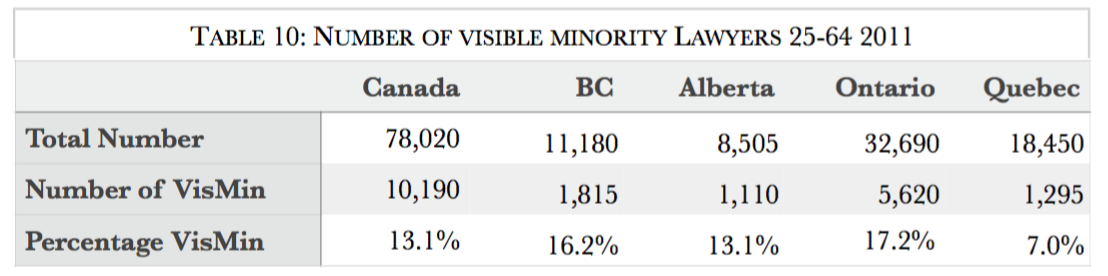
 Visible Minority LawyersNader Hassan and Fahad Siddiqui make the argument (the number of visible minority lawyers is higher than their article, based upon NHS data that I used in my book, Multiculturalism in Canada: Evidence and Anecdote):

These criteria narrow the field considerably [member of provincial superior court, bilingual, Maritime], and risk obscuring another important fact: our high court does not look like the rest of Canada. No Aboriginal or visible minority has ever been appointed to the Supreme Court. Regional representation — which convention so assiduously protects — is important, but in an increasingly ethnically and religiously diverse country, it is only one of many indicia of diversity.

Since the Abella Equality in Employment Royal Commission Report in 1984, a consensus has emerged among judges, lawyers and academics that judicial diversity matters. A diverse judiciary results in a broader range of perspectives, which is crucial to judicial decision-making. And greater judicial diversity fosters public confidence in the administration of justice.

Little progress has been made so far. Professor Rosemary Cairns Way of the University of Ottawa reports that Aboriginal and visible minority members account for roughly 23 per cent of the population, and yet from 2009 to 2014, only 1.04 per cent of appointees to the provincial superior courts were Aboriginal, and only 0.5 per cent were members of a visible minority group.

The same appears to be true of the senior reaches of the legal profession. The body that regulates lawyers in Ontario, the Law Society of Upper Canada, does not regularly collect comprehensive demographic data. But a Society report, released in 2010, shows that only 5 per cent of lawyers in Ontario between the ages of 45 and 64 are Aboriginals or visible minorities even though those two groups make up more than a fifth of that segment of the population.

It is sometimes argued that as Canada’s population diversifies, the legal profession will too. Problem solved — some years or decades down the line.

The statistics we have don’t bear out that claim though. Even among younger generations, Aboriginals and visible minorities are under-represented at the bar. And those who have managed to gain a foothold in the profession face unique challenges. The society reports that a majority of Aboriginal and visible minority lawyers believe that having a different cultural background has disadvantaged their careers. In that sense, the legal profession reflects trends in the broader job market. According to a recently released study led by University of Toronto researchers, black job applicants are 25.5 per cent more likely to land a job interview when they scrub their resumé of clues of their race.

The time has come for change. And this change requires leadership from the top. We need out-of-the box thinking, such as Trudeau’s laudable decision to name women to half his cabinet positions — including Canada’s first Aboriginal justice minister. The prime minister will have to take a similarly bold approach to fill the high court vacancy. An Aboriginal candidate should take priority. It’s an absolute shame that Canada’s highest court has never had representation from among our First Nations.

Nine different ‘alphabets:’ Inuit experts meet to standardize language

A real challenge, given the power of language and connection to identity. But the likely risk of not coming up with a common agreed approach will mean greater challenges to maintain and strengthen Inuktitut:

Two Inuit go hunting. One hands the other his rifle and the recipient says “ma’na.”

His partner, though, has no idea what he’s just heard. The word for thanks in his dialect is “qujannamiik.”

There are only 60,000 Inuit in Canada, but they are divided between nine different writing forms and at least that many dialects. On Friday, language experts are to meet in Ottawa to help bridge that gulf.

“People can generally understand each other, but there are serious limitations for that understanding,” said Natan Obed, head of Inuit Tapiriit Kanatami, Canada’s national Inuit group.

“If we had one unified writing system, we could maximize the ability for us to read in our language and also educate our children and provide them with learning resources.”

Inuktitut fractured because it was spoken by widely dispersed groups who rarely interacted. The language splintered further when missionaries developed writing for it.

Syllabics, originally based on characters from Pitman shorthand, are most common in the Eastern Arctic. Roman orthography, the letters of the alphabet most of us recognize, is mostly used in the west.

The dialects have diverged so widely that some use sounds that speakers from other parts of the North can’t even pronounce. Obed’s group produces a magazine called Inuktitut that native speakers in the far west and the far east just can’t read.

The drive to establish a standard writing form dates back to a recommendation in a 2011 report on Inuit education. Last September, experts from the four major Inuit regions began that task and continue their work on Friday.

Controversy is expected.

Many argue orthography is the way to go. It’s in common use everywhere — especially on social media and the Internet, both widely used by Inuit.

Last week, Inuktitut interpreters and translators voted at a conference in Iqaluit in favour of moving to orthography.

But many don’t want to say goodbye to the triangles, circles and squiggles of syllabics. The debate gets more heated because the areas where Inuktitut is strongest — almost all Quebec Inuit say they’re fluent — are the same areas that use syllabics.

“There are more Inuit talking seriously about transitioning out of syllabics into orthography,” Obed said. “(But) it is very contentious because it gets to the heart of who people are and how they’ve learned and express themselves.

“People have equated linguistic preservation and use to syllabics,” Obed said. “Syllabics attachment is based on the overarching history and the fact that syllabics allowed people to retain their language and their culture at a time of colonization and great upheaval.”

Source: Nine different ‘alphabets:’ Inuit experts meet to standardize language – Macleans.ca

Ontario public servants to get mandatory sensitivity training on indigenous people, history

While sad that this is needed (it’s 2016!), better late than never and likely one of the more significant TRC recommendations that will be implemented in the long-term.

Not sure what other provinces with large numbers of Indigenous peoples are doing but this approach should be considered by them if not already in place. The same applies to the federal government:

More than 60,000 members of Ontario’s public service will soon receive mandatory sensitivity training regarding the history and experiences of the province’s indigenous people, the Star has learned.

Premier Kathleen Wynne is expected to announce on Wednesday that every OPS employee will receive mandatory indigenous cultural competency and anti-racism training. Ontario’s public servants work in all government ministries from finance to child welfare, agencies and Crown corporations.

Wynne is also expected to further outline mandatory learning expectations in the province’s public education curriculum to include the impact of residential schools, the history of colonization and the role of treaties signed between the Crown and First Nations.

The changes push Ontario toward addressing the Truth and Reconciliation Commission’s (TRC) 94 recommendations, released last June, which are meant to incorporate indigenous culture and teaching throughout Canadian society.

For 100 years, residential schools — run by churches and sanctioned by the government — took nearly 150,000 First Nations, Métis and Inuit children away from their families and communities and sent them away to school. Thousands of children never made it home and died while at the schools.

TRC chair Justice Murray Sinclair called this dark period in Canadian history an act of cultural genocide as the impact of the mass removal of generations of children from their families left a legacy of broken families, poverty, mistrust of government, abuse, alcoholism and fractured lives.

A key component of the sensitivity training will be focused on violence against indigenous women and girls.

…The sensitivity training will instruct employees on terminology, colonial history in Ontario from treaties to child welfare and Indian hospitals such as the Fort William Indian Hospital Sanatorium, which operated from the 1940s to the 1970s. The training will discuss how social disparities and inequities grew from these experiences.

The training will include interactive cultural activities, the harm of stereotyping and the legacy of colonization. It will also teach better “communications and relationship-building skills to promote positive partnerships with indigenous people,” according to information on the event obtained by the Star.

Other courses required for Ontario public servants to take include workplace violence prevention and training on Ontario Human Rights Code requirements regarding persons with disabilities.

The premier is also expected to discuss further progress on collaborating with First Nations, Métis, and Inuit partners on how they are incorporating indigenous history and culture into the public school curriculum.

Source: Ontario public servants to get mandatory sensitivity training on indigenous people, history | Toronto Star

Indigenous peoples: In Canada, justice is not blind

The high numbers regarding indigenous incarceration rates are shocking. Comparable to Black incarceration rates in the USA:

While admissions of white adults to Canadian prisons declined through the last decade, Indigenous incarceration rates were surging: Up 112 per cent for women. Already, 36 per cent of the women and 25 per cent of men sentenced to provincial and territorial custody in Canada are Indigenous—a group that makes up just four per cent of the national population.

This helps explain why prison guard jobs are among the fastest-growing public occupation on the Prairies. And why criminologists have begun quietly referring to Canada’s prisons and jails as the country’s “new residential schools.”

In the past decade, the federal government passed more than 30 new crime laws, hiking punishment for a wide range of crimes, limiting parole opportunities and also broadening the grounds used to send young offenders to jail. At the same time, it has been ignoring calls to reform biased correctional admissions tests, bail and other laws disproportionately impacting Indigenous offenders. Instead, it appears to be incarcerating as many Indigenous people as possible, for as long as legally possible, with far-reaching consequences for Indigenous families.

But the problem isn’t just new laws. Although police “carding” in Toronto has put street checks, which disproportionately target minority populations, under the microscope, neither is racial profiling alone to blame. At every step, discriminatory practices and a biased system work against an Indigenous accused, from the moment a person is first identified by police, to their appearance before a judge, to their hearing before a parole board. The evidence is unambiguous: If you happen to be Indigenous, justice in Canada is not blind.

“What we are doing is using our criminal justice system to defend ourselves from the consequence of our own racism,” says Toronto criminal lawyer John Struthers, who cut his legal teeth as a Crown attorney in remote, northern communities. Rather than treat trauma, addictions, he says, “we keep the doors closed.”

Source: Cover preview: In Canada, justice is not blind – Macleans.ca

Newcomers – Reconciliation Needs You Too – New Canadian Media

One of the 94 recommendations of the Truth and Reconciliation Commission and one that will likely be implemented to some degree.

As Adrienne Clarkson notes in her book, Belonging: The Paradox of Citizenship, when immigrants become citizens they inherit both the good and bad parts of our history, and thus better knowledge of the history of Indigenous Peoples and their treatment is essential.

It is likely, should the Liberal government revise the citizenship study guide, Discover Canada, (almost a certainty), the overall diversity and inclusion theme will feature prominently, including with respect to Indigenous Peoples:

Canada’s Indigenous people are asking immigrants to join the nationwide process of reconciliation by learning about and celebrating Indigenous culture.

One of the many recommendations that the Truth and Reconciliation Commission (TRC) published in their final report calls on the government to incorporate more information on the history of Canada’s diverse Indigenous communities in information kits for newcomers and in citizenship tests.

This includes information on residential schools and the Treaties through which settlers dispossessed the Indigenous peoples of their land.

The recommendation is just one 94 outlined in the report from the TRC, whose work on restoring the relationship between the Canadian government and Indigenous communities culminated with the report’s delivery on Dec. 15, 2015.

Learning the true history of Canada

“I really think it’s important to realize that this was not an empty land when people came here. There were thriving nations in this land,” says Jane Hubbard, acting director of operations of the Legacy of Hope Foundation.

Her organization works to raise awareness about the history of residential schools in Canada and to promote reconciliation among Aboriginal and non-Aboriginal people in Canada.

“I think it’s very important that the true history be told, so that people understand that Canada did not start in 1867. There was a long history before contact as well,” she says.

Hubbard says Aboriginal peoples’ present-day contributions to society should also be included and celebrated.

“Often in a lot of government materials, Aboriginal peoples are referred to in such a way as to make someone think that perhaps they are a historical entity,” she says.

It is vital that newcomers do independent research to learn about Indigenous culture, instead of absorbing the misinterpretations of the general narrative.

“We would like to see more of the current-day representation. Thriving cultures, restoration of language. That people are here and walking amongst us and that they are lively contributors to society.”

Andrew Tataj is a second-generation Canadian whose parents came to Canada in the 1970s from Ireland and former Yugoslavia. “Learning about our history is important, because it can help newcomers assimilate into our culture, especially knowing about the country’s past – good and bad things,” says the computer engineer.

However, he is skeptical about the positive effect of providing more information. “I don’t think much can be changed when it comes to awareness. … It won’t get their land back,” he says.

Participating in reconciliation

Heather Igloliorte, an Inuit professor and chair in Indigenous art history and community engagement at Concordia University, outlines some ways in which newcomers can participate actively in the process of reconciliation.

“I think that one of the things that new Canadians could do is attend festivals and celebrations and Aboriginal peoples’ day and other events, so that they have an opportunity to meet and converse with Indigenous people. So that their understanding does not come only from literature, but also from first-person experience,” she says.

One of the primary focuses of the TRC was to expose the truths of the residential-school system.

Igloliorte says that it is vital that newcomers do independent research to learn about Indigenous culture, instead of absorbing the misinterpretations of the general narrative about them.

“It’s incredibly important for newcomers to Canada to understand the history of how we got to where we are today, so that they do not simply absorb the stereotypes and the racist perspectives towards Indigenous people that we still have in Canada right now,” says Igloliorte.

“I think Aboriginal people did not receive enough respect from the very beginning,” says Khaled Elrodesly, a biomedical engineer from Egypt who recently took his citizenship test. “They are supposed to be the first settlers of the Americas and everyone else that comes after them should respect their thoughts and ideas and try to connect with them.”

Source: Newcomers – Reconciliation Needs You Too – New Canadian Media

Cultural genocide: When we debate words, we delay healing – Payam Akhavan

Akhavan on the history and meaning of cultural genocide (reprinted in entirety):

What is “cultural genocide” and why does it matter? This powerful label was first adopted by the Truth and Reconciliation Commission (TRC) last June. It was meant to describe a colonial assimilationist policy, aimed at extinguishing Canada’s indigenous peoples “as distinct legal, social, cultural, religious, and racial entities.”

The long-suffering survivors of the residential schools celebrated this declaration with rapturous applause. But what followed was a storm of controversy on whether “genocide” was an appropriate term for this purpose; a controversy that has distracted us from confronting the reality facing Canada’s indigenous peoples.

As a former United Nations prosecutor at The Hague, I am well aware of the legal definition of this crime. What disturbs me is how this polemical debate disregards the deeper meaning of words; the importance of recognition for healing wounds. The TRC process was not a criminal trial. It was an opportunity for some 6,750 survivors to break the silence, to tell their heartbreaking stories to fellow Canadians.

Whether “cultural genocide” is a proper legal label is less important than its reality as a mourning metaphor; and abstract disputations about precise terminology are even less important than the urgency of national reconciliation with Canada’s indigenous people.

The history of the UN Genocide Convention sheds some light on this controversy. It was adopted in 1948, in the shadow of the Holocaust, following months of negotiations, after delegates agreed to include “physical” and “biological,” but to exclude “cultural” genocide from an earlier proposed draft. This was motivated by two reasons: On the one hand, some believed that the Nazi exterminations in gas chambers was a different crime than the destruction of historic monuments and minority languages; on the other hand, most non-European nations were still under colonial domination so their devastating experience with “civilizing missions” was not reflected in the debates.

Although “cultural genocide” had a short life, it was seriously considered as a legal concept. It is best described today as the ghost of proposed crimes past. What is most relevant for the residential school policy is that the “forcible transfer of children” – initially qualified as a form of “cultural genocide” – was retained in the formal definition as one of the acts by which genocide could be committed.

The postwar trial of Nazis had included prosecutions for the kidnapping of thousands of “racially valuable” children from occupied Poland. More recently, the International Court of Justice has interpreted the permanent transfer of children as “biological” genocide because, like forced sterilization, it destroys a group’s reproductive capacity. Whether the temporary removal of children for the purpose of destroying a group’s culture also qualifies is a matter of legitimate debate. At the very least, if accurate legal labels are that important, to the extent that residential school policy constitutes persecution of a group because of its identity, then it qualifies as the equally serious category of crimes against humanity. So why the storm of controversy about the TRC’s declaration?

As the legislative history demonstrates, even as a legal concept, “cultural genocide” is not as far-fetched as some may imagine. But the TRC used it reasonably as a non-legal descriptive term, and what is even more important, the survivors see it as a recognition of their intense grief and anguish. We should not underestimate the power of words in redeeming the humanity of victims. It could even be said that “cultural genocide” is more important as a mourning metaphor rather than a legal label, because the moral imperative facing us as a country is healing and transformation, and not sterile debates on taxonomy.

Moving forward, the challenge is ensuring that Canada respects the UN Declaration on the Rights of Indigenous Peoples so that we can make the legacy of colonialism a thing of the past. The reality today is that among indigenous Canadians, 40 per cent of children go to bed hungry, and the infant mortality rate is 2.5 times, the homicide rate six times and the incarceration rate 10 times the national average. Whether we call the past “cultural genocide” or something else, this shameful situation is obviously connected with a history of forced displacement and ethnic demonization.

How can we champion human rights at the UN if we cannot clean up our own backyard? Why don’t we replicate the outpouring of compassion towards Syrian refugees for our indigenous brothers and sisters? Moving from historical truth to national reconciliation – the challenge the TRC has put before us – is a litmus test of our self-conception as Canadians. There are hopeful signs of political progress. But in responding to this urgent call, we must also consider how each of us can contribute, as individuals and communities, to building a just future.

Perhaps in this way, instead of debates on “cultural genocide,” the next generation will dwell on cultural jubilation, as we celebrate the redemption of our shared humanity.

Source: Cultural genocide: When we debate words, we delay healing – The Globe and Mail