Bloc Québécois: Citizenship

Nice try, exclusive federal jurisdiction unlike immigration which is shared:

Leader YVES-FRANÇOIS BLANCHET pledged to introduce a bill that would require immigrants to demonstrate an adequate knowledge of French in order to obtain Canadian citizenship from Quebec. At the moment, knowledge of either official language will suffice. 

Blanchet’s proposed law would also require that the citizenship test be conducted in French only in Quebec, and increase the age above which an individual is exempt from the language requirement for citizenship from 55 to 65.

The Bloc may run into some resistance should it pursue this legal change when the next government is formed, if for no other reason than the fact that it implies that one can obtain Canadian citizenship “à partir du Québec”—from the province of Quebec. 

Quebec cannot grant Canadian citizenship, only the Government of Canada can. A federal government that agrees to devolve that authority to a province, by setting different rules depending on where the citizenship applications are processed, would be giving up a serious chunk of sovereignty. 

Source: Bloc Québécois: Citizenship

Venezuelans facing deportation in the U.S. seeking routes to Canada, including by illegal crossings 

Something going on with IRCC and CBSA as monthly stats on asylum claimants from IRCC date from December 2014 and irregular arrivals from RCMP/CBSA date from January (former generally issued in about 5 weeks, latter generally a week or two). Impact of cuts on important data given articles like this:

Venezuelans facing deportation from the United States under President Donald Trump’s immigration clampdown are seeking routes to Canada, including illegal crossings, according to Canadian immigration consultants.

They say some Venezuelans have already crossed into Canada – both at regular border posts and by slipping across – with others preparing to come here to escape being detained and deported from the U.S.

Hundreds of Venezuelans are facing deportation after Mr. Trump announced plans to end Venezuelans’ special protected status, introduced by the Biden administration, shielding them from deportation. Some with alleged links to gangs have already been detained and deported.

Immigration experts working with the Venezuelan community said Canada is viewed as a top destination for those who do not want to be returned.

The Canadian government does not deport Venezuelans to their home country, which is beset by violent crime.

Annie Beaudoin, a Canadian immigration consultant based in California, said “the end of the U.S. Temporary Protected Status (TPS) for thousands of Venezuelans, Haitians, and other foreign nationals, has translated into an increase in illegal crossings into Canada.”

She said some Venezuelans, including health and construction workers, attempting to come through illegal crossings might qualify for visas to come to Canada….

Source: Venezuelans facing deportation in the U.S. seeking routes to Canada, including by illegal crossings

Une pause du projet de loi sur l’intégration nationale, «ça n’arrivera pas», dit Roberge

Not surprising both in substance and political positioning:

Le ministre de l’Immigration, Jean-François Roberge, ne mettra pas « sur pause » l’étude détaillée du projet de loi 84 sur l’intégration nationale, comme l’ont demandé plus d’une centaine d’organismes et de personnalités dans une lettre ouverte. « Ça n’arrivera pas », a-t-il déclaré en mêlée de presse.

« Le projet de loi sur l’intégration nationale est extrêmement important. C’est une réponse au multiculturalisme », a-t-il ajouté.

Selon M. Roberge, également ministre de la Langue française, le projet de loi 84 viendra jeter les bases de comment le Québec accueillera les immigrants, soit en tout respect de la langue et de la culture communes. « Moi, je suis ouvert à avoir certains amendements, mais sur le fond, sur le cœur du projet de loi, on va de l’avant », a-t-il souligné.

Mardi, Le Devoir rapportait que dans une lettre ouverte, plus d’une centaine d’organismes d’aide aux immigrants et de personnalités, telles que Gérard Bouchard et Charles Taylor, ont demandé au ministre d’arrêter l’étude du projet de loi afin de tenir une consultation publique « large et inclusive ». Car celui-ci est loin de faire l’unanimité, avait déclaré la Table de concertation des organismes au service des personnes réfugiées et immigrantes.

Dans la foulée de son dépôt en janvier dernier, le projet de loi 84 avait suscité des inquiétudes chez une trentaine de personnalités publiques, dont d’ex-ministres du Parti québécois et du Parti libéral, qui en avaient critiqué les « accents assimilationnistes ».

D’autres, comme la Centrale des syndicats du Québec (CSQ), avaient dit craindre qu’il ne limite les immigrants dans la défense de leurs droits devant les tribunaux.

Source: Une pause du projet de loi sur l’intégration nationale, «ça n’arrivera pas», dit Roberge

The Minister of Immigration, Jean-François Roberge, will not “pause” the detailed study of Bill 84 on national integration, as requested by more than a hundred organizations and personalities in an open letter. “It won’t happen,” he said in a press scrum.


“The national integration bill is extremely important. It’s a response to multiculturalism,” he added.
According to Mr. Roberge, also Minister of the French Language, Bill 84 will lay the foundations for how Quebec will welcome immigrants, in full respect of the common language and culture. “I am open to having certain amendments, but on the substance, on the heart of the bill, we are going forward,” he stressed.


On Tuesday, Le Devoir reported that in an open letter, more than a hundred immigrant aid organizations and personalities, such as Gérard Bouchard and Charles Taylor, asked the minister to stop the study of the bill in order to hold a “wide and inclusive” public consultation. Because it is far from unanimous, said the Consultation Table of organizations serving refugees and immigrants.


In the wake of its filing last January, Bill 84 had raised concerns among about thirty public figures, including former ministers of the Parti Québécois and the Liberal Party, who had criticized its “assimilationist accents”.


Others, such as the Centrale des syndicats du Québec (CSQ), said they feared that it would limit immigrants in defending their rights in court.

French parliament restricts birthright citizenship in Mayotte

Of note:

France’s parliament on Tuesday definitively adopted a bill to restrict citizenship rights for children born in its Indian Ocean overseas territory of Mayotte.

The bill put forward by the right does not affect the “right of soil”, also known as “jus soli”, for the rest of France.

But critics on the left have slammed the bill as a concession to the anti-immigration far right and fear it paves the way for restrictions nationwide.

At present, a child born in France to foreign parents can be granted French nationality from the age of 13, provided he or she has spent a certain amount of time in France.

But further conditions have existed since 2018 for Mayotte, a French archipelago that attracts a large number of migrants from its poorer neighbour, the Comoros islands, who travel there irregularly seeking a better life.

Until now, children born there additionally needed to have a parent who had resided there legally for at least three months at the time of birth to apply for nationality.

With the new bill, both parents will need to have legally lived there for at least a year, with an exception in place for single parents.

The Senate approved a final text on Thursday, and members of the lower-house national Assembly backed it on Tuesday.

Source: French parliament restricts birthright citizenship in Mayotte

Experts urge parties to rethink immigration priorities

Perspectives from economist Mikal Skuterud, focussing on need to focus on high skilled immigrants, Gauri Sreenivasan, CCR, on refugee concerns and myself on the opportunities for rethinking immigration policies and priorities. pdf link not password protected.

Source: Experts urge parties to rethink immigration priorities, pdf

Citizenship applications remain strong

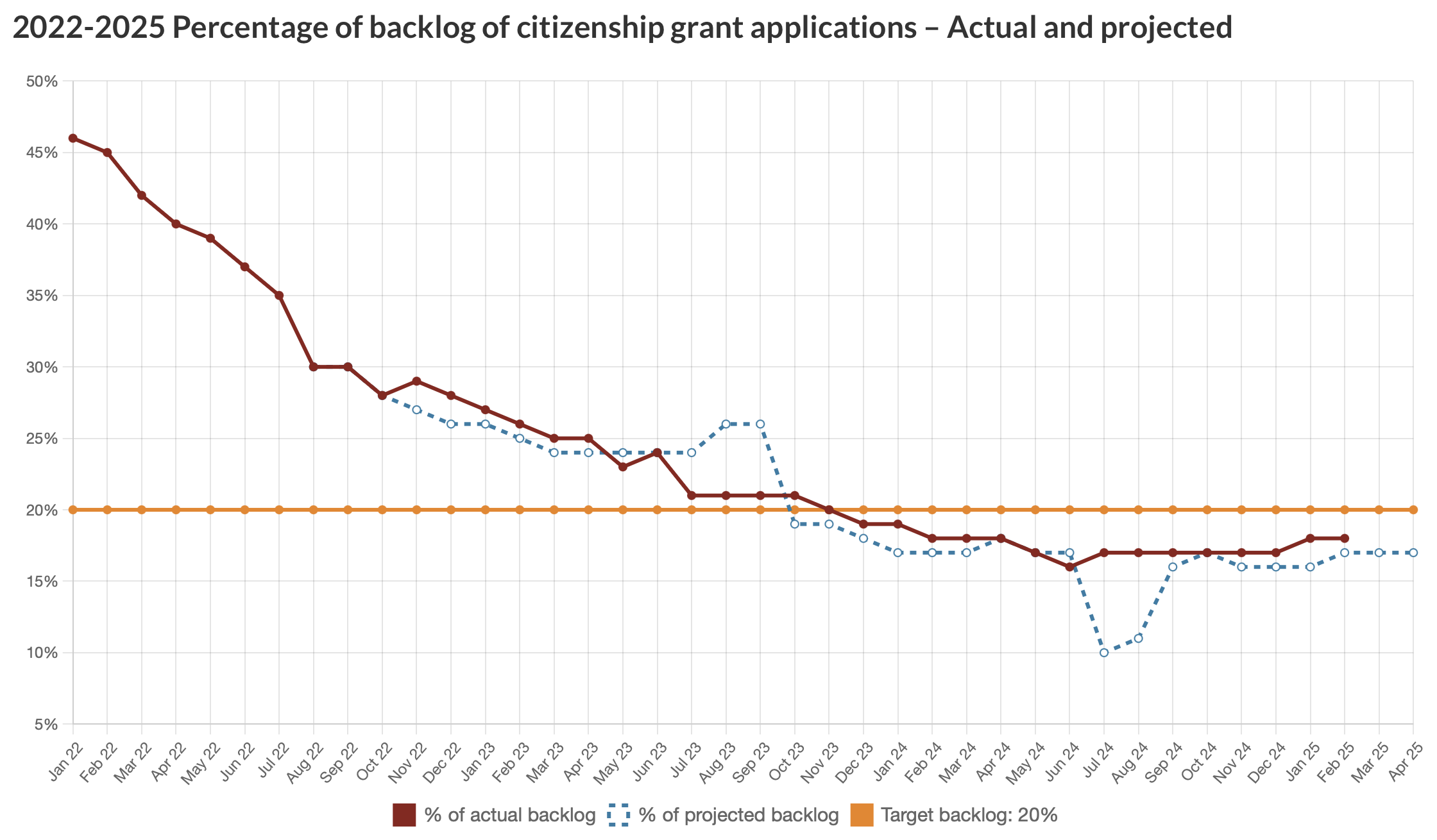
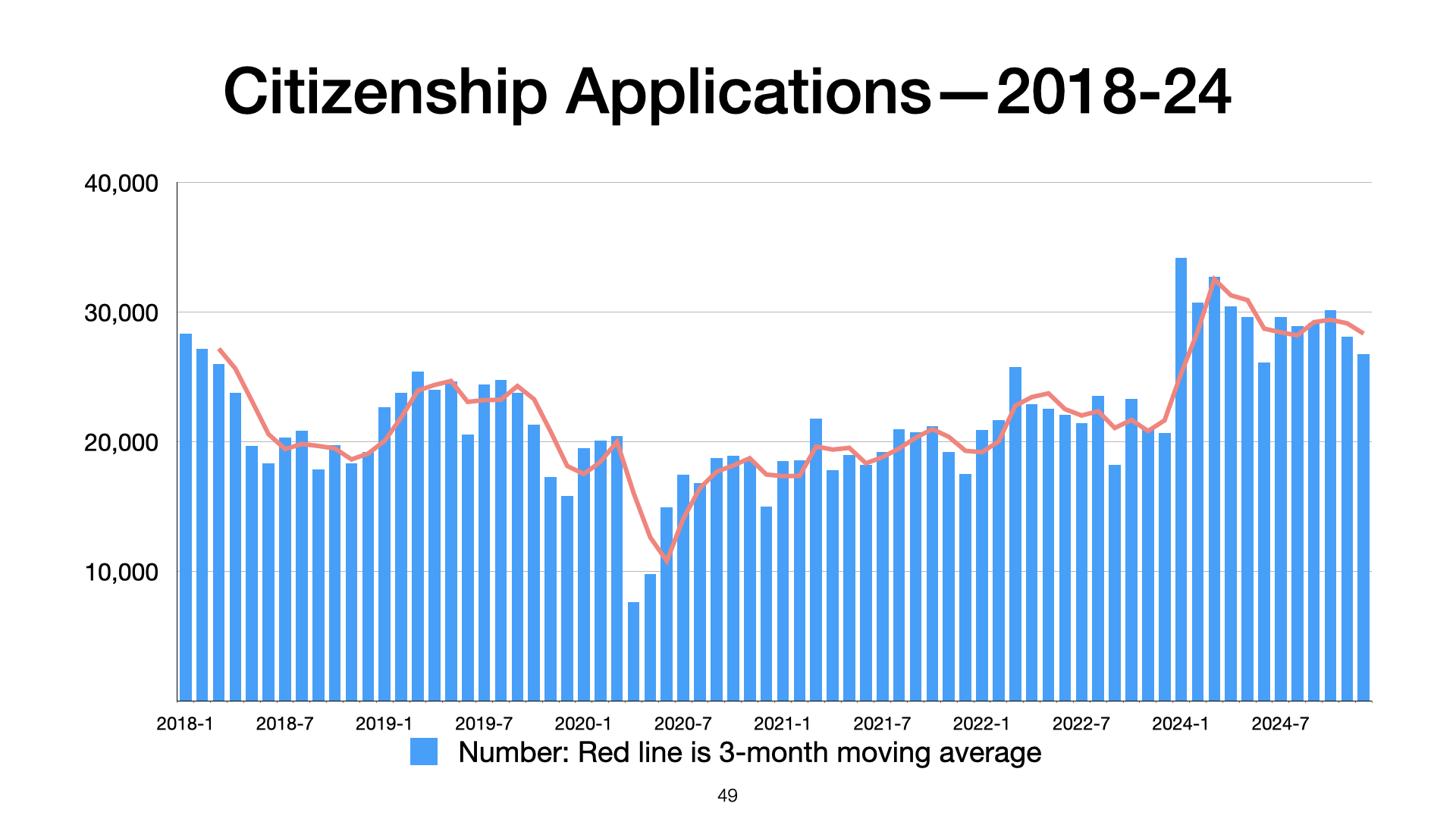
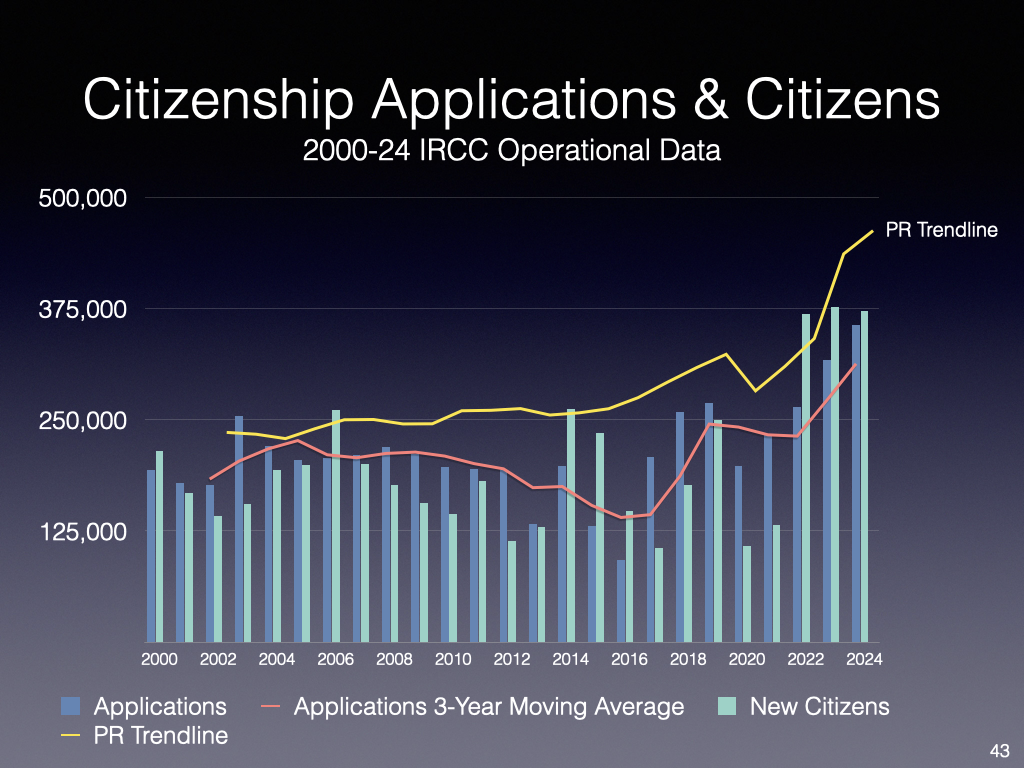
IRCC just released the 2024 numbers of monthly citizenship applications, confirming that interest in Canadian citizenship remains high, despite an overall decline in citizenship take-up.

Comparing applications, new citizens and permanent residents, highlights that the large increases in applications and new citizens over the last three years, along with the significant increase in permanent residents.

Lastly, as the number of new citizens has exceeded the number of applications, the backlog has dropped below the target of 20 percent, with over 80 percent meeting service standars.

Provincial immigration applicants in Canada see soaring processing times. They say the system is unfair

More fall-out from the needed policy reversals:

…Sangha is among many economic immigrants selected and nominated by individual provinces for permanent residence, who are caught up in processing delays; that’s largely because the federal government cut the number of new permanent residents for 2025 by 25 per cent to 395,000 and reduced it further in the next two years.

The provincial immigration nomination program was one of the biggest casualties, with its allocated spaces halved to 55,000 in 2025, 2026 and 2027. 

Apart from putting newcomers’ lives in limbo, it was a big blow for a program whose aim is to settle economic immigrants outside of Toronto, Montreal and Vancouver to places where their skills are needed.

The federal cuts are “one of the factors that’s suppressing the issuance of the actual PR (permanent residence) and the increase of the processing times,” said Calgary immigration lawyer Mark Holthe, on behalf of the Canadian Immigration Lawyers Association.

Beginning in the late 1990s, the provinces reached deals with Ottawa and started their respective nomination programs to recruit immigrants for local workforce needs. (Quebec has had its own special agreement to select its own immigrants.)

Applicants are screened and then referred to the federal Immigration Department for permanent residence processing. Newcomers are to remain in the province that nominate them.

The current delay in processing provincial immigration applications is only affecting nominees who apply under the “non-express entry” streams, which are not prioritized by federal officials.

Sangha, who came here in 2022 and works in IT for a petroleum company, said it’s unfair that he has to wait 21 months for processing when it takes just seven months for those in the express entry streams….

Source: Provincial immigration applicants in Canada see soaring processing times. They say the system is unfair

Citizenship: A partial return to in-person ceremonies

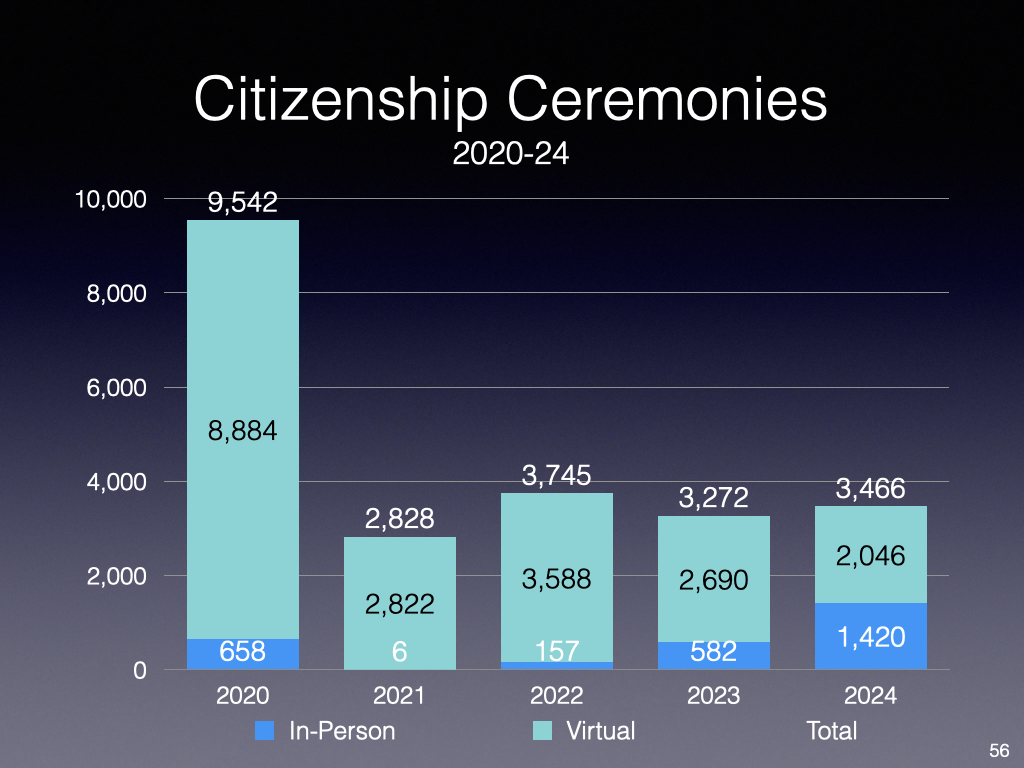
During the pandemic, IRCC shifted by necessity to holding virtual citizenship ceremonies. Once the pandemic was largely over, a shift back to in-person ceremonies occurred gradually. But the majority new citizens still become citizens through virtual ceremonies.

Reflecting this trend, the department published a Canada Gazette notice allowing for self-affirmation of the citizenship oath (“citizenship on a click”). The petition to Parliament I launched opposing that change, along with considerable negative commentary and likely then Minister Miller’s questioning this proposed change, resulted in it not being implemented.

In response to that petition, the government indicated that approximately two-thirds of all new citizens participated in a virtual ceremony (” From January 1, 2023 to September 30, 2023, the Department has held on average 50 in-person ceremonies and 224 video ceremonies per month with an average of 79 and 135 invited participants per event, respectively.”)

Subsequently, IRCC provided me with citizenship ceremony data from 2020 (start of pandemic) to 2024. The following charts summarize the change over the years.

Figure 1: Number of citizenship ceremonies by type
Figure 2: Relative percentages of in-person and virtual ceremonies

Using the same percentage breakdown between in-person and virtual ceremonies from January to September 2023 (IRCC was unable to provide breakdowns for this dataset), the following chart contrasts the number of new citizens by ceremony type.

IRCC does provide the option for applicants to specify their citizenship ceremony preferences:

The petition recommended that “Most citizenship ceremonies should be in-person.” However, this data highlights that while over 40 percent of 2024 ceremonies are now in-person, it still remains the fact that the majority of new Canadians participate in virtual ceremonies, reflecting the larger average size of virtual ceremonies.

Given the importance of citizenship ceremonies in immigrant integration and citizenship meaningfulness, any future government should continue and accelerate the shift back to in-person ceremonies.

Will the Trump era reverse Canada’s brain drain problem?

Opportunities:

…The imminent arrival of three eminent Ivy League professors and efforts by Canadian universities to attract American researchers, officials hope, herald the reversal of a perennial problem for Canadian universities: the brain drain to the United States.

“Canada has long wrestled with ways to retain our home-grown talent and attract international academics. Given the developments south of the border, there’s certainly an opportunity now for Canada to build on this. But we’re also competing with other countries,” said David Robinson, executive director of the Canadian Association of University Teachers.

“The big obstacle we face is that we’re in a period of serious financial retrenchment in the sector. Inadequate public funding and a sharp drop in international student enrolments due to caps on study visas mean that universities and colleges are suspending enrolments, cutting programmes, freezing new hiring, and even announcing layoffs.

“How to attract new talent when you’re cutting back on people and programmes? We have a climate that is generally supportive of academic freedom, but it’s only one part of the picture of what would make Canada an attractive destination. We also need the federal and provincial governments to urgently address the public funding gap,” said Robinson.

Richard Gold, director of McGill University’s Centre for Intellectual Property Policy and a lawyer, made the same point in an interview with University World News, before adding that to fully benefit from American scientists who come to Canada, Canadian universities and industry will have to drastically step up their game in developing the financial and corporate infrastructure that brings scientific discoveries to market.

“We’ve done really poorly at translating research into companies that make money and stay here. We sell most of our AI intellectual property to Google and others,” he said by way of example. “And then [we] buy it back at a higher price. Now there’s a recognition that we can’t rely on the United States,” he noted.

In 2000, in an effort to fight the brain drain, the Canadian government established the Canada Research Chair programme, which provides funding from an annual budget of CA$311 million (US$217 million) to more than 2,000 university professors.

“Chairholders aim to achieve research excellence in engineering and the natural sciences, health sciences, humanities, and social sciences.

“They improve our depth of knowledge and quality of life, strengthen Canada’s international competitiveness, and help train the next generation of highly skilled people through student supervision, teaching, and the coordination of other researchers’ work,” according to the programme’s website.

Keeping an eye out for Americans

Trump’s policies seem to be a genuine boost to Canada’s chances of attracting those “highly skilled people”.

A recent survey published by Nature showed that 75.3% of 1,608 US respondents said they were “considering leaving the country following the disruptions to science prompted by the Trump administration.

According to Nature, the day an early-career physician-scientist at a major university learnt his NIH grant had been terminated, “he e-mailed the department chair of colleagues at a Canadian university … He and his wife, who is also a scientist, are now interviewing for jobs in the country [Canada] and hope to move by the end of the year.”

As soon as the American administration announced cuts to the National Institutes of Health, National Science Foundation and other agencies, Frédéric Bouchard, Doyen de la Faculté des arts et des sciences at Université de Montréal (U de M), told his 35 department chairs “to keep an eye out for Canadians who began their careers in the United States or non-US citizens who had contemplated offers from the United States that may want to revise their plans either for budgetary or for political reasons – and also for Americans who are reconsidering where they can best pursue their careers”.

Despite budgetary restrictions at U de M, Bouchard told University World News that he expects to hire at least 25 professors this year and that there will be an increase “either of American candidates or international candidates who were considering the US market”.

Though he was unable to provide details, Bouchard said that following the announcement of the NIH grant cuts and US cuts to climate research, several long-time donors to U de M’s science programme approached him “to say that if we needed [financial] help to do strategic hiring, to give them a call”.

Donors to science, he added: “are very interested in the science ecosystem, if you will, because they know that science is international. So at some sort of high level, they always keep an eye out on how the international system is going.

“They see that research is being rattled [by the US cuts] and they know that we’re always building. So I was not surprised that they contacted us, but it was a welcome email”.

Beyond Canada

As Bouchard explained, universities around the world are also making plans to hire professors whose research programmes have been closed by the American cuts or because they do not feel comfortable in the United States.

The Kyiv School of Economics (KSE), which three years ago saw professors and graduate students leave Ukraine for safety following the Russian full-scale invasion, is among those universities on the lookout.

With funds provided by the Simons Foundation, the mission of which is to support mathematics and basic sciences, KSE is actively looking to hire mathematics and physics professors.

In a posting on X on 29 March, KSE rector Tymofii Brik invited academics who are “feeling uncertain or threatened” to apply to KSE and promised a warm welcome as well as relocation support.

In an interview with University World News, Brik noted that “right now there is a crisis in the United States”, a country he first studied in as a Fulbright Fellow.

“The crisis is political and geopolitical,” he said, noting that Trump’s administration has cut research funds, plans on increasing taxes on endowments, and attacked and cut funds from, among others, Columbia University.

“It seems that a lot of American faculty are frustrated. We hear that Jason Stanley is leaving Yale University because the university is not supporting faculty anymore,” Brik said.

“I think it’s an opportunity for us because despite the war, we are operational,” Brik noted.

“If you really want to be an academic and push science and innovation, Ukraine is about the best place because you have access to data about social activities and demography.

“You have real-time data about how the economy changes during the war. You can have access to data on military issues, so if you are an engineer, you can analyse that.

“Maybe the money is not as great as in the United States. But at least you have a sense of security and academic fulfilment. And you know that you’re fighting for democracy,” he added.

Threats to sovereignty

Dr Marc Ruel, a professor in the department of surgery, and division head and chair of cardiac surgery at the University of Ottawa Heart Institute (UOHI), earlier this year accepted an offer by the University of California, San Francisco (UCSF), to become the chief of the division of adult cardiothoracic surgery. Last month, he announced he had changed his mind.

Ruel saw himself, he told the CTV Television Network, as “a bit of a Canadian export” – a reference to Canada’s status as a hockey-mad country, which supplies 42% of the players on American National Hockey League teams, almost 150% more players than the next largest group: Americans themselves.

In an email to University World News, Ruel said he has the “greatest admiration for UCSF and their focus on care excellence, research, education, and innovation” and that his decision to remain in Canada should not be taken as “engag[ing] in their [American] internal politics”.

He told the Canadian newspaper Globe and Mail the “tipping point” in his decision to stay was Trump’s talk of making Canada America’s 51st state and the threat of crippling tariffs; by coincidence, he informed UCSF of his change of mind on 4 March, the day that Trump announced tariffs of 25% on Canadian imports.

Ruel told the Globe and Mail the threat to Canada’s “sovereignty and our identity . . . changes everything”.

“I can’t go to a jurisdiction that belittles our country,” he said.

In his email to University World News, Ruel set his decision in the context of international scientific exchange.

“In my view, it’s important for international scientific collaboration and exchange that the sovereignty of partaking countries is not something that is up for grabs or threatened by another.

“If that happens, it’s rather difficult for trust and collaboration to thrive. Science, research, and clinical leaders generally care about how their country – which has educated and supported them – is viewed by the one with which they will closely collaborate or might even move to in order to provide a new stage for their innovation, clinical care, research, or education platform,” he stated.

Patriotic education

While the Trump administration’s attack on Columbia triggered Stanley’s decision to accept the offer to come to Canada, his analysis of the authoritarian nature of American politics includes a trenchant critique of the laws that states like Florida have brought in banning the teaching of critical race theory in the K-12 system.

The vagueness of these laws, he explained to interviewer Michel Martin on Amanpour & Company, was not a bug in the system but, rather, a feature, designed to keep teachers looking over their shoulders because “your fellow citizens have been empowered to report you” for deviating from the “official state ideology”.

The ‘Dear Colleague’ letter issued by the Department of Education that Martin read serves as ‘Exhibit A’ for Stanley’s analysis.

The letter states “that educational institutions have toxically indoctrinated students with the false premise that the United States is built upon systemic and structural racism and advanced discriminatory policies and practices, and that proponents of these discriminatory practices have attempted to further justify them, particularly during the last four years under the banner of diversity, equity and inclusion, you know, DEI, smuggling racial stereotypes and explicit race consciousness into everyday training, programming and discipline”.

‘Exhibit B’ is Secretary of Education Linda McMahon’s statement in what she called the “final mission statement of the Department of Education”, which Trump tasked her with dismantling. In that statement, she wrote that the goal of American education is “patriotic education”.

The problem, Stanley underscored, is that the US was “founded and built upon systematic racism and exclusion. It’s part of our founding documents that we wanted to take more indigenous land … The United States is built on slavery. There’s no factual argument about that.

“So when you begin by saying that universities and K-12 schools are not allowed to teach facts, then you’re already on a very problematic playing field.

“And part of the point of these guidelines is to be vague because it allows wide latitude to target professors and to encourage students to report professors for anything that might suggest that the United States was not always the greatest nation on Earth and was essentially free from sin”.

Turning to higher education, Stanley noted: “Universities are not there in a democracy to stroke the egos of the citizens of a country. Just imagine your cartoon vision of an authoritarian country: it’s where the purpose of schools is to tell students to love their country and not question it.

“In a democracy, universities are there to teach the facts. They’re not there to breed patriotism. These documents explicitly tell us the purpose of schools and universities is to create patriotic citizens. That is not the purpose of the university. That’s nationalist education. That is not democratic education.”

Bending to Trump

Stanley is equally critical of American academics and university leaders who, he wrote in The Chronicle of Higher Education, have, in a pre-emptive way, acceded to Trump’s threats.

“Let’s keep our heads down and we won’t be seen; we won’t be a target,” he wrote before characterising Columbia’s “obsequious, embarrassing” response as amounting to: “Oh, hit us again, please. Hit us again.”

The Trump administration’s attack on Columbia – the withdrawal of US$400 million in research grants and pressuring the university to place the Department of Middle Eastern Studies into “academic receivership” because the administration objected to its “ideology” – stems, Stanley explained to Martin, from the Trump administration’s equation of “antisemitism” with “leftism”.

Born, Stanley says, in the hothouse atmosphere of Columbia’s campus during the pro-Palestinian encampment last year, which included “a large number of Jewish students” (but during which both Jewish and Palestinian students felt threatened), the equating of antisemitism with leftism has left little room for Jews like Stanley, who is highly critical of Israel but does not “want to take down the State of Israel”.

Trump’s administration, he underscores in this interview, has divided Jews into “good” and “bad” Jews. “And the good Jews are the ones who support Israel’s actions in Gaza, and the bad Jews are the people like me who are highly critical of what is happening and push for Palestinian rights,” he noted.

Worse, Stanley fears that the “history of this era will say that the Jewish people [as defined by Trump] were a sledgehammer for fascism.”

“It’s the first time in my life as an American that I am fearful of our status as equal Americans … because we are suddenly at the centre of politics, of US politics. It’s never good to be in the crosshairs for us; we are being used to destroy democracy,” he told Martin.

Fighting for freedom

Again and again in his essay, in his interview with Martin and on CBC, Stanley stressed his love for the United States.

“They are destroying my country,” he told Martin, referring to the Trump administration. “They are intentionally destroying my country.”

To do this, the destruction of the universities is vital.

“You take down the universities. You tell people that universities are just for job skills.

“They’re not democratic institutions anymore. And then you encourage people not to go to universities. You make student loans more difficult and expensive; privatise them. And then you delegitimise the university,” he stated.

Canada offers him the opportunity to fight the “fascist regime”, he believes, because it is a country “dedicated to freedom, to the values I love”.
Source: Will the Trump era reverse Canada’s brain drain problem?

Yakabuski: Le parti de la Charte

Right signal on pre-emptive use of the Charter:

…Lorsqu’on lui a demandé si son gouvernement avait l’intention d’intervenir devant la Cour suprême du Canada dans l’éventualité où cette loi se trouverait devant le plus haut tribunal du pays, M. Carney a répondu par l’affirmative. « Mon gouvernement a un malaise avec l’utilisation [préventive] de la “clause nonobstant” », a-t-il affirmé à propos de la disposition de dérogation enchâssée dans la section 33 de la Charte canadienne des droits et libertés. « L’enjeu est [de savoir si] on a des droits ici au Canada ou non. Un droit est un droit. Si on utilise trop souvent la “clause nonobstant” de manière [préventive], on dit qu’on n’a pas de charte des droits ici au Canada. C’est une question pour la Cour suprême. Ce n’est pas plus compliqué que cela. »

Or, la Cour suprême s’apprête déjà à examiner la question du recours préventif à la disposition de dérogation dans le dossier de la Loi sur la laïcité de l’État québécois, la loi 21. Cette cause sera entendue bien avant que toute contestation de la loi 96 puisse arriver devant le plus haut tribunal du pays.

S’il s’oppose uniquement à l’utilisation préventive de cette disposition, pourquoi M. Carney souhaite-t-il intervenir dans le dossier de la loi 96 si la question doit être, selon toute probabilité, réglée avant même que la Cour suprême n’accepte d’examiner ce texte législatif ? Est-ce que le chef libéral aurait plutôt sauté sur l’occasion de se prononcer sur la loi 96 afin d’envoyer un signal affirmant qu’il entend défendre la minorité anglophone du Québec ? Lui seul le sait.

Ce qui est toutefois clair, c’est qu’un gouvernement fédéral mené par Mark Carney chercherait à éliminer la capacité des gouvernements provinciaux à recourir préalablement à la disposition de dérogation. Ce n’est pas un détail. Le délai entre l’adoption d’une loi provinciale et le moment où la Cour suprême détermine si elle viole la Charte canadienne des droits peut s’étendre sur plusieurs années. La loi 21 fut adoptée en 2019, et on ne sait toujours pas ce qu’en pense le plus haut tribunal du pays.

En interdisant aux provinces de recourir de manière préventive à la disposition de dérogation, la Cour suprême imposerait une limite fondamentale à la souveraineté des provinces dans leurs champs de compétence. C’est ainsi que le constitutionnaliste Guillaume Rousseau qualifie la proposition de M. Carney de « radicale ». Une loi québécoise « pourrait être suspendue pendant six ou sept ans, en attendant un jugement de la Cour suprême, et ce, même si cette loi vise à régler un problème immédiat », a écrit Me Rousseau dans une chronique publiée cette semaine dans Le Journal de Montréal.

Professeur à l’Université de Sherbrooke, Me Rousseau a été nommé le mois dernier coprésident du nouveau Comité d’étude sur le respect des principes de la Loi sur la laïcité de l’État sur les influences religieuses par le gouvernement caquiste. C’est un fervent défenseur de la souveraineté parlementaire du Québec. Il n’en demeure pas moins qu’il soulève une question importante sur la pertinence de la disposition de dérogation si on interdit son utilisation préventive — surtout au Québec, où la suspension d’une loi linguistique pendant plusieurs années (en attendant que la Cour suprême détermine son sort) pourrait avoir une incidence non négligeable sur le déclin du français.

« Nous sommes le parti de la Charte, et nous allons intervenir à la Cour suprême dans les cas qui [pourraient] venir », a déclaré le chef libéral la semaine dernière lorsqu’il a été interrogé pour la première fois sur la loi 96. Qu’on se le tienne pour dit : le Québec a beau être « incroyable » aux yeux de M. Carney, il n’a pas l’intention de le laisser faire.

Source: Le parti de la Charte

… When asked if his government intended to intervene before the Supreme Court of Canada in the event that the law was before the highest court in the country, Mr. Carney answered in the affirmative. “My government is uncomfortable with the [preventive] use of the ‘notwithstanding clause’,” he said about the exemption provision enshrined in section 33 of the Canadian Charter of Rights and Freedoms. “The issue is [to know if] we have rights here in Canada or not. A right is a right. If we use the “notwithstanding clause” too often in a [preventive] way, we say that we do not have a charter of rights here in Canada. This is a question for the Supreme Court. It’s not more complicated than that. ”

However, the Supreme Court is already preparing to examine the issue of the preventive recourse to the derogation provision in the file of the Act respecting the secularism of the Quebec State, Bill 21. This case will be heard long before any challenge to Bill 96 can come before the highest court in the country.

If he opposes only the preventive use of this provision, why does Mr. Does Carney wish to intervene in the file of Bill 96 if the matter must, in all likelihood, be settled even before the Supreme Court agrees to examine this legislative text? Would the Liberal leader have rather jumped at the opportunity to vote on Bill 96 in order to send a signal stating that he intends to defend Quebec’s English-speaking minority? Only he knows.

What is clear, however, is that a federal government led by Mark Carney would seek to eliminate the ability of provincial governments to use the waiver provision beforehand. It’s not a detail. The time between the adoption of a provincial law and the time when the Supreme Court determines whether it violates the Canadian Charter of Rights can extend over several years. Law 21 was adopted in 2019, and we still do not know what the highest court in the country thinks of it.

By prohibiting the provinces from making preventive use of the waiver provision, the Supreme Court would impose a fundamental limit on the sovereignty of the provinces in their fields of jurisdiction. This is how the constitutionalist Guillaume Rousseau describes the proposal of Mr. Carney of “radical”. A Quebec law “could be suspended for six or seven years, pending a Supreme Court judgment, even if this law aims to solve an immediate problem,” wrote Me Rousseau in a column published this week in Le Journal de Montréal.

Professor at the Université de Sherbrooke, Me Rousseau was appointed last month as co-chair of the new Study Committee on Respect for the Principles of the Act on the Secularism of the State on Religious Influences by the Caquist Government. He is a fervent defender of Quebec’s parliamentary sovereignty. Nevertheless, it raises an important question about the relevance of the derogation provision if its preventive use is prohibited — especially in Quebec, where the suspension of a language law for several years (pending the Supreme Court’s fate) could have a significant impact on the decline of French.

“We are the Charter party, and we will intervene in the Supreme Court in cases that [may] come,” the Liberal leader said last week when he was first asked about Bill 96. Let’s take it for said: Quebec may be “incredible” in the eyes of Mr. Carney, he has no intention of letting him do it.