Quebec: Les immigrants décrochent une note presque parfaite au test des valeurs 

Not surprising, as persons prepare for these tests, just as they do for the Canadian citizenship test. But it does weaken the political argument that immigrants do not share common values:

Le test des valeurs imposé aux candidats à l’immigration permanente continue de battre des records de réussite au Québec. Bon an mal an, depuis son instauration, le taux de réussite de l’évaluation frise les 100 %.

Depuis le 1er janvier 2020, les personnes qui souhaitent obtenir leur résidence permanente à travers les programmes d’immigration économique du Québec doivent obtenir une attestation d’apprentissage des valeurs démocratiques et des valeurs québécoises. Ces programmes représentaient environ 70 % de toutes les admissions planifiées en 2023.

Il y a deux manières d’obtenir cette attestation, soit par un cours appelé Objectif intégration, soit par l’évaluation en ligne, préférée par la grande majorité des candidats à l’immigration.

Des 28 571 personnes qui ont fait l’évaluation en ligne entre avril 2023 et janvier 2024, c’est 99,79 % d’entre elles qui l’ont réussie. Les trois années précédentes, ce taux était encore plus élevé, à quelques centièmes de pourcentage près, selon une demande d’accès auprès du ministère de l’Immigration, de la Francisation et de l’Intégration (MIFI). Les données pour 2024-2025 doivent être dévoilées dans les prochaines semaines.

Les immigrants et les membres de leur famille ont droit à trois essais pour réussir le test, ce qui se fait en obtenant 15 bonnes réponses sur 20 questions (75 %). En cas d’échec à la deuxième tentative, un candidat peut assister à une session d’Objectif intégration. Ce cours dure 24 heures et donne souvent droit à une aide financière de 230 $ du MIFI. Ceux qui suivent toute cette formation obtiennent automatiquement l’attestation à présenter dans leur demande de Certificat de sélection du Québec.

Les questions de l’évaluation sont tantôt théoriques, tantôt des mises en situation, et offrent toujours des choix de réponse. On peut par exemple y demander si, vrai ou faux, les femmes et les hommes ont les mêmes droits au Québec. Une question présentée en exemple dans le guide pratique du MIFI pour aider à la préparation évalue les connaissances sur la discrimination : « Identifiez la ou les situations où il y a discrimination. Refuser un emploi : – À une femme en raison de sa grossesse. – À une personne qui n’a pas le diplôme requis. – À une personne à cause de son origine ethnique. »

Vers une révision ?

Le projet de loi 84, appelé « Loi sur l’intégration nationale », a été déposé à la fin janvier et il est présentement à l’étude en commission à l’Assemblée nationale. Lors du dépôt, le ministre de l’Immigration, Jean-François Roberge, avait évoqué que le test des valeurs pourrait « être révisé, être mis à jour ».

Le cours d’intégration, actuellement une autre option que le test, pourrait aussi être refait, voire devenir obligatoire. « On reverra les modalités, le contenu du cours. Est-ce que ces cours seront obligatoires ? Combien de temps ça prend ? Il pourra y avoir des obligations, on va les détailler plus tard, mais je ne l’écarte pas », avait-il déclaré devant les médias lors du dépôt.

À ce jour, une minorité de candidats à l’immigration a préféré le cours au test des valeurs. Entre 2020 et 2024, ce sont 6677 d’entre eux qui y ont assisté en vue d’obtenir leur attestation d’apprentissage des valeurs démocratiques et des valeurs québécoises.

M. Roberge a défendu le projet de loi devant les critiques, en disant vouloir créer un nouveau « contrat social », une « responsabilité partagée », au sein desquels les nouveaux arrivants auraient à contribuer aux principes fondamentaux du Québec.

LES VALEURS EN QUESTION

Elles ont été regroupées autour de cinq clés pour « mieux comprendre le Québec », explique aussi le cahier de préparation :

  1. Le Québec est une société francophone.
  2. Le Québec est une société démocratique.
  3. L’égalité entre les femmes et les hommes
  4. Les droits et les responsabilités des Québécoises et des Québécois
  5. Le Québec est une société laïque.

Source: Les immigrants décrochent une note presque parfaite au test des valeurs
Wright: Canadians don’t want to be the 51st state – and Americans don’t really want us

Another cathartic column for Canadians:

Canadians owe Donald Trump a debt of thanks. His musings about Canada becoming the 51st state have reminded us why we are Canadians in the first place and why we want to remain Canadians.

Still, it’s worth thinking about some of the legal steps to, and political implications of, a possible Canadian statehood.

First, Canada is a constitutional monarchy. To join the United States, it would have to become a republic. While that’s not impossible, it wouldn’t be easy. Amending the Canadian Constitution in relation to the King or Queen requires unanimous provincial consent. When was the last time all 10 provinces agreed on anything?

And what about Indigenous Peoples

Meanwhile, there are 634 First Nations governments – each with their own relationship with Canada or the Crown. Indeed, one of the mandates of the Department of Crown-Indigenous Relations and Northern Affairs is to recognize and implement “treaties concluded between the Crown and Indigenous Peoples.”

If it’s difficult to imagine Indigenous Peoples agreeing to give up their treaty rights, it’s equally difficult to imagine the U.S. negotiating new treaties and nation-to-nation relationships with 634 First Nations.

For its part, Quebec will never agree to give up the substantial power and real sovereignty it has as a province, even if every other province agreed to – which they won’t. In defence of their borders and the French language, Quebecers would likely secede from Canada long before any serious move towards Canadian statehood – and who could blame them?

Of course, this assumes that American lawmakers want a 51st state – and they don’t. Certainly, Republican lawmakers don’t, for the same reason they don’t want Puerto Rico and Washington, D.C. to become states.

Each state has two senators and it’s a safe bet that both Canadian senators would be Democrats or be from a separate party that would caucus with the Democrats. The GOP cannot risk becoming a minority in a closely divided Senate.

When Hawaii joined as the 50th state in 1959, there was a lot of handwringing, especially in the Jim Crow South. For example, a Mississippi senator insisted that Hawaii’s admission would mean “two votes for socialized medicine, two votes for government ownership of industry, two votes against all racial segregation and two votes against the South on all social matters.”

Canada: A potential Republican wasteland 

Republican senators have similar arguments against admitting Canada – two votes for universal, single-payer health care, two votes for abortion rights, two votes for LGBTQ+ rights, two votes for multiculturalism, two votes for science, two votes for vaccines, two votes for climate policies and two votes against tax cuts for the wealthy.

Each U.S. state also has members in the House of Representatives, according to its population. If Quebec doesn’t secede, Canada would be the most populous state in the U.S., giving it as many as 55 seats in the House which, with Canada’s admission, would have about 490 seats. If Quebec does secede, Canada would be the second most populous state, giving it as many as 45 seats.

Not all Canadian representatives would be Democrats or from a party that would caucus with them, but the majority would be, providing the Democratic Party with control over the House of Representatives into the foreseeable future.

Finally, the White House: Does anyone really think that Canadians would vote for the Republican Party in its current incarnation? Some would, but the majority wouldn’t.

In the last federal election, about 60 per cent of Canadians voted for the Liberals, the NDP, the Bloc Québécois or the Green Party – all centre and centre-left parties. Even if Quebec secedes, most Canadian voters still lean centre or centre-left.

In America’s winner-takes-all presidential election, Canada’s roughly 50 electoral college votes would go to the Democratic candidate, not enough to guarantee a Democratic victory when approximately 590 electoral votes would be up for grabs, but enough to permanently narrow the GOP’s path to victory.

If Canada does become part of the United States, it won’t be as a state. It will be as an occupied territory and occupations never end well for the occupier – something Americans understand after 20 years in Afghanistan and Iraq.

Bottom line: Canadians don’t want to become the 51st state and the Americans don’t want us anyways, which leaves us with Donald Trump, a troll with a large following on social media trying to own the libs and get under our skin.

My advice? Ignore him and get on with the related tasks of peace, order and good government and managing the economic fallout of his tariffs.

Source: Canadians don’t want to be the 51st state – and Americans don’t really want us

Jamie Sarkonak: Federal bureaucrat-activists strike again with ‘Understanding Islamophobia’ guide

Unfortunate but typical framing by the NP.

It is valid for the federal government to prepare such a primer, just as it was valid for the government to prepare its Canadian Handbook on the IHRA Working Definition of Antisemitism.

One of the omission in these types of documents is that they tend to discount, arguably overly so, the extremist elements within communities and their impact on the social fabric. Given the nature of some of the Gaza demonstrations and rhetoric, the primer should be more nuanced and note the presence of extremists (not unique to Muslims).

Unfortunately, I do not have the time to do a comparative analysis, side-by-side of the Islamophobia and Antisemitism primers but hopefully some others will do so (would make great undergrad essay!):

…It concludes by asking that more Canadians do more to assist the good image of Islam in Canada: audit workplaces and engage in “anti-racist leadership”; collect data on the religion of one’s employees; launch awareness campaigns for religious rights; provide workplace training; include Islam as an identity promoted within diversity, equity and inclusion practices.

The report altogether sends the message that any cool sentiment towards Islam, or at least lack of warmth, is a problem that needs to be fixed, just like anti-Muslim violence. But, it’s not the government’s job to ensure that a satisfactory number of people like any certain religion. This is Canada. While discrimination is wrong, and hate-motivated violence should be fully prosecuted by the law, individuals are allowed to have opinions, negative or positive, about religious groups.

It also maligns non-Muslim Canadians as a collective for the wrongdoing of individuals, which, hypocritically, is exactly what it asks Canadians not to do of Islam.

No other religious group gets this level of treatment from government, with dedicated federal appointees, equity initiatives, and heaps of funding for community groups and phobia-dispelling initiatives: not Sikhism, or Judaism, or Hinduism. Not even Christianity, even though it’s engrained into Canadian society as a result of history and forms the moral foundation of the West. Indeed, anyone with eyes knows that Christianity is frequently bashed in the public sphere for all sorts of reasons.

This report is an attempt at progress, but it’s anything but. It’s up to the public to think what it thinks, it’s up to employers to treat employees of all religions fairly, and it’s up to the government (and its courts) to punish violent, hateful criminal activity.

Source: Jamie Sarkonak: Federal bureaucrat-activists strike again with ‘Understanding Islamophobia’ guide, The Canadian Guide to Understanding and Combatting Islamophobia

The Alliance of Canadians Combatting Antisemitism, however, did note:

….But there was a shadow over the Forum that did not go unnoticed in the impromptu discussions taking place. The Prime Minister said he is a Zionist and we cannot normalize treating Zionism as a pejorative term. However, shortly before the Forum was held, the Canadian Guide to Understanding and Combatting Islamophobia was released by the Federal government. 

The Guide was led by the Special Representative on Combatting Islamophobia, Almira Elghawaby. Much of it is unproblematic. But it devotes a section to anti-Palestinian racism (APR) noting that, in Canada, the understanding of APR is growing, with initiatives like the Arab Canadian Lawyers Association’s 2022 framework. It also states that “some school boards have also developed or are in the process of developing their own definitions of anti-Palestinian racism to address this issue and its harmful effects.” 

These passages are footnoted to include, among other things, the Arab Canadian Lawyers Association’s report that defines APR in a way that makes all Zionists racists. For example, it claims that those who “fail to acknowledge Palestinians as an Indigenous people with a collective identity, belonging and rights in relation to occupied and historic Palestine” are racists. We also know that there is a call for filmmakers on Instagram respecting a film project on anti-Palestinian racism. It appears to be sponsored by the Arab Canadian Lawyers Association, the authors of the troubling definition of APR discussed above and funded by the Government of Canada (Employment and Social Development Canada).

A Call for Consistent Policies

No one should condone or permit discrimination against Palestinians because they are Palestinian, against Arabs because they are Arabs, or against Muslims because they are Muslim. Nor should anyone discriminate against those who wish to express “pro-Palestinian” views or criticize Israel in the same way that other countries are subjected to criticism. The IHRA definition of antisemitism and its illustrations make that clear. 

However, the federal government cannot have it both ways. Issuing a guide that incorporates by reference a definition of APR that demonizes all Zionists and Israelis is incompatible with what the Prime Minister told those assembled at the Forum, and incompatible with true Canadian values. If the Canadian government truly wishes to show its commitment to combatting antisemitism, it should immediately withdraw the objectionable passages of the Guide to Combatting Islamophobia and reconfirm its commitment that Zionists and Israeli-Canadians will not be demonized for their beliefs.

Source: The National Forum on Antisemitism and Mixed Messages

Website sells Canadian birthright for $35K to foreign moms 

One of the problems of alternative media and TikTok influencers is their lack of capacity and knowledge.

The number of suspected birth tourists (non-resident self-pay) has been published annually (by me) and the British Columbia data is no longer the highest given the large drop pandemic and post-pandemic of Chinese birth tourists at Richmond General and other British Columbia hospitals (see Birth tourism has doubled since the pandemic lull):

A suspicious website is advertising would-be mothers from around the world the opportunity to have anchor babies in Canada, ensuring their children become naturalized citizens.

The Russian-language website “CanadaMama consulting” is advertising their services at fees ranging up to $35,000 for migrant women interested in baby-tourism. The website promises a “safe birth” and a “life full of opportunities.” 

Potential clients are being lured by the prospect of free education, healthcare, employment opportunities and international travel for their children. The website’s default language is set to Russian, but also has built in English, Ukrainian, Chinese and Spanish translations.  

Canadian TikTok influencer Mario Zelaya was the first to bring attention to the website.

Among the services offered to those interested include property rentals, immigration consultation, visa support, medical service advisory and even newborn photography. 

Akin to airline companies, the website has multiple package options ranging from economy, to optimal to comfort, with additional services such as food delivery, hospital tours, shopping advice and interpretation services offered to those willing to pay extra.

CanadaMama also claims to operate “under contract” and work alongside Canadian hospitals – an unverified claim. 

The company claims to have operated for more than five years, carrying out dozens of successful births

Unconditional birthright citizenship in Canada is attracting many birth tourists, especially in British Columbia–where some hospitals have reported non-citizens making up a quarter of their maternity ward patients.

A Calgary-based obstetrician gynaecologist, Dr. Colin Birch, said in a CBC interview that birth tourism had the biggest impact on cities that had international airports, with trends slowing down after air travel was shut down during the pandemic. …

Source: Website sells Canadian birthright for $35K to foreign moms

Life in the shadows: Inside the world of Toronto’s undocumented migrants

Good series of profiles:

Every morning across the Greater Toronto Area, thousands of undocumented workers head out to their jobs in construction, cleaning and home care, despite the fact that they are not legally allowed to live or work in Canada.

Unlike in the U.S., where many undocumented people entered without authorization at the southern border, most of these individuals in Canada entered the country legally. They came as temporary workers, international students, tourists or refugee claimants, and saw their visas expire or refugee claims rejected before they were able to transition to another type of legal status.

It’s hard to give a definitive number of undocumented people in Canada, but the federal government says it could be as high as 500,000. Many have few legal resources and struggle to navigate Canada’s complex and sluggish immigration system. By staying in the country without authorization, they are forced into the shadows, where they face limited and substandard employment, health and housing options. The Globe and Mail spent time at sites where migrants congregate in Toronto – a church, a newcomer support centre and street corners where day labourers pick up under-the-table work – speaking with undocumented and formerly undocumented people. (The Globe is using only middle names for most people in this story owing to their risk of detention and deportation.)…

Source: Life in the shadows: Inside the world of Toronto’s undocumented migrants

Canada to grant legal status for thousands of undocumented construction workers

Up to 6,000 undocumented construction workers will be given a pathway to gain legal status in Canada, Immigration Minister Marc Miller said Friday in a news conference.

“These undocumented migrants are already living and working in Canada, and are contributing to the sector,” Immigration, Refugees and Citizenship Canada said in a statement.

“This pathway will keep them here legally so that they can continue to build the homes our economy and communities need with the proper protections.”  

This announcement comes over two years after the federal government said it would be expanding a small-scale pilot project that offered permanent residence for out-of-status construction workers who are already working undocumented in the sector here.

The government did not provide further details on when the pathway will be implemented or the criteria for eligibility.

Canada’s construction sector is grappling with a severe worker shortage, with tens of thousands of jobs unfilled across the country. According to BuildForce Canada, “the industry could face a recruiting gap of more than 85,000 workers by 2033.” 

A 2023 RBC report said the construction sector is short a whopping 64,000 jobs, posing a significant problem for an industry that must produce enough housing to meet demand from Canada’s ever-growing population — and the best workers for the job are newcomers.

In a bid to address these labour gaps, the federal government said it will be introducing “a temporary measure to allow foreign apprentices to complete their studies without a study permit,” effective March 7.

Source: Canada to grant legal status for thousands of undocumented construction workers

Niraula: Canada’s immigration process is increasingly digitized, but that can make if difficult to navigate

While all of these ideas may help, the author ignores the need for program simplification as a necessary condition for digital transformation. And like so many, the call is for more resources rather than recognizing trade-offs and financial and other limits:

…There is a need for more inclusive and user-friendly digital infrastructures. Since migrants’ information needs evolve pre- and post-arrival, targeted strategies to disseminate authorized information are also necessary.

Many young people, including migrants, regularly use social media. To ensure digital tools support rather than mislead migrants, the Canadian government must use online platforms to share migration information in a way that is clear and accessible.

In addition, IRCC and provincial governments should enhance online resources by offering multilingual, user-friendly portals. AI-powered chatbots, simplified immigration guides in video or storytelling formats, and blockchain-verified advisory services could improve accessibility while preventing misinformation.

Greater transparency is required in how social media platforms promote migration-related information. Stronger regulations should define these platforms’ responsibilities for removing inaccurate immigration content, similar to fact-checking initiatives for COVID-19 misinformation. 

Organizations that help newcomers get settled need increased funding for pre-and-post arrival workshops on navigating official resources and understanding legal rights. Public education campaigns can help to empower migrants to verify information and detect fraud.

By strengthening both digital governance and education, Canada can ensure that a more transparent digital tools are a pathway to informed migration decision-making rather than a source of confusion and vulnerability.

Source: Canada’s immigration process is increasingly digitized, but that can make if difficult to navigate

Canadians can soon get their passport in 30 business days — or it’s free

Good to have this kind of service guarantee although more of a reflection of current service levels than a stretch commitment:

The federal government announced on Friday that it’s going to be speeding up the processing for passports so Canadians can get their documents within 30 business days — or they’ll be free.

Under the change, any complete passport application will be processed within 30 business days or it will be free, with the passport fees to be refunded. The 30-day period does not include the mailing time of the application or the passport itself.

The 30-day limit applies whether Canadians submit their application online, in person or by mail.

Citizens’ Services Minister Terry Beech did not say when the process would begin, however, only noting it would happen later this year.

The shift by the government comes just three months after thousands of Canadians saw passport delays amid the Canada Post strike, which followed months of issues due to post-COVID-19 delays.

Beech also noted in a press release that the federal government continues to roll out its online passport renewal program, which began in December 2024, with eligible Canadians able to complete their application, pay fees and upload a professional digital photo from their computer or mobile device.

The government says the phased roll-out is being used to monitor, adapt and refine the process to ensure it is working before it’s rolled out to more Canadians in the coming months.

Source: Canadians can soon get their passport in 30 business days — or it’s free

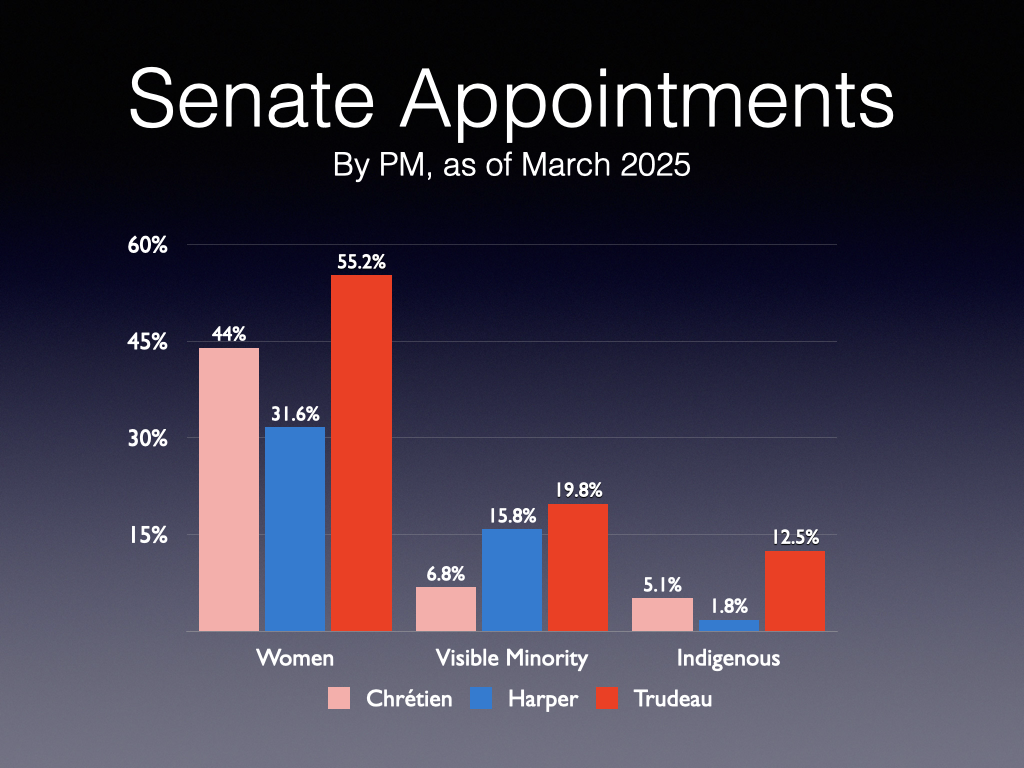
All Senate vacancies now filled as Trudeau makes 5 new appointments

Of note. My analysis of the diversity of appointments below across three prime ministers:

With just days to go until Prime Minister Justin Trudeau leaves federal politics, his office says five new appointments have now filled all the vacancies in the 105-seat Senate.

The Prime Minister’s Office says in a news release that the Governor General has appointed former Moncton mayor Dawn Arnold for New Brunswick and former MLA Tony Ince for Nova Scotia.

Non-profit executive Katherine Hay, charity CEO Farah Mohamed and former provincial politician Sandra Pupatello have been appointed for Ontario.

There were 22 vacancies in the Senate when Trudeau became prime minister in 2015 and launched what his government called a “new, non-partisan, merit-based process” to advise on appointments.

There have been 100 independent appointments to the Senate made on the advice of Trudeau, with a dozen in 2024 and 10 this year.

Source: All Senate vacancies now filled as Trudeau makes 5 new appointments

Government Monitoring of Immigrants’ Social Media

While hard to trust the Trump administration on much, a case can be made to check social media to flag potential security threats:

As part of an effort to enhance screening measures, the White House has announced it will require millions of immigrants seeking benefits ranging from green cards to citizenship to provide social media information on their immigration applications. 

The Department of Homeland Security (DHS) published a notice in the Federal Register on March 5, 2025, detailing plans to collect social media identifiers (“handles”) on nine immigration forms to comply with Executive Order 14161, “Protecting the United States from Foreign Terrorists and Other National Security and Public Safety Threats,” signed by President Trump on January 20, 2025.

According to the notice, USCIS will collect social media handles (but not passwords) to verify applicants’ identities and to assess whether granting immigration benefits might pose security or public safety risks.

The new requirement will apply to nine forms, including:

  • N-400 (Application for Naturalization) 
  • I-131 (Application for Travel Document) 
  • I-192 (Application for Advance Permission to Enter as Nonimmigrant) 
  • I-485 (Application for Adjustment of Status) 
  • I-589 (Application for Asylum and for Withholding of Removal) 
  • I-590 (Registration for Classification as Refugee) 
  • I-730 (Refugee/Asylee Relative Petition) 
  • I-751 (Petition to Remove Conditions on Residence) 
  • I-829 (Petition by Investor to Remove Conditions on Permanent Resident Status)

USCIS estimates this proposal would affect over 3.5 million applicants annually. The public has 60 days to submit comments on the proposal via the Federal eRulemaking Portal (Docket ID USCIS-2025-0003). After the comment period, DHS will review feedback before deciding whether to implement the rule as proposed, modify it, or withdraw it.

USCIS Social Media Monitoring: A Decade of Expanding Surveillance

For years, officers of U.S. Citizenship and Immigration Services (USCIS) have been checking social media accounts to look for immigration fraud across various application types, from family-based petitions to employment visas and naturalization applications.

The formal history of USCIS social media monitoring shows a clear evolution:

  • 2016: USCIS established a dedicated Social Media Division within its Fraud Detection and National Security Directorate (FDNS), marking the beginning of institutionalized social media vetting.
  • 2017: The Trump administration implemented “extreme vetting” procedures in March, intensifying the scrutiny of visa applications, including more thorough examination of applicants’ social media. In September, DHS issued a Federal Register notice indicating it would collect and keep information from social media on all individuals passing through the U.S. immigration system.
  • 2019: The Department of State began requiring all visa applicants to disclose their social media handles as part of forms DS-160 (Nonimmigrant Visa Application) and DS-260 (Immigrant Visa Electronic Application).
  • 2021: The scope of monitored platforms expanded to include not only major U.S.-based social media platforms but also international platforms from China and Russia.
  • 2025: With the latest Executive Order 14161 signed by President Trump on January 20, 2025, USCIS is now formalizing and expanding social media data collection to nine different immigration forms.

Law enforcement, however, has always been free to use social media as part of investigations of both threats and crimes.

Social Media Monitoring and Immigration Applications

USCIS officers and consular officials often use social media to confirm the legitimacy of relationships and claims made in applications. This can include checking the consistency between online activity and information provided in forms and searching for any content that might contradict statements made during the application process….

Source: Government Monitoring of Immigrants’ Social Media