Barnett: Trump Might Have a Case on Birthright Citizenship, Somin: Birthright Citizenship – A Response to Barnett and Wurman

These two articles given a sense of the different legal arguments (think it is still a stretch to justify a change without an amendment).

Starting with those who believe there is a case:

…Which brings us to the children of people who are present in the United States illegally. Has a citizen of another country who violated the laws of this country to gain entry and unlawfully remain here pledged obedience to the laws in exchange for the protection and benefit of those laws?

Clearly, the parents are not enemies in the sense of an invading army, but they did not come in amity. They gave no obedience or allegiance to the country when they entered — one cannot give allegiance and promise to be bound by the laws through an act of defiance of those laws. Such persons can even be summarily removed from the country without judicial procedures of the sort that would protect citizens. If the allegiance-for-protection view informed the original meaning of the text, then they and their children are therefore not under the protection or “subject to the jurisdiction” of the nation in the relevant sense.

The executive order’s exclusion of children born to mothers who are “lawful but temporary” residents is a more complicated question not addressed here. And whether Congress ought to grant naturalized citizenship to children born to those illegally present in the United States is a policy issue distinct from whether the 14th Amendment has already done so. The Supreme Court has, in a footnote, presumed that the 14th Amendment’s jurisdictional phrase applied equally to people who are here illegally, but the issue was neither briefed nor argued in that case; nor was it material to its outcome.

When they finally consider this question, the justices will find that the case for Mr. Trump’s order is stronger than his critics realize.

Randy E. Barnett is a professor of constitutional law at the Georgetown University Law Center and an author of “The Original Meaning of the 14th Amendment: Its Letter and Spirit.” Ilan Wurman is a professor of constitutional law at the University of Minnesota and the author of “The Second Founding: An Introduction to the 14th Amendment.”

Source: Trump Might Have a Case on Birthright Citizenship

Somin’s rebuttal:

In a recent New York Times op ed, legal scholars Randy Barnett and Ilan Wurman offer a partial defense of President Trump’s executive order denying birthright citizenship to children of undocumented immigrants, and migrants in the US on temporary visas. The Citizenship Clause of the Fourteenth Amendment grants citizenship to anyone “born … in the United States and subject to the jurisdiction thereof.” The standard view of this provision is that it covers everyone born in the United States that is subject to US law, and thus, as the Supreme Court explained in the 1898 Wong Kim Ark case “includ[es] all children here born of resident aliens, with the exceptions or qualifications… of children of foreign sovereigns or their ministers, or born on foreign public ships, or of enemies within and during a hostile occupation of part of our territory, and with the single additional exception of children of members of the Indian tribes owing direct allegiance to their several tribes.” The Indians “owing direct allegiance to their several tribes” were excluded because Indian nations were distinct sovereigns exempt from many US laws. For this reason, four federal courts have ruled against Trump’s order.

Barnett and Wurman argue that only people born in the United States at a time when their parents have traded “allegiance” for “protection” truly qualify as under the jurisdiction of the United States. They contend that illegal migrants haven’t made any such compact with the US, and therefore don’t qualify.

Barnett and Wurman cite an 1862 opinion by Attorney General Edward Bates stating that “The Constitution uses the word ‘citizen’ only to express the political quality of the individual in his relations to the nation; to declare that he is a member of the body politic, and bound to it by the reciprocal obligation of allegiance on the one side and protection on the other.” Barnett and Wurman claim the Citizenship Clause is based on a social contract theory under which people enter into a “social compact” with the government, trading allegiance for the protection of the laws.

There are several flaws in Barnett and Wurman’s “allegiance-for-protection” theory. The biggest is that, if consistently applied, it would undermine the central purpose the Citizenship Clause: extending citizenship to recently freed slaves and their descendants. Slaves born in the United States (and their parents, who were also usually slaves) obviously weren’t part of any social compact under which they traded allegiance for protection. Far from protecting them, state and federal governments facilitated their brutal oppression at the hands of their masters.

This situation changed, to an extent, with the abolition of slavery through the Thirteenth Amendment. But  the “subject to the jurisdiction” language of the Citizenship Clause refers to people subject to that jurisdiction at the time they were born. For example, the child of a foreign diplomat doesn’t get birthright citizenship if her parents later lose their diplomatic immunity. If being subject to US jurisdiction requires a compact trading allegiance for protection, former slaves obviously didn’t qualify. Thus, the Barnett-Wurman theory would defeat the central purpose of the Citizenship Clause. That alone is reason to reject it.

Another problem with their analysis is that they rely almost exclusively on sources interpreting the nature of citizenship before enactment of the Fourteenth Amendment, such as the 1862 Bates opinion. But the whole point of the Citizenship Clause was to expand the range of people eligible for birthright citizenship, to include former slaves. Thus, we should not assume that the Citizenship Clause is limited by previous understandings.

Barnett and Wurman do not consider extensive evidence from the period during and immediately after enactment, of the kind canvassed by scholars such as Michael Ramsey in his detailed 2020 article on this subject. That evidence, as Ramsey explains, strongly supports birthright citizenship for the children of undocumented migrants.

Barnett and Wurman argue that the traditional view cannot explain seeming anomalies, such as “the status of children born to citizens residing within enemy-occupied territory, who appear to have been considered citizens if their parents remained loyal… [a]nd… the status of children born to foreigners on foreign public vessels in U.S. waters, who were not considered citizens.” These aren’t actually anomalies at all. As the Supreme Court ruled in 1812, foreign public vessels in US territorial waters remain under the sovereignty of their governments, and therefore are not within US jurisdiction. Citizens residing within enemy-held territory remain under an obligation to follow US law, and that duty can be enforced upon them in a way it cannot be on foreign troops (for example through prosecutions undertaken after the US recaptures the territory).

Finally, it’s important to remember that, as Gabriel Chin and Paul Finkelman have shown, the freed slaves whose children were covered  by the Citizenship Clause included a large population that had entered the US illegally, by virtue of being brought in after the federal government banned the slave trade in 1808. This shows that illegal entry was not considered a barrier to being under US jurisdiction.

Even if valid, the Barnett-Wurman theory only partially justifies Trump’s order. That order excludes not just children of illegal entrants, but those born to migrants who entered legally on temporary visas. But their argument fails with respect to children of the undocumented, as well. At the very least, it is not strong enough to overcome decades of contrary precedent and practice, thereby subjecting hundreds of thousands of innocent children to the trauma of deportation.

Source: Birthright Citizenship – A Response to Barnett and Wurman

Poilievre suggests capping immigration at Harper-era levels, deportations for wrongdoers

Back to Kenney-era levels, about half of current levels (no specific mention of levels of temporary workers and international students). Unclear whether the provinces would accept such a major reduction but good to have Poilievre provide specific numbers.

Ramping up deportations will be more challenging than a “deport bogus refugees” or “deport hate” slogans:

Conservative Leader Pierre Poilievre has confirmed his plans to reduce immigration levels to Stephen Harper-era levels and deport those who break Canada’s laws while on temporary visas, in an exclusive interview with Juno News co-founder Candice Malcolm.

Juno News is a reader-supported publication. To receive new posts and support my work, consider becoming a free or paid subscriber.

On the broader issue of immigration levels, Poilievre stated that the current annual intake of permanent residents — set to reach 500,000 in 2025 — is unsustainable and has contributed to Canada’s housing crisis.

He proposed a return to the levels of previous Conservative governments, around 200,000 to 250,000 per year, aligning population growth with the number of new homes being built.

“It would be a lot more like the Harper numbers that were basically the same for 40 years before Trudeau took office — we were bringing in about 200,000 to 250,000 a year,” said Poilievre.

“We were building about the same number of homes as we were adding people, so we had a housing surplus. I would bring in a simple mathematical formula: we cannot bring in people faster than we add houses.”

According to Poilievre, the formula would be based on the homebuilding numbers from the prior year as well as population growth targets.

“I would actually make sure that we’re building housing surpluses over the next four years because that’s how we close the gap that has built up,” said Poilievre.

Poilievre also made it clear that his government would swiftly deport non-citizens who commit crimes while in Canada on temporary status. He emphasized that those engaging in violent acts, such as firebombing businesses or places of worship, should be immediately arrested and deported.

“I don’t know how anybody can disagree with that. If someone shows up in our country claiming to be a student or a temporary worker and they start firebombing coffee shops, bakeries, synagogues, or any other place, then they need to be immediately arrested and deported,” said Poilievre in reference to recent pro-Hamas protests rocking Canada.

“If someone is obviously a citizen, they should be prosecuted through our legal system and put in prison here in Canada for those sorts of crimes.”

Poilievre added the federal government also has to take the issue of illegal immigration seriously and expedite deportations for those found to be in Canada under false pretences.

“If someone comes in, makes a false asylum claim, and it gets rejected, they’re supposed to leave today,” said Poilievre.

“The challenge we’re going to face is that under nine years of the Carney-Trudeau Liberals’ open border policies, we now have millions of people whose permits are going to expire over the next two years. If they don’t leave, we have a very hard time even knowing they’re still here, finding them, and then carrying out a deportation.”

The Conservative leader, however, did indicate that among illegal immigrants there were “some among them that we do want to keep.”

“They could be a master’s graduate in computer engineering with a six-figure job in Kitchener-Waterloo, someone who has started a family, integrated, speaks the language. This is someone we want to keep,” said Poilievre.

“But we need to be able to make that decision ourselves through selection based on these criteria — not just by accident because people who are not eligible to stay decide they’re not going to leave.”

According to Poilievre, the Canadian government should implement further refugee reviews for claims, including what he calls a “last in, first out” approach.

“This is how it works: if you’re the last person to enter the country, your claim is immediately heard. Within a couple of weeks, if your claim is false, you’re sent back. What that does is send the signal to everyone who might come in the future that they’re going to be sent home automatically,” said Poilievre.

“The problem right now is that if someone gets in illegally — even if they’re not a real refugee, they’re not fleeing danger — they have seven or eight years of appeals, during which we’re paying for their hotels, lawyers, food, and healthcare, above and beyond what Canadians get.”

Source: Poilievre suggests capping immigration at Harper-era levels, deportations for wrongdoers

Urback: Society’s brainworms have gotten so bad, we can’t even recognize a swastika as a hate symbol 

More on Shopify’s hesitation in doing the obvious:

…Perhaps amid all of this noise, the executives at Shopify lost their bearings, or else feared some sort of bigger blowback if they were seen to capitulate to the mob. But good Lord, guys: we are talking about a swastika, a symbol that is synonymous with the desire for racial purity and the extermination of millions of Jews. This was not a borderline case: It was a Nazi symbol, being sold for profit, on a platform where it’s within the rights of the owners to make decisions based on personal discretion.

It is astounding that Shopify didn’t come out within an hour and announce they were taking down the shop for promoting a hate symbol. Maybe that should be included in their terms of service.

Source: Society’s brainworms have gotten so bad, we can’t even recognize a swastika as a hate symbol

Chris Selley: One Ontario party’s against cancelling Canadian historic figures. It’s not Conservatives

Of note:

Ontario Liberal Leader Bonnie Crombie is not a fan of the Toronto District School Board’s (TDSB) push to rename three schools. These are the ones currently bearing the accursed names of our first prime minister, Sir John A. Macdonald; of Scottish abolitionist Henry Dundas (of whom John Graves Simcoe, founder of Toronto, was a great fan; and of Egerton Ryerson, the crusading early supporter of public education in Upper Canada (who introduced school boards to the province, ironically enough).

“(President) Trump’s trade war reminds us why Canadian pride matters,” Crombie said in a statement, when I asked her about it. “Our history isn’t perfect, but we should learn from it — not rewrite it. (Conservative Leader Doug) Ford dodges tough conversations. I won’t. I’m proud of Canada.”

Ford hasn’t said anything about the plans to change the names, though the Canadian Institute of History Education is pressing him to. It’s leading a well-argued pushback against this typically slapdash and insulting decision, which (per the TDSB) is “based on the potential impact that these names may have on students and staff based on colonial history, anti-indigenous racism and their connection to systems of oppression.”

Note: “potential impact” they “may have.” In other words, no one asked for this. Rather, unelected educrats are doing it in the name (if not on the backs of) minority students who might well be far more interested in and respectful of actual Canadian history than the people running the schools are.

I asked Team Bonnie about this because she had already gone to bat for Macdonald earlier in the campaign, or at least for his woebegone statue at Queen’s Park. Designed by Hamilton MacCarthy, erected in 1894, it currently lives inside a plywood box for fear that unveiling it would lead to it being vandalized — as it was in 2020, necessitating repairs that the general public still hasn’t laid eyes upon. (Attacking statues is still technically illegal, for the record, but evidently only in the way that jaywalking is technically illegal.)

“Somebody should show some leadership,” Crombie told the Toronto Sun last month saying she was opposed to boxing up the statue. “Make a decision and deal with it.”…

Source: Chris Selley: One Ontario party’s against cancelling Canadian historic figures. It’s not Conservatives

Canadian Immigration Tracker – December 2024 update and full-year comparisons

Full Year 2024 annual comparisons

  • Permanent residents admissions: From 449,00 in 2023 to 482,000 in 2024 or 7.3 percent.   
  • TR2PR (Those already in Canada): From 244,000 in 2023 to 247,000 in 2024 or 1.3 percent. 
  • TRs-IMP: From 874,000 in 2023 to 746,000 in 2024 or -14.7 percent. Significant decrease in PGWP and spouses
  • TRs-TFWP: From 191,000 in 2023 to 198,000 in 2024 or 3.6 percent.
  • Students: From 709,000 in 2023 to 540,000 in 2024 or -28.9 percent. Post-secondary only: Decline from 544,000 to 387,000 or 23.9 percent.
  • Asylum Claimants: From 149,000 in 2023 to 175,000 in 2024 or 17.5 percent.
  • Citizenship: From 377,000 in 2023 to 372,000 in 2024 or -1.3 percent.
  • Visitor Visas: From 1,846,000 in 2023 to 1,478,000 in 2024 or -19.9 percent.
  • Note settlement services and citizenship application numbers for 2024 requested and will post when received.

Canadian Immigration Tracker – December 2024 update and full-year comparisons

Canada is now facing the danger of American misinformation

Indeed. Equally pernicious and Canadians are more vulnerable given US traditional and social media as more bend to Trump/Musk:

…Any effort to cower Canada into submission will undoubtedly include efforts to sow distrust among Canadians through misinformation and to try to influence our political elites – as the NSICOP report suggested our enemies are already trying to do. The main guardrail that has protected the U.S.-Canada security relationship is being removed before our very eyes, which is that the bureaucrats and military officials who understood the need for protecting the relationship are being silenced or removed and replaced with individuals whose only qualification is loyalty to the current President. Furthermore, the key advisers that Mr. Trump has surrounded himself with, including Mr. Musk, have already shown a ruthlessness and cunning when it comes to using misinformation campaigns to gain what Mr. Trump wants, largely via his X platform.

The Hogue Report and what has been reported by the NSICOP suggest that we should already expect efforts by our adversaries to sow distrust from the public toward our political leaders, which will have the added side effect of weakening our leaders’ abilities to respond to American efforts to destabilize Canada.

We can also expect these efforts to try to divide Canadian society. Complicating all of this will be the realization that the five adversarial states identified by the Hogue report will also see the opportunity to bandwagon on any American efforts to sow further distrust between Canada and the United States.

One of the saddest ironies to be made apparent by Mr. Trump’s moves against Canada, is that those who stand to gain the most from such actions are those states trying to weaken both Canada and the United States. A divided North America is ultimately a weakened North America, and this is very much in the interest of our adversaries.

Source: Canada is now facing the danger of American misinformation

Saudi Art Biennale Seeks To Modernise Islamic Tradition

Quite a change from my time in Saudi Arabia close to 40 years ago:

Under a vast canopy of tents in the Saudi city of Jeddah, religious artefacts are on display alongside contemporary art pieces, part of the kingdom’s bid to transform its ultraconservative image.

The second edition of the Islamic Arts Biennale, titled “And All That Is In Between”, features as its centrepiece segments of the “kiswa”, the black cloth embroidered with gold and silver that covers the Kaaba, the cubic building towards which all Muslims pray.

Hundreds more works are on display at the west terminal of King Abdulaziz International Airport in the coastal city, including valuable objects on loan from London’s Victoria & Albert Museum and the Louvre in Paris, and rare artefacts from the Vatican Library such as a medieval Quran in Hebrew script.”

This bringing together of the contemporary and the past really emphasises the change that Saudi Arabia is going through,” said Saudi artist Muhannad Shono, curator of the exhibition.

Home to Islam’s holiest sites, the kingdom has long been dominated by Wahhabism, a strict interpretation of Islam that prohibits the representation of human and animal figures.As a result of the prohibition of such depictions in most Sunni Muslim schools of thought, geometric patterns came to be widely prevalent in Islamic art.

But the biennale in Jeddah features medieval Persian illuminations, including royal portraits, as well as a fountain designed by Yemeni-Indonesian artist Anhar Salem whose mosaic tiles, assembled by colour using artificial intelligence, are made up of avatars sourced online.

A few metres (yards) away, Franco-Lebanese artist Tamara Kalo had recreated the camera obscura, the precursor to the modern camera invented in the 11th century by Muslim philosopher Ibn al-Haytham (Alhazen). Kalo told AFP her installation, made out of copper, sought to raise the question of “what it means to see and what it means to be a witness”.

The exhibition has also encouraged artists to be bold with scale, as can be seen from a massive disc covered in petrol — a nod to Saudi Arabia’s position as the world’s leading crude exporter — that spins endlessly.

Its creator, Italian artist Arcangelo Sassolino, said: “For me it represents time… it’s something that keeps evolving while we’re watching the piece.”

Under his “Vision 2030”, de facto Saudi leader Crown Prince Mohammed bin Salman has sought to transform the kingdom’s image, weighed down by decades of repression and ultraconservatism.

According to James Dorsey of the National University of Singapore, Saudi authorities are seeking to address what he described as a “reputation deficit”, having long been considered a “secretive, ultraconservative kingdom”.

Source: Saudi Art Biennale Seeks To Modernise Islamic Tradition

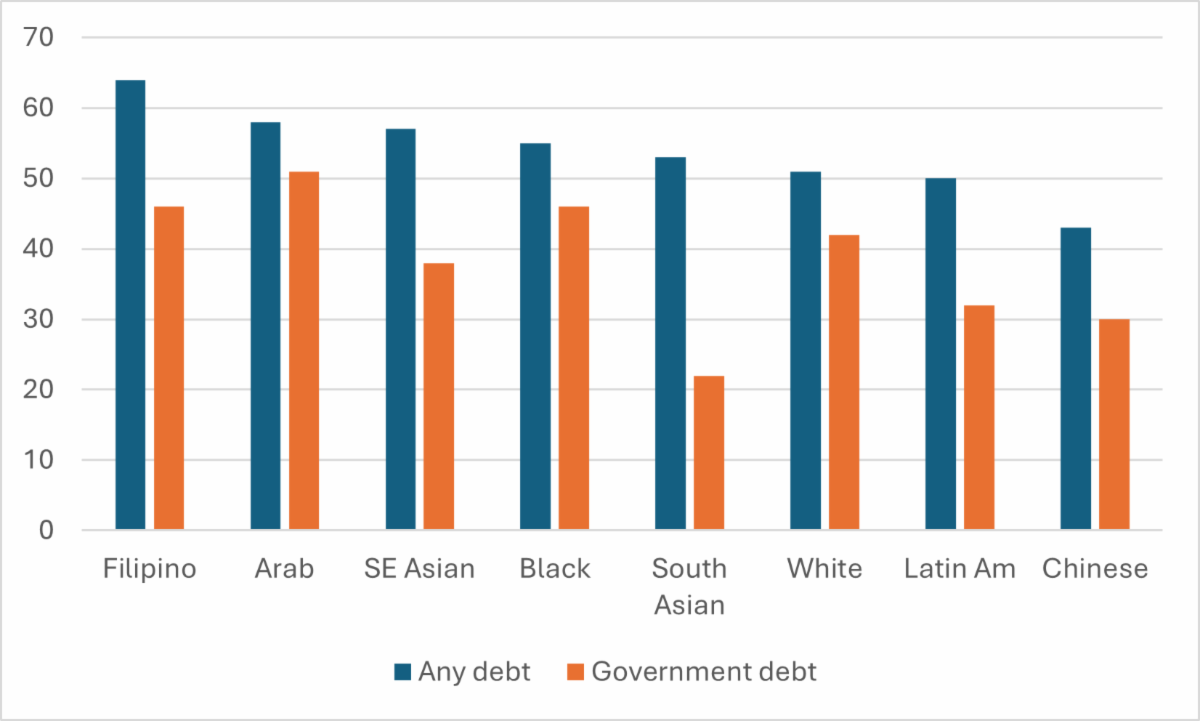
ICYMI – HESA: Student Debt by Ethnicity

Interesting variance and analysis, albeit relatively small:

Figure 4: Estimated Median 2023 Debt-to-Income Ratios, College and University Graduates Combined, Class of 2020

If you’re just dividing indebtedness by income (the blue bars), you get a picture that looks a lot like Figure 2 in debt, because differences in income are pretty small. But if you are looking at debt-to-income ratios across all students (including those that do not borrow) you get a very different picture because as we saw in Figure 1, there are some pretty significant differences in overall borrowing rates. So, for instance, Chinese students go from having the worst debt-to-income ratio on one measure to being middle of the pack on another because they have relatively low incidence of borrowing; similarly, students of Latin American origin go from being middle-of-the-pack to nearly the lowest debt-to-income ratios because they are a lot less likely to borrow than others. Black students end up having among the highest debt-to-income ratios not because they earn significantly less than other graduates, but because both the incidence and amount of their borrowing is relatively high.

But I think the story to go with here is that while there are differences between ethnic groups in terms of borrowing, debt, and repayment ratios, and that it’s worth trying to do something to narrow them, the difference in these rates is not enormous. Overall, it appears that as a country we are achieving reasonably good things here, with the caveat that if this data were disaggregated by university/ college, the story might not be quite as promising.

Source: Student Debt by Ethnicity

FIRST READING: Trudeau government already missing targets on pledge to bring down immigration

Annual changes in chart below. Monthly data indicates that change is happening:

In October, Prime Minister Justin Trudeau announced a suite of new controls on immigration designed to “pause population growth.” In a video at the time, Trudeau even expressed regret that he hadn’t curbed immigration sooner, saying, “We could have acted quicker and turned off the taps faster.”

Although admissions of international students have gone down dramatically in the interim four months, a new analysis by Desjardins finds that Canada is still accepting roughly the same amount of temporary foreign workers and permanent immigrants.

As such, the report said that Canadian population growth is about the same as it was before the October cuts, and isn’t likely to change without “more aggressive reductions.”

“We remain skeptical that the Government of Canada will be able to reach its (lower) target for admissions of newcomers,” it read.

Desjardins added that the Trudeau government often seems to make promises that it fails to fulfill, and that immigration reduction is a prime candidate for this.

Source: FIRST READING: Trudeau government already missing targets on pledge to bring down immigration

Selby: How narrow views of romance inform which marriages are seen as legitimate

For Valentine’s Day. Almost a killjoy commentary as not everything can or should be reduced to politics….:

…Legislation and scrutiny of marriages seen as fraudulent subtly position romance as a proxy to assess narrow liberal ideals. Somescholars have called this phenomenon a push for a “sexual democracy,” where women’s bodies are subtly expected to remain visible and sexually available as signs of their putative equality. 

Perhaps unexpectedly, niqab bans in both France and Québec further reflect these values. Full-face veils are, tellingly, depicted as lacking sexual agency and individualism, and impeding a cisgender woman’s ability to attract men.

Narrow views of what kind of romance should be legitimized and celebrated are not limited to governments. Such views also manifest in consumer culture and in the wedding industry, and are desired and performed by many of us, including among my research participants in arranged marriages. Romance’s pervasiveness, desirability and seeming spontaneity mask its politics.

As we enjoy romantic gestures on Valentine’s Day, we should also consider the cultural specificity of these tropes and their potentially exclusionary politics in determining whose relationships are deemed legitimate. Entrenchments of patriarchal chivalry, monogamy, consumerism and narrow gender roles can run in tandem.

Source: How narrow views of romance inform which marriages are seen as legitimate