Canada’s international student boom changed Brampton forever. As the program scales back dramatically, a strained community tries to adapt

Interesting deep dive regarding international students living in Brampton:

…Santos said the city first noticed the number of international students “growing significantly” in 2021 during the pandemic, mostly through reports of an increased number of illegal basement apartments and exponential use of food banks in the community.

At the time, the city helped organize an international student roundtable, summit and charter to discuss the challenges facing international solutions and bring together community leaders — and commit to finding solutions.

Local colleges have been supportive of the efforts, but she said the bigger issue has been all the students who live in Brampton but study elsewhere.

“One of the things we have advocated for is that student visas should be tied to their place of residence, not just their place of study,” said Santos, as it’s the local municipality that has to bear the cost of providing services for the residents, not the place where they might attend school.

The councillor has also asked the province increase the “heads and beds” levy, which sees the province pay municipalities $75 per person annually for those attending colleges and universities in lieu of property taxes to compensate for the cost of services like transit, roads, sewers, parks and recreation. Santos, in line with other municipal groups, has pushed for a doubling of that rate, and also asked that that the money be paid to the municipality where students live as opposed to where they are registered to study.

In Kaur’s case, for example, Toronto would receive the levy — even though she lives in Brampton. 

The city has also launched a residential rental licensing pilot program, aimed at targeting landlords who rent out rooms that are unsafe to students. The program allows bylaw officers to issue fines, but some landlords and critics say the licensing has made it more difficult for students to find any housing at all.

More recently, Santos said she has heard of dozens of cases of sex trafficking among students who have been forced to work as prostitutes in exchange for a place to live. But she said the data on the issue is scarce as most students are too scared to speak up, out of shame and the fear of having their student visas cancelled.

Fears of an ‘underclass’

In November, Brampton council passed a motion asking the federal and provincial governments for more support for students.

The motion asks to expand funding eligibility to allow international students to access existing regional supports, to increase the number of hours they can work in a week to 40 (from the federally mandated 24 hours a week), so students can access legal work from employers. It also asks for money to support a three-year pilot project that offers culturally responsive support around settlement, housing, employment and mental health.

Gurpreet Malhotra, the CEO of Indus Community Service, a settlement agency that supports Indo-Canadians, said the organization is working on the pilot project, and sent a proposal to federal immigration minister Marc Miller at a meeting in November. The two parties met this week.

“Our goal is to advocate with higher levels of government to ensure a better experience for these international students so they can settle and become unscarred and productive members of our community,” said Malhotra.

He said he fears it will lead to the “creation of an underclass,” if things continue as is.  

“When you are working under the table, and living under the table and don’t have access to social services, you have a built-in vulnerability to criminal and other negative activities,” he said.

Brown said while the federal and provincial governments have started to change policy in reaction to a growing backlash across the country, few are talking about how to support those who are already here.

“The question is, are those international students going to try to become permanent residents or are those students going to try to return home, and I don’t think we have clarity on that yet,” he said.

That’s why some local officials say the impact of the federal policies — particularly student caps — will be felt less in Brampton.

“Brampton will be the last place where the number of international students will go down,” said Toor, adding that many students have ties to the community and will opt to stay here.

But he’s unsure of how the city will manage in the long run. “This is not something we can absorb, as a city,” said Toor. “Just the scale of the population increase is immense for the city to handle it all — without planning for it.”
Source: Canada’s international student boom changed Brampton forever. As the program scales back dramatically, a strained community tries to adapt

CIBC Tal on NPRs: Short-term pain, long-term gain

Interesting take and does have provide a logic for regularization. But the devil will be in the details: “If as a society we manage to create the conditions for better integration of NPRs in the labour market over time, we should be able to reverse the negative trajectory in productivity growth of the past few years.”

àWhat conditions, how to establish, how to enforce:

…Due to the recent government response, the pace of NPR arrivals is expected to slow down notably in the coming years, although not by as much as predicted by official numbers. For reasons we have spelled out elsewhere, policymakers and analysts cannot assume that the over one million current temporary residents in Canada with expired visas will simply leave the country over the next two years.

In other words, the demographic change of the past few years is not about to reverse. Economic theory and common sense suggest that that is a good thing. After all, an aging population is viewed as a major drag on productivity in most OECD countries. The youth dividend enjoyed by Canada is unique. Yes, clearly it has been too much of a good thing in a very short period of time.

But from a longer-term perspective, retaining and integrating current immigrants and NPRs would result in stronger potential growth and improved productivity, as more new arrivals find employment closer to their skill level or add to their skillset. If as a society we manage to create the conditions for better integration of NPRs in the labour market over time, we should be able to reverse the negative trajectory in productivity growth of the past few years.

Source: NPRs: Short-term pain, long-term gain

HESA: Taking Donald Trump Seriously and What it Means for Canadian Higher Education

The article on Indian H1-B workers and family concerns regarding their children born in the USA could provide an example of a Canadian advantage along with a more accessible immigration system but uncertain:

…It would of course be nice if we could run the clock back to 2017. Back then, we talked bravely about how Canada might benefit from Trump, what with all the people clamoring to get out because of racism, interference in science, etc. There was, in short, an upside to chaos south of the border. But none of that is going to happen this time. The combination of an underpowered economy, overheated housing markets, and a general disinterest in funding science and education mean that there is little public license to seek a rise in immigration even for the most highly skilled. This is the price we pay for our generalized political complacency: when lemons strike, we can’t make lemonade.

That said, there should be opportunities, mainly research-based, in the maelstrom of change to come. The question is: which universities will be nimble enough to take advantage of them?

Source: Taking Donald Trump Seriously and What it Means for Canadian Higher Education

Trump’s birthright citizenship order rattles H-1B workers expecting a baby

Seems like the hardliners won this debate within the Trump administration but court decisions will likely make this moot:

Ajay’s dilemma shows the wide ranging fallout from the early days of Trump’s immigration crackdown. While the emphasis during the campaign was border security and deportations of people in the country without permission, some of Trump’s first executive orders have targeted legal immigrants. 

That includes refugees whose resettlement plans were canceled, asylum seekers whose appointments to plead their case were scrapped and holders of H-1B and other work and student visas who are now trying to navigate what the new policy on birthright citizenship means for their families.

The situation also highlights tension within the Trump universe about immigration. Elon Musk has called for an expansion of the H-1B visa program to help ensure a robust pipeline of workers for tech companies like his own, while others like Deputy White House Chief of Staff Stephen Miller have espoused more restrictive polices.

About 85,000 foreigners are allowed to move to the US annually under the coveted H-1B visa program, and there are now hundreds of thousands of people living in the US under those rules. Indians are the biggest recipients, accounting for 75% of all such visa petitions in 2020, with Chinese No. 2 with about 12% and Canadians No. 3. with 1%, according to US Citizenship and Immigration Services.

Under Trump’s order, citizenship would be denied to any child who doesn’t have at least one parent who is a US citizen or legal permanent resident. While it would apply to those in the country illegally — long a goal of Miller and others — it would also extend to those in the US as tourists, students or on temporary work visas.

The US is fairly unique in offering unconditional birthright citizenship, creating a special enticement for foreign workers deciding on which country to move to. Mexico and Canada have similar rules, but places including Australia, Germany, India and the UK don’t. If US nationals have a baby in Australia, for example, the child will automatically get the same visa status as the parents.

There is no official US data available about how many children are born to non-citizens annually. But in lawsuits challenging the order, lawyers said at least 150,000 children a year could be affected.

On Jan. 23, a federal judge in Seattle, John Coughenour, put the order on hold for 14 days and could extend that going forward. Other hearings set for challenges filed elsewhere are expected in the coming weeks.

Rajat Suri, a tech entrepreneur and co-founder of the ride hailing company Lyft Inc., said curtailing birthright citizenship has the potential to make it dramatically harder for US companies to recruit foreign workers.

“Every company that hires talented immigrants to come work for them, they are attracting them to build their lives, including families,” said Suri, whose latest venture is Lima, a company that helps foreign workers interested in moving to the US navigate the system. “If a baby is not going to be a US citizen, that is going to be a huge deterrent.”

He said attracting foreigners to the US is already complicated, given the extensive documentation and vetting needed to win a work visa. He met coworkers on temporary visas who opted to return home because of immigration complications, and adding a layer of uncertainty about the fate of any children born on US soil would only make things more complex, he said.

“We already put immigrants through so much unnecessary trauma,” said Suri, the child of Indian immigrants to Canada who is now a naturalized US citizen. “They will just go to some place that treats immigrants better, where they have options.”…

Source: Trump’s birthright citizenship order rattles H-1B workers expecting a baby

Five years on, Chinese Canadians recall ridicule and racism over pandemic precautions

Another reminder. One of my memories was flying back from LA late January 2020 and we and Chinese were the only ones wearing a mask:

…Once the pandemic was officially underway, data would eventually emerge suggesting caution in Chinese communities had yielded results, notably in the Metro Vancouver community of Richmond, B.C.

The city’s population is 54 per cent ethnically Chinese, according to the 2021 census, making it the most Chinese city in North America.

More than two years into the pandemic, British Columbia’s COVID-19 case distribution report in July 2022 showed the city had an infection rate by far the lowest in the Lower Mainland, and less than half of that in nearby Surrey. In a colour-coded infection heat map from that time, Richmond stands out as a pale island, surrounded by more heavily infected neighbouring municipalities.

Zhang says he has no doubt why Richmond’s COVID-19 numbers were so low before the virus mutated and new variants resulted in much higher rate of spread worldwide.

“I believe the COVID-19 cases in the Chinese community were the lowest since we paid so much attention to the pandemic and we set up systems to protect ourselves from COVID-19,” he said.

Poutanen said the process of making health recommendations against a new, evolving virus was similar to shooting at a moving target.

Health officials in Canada initially recommended against mask use by healthy, asymptomatic individuals. That ran counter to what health officials were saying in China and Hong Kong.

“Initially the thought was (for) symptomatic masking, but general masking was not needed,” Poutanen said of the Canadian response.

“That was partly because the thought was symptomatic spread is predominantly how this was being transmitted, but that changed. I certainly think that no question, masking — the mask mandates and knowledge of what masking can do now — is one of the ongoing infection control measures that we continue to use that is effective.”

Wu and other Chinese community members pointed to memories of the SARS outbreak from 2002 to 2004 in Hong Kong and mainland China, where hundreds of people died, as the dominant factor in their response to COVID-19. SARS also killed more than 40 people in Canada.

Wu still winces at the thought of how she was treated in the earliest days of the COVID-19 pandemic.

“It was just like it happened from yesterday,” Wu said, recalling being “the centre of attention” when she went masked and gloved into a grocery store, other shoppers “rolling their eyes.”…

Source: Five years on, Chinese Canadians recall ridicule and racism over pandemic precautions

Lipstadt: Antisemitism Is a Bipartisan Problem

Another reminder and warning:

At the conclusion of my confirmation hearings before the Senate Foreign Relations Committee in 2022, I was approached by a member of the committee who asked which posed a greater threat, antisemitism emanating from the political left or the political right? The question did not surprise me. I had heard it often, long before President Joe Biden had nominated me to serve as the State Department’s special envoy to monitor and combat antisemitism, the position I held for the past three years.

I replied that it made little difference to me whence the antisemitism came, I was against it. I described myself as an “equal opportunity” hater of antisemitism. The senator who asked seemed satisfied with my answer.

As the new administration begins and I leave this position, I have come to see, more clearly, that this oft-debated left/right question — that is, which side is worse — often serves as a political smoke screen.

The problem is that many on both the left and the right fail to call out antisemitism when it appears on their side of the political spectrum: Too many on the left are silent when it rears its head on university campuses. Too many on the right fail to condemn the overt antisemitism expressed by white nationalists. When I encounter this, it is clear to me that the intent is not to fight antisemitism but to use antisemitism as a cudgel against political opponents.

This is far too narrow a prism through which to acknowledge, assess and call out this hateful phenomenon. In the past few years, having witnessed the continued harm of antisemitism worldwide, I have become convinced that these double standards, which reduce the fight against antisemitism to partisan bickering, obscure the far greater threat that is Jew hatred.

I now see the threat in a multitiered fashion. Antisemitism is, first and foremost, a peril to Jews, their institutions and their communities. Whether the attack is on a synagogue in Australiasoccer fans in Amsterdam or women in Kibbutz Re’im and at the Nova music festival near the Israel-Gaza border, Jews are the target. And this alone would make it a legitimate matter for governments to address seriously. But antisemitism poses a threat beyond the threat to Jews.

It also threatens democracy and the rule of law. The cornerstone of antisemitism is a conspiracy myth which holds that “the Jews” control the most powerful levers of society, in government, media, finance and more. This lethal belief posits that Jews seek to empower and enrich themselves at the expense of all others. One might be inclined to dismiss this outlandish myth as merely a wild fantasy. But it has served as the rationale for genocide. Millions have been murdered because of it.

Those who adhere to this conspiracy theory — who see power ceded, not to a legitimate government, but to a Jewish cabal — have lost faith in the rule of law and are looking for someone or some group of people to blame. They’re willing to believe that their votes do not help them, their leaders do not represent them and their institutions do not protect them. Their distorted worldview renders accountable, rules-based government an illusion.

We have repeatedly seen malign groups and governments using it as a means of deepening public division within societies and among countries. Russia has propagated antisemitic conspiracy myths to help justify its war against democratic Ukraine. Iran supports the terrorist groups Hezbollah, Hamas and the Houthis by helping them cultivate antisemitic ideologies to justify depraved violence throughout the region. Their primary goal may not be only to spread Jew hatred, but to use Jew hatred to sow societal divisions and make all of us doubt the political health and strength of the democratic world.

Anything that erodes the rule of law and undermines our national security must be confronted collectively. But when antisemitism is viewed through a left/right lens, we risk making it the subject of a partisan debate. In doing so, we obscure the global threat it poses.

My tenure at the State Department was dedicated to ensuring that world leaders commit to taking the politics out of this issue. In 2024, the United States led 38 countries and four international bodies in outlining the Global Guidelines for Countering Antisemitism. These guidelines represent a landmark global framework intended to tackle Jew hatred and outline 12 best practices for governments and civil society to identify and act against this scourge. The guidelines make clear: “avoid politicization.” By endorsing these guidelines, members of the international community vow to combat antisemitism not as a political issue, but as a moral and policy imperative.

And in 2023, the United States released our first National Strategy to Counter Antisemitism. The National Strategy calls on members of Congress from both parties to work together and condemn antisemitism in all its forms. As I reflect on my tenure, I am proud of the important partnerships that I have forged on both sides of the aisle. Together, we must recognize that antisemitism assaults the very principles that define our open, free and democratic society. Tackling the current surge of global antisemitism must remain a bedrock of bipartisanship.

When antisemitism leads to violence, as it all too often does, the question we must ask ourselves is: How will we — Jew and non-Jew, left and right, people of all persuasions and beliefs — unite and respond?

Source: Antisemitism Is a Bipartisan Problem

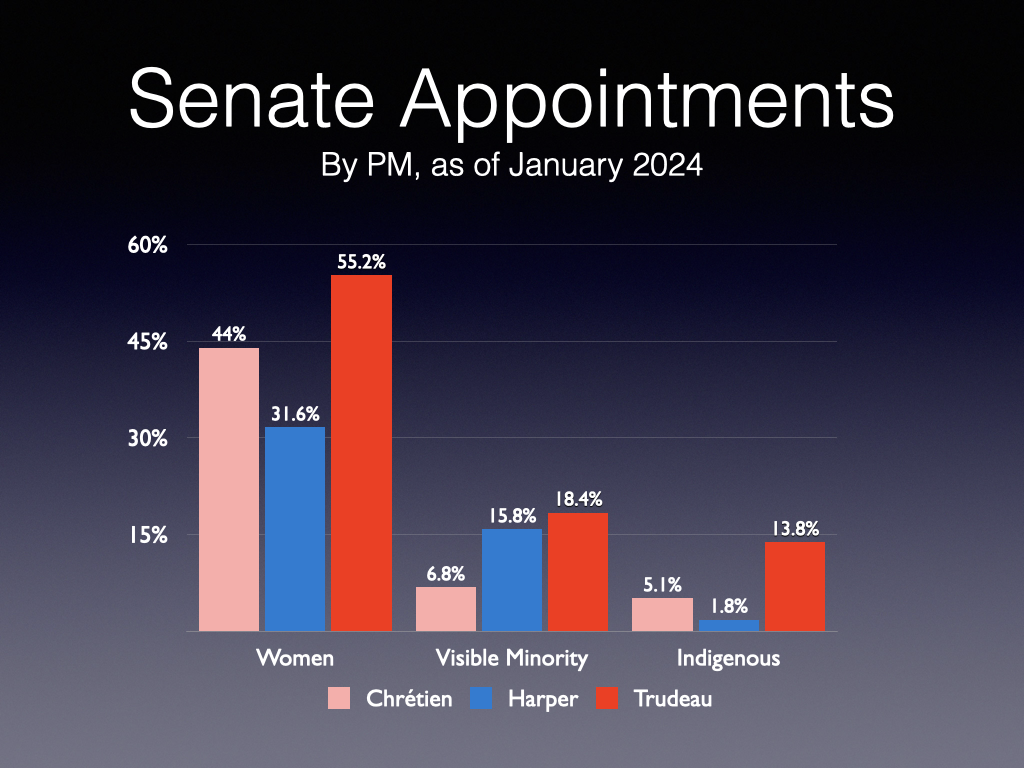
Trudeau to fill Senate vacancies before retiring: source

Diversity stats of appointments by PM (last minute senate appointments can be a poisoned chalice for governments):

…Prime Minister Justin Trudeau is planning a final wave of appointments to fill the 10 vacancies in the Senate before he retires in March, Radio-Canada has learned.

The move would allow him to leave a mark on Parliament for years to come, as these unelected legislators will be able to sit until the age of 75.

A source familiar with the matter says that the selection process for the future senators is already underway and should be completed before his departure. After proroguing Parliament earlier this month, Trudeau announced that he will leave power after the Liberal Party chooses a new leader on March 9.

In a written response, the Prime Minister’s Office confirmed that the advisory board for Senate appointments is at work to propose candidates for all vacancies.

“Prorogation did not affect the ability of the Governor General to make appointments to the Senate based on the advice of the prime minister,” said PMO spokesman Simon Lafortune. “The prime minister takes his responsibility to appoint senators seriously and will do so as long as he remains in office.”

The prime minister likes to praise the independence of the senators he has appointed since 2016, but he has nonetheless picked several high-profile Liberals to sit in the Senate in recent years.

The Conservative Party of Pierre Poilievre, which is leading in national polls, has long been critical of Trudeau’s choices of senators. The Conservatives now fear that Trudeau-appointed senators will try to block their agenda if the party wins the next election, which is expected in the spring.

There are currently 12 senators affiliated with the Conservative Party in the 105-seat chamber.

“For someone who advocated an independent Senate, [Trudeau] will have ended up filing the Senate with a large majority of Liberals or people who support his policies,” said Conservative Senator Claude Carignan….

Source: Trudeau to fill Senate vacancies before retiring: source

Lederman: At Auschwitz, there was no why

Lest we forget:

…Some of those lucky enough to survive Auschwitz not completely broken – many were – emerged with various whys as they sought a reason to go on. Primo Levi needed to tell the world. Elie Wiesel made it his mission to stop such horrors from happening ever again.

My mother’s why was simpler, less grandiose – if no less extraordinary. She met another survivor, they married, had three daughters. My parents, no longer alive, now have 23 descendants walking (or, in one sweet case, still just crawling) the Earth. We are her why.

I keep searching for mine. An obvious lesson of Auschwitz – beyond “do not murder” – could be to show kindness, care and respect for our fellow human beings. (I’ve had my moments, I know. I’m working on it.)

These can be small gestures, or they can be very big ones. But they must trump cruelty. I don’t think I need to explain why.

Source: At Auschwitz, there was no why

Worswick: If Ottawa botches the economy now, Canada might break apart [immigration aspects]

Of note:

…Immigration has followed a roller coaster over the past seven years, expanding dramatically and then being cut back to historical levels. Renewing our focus on high-skilled immigration rather than filling lower-wage jobs will help raise our average skill level and standard of living, positioning Canada to manage external shocks such as the proposed U.S. tariffs. Also, we need to rethink our international student policy. We should prioritize students in academic programs likely to have higher income jobs after graduation since many of these students will want to remain as economic immigrants. Given that immigration is a shared federal and provincial jurisdiction, we will need co-operation from both levels of government to achieve an economic immigration program that benefits Canada to the greatest extent possible.

Canadian housing affordability has declined in recent years as we seem unable to build housing fast enough to match our population growth. If this continues, more young Canadians will become disillusioned with Canada and may be attracted to alternatives such as Quebec sovereignty or Western separatism. We must make it a national priority to ensure that housing expands with population growth so that we can gain the important economic benefits from skilled immigration while also ensuring that all Canadians can afford housing.

We should see our national unity issues as opportunities to rally support for addressing these significant policy challenges. If provincial governments recognize that a united Canada is not guaranteed, they will be more flexible in terms of finding policy solutions to our economic challenges rather than risk a further deterioration in our national unity. Also, if the federal government can work constructively with the provinces on these questions, this could go a long way to convince Canadians that we have a future together.

Source: If Ottawa botches the economy now, Canada might break apart

Canada’s ‘smuggler’s paradise’ under renewed scrutiny amid Trump threats

Of interest:

…Akwesasne is part of what law enforcement agencies call the Swanton Sector, a vast stretch of eastern Ontario, Quebec, New York State, Vermont and New Hampshire. According to U.S. Customs and Border Protection, this is where the majority of illegal crossings happen from Canada – and it’s been on a dramatic rise in the past two years. The agency said it had made 19,300 apprehensions of illegal immigrants in the past fiscal year, up from the average of around 1,000 just a few years ago.

Canadian border officials also say the number of people coming the other direction illegally is on the rise. Last year, CBSA officers caught almost 34,000 foreign nationals along all land crossings with the U.S. who they believed were “inadmissible,” an increase of about 30 per cent from 2023. This is in addition to the more than 1,183 asylum seekers the RCMP caught last year trying to cross into Canada by land. In response to questions from The Globe, Canadian authorities said they couldn’t immediately isolate figures for the Swanton Sector.

On Jan. 7, investigators trailed the men after receiving evidence they say warranted a traffic stop under the Excise Act, which is typically used to prevent tobacco or cannabis smuggling. Akwesasne has a long history as a funnel for both. Tax-exempt cannabis and smoke shops are everywhere on the reserve, and old tobacco factories still stand here, from the era when cigarette companies used the territory to avoid paying taxes on their products….

Source: Canada’s ‘smuggler’s paradise’ under renewed scrutiny amid Trump threats