Le Devoir Éditorial | Intolérance, stupeur et consternation [racism among health care workers]

Timing could not be worse as CAQ government prepares its model of integration for Quebec. Reminder that reciprocal obligations apply to the host population as well:

C’est une histoire à faire hurler, sise aux frontières de nos espoirs d’intégration des immigrants et de la plate réalité du terrain, encore raviné par des poches d’intolérance et de discrimination. Les allégations de racisme au cégep et au CISSS de l’Abitibi-Témiscamingue, subi par des hommes et des femmes venus d’Afrique pour devenir infirmiers ici, ont tout pour ébranler le gouvernement Legault, lui qui doit dévoiler jeudi un projet de loi-cadre destiné à redéfinir le modèle québécois d’intégration des immigrants. Quelle ironie !

Il y a de ces hasards de calendrier qui font réfléchir. Le Devoir révélait mardi, sous la plume de sa journaliste Lisa-Marie Gervais, que des étudiants venus d’Afrique à l’invitation du gouvernement du Québec pour prêter main-forte en soins infirmiers avaient subi ce qui a toutes les allures du racisme. Dans un rapport obtenu par notre reporter et relatant les humiliations sévères infligées aux étudiants, ce passage ne peut que faire frémir : « Il paraît qu’en Afrique, vous êtes tous des animaux. C’est pour ça qu’au Rwanda, les gens se sont entretués. » Cette phrase indigne aurait été prononcée par une enseignante qui devait accompagner et former ces personnes, tous déjà des infirmiers dans leur pays natal.

L’origine de cette affaire compte pour beaucoup dans l’horreur qu’elle inspire. C’est dans le cadre d’un de ces programmes idylliques lancés par le Québec pour suppléer à une pénurie de main-d’œuvre au sein du personnel infirmier que ces étudiants ont foulé le sol québécois. Partis de leur continent africain avec une solide formation infirmière, ils étudiaient et subsistaient grâce à un programme du ministère de l’Immigration, de la Francisation et de l’Intégration (MIFI) décliné en quatre phases, et visant à terme la formation aux normes du Québec de 1500 infirmiers francophones. Le tout dans le cadre du Plan d’action ministériel pour la reconnaissance des personnes immigrantes.

L’ensemble de l’œuvre bénéficie du soutien des ministères de la Santé et des Services sociaux et de l’Enseignement supérieur. Ces détails non négligeables viennent ajouter une couche d’opprobre à l’affaire : ce fiasco est survenu sous la gouverne d’autant d’instances responsables vantant les mérites de ce parfait entrecroisement de l’offre et de la demande.

Le drame des étudiants humiliés s’est joué à plusieurs chapitres. D’abord, il y a eu les insultes racistes et les actes de dénigrement venus d’enseignantes et de responsables, tant du cégep de l’Abitibi-Témiscamingue que du CISSS où les étudiants effectuaient des stages et du travail à temps partiel comme préposés aux bénéficiaires, le tout en totale conformité avec le programme gouvernemental. Ensuite, l’échec scolaire. Ce sont des taux d’échec anormalement élevés le printemps dernier qui ont sonné la première alarme, car ainsi recalés, les candidats ont vu le sol se dérober sous leurs pieds : perte instantanée de l’allocation versée par le MIFI, impossibilité de travailler, retrait de l’assurance médicale. Certains ont pu effectuer une reprise, d’autres, non. Une infirmière ayant soutenu les victimes en dénonçant le traitement subi a été congédiée du CIUSSS où elle travaillait.

Un consortium indépendant dépêché en Abitibi-Témiscamingue pour résorber la crise a témoigné dans un rapport accablant de la nature des opérations de dénigrement constantes subies par les étudiants. Mais, comble de l’injure, ledit rapport ne s’est pas rendu aux autorités concernées, comme si on avait voulu cacher l’inénarrable. Une demande d’accès à l’information et une démarche journalistique ont permis de découvrir de quel traitement « dégueulasse » — le mot du ministre responsable de la Lutte contre le racisme, Christopher Skeete, en réaction à notre reportage — les étudiants avaient été victimes.

Interrogé sur cet événement malheureux, le directeur à la formation continue du cégep, Julien Pierre Arsenault, a parlé d’une question de « perceptions ». Dans d’autres médias, mardi, il dénonçait avec plus de vigueur les allégations de racisme.

Tout cela survient alors que le ministre de l’Immigration, de la Francisation et de l’Intégration, Jean-François Roberge, doit dévoiler jeudi un projet de loi-cadre dictant les termes d’un nouveau modèle d’intégration au Québec. Le ministre, qui dénonce haut et fort toute forme de xénophobie ou de racisme comme celle transpirant de notre reportage, affirme que son intention n’est pas seulement de dicter les exigences attendues des nouveaux arrivants, mais de déterminer aussi quels sont les devoirs et responsabilités de la société d’accueil, au nom d’un « principe de réciprocité ».

Les récits racontant des manifestations claires de racisme systémique dans les univers de l’éducation et de la santé ont malheureusement été suffisamment nombreux pour qu’on s’en inquiète. Bien que ce gouvernement résiste encore à nommer ce racisme installé dans certaines de nos organisations, il devrait comprendre qu’en repoussant les évidences, il contribue en quelque sorte à gangrener les préjugés. C’est le premier signe d’une volonté d’intégration de façade.

Source: Éditorial | Intolérance, stupeur et consternation

It is a story to scream, located on the borders of our hopes for the integration of immigrants and the flat reality of the field, still ravined by pockets of intolerance and discrimination. The allegations of racism at the CEGEP and the CISSS of Abitibi-Témiscamingue, suffered by men and women who came from Africa to become nurses here, have everything to shake the Legault government, which is due to unveil on Thursday a framework bill to redefine the Quebec model of immigrant integration. What an irony!

There are those calendar coincidences that make you think. Le Devoir revealed on Tuesday, under the pen of its journalist Lisa-Marie Gervais, that students who came from Africa at the invitation of the Quebec government to lend a hand in nursing care had suffered what has all the appearance of racism. In a report obtained by our reporter and reporting the severe humiliations inflicted on students, this passage can only make you shudder: “It seems that in Africa, you are all animals. That’s why in Rwanda, people have been king each other. This unworthy sentence would have been pronounced by a teacher who had to accompany and train these people, all already nurses in their native country.

The origin of this case counts for a lot in the horror it inspires. It was as part of one of these idyllic programs launched by Quebec to make up for a shortage of nursing staff that these students set foot on Quebec soil. Starting from their African continent with a solid nursing training, they studied and subsisted thanks to a program of the Ministry of Immigration, Francisation and Integration (MIFI) declined in four phases, and eventually aimed at training 1500 French-speaking nurses to Quebec standards. All under the Ministerial Action Plan for the Recognition of Immigrants.

The entire work is supported by the Ministries of Health and Social Services and Higher Education. These significant details add a layer of reproach to the case: this fiasco occurred under the guidance of so many responsible bodies touting the merits of this perfect intertersection of supply and demand.

The drama of the humiliated students was played out in several chapters. First, there were racist insults and acts of denigration from teachers and managers, both from the Abitibi-Témiscamingue CEGEP and from the CISSS where students carried out internships and part-time work as beneficiaries’ attendants, all in full compliance with the government program. Then, school failure. It was abnormally high failure rates last spring that sounded the first alarm, because thus failed, the candidates saw the ground escape from under their feet: instant loss of the allowance paid by the MIFI, inability to work, withdrawal of medical insurance. Some were able to make a recovery, others were not. A nurse who supported the victims by denouncing the treatment suffered was dismissed from the CIUSSS where she worked.

An independent consortium dispatched to Abitibi-Témiscamingue to resolve the crisis testified in a damning report on the nature of the constant denigration operations suffered by students. But, to the height of the insult, the said report did not go to the authorities concerned, as if they had wanted to hide the unspeakable. A request for access to information and a journalistic approach made it possible to discover what “disgusting” treatment – the word of the minister responsible for the fight against racism, Christopher Skeete, in reaction to our report – the students had been victims.

Asked about this unfortunate event, the director of continuing education of the CEGEP, Julien Pierre Arsenault, spoke of a question of “perceptions”. In other media, on Tuesday, he more vigorously denounced allegations of racism.

All this comes as the Minister of Immigration, Francisation and Integration, Jean-François Roberge, is due to unveil on Thursday a draft framework law dictating the terms of a new integration model in Quebec. The minister, who loudly denounces any form of xenophobia or racism such as that transpiring from our report, says that his intention is not only to dictate the demands expected of newcomers, but also to determine what the duties and responsibilities of the host society are, in the name of a “principle of reciprocity”.

Unfortunately, there have been enough stories of clear manifestations of systemic racism in the worlds of education and health to be concerned. Although this government still resists naming this racism installed in some of our organizations, it should understand that by pushing back the evidence, it contributes in some way to gangrenous prejudice. This is the first sign of a desire to integrate the facade.
Attention: Birth Tourism Notice [Humber River Health]

Wonder whether other hospitals have similar language (Humber had the highest percentage of non-resident self-pay births 2023-24):

Please be advised that while Humber River Health provides a High Quality full service Obstetrical Program, we do not support birth tourism.

We are not affiliated, associated, or in any way officially connected with CanadaMama Consulting  or any other birth tourism agency – despite any social media or website advertising they may choose to produce.

We urge all patients and families to exercise caution and ensure proper due diligence before entering into an agreement with third party organizations offering birth tourism.

Should you have any questions about the programs or services offered at Humber River Health or our current partnerships, please contact our Patients Relations Representative directly at (416) 242-1000.

Non-OHIP Rates for Uninsured Patients

Thank you for choosing Humber River Health as the place to have your baby.  

Your care provider (physician or midwife) will review the finance process with you during your prenatal visits.  

Effective November 13, 2023, the total charge for non-OHIP patients planning to deliver at Humber is $10,028 for the delivery. However, the cost of the hospital stay is subject to change and can only be confirmed on the delivery day and specific care needs. Non-OHIP birthing fees apply to gestational surrogacy whereby any parties of the surrogacy arrangement are from of out of country (even if some parties have OHIP).  Fee details need to be discussed with Cashier’s Office and payment made prior to the hospital delivery.

We ask that patients pay the full fees ten (10 days) prior to their hospital delivery.  Once payment is made, an official receipt will be provided by Cashier Office.  You will present this official receipt to the Birthing Unit Triage desk at time of registration. 

You can make the payment by cash, debit or credit card in person at the Cashier Office located at Level 1 room 1e1006 (east of Tim Horton’s near Emergency Department Fast Track Zone) of Humber River Health Hospital at 1235 Wilson Avenue.  A copy of your receipt will be issued to you….

Source: Attention: Birth Tourism Notice

Trump signs executive order to cancel student visas of ‘Hamas sympathizers’ who protested Israel’s war in Gaza

Already prompting similar calls in Canada, we article on Poilievre comments below:

President Donald Trump has signed an executive order promising “immediate action” from federal law enforcement against noncitizen college students and others in the United States who participated in pro-Palestinian demonstrations during Israel’s war in Gaza.

The president has pledged to “deport” all “resident aliens” who joined protests, Trump said in a White House fact sheet.

“Come 2025, we will find you, and we will deport you,” he vowed.

Trump also pledged to “quickly cancel the student visas of all Hamas sympathizers on college campuses, which have been infested with radicalism like never before,” he claimed.

The Department of Justice will “aggressively” prosecute what it characterizes as “terroristic threats, arson, vandalism and violence against American Jews” after “the explosion of antisemitism” on college campuses in the wake of Israel’s campaign, according to the White House.

“It shall be the policy of the United States to combat anti-Semitism vigorously, using all available and appropriate legal tools, to prosecute, remove, or otherwise hold to account the perpetrators of unlawful anti-Semitic harassment and violence,” the executive order states.

As The Independent has reported, both antisemitism and Islamophobic threats and violence surged after Hamas invaded Israel in 2023, kicking off the war in Gaza and widespread protests on U.S. campuses.

Under the order, government agencies have 60 days to produce a report “identifying all civil and criminal authorities or actions” to “curb or combat” antisemitism, with an inventory of complaints “against or involving” antisemitism in colleges and universities.

The U.S. Attorney General is “encouraged to employ appropriate civil rights enforcement authorities” to combat antisemitism, the order states.

Source: Trump signs executive order to cancel student visas of ‘Hamas sympathizers’ who protested Israel’s war in Gaza

Meanwhile in Canada:

FIRST READING: As anti-Israel rallies continue unabated, Poilievre calls for deportations

We see on our own streets antisemitism guided by obscene woke ideologies that have led to an explosion in hate crimes,” Poilievre said in a brief address at the official Holocaust Memorial Day ceremony in Ottawa.

He then added, “we must not just condemn these things, we must take action against them.”

“We must deport from our country any temporary resident that is here on a permit or a visa that is carrying out violence or hate crimes on our soil.”

Ever since the October 7 Hamas-led terrorist attacks against Israel, Canada has been hit by hundreds of anti-Israel rallies, blockades, and other actions — many of them organized by a handful of openly anti-Zionist groups including Toronto4Palestine, the Palestinian Youth Movement, and student groups such as McGill University’s Students for Palestine’s Honour and Resistance.

Some of the rallies were initially celebratory, but they quickly shifted to calls for “ceasefire,” often with the claim that Israel was committing genocide.

Now that a Gazan ceasefire has been in place since Jan. 19, rallies have continued unabated, often with calls for Palestinian “resistance” to continue until Israel’s complete destruction.

“The fight isn’t over. In fact, it has just begun,” Toronto4Palestine

Matthews: Can we at least put a stop to ‘birth tourism’ (USA)?

Some useful data in the commentary:

President Trump ignited a flurry of activity with his executive order attempting to stop “birthright citizenship” — the constitutional provision that all children born on U.S. soil (including the territories) automatically become U.S. citizens. Based on the first judge to rule on Trump’s EO, it appears the administration faces an uphill battle in the courts. But whatever the courts decide on birthright citizenship, Americans should at least be able to agree that the practice of “birth tourism” is an abuse of the system and should be stopped.

Birth tourism is when pregnant women from other countries enter the United States for the purpose of having their child, who under the 14th Amendment automatically becomes a U.S. citizen, usually returning home thereafter.

For example, the health policy news site Fierce Healthcare wrote in 2009, “Of late, a growing number of well-to-do Mexican mothers have been coming to the U.S. to have their babies, who automatically get American citizenship since they were born on U.S. soil.” One Arizona medical facility marketed “a ‘birth package’ offering cutting edge technology, cozy settings and the chance for mothers to grant their babies American citizenship.” The facility even posted its (2009) prices: $2,300 for a vaginal birth and $4,600 for a c-section.

While Mexican women may have been the primary offenders in the past, the Center for Immigration Studies (CIS) reported in 2020 that the list of countries has expanded to China, Taiwan, Korea, Nigeria, Turkey, Russia and Brazil. It adds that birth tourism has grown dramatically in some of the U.S. territories, where Chinese citizens can easily obtain visas to visit.

A senior policy director at Georgetown Law’s O’Neill Institute wrote in 2018, “Women from foreign countries, mainly China and Russia, are paying tens of thousands of dollars to temporarily relocate to the U.S. during their pregnancy in order to give birth in the U.S. and thereby guarantee U.S. citizenship for their child.”

The Wall Street Journal adds, “Companies in China have attracted attention in recent years for advertising such services, and airlines in Asia even started turning away some pregnant passengers they suspected of traveling to give birth.”

The federal government tried to limit birth tourism during the first Trump administration. The U.S. Department of State announced in January of 2020, “[T]he Department is amending its B nonimmigrant visa regulation to address birth tourism. Under this amended regulation, U.S. consular officers overseas will deny any B visa application from an applicant whom the consular officer has reason to believe is traveling for the primary purpose of giving birth in the United States to obtain U.S. citizenship for their child.”

It’s unclear how strictly this order has been enforced, especially given President Biden’s lax approach to immigration. But Trump wants to clamp down on the practice again by tightening the criteria to qualify for a tourist visa, the Journal reports.

How many births are we talking about? In 2020 the CIS estimated “that birth tourism results in 33,000 births to women on tourist visas annually.” While that’s a small percentage of the estimated 4.4 million child-citizens born to illegal immigrants, according to the Pew Research Center, it’s still a significant number.

To be sure, there are some key differences between birth tourism and those residing in the U.S. illegally who take advantage of birthright citizenship. Women engaging in birth tourism may be from upper-income families who enter the U.S. or its territories legally on a visa. And those returning with their child to their home country are unlikely to become a drain on taxpayers by signing up for various benefits available to children.

Then why do these women go to the trouble? Apparently, the hope is since their child is a U.S. citizen, they would receive preferential treatment in the future if or when they seek to move to the U.S. But even if one can sympathize with their goal, birth tourism is a flagrant abuse of the 14th Amendment’s birthright citizenship provision.

The courts, and ultimately the Supreme Court, will determine the merits of Trump’s executive order, but most legal scholars think ending birthright citizenship will take either legislation or a constitutional amendment.

But even if the courts uphold the 14th Amendment’s long-accepted meaning of birthright citizenship, that may not extend to birth tourism.

The Supreme Court permits exceptions and limitations to many of our constitutional rights. You have a Second Amendment right to own a gun. But the courts allow certain venues — e.g., government buildings, schools, commercial airplanes and sports facilities  — to prohibit bringing a gun on the premises.

The best solution is for Congress and the Trump administration to pass comprehensive immigration reform, which could include any limitations or restrictions Congress wants imposed on birthright citizenship. Unfortunately, comprehensive reform is unlikely until Republicans believe they have regained control of the borders. And that may take a while.

Merrill Matthews is a public policy and political analyst and the co-author of “On the Edge: America Faces the Entitlements Cliff.” 

Source: Can we at least put a stop to ‘birth tourism’?

Birth tourism rebounds close to pre-pandemic levels in B.C. as Trump takes action in U.S.

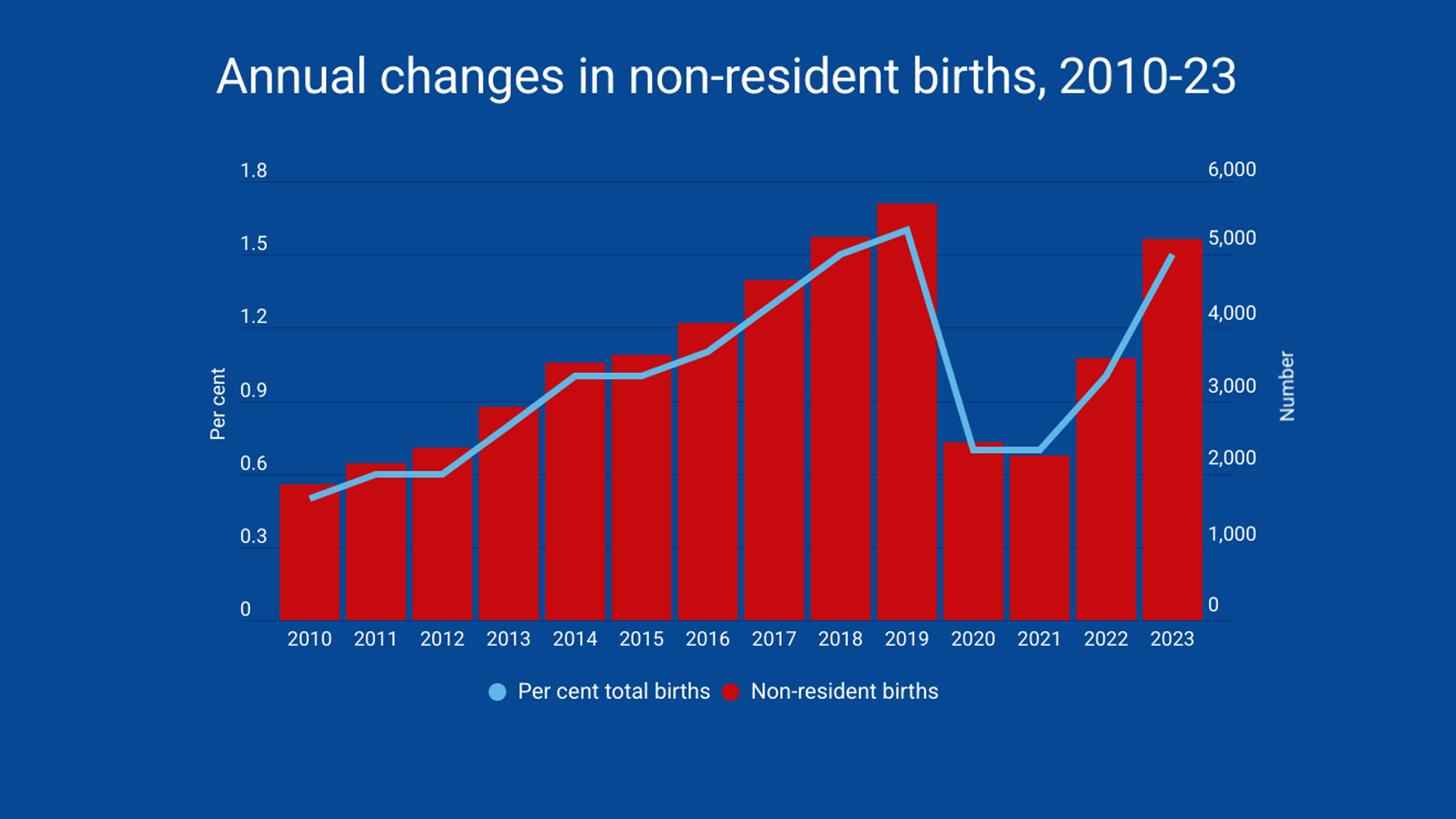
After falling precipitously during the COVID-19 pandemic, the number of births in B.C. from non-residents rebounded significantly in 2024, suggesting a resurrection of the birth tourism cottage industry, says immigration analyst Andrew Griffith.

And, said Griffith, the newly released health data, comes as U.S. President Donald Trump vows — not without controversy — to curb the practice south of the border, raising questions about a likewise response here in Canada.

“The effect on Canada of Trump’s executive order prohibiting birth tourism is unclear but may result in an incoming Conservative government to re-examine the issue,” said Griffith.

The former director general for the Citizenship and Multiculturalism branch of Citizenship and Immigration Canada released this week, via Policy Options, new annual figures on non-resident births across Canada showing 5,219 such births in 2023-24.

That is nearly as many as the record 5,698 seen in 2019-20 and more than double the short-term low of 2,245 experienced in 2021-22.

Between April 1, 2019, and March 31, 2020, 868 non-residents of Canada, excluding temporary foreign workers, refugees and international students, paid to give birth in B.C. hospitals alone.

Last year 513 such births occurred in B.C., up from an average of 152 during the two pandemic-impacted years. B.C. provides public health care (Medical Service Plan) to international students, temporary foreign workers and refugees, who do not factor into the data.

Unique to B.C. was the birth tourism industry in Richmond, as 24 per cent of all births there in 2019-20 were to non-residents on account of a burgeoning birth tourism cottage industry, such as birthing hotels run out of homes for pregnant Chinese nationals on tourist visas.

But that phenomenon appears to have disappeared.

“The decline in visitor visas granted to Chinese nationals is reflected in British Columbia’s Richmond Hospital, once the epicentre of birth tourism, declining from 24 per cent pre-pandemic and only recovered partially to sevent percent in 2023-24,” said Griffith.

Last year the top B.C. hospitals for such births were Richmond (102), Surrey Memorial (99), St.Paul’s/Mount Saint Joseph (97) and Children’s (85).

At issue is the fact birth tourism has raised ethical and practical questions around delivery of health-care services for Canadian women.

Source: Birth tourism rebounds close to pre-pandemic levels in B.C. as Trump takes action in U.S.

Michael Barutciski: With Trump’s deportations underway, what will Canada’s asylum policy look like? 

Useful reminder of limits. But Trump policies undermine the principles underlying the STCA:

In light of the Trump administration’s early moves to deport migrants without legal status in the U.S., there’s been heightened debate here in Canada about how we may (or may not) be positioned to handle a surge of claimants seeking refuge. Beyond the logistical capacity issues of handling high volumes of cases at our border, there are outstanding questions about Canada’s legal obligations to claimants and what, if any, policy and legal scope we have to manage the potential influx. The truth is it is greater than is often understood.

A key source of the confusion is that for years many in Canada have held a false assumption about the legal constraints imposed on our asylum procedures through a landmark Supreme Court decision in 1985, Singh v. Canada. The Globe and Mail’s editorial board recently repeated this mistake, asserting that Canada’s top court decided the Charter guarantees asylum seekers the right to a hearing as soon as they set foot in the country. This misreading of Singh has a real effect on our immigration predicament.

The Supreme Court did establish an important general rule in Singh: all persons who arrive at the border are covered by the Charter, regardless of their immigration status. Yet establishing that the Charter applies is not the same as interpreting the content of these Charter rights in various contexts.

In terms of refugee status determination procedures, the Supreme Court noted in Singh that the claimants, all Sikhs, were going to be sent by Canadian authorities back to their home country. For six of the seven claimants, this meant being returned to India, a country the Court considered dangerous for them given the violent internal tensions at the time. (The other claimant was to be returned to Guyana.)

However, the Supreme Court never generalized by saying that all claimants always have a right to a hearing. That is the exaggerated interpretation encouraged for years by activists and wishful-thinking academics. If claimants come to Canada via a safe third country, such as the U.S., then they can be returned to that country. This is the basic principle at the heart of the Safe Third Country Agreement (STCA), which the Court accepted last year when it refused to declare the agreement unconstitutional (as activists and academics have been demanding for years).

In other words, dealing with asylum claimants coming from the U.S. is a different situation than the one addressed in Singh and the legal constraints are not the same. This nuance is recognized in both the 1951 Refugee Convention and Canadian legislation. The convention does not even mention anything about hearings. Its most basic protection is the principle of “non-refoulement,” which stipulates that refugees cannot be returned to a country where their “life of freedom would be threatened.” It allows claimants to be returned to safe countries, which is why the adoption of the STCA was possible in the first place.

Section 101 of the Immigration and Refugee Protection Act specifically includes eligibility clauses that should suggest caution to anyone who believes automatic access to a hearing is part of Canada’s system. There is an initial determination as to whether the migrant is eligible to make a claim, including various security-related grounds of inadmissibility.

Moreover, there is also a clause rendering claimants ineligible when they come “directly or indirectly to Canada from a country designated by the regulations.” This is the legislative provision that enables return to the U.S. Even a cursory reading of the act should make clear that an automatic right to a refugee hearing was never intended or established by Parliament.

Despite these legal provisions, the Liberals have spent years reinforcing the confusion regarding Singh, constantly asserting that asylum seekers trying to enter “irregularly” at Roxham Road had the right to a hearing. When the government’s inaction regarding the illegal crossings led to record numbers of asylum claimants and public anxiety over the lack of border control, the government eventually negotiated an amendment to the STCA that essentially closed Roxham Road. Nobody seemed to notice that the supposed right to a hearing in Canada disappeared.

It is ironic that Prime Minister Trudeau recently acknowledged in the French version of a YouTube video that asylum seekers at Roxham Road were actually abusing the system. This incoherent and unserious approach was again revealed when Immigration Minister Marc Miller repeated the false argument about a supposed unqualified right to a hearing during a press conference explaining the reimposition of visas on Mexican nationals (who he claimed were abusing the asylum system).

After many years of lax asylum policies, followed more recently by continual controversies, there now appears to be an attempt to debate the country’s genuine asylum dilemmas with the Globe’s editorial board suggesting “new thinking is needed.” Most reasonable Canadians realize that tightening the current asylum system in a manner that treats claimants fairly is sufficiently challenging; we do not need to make it even more difficult by inventing legal constraints.

Singh established that asylum seekers in Canada who risk being returned to a dangerous country benefit from a right to a hearing if they claim protection. The corollary is equally important if we are to explore creative solutions to Canada’s asylum problems: there cannot be a Charter violation if asylum seekers are sent to a safe country. Although it will disappoint activists, the future of a sustainable asylum system will inevitably involve extraterritorial procedures and an extension of the safe third-country idea. We need to properly grasp basic legal constraints to make sure these procedures are as fair and humane as possible.

Source: Michael Barutciski: With Trump’s deportations underway, what will Canada’s asylum policy look like?

Multiculturalism is a bad fit for Quebec, immigration minister says

Here we go again. On the positive side, they will need to develop a definition that can be reviewed and assessed:

The minister responsible for immigration has justified the presentation of new legislation on the integration of immigrants by saying he wants to promote a common Quebec culture and less “ghettoization” of new arrivals.

Jean-François Roberge, the minister of immigration, francization and integration, said the legislation he will table Thursday will act as a counterweight to the Canadian concept of multiculturalism, which he said remains a bad fit for Quebec because it fails to clearly define a common culture with principles Quebecers believe in. Newcomers need to clearly understand Quebec is different from the rest of Canada when they arrive, Roberge said.

He said the proof of the need for a new bill, with a focus on the concept of interculturalism, lies in part in new data produced by Quebec’s French language commissioner showing the children of immigrants identify less with Quebec than their parents did.

“There is something broken,” Roberge told reporters at a news conference. “I don’t think we have, at this moment, a clearly defined social contract. We never outlined it. “We can’t criticize people who are not aware of something that has never been clearly defined.

“With our plan, with our bill, we will be pretty clear: We are a nation, we have a culture, we have democratic values, men and women are equal. People coming here must accept that.”

Roberge, however, was vague on how he plans to apply what is for now a statement of principles. The mechanics of how it will be applied will be included in the legislation, he said. He said the bill will revolve around the principle of reciprocity and a “moral obligation to adhere to Quebec culture in the larger sense.”

“We are a welcoming society; we remain open to the world. We want diversity on the Quebec territory, but we want a mix. We don’t want people living apart from one another. We think the ghettoization does not serve social cohesion.”

Roberge dismissed questions about whether the Coalition Avenir Québec government is again stirring up the identity issue as a way to shore up its sliding popularity. He said the CAQ government adopted other pieces of identity legislation, such as Bill 21 on state secularism and Bill 96 overhauling the Charter of the French Language, early in its mandate before the party fell from grace with voters.

“Our values don’t change based on the latest polls,” Roberge said. Roberge made the comments as the National Assembly resumed work Tuesday following the Christmas break.

Much of the focus of the session will be on the economy and the potential impact of U.S. tariffs. Premier François Legault made it clear at a caucus last week that other issues will be on the agenda, including those revolving around identity.

Roberge set the stage for the bill in a video Monday in which he said the new legislation will be a logical followup to Bills 21 and 96. “For the first time in our history, we will define who we are and how we want to continue to evolve as a nation,” Roberge said in the video. “With this bill, we propose a social contract uniting all Quebecers.”

But he was hit with questions about the government’s current inability to offer enough French courses to meet the demand from those arriving here. On the defensive, Roberge said Quebec is teaching the language to more people than ever — 80,000 in 2024 alone — and will improve the situation further in 2025. Waiting lists are long because too many immigrants have arrived in Quebec and he plans to reduce the total in the future, he said.

“Those who are here will be able to learn French and we will put the brakes on new arrivals, including temporary (immigrants), on our territory.”

Quebec’s opposition parties remained skeptical Tuesday about the government’s motives. Interim Liberal leader Marc Tanguay said his party is always open to discussing such issues as interculturalism, but warned the new bill has to respect fundamental rights. He said the government also has to put up the money to back its principles, which he said it has not done in the past.

“I think the first person who spoke of interculturalism was (former Liberal premier) Robert Bourassa in the ‘70s,” Tanguay said. “We are interculturalists and ready to work on this, but again the devil is in the details. We must not divide (Quebecers).”

Québec solidaire co-spokesperson Ruba Ghazal said there is an “incoherence” in Roberge’s message because he says immigrants need to integrate, yet the government keeps cutting French courses.

Parti Québécois Leader Paul St-Pierre Plamondon said that while he doesn’t believe everything in the new bill will be useless, the CAQ’s track record on immigration remains questionable because of its lack of results. “Let’s just say the CAQ has been good at window-dressing for the past seven years, so we’ll keep an eye on that,” St-Pierre Plamondon told reporters.

Source: Multiculturalism is a bad fit for Quebec, immigration minister says

Galston | Trump’s Attack on Birthright Citizenship

Good informative commentary:

James C. Ho, the son of immigrants from Taiwan and a naturalized U.S. citizen, received a juris doctor with high honors in 1999 from the University of Chicago Law School, where he joined the Federalist Society. He went on to work in the private sector, in the Justice Department and as a legal adviser to subcommittees of the Senate Judiciary Committee. Between 2005-06, he clerked for Justice Clarence Thomas. In 2008 he became solicitor general of Texas, succeeding Ted Cruz, who became one of his strongest supporters in the U.S. Senate. 

In October 2017, President Trump nominated Mr. Ho to fill a seat on the Fifth U.S. Court of Appeals, based in New Orleans. The Senate confirmed Mr. Ho two months later. In late 2020, Mr. Trump included Judge Ho on a list of potential Supreme Court nominees, where he reportedly remains today.

Judge Ho is a staunch cultural conservative. He supports an expansive understanding of religious liberty and in 2022 publicly pledged not to hire law clerks from Yale Law School, charging that the school not only tolerates but actively practices cancel culture. He vigorously opposes illegal immigration, arguing that a country that can’t control its borders isn’t fully sovereign. 

But Judge Ho is also the author of a 2006 legal article that strongly argued in favor of birthright citizenship, including for the children of illegal immigrants. In support of his conclusion, he cited the text and history of the 14th Amendment as well as the key cases—U.S. v. Wong Kim Ark (1898) and Plyler v. Doe (1982)—in which the Supreme Court has interpreted its application. In Plyler, he noted, all nine justices endorsed the proposition that illegal immigrants are “subject to the jurisdiction” of the U.S. This matters because the 14th Amendment establishes being “subject to the jurisdiction” of the U.S. as the threshold qualification for children born in the U.S. to be citizens at birth. Mr. Ho ended his legal paper by dubbing efforts to eliminate birthright citizenship “Dred Scott II.”

In October 2017, President Trump nominated Mr. Ho to fill a seat on the Fifth U.S. Court of Appeals, based in New Orleans. The Senate confirmed Mr. Ho two months later. In late 2020, Mr. Trump included Judge Ho on a list of potential Supreme Court nominees, where he reportedly remains today.

Judge Ho is a staunch cultural conservative. He supports an expansive understanding of religious liberty and in 2022 publicly pledged not to hire law clerks from Yale Law School, charging that the school not only tolerates but actively practices cancel culture. He vigorously opposes illegal immigration, arguing that a country that can’t control its borders isn’t fully sovereign. 

But Judge Ho is also the author of a 2006 legal article that strongly argued in favor of birthright citizenship, including for the children of illegal immigrants. In support of his conclusion, he cited the text and history of the 14th Amendment as well as the key cases—U.S. v. Wong Kim Ark (1898) and Plyler v. Doe (1982)—in which the Supreme Court has interpreted its application. In Plyler, he noted, all nine justices endorsed the proposition that illegal immigrants are “subject to the jurisdiction” of the U.S. This matters because the 14th Amendment establishes being “subject to the jurisdiction” of the U.S. as the threshold qualification for children born in the U.S. to be citizens at birth. Mr. Ho ended his legal paper by dubbing efforts to eliminate birthright citizenship “Dred Scott II.”

Until recently, Judge Ho’s article was of academic interest only. No longer. On day one of his second term, Mr. Trump issued an executive order aimed at eliminating birthright citizenship for children born to mothers who are present in the U.S. illegally or temporarily—unless the father is a U.S. citizen or permanent resident at the time of the birth. In response to suits filed by multiple states, a federal judge issued a temporary injunction against the executive order, calling it “blatantly unconstitutional.” 

If a higher court disagrees, this dispute will almost certainly end up at the Supreme Court. What then? If the justices follow Judge Ho’s argument—or their own prior rulings—Mr. Trump will lose. But in an interview last November after Mr. Trump’s election victory, Judge Ho offered the court an escape hatch. “Birthright citizenship obviously doesn’t apply in case of war or invasion,” he said. “No one to my knowledge has ever argued that the children of invading aliens are entitled to birthright citizenship.” If Mr. Trump’s characterization of mass illegal immigration as an invasion is legally correct, Judge Ho implies, the executive order could be upheld.

But is it an invasion? Enter the Texas Public Policy Foundation, not exactly a band of never-Trumpers. This staunchly conservative organization was headed by Kevin Roberts before he left to become president of the Heritage Foundation. Brooke Rollins, who founded the America First Policy Institute and is Mr. Trump’s nominee to head the Agriculture Department, is a senior adviser to the Texas foundation’s board. 

In November 2022, the foundation issued a report: “The Meaning of Invasion Under the Compact Clause of the U.S. Constitution.” After a careful textual, legal and historical inquiry, the report rightly concluded that the term invasion involves two core concepts—entry plus enmity. “Entry alone, which is trespass, is not sufficient to constitute an invasion,” the report concluded. While some nonstate actors, such as cartel-affiliated gangs, may fall under the category of invaders, most illegal entrants don’t. By itself, “the unlawful entry of people into the United States cannot be construed as an invasion.” Thus, Mr. Trump’s use of the term to characterize the situation at the southern border is a metaphor without legal validity or force. The report slams shut Mr. Ho’s proposed escape hatch. 

If the Supreme Court agrees to accept the cases challenging the executive order, the justices will face a choice: They can follow the text and history of the 14th Amendment as well as the court’s past decisions, or they can disregard logic and common sense to give the president what he wants, as they did in their decision on the scope of presidential immunity.

Many Americans have come to view the court as dominated by politics rather than nonpartisan jurisprudence. The court’s decision on birthright citizenship will either accelerate this decline in public trust or begin the long process of reversing it.

Source: Opinion | Trump’s Attack on Birthright Citizenship

Birth Tourism Update: Spillover from Trump?

My latest update. Curious to see if this prompts or not discussion in Canada and whether or not a likely Conservative government decides to revisit the issue:

Birth tourism has risen to pre-pandemic levels after it dropped in half during the shutdowns of COVID-19. In the U.S., Donald Trump has set about trying to end birthright citizenship. What impact his plan might here have remains to be seen. But birth tourism is an issue the next federal government may need to re-examine….

Source: Le tourisme de naissance a doublé depuis la fin de la pandémie, Birth tourism has doubled since the pandemic lull

Trump bump: U.S. citizenship renunciation inquiries surge in Canada, lawyers say

Of note:

…Alexander Marino, director of U.S. tax law at Moodys Tax Law in Calgary, said that most people renounce U.S. citizenship for tax reasons — the U.S. is one of the few countries that imposes tax based on citizenship, not residency.

This often involves expensive reporting and filing obligations that include estate and gift taxes, even after death.

Marino is also expecting a Trump bump in business.

“I can’t deny that most U.S. expats, in my experience, tend to be more left-leaning than right-leaning. For a lot of people, the election results are a bit of the straw that broke the camel’s back,” Marino said.

“We’re seeing a bump due to the election results.”

Marino said he has seen year-over-year demand increase since specializing in renunciation 12 years ago.

He said the spike in interest now is greater than in 2017 after Trump’s first presidential win, and he expected 2025 to see a record number of people try to give up U.S. citizenship.

Moodys typically offers five to seven renunciation information webinars each year for U.S. citizens living in Canada; this year, they may schedule up to 12, Marino said.

Anyone giving up U.S. citizenship shouldn’t expect the matter to be secret — the U.S. Federal Register publishes quarterly lists of everyone who has surrendered their citizenship. In May 2014, the list named singer Tina Turner, and in February 2017, future British prime minister Boris Johnson.

There were only a few hundred names on the lists in 2005, but numbers have risen sharply since 2014, when the Foreign Account Tax Compliance Act went into full effect. It requires that foreign financial institutions report on the foreign assets held by U.S. account holders.

In 2016, about 4,100 names were listed, but the next year, in Trump’s first year in the White House, numbers jumped by more than 50 per cent to about 6,900 names….

Source: Trump bump: U.S. citizenship renunciation inquiries surge in Canada, lawyers say