The Muslim Choice: Integration or Confrontation

Could also be written for many religions, the fundamentalist vs moderate:

…Two narratives about Islam have developed in western European countries, where Muslims are now a substantial minority presence. The first is of people from various countries settling into their new homes determined to live in peace with (if often at a distance from) their neighbours and the state. In several cases, these newcomers make a considerable contribution to public life: 25 Muslims were elected to the UK parliament in the July general election. The second narrative is of a group aggressively insisting upon their religious rights while they assert that they are the victims of comprehensive Western racism. Occasionally, atrocities are committed, usually by young Muslim men invoking Allah and at the deliberate cost of their own lives.

Likewise, parallel narratives have developed among the Muslim communities themselves. The first understands the West as a place in which they can live relatively well, practise their religion (or not) with little or no opposition, and enjoy freedoms often not available in their own—or their parents’—birth countries. A quite separate view sees relations with state authorities and native citizens in adversarial terms—a constant struggle against a colonial legacy of Islamophobic prejudice, hostility, suspicion, and barriers to freedom of expression and female dress that demand a militant response.

The attacks on mosques and individual Muslims during the August riots demonstrate that bigotry is still a problem among some cohorts of the UK population. But Islamophobia is also a much-abused and hotly contested term. Long before the summer riots, accusations of Islamophobia were used by those eager to deflect—or even reverse—blame for Muslim violence, and amplified by sympathetic parts of the media and some public figures. 

Yet polling does suggest that moderate British Muslim attitudes and communities are not a myth. In 2020, the Crest consultancy launched a research project that compared polls and focus groups of Muslims in eight towns and cities with a comparative group of the general population. The project concluded that

We found majorities of British Muslims trust the police, are concerned about Islamist extremism, support the aims of the [government’s counter-extremism] Prevent programme and would refer someone to it if they suspected that they were being radicalised. We found that the views of British Muslims frequently mirror those of the general population and even where they differ they rarely do so dramatically. 

Crest also found that British Muslims have a “broader range of views than is commonly acknowledged by politicians, the media and other participants in the debate on extremism.” The authors do not use the phrase “Muslim community,” since they believe the Muslim population is too diverse to make such a term useful. Instead, Muslims are seen as members of a common faith with differing backgrounds, ideas, and customs who have largely adapted to life in a new country.

As the August riots died down, another poll was conducted by More in Common, a think tank established in 2016 after the murder of Labour MP Jo Cox, and named after a House of Commons speech in which she said, “We have far more in common than that which divides us.” Its findings underlined the moderation of the British population as a whole and appeared to show that we do indeed have much in common in our views on extremism. Between 87 and 97 percent of respondents said, “The riots do not speak for me.” The outlier was Reform Party supporters, 41 percent of whom said that the riots did, in some measure, speak for them….

John Lloyd was a domestic and foreign correspondent for the Financial Times and a co-founder of the Reuters Institute for the Study of Journalism.

Source: The Muslim Choice: Integration or Confrontation

Lisée | Le Khmer bleu

Another interesting article by Lisée. May suggest BQ is concerned about apparent increase in support of Conservatives in Quebec but his points about vitriol are valid:

Lorsque Stephen Harper a pris le pouvoir en 2006, une de ses tâches les plus délicates était de maintenir l’unité d’un caucus de 124 députés. Certains des membres provenaient de l’ancien Parti conservateur, plus centriste, d’autres de l’ancien Reform Party, plus radicalement conservateur.

Le député de Nepean-Carleton, Pierre Poilievre, avait 26 ans. Il était le plus jeune député de la Chambre. Chaque mercredi au caucus conservateur, il se présentait au micro pour prêcher la bonne parole du conservatisme fiscal.

Poilievre avait des alliés. C’est que, la veille du caucus s’était réuni un groupe de députés partageant la même vision des choses, et déterminés à coordonner leur action pour contrebalancer l’influence des centristes, ces dépensiers, ces mous, ces libéraux égarés dans la grande tente de Harper. Le groupe avait débattu du nom qu’il devait se donner. Poilievre avait suggéré le « Liberty Caucus ». D’autres avaient proposé « True Blue ». Mais le député de Saskatchewan Andrew Scheer et l’Ontarienne Cheryl Gallant se disputent la paternité du nom finalement choisi : les Khmers bleus.

L’appellation est audacieuse, car elle renvoie aux Khmers rouges, les communistes cambodgiens qui ont à leur actif d’avoir torturé et assassiné plus d’un million et demi de leurs concitoyens — 25 % de la population du pays — entre 1975 et 1979. Vous me savez charitable, je conclurai donc que ce choix n’attestait pas d’une volonté d’assassiner leurs adversaires politiques. Seulement de les torturer. Je veux dire : psychologiquement. Au fond, ils exprimaient ainsi leur penchant pour l’intransigeance idéologique. C’est déjà assez chargé, merci. Détail intéressant : Maxime Bernier en était membre.

Harper était ravi de l’existence du groupe. Selon Andrew Lawton, qui raconte cet épisode dans son récent Pierre Poilievre: A Political Life (Sutherland), le premier ministre a indiqué à un des Khmers bleus que « les Red Tories et les députés québécois [deux groupes souvent indiscernables] étaient ceux qui réclamaient le plus d’attention dans les rencontres et exerçaient par conséquent une influence disproportionnée ».

Il fallait leur faire contrepoids. Un des membres du groupe, l’Albertain Rob Anders, se souvient que les rencontres produisaient chaque fois un consensus. « Puis nous nous présentions au caucus le matin suivant pour le marteler pendant les 30 secondes allouées à chaque député ». Un des Red Tories, Peter MacKay, décrit le jeune Poilievre comme un « faucon » se jetant comme sur une proie sur toute nouvelle dépense gouvernementale. Maintenant que Pierre Poilievre est dans l’antichambre du pouvoir, un trait de caractère s’impose, aiguisé par les années qui passent : l’intransigeance. Nous sommes en présence d’un homme politique volontaire, constant, d’une intelligence vive. Mais aussi d’un homme qui devait être absent, ou distrait, ou dissident, le jour où fut enseigné l’art de la nuance. Le jour aussi où il fut question de civilité, d’empathie, de « fair-play ».

Comme les Khmers cambodgiens, mais sans leur goût pour l’hémoglobine, Poilievre est partisan de l’affrontement total, de la terre brûlée, de l’annihilation (politique) de l’ennemi. J’en tiens pour preuve qu’il n’a pas le moindre scrupule à utiliser l’insulte personnelle et le mensonge pour arriver à ses fins.

L’insulte ? Affirmer que le chef du Nouveau Parti démocratique (NPD), Jagmeet Singh, est « un vendu » et que la seule raison pour laquelle il tient le gouvernement Trudeau au pouvoir n’est pas, comme il le dit, pour assurer aux Canadiens une assurance dentaire ou des médicaments gratuits, mais pour s’assurer de toucher sa pension, relève d’une volonté de détruire une réputation. Pas un programme, pas une idéologie, pas une proposition trop coûteuse : une réputation.

Le mensonge ? Cet été, le parti de Poilievre a diffusé une publicité peignant Singh comme un élitiste aimant les montres de luxe (il en a deux, reçues en cadeau), les BMW (vrai), les vestons bien coupés (vrai) et qui a fait ses études à Beverly Hills. Oups. La publicité omet de dire que c’est Beverly Hills, dans le Michigan. La volonté de tromper l’auditeur est patente. On y apprend aussi que Singh est un vendu, car il a décidé « de se joindre à Trudeau pour augmenter les taxes, les crimes et le coût de l’habitation ». En échange, il peut rester député jusqu’en 2025 pour ainsi « toucher sa pension de deux millions de dollars ».

Une pension de deux millions ? C’est beaucoup. En fait, il ne pourra la toucher qu’en 2035. En fait, elle ne sera que de 45 000 $ par an. Pour arriver à deux millions, il faut présumer qu’il ne mourra qu’à 90 ans, ce qui est vraisemblable, mais nullement scandaleux.

Beaucoup d’énergies sont investies par Poilievre et son équipe de Khmers bleus pour détruire l’adversaire, à l’aide d’exagérations — ce qui est courant — et de mensonges — ce qui n’était pas encore normalisé dans le discours politique canadien. Poilievre est un agent de propagation de l’irrespect mutuel.

En avril dernier, à la frontière du Nouveau-Brunswick, Poilievre a vu de sa voiture un groupe de manifestants arborant un drapeau « Fuck Trudeau ». Il s’est arrêté pour les saluer et leur a dit, au sujet du premier ministre : « Tout ce qu’il dit est de la bullshit. Tout, sans exception. » Peut-on imaginer Joe Clark, Brian Mulroney, même Stephen Harper aller gaiement à la rencontre de gens portant un message aussi grossier, les encourager et manquer à ce point de respect pour leur adversaire politique ? La réponse est évidemment non.

Au moment où les Américains pourraient (j’insiste sur le conditionnel) tourner la page sur dix ans de vitriol, les Canadiens s’apprêtent, l’an prochain, à entrer dans la zone de fiel.

Source: Chronique | Le Khmer bleu

Computer translation:

When Stephen Harper took power in 2006, one of his most delicate tasks was to maintain the unity of a caucus of 124 MPs. Some of the members came from the former Conservative Party, more centrist, others from the former Reform Party, more radically conservative.

The deputy of Nepean-Carleton, Pierre Poilievre, was 26 years old. He was the youngest member of the House. Every Wednesday at the conservative caucus, he appeared at the microphone to preach the good word of fiscal conservatism.

Poilievre had allies. It is that, the day before the caucus, a group of deputies had met who shared the same vision of things, and determined to coordinate their action to counterbalance the influence of the centrists, these spendthrift, these soft, these liberals lost in Harper’s large tent. The group had debated the name it had to give itself. Poilievre had suggested the “Liberty Caucus”. Others had proposed “True Blue”. But Saskatchewan MP Andrew Scheer and Ontario Cheryl Gallant are fighting for the authorship of the name finally chosen: the Khmer Blue.

The name is bold, because it refers to the Khmer Rouge, the Cambodian communists who have tortured and murdered more than one and a half million of their fellow citizens – 25% of the country’s population – between 1975 and 1979. You know me charitable, so I will conclude that this choice did not attest to a desire to assassinate their political opponents. Only to torture them. I mean: psychologically. Basically, they expressed their penchant for ideological intransigence. It’s already busy enough, thank you. Interesting detail: Maxime Bernier was a member.

Harper was delighted with the existence of the group. According to Andrew Lawton, who recounts this episode in his recent Pierre Poilievre: A Political Life (Sutherland), the Prime Minister told one of the Khmer Blue that “the Red Tories and Quebec deputies [two often indistinguishable groups] were those who demanded the most attention in the meetings and consequently exerted disproportionate influence”.

They had to be counterweighted. One of the members of the group, the Albertan Rob Anders, remembers that the meetings produced a consensus each time. “Then we presented ourselves to the caucus the next morning to hammer it during the 30 seconds allocated to each deputy.” One of the Red Tories, Peter MacKay, describes the young Poilievre as a “hawk” throwing himself like a prey on any new government spending. Now that Pierre Poilievre is in the anteroom of power, a character trait is necessary, sharpened by the passing years: intransigence. We are in the presence of a strong-willed, constant politician with a lively intelligence. But also of a man who must have been absent, or distracted, or dissident, on the day the art of nuance was taught. Also the day when there was talk of civility, empathy, “fair play”.

Like the Cambodian Khmers, but without their taste for hemoglobin, Poilievre is a supporter of total confrontation, of the scorched earth, of the (political) annihilation of the enemy. I take it as proof that he has no qualms about using personal insult and lies to achieve his ends.

The insult? To say that the leader of the New Democratic Party (NDP), Jagmeet Singh, is “sold out” and that the only reason he holds the Trudeau government in power is not, as he says, to provide Canadians with dental insurance or free medication, but to ensure that he receives his pension, is a desire to destroy a reputation. Not a program, not an ideology, not a proposal that is too expensive: a reputation.

The lie? This summer, Poilievre’s party broadcast an advertisement painting Singh as an elitist who loves luxury watches (he has two, received as a gift), BMWs (real), well-cut jackets (true) and who studied in Beverly Hills. Oops. Advertising omits to say that it is Beverly Hills, Michigan. The desire to deceive the listener is patent. We also learn that Singh is a sold out, because he has decided “to join Trudeau to increase taxes, crimes and the cost of housing”. In exchange, he can remain a deputy until 2025 to “receive his pension of two million dollars”.

A pension of two million? That’s a lot. In fact, he will not be able to touch it until 2035. In fact, it will only be $45,000 per year. To get to two million, we must assume that he will only die at 90, which is likely, but in no way scandalous.

A lot of energy is invested by Poilievre and his team of Blue Khmers to destroy the opponent, using exaggerations – which is common – and lies – which was not yet normalized in Canadian political discourse. Poilievre is a spreading agent of mutual disrespect.

Last April, on the New Brunswick border, Poilievre saw from his car a group of demonstrators flying a “Fuck Trudeau” flag. He stopped to greet them and told them, about the Prime Minister: “Everything he says is bullshit. Everything, without exception. “Can we imagine Joe Clark, Brian Mulroney, even Stephen Harper cheerfully meeting people carrying such a rude message, encouraging them and disrespecting their political opponent so much? The answer is obviously no.

At a time when Americans could (I insist on the conditional) turn the page on ten years of vitriol, Canadians are preparing, next year, to enter the bile zone.

Don Wright: Will Trudeau make it impossible for Eby to succeed?

Valid arguments:

It is three-and-a-half months since David Eby took the reins of power in B.C. There is no denying the energy and ambition he has brought to the role. Announcement after announcement has rolled out of the Premier’s Office since December 8 across a broad spectrum of initiatives in health care, housing, energy, infrastructure, increases in affordability tax credits and family benefits, and many, many more.

This column isn’t going to analyze the pluses and minuses of this ambition. Instead, I will argue that Premier Eby’s success on the big questions that will ultimately determine his political success may well be largely out of his control.

The most recent polling in B.C. shows that the most important issues are housing affordability, inflation/rising interest rates, and health care. Inflation and rising interest rates are overwhelmingly determined by federal monetary and fiscal policy, so largely outside the control of Premier Eby.  What about the other two big issues – health care and housing affordability?  While these two areas look to be within the domain of the provincial government, B.C.’s success in addressing the public’s concerns here will be largely hostage to the federal government’s immigration policy.  Let me explain.

Since it came to office, the current federal government has increased the level of immigration into Canada significantly.  Most of the attention has been focused on the increase in new permanent residents.  Last year, 438,000 people were granted permanent resident status, a 60% increase over 2015.  The federal government plans to raise this to 500,000 by 2025.

What receives less attention is another category of people coming to Canada – “non-permanent residents.”  This category includes Temporary Foreign Workers, International Students, and the International Mobility Program, which provides multi-year permits to live and work in Canada.  This category has been growing as well.  In fact, this category has been growing at a faster rate than permanent residents.  Last year there was a net increase of 608,000 in non-permanent residents. 

So, in total, the federal immigration policy resulted in an additional 1.045 million people coming to Canada – far and away the largest number of newcomers to Canada in one year ever.  Last year 160,000 of the 1.045 million came to B.C.

The rationale for these unprecedented numbers is that Canada has a “worker shortage.”  This rationale is almost entirely fallacious, but that is a subject for another column.  Let’s focus here on what this means to Premier Eby.

What is the basic problem in health care?  An inability to meet the public’s demands for medical services.  One million British Columbians don’t have a family doctor.  Waiting lists to get to see specialists and to get necessary surgery continue to get longer.  No doubt part of the problem is a result of the Covid pandemic.  But that rationalization is buying less and less forbearance by the public as we get further and further away from those dire days in 2020 and 2021.

The federal government’s prescription for this?  A rapid increase in the number of people who will need services from our health care system!

A story is spun is that the government will use the higher immigration numbers to bring in more health care professionals.  But this would only work if the proportion of qualified doctors, nurses and allied health workers in the more than one million new Canadians is significantly larger than the existing proportion of those professionals in the current Canadian population, and that they could get licenced immediately to practice in Canada.  Neither of these conditions will be met. 

The net result of this?  Premier Eby is going to have even more difficulty in delivering improved health care accessibility to British Columbians.

And then there is housing.  Almost all of the narrative around the shortage of affordable housing focuses on the supply side.  If only we could force municipalities to make permitting easier and faster, and to zone more density, our housing affordability would be solved.  The fact is, we build a lot of homes in B.C.  In Greater Vancouver – ground zero in our housing affordability problem – 365,000 homes were built in the 20 years between 2001 and 2021.  And there has been ample densification, as a walk through any of the redeveloped neighbourhoods in Vancouver shows. 

But supply is only half of the equation. Demand matters too.  And as quickly as we have built new homes, the population in our major urban centres rises as well. 

The Federal Government’s prescription for this?  Ramp up immigration numbers!

Again, a story is spun that this will actually increase housing supply because we are going to bring in more trades workers to build the houses we need.  Suffice it to say there are some pretty heroic assumptions here.  It is not going to work.

Of the 160,000 new British Columbians last year, more than 95% settled in the Lower Mainland, Southern Vancouver Island, and the Okanagan – where affordable housing was already acutely unavailable.

The net result?  Premier Eby is going to have even more difficulty in delivering more affordable housing.

This is all good for one group of British Columbians – those that are fortunate enough to already own a home.  So, thank you, Mr. Trudeau for making me wealthier and my fellow boomers wealthier. 

But if I were Premier Eby, I don’t think I would be quite as grateful.

Don Wright was the former deputy minister to the B.C. Premier, Cabinet Secretary and former head of the B.C. Public Service until late 2020. He now is senior counsel at Global Public Affairs.

Source: Don Wright: Will Trudeau make it impossible for Eby to succeed?

Kelly: Fix, don’t gut, the temporary foreign worker program

The CFIB view. Like Century Initiative and others, having to adjust to the new public opinion environment that their previously successful lobbying and pressures helped create.

It will be interesting to see how far a future Conservative government would restrict access to low-wage temporary workers given their sympathies with SMEs (large companies not so much):

…Canada needs to have an adult conversation about the labour market and admit that there are many jobs and locations where there aren’t enough Canadians to fill the gaps. TFWs can help supplement the Canadian labour force and protect Canadian jobs. I’ve spoken to several restaurant owners who have said they can find Canadian young people willing to work as servers in the front of house, but can find no one willing to staff in the kitchen. Hiring a couple of experienced cooks from overseas helps them ensure there is work for their Canadian crew.  

As for taking jobs away from students, we need a big reality check. While students may be available for work during July and August, how does the business owner staff a day shift in September or October without people available for work year-round? 

There are legitimate criticisms of the program. Temporary workers are often hired by employers who really need permanent staff. But this is where there is large agreement between employers and migrant groups—and even the United Nations report. Creating greater pathways between the TFW program and permanent residency is a way to fix many of the programs’ defects. For years, the CFIB has lobbied government to shift elements of the TFW program to an Introduction to Canada program where TFWs can shift to permanent status after one-to-two years in Canada. This would allow the worker to learn the job, put down some roots in an area of Canada they may not have otherwise, and then have full labour-market mobility at the end. We see this as a way to balance the relationship between workers and employers. 

The vast majority of employers use the TFW program as a last resort in their hiring process and treat their workers—both Canadian and foreign—well. I’ve spoken to many employers who have built fantastic relationships with their foreign workers, and provided help to give them a great start in Canada. Shrinking the program is unlikely to help any Canadian looking for work, but will certainly add to the immense pressures already facing many of Canada’s small businesses.

Dan Kelly is the president of the Canadian Federation of Independent Business.

Source: Kelly: Fix, don’t gut, the temporary foreign worker program

The quiet technocrat who steered Biden’s effort to tighten the border

Of interest:

The lead architect of President Joe Biden’s border strategy is not Vice President Kamala Harris, despite persistent Republican claims to the contrary. That role belongs to a bookish, little-known policy adviser named Blas Nuñez-Neto.

A data-driven technocrat, Nuñez-Neto has helped engineer Biden’s pivot toward tougher border enforcement and sweeping restrictions on asylum — moves that contributed to a nearly 80 percent drop in illegal crossings since December.

The transformation is shoring up one of Democrats’ biggest vulnerabilities ahead of the Nov. 5 presidential election and potentially defusing a top-polling issue for Republican nominee Donald Trump. After three years of record crossings, the U.S.-Mexico border is quieter and more controlled today than at any point since late 2020, before Trump left office.

Nuñez-Neto pulled that off by steering the administration back to a border policy framework Democrats used to embrace more easily, according to current and former administration officials. The formula: Be generous and welcoming to immigrants seeking to come lawfully, but stingy and firm with those who don’t.

The White House declined to make Nuñez-Neto available for an interview. Biden officials said the administration’s border policy moves have been shaped by senior White House officials and Homeland Security Secretary Alejandro Mayorkas, whom Nuñez-Neto worked for before being promoted to the White House in June.

In a statement, White House spokesperson Angelo Fernández Hernández said Biden “believes it is a false choice to say we have to walk away from being an America that embraces immigration in order to secure our border.”

“We must enforce our laws at the border and deliver consequences to those who do not have a legal basis to remain in the United States, and we must expand lawful pathways,” Fernández Hernández said.

Southwest border apprehensions by month

Illegal crossings at the U.S.-Mexico border have declined in 2024, according to U.S. Customs and Border Protection data.

Nuñez-Neto’s policy approach embodies the political calculus that while most Americans remain favorably disposed toward immigrants, few things erode the welcoming spirit faster than an out-of-control border. The growing U.S. economy needs workers, too, and immigrants help offset declining U.S. birth rates. But how they arrive matters.

Relying heavily on the president’s executive powers to grant entry using an authority known as parole, the Biden administration has been allowing nearly 75,000 migrants to enter each month through legal channels.

Republican critics denounce those pathways as a “shell game,” arguing the administration is facilitating mass migration through doors that should not be opened in the first place. But the expansion — paired with the most severe restrictions on asylum eligibility at the border from a Democratic administration in decades — has corralled the disorder.

Trump has largely ignored the change, displaying at his rallies a chart that shows record illegal crossings during Biden’s first three years and cuts out data showing the 2024 decline. He continues to label Harris, his Democratic opponent in the upcoming election, as the “border czar,” though she never held such a role. Biden tasked Harris with leading the administration’s plan to reduce Central American emigration by promoting investment and job creation, not to deal with immigration enforcement at the southern border.

That task — arguably one of the least-desirable in a Democratic administration — would become Nuñez-Neto’s.

A change in direction

The Argentine-born Nuñez-Neto was working on border security issues at the Rand Corporation in early 2021 when DHS policy adviser David Shahoulian — one of the few voices in the administration urging tougher measures at the border — recommended him for a job. He became chief operating officer for U.S. Customs and Border Protection.

Trump’s rhetoric and harsh policies in the White House had galvanized immigration advocacy groups and many Democrats against enforcement and the very idea of deterrence as an element of border security. Biden loosened restrictions, fueling a perception that the border was more open even as officials — including Harris — told would-be migrants “do not come.”

Shahoulian soon left the administration in frustration. In late 2021, Nuñez-Neto took over his role shaping border policy at DHS.

More than a year later, as the administration ended the pandemic-era Title 42 border restrictions, Biden officials increasingly sought help from Mexico, Panama and other nations in the region to help contain migration and cooperate with U.S. policies. Nuñez-Neto took on a second role as DHS’s top international envoy. He became a major diplomatic asset: a bilingual U.S. official capable of explaining policy to Spanish-language media and speaking directly to Latin American officials.

Nuñez-Neto developed an especially close partnership with Roberto Velasco, the top official at Mexico’s Foreign Ministry for North American affairs, according to current and former senior officials from both nations. Mexican authorities this year have arrested record numbers of migrants traveling through the country toward the U.S. border, a crackdown that Biden officials credit with sharply curtailing illegal crossings.

Angela Kelley, a senior adviser at DHS until June 2022, said the Biden administration has worked to craft a careful balance of incentives and penalties — carrots and sticks. She had been a longtime advocate for asylum seekers, and worked to resist Trump’s policies. Nuñez-Neto was laser-focused on border crossings, checking enforcement data daily.

“He’s more of a sticks guy, given his background,” said Kelley, now chief policy adviser at the American Immigration Lawyers Association.

Nuñez-Neto was promoted to the White House as the president announced strict new emergency measures that have upended decades of asylum law, closing the border when crossings are high and essentially barring access to U.S. courts for migrants who enter the country illegally.

The restrictions were made possible by a breakthrough agreement Nuñez-Neto helped negotiate with Velasco and other senior Mexican officials. It allows the United States to return large numbers of non-Mexican migrants back across the border — a crucial tool for agencies that have struggled to send deportees to Venezuela and other nations whose relations with Washington are strained.

As the deterrence policies took shape, the number of migrants released into the United States with a pending asylum claim — the procedure decried as “catch and release” — plummeted. It was Nuñez-Neto, not someone from Harris’s team, who fielded questions about the measures from reporters and on Capitol Hill.

“Those of us who follow the inside baseball of immigration know he’s the person that has become the de facto border czar,” said one policy adviser close to the administration who spoke on the condition of anonymity to describe informal conversations with top officials.

Nuñez-Neto has done so with a quiet, disciplined manner that is the stylistic opposite of swaggering Trump-era border officials. Some immigration advocates and activists have come to view him with scorn, as a border-cop-in-sheep’s-clothing who speaks of migrants sympathetically while orchestrating the kind of crackdown immigration hard-liners have only dreamed of.

The sharp drop in illegal crossings has allowed the Harris campaign to go on offense. She blames Trump for sinking a bipartisan Senate bill last winter that would have provided billions in new funding for more border agents, detention capacity, deportation flights and other enforcement tools. She has called for Congress to pass the bill, and says she would sign it into law if she’s elected.

But several of its toughest provisions — in particular the emergency asylum restrictions — are already in place…

Source: The quiet technocrat who steered Biden’s effort to tighten the border

Report highlights strained relationship between public servants and ministers

Of interest:

A recent report analyzing what makes a strong public service found that governments worldwide are grappling with building respect between ministers and bureaucrats. A former clerk of the Privy Council and an expert on parliamentary democracy and governance say the issue is prevalent in Canada.

The Global Government Forum report, “Making Government Work: Five pillars of a modern, effective civil service“, interviewed the top public servants from 12 countries, including Canada’s John Hannaford, to pinpoint five pillars of a successful civil service. One of those pillars involved a healthy relationship between ministers and senior officials — something Michael Wernick, a former clerk of the Privy Council, said was an “enduring” issue in Ottawa.

“The best you get is benign neglect and the worst you get is spirited hostility,” he said of how politicians treat public servants.

The report said its interviews with international leaders revealed “the growing challenge of aligning the immediate demands of political agendas with the long-term stewardship entrusted to civil servants” and highlighted “a lack of trust and understanding among ministers about the civil service’s fundamental role.”

While Hannaford declined a request for an interview, a report by deputy ministers on public service values and ethics prepared for the clerk highlighted the division between public servants and politicians. It said that participants from more than 90 conversations across the public service raised concerns about political interference in the public service.

“Some participants expressed concern with their ability to maintain political neutrality when dealing with political staff in a minister’s office,” the report said. “Striking a balance between political neutrality and providing expert advice, as well as the faithful implementation and delivery of programs and policies, can be challenging.”

It noted that there had been changes in the relationship between ministers and their offices given the “significant growth in political staff across the system.”

Wernick said the challenge of relationships between ministers and officials was not unique to the current government.

“There’s not really any sustained interest in the public service,” Wernick said, noting a pattern under both Liberal and Conservative governments. “I tabled four annual reports on the public service as clerk, and the number of times I was invited to a parliamentary committee to talk about it over those years was zero.”

Politicians, he said, are only interested in the public service when there’s a scandal.

“I’m sure there’s lots of cases every day and every week where ministers and their departments work effectively together … but the broad trend line seems to be that there’s an erosion of that relationship and the more populist sort of style of politics is about going for conflict.”

Wernick said the lack of respect between politicians and officials was most apparent during Parliamentary committee meetings.

“This incredibly disrespectful treatment of witnesses of parliamentary committees is just one symptom,” Wernick said, adding that officials were often “used as props” for social media posts and fundraising videos.

The report said one solution could be better training for ministers, political staff and officials to “bridge knowledge gaps” between their operations.

“If we were serious, there’d be an ongoing professional development, support for ministers and MPs and staffers,” Wernick said, adding that public servants could learn how to better support politicians and staffers.

Lori Turnbull, a professor in Dalhousie University’s faculty of management, whose research focuses has been on parliamentary democracy and governance, said the relationship between politicians and officials was always affected by the political climate at the time, noting that the current government is almost nine years old and has seen a lot of change in leadership.

“People know that this government is not doing well in the polls and, unless all the polls are getting it wrong, whenever this election is held, Pierre Poilievre is going to form a government,” Turnbull said, adding that in Canada there’s an expectation for the public service to be loyal to the government of the day until the moment it changes.

“Over time, there’s always going to be chafing in that relationship and there’s always going to be some trickiness when you get to that late stage of a government’s life where conflicts are going to come up, there’s going to be trust that is broken.”

Turnbull said the government’s reliance on contracting out advice and services was likely also causing distrust among public servants.

“Not that they ever have a monopoly on giving advice to the government, but it seems like this government has really gone out of its way to pull in advice and support from non-public-service entities,” Turnbull said. “Those sorts of things send a message to the public service that, ‘We don’t want you as you are.’”

Turnbull said ministers, political staff and senior public servants needed to be better educated when they took on a role on what it meant to have a healthy tension between the two sides based on trust.

“Our system needs trust or else it won’t work, but now we’re seeing that trust break down,” Turnbull said.

Source: Report highlights strained relationship between public servants and ministers

Yakabuski | Réparer ses dégâts

Strongly worded and valid:

S’il y a une critique qui revient sans cesse à propos du gouvernement du premier ministre Justin Trudeau, c’est qu’il met trop l’accent sur les annonces et pas assez sur la mise en oeuvre des programmes qui en découlent. C’est un gouvernement qui néglige de façon quasi systématique les conséquences inattendues de ses initiatives, se concentrant plutôt sur le message qu’il souhaite envoyer à certaines clientèles politiques visées. Il ne semble pas apprendre de ses erreurs, ou, quand il le fait, il est trop tard pour réparer les dégâts déjà causés.

La preuve de cela demeure sa gestion du système canadien d’immigration. Faisant jadis l’envie du monde entier, ce système était fondé sur des critères de sélection précis permettant au Canada de classer des demandeurs pour que seuls les plus qualifiés parmi eux obtiennent la résidence permanente, peu importe leur pays d’origine. Les libéraux avaient déjà commencé à déroger à ce principe avant la pandémie en créant des exceptions pour certaines catégories d’immigrants. À partir de 2021, toutefois, le gouvernement Trudeau a complètement chamboulé le système en rehaussant les seuils d’immigration permanente et temporaire afin de doper la croissance économique et de combler la pénurie de travailleurs dans certains secteurs de l’économie.

Non seulement le Canada allait accepter davantage de résidents permanents — en fixant une cible de 500 000 en 2025 —, mais ces derniers allaient de plus en plus provenir de bassins de centaines de milliers de résidents temporaires déjà basés au pays grâce à l’expansion massive des programmes fédéraux des travailleurs étrangers temporaires et d’éducation internationale. Les critères de sélection établis avaient été contournés pour favoriser ceux qui avaient déjà une expérience de travail au Canada, même s’il s’agissait d’un emploi à bas salaire ne requérant ni de compétences précises ni de diplôme de niveau supérieur. Mais en procédant ainsi, Ottawa pouvait se vanter d’accélérer l’octroi des permis de résidence permanente et de répondre aux demandes de main-d’oeuvre des employeurs.

Or, on sait ce qui s’est passé depuis. La crise du logement n’est que la pointe de l’iceberg, la conséquence la plus visible de cet abandon par les libéraux des principes qui avaient guidé tous les gouvernements fédéraux précédents en matière d’immigration depuis plus de cinq décennies. Le taux de chômage des jeunes de 15 à 24 ans s’est établi à 14,2 % en juillet, selon Statistique Canada, une hausse de 3,6 points de pourcentage depuis un an et le niveau le plus élevé depuis 2012. Chez les jeunes hommes, le taux de sans-emploi a grimpé à 16 %. La situation est encore pire chez les jeunes immigrants qui sont au Canada depuis moins de cinq ans, dont le taux de chômage s’est élevé à 22,8 % en juillet, en hausse de 8,6 points de pourcentage depuis le même mois en 2023. L’économie canadienne a beau continuer de croître, la création d’emplois demeure bien en deçà de l’augmentation de la population en raison de l’immigration permanente et temporaire. Qu’arriverait-il si jamais une récession ou un ralentissement économique prononcé frappait le pays ? Une « tempête parfaite ».

Cette semaine, le gouvernement Trudeau a enfin annoncé son intention de resserrer les critères d’admissibilité du Programme des travailleurs étrangers temporaires, pas dans un lointain avenir comme il l’avait plusieurs fois suggéré, mais à partir du mois prochain. Entre autres, la durée des permis sera réduite à un an plutôt que deux, et la proportion maximale de travailleurs temporaires au sein d’une même entreprise sera de nouveau à 10 % plutôt qu’à 20 %. Mais avec près de 2,8 millions de résidents non permanents au pays, plus du double du nombre de 2021, des experts s’attendent avec raison à ce que des milliers d’entre eux choisissent de vivre dans la clandestinité plutôt que de quitter le Canada lors de l’expiration de leur permis de séjour. Après tout, la plupart d’entre eux sont venus au Canada sur une base temporaire en espérant obtenir la résidence permanente par la suite, grâce aux changements de critères d’admissibilité introduits par les libéraux en 2021. Or, le ministre Marc Miller a laissé entendre cette semaine qu’Ottawa examine aussi maintenant la possibilité de réduire les seuils d’immigration permanente.

Le ministère de l’Immigration, Réfugiés et Citoyenneté Canada et l’Agence des services frontaliers du Canada (ASFC) sont déjà aux prises avec un fardeau de travail qui dépasse l’entendement. Ils n’ont ni l’effectif ni les ressources pour s’assurer que tous ces travailleurs étrangers temporaires et tous ces étudiants internationaux quitteront le pays dès l’expiration de leur permis. Et on peine à croire que les libéraux, aussi dépensiers soient-ils, vont rehausser le budget de l’ASFC pour déporter tous les nouveaux sans-papiers qui ne quitteront pas volontairement le Canada. Le gouvernement est déjà accusé d’avoir fermé les yeux sur l’exploitation des travailleurs étrangers temporaires par certains employeurs sans scrupule. Procéder à la déportation de milliers d’ex-travailleurs étrangers temporaires forcés de vivre dans la clandestinité lui vaudrait d’être affublé de l’étiquette « trumpiste ».

Le recul du gouvernement Trudeau cette semaine ne sera pas suffisant pour remettre le système d’immigration canadien sur les rails avant plusieurs années et fera gonfler les rangs des sans-papiers au pays, avec toutes les répercussions sociales et économiques que cela implique. Il est difficile d’imaginer que ce scénario du pire surviendra dans un pays qui faisait autrefois l’envie du monde en matière d’immigration.

Source: Chronique | Réparer ses dégâts

Computer translation

If there is a criticism that comes up constantly about Prime Minister Justin Trudeau’s government, it is that it puts too much emphasis on the announcements and not enough on the implementation of the resulting programs. It is a government that almost systematically neglects the unexpected consequences of its initiatives, focusing instead on the message it wishes to send to certain targeted political clienteles. He doesn’t seem to learn from his mistakes, or, when he does, it’s too late to repair the damage already caused.

Proof of this remains its management of Canada’s immigration system. This system was once envied by the whole world, was based on specific selection criteria allowing Canada to classify applicants so that only the most qualified among them obtain permanent residence, regardless of their country of origin. Liberals had already begun to derogate from this principle before the pandemic by creating exceptions for certain categories of immigrants. Starting in 2021, however, the Trudeau government completely turned the system upside down by raising the thresholds for permanent and temporary immigration to boost economic growth and fill the shortage of workers in certain sectors of the economy.

Not only would Canada accept more permanent residents — with a target of 500,000 in 2025 — but Canada would increasingly come from pools of hundreds of thousands of temporary residents already based in the country through the massive expansion of the federal temporary foreign worker and international education programs. The established selection criteria had been circumvented to favour those who already had work experience in Canada, even though it was a low-wage job requiring neither specific skills nor a higher-level diploma. But by doing so, Ottawa could boast of accelerating the granting of permanent residence permits and responding to employers’ demands for labour.

However, we know what has happened since then. The housing crisis is just the tip of the iceberg, the most visible consequence of this abandonment by the Liberals of the principles that had guided all previous federal governments on immigration for more than five decades. The unemployment rate of 15-24-year-olds stood at 14.2% in July, according to Statistics Canada, an increase of 3.6 percentage points in a year and the highest level since 2012. Among young men, the unemployment rate rose to 16%. The situation is even worse among young immigrants who have been in Canada for less than five years, whose unemployment rate was 22.8% in July, up 8.6 percentage points since the same month in 2023. The Canadian economy may continue to grow, but job creation remains well below population growth due to permanent and temporary immigration. What would happen if a recession or a pronounced economic slowdown ever hit the country? A “perfect storm”.

This week, the Trudeau government finally announced its intention to tighten the eligibility criteria for the Temporary Foreign Worker Program, not in the distant future as it had repeatedly suggested, but starting next month. Among other things, the duration of permits will be reduced to one year instead of two, and the maximum proportion of temporary workers within the same company will again be 10% instead of 20%. But with nearly 2.8 million non-permanent residents in the country, more than double the number in 2021, experts rightly expect thousands of them to choose to live in hiding rather than leave Canada when their residence permits expire. After all, most of them came to Canada on a temporary basis in the hope of obtaining permanent residence afterwards, thanks to the changes in eligibility criteria introduced by the Liberals in 2021. However, Minister Marc Miller suggested this week that Ottawa is also now considering the possibility of reducing permanent immigration thresholds.

The Department of Immigration, Refugees and Citizenship Canada and the Canada Border Services Agency (CBSA) are already struggling with a workload beyond comprehension. They do not have the staff or the resources to ensure that all these temporary foreign workers and all these international students leave the country when their permit expires. And it is hard to believe that the Liberals, no matter how spendthrift they are, will increase the CBSA budget to deport all the new undocumented who will not voluntarily leave Canada. The government is already accused of turning a blind eye to the exploitation of temporary foreign workers by some unscrupulous employers. Deporting thousands of former temporary foreign workers forced to live in hiding would ear him the “Trumpist” label.

The Trudeau government’s retreat this week will not be enough to get Canada’s immigration system back on track for several years and will swell the ranks of undocumented people in the country, with all the social and economic repercussions that this entails. It is difficult to imagine that this worst-case scenario will occur in a country that was once the world’s desire for immigration.

Gee: High-ranking Toronto cop who cheated in the name of equity received too light a penalty 

Undermines trust and efforts to improve representation:

…Even if she did not act for personal gain, the adjudicator said, her conduct fell “far below the standard expected of a police officer.” Ms. Clarke effectively admitted as much when she pleaded guilty last fall to a series of violations of the Police Services Act, among them discreditable conduct and breach of confidence.

She is lucky she was not dismissed from the force altogether. That she will be allowed to continue in the senior role of inspector is difficult to understand.

Police, quite obviously, exist to enforce the rules. When they themselves break those rules, however pure their motives, it undermines public confidence that the law will be applied fairly and evenly. That takes us into dangerous waters. If people start doubting the police, they are less likely to report crime and more likely to take justice into their own hands.

Those who campaign for racial justice know this better than anyone. It is strange to see some of them making a hero of Ms. Clarke.

Source: High-ranking Toronto cop who cheated in the name of equity received too light a penalty

TFWP: Setting the baseline to evaluate government changes

Just as the impact of the caps on international students is becoming apparent through monthly and quarterly numbers for post-secondary study permits, one can expect the government’s restrictions on low-wage temporary workers to start have an impact in the October-December quarter.

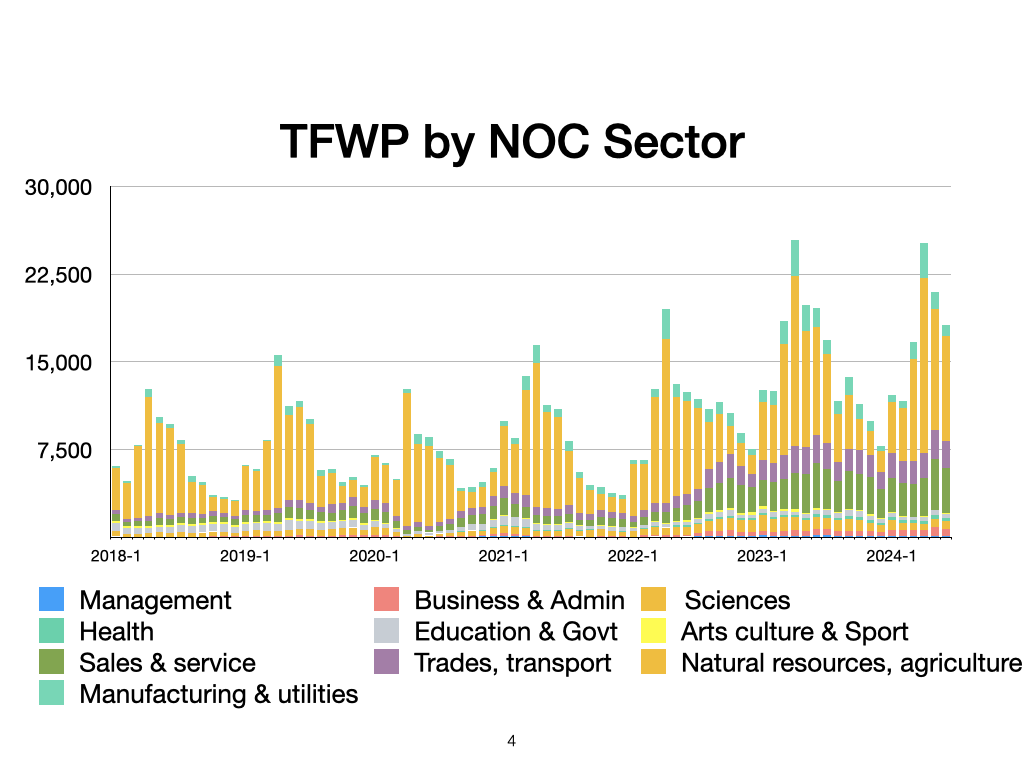
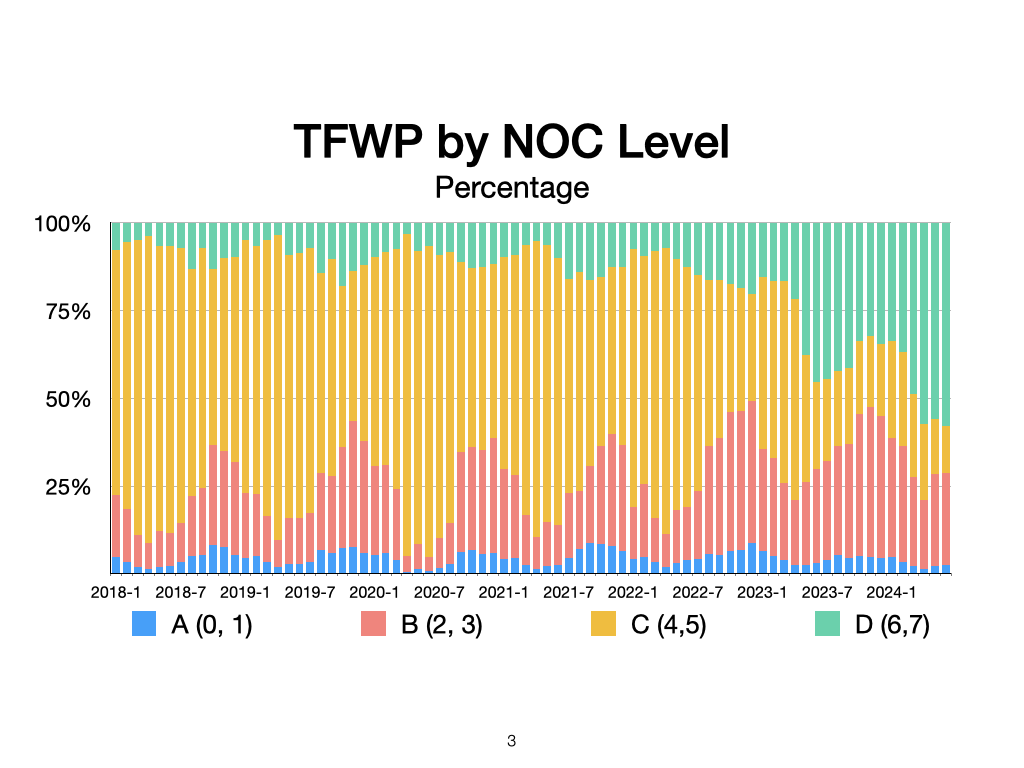
To better monitor and assess the impact, I prepared some charts on Temporary Foreign Workers by NOC Code. For those unfamiliar with the codes A 0 or 1: university degree, B 2 or 3: community college, apprenticeship, more than 2 years on the job, occupations with supervisory responsibilities or significant health and safety responsibilities, C 4 or 5: some secondary education, up to two years on-the-job training or equivalent, D 6 or 7: on-the-job training.

The following slides highlight the shift over the past five years. This provides a good overview and the context for articles like The sudden rise of temporary foreign workers in entry-level office jobs.

Starting with two views by NOC level, the numbers and the percentage shares which show the dramatic increase, both absolute and in percentage, of the low wage and low skilled temporary workers. Interestingly, there has been a squeezing of level C workers:

The next two slides provide the breakdown by NOC sector where sales & service and natural resources & agriculture have increased the most:

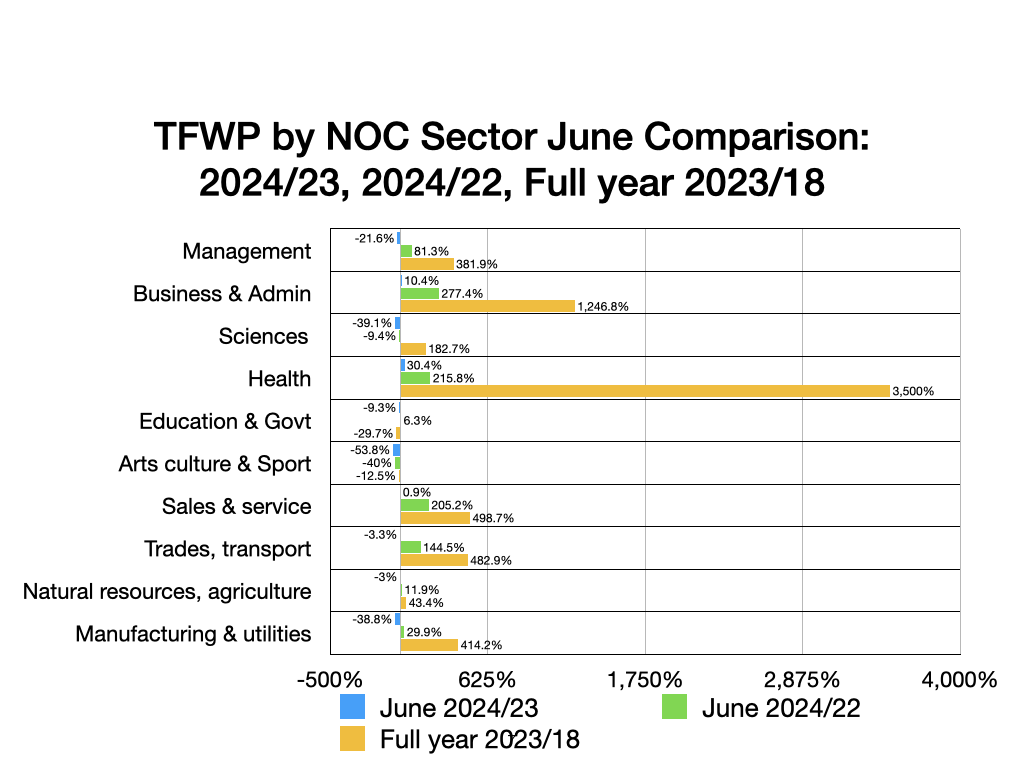
And lastly, looking at June year-over-year change and two year change, as well as from pre-pandemic 2018, showing again the greatest increase in level D occupations and, in terms of sectors, Business & Administration and Health, the latter from a low base:

Note to media: avoid year-to-date analysis in drawing conclusions as happened with Postmedia and other publications and focus on quarterly year-over-year changes.