Appears largely influenced by Skuterud and Worswick, appropriate, and an apparent ongoing distancing from the Century Initiative and others that have focussed more on population growth than productivity, although have also been pivoting:
2. Canada needs a talent strategy that includes high-skilled immigration
It has been observed by economists that humans are unique among species in their ability to create new knowledge, and it is this accumulation of knowledge that propels economic growth.
Education and talent are the cornerstones of economic growth because they foster innovation, increase productivity and enhance a country’s competitive edge. A well-educated and skilled workforce drives technological advancements. Investments in education and talent development create a knowledgeable labour force capable of sustaining and accelerating economic development, ensuring long-term prosperity and resilience in a global economy.
Advanced technology development is a highly competitive and future-oriented endeavor. Two prominent international examples of success in this area are the U.S. Defense Advanced Research Projects Agency (DARPA) and the German Fraunhofer-Gesellschaft. These organizations encourage firms in essential sectors to establish long-term technology objectives through clearly defined roadmaps that outline their vision and strategic plans for critical technological advancements.
Achieving these goals relies on world-leading R&D talent capable of pioneering solutions to significant industrial challenges. This necessitates a comprehensive talent strategy focused on STEM (science, technology, engineering and math) fields, including the creation and expansion of advanced industrial skills training programs and postgraduate excellence programs in research-intensive universities.
Currently, Canada’s immigration policy appears to be overly concentrated on meeting the labour market’s immediate needs, particularly by addressing acute shortages in low-skilled and low-wage occupations that have arisen since the pandemic in sectors such as accommodation and food services. The current federal immigration strategy has increased the labour supply in Canada, but it has been ledby a significant surge in temporary residents.
Historically, the Canadian immigration system has worked well by using a points-based mechanism through the Express Entry system to evaluate applicants, prioritizing those with higher education, work experience, language skills, and other factors that contribute to their potential economic contributions. This economic focus ensures that the system prioritizes skilled workers, professionals, and entrepreneurs, allowing newcomers to contribute positively to the labour market and economy.
A recommendation from a recent RBC report is on point:
“The federal government needs to update immigration policies to focus more strategically on immigrant outcomes and the long-term structural needs of the labour market, while keeping in mind the infrastructure capacity to accommodate newcomers. Addressing this will be key to maintaining economic prosperity over the long run, and Canada’s high quality of life.”
To enhance economic growth, it is essential to implement a robust immigration policy.
Economic immigration drives innovation and entrepreneurship, contributing significantly to economic dynamism. A well-structured immigration policy is vital for fostering a more dynamic and technology-driven economy.
Recommendation 17: Design immigration policies to prioritize long-term economic growth over short- term labour needs. This strategy will sustain the supply of high-skilled talent essential for productivity growth.
Would be nice if IRCC would provide a colleges/university breakdown in its level data series:
Canadian universities are expected to see international student enrolment dropping by at least 45 per cent from last year, a more drastic decline than the 35 per cent intended cut in study permit applications announced by the federal government earlier this year.
Although the measures introduced by Ottawa were meant primarily to rein in the runaway growth of study permit holders in the college sector, Universities Canada said the early numbers from its members don’t even come close to the targeted ceiling.
With Ottawa’s consultation underway to set its 2025 immigration levels, including targets for international students, the advocacy group representing 97 universities across Canada is pleading with the government not to impose further cuts to study permit quotas or make additional changes to the rules of the post-graduation work permits.
“The system is really just hanging on,” Universities Canada president and CEO Gabriel Miller said in an interview Thursday. “If it takes another blow in the next few weeks, it could be fatal.”…
…The AfD has campaigned angrily against their presence, and against any German role in supporting Ukraine in its fight against Vladimir Putin’s invasion. In fact, they are explicit admirers of Mr. Putin and his policies, and they have called for a renewed alliance with Moscow; Mr. Höcke proudly shows his loyalty by driving a Lada car. Those views are shared by Germany’s two far-left parties – dominated by former officials from East Germany’s Soviet-backed communist government – which together won almost 29 per cent of the Thuringia vote this past weekend.
Data suggest that Ukraine, and the larger question of loyalty to Mr. Putin or to the EU, has become a bigger issue for many AfD voters than immigration. For example, a poll this year showed that 84 per cent of AfD supporters are opposed to providing tanks and other military hardware to Ukraine.
The AfD likely won’t be part of any government. But they have succeeded in changing Germany’s political temperature. Germany is the largest European aid and arms contributor to Ukraine, but Mr. Scholz recently backed off on these commitments, shifting spending to domestic matters. He’s announced a rise in deportations. And he’s devoting himself to the Sept. 22 election in nearby Brandenburg, where pro-Putin parties, including the AfD, are expected to dominate.
Many of us would prefer a more steadfast and less accommodating response. But we should realize that, in some parts of Europe, Mr. Putin’s invasion has breached the walls of domestic politics.
Some analysis of the new Quebec immigration minister:
….À l’Immigration, l’arrivée de Jean-François Roberge est vue comme un moyen d’aligner les orientations du ministère avec le programme nationaliste de la Coalition avenir Québec (CAQ). Pour certains, Mme Fréchette — qui est ex-présidente-directrice générale de la Chambre de commerce de l’Est de Montréal — est perçue comme étant trop près des demandes des associations patronales, qui réclament des hausses radicales des niveaux d’immigration.
Cela ne l’a pas empêchée de « livrer les commandes » qui lui ont été passées par la CAQ, observe une source du milieu économique. Ex-péquiste, Mme Fréchette avait claqué la porte du gouvernement Marois en 2014, incapable de défendre la Charte des valeurs que son parti allait proposer en campagne électorale.
Les talents de Mme Fréchette à l’Immigration ont été remarqués au bureau du premier ministre. La ministre a su calmer le jeu, surtout après le tollé causé par une affirmation de son prédécesseur. En pleine campagne électorale, en 2022, Jean Boulet avait déclaré que « 80 % des immigrants s’en vont à Montréal, ne travaillent pas, ne parlent pas français ou n’adhèrent pas aux valeurs de la société québécoise ».
À l’aube d’élections fédérales, et vu l’explosion de l’immigration temporaire, les troupes de François Legault estiment que le moment est venu d’être plus revendicateur, plus « politique » dans ce ministère. Jean-François Roberge, notamment responsable des Relations canadiennes et de la Francophonie canadienne, apparaît tout désigné.
M. Roberge, ex-ministre de l’Éducation, fait partie de la frange nationaliste de la CAQ. « Jean-François, c’est un grand nationaliste, un enseignant, quelqu’un qui a à coeur le français », a dit à son sujet M. Legault après son assermentation. Dans ses fonctions actuelles, M. Roberge a notamment négocié une entente sur les langues officielles avec Ottawa. Quant à Christine Fréchette, elle est diplômée en administration et en relations internationales. Elle est souvent décrite comme une femme pugnace, mais discrète, capable d’obtenir les résultats qu’elle recherche….
…. At Immigration, the arrival of Jean-François Roberge is seen as a means of aligning the ministry’s orientations with the nationalist program of the Coalition avenir Québec (CAQ). For some, Ms. Fréchette — who is the former President and Executive Officer of the East Montreal Chamber of Commerce — is perceived as being too close to the demands of employers’ associations, which are calling for radical increases in immigration levels.
This did not prevent her from “delivering the orders” placed with her by the CAQ, observes a source from the economic community. Ex-Péquiste, Mrs. Fréchette slammed the door of the Marois government in 2014, unable to defend the Charter of Values that her party would propose in the election campaign.
Ms. Fréchette’s talents in Immigration were noticed in the Prime Minister’s office. The minister was able to calm the game, especially after the outcry caused by a statement by her predecessor. In the middle of the election campaign, in 2022, Jean Boulet said that “80% of immigrants go to Montreal, do not work, do not speak French or do not adhere to the values of Quebec society”.
On the eve of federal elections, and given the explosion of temporary immigration, François Legault’s troops believe that the time has come to be more demanding, more “political” in this ministry. Jean-François Roberge, in particular responsible for Canadian Relations and Canadian Francophonie, appears to be designated.
Mr. Roberge, former Minister of Education, is part of the nationalist fringe of the CAQ. “Jean-François is a great nationalist, a teacher, someone who cares about French,” said Mr. Legault after his oath. In his current duties, Mr. In particular, Roberge negotiated an agreement on official languages with Ottawa. As for Christine Fréchette, she has a degree in administration and international relations. She is often described as a pugnacious, but discreet woman, capable of obtaining the results she is looking for….
A related article, Le milieu de l’immigration craint que Roberge ne soit qu’un «ministre à temps partiel»
Nommer au ministère de l’Immigration Jean-François Roberge, qui détient déjà les portefeuilles de la Langue française et des Relations canadiennes, est « un choix cohérent » pour le gouvernement caquiste actuel, qui prône un nationalisme identitaire et économique et qui est engagé dans un bras de fer avec Ottawa. Mais l’Immigration est un véritable « monstre », qui demande une expertise complexe qui va au-delà des questions de langue et de main-d’oeuvre, indiquent des acteurs du milieu. M. Roberge est-il l’homme de la situation ?
« Je ne suis pas certain qu’il est très connaissant de tous les dossiers en immigration », dit Stephan Reichhold, directeur de la Table de concertation des organismes au service des personnes réfugiées et immigrantes (TCRI), qui représente plus de 150 organismes communautaires. Il rappelle que, au point de vue du budget et du nombre d’employés, c’est la francisation qui occupe le plus de place au sein du ministère de l’Immigration. « J’imagine que c’est surtout ça qui va intéresser [le ministre]. On va voir. On va laisser une chance au coureur. »
M. Reichhold craint surtout que l’immigration ne reçoive pas toute l’attention qu’elle mérite. « Ce sera un ministre à temps partiel et, pour nous, c’est toujours très handicapant », dit-il. Il cite comme exemple des prédécesseurs de Christine Fréchette : Jean Boulet, qui était aussi ministre de l’Emploi, du Travail et de la Solidarité sociale, et Nadine Girault, qui avait aussi la responsabilité des Relations internationales et de la Francophonie. « Le plus gros problème, on l’a vécu avec Jean Boulet, c’est l’absence du ministre. »
Il dit toutefois avoir été bien servi avec la ministre Fréchette, dont l’immigration était l’unique responsabilité. « Elle maîtrisait bien ses dossiers, et même si on n’était pas toujours d’accord, il était possible d’avoir de bons échanges avec elle, raconte M. Reichhold. Je ne sais pas dans quelle mesure M. Roberge va être à l’écoute, mais on espère avoir de bonnes relations avec lui. »
Au début de l’année, Jean-François Roberge avait suscité l’ire de plusieurs immigrants et personnes travaillant dans le milieu en déclarant que le grand nombre de demandeurs d’asile menaçait les services et pourrait aller jusqu’à compromettre l’identité québécoise. Aura-t-il un accueil plus tiède du milieu ? « Difficile à dire », avance M. Reichhold. « Il calquait son discours sur celui du premier ministre. Ça va freiner ses ardeurs [de devenir] ministre de l’Immigration. Il va comprendre que ce n’est pas à son avantage de tenir ce type de propos. »
Le portefeuille de l’Immigration, « pas un cadeau »
Professeure adjointe au Département de science politique de l’Université de Montréal, Catherine Xhardez fait aussi remarquer que la ministre sortante avait réussi à piloter habilement les dossiers de l’Immigration pour plaire aux diverses « coalitions » — économiques, identitaires — de la Coalition avenir Québec. « Elle avait réussi à gagner le respect et la confiance de plusieurs groupes et à naviguer entre eux. C’est ça qui est le plus difficile. Ça va constituer un défi pour le nouveau ministre », dit la chercheuse spécialiste en politiques publiques et en immigration.
Le défi sera aussi de gagner la confiance des acteurs de la première ligne. « Quand on devient ministre de l’Immigration, on est confronté à toute cette complexité. C’est tellement hétéroclite. Il y a beaucoup de programmes. C’est un monstre, l’Immigration. Ce n’est pas un cadeau », constate-t-elle. C’est là une occasion pour le nouveau ministre de se plonger dans la réalité du terrain. « C’est son défi et en même temps une opportunité de gérer mieux, en synergie et de manière plus holistique », croit Mme Xhardez.
Et l’immigration, c’est beaucoup plus que de la francisation. « Pour être en mesure de négocier, il faut connaître sur le bout des doigts les programmes, les chiffres, comprendre les accords et rester compétitif par rapport au reste du Canada, et ça veut dire aussi comprendre les employeurs, le patronat, le milieu des affaires et comprendre les problèmes de terrain dans l’accueil et la disponibilité des services. »
Appointing Jean-François Roberge, who already holds the French Language and Canadian Relations portfolios, to the Ministry of Immigration, is “a coherent choice” for the current Caquist government, which advocates identity and economic nationalism and is engaged in a tug-of-war with Ottawa. But Immigration is a real “monster”, which requires complex expertise that goes beyond language and labor issues, say actors in the field. Mr. Is Roberge the man of the situation?
“I’m not sure he’s very knowledgeable about all immigration issues,” says Stephan Reichhold, director of the Table for Concertations for Refugees and Immigrants (TCRI), which represents more than 150 community organizations. He recalls that, from the point of view of the budget and the number of employees, it is the francization that occupies the most space within the Ministry of Immigration. “I imagine that this is mainly what will interest [the minister]. We’ll see. We’ll give the runner a chance. ”
Mr. Reichhold fears above all that immigration will not receive all the attention it deserves. “It will be a part-time minister and, for us, it is always very disabling,” he says. He cites as an example Christine Fréchette’s predecessors: Jean Boulet, who was also Minister of Employment, Labour and Social Solidarity, and Nadine Girault, who was also responsible for International Relations and La Francophonie. “The biggest problem, we experienced it with Jean Boulet, is the absence of the minister. ”
However, he says he was well served with Minister Fréchette, whose immigration was the sole responsibility. “She mastered her files well, and even if we did not always agree, it was possible to have good exchanges with her,” says Mr. Reichhold I don’t know to what extent Mr. Roberge will be listening, but we hope to have good relations with him. ”
At the beginning of the year, Jean-François Roberge had aroused the ire of several immigrants and people working in the environment by stating that the large number of asylum seekers threatened the services and could go so far as to compromise Quebec identity. Will he have a lukewarm welcome from the environment? “Hard to say,” says Mr. Reichhold “He modelled his speech on that of the Prime Minister. It will curb his ardor [to become] Minister of Immigration. He will understand that it is not to his advantage to make this type of comment. ”
The Immigration portfolio, “not a gift”
Catherine Xhardez, an assistant professor in the Department of Political Science at the Université de Montréal, also notes that the outgoing minister had managed to skillfully manage immigration issues to please the various “coalitions” – economic, identity – of the Coalition avenir Québec. “She had managed to gain the respect and trust of several groups and navigate between them. That’s what’s the most difficult. It will be a challenge for the new minister, “says the researcher specializing in public policy and immigration.
The challenge will also be to gain the trust of front-line actors. “When you become Minister of Immigration, you are faced with all this complexity. It’s so heterogeneous. There are many programs. It’s a monster, Immigration. It’s not a gift,” she says. This is an opportunity for the new minister to immerse himself in the reality of the field. “This is his challenge and at the same time an opportunity to manage better, in synergy and in a more holistic way,” believes Ms. Xhardez.
And immigration is much more than francization. “To be able to negotiate, you have to know the programs, the numbers, understand the agreements and remain competitive with the rest of Canada, and it also means understanding employers, employers, the business community and understanding the field problems in the reception and availability of services. ”
This short article continues my analysis of citizenship by examining the intersectionality between visible minorities, religious minorities and gender in terms of citizenship acquisition, education and income, 15 years old and higher.
Overall, the percentage of non-citizens is greatest among South Asian Hindus and Sikhs, likely reflecting India’s prohibition of dual citizenship. Black and Arab Muslims have higher rates of non-citizens than Christians save for Black Christian men. For the most part, being a university graduate does not appear to affect this overall pattern. None & secular have the largest median after-tax income across most visible and religious minority groups. Male non-citizens have significantly lower levels of government transfers than female non-citizens, again across most visible and religious minority groups. However, there are relatively few gender differences in poverty rates across most visible and religious minority groups.
To provide context on immigrant visible and religious minorities, Tables 1 and 2 provide the overall national and provincial percentages for all immigration periods.
Table 1 highlights the percentage of the various visible minority groups at the national and provincial levels. Overall, 53 percent are female immigrants. The higher percentage of female immigrants applies to most groups with the exception of Arabs and West Asians, where women form less than 50 percent of all immigrants.
Visible minorities form 69 percent of all immigrants but this percentage has increased to 83 percent in the most recent census period, with more Black and Filipino immigrants than Chinese, and more West Asians than Southeast Asians.
Similarly, Table 2 provides a similar breakdown for religious minorities for all immigration periods, national and provincial. Overall, women form 52 percent across all religions, with Buddhists and Christians having higher percentages of women, while Muslims being the only group with a marginally smaller percentage of women.
Religious diversity is increasing. While non-Christians formed 53 percent across all immigration periods, they formed 60 percent of immigrants in the 2016-21 census period. The percentage of Muslim immigrants has increased from 13 to 20 percent, Hindus from 6 to 11 percent, Sikhs have increased marginally from five to six percent. Both Buddhists and Jews have declined; the former from 3 to 1.5 percent, the latter from one to 0.5 percent.
Religious diversity varies among visible minority groups.
Some visible minority groups have greater religious diversity than others, notably South Asians, Blacks, Southeast Asians and to a lesser extent Arabs, West Asians and Japanese. The percentage of None & secular is highest among Chinese and Japanese. I have not included traditional given the small overall numbers and minimal numbers among visible minorities.
Table 3 highlights the overall contrast between those who have naturalized and those who remain non-citizens. Overall, the percentage of non citizens is greatest among South Asian Sikhs and Hindus, Black and Arab Muslims, Latin American and Korean None & secular, along with all religions among Japanese. The greater percentage of non-citizens among South Asian Hindus and Sikhs may reflect India’s prohibition of dual citizenship; however, China’s similar prohibition does not appear to have impacted naturalization to the same degree. Fewer women than men are naturalized among Buddhists, Southeast Asian and Korean None & secular, and all Japanese religions.
Education
Table 4 provides the population numbers by religious affiliation of visible minorities for all education levels and bachelor’s degree or higher, along with the percentage of bachelor degrees, ordered by group size. University degrees vary significantly by visible minority group, with Blacks, Latin Americans, Southeast Asians having lower rates than non visible minorities. With respect to religious minority groups, Buddhists and Sikhs have lower rates than Christians, who in turn have lower rates than Hindus, None & secular, Jewish and Muslims.
Table 5 contrasts non-citizen rates for the university educated. Highest rates for non-citizens are Japanese Buddhists and Christians, South Asian Hindus and Sikhs, followed by Black and Latin American Christians and Muslims. Overall, more women remain non-citizens than men among Buddhists, Sikhs and None & secular with exceptions for South Asian and Black women None & secular. The greatest gaps are with Southeast Asian, Korean and Japanese all major religions, and West Asian Christians.
Income: After-tax, government transfers, poverty rate
Table 6 compares median after tax income, government transfers and poverty rates by visible minority, religious minority and gender. With respect to median income, the overall pattern shows that non-citizen visible minorities, regardless of their religious affiliations, have lower median incomes than visible minority citizens, with gender varying by group. Chinese and Southeast Asian women, all religions have higher incomes than citizens, as do Arab Muslims and no religion secular.
Most racialized/religious women citizens have significantly lower median AT income save for Black Christians, Black Muslims and no religion, secular. While overall gender differences are generally small, Buddhist non-citizen women are doing relatively better than Buddhist non-citizens men and Jewish women relatively worse.
Women have higher levels of government transfers then men across all groups save West Asian Christian non-citizens, reflecting child benefits, CPP, OAS, survivor benefits, GIS supplement and possibly social assistance with the exception of traditional overall and all Japanese men, among non visible minorities, only Christian men have a lower percentage.
Table 7 compares the after-tax median income of religious minorities compared to Christians for naturalized citizens and non-citizens. Among the visible minority population, Hindu men citizens and non-citizens have higher median income than Christians, as do Jewish women citizens and Jewish men non-citizens and Arab Muslim women citizens and non-citizens. For most visible minority groups, None & secular citizens and non-citizens have higher median incomes than Christians, with the exception of South Asian women non-citizens, Black citizens and non-citizens, Chinese citizens and non-citizens, Filipino non-citizens, and Southeast Asian men citizens and all non-citizens.
The positive income gap between citizens and non-citizens is greatest for None & secular for most groups. Conversely, the positive income gap for non-citizens compared to citizens is for south Asian Hindu and Muslim men, Chinese Buddhists and None & secular, and Japanese Buddhists and None & secular.
Concluding observations
In general, visible minority group affiliation is more significant in education and income differences than religious affiliation. However, the variation within visible minority groups by religious affiliation is significant, particularly for Buddhists, Muslims and Sikhs.
Overall, the percentage of non-citizens is greatest among South Asian Hindus and Sikhs, likely reflecting India’s prohibition of dual citizenship. Black and Arab Muslims have higher rates of non-citizens than Christians save for Black Christian men. For the most part, being a university graduate does not appear to affect this overall pattern. None & secular have the largest median after-tax income across most visible and religious minority groups. Male non-citizens have significantly lower levels of government transfers than women, again across most visible and religious minority groups. However, there are relatively few gender differences in poverty rates across most visible and religious minority groups.
Just as there is diversity within visible and religious minority groups, largely reflecting country of origin, this analysis highlights the need for ongoing disaggregated data to better understand the dynamics behind immigrant integration and citizenship.
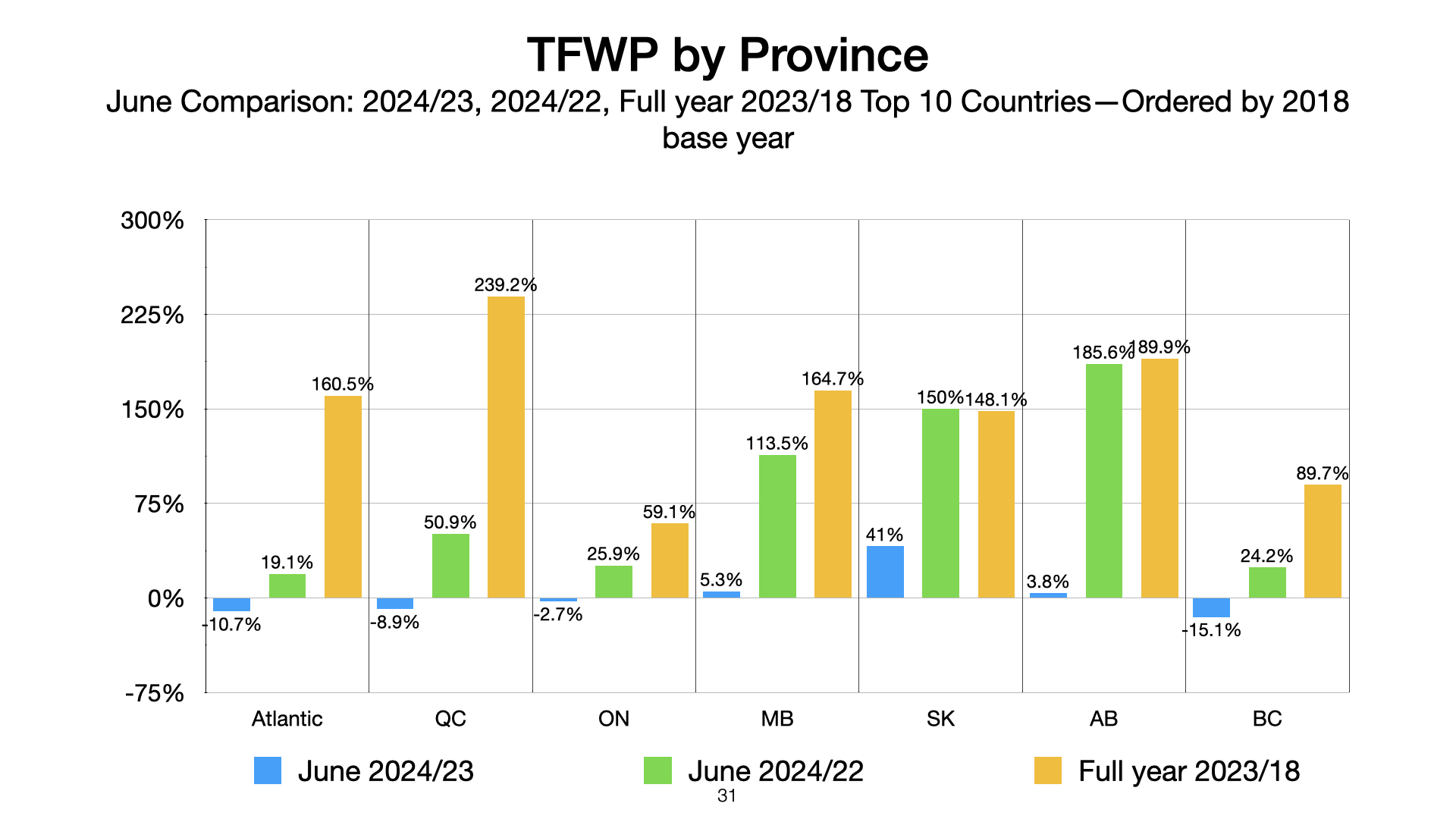
My Quebec friends and experts, point out the hypocrisy given that Quebec also jumped on the Temporary Foreign Workers bandwagon.
With only two years experience in politics, Quebec Immigration Minister Christine Fréchette may be a political upstart, but she seems to be the spearhead of Canada’s immigration policy.
And now, with a mini cabinet shuffle likely on Thursday, François Legault could entrust her with yet another major file: the economy.
Since Fréchette took over as immigration minister in 2022, she has not been the most vocal or flamboyant minister but she has been trusted with one of her boss’s most cherished priorities. And again and again, Canada has followed Fréchette’s lead on immigration.
She was at the heart of a united front among the provinces on the asylum seekers file, she pushed Ottawa to impose a visa on Mexican nationals to enter the country and obtained a reimbursement of $750 million for the costs incurred in processing asylum seekers between 2021 and 2023.
The agreement, announced by Prime Minister Justin Trudeau and Premier François Legault in June, stung the premier of British Columbia, who denounced a double standard between Quebec and Western Canada.
“If this is a federal program to support newcomers, it needs to be in place nationally,” said Premier David Eby.
Yet since Legault became premier, the relationship between Quebec and the other provinces has rarely been as aligned on the issue.
In 2018, Legault wanted to limit the amount of immigrants Quebec takes in every year. Quebec has an accord with the feds that gives it more power than other provinces to select newcomers. The move, at the time, was criticized in the province, but also elsewhere in the country at a time when the Trudeau government had an open-arms approach to immigration.
In an interview with the National Post, Christine Fréchette underlined how her party was a “pioneer” of the idea that Canada welcomes too many immigrants and that it must review its thresholds.
“Two years ago, we were practically the only ones to hold this discourse, and the rest of Canada accused us of being too rigid and almost anti-immigration,” she said.
These days, the CAQ’s vision of immigration is gaining traction elsewhere. “We were clear-sighted in this matter. We were ahead of the parade. We were the ones who shed light on the debate with what it could generate as negative impacts for Quebec in terms of perception,” she added.
In the province, the Liberal Party of Quebec, which used to accuse the CAQ of blowing “on the coals of intolerance” because of its stance on immigration, has recently said it wanted more control because “under the CAQ, we saw an uncontrolled increase in new arrivals.”
Even the Liberals in Ottawa are adjusting. The Trudeau government is currently targeting about half a million new permanent residents a year, a sharp increase from about 300,000 a year when the Liberals came to power in 2015.
But Immigration Minister Marc Miller has already announced a plan to reduce the number of non-permanent immigrant by about 20 per cent over the next three years. He also wants to decrease the temporary resident population to about five per cent of Canada’s total. It currently stands at nearly seven per cent.
“Now that the rest of Canada is starting to endorse a vision that is close to that of Quebec, that we cannot open the doors without counting, I hope that this will positively change the image of Quebec,” Fréchette said.
CAQ officials even said that Fréchette’s work gave them the impression that she was Canada’s real minister of immigration.
“I think if that’s a compliment, then good for her,” said Miller in a phone call with the National Post. “I know we have a role to make things work, and I certainly have been accused, I think unfairly, of wanting to change the shape of Quebec. So maybe it’s a backwards insult to her.”
The feeling is far from unanimous in Quebec, as in Ottawa, but in both capitals, sources are quick to emphasize to what extent she is competent and in control of her files.
The vision of Quebec and how it sees the role of immigrants and immigration, in addition to its resistance towards its federal counterpart tees up “really difficult relationships,” according to Miller.
But he salutes Fréchette’s dedication in attending meetings with other provinces to make her point of view known and push for reforms.
“Whether (Fréchette is) calling the shots, (that) certainly isn’t the case,” he said.
In an interview, Fréchette said she doesn’t really feel like a federal minister, but she emphasized how effective her government has been.
She doesn’t want the federal job, saying she’s “happy that minister Miller is in charge” and that he has a lot to do in his portfolio.
However, it’s a portfolio that could quickly slip away from her. On Wednesday, Quebec’s “super minister” who oversees economic and energy issues, Pierre Fitzgibbon, confirmed he was stepping down after earlier reports sent the province into a political tizzy. “Fitz” is a key player in the plan to entice electric vehicle battery plants to Quebec that has been making headlines in the province for the past few years.
Fréchette’s name was soon circulating as a successor. A source told the National Post that she would gladly take charge of this economic file. Fréchette, who has a background in economics, is “ready for changes,” the source said.
“Be patient,” said Legault at a press conference when asked if Fréchette was on the list to succeed Fitzgibbon. He also confirmed that he would make a ministerial adjustment on Thursday in Quebec City.
Private certification programs certainly can have a role. Ironically, industry concentration can help their effectiveness if they become accepted:
The proposed fair farmwork certification is designed to complement authorities’ enforcement of employment standards, a stick that’s imperfect at best. The certification is meant to be the carrot, rewarding operators who treat their employees well and helping them attract and retain workers in an industry with chronic labour shortages.
Although such voluntary programs by non-governmental organizations already exist in other jurisdictions, they need buy-in from grocery retailers and even consumers. Advocates and experts say this initiative can help address issues of food security, food processing quality standards and labour exploitation.
“What we eat matters. There are so many other human beings involved who do not have the same rights as we do, and they deserve to have better conditions,” said University of Windsor Prof. Tanya Basok. Basok led the project with Anna Triandafyllidou, Canada Excellence Research Chair in Migration and Integration at Toronto Metropolitan University.
“A lot of businesses nowadays have social responsibility statements and that’s how they buy their customer loyalty.”
The launch comes just as Ottawa is about to give these workers the freedom to change employers within the agricultural sector.
Researchers examined current social certification projects for food production and explored how best to introduce such a program in Canada. This month, the Fair Farmwork Toolkit will be released as a step-by-step guide.
Basok, whose research focuses on migrant rights, said a lot of Canadians started to recognize the role of migrant farm workers in the food supply chain and their precariousness and working conditions during the pandemic.
Despite government attempts to improve labour protection, she said many migrant workers remain silent because they are afraid to be sent home and denied work by employers if they speak out.
“The working conditions have to improve,” Basok explained. “Inspections would be one way. But there has to be something more. What would encourage growers to provide better conditions for the worker? So that’s where we’ll bring some kind of market mechanisms to improve working conditions.”
What different certification models have in common, she noted, is they all provide a way for workers to express their needs and concerns.
The Equitable Food Initiative, for instance, started in the U.S. as a coalition by Oxfam America, Costco Wholesale and United Farm Workers. It was launched as an independent non-profit social enterprise in 2015 that offers a comprehensive certification audit, covering labour conditions, food safety and pest management.
An Equitable Food Initiative label signifies that the food comes from a grower that meets the standards in compensating and treating the workers fairly.
“Let’s say Costco has a few big farms in Ontario or B.C., and they say, ‘We now want all of our suppliers to abide by social certification standards and otherwise we’re not buying your product,’” said Borrelli, who prepared the tool kit.
“So what’s the grower going to do? When Costco, Walmart, Target and all these retailers demand more from their suppliers, there’s that level of enforcement.”
Sunrite Greenhouses, a farm in Kingsville, Ont., learned about the EFI program over a year ago after one of its U.S.-based customers requested it to complete a social responsibility audit. Two trainers provided training to 20 leadership team members at the farm, which drew from all levels of the company from worker to the CEO.
The one-time training was followed by an audit, which identified issues and gave the management an opportunity to fix them. The Equitable Food Initiative certificate was then issued upon compliance. The workers have a voice on the leadership team and there is an anonymous reporting system to let them report issues, make comments and suggestions in their native languages. The training cost $20,000 (U.S.), which is separate from the audit fee.
“We are starting to see a culture shift in the company where employees are prioritizing safety and the well-being of all workers more, and there has been a slight boost in morale,” said Amanda Sharman, food safety compliance and regulatory specialist and EFI co-ordinator for Del Fresco Produce Ltd.
“When workers are happier because they feel like they are heard, and they can see improvements being made … we see productivity, camaraderie and safety culture all increase.”
Del Fresco operates Sunrite, which hires 170 foreign workers and 20 domestic workers during the peak of the season. The 46-acre farm produces tomatoes, peppers and organic mini-cucumbers.
Migrant worker advocate Gabriel Allahdua said that when he makes presentations to university students about workers’ rights, the audience is often interested in how to buy food that is ethically sourced and what they can do as consumers to support workers.
“Consumer power can certainly create changes in the market,” said Allahdua, who first came to Canada from St. Lucia in 2012 under the seasonal agricultural worker program. “So this is filling a void for Canadians, who are increasingly raising concerns.”
Having another tool to hold growers and grocery retailers accountable is welcomed, he said, but no matter how a certification mechanism is shaped, farm workers must be actively involved in decision-making.
Chris Ramsaroop, an organizer of Justicia for Migrant Workers, said a certification process can never replace legislative protections because participation is voluntary and it fails to address what he called the indentured nature of migrant worker schemes.
“It is imperative that the necessary structural measures are undertaken so that agricultural workers can exert their rights to organize and collectively bargain,” said Ramsaroop.
“It is imperative that these type of fair food programs do not impede or become an obstacle to the advocacy and organizing that address larger structural reforms to our food system, our agricultural system and our immigration system.”
…A report by LAC on its consultation in June and July, seen by The Globe and Mail, says many stakeholders it spoke to were concerned about the implications “of associating Ukrainian names with Nazis, especially considering that this was part of Russia’s invasion of Ukraine in February 2022.”
They were worried that Russia could use the report to “further these allegations or conduct disinformation campaigns in Canada,” which might affect public support here for Ukraine.
Ihor Michalchyshyn, chief executive officer and executive director of the Ukrainian Canadian Congress, said he thought the government is bound by Justice Deschênes’s view that Part 2 of the report should “remain confidential.”
But he added that all alleged war criminals, regardless of when or where they committed their crimes, should be brought to trial under Canadian criminal law. “If evidence of wartime criminality by any person found in Canada exists, that information must be communicated to the proper authorities for investigation,” he said.
The report by LAC on its consultation said some people expressed concern that people who committed atrocities during the Second World War “were allowed to live peacefully in Canada and never faced any justice measures due to insufficient evidence.”…
With the recent U.S. Supreme Court ruling that now requires potential voters to provide proof of citizenship with their state-created voter registration forms, Indigenous voting rights advocates want Indigenous people to know that they can still register to vote as tribal citizens.
Patty Ferguson-Bohnee said that Indigenous people living in Arizona who are enrolled in a federally recognized tribe can use their tribal identification numbers to prove their citizenship.
“As long as a tribal member is an enrolled member of their tribe, they can use that tribal ID number to register on the state form, and that will prove citizenship for purposes of voter registration,” she said, adding that it’s because all Indigenous peoples were declared citizens of the United States in 1924.
Ferguson-Bohnee is the Director of the Indian Legal Clinic and a Clinical Professor of Law at the Sandra Day O’Connor College of Law. She also coordinates the Arizona Native Vote Election Protect Project, which focuses on protecting the right to vote for Indigenous voters in Arizona.
“If you prove you’re a Native American through using your enrollment number, your citizenship is verified,” she said because there is a space for Indigenous peoples to include that specific information on the state voter registration form.
“The people who are registering voters need to know that we can’t leave that blank because if you do not provide that on your state form, they will reject it,” Ferguson-Bohnee added.
The U.S. Supreme Court ruled on Aug. 22 that Arizona can enforce part of a voter registration law being challenged in federal court, allowing the state to bar legal voters from registering weeks before the election.
Ferguson-Bohnee said the law will cause some confusion among organizations and people out in the community trying to register voters, and it may discourage voters from registering.
“The goal of the law was to create barriers to the ballot box,” she said. “And even to prevent eligible voters from registering to vote.”
Lower courts initially blocked the Arizona law in 2022, but in a 5-4 order, the Supreme Court reinstated a portion of the law that allows the state to stop accepting state-created voter registration forms from Arizona residents unless they provide proof of citizenship.
The ruling means that potential voters who register to vote in Arizona using the state-created voter registration forms will need documentation proving citizenship for the registration to be valid. If no proof is provided, the state will reject the form — without informing them.
Ferguson Bohnee said there is no option to correct the form once it gets rejected, so she suggests that people register with the federal forms first. Then, when they have all the documentation readily available, their registration can be promoted to full-ballot voters.
“It’s very discouraging because it’s making a change right in the midst of the election process when people are registering people to vote,” Ferguson-Bohnee said. “This decision by the court is revising the playing field for election law.”
Not all Indigenous peoples may have their enrollment numbers available, but that shouldn’t discourage them from trying to register to vote. Ferguson-Bohnee said that is when they should register using the federal voter registration form.
She said that registering with a federal form only requires people to affirm their citizenship, not provide document proof, so people will be registered to vote in federal elections, including the presidential and senate races.
However, Ferguson-Bohnee said that if the voter can provide documentary proof of citizenship later, their status will be moved to a full ballot voter, which includes state elections — but that has to be done the Thursday before Election Day.
The court ruling has left some voting organizations baffled about their best course of action because it disrupts the plan of action that has been in motion within Indigenous communities for months.
Arizona Native Vote Executive Director Jaynie Parrish said it has left her team in limbo.
“We’re waiting to hear more directions on what our team needs to do,” Parrish said, adding they haven’t been provided a clear path forward on how this impacts Indigenous voters in Arizona.
Of note, again linked mainly to housing and employment concerns:
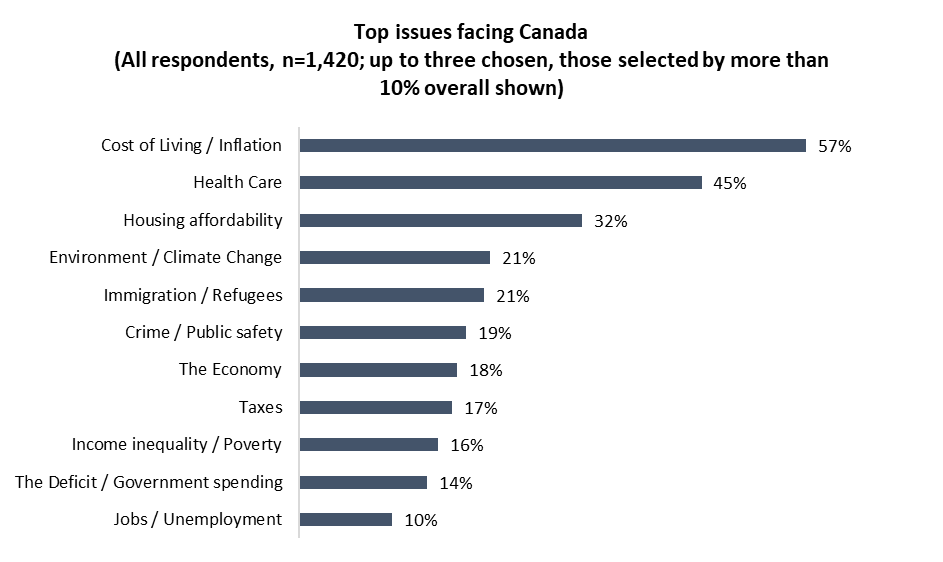
…When parliament resumes seating later this month, there will be a full docket of issues waiting to be addressed. A majority of Canadians (57%) believe the cost of living is one of the top issues facing the country at the moment, while more than two-in-five (45%) say the same of health care. Behind that, one-in-three worry over housing affordability. Other concerns trail far behind those three, but at least one-in-five say climate change (21%), immigration (21%), and crime and public safety (19%) are key challenges for Canada:
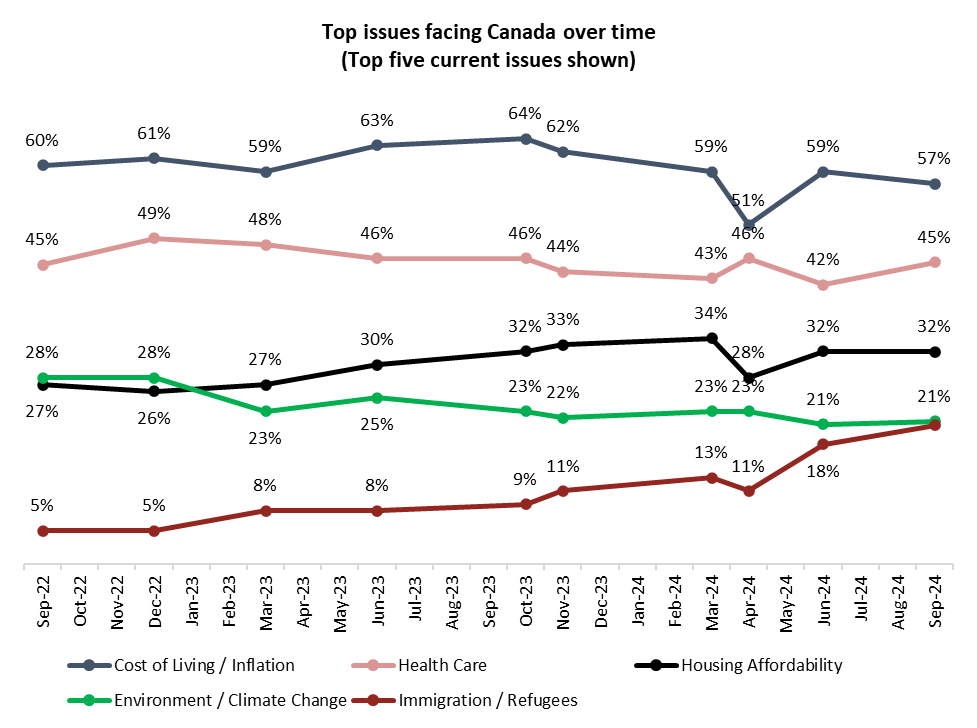
Concern over immigration nearly quadruples over past two years
Some issues are lingering – cost of living, health care, and housing affordability have consistently been selected by Canadians as top issues over the past two years – while others have grown more pressing according to Canadians. The proportion of Canadians that select Immigration / Refugees as a top issue has nearly quadrupled over the past two years.
Perhaps at issue is growing attention over the ripple effects of the federal government’s Temporary Foreign Workers program, which had been expanded as the country dealt with a post-pandemic labour shortage. In 2023, the federal government allowed employers to hire nearly 240,000 temporary foreign workers, more than double the amount it allowed in 2018. After a cabinet retreat focused on housing and immigration, the federal Liberal government announced plans to scale back the program. There will be more to come on Canadian public opinion on the Temporary Foreign Workers program in a forthcoming report.
Those who say they will vote Conservative if the election were held today are the most likely to be concerned about immigration. It’s the second most chosen issue behind the high cost of living among those likely voters. Conservative leader Pierre Poilievre has said a government led by him would reduce immigration, keeping population growth lower than the number of new homes.
The issues concerning likely Liberal voters remain consistent from two years ago, while those who say they will vote NDP are becoming increasingly concerned with housing affordability (+9) and less so with climate change (-11)…



 Multicultural Meanderings