TFWP: Setting the baseline to evaluate government changes
2024/09/03 Leave a comment
Just as the impact of the caps on international students is becoming apparent through monthly and quarterly numbers for post-secondary study permits, one can expect the government’s restrictions on low-wage temporary workers to start have an impact in the October-December quarter.
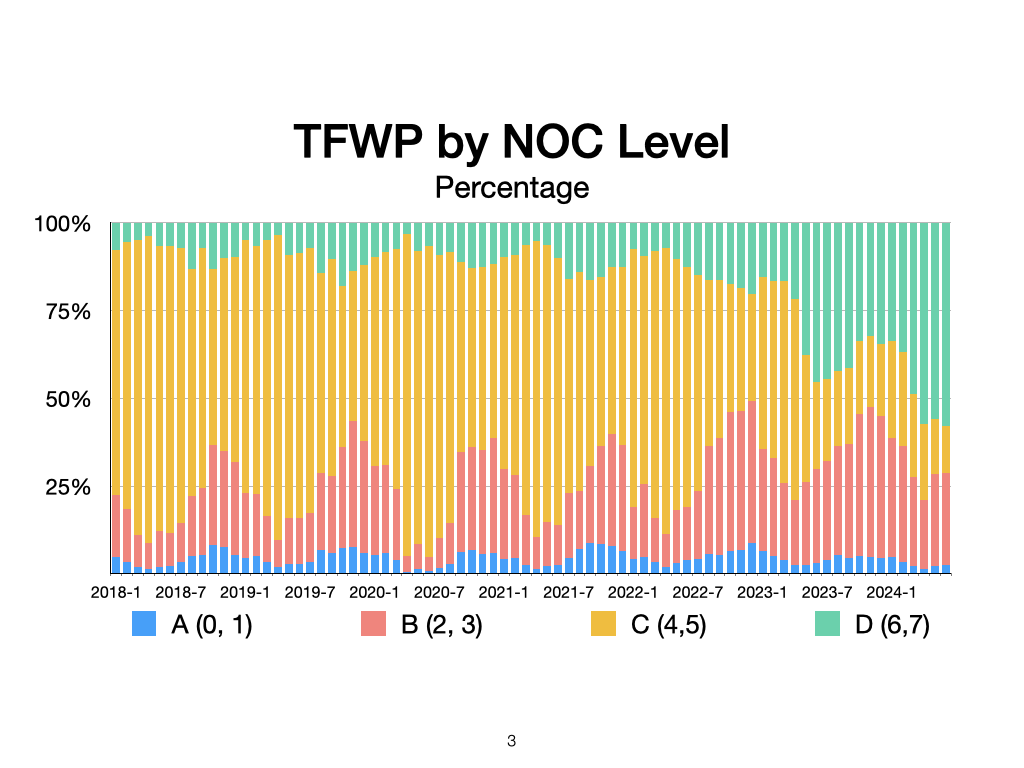
To better monitor and assess the impact, I prepared some charts on Temporary Foreign Workers by NOC Code. For those unfamiliar with the codes A 0 or 1: university degree, B 2 or 3: community college, apprenticeship, more than 2 years on the job, occupations with supervisory responsibilities or significant health and safety responsibilities, C 4 or 5: some secondary education, up to two years on-the-job training or equivalent, D 6 or 7: on-the-job training.
The following slides highlight the shift over the past five years. This provides a good overview and the context for articles like The sudden rise of temporary foreign workers in entry-level office jobs.
Starting with two views by NOC level, the numbers and the percentage shares which show the dramatic increase, both absolute and in percentage, of the low wage and low skilled temporary workers. Interestingly, there has been a squeezing of level C workers:

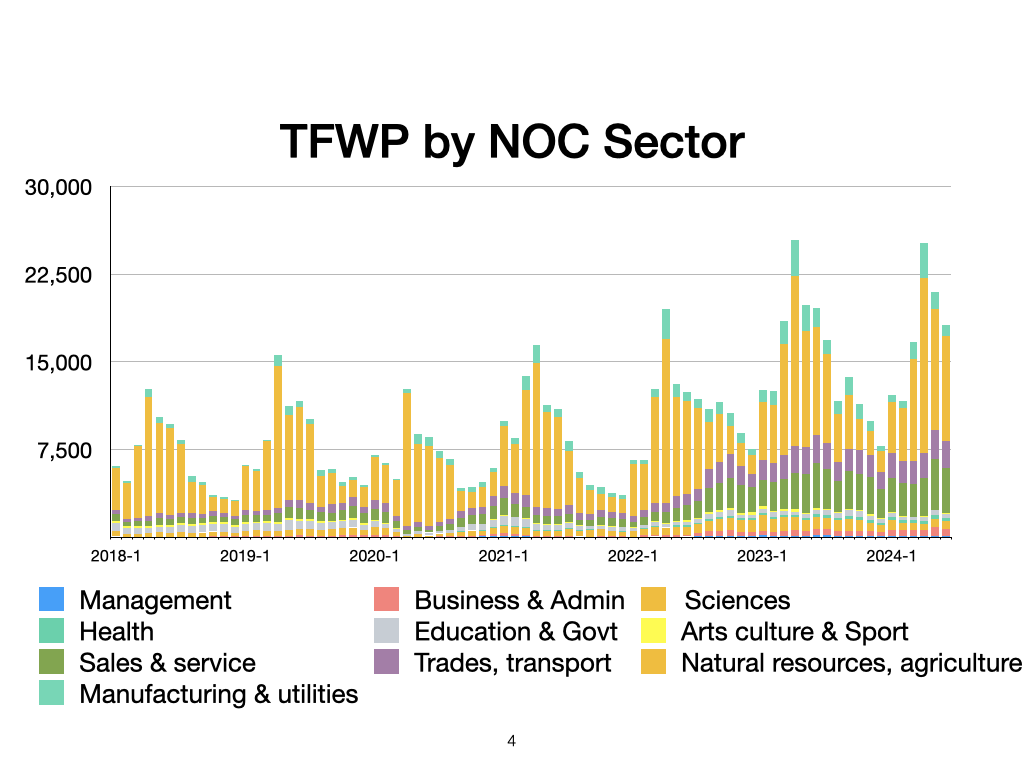
The next two slides provide the breakdown by NOC sector where sales & service and natural resources & agriculture have increased the most:

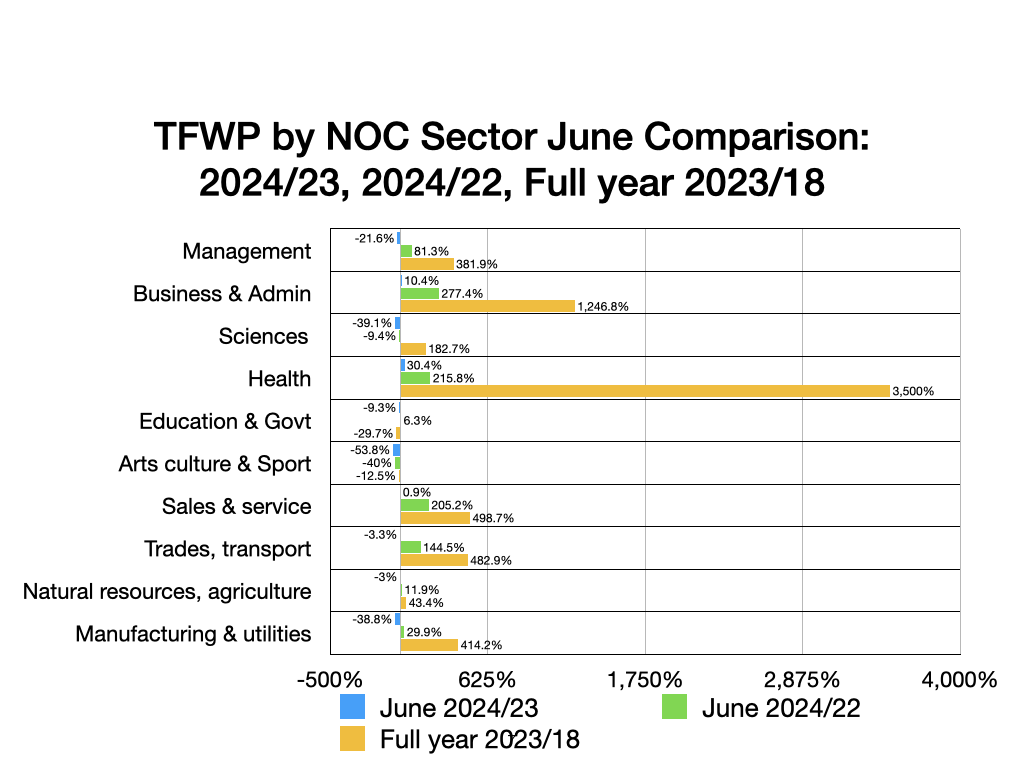
And lastly, looking at June year-over-year change and two year change, as well as from pre-pandemic 2018, showing again the greatest increase in level D occupations and, in terms of sectors, Business & Administration and Health, the latter from a low base:

Note to media: avoid year-to-date analysis in drawing conclusions as happened with Postmedia and other publications and focus on quarterly year-over-year changes.
 About Andrew
 Multicultural Meanderings