Colby Cosh: Lululemon’s sweetheart deal for temporary foreign workers

Of note. The vast majority of those hired under the TFWP are low-wage workers:

…It is easy to imagine that the decision to approve the permits was a no-brainer for B.C., Ottawa, and the federal ministers who quarterbacked the exemption. And, yes, Lululemon is a brand Canadians surely feel positive about, leaving aside that little blip with the terrible Olympics outfits.

But, you know, those positive feelings are surely strained just a tad when you hear about those jobs Lululemon couldn’t fill from the vast reservoir of educated and enterprising humanity that is the Lower Mainland of B.C. The company’s TFW exemption is allowing it to hire people for positions that no Canadian could conceivably fill, to wit: “graphic designers, advertising and marketing managers, computer systems managers, retail wholesale buyers, pattern-makers and industrial engineers.” This list includes some jobs I’ve seen friends move to Vancouver to do! Either things have changed a lot human-capital-wise out on the coast, or Lululemon just wanted a backdoor subsidy in exchange for maintaining its visible connection with Canada.

To be sure, companies have to fight their corner ferociously against the perpetual efforts of governments to drink their blood, but Vescera’s story observes that Lululemon also battled his team’s efforts to obtain documents about the exemption through the province’s freedom of information law. The company half-successfully tried to invoke the “harmful to third-party business interests” provision that is present in B.C.’s FOI law, along with those of most provinces. This, to me, is genuinely irksome practice—made worse because, although the Investigative Journalism Foundation received redacted documents, nobody will explain what third party’s interests are being protected, or why.

Indeed, I cannot fathom a reason for any “business interests” provision in any FOI law at all. The inherent danger in all dealings between businesses and governments are an overwhelmingly important reason for freedom of information law to exist. Allowing suppression of information on the grounds that some teat-sucking client of the state might be embarrassed or compromised is simply a license for the concept of FOI to be nerfed to death

Source: Colby Cosh: Lululemon’s sweetheart deal for temporary foreign workers

Haitian immigrants helped revive a struggling Ohio town. Then neo-Nazis turned up

Sigh:

While Donald Trump made baseless, dangerous claims that immigrants in Ohio were eating people’s pets in front of millions of viewers at Tuesday night’s presidential debate, Johnson Salomon, a Haitian man who moved to Springfield in 2020, was watching cartoons with his kids before putting them to bed.

He got a text from a friend telling him to turn on the debate. When he saw the headlines about what the former president and Republican nominee in November’s election had said, he was in total shock.

“This was a false claim. I couldn’t believe that such a high official could make such a claim,” Salomon said.

Trump’s running mate JD Vance, Elon Musk and prominent Ohio Republicans had already spread the false rumors, lying about how Haitian immigrants had been killing and eating people’s pets in Springfield, a blue-collar town of 60,000 people in western Ohio. But the rumors, leaving Salomon and other Haitians in fear of being targeted for violence and discrimination, didn’t start with them.

They were initially spread online in August on social platforms used by far-right extremists and by Blood Tribe, a neo-Nazi hate group.

Springfield officials and police say they have received no credible reports of pets being harmed by members of the immigrant community, instead suggesting the story may have originated in Canton, Ohio, where an American woman with no known connection to Haiti was arrested in August for allegedly stomping a cat to death and eating the animal.

Haitians and immigrants from Central American countries have been in high demand at Springfield’s Dole Fresh Vegetables – where they’ve been hired to clean and package produce – and at automotive machining plants whose owners were desperate for workers due to a labor shortage in the wake of the Covid-19 pandemic.

New Caribbean restaurants and food trucks have opened across south Springfield where once abandoned neighborhoods are now bustling with residents. A popular Haitian radio station has been broadcasting for several years. And every May, thousands turn out for Haitian Flag Day that’s celebrated at a local park.

But the glut of new arrivals has also stretched hospitals and schools in the area, angering many locals who resented their presence. The outrage reached a crescendo last August, when an 11-year-old boy was thrown from a school bus and killed after its driver swerved to avoid an oncoming car driven by a Haitian immigrant who didn’t have an Ohio driver’s license.

The child’s death fueled anger and racism on Facebook and at Springfield city commission meetings, where public comments about immigration have often run for more than an hour. Locals upset by the growing immigrant community wondered if they were being taken over – if Springfield had become ground zero for the baseless “great replacement theory”.

Soon, rightwing extremists seized on Springfield’s unrest.

Armed neo-Nazi members of Blood Tribe – a hardcore white supremacist group, according to the Anti-Defamation League – flew flags bearing swastikas and marched through a prominent downtown street while a jazz and blues festival was taking place nearby in August.

One witness to the march, who declined to be interviewed by the Guardian due to fearing for their family’s safety after being doxed by rightwing extremists online, reported that members of the group pointed guns at cars and told people to “go the fuck back to Africa”.

A Springfield police representative, however, appeared to downplay the scene, telling local media that the hate group’s march was “just a little peaceful protest”.

Several days later, a leading member of Blood Tribe who identified himself as Nathaniel Higgers, but whose real name is Drake Berentz, spoke at a Springfield city commission meeting.

“I’ve come to bring a word of warning. Stop what you’re doing before it’s too late,” Berentz told Springfield’s mayor, Rob Rue. “Crime and savagery will only increase with every Haitian you bring in.”

Berentz was promptly kicked out for espousing threatening language. Nonetheless, on Thursday morning, a bomb threat prompted Springfield’s city hall, a school and other government offices to be evacuated.

Source: Haitian immigrants helped revive a struggling Ohio town. Then neo-Nazis turned up

Quebec calls for anti-Islamophobia adviser’s resignation after she recommends universities hire more Muslim professors

Tone deaf with respect to Quebec sensitivities, whether these sensitivities are warranted or not.

Apart from her questionable premise, Arab and West Asian professors and lecturers form 8.1 percent of the total, greater than their share of the total population (NOC-based). So on the surface, not a case of under-representation:

The Quebec government renewed its call for Canada’s special representative on combatting Islamophobia to resign Friday, after she sent a letter to college and university heads recommending the hiring of more Muslim, Arab and Palestinian professors.

The existence of the letter, dated Aug. 30, was first reported by Le Journal de Québec, and a Canadian Heritage spokesperson said Friday it was sent to institutions across the country.

In her letter, Amira Elghawaby says that since the start of the war between Israel and Hamas in October 2023, a dangerous climate has arisen on campuses. She offered a number of suggestions to ease tensions within educational institutions: supporting freedom of expression and academic freedom; briefing campus leaders on civil liberties and Islamophobia; and hiring more professors of Muslim, Arab and Palestinian origin.

It was the reference to hiring that drew the immediate indignation of Quebec’s higher education minister, who called on Elghawaby to resign, saying she should “mind her own business.” Minister Pascale Déry said hiring professors based on religion goes against the principles of secularism the province adheres to.

“She has no legitimacy to ask our colleges and universities what to do,” Déry said through her X account, adding that Elghawaby had “insulted” Quebeckers on “several occasions.”…

Source: Quebec calls for anti-Islamophobia adviser’s resignation after she recommends universities hire more Muslim professors

Todd: Little-known program dominates Canada’s massive guest-worker scheme

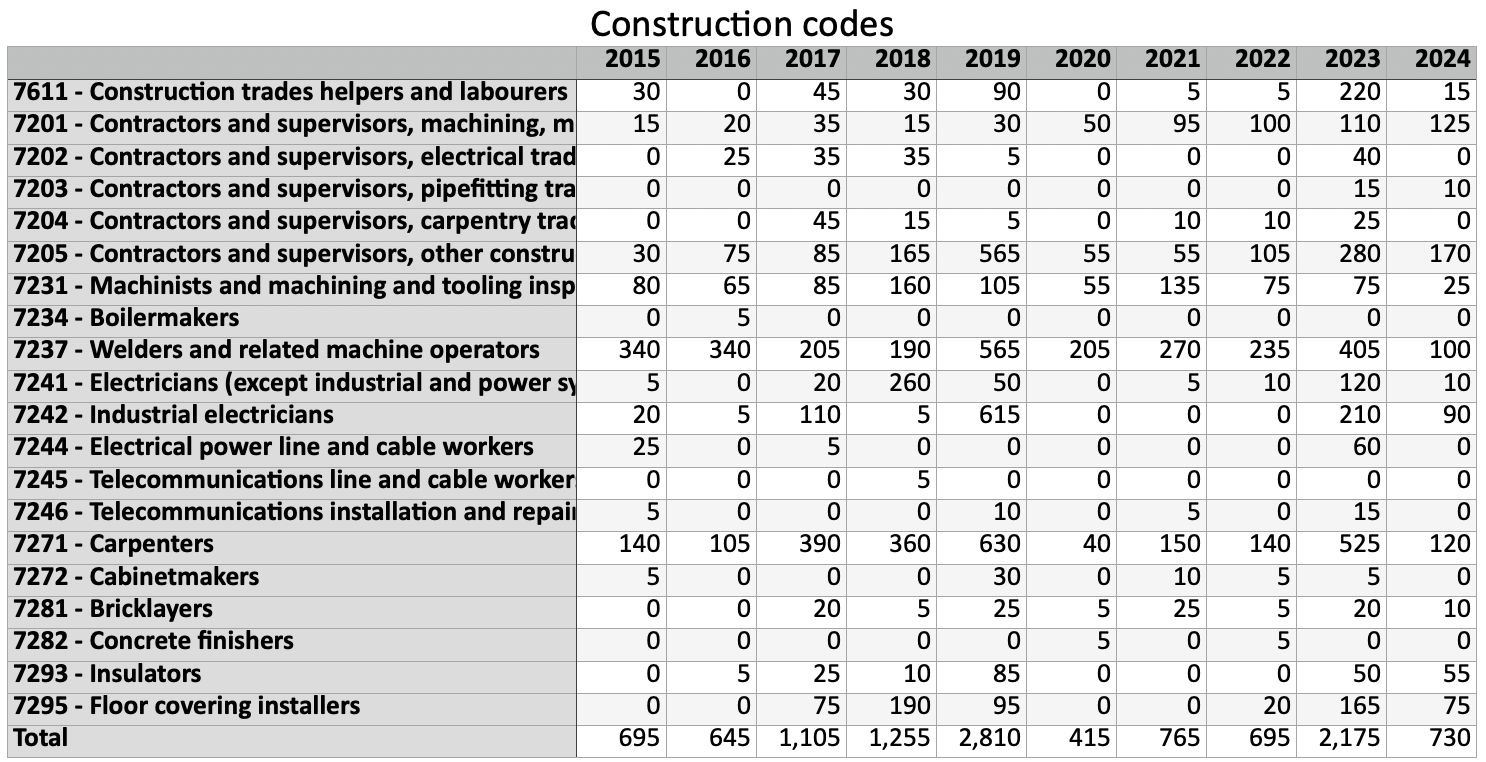
Unfortunately, Olsen didn’t check the data (Temporary Residents: Temporary Foreign Worker Program (TFWP) and International Mobility Program (IMP) Work Permit Holders – Monthly IRCC Updates – Canada – International Mobility Program work permit holders by province/territory, intended occupation (4-digit NOC 2011) and year in which permit(s) became effective). Had some time to look at the construction sector, highlighting that there has been an increase at the supervisory level (B):
Union leader Mark Olsen is frustrated Canadians know almost nothing about Ottawa’s international mobility program. And he’s afraid company bosses want it that way.

The program is the vast federal guest worker program that now brings by far the most newcomers into Canada — with more than one million in the country now.

It’s also the program that Olsen believes makes it most easy for employers to exploit guest workers, which in turn harms Canadian workers.

As the western manager of the Laborers International Union of North America, Olsen said that the international mobility program is drawing more than four times as many guest workers as the more discussed temporary foreign workers program.

Two weeks ago Prime Minister Justin Trudeau promised to modestly trim the temporary foreign workers program by up to 80,000 workers after protests that it was responsible for a high number of low-wage workers at a time of high unemployment among Canadian young people.

An Angus Reid Institute poll released Tuesday shows that 56 per cent of Canadians believe the Liberals are bringing in too many temporary workers, which they think is making it harder to access housing and obtain decent wages.

Olsen believes Trudeau’s gesture with the temporary foreign workers program is window-dressing. If the past is a guide, he said, the federal government and corporations will just use the decline of that program to funnel more foreign workers into the expanding international mobility program.

The government’s strategy, Olsen said, will continue to “institutionalize foreign worker exploitation, discrimination and abuse, distort the labour market, suppress Canadians’ wages and lead to a loss of training opportunities and jobs for Canadian workers, including Indigenous people and women.”

There is a need, Olsen said, for qualified people to come from other countries to work in Canada. That’s especially the case in Canada’s gigantic construction industry, which employs most members of the Laborers International Union of North America. But guest workers, Olsen said, must be invited to the country in a way that’s fair both to them and to Canadian workers.

The major defect in the international mobility program, Olsen said, is that, unlike the temporary foreign workers program, it doesn’t require Canadian employers to provide evidence to the government that they’re unable to find a Canadian to do the job.

“This has made the IMP (international mobility program) ripe for abuse of both the system and the temporary worker, and has fuelled explosive growth under the program,” said Olsen.

A second problem with the international mobility program is that employers are allowed to pay the foreign workers significantly less than they pay Canadians in the same job, whether they’re in the field of high tech, health care, retail or construction. That’s because bosses only have to commit to paying foreign workers a wage that is higher, even only slightly higher, than the median Canadian salary, which Olsen said is in the $23-an-hour range.

That leads to international mobility program workers often doing the same tasks as Canadian workers at far lower wages.

Obviously, Olsen said, the big wage disparity hands bosses an incentive to hire cheap labour through that program, rather than seek Canadian applicants.

“It results in employers paying substandard wages and often no benefits to foreign workers,” Olsen said in a joint memo with Eric Olsen, his brother, who is the political director for the western arm of Laborers International Union, which has about 400,000 members in the U.S. and 150,000 in Canada. “It also allows employers to pay Canadian workers less than the market would ordinarily require, distorting the market.”

The B.C. Building Trades this year put together a report on migration, with case studies showing how B.C. employers paid foreign workers much less than Canadians during construction of the Golden Ears Bridge, the Murray River mine project and the Canada Line.

Since 2015, the Liberal government has dramatically increased the number of temporary residents in Canada, to about 2.8 million. Immigration Minister Marc Miller said this year that nine per cent are in the temporary foreign workers program stream, 44 per cent are employed in Canada through the international mobility program category and another 43 per cent are foreign students, most of whom are allowed to work.

However, Mark Olsen is on to something when he worries ordinary Canadians have no idea about the country’s many guest worker programs — and the often crucial differences between them.

Canada’s migration system is complex and confusing. Even politicians, pundits and pollsters often make comments that suggest they mistakenly think the temporary foreign workers program is the only Canadian stream for “temporary” workers. It doesn’t help that the term, international mobility program, is itself fuzzy.

In the face of the public’s ignorance, which Mark Olsen believes companies capitalize on, the leaders of the Laborers International Union want to reform Canada’s guest-worker programs.

One top recommendation is that bosses using the international mobility program must prove there is a need for each guest worker. Such declarations exist with the temporary foreign workers program, when employers fill out a document called a labour market impact assessment.

And since news reports frequently arise about abuse and deception in regard to the rules of the guest worker system, the union says “there must be proper enforcement and significant penalties.”

In addition, union wants all foreign workers in Canada to “have the same rights as Canadian workers” and “be paid the same as Canadian workers in wages and benefits.”

It also recommends providing foreign workers “a pathway to Canadian citizenship.” As the union’s policy paper says: “If these workers are good enough to be invited here to build our country, they are good enough to stay and build their families and communities.”

In regard to these last two reforms, Mark Olsen acknowledged that there is sometimes resistance from members of his union.

Given changing public sentiment in Canada, that’s not surprising. One key finding in this week’s Angus Reid poll is that only 24 per cent of Canadians believe guest workers should be offered a route to citizenship.

Nevertheless, Mark Olsen said after he talks to members about the union recommendations on guest workers, they invariably end up embracing the union’s viewpoint, which he describes as “respect for all.”
Source: Little-known program dominates Canada’s massive guest-worker scheme

Blogging break until mid-October

As in previous breaks, will monitor during the break.

The Potential of Canada’s International Education Strategy: Evidence from the “MIT of the North”

Excellent case study and analysis by Mikal Skuterud and others that challenges Canada to adopt a strategic approach to international students and education focussing on quality, not quantity:

UWaterloo is best known for its academic programs in computer science, mathematics, and engineering, which has earned it the moniker the “MIT of the North.” Evidence that UWaterloo’s international student graduates struggle in Canadian labour markets relative to their Canadian-born counterparts graduating from the same academic programs with similar academic standing provides a direct test of the skill underutilization hypothesis. The evidence also offers critical lessons on whether policy efforts to realize the full economic potential of international students are best directed at augmenting employer hiring behaviour through DEI initiatives, for example, or at improving the attraction and selection of international talent and promoting skill formation, including language training.

Our main findings are:

1. Roughly 70 percent of UWaterloo’s international students transition to Canadian permanent residency (PR), twice the rate of international students at the national level. There is little difference in the transition rates of UWaterloo’s students with the highest and lowest academic achievement and little evidence that policy efforts since 2008 to ease foreign students’ Permanent Residents transitions has impacted UWaterloo graduates, unlike at the national level. This suggests these policies have primarily affected the immigration outcomes of lower quality graduates, including community college graduates.

2. Canadian-born students at the 95th percentile of the skill distribution leave Canada after graduation at twice the rate of Canadian-born students at the 5th percentile. While the best international students are twice as likely to outmigrate as the best Canadian-born graduates, there were five times more Canadian-born graduates of UWaterloo between 2005 and 2021. This implies that Canadian students have contributed more in absolute numbers to “brain drain” in recent years than international students at UWaterloo.

3. The average post-graduation earnings of UWaterloo’s international students not only exceed Canadian-born graduates of UWaterloo, but also Canadian-born university graduates nationally. Moreover, the earnings advantage of UWaterloo’s international student graduates has increased over time as the economic returns to degrees in technology and engineering, where UWaterloo’s foreign students are heavily concentrated, have increased relatively more.

4. Comparing students graduating at the same time from the same academic programs with similar academic standing, we find evidence of disparities in international students’ average earnings after graduation. The earnings gaps are largest for East Asian, especially Chinese-born graduates. They are also concentrated among academically weaker students and appear to be entirely explained by deficiencies in English language proficiency. The results provide no evidence consistent with the common belief that immigrants’ skills are underutilized in the Canadian economy. In fact, we find that measured skills are more important in determining the labour market earnings of foreign-born than Canadian-born graduates.

Overall, our analysis points to the potential of Canada’s International Student Strategy to boost economic growth. However, given the extent to which student outcomes vary by program of study and institution, realizing this potential requires prioritizing quality over quantity in foreign student admissions. Unfortunately, the Strategy has become preoccupied with growth, especially in the college sector.

We recommend redirecting the Strategy in two directions. First, IRCC needs to offer international students a single transparent pathway to economic-class immigration that relies exclusively on an enhanced Comprehensive Ranking System to select candidates with the highest expected future Canadian earnings. The success of the CRS in predicting immigrants’ future earnings can be enhanced significantly by adding applicants’ fields of study, school identities, and post-graduation earnings to the set of criteria used.

Second, Canada can do more to influence the choices that the world’s best and brightest students make themselves about where to study and settle after graduation. Options include using targeted tuition subsidies to attract exceptional prospective foreign students to the country’s top university programs in technology and engineering and income tax schemes to incentivize the highest quality graduates to work in Canada after graduation.

Source: https://clef.uwaterloo.ca/wp-content/uploads/2024/09/CLEF-074-2024.pdf

McWhorter: Harvard, Brown and Other Top Schools Are Thinking About Black Freshmen the Wrong Way

Interesting suggestion on how to interpret the numbers:

Several highly selective universities have recently reported that in their first freshman classes admitted after the Supreme Court banned racial preferences in admissions, the number of Black and Latino students has fallen.

The percentage of Black freshman at the Massachusetts Institute of Technology, for instance, declined from 15 percent last fall to 5 percent for this fall. At Amherst College the number fell from 11 percent to 3 percent. Other schools have reported less precipitous but still noticeable drops, such as from 18 percent to 14 percent at Harvard, 10.5 percent to 7.8 percent at the University of North Carolina, Chapel Hill — a taxpayer-supported public university in a state where 23 percent of the population is Black — and 15 percent to 9 percent at Brown University, a school that has spent considerable energy looking at its early ties to the slave trade. Yale and Princeton held relatively steady, but an overall trend is clear.

The conventional wisdom is that this is alarming, but I’m not seeing it that way. We are trained to regard news on racial preferences in a way that makes us see tragedy where, through different glasses, we might just see change.

A first question to ask: Will Black students who weren’t admitted be OK? There is every reason to suppose so. Racial preferences were banned for the University of California in 1996, and the way critics discussed it back then, one would almost have thought that the highly selective U.C. Berkeley and U.C.L.A. were the only campuses in the entire university system. I taught at Berkeley at the time, and some young Black filmmakers had me audition (long story) for a film about a fictional Black teenager who was so devastated by being denied admission because of the new rules that he took his own life in despair.

In real life it was hard to see tragedy in a Black student having to go instead to one of the many other excellent options, like U.C. Davis and U.C. Santa Cruz. As regards that student’s future success, time has borne out that intuition. A study by the Berkeley economist Zachary Bleemer found that the ban had no effect on the post-college wages of Black applicants to University of California schools. (There was, however, a differential for Latinos, an effect that was difficult to explain.)

A second question to ask is whether the universities themselves are OK. There seems to be an assumption that they suffer if Black students are represented at less than our 14 percent presence in the population. But it is difficult to specify just what that assumption is based on.

For example, at Brown, almost one in 10 freshmen is Black (and that doesn’t count applicants who did not specify their race). Black America has suffered too much genuine tragedy for it to be considered ominous that “only” one in 10 students in a matriculating class at an Ivy League school is Black.

Nevertheless we are told to bemoan the decrease in general diversity. But wait — how many Black students do the white ones need in order to get an acceptable dose of diversity? The same question applies to whether Black students will feel there are enough people who look like them to feel at home at the school. I would think that at Chapel Hill, for example, 7.8 percent — about one in 12 freshmen — is enough to build a healthy community.

Plus, there is no real evidence that diversity enhances a good college education. No reasonable person is seeking lily-white campuses. But the idea that diversity means, specifically, better learning has turned out to be difficult to prove. Terrance Sandalow and others observe that what are considered Black views — on topics like police conduct or the availability of quality schooling — are as likely to be aired by non-Black students as by Black ones (a good thing, by the way).

The 1999 report by the psychologist Patricia Gurin, which is often cited as demonstrating that diversity improves college education, was based on students self-reporting vague, self-congratulatory qualities such as whether they came out of college with a drive to achieve or with a sense of satisfaction with their college work. Nor is there much proven benefit post-graduation: This spring, a meta-analysis of 615 studies has shown that workplace diversity does not substantially enhance team performance and cooperation.

There is, however, one other argument for giving extra points to Black applicants. Despite the California data I mentioned, nationwide it is true that going to an Ivy League school rather than a solid non-Ivy increases lifelong earnings, as well as the chance of attending graduate school or getting a job at a top-ranked law firm.

But that one advantage is not worth the endless dissonance that racial preferences in admissions would continue to create, whether we liked it or not.

There would always have been a sense among many non-Black students (and even professors) that many Black applicants got in for different reasons than white and Asian applicants did.

Asian families would always have felt they were evaluated more stringently than Black students, as was clearly shown to be the case at Harvard. This feeling would have persisted especially because they, too, are part of minority groups that experience racism.

Eliminating both Black students’ stigma and Asian students’ sense of foul play is more important than closing any gap in future earnings, which in any case hardly indicates that Black students outside of the Ivies are relegated to washing cars for a living. Admissions preferences intended to promote socio-economic rather than just racial diversity would encounter much less pushback and confusion.

Here’s a proposal, radical though it may (unfortunately) seem: Colleges should be very happy with the new numbers. Brown, for example, should be saying, “Hey look — even without that outdated and condescending Blackness bonus, we’re still at 9 percent!” Getting into an elite college is hard, and we should celebrate Black applicants pulling it off in such high numbers, even if they don’t happen to fall precisely at 14 percent. We are taught that on race, professional pessimism is enlightened. I don’t get it.

Source: Harvard, Brown and Other Top Schools Are Thinking About Black Freshmen the Wrong Way

Lederman: Russians at War is an exceptional documentary and needs to be seen

Of note, joins the genre of movies such as Das Boot, Los Chicos de la Guerra, and All Quiet on the Western Front, albeit all of these were made after the wars ended, not during hostilities. Interesting question, will this film be shown in Russia or not?:

…The feature film All Quiet on the Western Front, which also humanized the “wrong” side of the First World War with its devastating portrayal of a young German soldier’s experiences, won four Academy Awards last year, including best international feature film.

Russians at War, which dispels the myth that there is any glory involved in war whatsoever, deserves similar recognition. It certainly deserves a chance to be seen.

Of course, Russians is much more sensitive. It is a documentary to begin with, but also because this catastrophe is happening right now. It is bringing agony to Ukrainians at this very moment. Nobody should have to experience what Ukrainians are suffering through at the hands of Russia.

This film in no way discounts that. If anything, it emphasizes it.

It does not disregard the inhumanity of war to humanize the low-level members of the aggressor’s army: Russian soldiers and medics as young as 20 who are sent to the front lines along with their hopes and dreams – and their not-quite-yet-fully-developed prefrontal cortexes. The opposite, in fact.

Russian fighters – some drafted, some indoctrinated, some there to keep their families fed back home or a friend company at the front, some there because they don’t know why – are also victims of this war. As one notes in the film, they are at war with themselves. “Slavs against Slavs.”

Thousands and thousands of people, Ukrainian and Russian, have been ripped from their lives to further a madman’s dream.

And a talented filmmaker, without an official posting or even a press pass, followed them almost all the way to the front so that we could know about it. And be outraged. Not at the film; at the war.

Censoring art is never a good idea. But keeping this film under wraps is denying the public of more than the experience of seeing an excellent movie. It is restricting access to a vital message: an unforgiving indictment of war.

Peace.

Source: Russians at War is an exceptional documentary and needs to be seen

Hopeful immigrants to Canada are learning French after other paths to permanent residency prove difficult

Not entirely unexpected as many applicants will explore different options. Some of the individual cases cited suggest a level of determination and work ethic that make them likely to be successful immigrants:

…Some economists have criticized prioritizing French-language skills for immigrant selection, saying it affects Canada’s ability to attract top talent.

University of Waterloo’s Prof. Skuterud points out that giving priority to French-language speakers with lower scores means that a large number of applicants with scores above 500 – who have the potential of making higher incomes but don’t speak French – aren’t invited to apply.

“This is the trade-off we have: computer science students at the University of Waterloo are getting frustrated and saying I’m going somewhere else,” Prof. Skuterud said. “This is a huge problem if what you care about is productivity, which is what everybody is talking about now.”

It comes down to the society’s priority whether it’s for labour market success or letting in immigrants that will assimilate into Francophone culture, said Philip Oreopoulos, an economics professor at the University of Toronto.

Prof. Oreopoulos agrees that the new category doesn’t maximize chances for immigrants’ productivity. “I don’t think outside of Quebec, favouring more points for knowing French would lead to better labour market success than, say, favouring graduate education,” he said.

Jeffrey MacDonald, a communications adviser at the Ministry of Immigration, Refugees and Citizenship Canada, points out that supporting francophone immigration is part of an obligation Canada made in its Official Languages Act. And, he added in an e-mail, the new French-language category “will contribute to stronger and more prosperous Francophone communities for generations to come.”

Source: Hopeful immigrants to Canada are learning French after other paths to permanent residency prove difficult

COVID-19 Immigration Effects – July 2024 update

Highlights:

  • Permanent residents admissions: PR Admissions: Increase from 44,530 in June to 47,770 in July. July year-over-year change (change from 2022 in parentheses): Economic – PNP 34.9% (15.0%), Economic – Federal 11.7% (0.7%), Family 2.8% (-2.1%), Refugees 14.4% (30.8%)
  • TR2PR (Those already in Canada): Increase from 19,170 in June (43% of all PRs) to 22,100 in July (46.3% of all PRs). July year-over-year change (change from 2022): 10.6% (32.5%)
  • TRs-IMP: Decrease from 70,435 in June to 61,510 in July. July year-over-year (change from 2022): Agreements: 205.6% (-32.8%), Canadian Interests: -27.7% (29.9%), Other IMP Participants -56.1% (430.3%), Not stated -18.0% (-17.7%)
  • TRs-TFWs: Decrease from 19,230 in June to15,330 in July. July year-over-year change (change from 2022): Caregivers -18.8% (0.0%), Agriculture -23.0% (-19.5%) and Other LMIA -9.4% (79.4%).
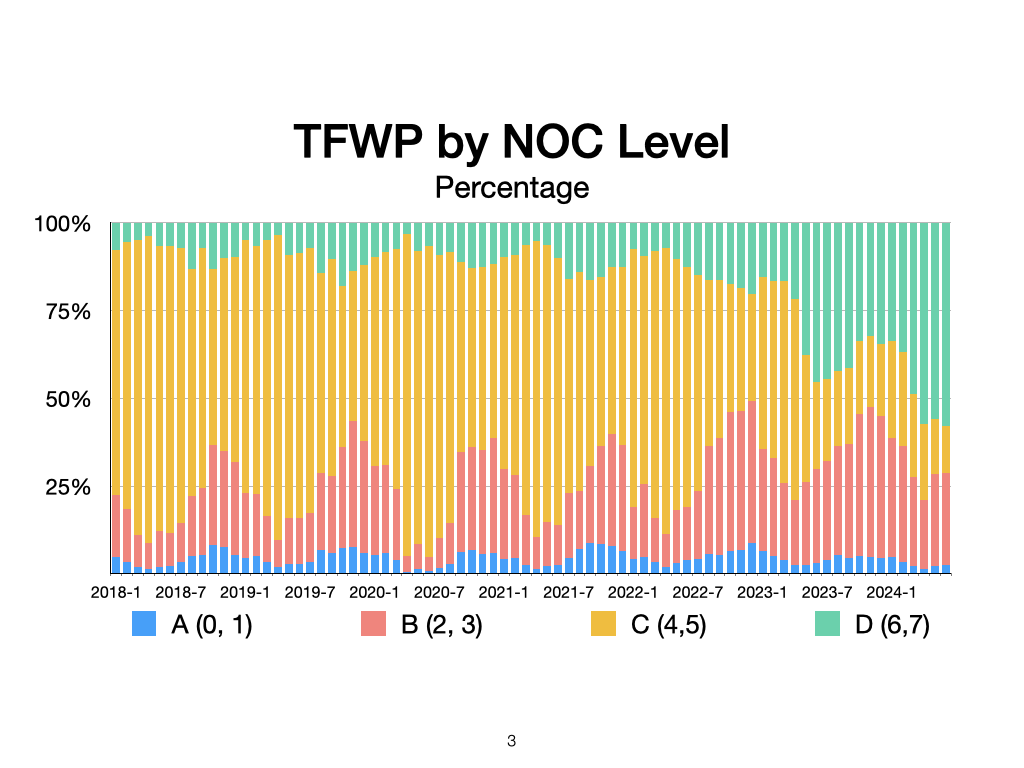
  • NEW: TRs by occupation code (June, will be updated quarterly): 58 % low-wage (D), year-over-year change (change from 2022) 18.5% (571.3%): 
  • Students: Increase from 29,420 in June to 35,105 in July. July year-over-year change (change from 2023): -35.4% post-secondary -41.5% (-5.1%). Year-to date 2024 compared to 2023 decline of 4 percent 
  • Asylum Claimants: Stable, from 14,485 in June to 14,825 in July. July year-over-year change (change from 2022): 23.4% (90.1%)
  • Citizenship: Increase from 33,179 in June to 36,070 in July. July year-over-year change (change from 2022): 15.4% (25.0%). Year-to date 2024 compared to 2023 increase of 16 percent
  • Visitor Visas: Increase from 118,402 in June to 127,399 in July. July year-over-year change (change from 2022): -19.7% (37.6%).Slide 3 has the overall numbers and change.

https://www.slideshare.net/slideshow/canadian-immigration-tracker-key-slides-july-2024-pdf/271760138