Avi Benlolo: University of Windsor shamefully caves to anti-Israel protesters

Sigh….. But rather than a preference for pro-Israel or pro-Palestine students, preference should be given to those with a more balanced approach to any number of issues, whether in social media or elsewhere:

…The university could have employed a multitude of measures to clear the encampment without succumbing to the terms set by radical students. It could have immediately dismantled the encampment, as York University did. It could have filed for a court injunction without agreeing to any terms, as the University of Toronto did. It could have launched a lawsuit against the organizers, as the University of Waterloo did, resulting in the removal of the encampment. Or it could have finally convinced law enforcement to clear out the encampment, as McGill University did.

All these measures and more were available to the University of Windsor. Instead, it appears to have signed a perilous agreement that undermines academic freedom and Canadian values. Universities are supposed to be about preparing young people for the workforce. UWindsor has promised to protect students involved in the encampment. But in the real world, where these pro-Palestinian students will one day seek employment, such protections will vanish.

In New York this week, a top law firm (Sullivan & Cromwell) announced it’s hiring policy will exclude anyone involved in anti-Israel campus protests. I would encourage all companies to adopt similar policies, lest they too fall victim to an encampment in their boardrooms. Preference should be given to hiring pro-Israel university students. They are courageous defenders of democracy and need our support and encouragement.

Source: Avi Benlolo: University of Windsor shamefully caves to anti-Israel protesters

Recent immigrants suffer in Canada’s weakening job market

Of note:

Newer immigrants are struggling as the Canadian labour market goes through a rough patch.

The unemployment rate for recent immigrants – those who became permanent residents within the last five years – was 12.6 per cent in June, an increase of four percentage points from a year earlier, according to Statistics Canada. (All figures in this piece are three-month moving averages, unadjusted for seasonality.)

It’s a very different story for those born in Canada. Their unemployment rate was 5.5 per cent last month – up slightly from 5 per cent in June, 2023.

The gap in jobless rates between these groups is the largest since August, 2014.

The labour market has softened over the past two years year as companies struggle with higher interest rates, making them more hesitant to hire. At the same time, the Canadian population has soared – largely because of strong immigration – and led to an infusion of job seekers….

Source: Recent immigrants suffer in Canada’s weakening job market

More than half of recent Senate appointments have ties to Liberal Party

Of note. Haven’t done a political linkages analysis but the table below contrasts senate appointments by PM from a diversity perspective:

Despite Prime Minister Justin Trudeau’s promise to rid the Senate of partisanship and patronage, most of the senators appointed to the upper house over the past year have ties to the Liberals.

Since July 2023, Trudeau has nominated 12 senators, eight of whom — 66 per cent of the total — have donated money to the federal Liberals or have worked with the federal party or a provincial Liberal party.

That’s a significant jump in the number of Senate appointees with partisan Liberal ties — up from about 30 per cent of all senators appointed between January 2019 and July 2023.

“I think it is a disturbing trend,” said Emmett Macfarlane, a political science professor at the University of Waterloo who wrote a draft document that became the basis for the advisory committee on Senate appointments.

“The appointment of the occasional partisan or person with a partisan history is completely, I think, valid,” he said. “What is troubling is to see a slew of partisan appointments, particularly those that match the government stripes. This actually goes against the whole spirit of the reform.”

In 2014, as the Senate was mired in an expenses scandal, then-opposition leader Trudeau expelled senators from the Liberal caucus.

As prime minister, he created an independent and nonpartisan advisory board for Senate appointments in 2016. Since then, he’s named only senators recommended by the board. Trudeau has named more than 80 senators since taking office.

Source: More than half of recent Senate appointments have ties to Liberal Party

AI Can Fix Immigration, Low Fertility & Retirements

While I believe that AI holds great potential, this analysis is overly optimistic in the shorter term. Longer-term, much more likely:

AI-enabled automation may hold the key to solving three major problems: immigration, low fertility rates and retirements. But strangely, automation is not a planned policy solution to these and related problems. Why there were all sorts of problems with how the US federal government handled the Covid 19 pandemic, Operation Warp Speed was not one of them. Should AI-enabled automation receive the same kind of investment priority the vaccine received – instead of how defensively everyone treats “automation”? Remember that Operation Warp Speed “was a public-private partnership initiated by the United States government to facilitate and accelerate the development, manufacturing, and distribution of COVID-19 vaccines, therapeutics, and diagnostics.” Is this a model for investments in AI and automation?

AI & Immigration

For example, instead of making economic arguments for why the US (and other countries) need immigrants, why not sidestep the argument with a massive federal investment in automation designed to contribute directly to economic growth? Is there a public-private partnership opportunity here? Obviously many companies are pursuing automation at breakneck speed. They want to save money and increase profitability by reducing their dependency on humans. Progress is impressive. But the suggestion here is a massive public-private partnership to accelerate and focus automation on the economic holes immigration is intended to fill.

Obviously, there are many reasons why people come to the US and other developed countries. The economic argument is not to diminish any of those motivations. Instead, the hypothesis is that the economic arguments around immigration might be framed very differently than they are today. We know, for example, that many immigrants come to the US to avoid political prosecution, violence and because they want better lives for their families. All good, but the economic arguments that politicians make about the need for more immigration might be influenced by warp speed investments in automation. Of course, since “politicians” are heat-seeking missiles to money and power, it’s impossible to know if they’d even entertain arguments that don’t perfectly fit their personal agendas. But that aside, there are opportunities to leverage AI-enabled automation to address some of the economic requirements that immigration might – or might not – satisfy.

AI & Low Fertility Rates

Let’s now look at human reproduction:

“The general fertility rate in the United States decreased by 3% from 2022, reaching a historic low. This marks the second consecutive year of decline, following a brief 1% increase from 2020 to 2021. From 2014 to 2020, the rate consistently decreased by 2% annually.”

(Note that “the fertility rate measures the number of live births per 1,000 women within the childbearing age range, often 15-44 years old.”)

What does this mean?

“A prolonged US total fertility rate this low – specifically, a rate substantially below 2 – would lead to slower population growth, which could in turn cause slower economic growth and present fiscal challenges. While the decline presents a fairly new challenge to the United States, other high-income countries have sustained below replacement level fertility for some years now and have attempted policies to mitigate that trend.”

Automation can help mitigate the trends. AI can provide nuanced efficiencies.

Is automation an answer to aging societies? Well, if there’s machine to replace a non-existent human – so long as the human needs to be replaced – is that all bad? All of the worry about aging societies shrinking because of low birth rates can perhaps be relieved through automation.

Retirements

The same argument that applies to low fertility applies to retirements, early or otherwise. What does it matter if someone retires from a job that can be automated?

We’re told that retirements are increasing at a pace never before seen:

“Today, the number of retirees is surging at a remarkable pace, outpacing the influx of new workers. This trend is leading to an unparalleled aging of America’s population, bringing about significant transformations in the workforce, economy, and the global mobility industry.”

Implications?

“The demand for workers continues to be robust, with approximately two job openings available for every unemployed individual. And with more than 75 million baby boomers retiring sooner rather than later, it’s clear that employers will need a strong workforce plan for replacing exiting workers.

“Meeting the workforce gap presents a considerable challenge. Relying solely on Gen X workers is not enough, and many millennials may lack essential work experience. Foreign-born workers could face immigration hurdles, and not all roles are suitable for flexible or remote workers.”

If ever there was a role for automation, this is it.

Automation Policy

I’ve discussed this before:

“Do we need tax preparers? Car salespersons? Loan officers? Automation has only begun, and as more and more employees call it quits, automation may take their place faster than we think. Why wouldn’t Uber want to eliminate their biggest headache – drivers – with autonomous vehicles? Why wouldn’t all companies want to deploy ‘workers’ that work 24/7, never need vacations, never join unions and never get sick? Checkout clerks? Postal workers? Gas station attendants (almost gone now)? And many more.”

Honeywell reports some survey results that focus on robotics:

“The productivity gains that we see from … robotics have increased,” said John Dillon … ‘the technology has gotten better … (and) the cost of not automating has gotten higher.’

“That’s because a warehouse that might typically require 2,000 workers could deploy technologies and warehouse execution software to instead operate with only 200 people.”

Automation may be the answer to many economic problems. In 1982 (!), the government believed in the power of automation through “federal efforts to encourage automation (which included): (1) financial incentives for private sector action; (2) research responsibilities; (3) technology transfer mechanisms; (4) support of engineering education; and (5) the development of standards to facilitate integration of diverse components of automation systems.” But today – 40 years later – here’s the question heard over and over again: “what should the government do about the coming automation apocalypse?”

Automation and its closest friend “AI,” are not the apocalypse. They’re solutions to some tough economic problems the US and developed countries face. Yes, there will be job displacement and perfectly timing the adoption of automation to immigration, fertility rates and retirements is impossible. But the hypotheses should at least be tested. It may be that planned automation can reduce some economic stress — maybe a lot of stress. The technology is ready. The companies are ready. But will the politicians support Operation Automation? Or are they focused on other things?

Source: AI Can Fix Immigration, Low Fertility & Retirements

Malaysia’s human rights commission to seek royal support to block citizenship law changes

Of note:

The Human Rights Commission of Malaysia is seeking royal support to block new citizenship laws that it says will render more people in the country stateless.

The commission, commonly referred to by its Malay language acronym Suhakam, is planning to submit a memorandum to the Conference of Rulers by July 16, outlining its objections to proposed legal amendments which have been described as “regressive” and “cruel” by critics.

Amendments to the Federal Constitution related to citizenship matters must have the consent of the Conference of Rulers – a council comprising the nine rulers of the Malay states of Negeri Sembilan, Selangor, Perlis, Terengganu, Kedah, Kelantan, Pahang, Johor, and Perak, and the governors of the other four states, Penang, Melaka, Sabah and Sarawak.

One of the changes proposed by the Anwar Ibrahim administration is a long-awaited amendment to finally automatically confer citizenship to children born overseas to Malaysian mothers.

But the new law will not be applied retrospectively, rendering it ineffective for those already born to Malaysian mothers outside the country.

Currently, only children born to Malaysian fathers abroad are automatically conferred Malaysian citizenship.

“We want it to be retrospective,” Suhakam commissioner Ragunath Kesavan, a former Malaysian Bar president, told The Straits Times.

Other proposed amendments are aimed at making it tougher to obtain citizenship, including lowering the age limit of childhood citizenship applications from 21 to 18, removing automatic citizenship for children of permanent residents born in the country, and stripping foreign wives of citizenship if the marriage is dissolved within two years of them becoming Malaysian.

“The amendments are the most regressive constitutional amendments ever brought by any government in Malaysia. They take away the rights of a child,” Mr Kesavan told a rights forum on July 5.

As for foreign wives, he pointed out that people taking up Malaysian citizenship have to give up citizenship in other countries, as holding dual citizenship is not permitted for Malaysians.

“In the first two years of marriage, if you are abused by your husband, you cannot walk out of that relationship,” he said.

“This is why we need to oppose the constitutional amendments.”

Source: Malaysia’s human rights commission to seek royal support to block citizenship law changes

Ottawa strengthens vetting after officials failed to pass on new human-rights chief’s alias to RCMP, CSIS

A possible general rule, avoid appointments to those who have used aliases and, of course, if they have used aliases, check them out. Remember when working in multiculturalism on grants and contribution funding, we were shocked when Minister Kenney’s staff would check social media of those applying. But seeing what they uncovered, recognized the merit of doing so:

…Mr. Dattani disclosed his alias Mujahid Dattani in the process of applying for the role. The federal government’s background check consent form includes a line for applicants to provide any other names they have used.

But the Privy Council Office (PCO), which is responsible for background checks on government appointments to senior positions, says it failed to pass on Mr. Dattani’s alias for security checks to CSIS, the RCMP and the Canada Revenue Agency, which helps with screening.

The PCO also did not search under Mr. Dattani’s aliases using open sources on the internet, before he was appointed. The PCO “regrets its error,” Daniel Savoie, a PCO spokesman, said in a statement Monday.

It also failed to tell the Justice Minister’s office and the Prime Minister’s Office about the aliases….

Source: Ottawa strengthens vetting after officials failed to pass on new human-rights chief’s alias to RCMP, CSIS

LILLEY: Trudeau’s Black Justice plan just far-left politics

Good indicator of how a future conservative government will reverse some of the more ideological language and positions in multiculturalism and diversity policies and programs. Given Jivani’s profile in the party, likely he will play a role in formulating policies:

The report starts by stating that Canada’s criminal justice system was never meant to serve black Canadians but to harm them. When that’s the starting point, you know the report you are about to read is coming with a heavy political bias.

Last week the federal Department of Justice published A Roadmap for Transformative Change: Canada’s Black Justice Strategy. It amounts to a rehashing of far-left ideology on justice issues dressed up in the clothing of racial justice and equality.

Jamil Jivani, Conservative MP for Durham, a lawyer and a Black man, is quite vocal in opposing the recommendations of this strategy.

“The main problem with this Black justice strategy is that it’s only exacerbating the bad policies that the Liberal government has already brought in, and at a time where crime is going up, and Black Canadians are suffering from that increase in crime,” Jivani said in an interview on Tuesday.

Jivani calls the policies in the publication radical and is calling on the Liberal government to reject the proposals. If you read it for yourself, it will be clear that this is a highly political document pushing a radical agenda.

On page 39 the report calls for the Controlled Drugs and Substances Act to be amended, “to remove all criminal penalties for possession offences of up to a 30-day supply of a controlled substance.” On the same page, the report calls for dropping whether a firearm was used or the severity of the crime at hand as a reason in determining whether bail should be granted.

Time and again, this report calls for bail to be made easier to obtain even though under the Trudeau Liberals it is the default option in all but the most extreme exceptions. That they want bail made easier to get is due to the philosophy the authors approach the criminal justice system with, it isn’t about race.

“The reality is as a Black Canadian, as a Black man, it is especially frustrating that these very radical, harmful policies are being recommended as if they’re good for Black Canadians,” Jivani said.

“When over one out of 10, over 13% of homicide victims in Canada are Black men and Black women and the idea that you would make crime worse and say that it’s good for Black people is insane.”

On the issue of sentencing, the report calls for the elimination of all mandatory minimum sentences and making conditional sentences available for all offences — that would include murder. The ultimate goal of the report is to bring about changes that make sure as few people as possible go to jail in Canada and that those already in jail are let out.

“Canada must aim to reduce the overall current rate of persons incarcerated relative to the population by 30% by 2034, and given levels of overrepresentation, incarceration rates for Black and Indigenous people must be reduced by 50% of the current rate, relative to their proportion of the population, in this time,” the report states.

Jivani points out that the push for reducing the prison population fails to consider the severity of the crimes committed or whether those involved are repeat offenders.

The authors of this report are all accomplished people with impressive resumes, yet they are clearly and heavily political all at the same time.

Taking far-left political theory and repackaging it as racial justice doesn’t mean that it’s still not far-left political theory. The authors, though, have made clear they don’t accept any criticisms.

Zilla Jones, a lawyer and one of the lead authors of the report, replied to Jivani’s criticism on X by saying her goal with this report was to change discussions about crime away from the conservative point of view.

“This is one goal of Canada’s Black Justice Strategy — to transform the conversation around the justice system from being held hostage to small-c conservative talking points people repeat without thinking, such as those below, to one that actually responds to public safety needs,” Jones said.

It’s a nice summary of her view of the current judicial system, held hostage to conservative viewpoints which are held by people who don’t think. Read her statement and tell me that this report isn’t primarily about politics.

That’s why we can expect the Liberal government to not only accept this report but embrace it and implement the policies. They are all about the politics, even if that means bad policies.

Source: LILLEY: Trudeau’s Black Justice plan just far-left politics

Canada to stop processing study permits for colleges, universities that fail to track international students

The federal government having to take on a role the provinces should be doing given in their jurisdiction :

The federal government plans to suspend processing of study permits from post-secondary students if the schools fail to keep track of international students’ enrolment. 

The proposed regulations would compel colleges and universities to report to the federal Immigration Department whether a student is attending school and complying with all study permit requirements.

The move is part of recent attempts to restore confidence in Canada’s international student program.

Under the plan unveiled in the Canada Gazette, students must also apply for a new study permit whenever they want to switch schools, and before the start date of the new study program.

In flexing its muscle to ensure compliance, the federal government is treading a fine line, as governance of the education system falls under provincial jurisdiction.

The Immigration Department is responsible for the entry of international students, establishing the conditions that study permit holders must meet while in Canada, and deciding whether a study permit should be issued.

Although Ottawa only grants study permits to “designated learning institutions,” it’s the provinces that designate if a college or university is authorized to admit international students.

As a result, federal officials have had a tough time monitoring what goes on after a student enters Canada. They don’t know if a student is enrolled in the school named in their study permits or if they are actually studying until they need to extend a permit or apply for postgraduation work permits….

Source: Canada to stop processing study permits for colleges, universities that fail to track international students

Posts linking crime to immigration in Canada are unfounded

Of note and unhelpful misrepresentation of the data:
Crime rates in Canada have been on a slight rise over the last decade, but there is no evidence linking this to immigration encouraged by Prime Minister Justin Trudeau’s government. Research shows Canadian immigrants commit fewer offenses overall than native-born citizens.

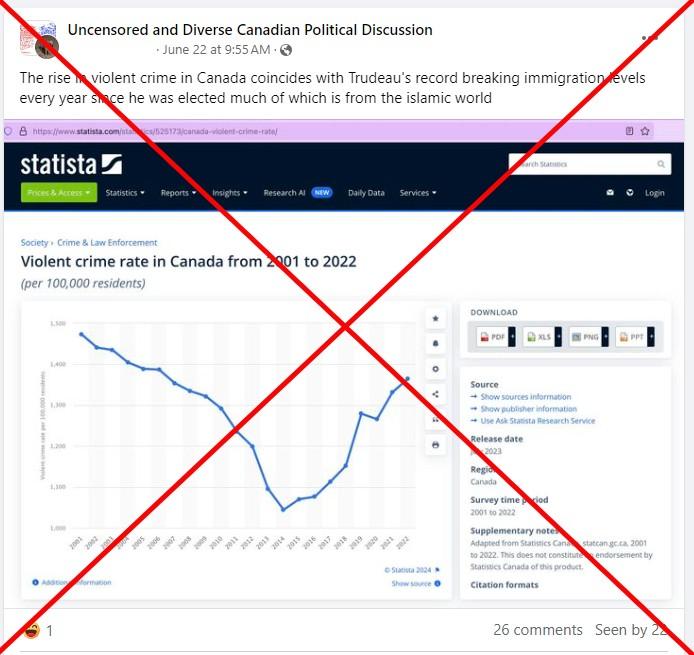
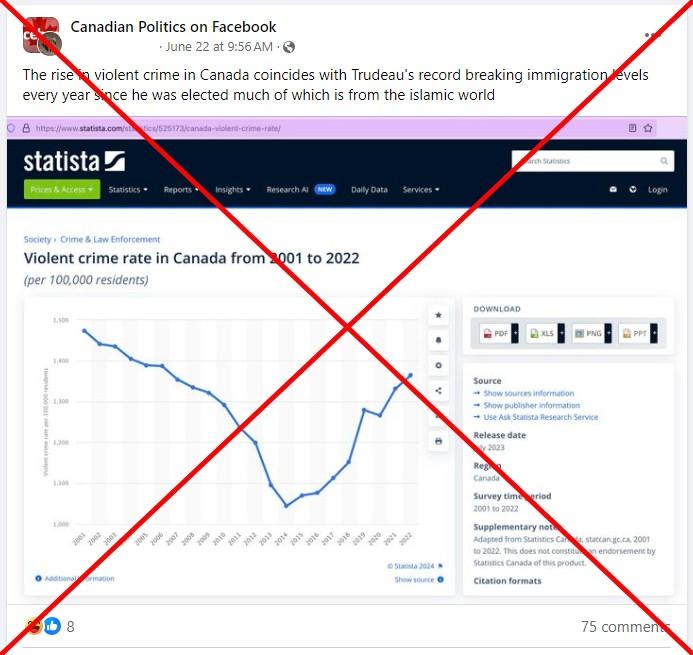
“The rise in violent crime in Canada coincides with Trudeau’s record breaking immigration levels every year since he was elected much of which is from the islamic world,” says a June 22, 2024 Facebook post.

The post includes a graph from the data-gathering site Statista that shows the violent crime rate in Canada fell between 2001 and 2014 before climbing again after 2015 — the year Trudeau assumed office. The same graph has circulated in multiple Canadian Facebook groups.

Image

Screenshot of a Facebook post taken July 9, 2024

Image

Screenshot of a Facebook post taken July 9, 2024

The Liberal prime minister’s term has been marked by a push to increase immigration, triggering debates about the availability of housing, food and jobs — as well as misinformation.

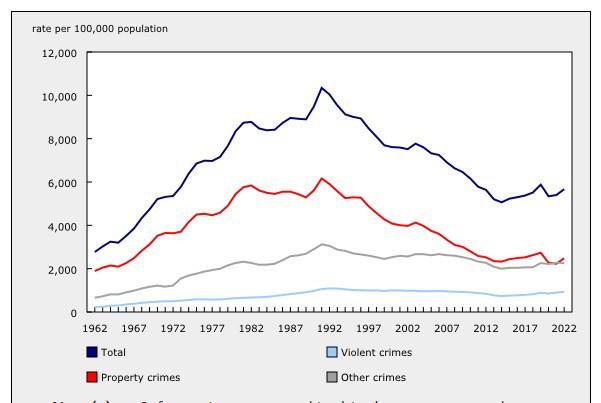
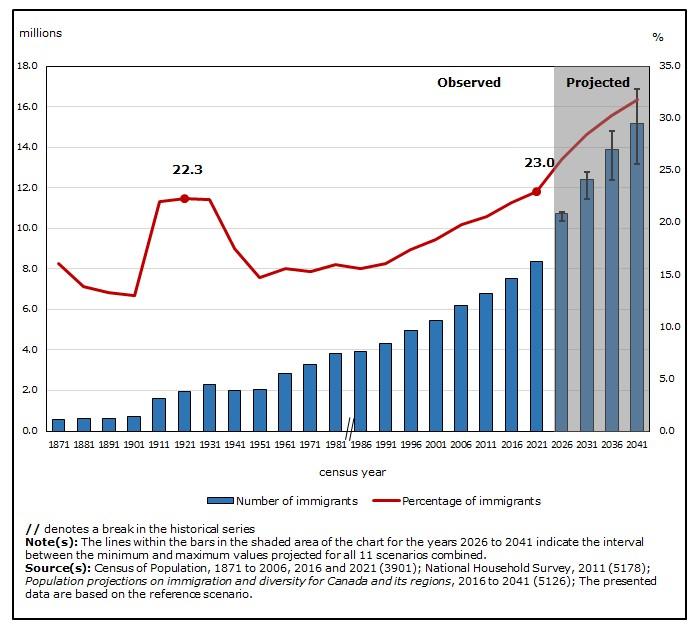
The Statista chart cited in the posts roughly matches data on violent, police-reported crime from Statistics Canada (archived here and here). However, government data do not indicate a relationship with immigration, which has steadily risen since the 1950s (archived here).

Image

This screenshot taken July 9, 2024 shows a Statistics Canada graph depicting police-reported crime between 1962 and 2022

Image

This screenshot taken July 9, 2024 shows a Statistics Canada graph depicting immigration rates from 1871 to 2021, as well as future projections

Anyone can find a correlation between any two things,” said Frank Cormier, a criminologist at the University of Manitoba (archived here). “In-correlation most certainly does not always — actually very rarely — indicates causation.”

He added that research shows “areas that have higher rates of immigration actually tend to see lower crime rates.”

“So, there is absolutely zero evidence that links higher rates of immigration with higher rates of crime,” he said July 4, 2024.

Examining crime, immigration

Researchers have for decades found an inverse relationship between immigration and crime in Canada.

A 2009 study from the University of Toronto found any trends towards youthful criminal activity among immigrants in the city decreased between two generations growing up in the 1970s and 1990s (archived here).

More recently, a 2020 paper from Toronto Metropolitan University examining crime rates between 1976 and 2011 also found the proportion of foreign-born residents was “either not significantly associated or negatively associated with changes in crime rates within Canadian cities” (archived here).

Cormier said one possible explanation is that immigrants must abide by the law to preserve their sometimes tenuous status within the country.

“Adults who are immigrants know that if they commit a crime that is serious enough, they face deportation,” he said. “So, the average immigrant has far more to lose than the average non-immigrant in Canada.”

Cormier said new arrivals also tend to place a higher emphasis on familial bonds and education, which generally lead people away from criminal activity.

Nicolas Ajzenman, an assistant professor in the economics department at McGill University (archived here), agreed that in Europe and the Americas, the effect of immigration on crime is practically non-existent.

However, he emphasized that immigrants are a heterogeneous demographic and that no trend applies globally.

“There are also a few papers documenting a positive effect, especially when the regulations to work legally are tougher,” he said in a July 4, 2024 email, noting that some research has found evidence of increased property crime rates.

A 2013 study found this trend in the United Kingdom, for example (archived here).

But property crime is not the same as violent crime, the category mentioned in the social media posts — and Ajzenman said immigrants who can fully integrate into local labor markets are usually associated with a reduction in delinquency.

Comparing crime statistics

Cormier said data alone do not paint a complete picture of crime, since they only measure incidents recorded by law enforcement.

“If police concentrate their efforts looking at certain types of crime or against certain parts of a city, then crime rates in those areas or on those certain crimes will tend to go up quite significantly,” he said.

Cormier said the Statista graph shared online also shows a relatively small date range, implying that crime has jumped dramatically in the past 10 years.

However, more complete data from Statistics Canada indicate crime reports are still below the level seen in 1990s.

We’re still not anywhere close to where things were before,” Cormier said.

Statistics Canada reported in 2018 that while there was not one single cause for decreasing crime near the end of the 20th century, the dip could be related to an aging population, changing police strategies and shifting attitudes toward illegal behavior (archived here).

Researchers and news reports say Canada’s violent crime rate has risen since 2015 due to a combination of factors, including waning social safety nets — especially following the Covid-19 pandemic — over-reliance on police and firearms entering from the United States.

Read more of AFP’s reporting on misinformation in Canada here.

Source: Posts linking crime to immigration in Canada are unfounded

Steven Vertovec in conversation with Dan Hiebert

Nice short and informative interview:

Our Founding Director Prof. Steven Vertovec in conversation with Dan Hiebert, Professor Emeritus of Geography at the University of British Columbia, on the world of migration from a policy perspective.

Source: Steven Vertovec in conversation with Dan Hiebert