She may well be right given that most of these resolutions were carefully crafted and reflect issues that many may feel activists and advocates have been excessive in their demands and approaches. And her point on that voters may have different views on each of these resolutions appears likely:
The Conservative policy convention has come and gone amid a hail of plaudits, photo-ops, and favourable polls. Leader Pierre Poilievre has managed to unite the party faithful and win over Canadian voters, by tapping into their economic angst and fatigue with Prime Minister Justin Trudeau, who is increasingly seen as out of touch, and out of time.
But the convention also opened a new political fault line: the culture wars. Delegates voted that children should be prohibited from gender-related “life-altering medicinal or surgical interventions,” upheld women’s rights to single-sex spaces and sports, and rejected mandatory diversity, equity, and inclusion training and race-based hiring practices. A majority also supported allowing Canadians to refuse vaccines on the grounds of “bodily autonomy.”
For some voters, however, these issues are highly motivating. Research firm Angus Reid Institute recently asked Canadians what they think about the culture wars, and identified two groups of voters who strongly engage on them: “zealous activists” who favour “progressive” policies like pronoun use and represent 17 per cent of voters, and “defiant objectors” who reject such changes and constitute 20 per cent of the electorate. Broken down by party affiliation, a clear pattern emerges: 47 per cent of Canadians who voted Conservative in 2021 are defiant objectors, while only three per cent of Liberal and NDP voters are.
But while 44 per cent of NDP voters are zealous activists, only 22 per cent of Liberal voters are, suggesting that there is much less dogmatism in this group.
For the parties, this means picking their battles and carefully choosing their bedfellows. The culture wars are not intersectional. Parents who object to the medical transitioning of children do not necessarily support restrictions on abortion. Advocates for women’s only spaces don’t necessarily believe people should be able to refuse vaccines. They may also be uncomfortable lining up with people who do.
Angus Reid will be publishing more data in the weeks to come on specific issues, but their findings on gender identity align with the results of the Conservative convention: 43 per cent of Canadians say parents should both be informed and give consent if a child wants to change how they identify at school, while 35 per cent believe that parents should be informed but consent is not required. Those who supported the Conservative Party of Canada in the 2021 federal election are twice as likely as past Liberal voters (64 per cent to 30 per cent) and three times as likely as past NDP voters (20 per cent) to say parents’ consent is needed. At the Conservative convention, the resolution outlawing medical transition passed on the convention floor with 69 per cent.
Perhaps unsurprisingly, the three words that came up most often in the survey to describe the culture wars were divisive (60 per cent), exhausting (59 per cent), and unnecessary (40 per cent). Pundits who say they are a side issue are wrong: they have seeped into Canadians’ daily lives. Their kids go to school and are told to state their preferred pronouns on the first day of class. Their grandmother goes to an aquafit program and is uncomfortable changing alongside men in an all-gender locker room. They attend DEI sessions where they are shamed for their skin color and just “go along” so as not to get cancelled.
As pollster Nik Nanos observed, although some may see risk on the social-policy front, the reality is that the Conservatives don’t need every voter: they need about 36 per cent. “A majority could oppose their social conservative agenda and they can still win an election.” And a silent majority could guarantee it.
But will they? Despite all the signals on possible changes, any pivot may be too hard a political reversal for the government and its NDP partner to make.
But Breguet makes a convincing case, as it is the only short-term measure that can show seriousness on housing and other related files.
And I continue to believe that given these issues affect immigrants and non-immigrants alike, this may be less of a third rail then appears:
How could the Trudeau government interject new political life into itself? It could switch its position on immigration. I’m not talking about going PPC or [Quebec Premier Francois] Legault, but a significant pivot from ongoing increase to the country’s immigration in-take target and its general “century initiative” rhetoric.
This isn’t such a far-fetched idea. We’ve seen recent glimpses when government raised the prospect of a possible cap on the number of international students, a group that has ballooned massively in recent years to reach 900k recently, and is believed, at least by some, to put significant pressure on rents and housing prices.
While the Liberals have, at times, given the impression that they don’t take the housing crisis seriously and are inclined to double down on satisfying their increasingly mortgage-free boomer base, we must also recognize that the Liberal Party of Canada has historically been remarkably good at adapting and pivoting when needed. They read the room much better than the Conservatives and New Democrats.
So, if they decide to get more serious on the housing file, they’ll need to confront the fact they can’t build enough (or, more precisely, incentivize provinces and cities to build) to make a meaningful difference on prices before 2025. They could however pivot on immigration and have results quickly.
It might start with reducing the number of international students. But the government’s track record on immigration and built-in strengths could enable it to go further by reducing the number of permanent residents (including points-based immigrants and refugees) without the risk of people questioning its commitment to immigration and diversity.
It’s hard to know how much such a policy pivot would affect housing demand and in turn prices but it may not matter per se. Politics, of course, is ultimately about optics. The government would look like it’s trying to get to the root of the housing crisis. The Conservatives, by contrast, appear afraid of their own shadows with anything related to immigration.
The prime minister might therefore gamble that his name and decades of good-faith support for immigration and multiculturalism would allow him to pivot without alienating voters from cultural and visible minorities—something that the Conservatives likely cannot afford, especially after the 2015 election. The Liberals in short may have the political maneuverability to counterintuitively run to the right of the Conservatives on immigration.
Polls have shown people are ready to support a reduction in immigration levels. A well-crafted message centered on helping the housing market could succeed and take this topic away from Poilievre who currently enjoyed a de facto monopoly on it in the past couple of years.
Bryan Breguet, Too Close to Call founder and pollster
Of interest, a progressive who challenged progressive orthodoxies:
Bayard Rustin, a trusted adviser to Martin Luther King Jr. and chief organizer of the 1963 March on Washington, was a towering figure in the fight for racial equality. Remarkably for a man of his generation and public standing, he was also openly gay. When Mr. Rustin died in 1987, obituaries downplayed or elided this fact. Emblematic of this erasure was this paper, which made only passing mention of his homosexuality and obliquely described Mr. Rustin’s longtime partner as his “administrative assistant and adopted son.”
In the decade since President Barack Obama awarded him a posthumous Presidential Medal of Freedom, the country’s highest civilian honor, there has been a welcome resurgence of popular interest in Mr. Rustin’s extraordinary life. He was frequentlyinvoked in commemorations of the march’s 60th anniversary last month and will be the subject of a feature film produced by Barack and Michelle Obama’s company that will come out later this year.
Whereas remembrances of Mr. Rustin once evaded the issue of his sexual orientation, today, in accordance with our growing acceptance of gay people and awareness of the discrimination they have faced, such tributes are likely to center it. This past June, for instance, the PBS NewsHour aired a segment for Pride Month titled “The story of Bayard Rustin, openly gay leader in the civil rights movement.” Other representative encomiums celebrate the “gay socialist pacifist who planned the 1963 March on Washington”and “the gay black pacifist at the heart of the March on Washington.”
Mr. Rustin is today often extolled as an avatar of “intersectionality,” a theoretical framework popular among progressives that emphasizes the role that identities play in compounding oppression against individuals from marginalized groups. While it’s admirable that Mr. Rustin is being recognized for something he never denied (according to one associate, he “never knew there was a closet to go into”), these tributes studiously ignore another aspect of his life: how, throughout his later career, Mr. Rustin repeatedly challenged progressive orthodoxies.
Mr. Rustin, who was characterized by The Times in 1969 as “A Strategist Without a Movement” and, upon his death, an “Analyst Without Power Base,” would most likely find himself no less politically homeless were he alive today. A universalist who believed that “there is no possibility for black people making progress if we emphasize only race,” he would bristle at the current penchant for identity politics. An integrationist who scoffed at how“Stokely Carmichael can come back to the United States and demand (and receive) $2,500 a lecture for telling white people how they stink,” he would shake his head at an estimated $3.4 billion diversity, equity and inclusion industry that often prioritizes making individual white people feel guilty for the crimes of their ancestors while ignoring the growing class divide. A pragmatist who noted, “There is a strong moralistic strain in the civil rights movement which would remind us that power corrupts, forgetting that the absence of power also corrupts,” he would have no patience for social justice activists unwilling to compromise. And a committed Zionist — supportive of the state but likely critical of its government — he would abhor the Black Lives Matter stance on Israel and the recent spate of antisemitic outbursts by Black celebrities. Mr. Rustin’s resistance to party dogma is a neglected part of his legacy worth celebrating, an intellectual fearlessness liberals need to rediscover.
The origin of Mr. Rustin’s estrangement from the progressive consensus began with his belief that once federal civil rights legislation was achieved, the American left would need to turn its attention from racial discrimination to the much more pervasive problem of economic inequality. Four months after the march, Mr. Rustin was invited to deliver a speech at Howard University to the Student Nonviolent Coordinating Committee. According to the Times account, Mr. Rustin “said that the civil rights movement had gone as far as it could with its original approach and that the time had come to broaden the movement, which, he said, faces the danger of degenerating into a sterile sectarianism.” To avoid this fate, he argued, it must “include all depressed and underprivileged minority groups if their own movement is to make another leap forward.” Deriding direct-action protest tactics as mere “gimmicks,” Mr. Rustin counseled the young activists that “Heroism and ability to go to jail should not be substituted for an overall social reform program … that will not only help the Negroes but one that will help all Americans.”
Mr. Rustin expanded upon this analysis in a seminal 1965 Commentary magazine essay, “From Protest to Politics.” Published after the passage of the Civil Rights Act and several months before the signing into law of the Voting Rights Act, Mr. Rustin argued that the main barrier to Black advancement in the United States would soon no longer be racism but poverty. “At issue, after all, is not civil rights, strictly speaking,” he wrote, “but social and economic conditions” that transcended race. The problems facing Black America, therefore, needed to be seen as the “result of the total society’s failure to meet not only the Negro’s needs, but human needs generally.” A stalwart social democrat, Mr. Rustin argued that meeting these needs required a coalition of “Negroes, trade unionists, liberals, and religious groups” to push the Democratic Party to the left on economic issues.
Sectarian appeals based solely on race — whether from white segregationists or Black nationalists — threatened this aim. In May 1966, the moderate integrationist John Lewis was ousted from the chairmanship of SNCC by the Black Power radical Stokely Carmichael. Mr. Rustin responded with another Commentary essay, “‘Black Power’ and Coalition Politics.” Black Power, he wrote, was “simultaneously utopian and reactionary” as it “would give priority to the issue of race precisely at a time when the fundamental questions facing the Negro and American society alike are economic and social.” At a time when the Democratic Party is losing the support of working-class Americans of all races, this component of Mr. Rustin’s legacy is as important as ever.
Committed to a political program that would improve the lives of the poor and working class regardless of their skin color, Mr. Rustin opposed racial preferences . In 1969, he called a proposal for slavery reparations “preposterous,” elaborating that “if my great-grandfather picked cotton for 50 years, then he may deserve some money, but he’s dead and gone and nobody owes me anything.” Worse than a point of personal pride was the way in which the call for reparations divided the multiracial working class. As a “purely racial demand,” Mr. Rustin contended, “its effect must be to isolate blacks from the white poor with whom they have common economic interests.”
Testifying before Congress in 1974 against affirmative action, Mr. Rustin said: “Everyone knows racial discrimination still exists. But the high rate of black unemployment and the reversal of hard-won economic gains is not the result of discrimination,” but of the same, general economic conditions that affected the white unemployed. Contrary to contemporary “antiracism” advocates who claim that the existence of racial disparities necessarily constitutes evidence of racism, Mr. Rustin asserted, “That blacks are underrepresented in a particular profession does not by itself constitute racial discrimination.”
Another major source of tension between Mr. Rustin and the progressive left concerned American foreign policy. Briefly a member of the Young Communist League in the 1930s, Mr. Rustin followed the path of many a disillusioned ex-Communist by becoming a staunch anti-Communist. Although an early opponent of American military involvement in Vietnam, Mr. Rustin could not, as he wrote in 1967, “go along with those who favor immediate U.S. withdrawal, or who absolve Hanoi and the Vietcong from all guilt. A military takeover by those forces would impose a totalitarian regime on South Vietnam and there is no doubt in my mind that the regime would wipe out independent democratic elements in the country.”
In his role as chairman of Social Democrats, USA, the more hawkish faction to emerge from a split within the Socialist Party of America over the Vietnam War, Mr. Rustin was an outspoken critic of the Soviet Union and international Communism. He declined to endorse Democratic Senator George McGovern’s antiwar presidential candidacy in 1972 and joined other hawks in forming the Coalition for a Democratic Majority, an initiative to oppose the Democratic Party’s leftward lurch, becoming its vice chair. In the 1976 Democratic presidential primary, Mr. Rustin supported Senator Scoop Jackson of Washington, whose decades-long career combined strong support for civil rights and social welfarism at home with robust anti-Communism abroad.
Mr. Rustin’s evolution from absolute pacifist (epitomized by the two years he spent in a federal penitentiary during World War II as a conscientious objector) to Cold War liberal dismayed many of his allies on the left, who accused him of betraying the principles of Gandhian nonviolence he had brought to the civil rights movement. But Mr. Rustin’s transformation was born of long deliberation and genuine conviction; according to one biographer, Mr. Rustin repeatedly said that if he had been aware of the Holocaust during World War II, he most likely would not have become a conscientious objector.
If Mr. Rustin’s erstwhile comrades considered him a sellout, so too was he disillusioned with a political camp that posited a moral equivalence between the United States and its Soviet adversary. “Whereas I used to believe that pacifism had a political value, I no longer believe that,” Mr. Rustin stated flatly in 1983. “It is ridiculous, in my view, to talk only about peace. There is something which is more valuable to people than peace. And that is freedom.”
Yet another source of antagonism between Mr. Rustin and the left was his outspoken opposition to antisemitism within the Black community and fervent support for the state of Israel. “So far as Negroes are concerned,” he wrote in 1967, responding to an eruption of antisemitic statements by radical Black activists, “one of the more unprofitable strategies we could ever adopt is now to join in history’s oldest and most shameful witch hunt, antisemitism.” The following year, in an address to the Anti-Defamation League, Mr. Rustin condemned “young Negroes spouting material directly from ‘Mein Kampf.’” In 1975, as the United Nations General Assembly was preparing its infamous resolution condemning Zionism as a “form of racism,” Mr. Rustin assembled a group of African American luminaries including A. Philip Randolph, Arthur Ashe and Ralph Ellison into the Black Americans to Support Israel Committee (BASIC). “Since Israel is a democratic state surrounded by essentially undemocratic states which have sworn her destruction, those interested in democracy everywhere must support Israel’s existence,” he declared.
A descendant of slaves who was himself a victim of brutally violent racism, Mr. Rustin never let his country’s many sins overshadow his belief in its capacity for positive change. His patriotism was unfashionable among progressives while he was alive and is even more exceptional today. “I have seen much suffering in this country,” he said. “Yet despite all this, I can confidently assert that I would prefer to be a black in America than a Jew in Moscow, a Chinese in Peking, or a black in Uganda, yesterday or today.”
For his heresies against progressive dogma, Mr. Rustin was derided as a “neoconservative.” (Indeed, he was one of the first political figures to be branded with this epithet, coined as a term of abuse for members of the Social Democrats, USA by their more left-wing rivals.) But while Mr. Rustin may have taken part in various neoconservative initiatives and counted individual neoconservatives as friends and allies, he was not himself an adherent of this ideological persuasion. Unlike most of the thinkers and activists associated with neoconservatism, Mr. Rustin never abandoned his social democratic convictions, nor did he endorse Ronald Reagan. On the contrary, he wrote that “insensitivity and lack of compassion increasingly are becoming the hallmarks of the Reagan administration’s domestic program” and stated that the Black poor “have been victimized by years of Reaganism.”
Mr. Rustin’s life offers a sterling example of moral courage and personal integrity. Resisting the temptations of tribalism, standing up for one’s beliefs even when it angers one’s “side,” advocating on behalf of the least among us — Mr. Rustin embodied these virtues to an uncommon degree. And undergirding it all was a bedrock belief in our common humanity. Asked to contribute to an anthology of Black gay men the year before his death, Mr. Rustin respectfully declined. “My activism did not spring from my being gay, or for that matter, from my being black,” he wrote.
Rather it is rooted, fundamentally, in my Quaker upbringing and the values that were instilled in me by my grandparents who reared me. Those values are based on the concept of a single human family and the belief that all members of that family are equal. Adhering to those values has meant making a stand against injustice, to the best of my ability, whenever and wherever it occurs.
I am heartened to see a new generation of Americans belatedly acquaint themselves with Bayard Rustin’s life and work. If we truly wish to honor his remarkable legacy, we should begin by recognizing him as he would have wanted: for his ideas, not his identity.
Worrisome but not surprising given all the articles and commentary regarding the impacts on housing, healthcare and infrastructure. All reflecting policy and political failings:
More than half of Canadians want the federal government to accept fewer immigrants than it is planning for in 2023, a new poll shows – a rise from one in three in March.
Il faudrait beaucoup plus que 60 000 immigrants au Québec chaque année pour freiner le déclin du poids démographique au sein du Canada, souligne d’emblée le démographe Marc Termote. Il est toutefois « assez d’accord » avec la hausse des seuils, l’un des deux scénarios proposés par le gouvernement de François Legault, puisqu’elle permettrait au moins de maintenir la population de la Belle Province.
L’une des options de l’exercice actuel propose en effet de faire grimper les seuils d’au moins 10 000 immigrants permanents d’ici 2027.
Le professeur associé de démographie à l’Université de Montréal avait lui-même suggéré l’an dernier de passer peu à peu à une cible de 58 000 immigrants au Québec, dans un rapport commandé par le ministère de l’Immigration, de la Francisation et de l’Intégration (MIFI).
Son raisonnement pour en arriver à ce chiffre différait cependant de celui du gouvernement, qui le justifie notamment par la possibilité d’une « contribution accrue aux besoins de main-d’oeuvre dans certains secteurs d’activité prioritaires », dans son cahier préparatoire aux consultations.
C’est plutôt une question de maintien démographique : « On dépend à 100 % de l’immigration rien que pour garder constant à long terme le nombre d’habitants au Québec », explique-t-il. Comme ailleurs dans les pays industrialisés, la province est en voie de connaître un accroissement naturel près de zéro, alors que les naissances ne compenseront bientôt plus les décès. Pour garder même « la faible croissance démographique actuelle du Québec », il serait nécessaire d’arriver à au moins 58 000 immigrants, dit M. Termote.
Un seuil à 58 000 — ou à 60 000, comme ce que propose le gouvernement — dépasserait le maximum enregistré au cours des cinquante dernières années, note-t-il.
La cible annuelle de 50 000 immigrants représente quant à elle à peu près la quantité de résidences permanentes permises par Québec chaque année depuis 2009. Pendant la même période, la population du Québec a grossi de 13 %. C’est donc le « taux d’immigration » qui a diminué, c’est-à-dire la proportion de nouveaux arrivants par rapport à la population totale.
« Le taux d’immigration est l’une des manières de raisonner, mais il faut considérer d’autres facteurs », dit le démographe, comme la volonté ou non d’un État de faire grossir sa population. Le Québec a, par exemple, eu des taux d’immigration beaucoup plus élevés lors de grandes crises humanitaires, comme en 1957 après l’invasion soviétique de la Hongrie ou au tournant des années 1980 avec l’arrivée de réfugiés vietnamiens.
Pas de remède au déclin relatif
Quant au poids démographique de la province dans le pays, le verdict de M. Termote est sans appel : « On est condamnés à être marginalisés au sein du Canada. »
Même si le nombre de résidents permanents a varié 14 000 et 55 000 par année depuis 1951, une constante demeure : le Québec a toujours reçu une proportion d’immigrants moins grande que son poids démographique dans le Canada. Un phénomène qui sous-tend l’érosion du poids démographique dans la Fédération.
En 1951, par exemple, une année d’immigration pourtant importante, Québec a accueilli 24 % de tous les immigrants au Canada, mais la population de la province représentait 29 % de celle du pays.
Cet écart a aussi été particulièrement grand récemment. En 2019, première année où la Coalition avenir Québec a déployé son programme d’immigration, la province a reçu 12 % de toute l’immigration du Canada avec 40 000 résidents permanents. Le Québec représentait près de 23 % de la population totale. Même un seuil de 60 000 immigrants ne continuera de représenter qu’environ 12 % du total canadien attendu de 485 000 en 2024.
Est-ce le Canada qui va trop vite ? Ou le Québec qui va trop lentement ? « C’est une tendance de longue durée qui n’est pas près de s’arrêter », répond avec tact le professeur à cette question de plus en plus polarisante. En extrapolant, « même si c’est un exercice dangereux », à la fin du siècle, le poids du Québec ne sera plus que 15 % au sein du Canada, a-t-il calculé.
Aucune des façons de remédier au déclin du poids démographique du Québec ne lui semble envisageable. Il faudrait remonter la fécondité à des niveaux supérieurs à ceux des cinquante dernières années, ce qui est « injustifié du point de vue éthique pour les femmes », croit-il. Ou encore, recevoir plus de 100 000 immigrants, ce qui lui semble « irréaliste » et en « rupture complète avec les objectifs de la politique linguistique poursuivis depuis des décennies », écrivait-il en 2022.
Highlighting just how difficult any change will be, no matter how needed, given provincial and education institution opposition. Unclear whether the federal government will have the political courage to impose some form of cap or restrictions.
HESA has a good post on the difficulties (Caps on Student Visas) particularly for the federal government should it try to assess different education institutions etc. A possible way around this would be to manage the granting of study permits like Provincial Nominee Program, with provincial-level caps, declining over time, with provincial responsibility to review DLIs to reduce the visa mills of private colleges and the public colleges that subcontract to them:
As Canada continues to grapple with a housing crisis, the conversation is increasingly turning to international students coming into the country.
But multiple provinces are pushing back on federal suggestions that an international student cap could help solve the problem, and say they haven’t been consulted.
Immigration Minister Marc Miller, Housing Minister Sean Fraser and Public Safety Minister Dominic LeBlanc have all indicated that Ottawa is considering a cap on student intake.
Following their comments over the past two weeks, Global News reached out to provincial and territorial governments about how it would impact them and whether they would support any caps.
Three provinces, British Columbia, New Brunswick, and Newfoundland and Labrador, told Global News they had not been consulted on any proposed cap. Only the government of the Northwest Territories said it had been in contact with Ottawa about a proposed student cap.
“The GNWT has been in discussions with the federal government regarding potential changes around international students and, while not the main focus, a proposed cap has been mentioned,” a spokesperson for the N.W.T. government said.
A B.C. government official on background said, “At this time, Provincial officials responsible for international education have not been contacted by IRCC or any other department with a proposal to cap international student enrolment. We will await and review any international student enrolment policy.”
Angela Picco, a spokesperson for the Newfoundland and Labrador Department of Education, said international students were a crucial part of the province’s strategy to address its demographic challenges.
“We are hopeful that we will have the opportunity for consultation before any cap is implemented to ensure that it does not disadvantage our province, given the demographic challenges facing our province and the role of post-secondary education in attracting newcomers to this province,” she said.
Picco added that the provincial government would support post-secondary institutions increasing their international student numbers.
New Brunswick similarly said international students have been integral to the “province’s economy for a number of years and the attraction and retention of them is critical to our current and future workforce.”
“We have seen the number of international students increase over the past few years and we hope this trend will continue,” Judy Désalliers, a spokesperson for the Post-Secondary Education, Training and Labour Ministry, said.
“The federal government, through Immigration, Refugees and Citizenship Canada, regularly meets with the provinces and territories but has not consulted with New Brunswick about a proposed cap on international students,” the statement added.
The government of Saskatchewan told Global News it thinks the province and its institutions are in the best position to determine the appropriate number of international students since education is an area of provincial jurisdiction.
“As such, we find no justification for implementing such a restriction in our province thanks to the hard work of our institutions ensuring housing and other needs of students are being met,” Sam Sasse, a spokesperson for the Ministry of Advanced Education, said.
“Our government has confidence in the ability of Saskatchewan’s designated learning institutions to manage recruitment and support for both domestic and international students.”
What about Quebec and Ontario?
Quebec, too, said it is working to attract international students, particularly francophone students and those in “priority sectors.”
The Quebec Ministry of Education also indicated it was concerned about the income of higher educational institutions.
“The ministry will closely follow federal government decisions that could have an impact on the income of higher education establishments in Quebec,” a spokesperson said, writing in French.
Ontario, which is home to nearly half of all international students in Canada, said in a statement that while the federal government was responsible for immigration policy, “all levels of government have a role to play in supporting the welcoming of international students.”
The Ontario government did not clearly state whether it would support any kind of a cap.
A Nova Scotia government spokesperson said while it would be premature to comment right now, “Nova Scotia would want to be given the opportunity to be consulted because international students make a positive impact on our province. We want to help them build a life and career here when they graduate.”
The role of international students in provincial labour markets was also raised by provinces and territories. The N.W.T. was among those, saying the region already caps international students at 30 per cent of an institution’s total population.
“It is important that any federal adjustments to the classes of immigrants which may be allowed into Canada each year, including international students, not negatively impact the NWT’s ability to attract and retain international students and talent, which are important to the territory’s labour market and economic development,” a spokesperson said.
Alberta currently has 90,000 job vacancies across sectors, with many employers looking to international students to fill those labour gaps. A spokesperson for the ministry of advanced education told Global News their labour forecasts show “international students will play a key role in complimenting our efforts in broadening and deepening Alberta’s talent pool.”
A spokesperson for P.E.I. said the province was looking forward to hearing the details of any proposed cap on international students, so it can better understand the implications for P.E.I.
A spokesperson for the Yukon said this was an “issue for some of the other jurisdictions in Canada,” since the territory only has Yukon University and three registered private training institutions.
Manitoba and Nunavut did not respond to a request for comment by deadline.
The growing focus on federal immigration and whether targets need to be reviewed comes as the country struggles to cope with a housing crisis.
NDP Leader Jagmeet Singh told reporters on Monday that it would be unfair to blame students.
“I want to be really clear on this. International students are not to be blamed for the housing crisis we’re in. Over the past decades, both Liberals and Conservatives have not built enough homes,” Singh said.
Singh said the NDP, if elected in the next federal election, would require colleges and universities that have international student enrolment to prove that they can provide them housing.
“If you’re welcoming students in, you should be able to house them,” he said.
Singh said that while provinces had a “role to play” in easing the housing crisis for students, he was “not interested in playing a blame game.”
The NDP leader said student housing needed to be a part of any national housing strategy.
Conservative Leader Pierre Poilievre last month called Canada’s immigration system “broken” and said, “I’ll make sure we have housing and health care so that when people come here they have a roof overhead and care when they need it.”
After last month’s cabinet retreat, Prime Minister Justin Trudeau said Canadians should be “very careful” about blaming international students for the housing crisis.
“We have to be very careful. Over the past years, we’ve seen a lot of different people and a lot of different groups blamed for the housing crisis. At one point it was foreign homebuyers. At another point it was developers being super aggressive. Another point, it was under-investments by various orders of government. Now it’s people saying, ‘Oh, it’s international students,’” Trudeau said.
Many of the provinces told Global News they were investing significantly in building student residences. At the same time, Fay Faraday, a law professor at Osgoode Hall Law School and immigration law expert, said Canadian universities depend on international students for a large chunk of their revenue.
She said this is because of declining provincial support for post-secondary education over the last few years.
“The international student population is critical to the functioning of the university because the fees that they pay, which are significantly above domestic fees, fill the gap in the underfunding for the public education system and secondary public education system,” Faraday said.
Last month, Universities Canada also pushed back against a potential cap on international student intake.
“Recent comments conflating international students and the housing crisis are deeply concerning to Universities Canada and our members,” Lisa Wallace, a spokesperson for Universities Canada, said in a statement.
“International students bring important knowledge, diversity and skills to our campuses, communities and workforce. We must continue to welcome them to study at Canadian universities.”
According to a recent survey by the Daily Bread food bank, which was released on Wednesday, Immigration, Refugees and Citizenship Canada’s estimated living expense used during the application process is nearly half of what a student in Toronto typically spends.
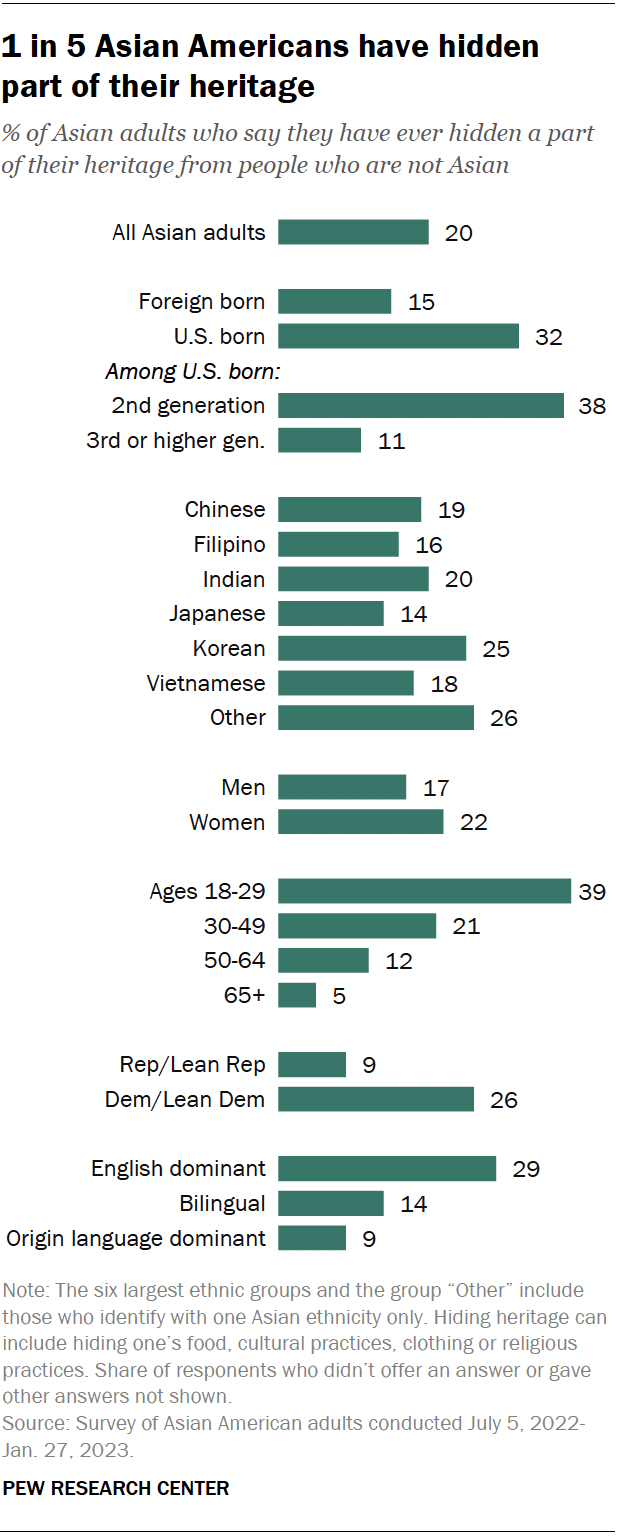
Noteworthy. Also of interest is that it sharply declines in the third or higher generations, along with being highest in the second generation, where many of the integration and identity struggles are:
One-in-five Asian American adults say they have hidden a part of their heritage – cultural customs, food, clothing or religious practices – from non-Asians at some point in their lives. Fear of ridicule and a desire to fit in are common reasons they give for doing this, according to a Pew Research Center survey of Asian adults in the United States conducted from July 2022 to January 2023.
How we did this
Birthplace and immigrant roots play a role in who is most likely to hide their heritage: 32% of U.S.-born Asian adults have done this, compared with 15% of immigrants. Among those born in the U.S., second-generation Asian adults (in other words, those with at least one immigrant parent) are more likely than third- or higher-generation Asian Americans (those with U.S.-born parents) to have hidden their culture from non-Asians (38% vs. 11%).
Second-generation Asian Americans make up 34% of the U.S. Asian population, at approximately 7.9 million people, according to a Center analysis of the 2022 Current Population Survey. The majority of this group (66%) is under age 30. And according to our survey, they also primarily speak English.
Aside from generational differences, here are other survey findings about who is most likely to have hidden their heritage from non-Asians:
Korean Americans are more likely than some other Asian origin groups to say they have hidden part of their heritage. One-in-four Korean adults (25%) say they have done this, compared with smaller shares of Chinese (19%), Vietnamese (18%), Filipino (16%) and Japanese (14%) adults.
Asian Americans ages 18 to 29 are about twice as likely as older Asian adults to have hidden their culture. About 39% of Asian adults under 30 have hidden their culture, food, religion or clothing from non-Asians. About one-in-five Asians ages 30 to 49 (21%) have done this, as have 12% of Asians 50 to 64 and 5% of those 65 and older.
Asian adults who are Democrats or lean Democratic are much more likely than those who identify with or lean toward the Republican Party to have hidden their identity. Among Asian adults, 29% of Democrats have hidden their culture from others, compared with 9% of Republicans.
Asian Americans who primarily speak English are more likely than those who primarily speak the language of their Asian origin country to have hidden part of their heritage. Some 29% of English-dominant Asian adults have hidden their heritage, versus 14% of those who are bilingual and 9% who primarily speak their Asian origin language.
Why some Asian Americans hide their heritage
Asian Americans who said they have hidden part of their heritage also shared why they did so. Some of the most common reasons were a feeling of embarrassment or a lack of understanding from others.
However, different immigrant generations also cited various other reasons for hiding their culture:
Many recent Asian immigrants said they have tried to fit into the U.S. and fear that others may judge them negatively for sharing their heritage.
U.S.-born Asian Americans with immigrant parents often said they hid their heritage when they were growing up to fit into a predominantly White society. Some in this generation mentioned wanting to avoid reinforcing stereotypes about Asians.
Some multiracial Asian Americans and those with more distant immigrant roots (third generation or higher) said they had at times hidden their heritage to pass as White.
What U.S.-born Asian Americans say about growing up in the U.S.
In 2021, the Center conducted 17 focus groups in which Asian Americans born in the U.S. answered questions about their experiences growing up. Some second-generation Asian Americans shared distinct examples of hiding their heritage and having to balance their family’s cultural practices with the culture of broader American society:
“[It] was kind of that stigma when you were little, a teen, or you were younger that [you] don’t want to speak Chinese … because people would think that you’re a FOB [fresh off the boat] or an immigrant.” – Early 30s man with Chinese immigrant parents
“I remember in elementary school, I don’t even know what my mom brought me, [but] it was some Taiwanese dish. I guess it just had a more pungent smell to it. The kids would just be like, ‘Oh, what is that smell? You guys smell that?’ I would just cover my lid and be like, ‘Okay, I’m not going to eat my lunch.’” – Early 20s woman with Taiwanese immigrant parents
“[I] used to roll as Asian/Hispanic because I was too scared of my identity to say I was Pakistani. I remember 2011 or 2012, when [U.S. special operations forces] killed [al-Qaida leader Osama] bin Laden in Pakistan, after that happened, I was like, ‘Yeah, I’m definitely not saying I’m Pakistani,’ because people were coming up to me and they’re like, ‘Oh my God, they killed your uncle. They found him in your homeland.’” – Early 20s man with Pakistani immigrant parents
Alongside these struggles, many second-generation Asian Americans talked about being proud of their cultural background and wanting to share it with non-Asians:
“[W]hen I go to Cambodia and speak the language, it’s like connecting with an old friend … or meeting somebody from my past because so many of those ideas of what love is, of what it is to be part of a community, and even to live by example comes from having that language still alive within me.” –Early 30s man with Cambodian immigrant parents
“[T]here are going to be ups and downs. Definitely one of the downs is being labeled by other people for our differences. But one of our ups is that we have culture and language that we can always rely on; we have some diversity in customs and cultures that we could go back to. And if people are willing to experience these new differences, we can definitely pass it on and spread awareness of different cultures.” –Early 20s man with Korean immigrant parents
Every year for the last four years, Maha Al-Zu’bi, a former Calgary professor, her husband Tahseen Kharaisat, a former local restaurant owner, and their five-year-old son Furat have dressed in red and white to celebrate Canada Day from the apartment they’re renting in the northwest suburbs of Amman, Jordan.
Maha says, while it’s always a celebratory day, it’s a hard one — because sometimes even the thought of looking at pictures from home brings her to tears.
“We strongly believe we’ll be back in Canada someday. But we don’t know when,” Maha told CBC News. “We love Canada, but sometimes when you love someone you close your eyes to their mistakes because you love them.”
The “mistake” Maha refers to is a federal policy with roots stretching back through the last decade. Families, their lawyers and advocates say it effectively blocks Canadians from adopting children from many Muslim-majority countries. The sticking point is a difference in terminology between how those countries, and Canada, view adoption.
CBC News spoke with two families who say their lives are on hold while they’re left waiting for the government to recognize their adoptions as legal.
‘The way I was being treated never felt like I was Canadian’
Al-Zu’bi and Kharaisat are Canadian citizens. When they moved to Calgary in 2011, Al-Zu’bi quickly got a job at the University of Calgary, where she completed a PhD in environmental design, while Kharaisat opened a shawarma restaurant.
But their family didn’t feel complete — the couple had always hoped to have a child.
After years of exhausting and expensive fertility treatments, and with Al-Zu’bi in her early 40s and Kharaisat about to enter his 50s, time felt like it was running out.
The waitlist to adopt a child in Canada was at least five years, so the couple turned to their country of origin, Jordan, to find a child in need of a home. That’s where they met Furat. The three-month-old boy was born with a cleft hand — a congenital condition where the centre of the hand is missing fingers. He was abandoned by his birth mother due to his disability.
“The first moment the lady gave him to me, I was staring into his eyes and he gave a big smile — it was a great sign that he’s as happy as we are,” Al-Zu’bi said.
They decided to welcome Furat into their family and completed the Jordanian adoption process, under a law called kafala. It never occurred to them to consult a lawyer to investigate whether Canada would treat some international adoptions as different than others — and there was nothing clearly visible on theCanadian government’s website that would indicate that adopting from an Islamic country would be prohibited.
One week after Furat was adopted, the family applied to the Canadian embassy for his visitor visa. It was promptly rejected.
“It was a surprise. And, to be honest, it was very disappointing,” Maha says. “I file taxes every year. We’ve always been good citizens. I love Canada … but [once I started being interviewed] the way I was being treated never felt like I was Canadian. It wasn’t welcoming.”
The family’s lawyer wrote to Alberta Adoption Services to request a review of the department’s policy. Alberta’s justice department instead responded, stating the federal government would need to amend its immigration regulations for the adoption to proceed.
The U.S. issued Furat a visitor visa, despite Canada’s reluctance. The CBC has blurred the photo to hide any personal information. Supplied by Maha Al-Zu’bi (Supplied by Maha Al-Zu’bi)
While adoption is provincially regulated in Canada, few provinces allow for exemptions to the policy, and advocates say the federal restriction means it’s difficult, if not impossible, for families to adopt children under a certain type of Islamic legislation.
That’s because in many Islamic countries, like Jordan, guardianship is established under kafala law, by which adoptive parents become the sponsors or guardians of a child, but not their official adoptive parents. It’s based on an interpretation of the Qur’an that encourages fostering children in need, without severing the possibility of ties to the child’s biological family.
The official reason Furat is barred from entering Canada is that Canada, as a signatory of the Hague Convention on intercountry adoption, does not recognize parent-child guardianships established in countries under Islamic law. Yet the United States, Britain and Australia, all signatories to the same convention, allow adoptions from Islamic countries.
Countries affected by the legislation include Jordan, Somalia, Pakistan, and Morocco. It’s a policy the current federal government promised to review five years ago — but questions from CBC News to the government about the status of that review went unanswered.
Immigration, Refugees and Citizenship Canada maintains these countries’ policies don’t meet Canada’s legal definition of adoption. However, critics say Canada’s policy is based on a misinterpretation of Islamic adoption law that unfairly discriminates against Muslim families.
The IRCC says that while the government is “sensitive to the emotional stress that can be caused when there are issues with cases involving children” it must take precautions to ensure international adoptions comply with laws in Canada, the Hague Convention, and the child’s country of origin.
“Once the adoption process has been completed in accordance with the laws of both countries, then the immigration or citizenship process to bring the child to Canada can proceed,” the IRCC said in an emailed statement.
The family has submitted all requested legal documents, including a letter of support and verification of legal guardianship from Jordan’s foreign affairs ministry and the minister of social development. The IRCC says, as Furat’s case is before the courts, it’s unable to comment further.
Policy’s origins date back to counter-terrorism memo
In British Columbia, unlike Alberta,provincial legislation allows an adoption agency to sign off on non-Hague-recognized adoptions in advance, before a family adopts from overseas, which has allowed some adoptions to be completed in countries like Morocco.
Delia Ramsbotham, managing director of B.C.’s Sunrise Family Services Society, says her agency has received calls from families across the country asking how to adopt from nations that don’t have an established adoption process with Canada — and that sometimes she has to break the news the adoption might not be possible, due to the country they’re trying to adopt from or where they live.
She says that one of the reasons Hague adoption rules are so restrictive is because they’re meant to ensure children are legally available for adoption, and that they’re able to legally immigrate into their adoptive parents’ country.
“It’s an attempt to try to put safeguards in place for everyone involved,” she said. “The powers that be don’t want people who live in Canada flying overseas and doing an adoption and bringing those kids back if we don’t know if those kids were trafficked, if those kids were actually in need of a family or if their parents were paid off … it’s not just protecting the children, it’s protecting the birth parents, and adoptive parents.”
She suggests that anyone preparing to adopt first contact their province or territory’s adoption agency, to get guidance on navigating the complex patchwork of laws between Canada and whichever country they’re interested in adopting from.
When asked by CBC News why Alberta doesn’t recognize guardianship adoptions, like B.C., a spokesperson for Alberta’s minister of children and family services said its legislation doesn’t “recognize guardianship orders as equivalent to adoption orders.”
They added that it’s outside the province’s legislated authority to be involved in international adoptions that only grant guardianship orders.
While Canada ratified the Hague Convention in 1995, adoptions from Islamic countries still appear to have been accepted across Canada until about 2013. That year, Canada abruptly issued a notice that it had banned all adoptions from Pakistan, stating “Pakistani law allows for guardianship of children but does not recognizeour [Canada’s] concept of adoption.”
The CBC’s Fifth Estate releasedan investigation into the policy in 2018, where it found that the restriction had quietly been extended to virtually all Islamic countries, and that emails from federal officials to provinces and territories were attempting to drum up support for the change.
It found that just days before the Pakistan adoption ban, a heavily redacted memo addressed to former foreign affairs minister John Baird, titled “Canadian programming to counter the terrorist threat from Pakistan,” raised questions of whether the decision was motivated by a national security agenda.
CBC News has filed requests under the Access to Information Act with the hope of clarifying the origins of the policy and determining whether the current federal government has endeavoured to change the policy, but has yet to receive the results of those inquiries.
The office of then-federal immigration minister Ahmed Hussen said in 2018 that it would undertake a review of the policy and determine a path forward to recognize Muslim adoptions. But the results of that review, if complete, do not appear to have been made public.
CBC News asked Immigration Minister Sean Fraser’s office for comment on the status of that review and was told that the office does not have an update to share. Any further comment was referred to the IRCC.
The federal government’s website states it can providehumanitarian exemptions to the policy. And legal decisions, like one by an Edmonton Court of Queen’s Bench Justice in 2015, have declared that kafala law does create “apermanent parent-child relationship.”
And yet, five years later, the government policy remains the same, with no clarity. And more families are left in legal limbo.
‘I was so hurt’
Farhan Abdi Omer, a Canadian citizen from Somalia who works as a security officer at the Calgary Courts Centre, is another parent confounded and, in his words, “heartbroken” by the government’s denial of his application to bring his two sons to Canada.
For three-and-a-half years, Omer, like the Al-Zu’bi family, has applied, been denied, and is now in the process of appealing Canada’s immigration system.
Fifteen years ago, Omer was working as a police officer in Somalia. One evening, while inspecting an area of Mogadishu that had seen intense violence and targeting of Somali Christians, he happened across two boys, Ayanle and Khader, on an abandoned street.
They were approximately three and five years old. Omer and his late wife took the boys in, and searched for their birth parents for over a year before deciding to formally adopt them via a secular, United Nations-recognized court in Somalia in 2009.
Later, the family fled Somalia, and became refugees in neighbouring Djibouti. Omer and his wife decided he should immigrate to Canada first, to save money and prepare for the entire family’s arrival down the line.
While in Djibouti, Omer’s wife was diagnosed with cancer, delaying their immigration process as his earnings in Canada went toward her chemotherapy treatments. She passed away in 2017, leaving the boys in the care of Omer’s mother before he began the process to bring them to Canada.
By this point, Omer’s two sons had become Christians, which he says makes them more vulnerable to discrimination in Djibouti.
In 2019, the same year Maha Al-Zu’bi and Tahseen Kharaisat applied for Furat’s temporary visa, Omer applied to sponsor his boys to come to Canada. The application was referred to the Canadian High Commission to Kenya in Nairobi. The visa office twice expressed concern that the Somali adoptions were not legally valid because Somalia is predominantly Islamic.
“I am concerned that there is no official law or legal structure that allows full adoption in Somalia,” reads one of the letters from the high commission, dated May 17, 2021, which Omer provided to CBC News.
“While issues and obligations related to guardianship, custody and care of children left without biological parents may be addressed in Islamic Sharia law as understood in Somalia, Islamic Sharia law and other bodies of law in Somalia do not allow for full adoption of a child, as generally understood in Canada.”
The letter also says the immigration program manager was concerned the arrangement may not be in the best interests of the child because there is “no competent recognized central government adoption authority or child welfare agency in Somalia” with the capacity to approve adoptions, verify the origins of the child or verify adoption documents.
In response, Omer explained, with supporting documentation, that the Somali adoption order was issued by a secular, UN-recognized court.
Further, Omer obtained an order from an Alberta Court of Queen’s Bench (now King’s Bench) justice that establishes that Omer’s Somali adoption order has the legal effect of an adoption order under Alberta law.
Despite these responses, Omer says the visa office refused the applications on the basis that adoptions are not available in Somalia as it is a majority Islamic jurisdiction.
“I was so hurt … Because I’m a Muslim?” Omer said. “I’m a citizen, a Canadian. I respect everyone, all religions. I am integrated. I mean, I can’t hear that from Canada. If I heard that from Somalia, I would say, ‘OK,’ but from Canada? I can’t hear that. It’s not acceptable.”
Last summer, Omer’s application was officially denied, with the family being told by the immigration program manager that he was not satisfied that a legal adoption had taken place.
Ramsbotham, the B.C. agency adoption director, says even if Omer had moved to B.C. and not Alberta, B.C. law likely still wouldn’t allow for him to bring his children to Canada — because it only allows for adoptions approved in advance, and Omer had taken guardianship of his children long before he immigrated.
She said she’d like to see more targeted humanitarian exemptions to the law.
“I do wish that the government would create a provision for valid placements of kids in different circumstances,” Ramsbotham said. “The human experience is too complicated to fit nicely into all the laws that are drawn out.”
A legal fight
Omer is currently in the process of appealing the decision with the support of pro bono legal counsel. In the meantime, he has been working seven shifts a week at the courthouse, sending money to the boys, who are now 18 and 20, and his mother.
Omer’s immigration agent, Tewolde Yohannes, says he has been approached by about half a dozen other Somali families in Calgary struggling to bring their adopted children into Canada, but that after his experience with Omer’s case, he will no longer take on their cases.
“It just drains you,” he says, “knowing the outcome will most likely be negative.”
Omer’s current pro bono counsel is Nick Ettinger. He says the immigration appeal process “can be virtually unnavigable without legal counsel, which may be financially out of reach for many newcomers to Canada.”
In their appeal, Omer’s counsel raised concerns that a ban on adoptions from Islamic countries is discriminatory. An appeal earlier this year argued that the denying visa officer’s blanket statement that Islamic law doesn’t allow for full adoption “lacks transparency … and constitutes an unfounded generalization.”
Omer says his sons face risks to their safety back in East Africa, due to their identity, and he is anxious to bring them to Canada as soon as possible. In the Alberta court’s endorsement of Omer’s adoption order, the presiding judge noted the particular vulnerability of the boys and the urgency with which their application should be processed.
“They need somebody to guide them to success in their life. They need somebody to help them. I need them because I need, you know, to be happy with them — because I was happy,” Omer said. “They’re really smart kids and I want them to have a better life.”
Impossible choices
Al-Zu’bi and Kharaisat are also fighting the government’s decision in Federal Court.
After four years of waiting to return to Canada, they’ve incurred enormous costs — Tahseen was forced to sell his restaurant, the couple depleted their savings, and they sold off all their furniture to pay for their legal expenses.
In one letter from the immigration office in Jordan, an immigration officer told the family that since the Canadian couple chose to adopt their child in Jordan, they might as well just stay there.
“I have considered the emotional and financial hardship to the guardians who have chosen to leave Canada … I do not find that the hardship of the situation they have chosen to pursue is undue,” the officer wrote.
Maha Al-Zu’bi says that since adopting Furat, she hasn’t spent a day away from his side. They could stay in Jordan, but it would mean selling their home in Canada, declaring non-residency, losing their careers, and starting over. Back in Canada, more than 100 friends have written letters of support on their behalf to the government.
Michael Greene, the couple’s lawyer, calls the denial “unfair, [and] grossly unjust.”
Greene says the decision to interpret the Hague Convention to exclude kafala adoption is an entirely political one — no court was involved in the change. He points to a number of changes to immigration legislation either made or considered at the time of the decision, during former federal immigration minister Jason Kenney’s tenure, such as the examination of a plan to cut off refugees withhealth issues and the passage of a law that allows the immigration minister to decide who can and can’t enter the country on the basis ofnational security concerns.
“It’s a political decision. It wasn’t like the courts came down and said, ‘You can’t recognize kafala adoptions anymore.’ I’m suspicious of how the law came about,” Greene says.
However, Kenney, who is no longer in politics, says he had not heard of Canada’s policy on kafala law until CBC News contacted him in August to ask about its origins, and says it never came up during his time as immigration minister.
He added that he does feel the IRCC needs to be rigorous when it comes to international adoptions, whether to prevent child trafficking through “failed states and deeply corrupt countries” or to avoid creating a “back door for de facto immigration for young people who are not bona fide adoptees.”
‘We encourage Furat to always be happy’
Furat, who is now four, is a bubbly and bright little kid.
In a recent Zoom interview with CBC News, he seemed unaware of his family’s plight — but eager to talk about his excitement to see Canada, and to show off his taekwondo moves. But the burden of the situation was apparent on Al-Zu’bi’s face, as she wiped away tears while speaking.
“It’s not easy. We encourage Furat to always be happy. We are trying our best to give him whatever we can for a normal child. We will keep pushing,” Al-Zu’bi said.
Meanwhile, Omer is still preparing to bring his sons to Canada. He talks to the boys and their grandmother daily, before work. He tells them the process has been delayed, but does not share the reason their applications have been rejected.
“They think Canada is very open, and there is freedom of religion here. I don’t want them to lose hope,” he says.
When asked to clarify its policy on adoptions under kafala law, the IRCC sent the following statement:
The Government of Canada’s first priority is to protect the safety and well-being of the child/children involved in international adoptions.
Immigration, Refugees and Citizenship Canada (IRCC) is sensitive to the emotional stress that can be caused when there are issues with cases involving children. Nonetheless, IRCC must take all necessary precautions to ensure that all international adoption cases involving children comply with Canadian laws, international laws, as well as the statutes and regulations of the child’s country of origin.
The Hague Convention on Protection of Children and Co-operation in Respect of Intercountry Adoption (“Hague Convention”), to which Canada is a party, covers only international adoptions that create a permanent legal parent-child relationship between the adoptive parents and the adopted child. Some countries have other systems in place, such as guardianship or Kafala, which does not sever the legal relationship between the biological parents and the child and does not create a new permanent legal parent-child relationship.
These types of systems do not meet Canada’s legal definition of adoption (see s. 3(2) of the Immigration and Refugee Protection Regulations). The Hague Convention, as well as federal, provincial and territorial legislation in Canada, state that the laws of both the country of origin and the receiving country must be complied with for all international adoptions. A key consideration under the Hague Convention is that the child’s availability for adoption must be determined by the child’s state of origin.
For all international adoptions, two separate processes must be completed:
1. The adoption process, and
2. The immigration or citizenship process.
The adoption process involves the adoption authorities in the province or territory of residence of the prospective adoptive parents and the State from which the child is being adopted. Once the adoption process has been completed in accordance with the laws of both countries, then the immigration or citizenship process to bring the child to Canada can proceed.
In Canada, adoption is the responsibility of the provinces and territories, and they all have their own legislation implementing the Hague Convention. IRCC’s role as the competent authority for immigration and citizenship is to make a determination on the right of the child to enter and reside permanently in Canada.
Odd that former minister of immigration is signalling possible changes rather than the current immigration minister. Whether deliberate strategy for the minister who was responsible for increases to take some of the possible heat over high immigration levels, or simply that he now understands (better late than never) the linkages between immigration levels and housing pressures.
Will only know whether this is just a series of trial balloons or a significant pivot with the release of the immigration levels plan later this fall:
Canada’s housing minister says the federal government isn’t ruling out changes to its ambitious immigration targets, but maintains the country should also focus on what it can do to increase housing supply when it comes to addressing current housing challenges.
“When we look to the future of immigration levels planning, we want to maintain ambition and immigration, but we want to better align our immigration policies with the absorptive capacity of communities that includes housing, that includes health care, that includes infrastructure,” Sean Fraser said in an interview on CTV’s Question Period with Vassy Kapelos on Sunday.
Fraser said he believes the federal government has “some work to do” with its temporary immigration programs, which currently operate on the basis of demand in an “uncapped way,” but doesn’t “necessarily” need to reduce the number of newcomers who become permanent residents each year. It’s common for almost half of those individuals to already be in Canada as temporary residents, he noted.
Before making any changes, however, Fraser said the federal government would have to consult with other levels of government — since deciding which institutions take in international students is within the purview of provincial governments — as well as institutions that have “a duty to play part of a role in housing the people who come here.”
He also stressed that conversations around addressing the country’s housing crisis should not solely revolve around immigration.
“It’s important that when we’re looking at the answer to our housing challenges, we also focus on what we can do to increase the supply,” the minister said.
“I think it’s essential that we remember that immigration remains one of Canada’s strongest competitive advantages in the global economy.”
Fraser introduced Canada’s ambitious immigration targets in November 2022 when he was the federal immigration minister, with a goal of bringing in 465,000 permanent residents in 2023, 485,000 in 2024 and 500,000 in 2025.
At the time, he said the move was necessary to ensure Canada’s economic prosperity, by helping businesses find workers to fill in labour gaps and to attract the skills required in key sectors including health care, skilled trades, manufacturing and technology.
Academics, commercial banks, opposition politicians and policy thinkers, however, have been warning the federal government the country’s high-growth immigration strategy is exacerbating Canada’s housing crisis.
But when speaking with Kapelos on Sunday, he said his preference is to continue to welcome “significant numbers” of international students “because the program is good for Canada, both in the short term and the long term when you create a pipeline of potential new citizens.”
“If we were going to shift the way that we operate, to set a target or to align the numbers with the housing capacity, it’s a monumental change in the way that Canada does immigration,” Fraser said.
“That doesn’t mean we shouldn’t do it. But it does mean if we’re seeking to make a permanent change to the way that Canada’s immigration laws operate, we have to do it right.”
Welcoming people to Canada who are making a productive contribution to the country’s economy is “essential,” Fraser said, adding he doesn’t “want to lose that.”


 Multicultural Meanderings