MPs call for House study after UN report slams Canada’s efforts to combat contemporary slavery, forced labour

Of note:

A recent report from the United Nations’ special rapporteur on contemporary forms of slavery has raised alarm over Canada’s handling of the issue at home, including particular criticism for the Temporary Foreign Workers Program. With Parliament now back from its summer recess, NDP, Liberal, and Conservative MPs say they want to see a House committee undertake a study in response. 

Following a two-week visit, UN Special Rapporteur Tomoya Obokata released a 12-page statement of preliminary findings on Sept. 6, within which he highlighted Canada’s Temporary Foreign Workers Program (TFWP) as a top source of concern, saying the program’s low-wage and agricultural streams in particular “constitute a breeding ground for contemporary forms of slavery,” and that he is “perturbed by reports” that the number of workers entering Canada through this program is “sharply on the rise.”

“The Special Rapporteur is disturbed by the fact that certain categories of migrant workers are made vulnerable to contemporary forms of slavery in Canada, by the policies that regulate their immigration status, employment, and housing in Canada, and he is particularly concerned that this workforce is disproportionately racialized, attesting to deep-rooted racism and xenophobia entrenched in Canada’s immigration system,” reads the statement.

Obokata was in Canada between Aug. 23 and Sept. 6 to assess Canada’s efforts to prevent and address contemporary forms of slavery, including forced and child labour. He’s set to present a full report, which will expand on his initial findings and cover additional issues, to the UN Human Rights Council in September 2024. 

NDP MP Heather McPherson (Edmonton Strathcona, Alta.) said the rapporteur’s initial findings need to be raised in the House of Commons.

McPherson is a member of the House Foreign Affairs Committee’s Subcommittee on International Human Rights, which studied the human rights situation of the Uyghurs, and the role of the Canadian Ombudsperson for Responsible Enterprise in 2021. In light of the rapporteur’s findings, she said she’d like the “subcommittee to be looking at this again.” 

“We’ll be bringing that forward at that point [when the House returns], that they examine this and that we do get testimony on this report,” and look at the issue “from a larger frame,” beyond the ombudsperson, to also include examination of due diligence and human rights legislation, McPherson told The Hill Times on Sept. 15. 

She pointed to the Special Committee on Canada-China Relations and the House Foreign Affairs Committee itself—she is a member of both groups—as other potential arenas to pursue a study, noting, for example, the issue of Uyghur forced labour in Canada’s supply chains. 

“We have an awful lot to study within those committees, and so it’ll be a situation of trying to find the right place for it to land, and whether there’s bandwidth to do that,” said McPherson, adding she thinks the House International Trade Committee should also pick up the issue.

Conservative MP Arnold Viersen (Peace River–Westlock, Alta.), a member of the Subcommittee on International Human Rights and of the All-Party Parliamentary Group to End Modern Slavery and Human Trafficking, said he’s in favour of “studying the issue of human trafficking and how Canada can better fight it at any and every turn, so I would welcome a study in that respect.” 

Liberal MP John McKay (Scarborough–Guildwood, Ont.), another member of the all-party group, agreed the rapporteur’s findings bear “an examination by a House of Commons committee.” 

“We are bringing in a lot of people under particular policies, and it’s always worthwhile to examine the efficacy of those policies. Canada has a labour shortage … but we simply cannot be a nation that exploits other human beings in labour conditions that are such as the rapporteur has described. He used very strong language,” said McKay.

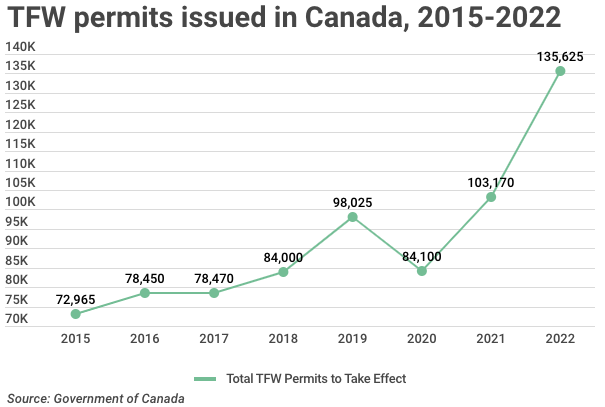
As noted by Obokata, use of the TFWP is on the rise in Canada. Between 2021 and 2022, the number of TFW permit holders increased by 31.5 per cent to reach 135,625 individuals. It’s on track to surpass that total in 2023, with 130,155 such permits already having come into effect in the first three quarters of the year, according to federal data

“It is a fact that temporary foreign workers make vital contributions to Canada’s national economy and possess valuable skills for which there is consistent demand, and yet paths for long-term or permanent residency is extremely limited or non-existent for most workers working in agriculture and other low-skills sectors,” reads the rapporteur’s report.

Obokata said while in Canada, he “received first-hand information from a large number of stakeholders, notably migrant workers themselves, pointing to the appalling working and living conditions in reality,” including excessive work hours, “extra-contractual tasks, physically dangerous tasks, low wages, no overtime pay,” access being denied to health care, limited access to social services, overcrowded and unsanitary employer-provided housing, “as well as sexual harassment, intimidation, and violence at the hands of their employers and their family.”

Such issues could be prevented through “effective labour and health and safety inspections,” but Obokata said from what he heard, those being done by federal, provincial, and territorial inspectors “are grossly ineffective,” don’t happen regularly, can be done remotely, and allow for advance notice to employers when done in person, enabling them to “make necessary preparations on the day of inspection.” Moreover, he said “most migrant workers are unaware” of the existence of existing federal, provincial, and territorial complaint mechanisms, or are afraid to report labour law violations “due to the fear of unemployment or deportation.”

While acknowledging “important developments” in the effort to protect the human rights of workers, and eradicate forced and child labour in the country’s supply chains—like the 2022 release of the Responsible Business Conduct Strategy and the 2021 update to the Code of Conduct for Procurement—Obokata said he still has “some concerns over Canada’s current approach to human rights due diligence for Canadian companies.”

He noted, for example, that Bill S-211’s reliance on self-reporting, lack of monitoring mechanism, and lack of requirements to implement “human rights due diligence” or measures to “prevent, address, and remedy abuses once identified,” risks it “becoming a box ticking exercise where companies simply submit the same statement every year, as has been reported in other jurisdictions.” The Fighting Against Forced Labour and Child Labour in Supply Chains Act, which comes into force in January 2024, requires companies that check two of three boxes—having at least $20-million in assets, $40-million in revenue, or 250 employees—to report on measures taken to “prevent and reduce the risk” of forced or child labour in their operations and supply chains.

Obokata said in raising concerns with the federal government, he was told draft legislation on due diligence to complement Bill S-211 is “currently” being considered. He urged the government to do so “expeditiously,” and for clear guidance on reporting requirements under S-211, and monitoring and oversight mechanisms to be established in the interim. 

McKay, Viersen, and Independent Senator Julie Miville-Dechêne (Inkerman, Que.) were among those who met with Obokata virtually on Aug. 15 just before his visit in their capacity as members of the all-party parliamentary group, with talk focused on S-211, which was sponsored by McKay and Miville-Dechêne in the House and Senate, respectively. 

McKay and Miville-Dechêne told The Hill Times they disagree with Obokata’s assessment of S-211 as a mere “box-ticking exercise,” with McKay saying he takes “strong exception to anyone who says this legislation will not be effective.” 

There’s an “immense amount of work that entities are going to have to do in order to be able to comply with the legislation,” argued McKay, with potential “enormous” consequences, including the fact that “the regulatory filing signed by a senior officer and approved by the board of the entity” will be “looked at by other regulators,” and “by those who do financing,” consumers, and NGOs. McKay said in discussions with lawyers and others “who work in this area” in Toronto last week alongside Miville-Dechêne, the pair heard serious concerns “about the work that’s going to be required in order to make sure that they comply.” 

“Our model is a stronger model than the U.K. model,” said Miville-Dechêne of S-211, noting the bill includes fines for non-compliance, and transmitting information that’s knowingly false. “I would say it’s a step, but a very important step and the first step, too, for a country that has … talked, politically, a lot about our respect for human rights, and by implementing this law, it is a step in the right direction.” 

McKay, Miville-Dechêne, and Viersen all said they expect clear guidance on reporting requirements under S-211 to come through its enacting regulations, which are still being awaited from the minister responsible, Public Safety Minister Dominic LeBlanc (Beauséjour, N.B.). Asked when those regulations would be tabled, LeBlanc’s office did not respond by filing deadline. 

McKay and Miville-Dechêne urged the government to table its draft regulations as soon as possible, with the Senator noting there are only three-and-a-half months left before S-211 comes into force, “which is not, in political terms, that long to give clear guidance to companies.”

Viersen called the wait on regulations “quite frustrating.” 

As for a parliamentary study, Miville-Dechêne said while the rapporteur’s preliminary findings must be listened to—and that she, too, is “very worried” about the potential for exploitation through Canada’s TFW program—she noted “he’s going to have more to say” when the full report is released next year. She highlighted that the Senate Social Affairs Committee is already in the midst of a study on Canada’s temporary and migrant labour force. 

“I find on this particular issue [the TFWP], Mr. Obokata is right on,” she said. 

Among other things, the rapporteur’s report also raised concern over the effectiveness of the federal Ombudsperson for Responsible Enterprisesestablished in 2019, which Obokata noted didn’t release its first initial assessment reports on complaints until this year—nearly four years after its creation. He highlighted that its mandate covers “only a limited number of sectors,” and excludes a number “where labour exploitation is rife, like agriculture, fishery, manufacturing, and construction,” which the rapporteur said should be “core” to the office’s mandate. He called for the ombudsperson to be given statutory powers to compel witnesses and documents, “with clear consequences” for companies that don’t comply, and for its independence to be ensured.  

McPherson said the rapporteur’s report has “echoed all of the concerns that the NDP has raised for some time,” including its criticisms of Bill S-211, which her party voted against in the House, and the effectiveness of the ombudsperson.

“We’ve got a government right now who is saying that they care about human rights, they’re talking about the need to ensure that Canadian companies working abroad are acting effectively, but every chance they have to bring forward good, strong legislation, they fail,” she said.

On the TFWP, McPherson said the NDP, “from the very get-go,” has said “the program needs to be revamped” and “that any individual who comes to Canada to be a worker needs to have a path to become a Canadian citizen.” 

“This program has been flawed” from the very beginning, she said, starting under the previous Conservative government, and continuing under the Liberals, despite its pledge to fix it.

The Hill Times reached out to Trade Minister Mary Ng (Markham–Thornhill, Ont.) and Immigration Minister Marc Miller (Ville-Marie–Le Sud-Ouest–Île-des-Soeurs, Que.) for comment and reaction to the rapporteur’s report. 

An emailed response from Global Affairs Canada confirmed Ng’s office has “reviewed the rapporteur’s statement.”

“We are taking into consideration the findings in the statement and how we can reflect on them moving forward as we work to eradicate forced labour from Canadian supply chains and ensure that Canadian businesses operating abroad do not contribute to human rights abuses,” reads GAC’s response. 

In its emailed response, Miller’s office highlighted “several permanent immigration pathways available for workers,” including through an Agri-Food pilot launched in May 2020 and recently extended until May 2025; the Provincial Nominee Program; the Atlantic Immigration Program; and express entry eligibility for agricultural supervisors and managers, among other things. 

“In Canada, the rights of all workers—including temporary foreign workers—are protected by law. Temporary foreign workers have the same rights and workplace protections as Canadians and permanent residents,” reads the response from Miller’s office, noting that new regulations aimed at increasing protections for foreign workers were implemented federally in September 2022.

“We will continue engaging all levels of government, provinces, and territories—to ensure all workers are safe and protected wherever they are in the country.”

Source: MPs call for House study after UN report slams Canada’s efforts to combat contemporary slavery, forced labour

Ottawa forecasts 1.4 million international student applications a year by 2027, document shows

Hard to deny the impact such numbers would have on housing, healthcare and infrastructure pressures and the increased numbers of disillusioned students given worse economic outcomes and likely frustration for the majority who will not transition to permanent residency.

But unlikely to convince the denialisms among the various interest groups that favour higher numbers.

Good that IRCC officials are carrying out this analysis:

The number of foreign students applying to come to Canada each year is forecast by the federal immigration department to rise to 1.4 million by 2027, an internal policy document says, which also raises concerns that such growth is “unsustainable.”

Immigration, Refugees and Citizenship Canada forecast the rapid rise in the number of foreign students in a paper last month about establishing a class of “trusted” universities and colleges, which would qualify for faster processing of international student study permits.

The document, obtained by The Globe and Mail, says that from 2019 to 2022 study permit applications for overseas students have increased by nearly 300,000 a year.

“By 2027, volumes are forecasted to nearly double to 1.4 million applications per year,” it says.

The federal document was sent to a select group of universities and colleges taking part in a pilot to establish the proposed trusted-institutions framework.

The IRCC paper forecasts that applications from foreign students will reach 949,000 this year, and just over one million next year. The number is projected to rise to 1.1 million in 2025, 1.28 million in 2026 and 1.4 million in 2027.

It says a recent strategic immigration review – and a continuing review of the international students program – has raised a number of concerns including “unsustainable growth in application volumes, impacting education quality, community infrastructure, and IRCC processing capacity.”

The paper says that the rapid growth in the intake of foreign students “has disrupted processing times” for study permits to enter the country. Meanwhile universities and colleges have become “increasingly dependent” on international students for revenue, in some cases not providing international students with “a positive education experience in Canada.”

It is currently piloting metrics to determine which universities and colleges are eligible to be counted as trusted institutions. To qualify they would have to share data annually with the immigration department, including the number and percentage of international students living in university housing.

Alex Usher, founder of Higher Education Strategy Associates, said on-campus housing is often not the cheapest option and this measure could reward universities attracting the wealthiest international students

Housing Minister Sean Fraser – the former immigration minister – floated the prospect of a cap on international student numbers at the cabinet retreat in Charlottetown last month, saying the number of foreign students is putting pressure on rental markets and driving up costs. Immigration Minister Marc Miller said at the retreat that around 900,000 students are expected to enter Canada this year.

A Senate report on Canada’s international student program, published Wednesday, said that many international students are forced to live in crowded, sub-standard housing, with universities failing to provide them with accommodation, even though they pay far higher tuition fees than Canadian students and inject around $22-billion into the economy each year.

One of the report’s authors, Senator Hassan Yussuff, questioned assertions that international students are to blame for the shortage of affordable housing, saying that many are living in cramped and overpriced accommodation with little protection from avaricious landlords.

The Senate report quoted findings by Statistics Canada that 40 per cent of study permit holders live in unsuitable accommodation compared with 9 per cent of the rest of Canada’s population.

Housing supply and affordability are a decades-old problem that cannot be solved by putting the burden principally on international students,” the report said.

It said that reducing international student numbers will reduce housing demand although the benefits would vary in different parts of the country and depend on the “tenancy preferences of Canadians.”

The Senate report said 51 per cent of international students settle in Ontario, with 20 per cent in B.C., and 12 per cent in Quebec.

The report added that the number of foreign students coming to Canada could be affected by diplomatic disputes with India and China, the “top international source countries.”

The IRCC, in assessing whether universities and colleges qualify as trusted, will gather information from government of Canada databases, such as on the “rate of adverse outcomes for study permit holders” –including convictions of international students for crimes in Canada. Ottawa will also check the approval rate of study permits to attend an institution.

It will also assess the “average teacher-student ratio” for the most popular courses taken by international students, retention and completion rates, foreign students’ ability to speak English or French, and the proportion of students who transition to permanent residency in Canada.

It says following the pilot, universities and colleges would be able to apply and the trusted institutions system could be up and running by spring next year. Foreign students applying to attend colleges and universities on the approved list could “receive expedited processing for the 2024 academic session.”

Source: Ottawa forecasts 1.4 million international student applications a year by 2027, document shows

Tensions with India raise concerns fewer international students will choose to study in Canada

Could be a good thing given the stories of fraud and exploitation and failed expectations. But not good for the institutions that rely on the revenues:

Diplomatic tensions between New Delhi and Ottawa threaten to curtail a relationship that funds a significant portion of Canada’s postsecondary education system.

The government of India issued a statement Wednesday warning Indian students in Canada about “growing anti-India activities and politically-condoned hate crimes and criminal violence.”

The statement urged students and other Indian nationals to exercise caution, but did not recommend against travel to Canada entirely. Instead it warned students of a “deteriorating security environment” and advised against visiting regions or venues targeted by those with what it called an “anti-India agenda.”

It’s the latest salvo in a growing diplomatic crisis between the two countries. On Monday, Prime Minister Justin Trudeau said in the House of Commons that Canadian security agencies had been pursuing credible allegations of links between agents of the government of India and the killing of a Canadian citizen, Hardeep Singh Najjar, who supported the movement for an independent Khalistan.

Canada expelled an Indian diplomat earlier this week and India responded by doing the same to a member of Canada’s High Commission in New Delhi.

There is some concern that the Indian government could continue to stir fears about conditions in Canada, which might diminish demand for Canadian postsecondary education.

India issued a similar warning for students in Canada last year, however, and it had little, if any, impact. At the time Canadian police services could not point to any rise in anti-Indian violence.

Students from India make up about 40 per cent of the more than 800,000 international students in Canada, according to the Canadian Bureau for International Education. They are by far the largest single group at Canadian schools, followed by China at about 12 per cent and the Philippines at 4 per cent. At least six Ontario colleges have more students from India than from Canada.

International student tuition, which is several times higher than for Canadian students, has become essential to the finances of many postsecondary schools.

Roopa Desai Trilokekar, a professor of education at York University, said there is some risk that if this diplomatic fight escalates, the government of India could use its platform to discourage Indian students from applying to Canada. Something similar occurred more than 10 years ago with respect to Australia, after incidents that targeted Indian students in that country, she said. Study applications to Australia subsequently dropped.

Canada was already getting negative press in India because of difficulties with housing and work conditions that many students face when they arrive, she said. The diplomatic feud will only heighten the publicity around some of these issues, she said.

“I would imagine that we’re going to see a dip. But I don’t know how large the dip will be. And it will depend whether any official stances will be taken by either of the governments,” Prof. Trilokekar said.

She said the Canadian government, which is reviewing its international education policies, should reconsider the role of education in its geopolitical strategy.

“It’s going to require rethinking. There’s a lot of dependence on students from India.”

Gautham Kolluri, an international student recruiter based in Ontario, said he has already heard from students concerned that supporters of an independent Khalistan would attack Indian students in Canada.

But Mr. Kolluri said he doesn’t believe this diplomatic dispute will seriously reduce the number of students interested in coming to Canada. Demand from India is very high, he said. And unlike Saudi Arabia, which recalled students on government-funded scholarships during a diplomatic dispute with Canada in 2018, India does not have a ready mechanism to alter student migration, he said.

Jaspreet Singh, founder of the International Sikh Students Association, said he doesn’t think the political tensions will affect Sikh international students in Canada. He said India is unlikely to shut off a migration path that offers opportunity to young people who might otherwise have difficulty finding work or a spot in a university.

“If they tried to do something like this, there would be a huge backlash,” he said.

Source: Tensions with India raise concerns fewer international students will choose to study in Canada

A Kinder, Gentler DEI?

An overly negative portrayal of efforts to address some of the excesses of DEI:

The Diversity, Equity, and Inclusion fad is on the ropes.  Multitudes of state lawmakers are attempting to limit or ban DEI training at state-funded institutions. And in at least six states, anti-DEI bills have been signed into law. At the same time, conservative legal groups are increasingly taking aim at corporate diversity programs. Amazon and Starbucks both face discrimination lawsuits over their diversity initiatives. Comcast has already settled a suit of its own.

With DEI in ever-worse odor, a psychologist and a sociologist, both of whom specialize in bias and diversity, have taken to the Wall Street Journal to explain what DEI training gets wrong and how to fix it. Mahzarin Banaji and Frank Dobbin write that DEI programs fail because they tend to “shame trainees for holding stereotypes” and “seek to solve the problem of bias by invoking the law to scare people.” As a result, they say, “people often leave diversity training feeling angry and with greater animosity toward other groups.”

So the authors recommend a different approach. First, DEI trainers should introduce their ideas with humility. Second, they should “give managers a way to counter biases—namely, training in strategies for cultural inclusion.” With these fixes in place, they say, “implicit-bias education can alert students to the fact that people committed to equality nonetheless hold biases.”

Perhaps Banaji and Dobbin should consider this: No implicit-bias training will ever work because free adults rightfully resent being “trained” by academics in how to treat other human beings. People leave DEI sessions feeling angry because the very notion of wise and good consultants trying to improve your character at the workplace is infuriating.

Think about the premise of it. Until the office trainers get ahold of you, you’re assumed to be morally defective, unfit for mixed company. (Never mind that the classroom trainers have already had a crack at you.) It’s a sweeping insult. Your parents, your faith, your spouse, your friends, your education, your own introspection and personal exploration—all failures. You need the folks with the quizzes and pamphlets and roleplaying sessions to sort you out and make you a good person.

It would be bad enough if DEI training was aimed strictly at altering your superficial behavior. But, as we see above, the key concept here is “implicit bias.” The trainers are there to introduce you to your inner bigot and show you how to tame him.

Besides the very real possibility that you might not have an inner bigot, what business is it of anyone’s if you do? There’s no law against thinking cruel and stupid thoughts. There are laws against acts of discrimination, and they should be invoked wherever applicable. It’s not for no reason that fighting “pre-crime” is the stuff of dystopian science fiction. What stays in your head is yours to do with as you please. Period.

If people leave DEI training with “greater animosity toward other groups,” maybe that’s because they had managed to keep the darkest parts of their subconscious healthily buried until someone with a human-resources-related degree tried to drag it out into their conscious awareness.

DEI is failing and under legal attack because it’s a bad idea. Not because real DEI has never been tried. I don’t doubt that many of its champions mean well. But, as with cruel ideas, compassionate ones don’t count until they’re executed. DEI is now doing real-world harm. And there are laws against that.

Source: A Kinder, Gentler DEI?

Une voie rapide d’immigration seulement critiquée par l’Université McGill

Not surprising, as McGill would be most affected

Une voie rapide d’immigration permanente applicable uniquement aux étudiants étrangers ayant étudié en français préoccupe fortement l’Université McGill, qui estime qu’il s’agit d’un système à deux vitesses qui exclura des étudiants.

« Étant donné que ces personnes possèdent un diplôme québécois, qu’elles sont jeunes et qu’elles vivent déjà ici, en français, depuis plusieurs années, elles constituent un bassin exceptionnel où recruter de nouveaux Québécois et de nouvelles Québécoises », écrit le premier ministre du Québec, François Legault, dans le cahier de consultations sur la planification pluriannuelle de l’immigration, en les décrivant comme « des candidats idéaux ».

Cela fait réagir l’Université McGill, qui enseigne et fait de la recherche principalement en anglais, et qui pense que cette approche pénalisera les étudiants étrangers « même s’ils peuvent démontrer une excellente connaissance orale et écrite du français ».

« Nos étudiants risquent de sortir perdants de cet exercice », a déclaré Fabrice Labeau, premier vice-principal exécutif adjoint (études et vie étudiante) de l’Université McGill, lors de son passage aux consultations mercredi après-midi. À la suite de la réforme proposée au volet « diplômés » du Programme de l’expérience québécoise (PEQ), un diplômé du Québec pourra déposer une demande de résidence permanente dès la fin de ses études au lieu d’attendre les 12 ou 18 mois d’expérience de travail actuellement exigés.

Une voie rapide qui crée un système « à deux vitesses » et qui exclura des étudiants, croit-il. Il cite en exemple un étudiant de McGill originaire de Chine qui l’a contacté récemment. Celui-ci suit des cours de français tout en étudiant dans son programme à temps plein en anglais afin de « s’intégrer à la société québécoise ». « Cet étudiant s’inquiète maintenant pour son projet de vie au Québec, qu’il a patiemment construit au cours des dernières années », souligne-t-il.

Une bonne part de l’effectif étudiant songera à d’autres options que l’Université McGill, refroidie par les difficultés de s’établir au Québec par la suite, appréhende Fabrice Labeau. « Si on peut assouplir les règles, nous, on peut travailler fort sur la francisation », assure-t-il. L’établissement accueille présentement 12 000 étudiants étrangers, ce qui représente 30 % de sa population étudiante.

« Ne serait-il pas préférable d’évaluer chaque candidat à l’immigration individuellement plutôt que d’indiquer d’emblée une préférence pour ceux ayant suivi un programme francophone ? » demande l’université dans son mémoire.

Une voie de passage existe, dit Fréchette

Une voie de passage existe, a tenu à préciser la ministre de l’Immigration, de la Francisation et de l’Intégration, Christine Fréchette, en réponse aux préoccupations de l’université.

« Les étudiants qui auront obtenu un diplôme dans un programme en anglais auront tout de même la possibilité d’appliquer pour le PEQ “diplômés”, s’il advenait qu’ils ont fait trois ans d’études en français au niveau secondaire ou postsecondaire », a-t-elle dit. Il est également possible pour eux de déposer leur candidature à la résidence permanente après une année d’expérience de travail s’ils maîtrisent le français au niveau requis.

Une réponse qui n’a pas semblé convaincre Fabrice Labeau, qui a, de son côté, invoqué l’attractivité des universités. « Leur fermer la porte à la voie rapide, c’est une difficulté », dit-il.

Source: Une voie rapide d’immigration seulement critiquée par l’Université McGill

Douglas Todd: Trudeau’s defiance of India ‘killing two birds with one stone’

Some interesting insights regarding the different positions within the Sikh and South Asian communities:

The callers lined up like almost never before on Harjit Singh Gill’s radio talk show this week after Prime Minister Justin Trudeau declared there were “credible allegations” that Indian agents were involved in the June murder of a Sikh activist outside a Surrey gurdwara.

“Things are very hot in the community,” said Gill, who has a morning talk show on Sher E Punjab, 600 AM. Trudeau took a chance on going public about the bloody end of the Khalistan independence fighter, Gill said, and many of B.C.’s 300,000 Sikhs felt affirmed by it.

Sikhs, who make up B.C.’s second-largest religious group after Christianity, have complained to Ottawa for months that India’s government, led by Prime Minister Narendra Modi, who many call a Hindu nationalist, must have had a hand in the slaying of Hardeep Singh Nijjar.

A plumber whom Indian authorities have accused of murdering a Hindu priest and killing six in a Punjabi cinema bombing, Nijjar was shot in his truck in the parking lot of the giant Guru Nanak gurdwara, of which he was president.

Since Gill believes no politician makes such a big move without considering its electoral implications, he said Trudeau “killed two birds with one stone” in his high-impact claim, which Indian government officials have angrily denounced as “absurd and motivated.” They are now asking Indian nationals to be cautious about visiting Canada because of its “growing anti-India activities and politically condoned hate-crimes.”

Trudeau’s thunderbolt declaration, Gill said, was satisfying to many Canadian Sikhs, particularly advocates of a separate Sikh homeland called Khalistan, in the way it protected Canadians’ sovereignty and right of free expression.

The prime minister, Gill said, also brilliantly distracted voters from issues that were killing him in the polls.

They include the housing affordability crisis, China’s subversion of Canadian elections and Trudeau’s poorly rated performance at this month’s G20 summit in India, where Modi accused Trudeau of protecting Sikh militants who employ violence in their battle for the ethno-religious vision of Khalistan.

Trudeau’s attack on possible interference by India’s government will resonate not only among Sikhs, but among immigrants from all sorts of countries, says Andres Machalski, president of Mirems, which monitors more than 800 foreign-language media outlets in Canada.

Since millions of immigrants have come to Canada to escape discrimination and persecution in their homelands, Machalski said, “Trudeau’s unassailable message to all immigrants is, ‘We will stand up for you.’”

That message can hit home for people who have left behind all sorts of conflict-ridden nations, whether China, Ukraine or Sri Lanka, said Machalski. It reverberates for Machalski himself, since he came to Canada as a refugee from Argentina in 1976, when elected leaders were replaced in a ruthless military coup.

Specifically, Machalski said Trudeau’s declaration on the opening day of parliament, which “gained maximum attention” and divert from issues working against his popularity, was mostly aimed at garnering support from the roughly 800,000 Sikhs in Canada.

Even though the number of Hindus in Canada is about the same, and many will be upset by Trudeau’s attack on the Hindu-majority country of India, Machalski said Punjabi Sikhs in Canada have a stronger group identity and are more politically organized and influential than Hindus, particularly in crucial federal and provincial ridings in Greater Toronto, Metro Vancouver and Calgary.

That’s the case, Machalski said, despite Punjabi Canadians disagreeing on just how much support there is for a separate Khalistan in this country.

“Many Sikhs kind of just tolerate the Khalistanis and their vociferous rallies,” he said.

Despite the wide distribution of vivid photos of Canadian Sikh protesters outraged at India, Gill agrees the Sikh population is “not monolithic.”

It’s hard to get numbers on how many Canadian Sikhs share the vision of Khalistan, said Gill, who looks forward to the results of the non-binding referendum that a secessionist group, Sikhs for Justice, has organized.

Last week vote organizers claimed 135,000 India-born Canadians in the Lower Mainland showed up to vote in the referendum that Nijjar, whom India accused of terrorism, had helped organize.

Earlier referenda were held among the large Sikh populations in Britain and suburban Toronto, which has contributed to Modi’s accusation that offshore agitators are stirring up division in his nation.

Prominent Punjabi Canadian Barj Dhahan, who has spent the past 30 years conducting business and philanthropy between B.C. and India, doesn’t trust the Metro Vancouver referendum. He says it’s not clear, for instance, who is eligible to vote in it.

And since Dhahan frequently travels to northern India, he says he knows the idea of Khalistan is virtually dead there. Sikhs in India “are much more worried about getting jobs and having a future.”

Gill, the talk-show host, also acknowledges the Khalistan movement is weak in India, in part because of changing demographics. In Canada, Gill said, views on Khalistan can differ sharply between Sikh fundamentalists and Sikh moderates, who often end up fighting for control of the province’s many gurdwaras.

Machalski, who monitors the discourse in dozens of Punjabi print and broadcast outlets across Canada, said there is no more uniformity among Canadian Sikhs on Khalistan than there is among Canadian Catholics on the pope.

Despite their wide range of views, Machalski said Sikhs in Canada are a powerful political force in electoral politics, including as MPs and MLAs, in part because of their ability to get assistance from the leadership of gurdwaras, which fill the role of community centres even for non-religious Punjabis.

Shinder Purewal, a Kwantlen Polytechnic University political scientist, and Dhahan have described how the Sikh population “punches above its weight” in politics for many reasons, particularly because of its ability to impact partisan nomination battles, including that of lawyer and NDP leader Jagmeet Singh, who was an early critic of India and defender of Khalistan supporters.

Source: Douglas Todd: Trudeau’s defiance of India ‘killing two birds with one stone’

Madhany: It’s time to dispense with false narratives and look for real solutions to Canada’s housing crisis

Madhany makes the classic mistake of conflating concerns over high immigration levels with being anti-immigration. Most of recent commentary, mine included, cannot be characterized as anti-immigrant as it largely questions absorptive capacity (e.g., housing, healthcare, infrastructure), poor economic outcomes of any recent arrivals and how high levels of both permanent and temporary residents are not improving Canadian productivity.

Moreover, by claiming that this questioning labels immigrants as scapegoats and fanning “the flames of bigotry and hate,” it becomes a self-fulfilling prophecy, rather than acknowledging high levels are part of the problem and these issues impact upon immigrant and non-immigrant alike.

As an immigrant, a daughter of immigrants, and now the leader of an organization dedicated to helping newcomers thrive, I’ve seen the many ways that investing in the success of new Canadians pays dividends. More recently, however, I’ve seen something more troubling: immigrants, refugees, and international students positioned as scapegoats and blamed for a very real housing crisis. This dangerous discourse needs to stop. The narrative at its root is not only inaccurate—the housing affordability crisis is a complex, systemic issue abetted by poor planning and political finger-pointing—but it is also actively harmful. It fans the flames of bigotry and hate. It also threatens the health of the Canadian economy, in both the immediate and long term.

My family came to Canada when I was a teenager. I remember even then, decades ago, how difficult it was for my family to find an affordable place to live. In Kenya, my dad had been a successful businessman. He was fluent in English and had an impressive accounting background. But as a newcomer who lacked Canadian work experience, he was denied all but the most menial jobs. At one point, he took a job cleaning washrooms at a golf club to support our family.

Even at that early age, I knew there was something wrong: people shouldn’t have to struggle so hard to give their best or build a future in their new country. That knowledge shaped my career and life. Since then, I have dedicated myself to welcoming newcomers. I began as an employment counselor, became a career public servant, and now serve as the managing director and deputy executive director of an organization that, on the one hand, evaluates academic credentials so people can put their skills and talents to work in Canada. On the other hand, we work with scores of Canadian partners to shape policy, design programs, and provide philanthropic funding to eradicate the barriers that keep newcomers on the sidelines, struggling to contribute their skills even to fields like health care, where workers are so desperately needed.

Instead of exploring how we can dismantle barriers for newcomers and all Canadians, we’re seeing increased discourse blaming newcomers for the housing affordability crisis. To be clear: limiting immigration or international student numbers will not fix the housing crisis, nor did rising numbers create it. These issues loomed for decades with no real action taken or effective policy solutions in place to address them.

Others with housing policy expertise have recommended promising solutions to this problem. These include zoning regulations that favour multiplex dwellings in cities; regulation of large real estate investors who, in 2019-2020, owned as much as 29 per cent to 41 per cent of housing in several provinces; and a focus on ensuring the availability of more rental properties in our cities—as well as ways for immigrants to more easily prove their credit histories so that landlords will rent to them. But rather than tackle the housing crisis head-on, influential voices are putting the blame squarely on immigrant communities.

We’ve got to flip the script. Let’s recognize the essential role that newcomers and various cultural communities play in building a brighter future for our entire nation. After all, immigrants will play a key role in ensuring that Canada’s workforce and tax base continue to grow, and that Canada continues to succeed on the global stage. Consider this: by 2030, five million Canadians are projected to retire, and the worker-to-retiree ratio will drop down to only 3:1. Without immigrants, we haven’t a hope of filling 800,000 job vacancies (and counting). Indeed, immigration accounts for almost 100 per cent of Canada’s labour force growth. By 2032, it’s projected to account for 100 per cent of Canada’s population growth.

Recognizing newcomers’ economic value is one thing. Solving our housing woes is another. One potentially viable action plan would be for cross-sectoral Canadian leaders to organize a multi-sectoral roundtable capable of tackling the housing affordability crisis with the nuance and specificity that it demands. Models for this—including the Refugee Jobs Agenda Roundtable—exist and are effective.

Regardless, it is time to dispense with false narratives and look for real solutions. Canada needs immigrants and needs them to succeed. When everyone is welcome, everyone wins.

Shamira Madhany joined World Education Services as managing director Canada and deputy executive director in 2018, after more than two decades of public service. She has extensive experience working with licensing bodies, settlement agencies, and higher education and post-secondary sectors in Ontario.

Source: It’s time to dispense with false narratives and look for real solutions to Canada’s housing crisis

Immigration is religion’s only hope – UnHerd

Of interest (similar trend in Canada):

When my father was going through the process of becoming an Elder in the United Methodist Church, he was required to take courses on Diversity, Equity and Inclusion. One course involved a presentation on how white people needed to make room for, and amplify the voices of, “people of colour”. My father is an immigrant from China. He, like other immigrant preachers, was confused about who the term “person of colour” referred to, and why a faith founded on the idea that there is “neither Jew nor Greek” is so obsessed with racial divisions.

Who can blame them? The progressive ideology that in recent years has swept through mainstream American Protestantism is often impenetrable to those from non-Western countries.

And yet, it is just such immigrants who are keeping Christianity alive in our secular world — everywhere from France’s Afro-Caribbean megachurches to London’s Black Majority Churches. In America, the number of citizens identifying as Christians has fallen from 90% to 64% in the last 50 years, while immigrants are becoming more influential: more than two thirds of them are Christians.
American progressives are increasingly stoking fears of an incipient “white Christian nationalism” bringing about a Cromwellian theocracy. But white Americans have actually been secularising at a slightly faster rate than other ethnicities. While black Americans have also experienced secularisation, they are still more likely to go to church and pray than the average American. And African immigrants to the US are more religious than American-born black people. The rise of Latino evangelicals in America has also been receiving mainstream coverage.

“Conservative Christians”, the bogeyman for white progressives, are therefore increasingly likely to be people of colour — the very people whose voices progressives apparently want to amplify. Christians of African origin are far more likely to hold conservative views on sexuality, while Latino evangelicals are quickly becoming a Republican bloc.

White conservatives, meanwhile, have a tendency to bemoan the secularisation of the West and the decline of traditional values, while supporting restrictive immigration processes — perhaps not realising that non-Western immigrants are more likely to be socially conservative than American-born citizens, or perhaps because their economic or tribal instincts trump their religious ones. Both progressives and conservatives are therefore mired in contradiction.

Despite the fact that liberals are secularising faster than conservatives, for the last decade, the leadership of the United Methodist Church has been adopting views on sexuality and gender identity that are in line with those of secular progressives, triggering a slow-motion denominational schism. Some years ago, I attended a UMC conference with my parents at which some attendees wore rainbow armbands in support of a movement to ordain gay clergy. Almost all of them were white. None of the representatives from immigrant congregations, and few from black congregations, wore the armbands. “Before I came to America, I thought this was a nation built on Christian values,” commented one attendee. “Why are these people going against God’s will?”

A progressive Christian might see this as a contradiction: if Jesus came from Heaven to help the marginalised, why do these marginalised Christians antagonise a fellow marginalised group? Liberal white people, who usually preach multicultural ideals, cannot answer this question honestly without making it sound like Western culture has the “correct” view on sexuality — the major irony being that progressives dismiss Western culture for what they see as regressive views.

While progressives blame “the Christian Right” for society’s ills, religious conservatives often complain about “woke Christianity”. They point to examplessuch as Allendale United Methodist Church, which had a “non-binary” drag queen deliver sermons and bills itself as “a church that is committed to anti-racism and radical solidarity with folx on the margins”. They argue that such acts are based on ideology stemming from the secular world rather than theology based on Biblical exegesis.

A similar dynamic can be observed in the UK. Earlier this year, the Church of England floated the idea of using gender-neutral pronouns for God, and allowed prayers of blessing for gay couples. The backlash was swift. Many bishops in Africa and Asia rejected the authority of the Archbishop of Canterbury — and criticised the Anglican church’s (largely white) leadership. But even within the UK, there was fierce opposition to progressive Christianity from ethnic minorities, who are keepingBritain’s Christian population from declining.

However, the religious conservatives probably have less to worry about than the progressives, in the long run. If progressive Christian churches align themselves more closely to the values of secular society than to religious ones, they will cease to exist. A similar phenomenon can be seen in American Judaism. Orthodox Jews, who take their faith seriously, and mostly vote Republican, are currently in the minority, but they are estimated to grow to become the dominant branch of American Judaism by 2050. This is partly due to birth rates, but also because non-Orthodox Jews, who mostly vote Democrat, are secularising quickly; they are far more likely to partner with non-Jews, stop observing Jewish traditions, or to cease to identify as Jewish altogether. Christianity, too, looks set to depend on the most orthodox sustaining the faith.

It is ironic that Christianity is now seen as “problematic” by progressives, because the roots of liberalism, which opened the door for progressivism, partially derive from Christianity — or Protestantism, to be specific. It was the Reformation that shifted religious practices away from a central authority to that of individuals. As Tom Holland has pointed out, almost every country that has legalised gay marriage has been shaped by centuries of both liberalism and Protestantism.

It is also ironic that white progressives support multiculturalism over assimilation, because it is the latter that would align the beliefs of immigrant communities with the values of the utopia dreamed of in Diversity, Equity and Inclusion trainings. In other words, though liberalism paved the way for immigration and multiculturalism, immigration and multiculturalism actually weaken liberalism; though Christianity paved the way for liberalism, Christianity could prove liberalism’s downfall.

The tension between a multicultural utopia pushed by secular progressives versus the socially conservative, religious-inflected attitudes many non-white groups hold has led to quite a few awkward skirmishes. While most black people vote for the same party as white liberals, 37% of black Democrats say their religious views influence how they think about transgender topics, compared to only 11% of white Democrats. While 66% of black Democrats say a person’s gender is their sex determined at birth, only 27% of white Democrats say the same.

Conservatives in America are also tying themselves in strange knots. A common refrain is that Islam is incompatible with Western civilisation. And yet, some conservative Christians find themselves allied with Muslims against what they both see as America’s decadent hyper-individualistic secular culture. In a number of American cities, Muslims have joined conservative Christiansto protest the inclusion of explicitly LGBT-themed books in elementary schools, leading to accusations that “some Muslim families” are “on the same side of an issue as White supremacists and outright bigots”. To progressives, a “bigot” is a stereotypical white Christian conservative; to see non-white Muslim families standing beside them in droves caught many off guard. An all-Muslim city council in Michigan was once held up by liberals as a symbol of diversity, until it voted earlier this year to ban Pride flags being flown on city property, to the delight of many social conservatives. Slate has gone so far as to call Muslim voters “the new Republicans” — an unexpected twist after two decades of Republican fear-mongering against Islam.

At the same time, presidential candidate Vivek Ramaswamy, a Hindu, has gone from a virtual unknown to third place in the Republican primary, by picking up the support of many conservative Christian voters. Ramaswamy does not shy away from his faith, but rather emphasises the similarities between certain schools of Hindu and Christian thought. Many conservative Christians, it seems, would rather ally with conservatives from other religions than Christians on the other side of the political divide.

It has taken a cosmic convergence of contradictions to get to this point. White progressives, with their absolute devotion to immigration, have inadvertently championed immigrants from cultures that outrightly reject progressivism. With their just-as-absolute devotion to multiculturalism, those same white progressives have created a trap for themselves where they are unable to criticise a non-white person’s culture, values or beliefs — even when they actively go against sacred progressive views on gender and sexuality. Meanwhile, white conservatives find themselves forging alliances with people they never thought they’d work with — people whose entry into the country they might have objected to. Old alliances are dissolving — and battle lines are drawn anew.

Could these steps help fix Canada’s international student system? Senators think so

Sound assessment of some of the weaknesses and lack of integrity in international student recruitment and the complicity of education institutions and provincial governments.

Generally sensible recommendations but given jurisdictional issues, I favour some variant of provincial caps that oblige the provinces to tighten up approval of DLIs to address some of the worst abuse.

Ideally, of course, higher education would have adequate funding but defining “adequate” should not be equated with the status quo nor should it be assumed that provincial governments would simply pick up any shortfalls due to reduced international students:

Canadian governments must better police the educational sector and develop a national policy to manage foreign student intake to maintain the integrity of the country’s international education program, says a new study.

In a report released on Wednesday, four independent senators recommended stricter criteria for the so-called designated learning institutions (DLIs) to host international students and steeper penalties to hold them accountable to “unscrupulous behaviour and negligence” of their recruitment agents.

“Canada’s international student program benefits significantly from the presence of agents since they are the drivers of an industry that contributes tens of billions to the economy each year,” said the report prepared by Senators Sabi Marwah, Ratna Omidvar, Yuen Pau Woo and Hassan Yussuff.

“Agents and DLIs are not necessarily acting with the best interests in mind of international students themselves. There is little incentive and no oversight by Canadian governments to ensure both agents and DLIs place international students at DLIs most suitable for each student’s educational, career and immigration objectives.”

The integrity of Canada’s international student program has increasingly come under public scrutiny after hundreds of students from India were found to have come here with allegedly fraudulent college admission letters earlier this year.

Amid the country’s worsening housing crisis, the exponential growth of the international student population — inching toward 900,000 this year — has prompted the federal government to consider reining in their intake by strengthening its program integrity.

According to the Senate report, some 51 per cent of international students settle in Ontario, followed by B.C. (20 per cent), Quebec (12 per cent), Alberta and the Atlantic Provinces (both at 5 per cent) and Manitoba and Saskatchewan (both at 3 per cent).

While Canada has benefitted financially and culturally from international students — $22 billion in tuition revenues and spending to the economy a year, the report said there have been costs associated with the growth of the enrolment.

Canadian colleges and universities have continued to count on international tuition fees as a revenue source as government investments in education declined. Since 2006, said the report, the gap in tuition between international and domestic students has risen from double to five times as of last year.

“DLIs are responsible for setting admissions criteria for international students, but their desire to recruit as many as possible often results in low admissions standards,” said the 26-page report.

“DLIs then discover certain international students are not academically proficient enough to keep up with their programs in Canada.”

The recruitment frenzy has been fuelled by education agents, who typically receive from the schools a commission that ranges between 15 and 20 per cent of the admitted international student’s first year of tuition. The report said it works out to average commissions of $1,500 to $7,500 per student.

Adding to the mix are unscrupulous private colleges and ghost agents who prey on the ignorance of international students with “empty promises” about career prospects in Canada upon graduation and who lie about eligibility for work permits and permanent residence.

“The International Student Program has been a victim of its own success. International students have a strong desire to come to Canada, however they face many challenges including high tuition fees and abuse. In many cases they do not receive the support they need to overcome these difficulties,” said Sen. Omidvar.

“They are also being blamed for the many current economic and social challenges facing Canada, but they are the victims and not the perpetrators. We need to change the program to ensure it works for Canada and the students that contribute so much to our country.”

The Senate report said the top priority to address the integrity of the program is to conduct a national review to ensure the Canadian post-secondary sector is financially sustainable because funding shortfall is what has led to the aggressive recruitment of international students.

It also recommended a higher bar for schools to qualify to admit international students by requiring them to submit detailed plans on how they assist students in securing housing, asserting legal rights, finding employment — similar to what they had to comply during the pandemic as a condition to welcome international students back on campuses.

“DLIs who do not live up to standard should be subject to losing their ability to welcome additional international students,” said the report.

Given the “outsized role” education agents play in the industry, it recommended that immigration officials must regulate these recruiters and impose stronger penalties, such as fines and the revocation of DLI status against schools who benefit from unscrupulous agents.

The report said Canada should follow Australia’s step in requiring educational institutions to upload agent information into a centralized portal, including which agents they have written contracts with, and study visa outcomes by their agents including whether applications were approved, refused, withdrawn, or deemed invalid.

While many of the international students are lured by the prospects of permanent residence, just 30 per cent of them managed to become permanent residents within 10 years of arrivals due to the limited spots available annually.

The report said Canada must develop a national strategy to align the number of international students admitted with its annual permanent resident targets based on the needs of provinces, educational institutions and employers.

Source: Could these steps help fix Canada’s international student system? Senators think so

Feds still working through family reunification backlog for immigration ‘golden ticket’

Lottery is the easiest way to manage high demand and increasing demand.

Weakens the demographic arguments justifying current high levels but understandable that families would like to have parents and grandparents with them (many do help with childcare):

Demand always Immigrants hoping to reunite with family members through the federal government’s Parents and Grandparents Program will be invited to apply beginning Oct.10 — but for the fourth consecutive year, those invitations will only be delivered to eligible applicants who expressed interest by 2020.

And even then, as has been the case since 2017, those invitations will be randomly selected in a lottery.

“We try not to make any promises,” said Laila Joud, 34, who wants to sponsor her parents so they can move from Syria to Ottawa to live with her family. Joud is now a permanent resident who moved to Canada from Syria via Qatar with her husband and child in 2019. She was also pregnant at the time

Her parents split their time between Syria and Qatar, waiting for the chance to come to Canada.

“The situation in Syria right now — the economic and the social — it’s just not the best and I would love to have the chance to give them the opportunity to be here,” said the communications specialist who works at a non-profit in Ottawa.

“It will mean they have a better life.”

Joud has not been able to get her name into the draw for the program, since she wasn’t eligible in 2020, the last time the federal government accepted interest-to-sponsor (ITS) applications.

Ghiath Joud and Sawsan Youssef during a trip to Ottawa to visit their daughter. (Submitted by Laila Joud)

Over 200,000 potential sponsors expressed interest in bringing their family members to Canada that year, said IRCC spokesperson Isabelle Dubois.

“Given the volume of ‘interest to sponsor’ received in 2020 that are still remaining in the pool, IRCC will again use the 2020 pool of submissions for the 2023 intake,” said Dubois.

Over a two-week period beginning Oct. 10, IRCC will begin sending invitations for 24,200 people to apply, said Dubois. From those, IRCC hopes to process 15,000 successful applications.

“We don’t understand the rationale behind it,” said Joud, who was hopeful the government would take new ITS applicants this year.

“I understand the complications and everything that’s affecting this process but I want a chance like many others.”

Super visa not a substitute

“I think everybody can agree that having the last expression of interest, the last ability to put your name in, in 2020, that is really unfair,” said Tamara Mosher-Kuczer, senior lawyer and founder at Lighthouse Immigration Law.

“If they didn’t get in the pool in 2020, this is another year, yet another draw that has passed them by,” she said.

And even if someone is lucky enough to be selected to apply, “they’d have to wait at least probably two years for the application to be processed,” Mosher-Kuczer said.

There is another more costly option, she said. Parents and grandparents can apply for a Canadian super visa which allows them to visit their children or grandchildren for up to five years.

“The problem is they have to pay for health insurance the whole time the family members are here,” said Mosher-Kuczer. “And the family members aren’t able to work. So it’s prohibitive for a lot of people.”

In fact, Joud’s parents came to Canada on a super visa but decided it was too restrictive and have since returned home.

Laila Joud says having her parents, Ghiath Joud and Sawsan Youssef, living with her in Ottawa would bring huge emotional support. (Submitted by Laila Joud)

Get your paperwork in order

Mosher-Kuczer has some advice for people in the 2020 pool.

“Start gathering the supporting documents now,” she said. “If you get one of these invitations, it’s the golden ticket. It’s a once in a lifetime opportunity, you’re unlikely to get invited again. So you need to be able to have that application submitted in 60 days.”

It’s not a lot of time to get everything together, but if you wait, you’re up against a tight deadline, she said.

“A lot of this information is hard to gather and then everything has to be translated according to IRCC’s very strict specifications,” she said, adding the process can be costly.

“But people don’t want to spend the money to start making those translations and getting those documents and getting the police clearances.”

Mosher-Kuczer said she also wishes the government would institute a weighted lottery: the longer you’ve been on the list, the stronger your chances of being selected.

Joud is still hopeful the government will soon reopen the parent and grandparent sponsorship program to people not yet in the pool.

“There are the obvious reasons,” she said. “Being immigrants into the country. Being away from family. Being in a country where you almost have no one. It’s just having that family bond, having them with my kids.

“I am waiting for the day.”

Source: Feds still working through family reunification backlog for immigration ‘golden ticket’