Coalition of Black communities concerned anti-racism measures under unfair scrutiny after death of former TDSB principal

Understandable. But similarly need to be mindful of counterproductive approaches as this case illustrates:

A coalition of Black community organizations in Ontario is expressing concern that a government review of the circumstances that led to the death of a former Toronto District School Board principal will put anti-racism and equity measures under unfair scrutiny.

Speaking in front of the provincial legislature in Queen’s Park on Wednesday, representatives of the organizations said the death of the principal, Richard Bilkszto, is being used to dismantle these diversity measures at school boards and to discredit Kike Ojo-Thompson, an anti-racism trainer who led a workshop the former principal attended two years ago.

Mr. Bilkszto retired from the school board in 2019 after more than two decades in education, but continued to work on a contract basis. His lawyer, Lisa Bildy, has said he died in July by suicide. He had filed a lawsuit against the school board, alleging it had failed to protect him after a confrontation with Ms. Ojo-Thompson during the workshop.

Ontario Education Minister Stephen Lecce characterized Mr. Bilkszto’s allegations as “serious and disturbing” in a statement last month. He said that his government would review the circumstances that led to the educator’s death.

It is not clear if the workshop played any role in the death. Even so, the incident has galvanized right-wing commentators, who have been critical of equity, diversity, and inclusion training at school boards. The government has said it will investigate what happened during the workshop as part of its probe.

The group outside the Ontario legislature on Wednesday called for transparency in the government’s review.

“Any attempt to remove or restrict anti-racism education in this province will have severe and detrimental consequences perpetuating inequities and hindering the progress we have collectively made in fostering an inclusive and compassionate learning environment,” Amanuel Melles, executive director of the Network for the Advancement of Black Communities, told reporters.

“Any attempt to remove and restrict anti-racism education in this province, based on the death of one individual, is an intentional appropriation of the death for political gains,” he added. “This will not happen under our watch.”

Idris Orughu, a community organizer, told reporters there is an “active campaign to villainize and undermine anti-racism work in this province.”

The organizations are calling for the province to meet with them, reaffirm its commitment to anti-racism work and “denounce the scapegoating” of the trainer and her consulting firm, which is called the KOJO Institute.

In a statement on Wednesday, Grace Lee, a spokesperson for Mr. Lecce, said that while the review “into these disturbing allegations will occur, we remain firm that professional anti-racism and anti-discrimination training will continue.”

Before his death, Mr. Bilkszto was outspoken about diversity and equity issues. Last year, his name appeared on the conference agenda for New Blue, a newly created right-wing political party in Ontario. He was scheduled to speak on critical race theory in schools.

In his lawsuit, Mr. Bilkszto alleged that Ms. Ojo-Thompson “implicitly referred” to him as a racist and a white supremacist during the workshop, which was a professional-development course for administrators. Mr. Bilkszto alleged that senior school staff did not stop the harassment. He said this was contrary to the school board’s policy of protecting the well-being and safety of its employees.

None of the allegations have been proven in court.

A statement of claim provided by Mr. Bilkszto’s lawyer said that, during a session, Mr. Bilkszto expressed an opinion that challenged a claim by Ms. Ojo-Thompson that Canada was more racist than the United States and had “never reckoned with its anti-Black history.”

Mr. Bilkszto, who had previously taught in Buffalo, N.Y., disagreed and referred to Canada’s education and health care system. He said it would have been an “incredible disservice to our learners” to suggest Canada lagged the U.S. in this way.

In a session the following week, Ms. Ojo-Thompson emphasized the previous interaction with Mr. Bilkszto “as being a ‘real-life’ example of ‘resistance’ in support of white supremacy,” the statement of claim said.

Mr. Bilkszto said he was berated in front of his peers and felt humiliated, according to the claim.

In May, 2021, Mr. Bilkszto filed a mental stress injury claim with the Workplace Safety and Insurance Board over the training. The WSIB decision, which was provided to The Globe and Mail by his lawyer, was in his favour. He was awarded almost two months of lost earnings in a ruling that described Ms. Ojo-Thompson’s behaviour during the training sessions as “abusive, egregious and vexatious.”

His lawyer, Ms. Bildy, said in a statement that the incidents caused her client “severe mental distress” and that he “succumbed to this distress.”

In a statement on the KOJO Institute’s website last week, Ms. Ojo-Thompson said her company would co-operate with the government review. She said allegations made by Mr. Bilkszto were false. The incident, she said, is “being weaponized to discredit” anti-racism work.
Source: Coalition of Black communities concerned anti-racism measures under unfair scrutiny after death of former TDSB principal

Urbaniak: Becoming a Canadian citizen should require a ceremony

Another good commentary on the need for ceremonies. New immigration minister Miller likes attending ceremonies so perhaps he can ensure that most new Canadians can as well:

Last week, the federal cabinet had a major shuffle.

The new ministers and the re-positioned ministers did not “self-administer” their oaths and declarations. They were not sitting by themselves in their living rooms with no one watching when they assumed their new roles.

On the contrary, they were expected to attend a ceremony.

The ritual, the formality and the gravity of the event at Rideau Hall – steeped in symbolism – signalled to the ministers and to everyone that ministerial appointments are important.

Well, becoming a Canadian citizen is very important. Canada is important.

Becoming a Canadian citizen merits a ceremony in most cases, not just in occasional cases by request.

The government of Canada is wrong to push self-administered, on-line oaths with no ceremony of any kind.

This policy was recently announced in the Canada Gazette, the official record of federal government notices and decisions.

Inspirational Canadian

In 2018, I came across the obituary of Kamal Akbarali. I was sad to see it. I had met Judge Akbarali several times as a high-school student in the 1990s.

Kamal Akbarali was a citizenship judge, and he performed the role very well. He was also an inspirational Canadian. He loved this country.

My fellow students and I had the pleasure of attending a few public citizenship ceremonies at which Judge Akbarali presided. We were the “audience.” We were there to welcome and acknowledge the new Canadians, our soon-to-be-fellow citizens. Some of them were our peers from school.

Judge Akbarali made an impression on me.

I remember being moved by what he said about his own journey. It sounded like the stories of my own grandparents, who found freedom and possibilities and affirmation in Canada.

Judge Akbarali came to Canada from Pakistan in 1965. At the ceremonies, he talked about how he got started in this country. He took on a career in finance and started a family.

Judge Akbarali talked about the plight of refugees, about democracy, about peace, about service to others, about respect for Indigenous Canadians and people from all over the world.

In other words, he talked about Canada and aspirations for Canada.

Although full of gratitude, he did not insist the country was perfect. In his view, a good citizen is compassionate, sometimes critical and always constructive.

As Judge Akbarali spoke, I could almost feel the beautiful vastness and diversity of the country. I felt hopeful and motivated.

After each ceremony, a beautiful cake would be rolled out so that we could celebrate our fellow Canadians. The new citizens had just gone through a life-changing, emotional event.

Bureaucratic efficiency?

The stated rationale for the move toward self-administered oaths is administrative efficiency – easing the backlog by “three months of processing time.” (The change, however, is slated to be permanent.)

There is essentially no acknowledgment of the value of civic symbolism, public celebration and instilling a sense of community by the act of officially gathering.

To clear backlogs, additional part-time officiants – respected citizens — could be brought on by Ottawa. They could help with processing. They could preside at ceremonies by request. (Nova Scotia recently did this with a successful recruitment push for part-time administrative justices of the peace for civil weddings. I happen to be one of them.)

What can we do now?

I believe this is a case where a personally addressed note, in your own words, to your member of parliament could have some impact.

A petition

Also, please check out the excellent petition by Andrew Griffith, a former senior public servant in the federal Department of Immigration, Refugees and Citizenship.

You can sign it electronically on the website of the House of Commons. It is labelled as petition e-4511.

The petition calls on the Minister of Immigration, Refugees and Citizenship to “abandon plans to permit self-administration of the citizenship oath.”

The petition also urges Ottawa to “revert to in-person ceremonies as the default, with virtual ceremonies limited to 10 per cent of all ceremonies.”

Griffith believes backlogs can be addressed by other efficiencies and by holding more ceremonies on evenings and weekends.

I concur. I hope the minister listens.

The minister’s name is Marc Miller, and he assumed his current role in a ceremony – the same one that was held at Rideau Hall last week.

Dr. Tom Urbaniak, professor of political science and director of the Tompkins Institute at Cape Breton University, is the author of six books. The most recent is “In the Public Square: A Citizen’s Reader.”

Source: URBANIAK: Becoming a Canadian citizen should require a ceremony

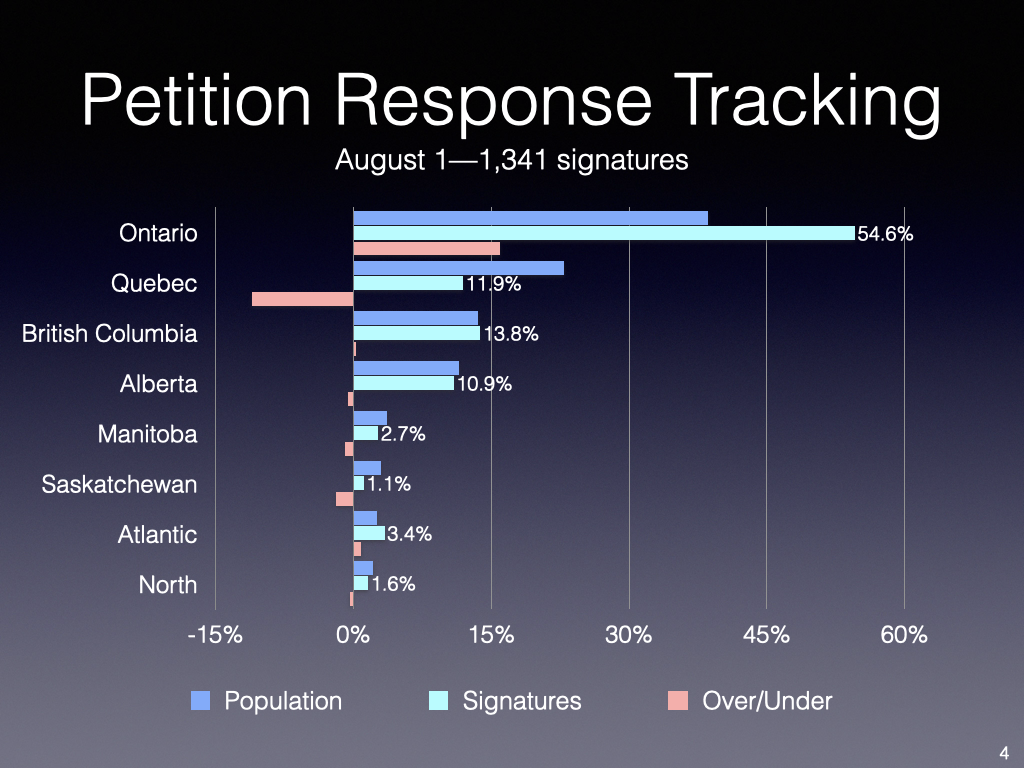
Petition e-4511 – Opposing self-affirmation of the #citizenship oath “citizenship on a click” – Signatures to August 1

The chart below breaks down the 1,341 signatures as of 1 August by province. While Ontario remains over-represented, this is gradually becoming less so. Quebec overtook Alberta this week and, if current trends continue, will approach or surpass British Columbia, thanks to my friend and partner on this petition, Richard Babczak.

And if you haven’t yet considered signing the petition, the link is here: https://petitions.ourcommons.ca/en/Petition/Details?Petition=e-4511

What I wish someone told me about working in Canada when I first immigrated

Good practical advice:

When you’re a new immigrant to Canada and entering the corporate workforce, you need to strike a fine balance. You need to believe in your value and in what you bring to the table, but also work to integrate into a whole new culture in which the learning curve can be steep. In the decades since I began that journey myself, I’ve gained a number of insights I wish someone had told me when I first arrived. I’ve also learned what some of the obstacles are that hinder growth and how to overcome those hurdles.

Obstacles that hinder growth

Communication styles may not be what you’re used to

I once had a manager who was a senior vice-president and managed more than nine nationalities. He said he initially tried the Canadian approach in other places he worked, but quickly discovered that each group wanted to be spoken to in a certain way. The British wanted things non-emotional while the Spanish were the opposite: he had to show he cared. French people wanted to start with an argument. He had to develop a playbook for speaking to groups from each nationality. But not every manager will have this skill level, so you may need to adapt.

In Canada, people often take a softer approach to communication than in some places. Feedback is often sandwiched – a positive, a negative, then another positive. If you don’t understand what a person means, be straightforward and ask direct questions. Don’t just let your imagination fill in the blanks. Also, be curious. Take the time to learn about what’s considered rude, passive-aggressive and so on, to prevent possible missteps.

Canadian corporations operate with flatter hierarchies than in some places

While there is hierarchy in the corporate structure, it’s not exercised the same way you may be accustomed to. I have seen examples of people who come from cultures in which having a title means they expect to be trusted blindly and to be treated like the boss. That’s acceptable in some cultures, but it doesn’t work that way in Canada. Leaders and managers are often less autocratic. This can play in your favour, in the sense that if you’re adaptable, you can gain advantage in a flatter structure that generally has decent respect for workers. However, if your mindset is stuck and you come from a place of entitlement or thinking that people owe you something, it will backfire.

One major difficulty can be feeling undervalued

Employers are often proud of being Canadian, and it can make employees, potential hires and even students feel that others are not good enough. Despite Canada’s messages about welcoming immigrants and valuing diversity, there is a difference between that initial PR machine and the on-the-ground experience, where people may make you feel like you don’t have the right accent or sufficient Canadian work experience.

And let’s be real – you may be subjected to discrimination, bias and racism. I myself have been isolated and bullied, and I’ve faced language barriers as a francophone; even after all these years, my mind works differently than those whose first language is English.

These factors can hinder your growth.

Tips to thrive

Networking is key

If you come here as an adult, you may not have school or university networks or friend circles. Join organizations, attend events and seek out networks to join. Find mentors and people who can guide and support you. Doing this, and finding the right mentor, can give you a real boost. Canada is a place where, overall, people take a favourable view of immigration and where there are many opportunities, but it’s important to be proactive.

Learn about your host country

Of course, you both should be learning about each other, but as an immigrant, you should take the lead. Learn about Canada’s customs and traditions. Don’t stay within your community exclusively – expand and meet others, including people who aren’t like you. It may be worth investing some time and money into additional formal education, too. It might not be easy, but it’s worth the effort, both for the diploma and for the connections you make while you’re doing it.

That being said, when you’re an immigrant, it’s not about becoming a different person.

Remember your value

You’re willing to face risk – or you wouldn’t be here. Keep that bravery, that sense of risk-taking. You may need to work harder or prove yourself more, and without drawing on that strength, you may quickly become disgruntled.

Be confident that you add value. Don’t come at it from the perspective of begging. If you’re here, it means you are adding value to this country. You add diversity to the table and it’s important. Celebrate your difference and see it as the positive that it is.

Finally, be willing to help other immigrants with the things you learn along the way. That, too, is an added value you can bring to Canada thanks to your own perspective and insights. Entering the workforce as an immigrant can be tough, but you’re tougher.

Karima-Catherine Goundiam is the founder and chief executive officer of digital strategy firm Red Dot Digital and business matchmaking platform B2BeeMatch.

Source: What I wish someone told me about working in Canada when I first immigrated

Henrietta Lacks’ descendants reach a settlement over the use of her ‘stolen’ cells

Of note (The Immortal Life of Henrietta Lacks is well worth reading):

The family of Henrietta Lacks has reached a settlement with a science and technology company that it says used cells taken without Lacks’ consent in the 1950s to develop products it later sold for a profit.

Lacks was being treated for cervical cancer at Johns Hopkins University in 1951 when doctors removed cells from her tumor without her knowledge or permission.

Those cells — now known as HeLa cells — had remarkable properties that allowed them to be endlessly reproduced, and they have since been used for a variety of scientific breakthroughs, including research about the human genome and the development of the polio and COVID-19 vaccines.

Lacks’ descendants have argued that she and other Black women were “preyed on” by a group of white doctors in the 1950s and that her family was never compensated for the use of her genetic material, which made such profitable scientific advancements possible.

“Not only were the HeLa cells derived from Henrietta Lacks — the HeLa cells are Henrietta Lacks,” Ben Crump, an attorney for the family, said during a news conference Tuesday.

Thermo Fisher Scientific, a Massachusetts-based science and technology firm, previously asked a judge to dismiss the case, arguing in part that the plaintiff’s claims were too old.

In nearly identical statements, the company and attorneys for Lacks’ family said the “parties are pleased that they were able to find a way to resolve this matter outside of Court and will have no further comment” on the settlement.

The terms of the settlement agreement are confidential.

Attorneys for Thermo Fisher Scientific said in an earlier court filing that only a “handful” of the many products that the company sells are “HeLa-related.”

Lacks’ life was the subject of a popular nonfiction book, The Immortal Life of Henrietta Lacks, and later a film of the same name starring Oprah Winfrey.

On its website, Johns Hopkins University says that it never profited from Lacks’ cells and that, though the collection and use of her cells was “an acceptable and legal practice in the 1950s, such a practice would not happen today without the patient’s consent.”

Speaking at Tuesday’s news conference, Alfred Carter, one of Lacks’ grandsons, called it a “day that will go down in history.” He noted that Tuesday was Henrietta Lacks’ 103rd birthday.

“It couldn’t have been a more fitting day for her to have justice, for her family to have relief,” he said.

Source: Henrietta Lacks’ descendants reach a settlement over the use of her ‘stolen’ cells

Chris Selley: In Canada, even Muslims can be conservatives

As can any group. Ibbitson and Bricker made the point about many immigrant-origin communities being more socially conservative in their 2014 book, The Big Shift but this has not hampered the Liberal government in the three subsequent elections, suggesting less important than other issues.

But valid that all parties need to be more careful in their ethnic and religious vote targeting to avoid greater divisiveness just as they also need to ensure inclusive messaging. Not an easy balance…:

Canada’s media-political universe continues to indulge one of the more fascinatingly insulting ideas in recent memory: That some socially conservative Muslims are lining up in opposition to LGBTQ- and especially gender-related school activities — drag queen story times are a prominent example — because they’ve been duped or manipulated into it by non-Muslim conservatives, especially those awful Americans.

There’s a far simpler explanation, of course: Muslim conservatives are leery-to-outraged by such things for the same reason non-Muslim conservatives are, namely some combination of religious and cultural norms, the shock of the new, and good old-fashioned gut instinct.

In addition, many Muslim-Canadians have their roots in countries where homosexuality is forbidden, never mind celebrated at elementary schools. It would be downright shocking if they had arrived pre-installed with Trudeauvian social values.

But some Canadian liberals just can’t seem to accept this.

“To some, the recent protests have been an example of conservative Muslims pushing back against causes championed by the left — which have in the past included standing against Islamophobia — amid concerns that prevailing progressive ideals conflict with their religious teachings,” the Toronto Star reported this week. “To others, it has tones of political manipulation, with members of a minority group being used to mask a larger push toward intolerance.”

“For white supremacists, expanding their base this way, or even appearing to grow support for their ‘causes’, offers (an) advantage,” Star columnist Shree Paradkar observed. “(I)mages with visibly Muslim people in their midst make for an effective cover.”

Paradkar called the situation “heartbreaking,” which epitomizes the condescension inherent in this narrative: After all Canada has done for these people, they take up with … with … conservatives? Woe!

Prime Minister Justin Trudeau has ushered this idea from the country’s faculty lounges and opinion pages into the mainstream, lately lecturing real live Muslim Canadians in the flesh about the error of their ways. “Misinformation” about school curriculums and activities is “being weaponized by people who are not doing it because of their interest in supporting the Muslim community,” he recently admonished parishioners at a Calgary mosque. “These are people on the far-right who have consistently stood against Muslim rights and the Muslim community.”

There it is again — this idea that Muslims are defaulting on some kind of debt.

It’s an Upper Canadian twist on the narrative that’s taken hold in Quebec in recent years: Where Quebec nationalists and conservatives would rather Muslims abandon their hijabs and embrace French-style secularism (because it’s such a success!), liberals in the Rest of Canada are happy for Muslims to worship and dress as they please, just so long as they don’t fraternize with social conservatives or take up social-conservative causes.

This is not the multiculturalism that the Liberals market to potential immigrants — the freedom to believe and worship and influence Canadian society as they choose. It’s more akin to blackmail: “We support you. We stand with you. It’d be a shame if we stopped, wouldn’t it?”

I’m using a very loose definition of “social conservative” here, incidentally. A Léger poll for the Conservative Party of Quebec, published in May, found 38 per cent of Quebecers felt drag queen story times were inappropriate for children. Many if not most would bristle at being called socially conservative. And most would not show up outside a school to protest about it.

But there’s no good reason Muslims shouldn’t pursue so-con causes in Canada unabashedly. And if they make “unlikely allies” with their non-Muslim so-cons, as the media often put it, I submit that’s for one very bad reason: The paranoia over Islamic terrorism and mass Muslim migration that took hold in some quarters after 9/11, which thankfully in Canada has proven unfounded. If that’s now far enough behind us that conservative Muslims and non-Muslims can make common cause in pursuit of common interests, I dare say we might even be looking at a good-news story.

Surely Canada would be better off if its parties and candidates stopped courting ethnic and religious voters en bloc, as if membership in a certain community ought to determine one’s position on housing policy, or the GST, or carbon pricing, or all the other things that affect our day-to-day lives. It would be a big change for Conservative strategists as well as Liberal ones, but we would be much stronger for it as a nation.

Source: Chris Selley: In Canada, even Muslims can be conservatives

Sun Editorial: Trudeau’s responsible for housing policy

Seems like Postmedia on a roll with this linkage:

Prime Minister Justin Trudeau claiming housing isn’t a primary federal responsibility flies in the face of everything he’s said about the issue since coming to power in 2015.

Seriously, what is he thinking?

Appearing in Hamilton on Monday to announce four affordable housing projects creating 214 new units, to which federal taxpayers contributed $45 million, Trudeau said: “I’ll be blunt as well. Housing isn’t a primary federal responsibility. It’s not something that we have direct carriage of. But it is something that we can and must help with.”

He blamed the previous Stephen Harper government for abandoning housing policy, accusing Conservative leader Pierre Poilievre of being a party to that decision.

He also said the Ontario government should be doing more.

We agree with Trudeau that all levels of government have a part to play in the issue of housing supply, but for him to claim affordable housing isn’t a primary federal responsibility, undermined his own message that, “of all the cost-of-living challenges … housing is the most expensive thing.”

If that’s true, given everything Trudeau has said about the importance of affordable housing since he came to power in 2015, it had better be a primary responsibility for him.

As for Trudeau not having “direct carriage” of the issue, he has direct carriage of immigration, where he’s rapidly increasing the level to 1.45 million new arrivals between 2023 and 2025, contributing to the surge in demand and higher costs for housing nationally.

Trudeau knows this. As he said Monday: “Right now we’re facing a real challenge around housing in terms of supply. There’s simply not enough places for people to live.”

On the campaign trail in 2015, Trudeau promised a “comprehensive National Housing Strategy” to “make housing more affordable for those who need it most – seniors, persons with disabilities, lower-income families and Canadians working hard to join the middle class.”

As of March, 2023, according to the feds, taxpayers have committed $33.69 billion to Trudeau’s national housing strategy, which will top out at over $82 billion in March, 2028.

Trudeau says this has helped almost two million families and individuals get the housing they need.

If he’s going to claim successes in federal housing policy, he has to account for its shortcomings as well.

Source: EDITORIAL: Trudeau’s responsible for housing policy

Kinsella on Ifill: The kind of things you hear from bigots

Valid observation:

Bigot.

That word — along with the corollaries racist, sexist, hater, et al. — get thrown around a lot, of course.  It happens so often, these days, that those words have lost all meaning.  Like they say: if everyone is a racist, then no one is a racist.

But Erica Ifill keeps at it, just the same.

To Erica, seemingly, everyone who isn’t like her — that is, a person with dark skin — is less than her.  She’s been preaching division for years now, on social media and behind a paywall at the Hill Times.  She calls herself “an award-winning anti-oppression journalist and economist.”

Full disclosure: I happily wrote for the Hill Times for years.  When I was there, my editor was mainly Kate Malloy.  Kate and I agreed that Hill Times columnists were not allowed to take cheap shots at each other, in the paper or elsewhere.

But if an occasion arose where criticism was merited, then the target would get a heads-up.

Other media have the same rule.  When Ezra Levant and I did commentary at the Sun News Network, for example, we promised we wouldn’t go after each other — even though we didn’t particularly like each other.  And we didn’t.

Despite that, I picked up the Hill Times one morning, where I found a column Erica Ifill had written about me.  Among other things, she said I was toxic, unethical, disloyal, and that I had never “lived up to any modicum of respectable conduct.” And so on.  Pretty good zingers, if not terribly original.

And then, she said I was a racist.

Given that I’ve spent most of my adult life documenting and opposing racism, that one was over the line — particularly coming from a newspaper I wrote for, and published without the courtesy of a heads-up.  So, I quit, and I haven’t looked at the Hill Times since.

Until this week, that is.  This week, Erica unburdened herself of some opinions that — if the world was still in any way sane — would see her losing her gigs at the Hill Times, Canadaland, CBC and the like.  She won’t, but she should.

When Bingo, a Toronto Police dog was allegedly shot by one Kenneth Grant — the day after Grant allegedly shot and killed one Sophonias Haile in Etobicoke — Ifill was unmoved.  Here’s what she put on Twitter (as it was then known):

“It’s amazing to me how white people show more compassion to animals than to people on the street. You people are reprehensible.” She then posted a graphic of a white person and a dog, mouth on mouth.  It even looked sort of sexual.  “WHITE PEOPLE BEFORE THEY LEAVE THE HOUSE,” the graphic read.

Can you imagine what would happen if a white columnist at the the Hill Times said that about black people?

Anyway. People were outraged, of course, because what the Hill Times columnist posted was insane.  But she wouldn’t back down.  She posted a “study” that read, in part: “The use of dogs as tools of oppression against African Americans has its roots in slavery and persists today in everyday life.”

“Slavery.” And here we simply thought that a dog had been shot and killed: turns out the dog deserved it, because of slavery.  So said Erica, who wrote: “F*** Bingo. Guess he ran out of luck.” She then posted a smiling emoticon.

And, even then, she wouldn’t concede that she had gone too far. “Free speech is for white people and white feelings only,” she declared. She’d experienced a “whitewash,” she said. She was “glad y’all are offended,” she said.

For the Hill Times’ Erica Ifill, all of this is great fun.  A giggle.  She calls white people racist all the time.

She has suggested that “white people” have “a Nazi phase.” That Canada was “built on white supremacy and the fascism of right-wing, Christian dogma.”  That Canada has “white supremacist and seditious elements within.”

Even the Justin Trudeau government is white supremacist, apparently: “When it comes to racism and white supremacy, this country continues to be two-faced. While the Trudeau government denounces white supremacist extremism at home, it meets with them in the dark.”

And so on, and so on.  When you hear that Erica celebrated the death of Queen Elizabeth — a woman who “bathed in the blood of my ancestors” — well, none of this stuff is particularly shocking anymore.

It is, however, the sort of anti-white racism and black supremacy upon which Louis Farrakhan built his Nation of Islam empire.  It is dishonest and damaging and divisive.

It is also the sort of thing you hear from bigots.

Like Erica Ifill.

— Kinsella is the author of the bestselling Web of Hate, and the leader of the group Standing Together Against Misogyny and Prejudice, which led a successful campaign against a pro-Nazi newspaper in Toronto.

Source: KINSELLA: The kind of things you hear from bigots

ICYMI: Ottawa to focus on tech-related immigration despite industry headwinds

Some good notes of caution by Statistics Canada experts and UBC’s David Green:

The federal government is upending its points-based system for immigrant selection this year and prioritizing candidates with experience in the technology sector, despite recent layoffs and weakening labour demand in the industry.

Since June 28, Ottawa has invited people with particular attributes to apply for permanent residency (PR), a departure from how the Express Entry system, which accounts for a large portion of economic immigration to Canada, usually works.

Candidates in that pool are assigned a score – based on such factors as age and education – and the government regularly selects those with the highest scores to apply for PR status.

Under the new approach, Immigration, Refugees and Citizenship Canada (IRCC) is frequently sending out invitations to apply to a subset of individuals. This year, IRCC will focus on people with French-language skills or recent work experience in one of five fields, including STEM (science, technology, engineering and math) and health care.

Sean Fraser, who until recently was immigration minister, said category-based selection would help Canada to bring in health care and construction workers that it desperately needs in ailing sectors of the economy.

“Realistically, we need to leverage the new flexibilities that will kick in in 2023 to do targeted draws for people who have the skills to build more houses,” he said at a press conference last November.

But the federal government will put considerably more emphasis on the recruitment of STEM workers, according to targets that IRCC shared with The Globe and Mail.

Between 28 per cent and 31 per cent of PR invitations that are issued through the Express Entry system this year will go to people with recent experience in certain STEM jobs, such as data scientists and software developers. Most applications are processed within six months of being received.

This easily exceeds the target ranges for candidates with French-language proficiency (11 per cent to 15 per cent) or those with experience in specific occupations within health care (nine per cent to 12 per cent), trades (three per cent to four per cent), transportation and agriculture (one per cent to two per cent each).

The emphasis on tech-savvy immigrants is part of a broader recruiting strategy that’s taken shape in recent weeks. This month, for example, the federal government invited skilled workers with H-1B visas in the United States to apply for Canadian work permits, hitting its cap of 10,000 applications within 48 hours of the initiative’s launch.

But this push also coincides with a challenging time for the tech sector, which has endured a series of high-profile layoffs over the past year, including two rounds of sweeping cuts at Shopify Inc.Tech-related job growth has slowed dramatically this year, while postings for some roles have plunged to below pre-pandemic levels.

There’s been “a huge shift in the job market when it comes to recruiting activity and hiring appetite,” said Brendon Bernard, senior economist at hiring site Indeed Canada.

Economists and policy experts have warned that Canada has a checkered history in matching immigrants to specific jobs.

Just under 50 per cent of STEM-educated adult immigrants in the U.S. and Canada worked a STEM job in the mid-2010s, according to a report that Statistics Canada published in 2020.

Of the remaining STEM-educated immigrants, about 50 per cent in the U.S. found a job that required a university degree, while in Canada, just 20 per cent did. “In Canada, most STEM-educated immigrants who could not find employment in a STEM occupation found lower-skilled jobs,” Garnett Picot and Feng Hou wrote in the report.

The authors noted that Canada experienced a rush of STEM-educated immigrants in the 1990s, in response to the ill-fated dot-com boom, and their ranks “have remained at high levels” ever since. “In the absence of a shortage of STEM workers, employers may prefer to hire those educated in Western countries,” the report said.

Tech companies, on the other hand, frequently say that Canada suffers from a shortage of skilled workers, making it tough to compete globally.

To date, IRCC has invited 8,600 people to apply for permanent residency over five rounds of category-based selections. There has been one round of STEM invites that went to 500 people.

IRCC will continue to select people from the broad pool of Express Entry candidates, not just those with specific attributes; if a STEM worker receives a PR invite in this manner, it counts toward the target for that category. And depending on a person’s attributes – say, a French-speaking engineer – they can be counted in multiple categories.

The Immigration Department developed its list of desired occupations after a public consultation that drew 289 responses from various stakeholders, including Amazon and the Council of Canadian Innovators, a lobby group for prominent tech companies. The categories are in place for 2023 and subject to change thereafter.

The Express Entry system is being shaken up in the process. By filtering for specific job experience, the government is reaching deeper into the pool of candidates, which means that some high-scoring candidates will get passed over. (The scores correspond to their expected earnings in Canada, based on the outcomes of previous newcomers.)

“You’re going to bring in STEM workers whose points, in terms of education etc., would actually not get them in here” under the usual approach, said David Green, an economics professor at the University of British Columbia.

“It’s not like there’s an infinite number of really good STEM workers out there. There’s going to be a distribution, and by doing this, we are going down to the less competent part of the distribution.”

Source: Ottawa to focus on tech-related immigration despite industry headwinds

Des immigrants parlant le français au quotidien déplorent leur exclusion des «statistiques de Legault»

A noter. One personal story but have noticed that Le Devoir has increased its coverage of immigration often highlighting these kinds of situations and issues:

Ils ont choisi le Québec pour sa réputation progressiste, son ouverture sur le monde et parce qu’ils sont francophiles. Ils ont quitté les États-Unis, inquiets du devenir du pays durant la présidence de Donald Trump. Des immigrants américains se disent aujourd’hui « sous le choc » et « déçus » par le discours et les politiques du gouvernement de François Legault, qui rongent leur sentiment d’appartenance.

Alors qu’ils font tout pour apprendre et vivre en français, ces nouveaux arrivants rejettent l’étiquette de personnes qui « anglicisent » le Québec. Même s’ils utilisent le français dans leur quotidien et au travail, ils ne compteront jamais dans « les statistiques de Legault », déplore Kiyoshi Mukaï, Américain d’origine japonaise installé à Montréal depuis un an et demi.

Les deux indicateurs cités par le premier ministre François Legault, notamment dans son dernier discours d’ouverture, sont en effet la langue maternelle et celle parlée à la maison. M. Mukaï ne coche donc pas les bonnes cases : l’anglais comme langue maternelle, il parle espagnol à la maison, la langue maternelle de son épouse, Victoria Girón, originaire du Honduras.

« J’ai toujours voulu vivre au Québec », précise Kiyoshi Mukaï à plusieurs reprises durant l’entrevue avec Le Devoir,réalisantune partie de ses études en français. « Quand Trump a commencé sa campagne, j’ai appelé un consultant en immigration et déposé une demande », raconte-t-il. Il a ensuite patienté durant quatre ans, entre 2018 et 2022, notamment à cause de délais liés à la pandémie, pour enfin officiellement immigrer à Montréal.

Tous les deux assurent utiliser le français quotidiennement dans leur vie sociale et au travail. Ils ont même été prêts à débourser près de 4000 $ pour que Mme Girón puisse étudier la langue dès son arrivée. Elle ne détenait alors qu’un visa de visiteur et n’avait donc pas accès à la francisation gratuite.

Partant pratiquement de zéro, elle a réussi le tour de force d’atteindre un niveau conversationnel en six mois, niveau qu’elle démontre tout au long de notre entrevue. « Pour nous, c’était très important d’acquérir la langue pour faire partie de la société, même s’il fallait payer », raconte-t-elle. Non seulement pour aller au dépanneur ou prendre le métro, mais aussi pour son « indépendance », précise-t-elle.

Maintenant que le couple est marié, elle a obtenu un visa de travail. Architecte de formation, elle suivra bientôt une formation linguistique complémentaire et un peu plus technique pour ses éventuelles entrevues d’embauche.

Dans l’ombre des statistiques

« Nous, ce qu’on vit est que le français est clairement la lingua franca. Au point que ça surprend nos amis qui nous visitent », assure aussi un autre Québécois d’origine américaine. Il a beaucoup de points en commun avec M. Mukaï et Mme Girón, mais il a demandé de protéger son identité par peur de devenir une cible en ligne.

Chercheur universitaire dans un établissement francophone à Montréal, il a quitté Portland en Oregon, lui aussi durant les années Trump, un endroit pourtant réputé comme un bastion progressiste. « Un jour, j’ai trouvé ma petite fille, qui avait alors 6 ans, qui se cachait sous le lit avec une amie. Elles jouaient qu’il y avait un tireur actif. Je me suis dit “Est-ce que c’est vraiment ici qu’on va élever nos filles ?” » La mise en situation était potentiellement tirée d’un exercice contre les fusillades, qui sont devenues courantes dans les écoles américaines.

« La première fois qu’on a visité Montréal, on a été tellement attiré par la diversité, l’aspect international et le fait de pouvoir communiquer dans plusieurs langues », relate-t-il.

La famille ne regrette pas son choix. Leurs deux enfants sont maintenant « 100 % bilingues », car ils fréquentent l’école francophone grâce à la loi 101. Ils savent chanter des paroles des Trois Accords ou des Cowboys Fringants.

« Mais on ne comptera jamais dans les statistiques de Legault, on ne marche pas dans son message politique », dit l’homme dans la cinquantaine. « Je comprends de plus en plus que nous ne serons jamais acceptés comme des Québécois », dit-il. Il trouve ce constat « triste et décevant », alors que, comme pour nombre d’immigrants, il lui semble plus facile de se dire Canadien.

Il dénonce le choix de s’en tenir surtout à la langue maternelle, « quelque chose qu’on ne contrôle pas ». Si la possibilité d’appartenir, de se réclamer Québécois en dépend, alors il faut faire partie « d’une ethnie en fin de compte, au lieu d’une nationalité », constate-t-il.

Impossible, à ce compte, d’entrer dans « ce gabarit », même par l’assimilation — une politique que les États-Unis ont explicitement abandonnée dans les années 1990 et aujourd’hui associée à la droite trumpiste —, note-t-il.

Des délais

Les politiciens « donnent un portrait faux et incomplet » de l’immigration, croit M. Mukaï. Le discours sur le déclin du français sert, selon lui, à justifier des seuils d’immigration plus bas : « À l’heure actuelle, on sait notamment que la peur de l’anglicisation du Québec a joué un rôle dans les limites annuelles établies pour la réunification familiale », constate-t-il.

Ces délais qui s’allongent, il en connaît quelque chose. Sa femme attend depuis plus d’un an d’obtenir sa résidence permanente. Même si le couple a le privilège d’être ici ensemble, Mme Girón ayant d’abord obtenu un visa de touriste puis un visa de travail, il déplore d’être instrumentalisé pour une politique qui « garde des couples et des familles séparées ». « Pour moi, c’est inhumain », dit-il.

« Je sais que c’est un privilège d’immigrer et je suis toujours reconnaissant […], mais je me sens un peu confus et trahi en même temps », confie M. Mukaï.

Le ministère fédéral de l’Immigration a récemment confirmé au Devoir que les seuils établis par Québec ralentissent en effet le regroupement familial. Les délais sont de 10 à 15 mois plus courts dans le reste du Canada. Au total, 36 800 personnes sont en attente d’une résidence permanente dans la catégorie du regroupement familial au Québec, alors que la barre maximale établie par le gouvernement Legault se situe à 10 600 personnes pour l’année 2023.

C’est précisément les participants à ce programme que le premier ministre a accusé en 2022 de mettre le Québec sur la voie de la « louisianisation ».

Pour tous ces immigrants, il y a pourtant d’autres marqueurs identitaires clairs et tout aussi importants, comme les valeurs progressistes, féministes et égalitaires, citent-ils tous. « Au Québec, on se sent dans une société distincte. C’est plus une communauté, et la manière de traiter les gens est plus amicale », observe Victoria Girón.

« Toute l’huile qui a été jetée sur le feu identitaire, c’est vraiment pour distraire, alors que d’autres choses sont bien en train de pourrir, comme la santé et l’éducation », dit quant à lui le chercheur universitaire.

Source: Des immigrants parlant le français au quotidien déplorent leur exclusion des «statistiques de Legault»