Joel Kotkin: To embrace immigration, Canada must reject Trudeau’s racialized policies

More ideology at play than reason. One third oppose immigration levels means two-thirds and neutral or support, numbers that have been relatively consistent over the past 20 years and ones that dwarf most other countries.

While I also find some of the government’s language and virtue signalling tiresome, it does not appear to have resulted in less support for immigration as the government continues to increase immigration levels each year. Concrete issues like housing shortages, healthcare stress and the like pose a greater risk.

Funny typo “school emissions” rather than admissions!

Recent government moves to increase immigration to 1.2 millionover the next three years reflects both a hopeful sign for Canada’s future, but also potential impact. Along with immigration’s many benefits, we could see the intensification of racialism and identity politics, the kind that is threatening to tear apart an already deeply divided United States.

Of course, Canada is not burdened, like the United States, by the legacy of slavery, but both countries do share a similar legacy of displacement of Indigenous peoples and share a justified collective guilt over it. But Canada’s future, even more than that of the U.S., will be shaped by immigration. In Canada immigrants represent 21 per cent of the total population, compared to just 15 per cent in the US.

Most of these newcomers are from outside Europe. In the last half century, non-Europeans have grown from barely ten per cent to nearly 80 per cent of all immigrants. Using the awkward term “racialized” minorities used by the government to define non-Europeans, their share of the population rose from 16 to 22 per cent, between 2006 and 2016. By 2041, according to Statistics Canada, half of Canada could be immigrants, or their children.

Canada needs newcomers. After all, the Canadian birthrate has fallen well below replacement, contributing to skilled labour shortages in hospitals, factories and schools. In contrast to the U.S., where family ties predominate, Canadian policy wisely focuses on the county’s s economic vitality.

Certainly, many Canadian minorities embrace capitalist work ethic and discipline with enthusiasm. As in the U.S., they show a  greater proclivity to start businesses than most Canadians. Overall, although their average incomes lag, racial minorities in Canada boast higher labour participation rates than Europeans, and have made steady progress, with most reaching close to equity by the third generation.

Rather than embrace and promote this progress, some Canadian academics, media and politicians — including Prime Minister Justin Trudeau — seek to construct  an increasingly racialized public policy, with a fashionable emphasis on “anti-racism.” Rather than embrace his father’s passionate commitment to national unity, the son has adopted a race-driven ideology, separating Canadians by ethnic group, as well as gender and sexual orientation.

In the U.S. we can already see the damage caused by this mentality. Particularly under the Biden administration, racial classificationhas become a tool for preferences. Once the party of segregation before embracing integration, the Democrats now are regressing, again embracing racial preferences and quotas in universities, corporations, and professional organizations over merit as a primary qualification.

Wherever this approach is adopted, it undermines the very rationale that all liberal societies have enjoyed — and indeed are the very things that attracts migrants to these countries. In its ugliest form, the racialist agenda seeks to unite “people of colour” — known as BIPOC — against the white majority. In some places, this has taken on the character of Mao’s Cultural Revolution, with all whites forced to admit their racism, whatever their personal feelings.

Advocates for  BIPOC — an acronym for Black, Indigenous, and People of Colour — envision a coalition of nonwhites to struggle against what the  BIPOC Project calls a hegemonic “white supremacy, patriarchy and capitalism.” This thinking is deeply embedded in the Biden Administration Education Department,  where one official has even denounced democracy itself as “built on white supremacy.” California, the mecca of racial virtue signalling, has even decided to award six figure “reparations” for slavery, even though it was never a slave state and has discriminated far worse against Asians as well as the native Mexican and Indigenous populations.

Now imagine the impact of such thinking on a an increasingly diverse Canada. Who do you extend preferences to when several “racialized groups” — Korean, Japanese, Chinese, Arab and Indian — exceed white incomes by third generation. Generally speaking, Asians outperform whites in education as well as income, even as other minorities do worse and whites, far from the top perch, sit in the middle.

Canadian Universities, like their American counterparts have become enamoured with the politics of guilt-tripping whites, accusing them of the damage done to First Peoples, irrespective of when their families arrived or any real culpability. Similarly, tolerance of antisemitism and Holocaust denial are now tolerated  and even supported, by Members of Parliament as a means, apparently, of appealing to Muslims.

This is not good for Canada, and it isn’t good for minorities and immigrants either. Canada has been, if imperfect, a relative place of refuge, a society where personal merit remains more valued than membership in a particular gene pool, religious sect, or caste. As in the United States, a racialist approach seems likely to boost  opposition to immigration    that has emerged in Europe as well as the United States. Even though illegal immigration is less than of an issue in Canada, at least a third already express dissatisfaction with the current levels of immigration.

Just imagine when French and English Canadians, as well as the children of European immigrants, find themselves discriminated against in such things as school emissions. Ironically, some of the biggest victims of a preference regime might be the largest immigrant group, Asian Canadians, who have the misfortune of outperforming other ethnic groups.

Canada can find better ways to help immigrants, and other Canadians, by promoting broad-based economic growth and policies that lead to lower house prices, a major impediment to moving into the middle class. Rather than celebrate separatism, Canadians should embrace the multiculturalism of the streets, particularly in suburbia, as well as the growing intermarriage ratesamong Asians and other minorities.

Canadians have to balance their need for immigrants with a sense of common national purpose. A great country cannot be built on a bed of guilt and racial jockeying, but on a common acceptance of merit, fairness and openness, remaining a beacon of humanistic sanity in an increasingly divisive world.

National Post

Joel Kotkin is author of The Coming of Neo Feudalism — A Warning to the Global Middle Class, presidential fellow in urban futures at Chapman University, in Orange, CA and executive director of the Houston-based think tank, Urban Reform Institute.

Source: Joel Kotkin: To embrace immigration, Canada must reject Trudeau’s racialized policies 

Fruit and vegetable growers need strong agriculture policies

Note reference to seasonal agriculture workers:

Labour shortages and financial support programs are crucial issues for many Canadian farms trying to meet growing global food demands, says Charles Stevens, Chair of the Ontario Fruit and Vegetable Growers’ Association (OFVGA).

The most useful support for them would be streamlining government inspections of farms and establishing financial protection for fresh fruit and vegetable farmers to match what U.S. growers have, he told the Commons agriculture committee.

OFVGA wants quick passage of the Financial Protection for Fruit and Vegetable Growers Act to match the support available to American farmers when buyers go bankrupt.

Other helpful measures would be implementing a grocery code of conduct, refunding tariffs on Russian fertilizer and protecting farms from anti-competitive practices by large retailers, “which are stretching family farms to the limit,” he said.

The government should also increase funding to Agriculture Canada’s Pest Management Centre to develop new crop protection technology for the fruit and vegetable industry. Without the Centre, “we’re going down the tube. It’s very important.”

At the rate farm land is being converted to other uses, there will be no agriculture left in Ontario in 100 years, Stevens said. “We need better land use policies to save the No. 1, 2, 3 and 4 agriculture lands, which a farmer can make a living on. The five, six, and seven, which he cannot make a living on, maybe that’s where we need to put the houses.”

The Canadian Agricultural Human Resource Council says that in 2021 labour shortages cost Canadian farms $2.9 billion in lost sales. Meanwhile studies of Ontario farm safety net programs show 95 per cent of farms would be negatively impacted without them.

Government should make a priority of the Seasonal Agriculture Workers Program, which is important to the fruit and vegetable sector. “If we lose this or if it gets tweaked badly, we’re out of business.”

It used to take a month to get seasonal workers approved through Service Canada, he said. “Now it’s six months. We have to organize for six months to get it through Service Canada. It is not getting its job done in time for us to get the job done.”

Despite all the criticism of the seasonal workers program, Stevens said, “Almost all farmers treat their workers as well as their local workers or they’d be out of business. I have a man who’s been with me for 34 years. They are vital. We would not have a horticulture industry in Canada without this labour.”

He also urged that government inspections be streamlined. “They are complicated and drawn out, especially the temporary worker program integrity audits. There were 11 audits on my farm last year. When I started, there were none. It doesn’t help the farmer when he’s under stress and harvesting his crop to have somebody come in and audit. At the end of the day, there has nothing wrong, and it just overburdens them.”

More than 75 per cent of fresh vegetables and 80 per cent of the fresh fruit sold in Canada are imported. Still Canada exported $2 billion in fresh vegetables and $3 billion in frozen fruits and vegetables in 2021.

Source: Fruit and vegetable growers need strong agriculture policies

P.E.I apple orchard firm ordered to pay thousands to foreign workers in ‘cash for pay scheme’

Classic case of exploitation and abuse:

P.E.I.’s Employment Standards Branch has ordered an apple orchard company in Kings County to pay thousands of dollars to four foreign workers who refused to participate in what the province’s chief labour standards officer called a “cash for pay scheme.”

Canadian Nectar Products has been ordered to pay the former employees sums ranging from about $5,000 to nearly $15,000 for unpaid wages. A related company, Fruits Canada, was ordered to pay one former employee $233 for unpaid wages.

The companies, and others linked to them, are the subject of an ongoing investigation by the Canada Border Services Agency related to similar allegations, in which workers claim their employer demanded cash payments in exchange for paycheques of lesser value than the cash that was remitted.

Source: P.E.I apple orchard firm ordered to pay thousands to foreign workers in ‘cash for pay scheme’

Browne: Canada, it’s time to appoint a Black Equity Commissioner

Not convinced that this will address practical issues and unclear whether she is thinking of only more awareness and political role as in the case of antisemitism and islamophobia, or something with more teeth like the an officer of parliament like the official languages commissioner.While I have argued in the past that an officer of parliament for multiculturalism could be useful, given a fair degree of commonality of issues across the various groups, commissioners for specific communities would be overkill and reduce accountabilities in the departments responsible:

From Dec. 5 to 8, some Ottawa residents have been part of the Canadian delegation, including representatives from the federal government and Black-focused community organizations, attending the first meeting of the UN Permanent Forum on People of African Descent, in Geneva Switzerland. The forum will be an advisory body to the UN Human Rights Council, in line with the program of activities for the implementation of the UN International Decade for People of African Descent, which runs from 2015 to 2024.

A number of the Black groups attending will be calling for the government of Canada to appoint a Black Equity Commissioner, similar to the permanent Special Envoy on Antisemitism and new Special Representative on Islamophobia announced in the 2022 federal budget

Beyond the obvious reason of simple equity, there are other reasons for appointing a Black Equity Commissioner. First, with a little under two years left in the UN Decade for People of African Descent, the commissioner will help ensure addressing anti-Black racism remains a federal focus after the special decade ends. Second, with Statistics Canada reporting that Black Canadians faced the most hate crimes in Canada in 2020, and with other data showing Black Canadians continue to be disproportionately negatively impacted by the COVID-19 pandemic, lack of affordable housing, under-employment and other social determinants of health, the commissioner is more essential than at any moment in recent history to safeguard and expand substantive equality rights for Black people.

Source: Browne: Canada, it’s time to appoint a Black Equity Commissioner

Krugman: Does :ChatGPT Mean Robots Are Coming For the Skilled Jobs?

Of interest. Much of government work is potentially vulnerable to these technologies. Hope IRCC is exploring this and comparable chat systems to address some of the service pressures:

Will robots take away our jobs?

People have been asking that question for an astonishingly long time. The Regency-era British economist David Ricardo added to the third edition of his classic “Principles of Political Economy,” published in 1821, a chapter titled “On Machinery,” in which he tried to show how the technologies of the early Industrial Revolution could, at least initially, hurt workers. Kurt Vonnegut’s 1952 novel “Player Piano” envisaged a near-future America in which automation has eliminated most employment.

At the level of the economy as a whole, the verdict is clear: So far, machines haven’t done away with the need for workers. U.S. workers are almost five times as productive as they were in the early postwar years, but there has been no long-term upward trend in unemployment:

Higher productivity hasn’t hurt overall employment.
Higher productivity hasn’t hurt overall employment.Credit…FRED

That said, technology can eliminate particular kinds of jobs. In 1948 half a million Americans were employed mining coal; the great bulk of those jobs had disappeared by the early 21st century not because we stopped mining coal — the big decline in coal production, in favor first of natural gas and then of renewable energy, started only around 15 years ago — but because strip mining and mountaintop removal made it possible to extract an increasing amount of coal with many fewer workers:

Some jobs have largely disappeared.
Some jobs have largely disappeared.Credit…FRED

It’s true that the jobs that disappear in the face of technological progress have generally been replaced by other jobs. But that doesn’t mean that the process has been painless. Individual workers may not find it easy to change jobs, especially if the new jobs are in different places. They may find their skills devalued; in some cases, as with coal, technological change can uproot communities and their way of life.

This kind of dislocation has, as I said, been a feature of modern societies for at least two centuries. But something new may be happening now.

In the past, the jobs replaced by technology tended to involve manual labor. Machines replaced muscles. On the one hand, industrial robots replaced routine assembly-line work. On the other hand, there has been ever-growing demand for knowledge workers, a term coined by the management consultant Peter Drucker in 1959 for people engaged in nonrepetitive problem solving. Many people, myself included, have said that we’re increasingly becoming a knowledge economy.

But what if machines can take over a large chunk of what we have historically thought of as knowledge work?

Last week the research company OpenAI released — to enormous buzz from tech circles — a program called ChatGPT, which can carry out what look like natural-language conversations. You can ask questions or make requests and get responses that are startlingly clear and even seem well-informed. You can also do fun things — one colleague recently asked for and received an analysis of secular stagnation in sonnet form — but let’s stick with things that might be economically useful.

ChatGPT is only the latest example of technology that seems to be able to carry out tasks that not long ago seemed to require the services not just of human beings but of humans with substantial formal education.

For example, machine translation from one language to another used to be a joke; some readers may have heard the apocryphal tale of the Russian-English translation program that took “the spirit was willing, but the flesh was weak” and ended up with “the vodka was good, but the meat was spoiled.” These days, translation programs may not produce great literature, but they’re adequate for many purposes. And the same is true in many fields.

You can argue that what we often call artificial intelligence isn’t really intelligence. Indeed, it may be a long time before machines can be truly creative or offer deep insight. But then, how much of what human beings do is truly creative or deeply insightful? (Indeed, how much of what gets published in academic journals — a field of endeavor I know pretty well — meets those criteria?)

So quite a few knowledge jobs may be eminently replaceable.

What will this mean for the economy?

It is difficult to predict exactly how A.I. will impact the demand for knowledge workers, as it will likely vary, depending on the industry and specific job tasks. However, it is possible that in some cases, A.I. and automation may be able to perform certain knowledge-based tasks more efficiently than humans, potentially reducing the need for some knowledge workers. This could include tasks such as data analysis, research and report writing. However, it is also worth noting that A.I. and automation may also create new job opportunities for knowledge workers, particularly in fields related to A.I. development and implementation.

OK, I didn’t write the paragraph you just read; ChatGPT did, in response to the question “How will A.I. affect the demand for knowledge workers?” The giveaway, to me at least, is that I still refuse to use “impact” as a verb. And it didn’t explicitly lay out exactly why we should, overall, expect no impact on aggregate employment. But it was arguably better than what many humans, including some people who imagine themselves smart, would have written.

In the long run, productivity gains in knowledge industries, like past gains in traditional industries, will make society richer and improve our lives in general (unless Skynet kills us all). But in the long run, we are all dead, and even before that, some of us may find ourselves either unemployed or earning far less than we expected, given our expensive educations.

Source: Does ChatGPT Mean Robots Are Coming For the Skilled Jobs?

Ibbitson: A demographic apocalypse lies behind Chinese protests and Saunders: China will soon not be the world’s most populated country. That’s good – so why is Beijing fretting?

While Ibbitson offers an apocalyptic view, Saunders present a more nuanced picture, noting that:

Population decline will soon be the norm in all but a handful of countries. While governments around the world are racing to keep population up to avoid the higher public costs of that decline (especially in structurally underpopulated countries such as Canada), we’re all going to have to learn to make substantial progress without population growth. The soon-to-be second-biggest country ought to be leading the way.

Starting with Ibbitson’s apocalyptic view:

The Chinese government will probably be able to contain the protests over COVID-19 restrictions. Beijing will probably be able to contain the protests that come after that, which may be about COVID-19 or something else. But what about the protests after that? And the ones after that?

People who are pushing back against excessive restrictions by an authoritarian regime are also reacting to a slow-moving demographic apocalypse, though many of them might not know it.

China’s population will probably begin to decline this year, and will continue to decline every year after that. The country will lose half of its population by the end of the century, possibly sooner. These losses will place an enormous strain on the country’s economy and social fabric. We can expect repeated waves of protests. Maybe worse.

According to the country’s National Bureau of Statistics, China’s total fertility rate (the average number of children born to a woman in her lifetime) fell to 1.15 in 2021. That is one full baby short of the 2.1 children-per-woman needed to sustain a population.

Worried about the dangers of overpopulation, the Communist government imposed its Draconian one-child policy in 1979. Like so many authoritarian restrictions, the policy had unintended consequences: For decades, hundreds of millions of Chinese parents had one child. They got used to it.

Alarmed by falling fertility, the government raised the ceiling to two children in 2015, and to three children last year. But the fertility rate continued to fall.

Many countries, including Canada, have fertility rates below replacement rate. (Ours is 1.4.) We make up the shortfall through immigration – something that China, whose population is more than 92 per cent Han Chinese, discourages.

For a variety of reasons – including insufficient government supports for child care, the high cost of tutors to give a child an advantage at school and a stigma against giving birth outside marriage – China and other East Asian societies have some of the lowest fertility rates in the world.

The upshot: The World Economic Forum estimates that China’s population will start to decline in 2022.

“The world’s biggest nation is about to shrink,” the report declares.

Unless fertility rates rebound – and no country in the world has brought its fertility rate back up to replacement rate, though several have tried – the world’s most populous country, with 1.4 billion people, will lose more than half its population over the course of this century, the Shanghai Academy of Science predicts. Another study, reported last year in the South China Morning Post, warns the population could halve within the next 45 years.

This will place an intolerable strain on younger workers. Because there will be fewer people entering the workforce every year, there will be fewer consumers available to buy the things that drive an economy. And this ever-shrinking pool of workers will see more and more of their income funnelled into supports for the elderly.

“China’s low fertility and declining number of working-age population will definitely result in slower economic growth” along with “social and economic inequalities,” said Ito Peng, Canada Research Chair in Global Social Policy at University of Toronto, in an e-mail exchange.

“As the labour market becomes increasingly more precarious and divided, and as the income gap continues to rise, I think it will lead to more social and economic polarization,” she continued.

Many China observers speak of a post-Tiananmen Square social contract: After the suppressed demonstrations in 1989, the state promised prosperity if people avoided politics and left the Communist Party in charge.

But each year going forward, the state will find it harder to fulfill its side of the bargain, as fewer and fewer young people support more and more old people in a slowing economy.

Many people around the world will welcome a world in which there are half a billion fewer people contributing to global warming and otherwise taxing the resources of the Earth.

But urging Chinese workers to embrace the limits of growth won’t ease their financial burden. Many of them won’t accept such hardship quietly.

The recent protests are the most extensive in more than 30 years. But they may be just the beginning.

Source: A demographic apocalypse lies behind Chinese protests

Turning to the earlier commentary by Saunders:

The news that China will soon cease to be the world’s largest country, by population, should not have been received as an unwelcome development.

But the projection that in 2023 India will surpass China as the most populated country – a detail contained in this week’s annual United Nations world population forecast – capped a long-mounting frenzy within China’s media and political class about its faster-than-expected shift to a declining population.

Beijing, visibly alarmed by this pending milestone, is now desperately pursuing population-growth strategies that include incentives to have more children and, more ominously, restrictions on birth control and abortion rights (especially for minorities), as well as efforts to prevent well-off people from fleeing to more democratic countries.

President Xi Jinping’s about-face on population policy during the past half-dozen years might appear irrational, if you don’t understand the real source of anxiety. After all, Beijing spent decades alarmed by the spectre of overpopulation, attempting to combat it with sometimes draconian family-control measures.

But what actually caused China’s population to all but stop growing was its shift from being a poor agrarian country to an increasingly middle-class consumer economy. It is now home to about 400 million citizens whose family incomes fit securely into the global middle class (with family earnings between $19,000 and $95,000 a year).

The Chinese Communist Party, as it likes to boast, has succeeded in ending the horrific absolute poverty that was created during the postwar decades by, well, the Chinese Communist Party. As a consequence, China’s population stopped growing quickly for the same reasons that it has in two-thirds of the world’s countries: urbanization, education, greater equality for women and income security.

Why wouldn’t China content itself with being a non-impoverished country of more than a billion? After all, it is Indian Prime Minister Narendra Modi’s failure to attain this status that has given his country the population crown. Its female work force participation rate is a shameful 19 per cent (compared with 62 per cent in China) and its share of agriculture in employment has actually risen, to almost 40 per cent (while China’s has fallen below 25 per cent).

So why is Beijing so anxious? To understand that, you need to look beyond the headline national-population figures in that UN report. As economic writer Justin Fox noted in his analysis at Bloomberg, the striking change is how quickly working-age populations are falling: Within a few decades, Europe, Canada and the United States will have more working-age people than all of East Asia.

You might think this doesn’t matter any more. Aren’t we beyond the age when a country needed vast reserve armies of labour? China stopped being predominantly a low-wage export-manufacturing economy around the time of the 2008 economic crisis. There just aren’t that many very low-wage, labour-intensive industries at the heart of major economies any longer; the big growth sectors these days, especially in China, are all more skilled, more educated, service-dominated fields.

But Mr. Xi and his officials aren’t obsessed with the size of their working-age population because they want more workers; they’re obsessed because they believe an aging population, with fewer tax-contributing workers and more revenue-consuming pensioners, will make it impossible to escape the “middle-income trap.”

That theory emerged in 2006 to describe the paradox faced by most countries in Latin America and the Middle East, as well as some in Asia: The very economic growth that got them out of poverty made their wages too uncompetitive to rise beyond the slightly-above-poverty level, where they then remain stuck.

In his fascinating recent analysis of Mr. Xi’s decade-long obsession with the concept, Frank Tang of the South China Morning Post notes that the President and his cabinet have raised the spectre of middle-income traps dozens of times in major speeches and reports. Senior party officials have frequently concluded that the biggest barriers to breaking out of the trap are “the economic impact of the country’s rapidly aging population” and its falling fertility rate – possibly because they know that Asian countries that have escaped it, such as South Korea and Singapore, did so while their populations were still growing.

Major economic analyses of China’s economic prospects, however, conclude that any escape from the trap requires increases in efficiency, productivity and technological innovation – and an end to repressive policies that are quickly driving developed economies away from investing in, and trading with, China. A growing working-age population may make it cheaper and easier to do so, but isn’t really required.

Population decline will soon be the norm in all but a handful of countries. While governments around the world are racing to keep population up to avoid the higher public costs of that decline (especially in structurally underpopulated countries such as Canada), we’re all going to have to learn to make substantial progress without population growth. The soon-to-be second-biggest country ought to be leading the way.

Source: China will soon not be the world’s most populated country. That’s good – so why is Beijing fretting?

May/Savoie: Canada needs a royal commission to fix problems with the federal public service

There are so many issues where a royal commission would be useful and provide deeper insights and solutions to some of the weaknesses of Canadian government policies and programs:

Canada’s public service needs to be fixed. It’s growing like gangbusters, faces relentless attack, is losing the confidence of politicians, and struggles to keep up in a changing world because it is using decades-old policies and processes, says a leading expert.

Donald Savoie, Canada’s pre-eminent scholar and expert on public administration, is calling for a royal commission into the role of the public service, the first in more than 45 years, to fix its deteriorating relationship with ministers, Parliament and Canadians.

Savoie has written exhaustively about what’s wrong with the public service. But he now believes the non-partisan institution has so irreparably come off its moorings that only an independent royal commission can fix it.

“I reluctantly came around to a royal commission because I see no better option. I’m not a big fan of them. They’re costly and once launched can go off on tangents… But what else can we do?”

He says the time is right because the public service is under “sustained criticism with bureaucrat bashing taking hold everywhere.”

The work and expectations of the public service has changed dramatically over the past 45 years while the rules under which they operate stayed the same. Ministers of all political stripes have hired large staffs for policy advice, whereas they used to rely on getting that from public servants.

All of that is taking its toll on the morale of the public service, frustrating those who work there and discouraging those who may be interested in working in government.

The most worrisome problem is the lack of trust.

Forty years ago, a minister ‘s office had three or four assistants and the main policy adviser was the department’s deputy minister. Today, ministers have several dozen staff headed by chiefs of staff ­— equivalent to assistant deputy ministers — and have their own policy advisers.

“Why is it that 40 years ago there was no such thing as a policy adviser to a minister? It used to be a deputy minister, but now every minister’s office has four or five,” says Savoie. “That tells me ministers are saying: ‘we don’t accept the policy advice that comes from our deputy minister.’ That’s a pretty fundamental question.”

Public servants basked in accolades in the early days of the pandemic for responding quickly and getting benefits out to Canadians. That all turned as the pandemic eased and public servants were lambasted for moving too fast and making mistakes.

Service debacles such as passport and immigration delays fed Canadians’ growing discontent with government, while populist leaders such as Pierre Poilievre and anti-institution protest groups are tapping into that mistrust.

Savoie says it’s now increasingly popular to deride the public service as too big, overpaid, underworked and pampered with pensions and benefits few Canadians enjoy.

“I hear it, I understand it,” he says. “But where does all that bashing take you? We better have a sober second thought. This is a vitally important institution and all we’re doing is belittling it.”

Then, the rapid growth in the size of the public service, which went into overdrive during the pandemic, grabbed the spotlight.

The public service is growing faster than the private sector as the economy recovers from the pandemic. It’s bigger than ever and the Parliamentary Budget Office expects it will hit 409,000 employees within five years – and maybe more.

On top of that, outsourcing work to contractors – the so-called shadow public service – is also soaring. But all that growth isn’t paying off with better services.

Savoie laments that fixing the situation isn’t on anyone’s radar. The public service can’t do it. The prime minister, ministers and even the clerk of the Privy Council, the head of the public service, already have too much on their plate. On top of that, he argues, “nobody knows what to do about it. “

“The public service is an institution that’s been buffeted about for so long…but it can’t speak out,” says Savoie. “They can’t voice what they think is wrong.

“So how do we get to the bottom of these issues? I think we can only do that with a detached body, that’s neither reporting to the public service nor politicians, and can look coldly at how it has evolved and what needs to be done to fix it.”

Reforming the public service has been an enduring challenge for more than 50 years. There’s been debate over the years about who’s best to lead the way on reform – public servants, the government or Parliament.

A royal commission is an independent investigation into matters of national importance. It comes with broad powers to hold public hearings, call witnesses under oath and compel evidence. They make recommendations to the government on what should change.

There have been at least four such royal commissions into the public service over the years. The last ones are the Glassco Commission in the 1960s and the Lambert Commission in the 1970s.

The Glassco commission focused on government organization. Its recommendations can be summed up as “let the managers manage.” The Lambert Commission delved into financial management and accountability. Its work can be summed up as “make the managers manage.”

But Savoie says both commissions, led by businessmen, never considered how management reforms related to Parliament or ministers.

They were followed by a series of reform initiatives led by the public service – Public Service 2000; the 1990s Chretien government Program Review; La Relève of 1998; the Task Force on the Human Resources Services Modernization Initiative of 2015-16, through to Blueprint 2020, which has been updated with Beyond 2020.

Savoie holds the Canada Research Chair in Public Administration and Governance at the Université de Moncton. His research and achievements are prodigious, and have influenced policy and public management. He has won too many awards to count ­— including being named a Companion of the Order of Canada in 2022 — and has published 52 books and is always working on another.

Savoie has warned about eroding trust, the concentration of power and “politicization” of the public service in articles and books ever since he wrote the 1999 book, Governing from the Centre, a must-read in Ottawa circles that made him persona non-grata with then-prime minister Jean Chrétien.

Back in 2003, Savoie wrote Breaking the Bargain, about the unravelling of the traditional bargain underpinning the relationship between politicians and public servants.

Public servants are still nominally bound by that bargain. They are still expected to be anonymous and non-partisan and when meeting with parliamentarians, “have no distinct personality from their ministers” – like bureaucrats 45 years ago, says Savoie.

A recent report, Top of Mind, by two think tanks – the Ottawa-based Institute on Governance and the Brian Mulroney Institute of Government at St. Francis Xavier University – also threw the spotlight on the increasingly troubled relationship after probing public service executives at all levels of government about their biggest challenges.

Stephen Van Dine, who led the project, argues reform is overdue and supports the idea of independent review by a royal commission.

“Recent events have shown a fundamental decline in understanding between the roles of elected and unelected public officials resulting in poor decisions, absence of foresight and planning to anticipate policy needs,” he says. “It means policy options to address climate change, health care reform, and cost of living are likely less robust.”

The Top-of-Mind report found that today’s executives worry about falling public trust in government; the decline in senior bureaucrats giving “fearless advice” to ministers; a hollowing-out of policy capacity; a post-pandemic economic reckoning; conflicts among levels of government; and the need for public service reform.

There is a growing appetite to reform the public service. Politicians, public servants and Canadians don’t feel it is working like it should, but it’s not a groundswell and won’t be a vote-winner for the campaign trail.

The Trudeau government was elected in 2015 as saviours of the public service, with promises of a new “golden age,” but some argue an all-powerful PMO and mistrust has made things worse.

The big worry for those like Savoie who believe the “strength of Canada depends on the strength of the public service” is that with the rise of populism and its push for smaller and less intrusive government it will be fixed by sweeping cuts, downsizing and privatization.

“There has to be a rational way to do this,” said Savoie.

Source: Canada needs a royal commission to fix problems with the federal public service

USA: A more equitable distribution of the positive fiscal benefits of immigration

Interesting suggested approach to compensate states for the associated costs. Unlikely to change the politics, however. Quebec has a case with respect to Roxham Road arrivals but given the lop-sided nature of the Quebec grant, hard to have much sympathy:

The economic benefits of immigration are well documented. Immigrants boost economic activity, promote innovation, and improve the productivity of native-born workers. Increases in immigration raise both tax revenues and fiscal costs. The mix of revenue types and benefits provided across the federal, state, and local levels mean that tax revenues increase the most at the federal level and costs increase the most at the subnational level. The result is a net fiscal benefit to expanded immigration at the federal level and a net fiscal cost at the state and local levels for the average immigrant.

THE CHALLENGE

Immigrants have a direct positive fiscal impact to the extent that they pay taxes and an indirect one if the increase in economic activity they create generates government revenue. The federal government provides a relatively small share of the public services that immigrants receive while accruing much of the revenue. The fiscal costs to immigration are disproportionately paid for by state and local governments, largely owing to the top two state and local expenditure categories: education and health care. Children of immigrants have access to public schools regardless of their own or their parents’ immigration statuses, and schools are mainly financed at the state and local levels. In addition, health-care benefits for immigrants are partially financed by states or localities.

THE PATH FORWARD

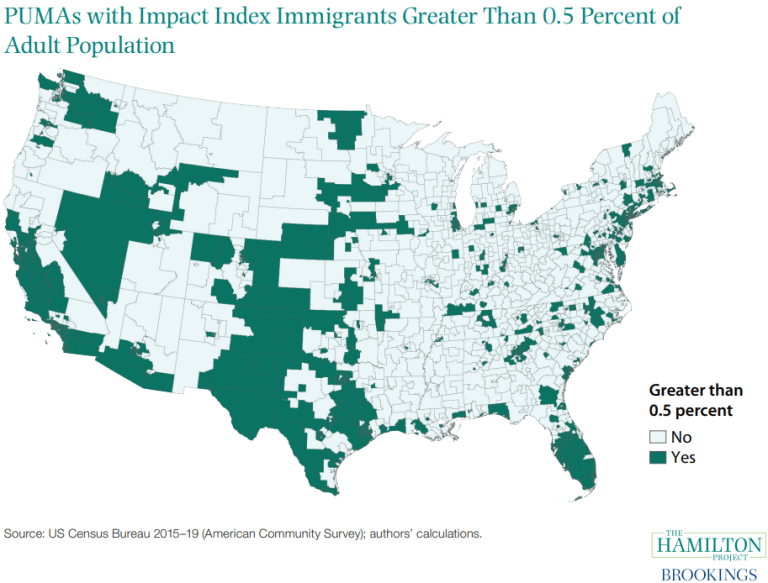
To ensure that the local communities affected by federal immigration policy receive more of immigration’s fiscal benefits, the authors propose to redistribute some of the fiscal gains of immigration to defray the immediate net fiscal costs that arise from welcoming newly arrived, less-educated immigrants. This proposal creates a method for determining the communities that qualify for funds, the Immigration Impact Index, and justifies an evidence-based dollar value per immigrant ($2,500) to be remitted to Immigration Impact Index communities by the federal government. These funds would visibly and transparently flow through education- and health-based federal funding channels: namely Impact Aid (education) and Federally Qualified Health Centers (health).

Figure showing PUMAs with Impact Immigration Immigrants Greater than 0.5% of Population

Source: A more equitable distribution of the positive fiscal benefits of immigration

Macron looks to crack down on illegal immigration with new law

The ongoing debates and responding to pressures from the right:

Macron’s centrist government unveiled the outlines of a new draft immigration law on Tuesday that will be debated formally in parliament in early 2023.

It comes just four years after a 2018 law with similar objectives, passed during Macron’s first term in office, which also aimed to take the heat out of an explosive political issue.

“It’s about integrating better and expelling better,” Macron’s hardline interior minister, Gerald Darmanin, told France Info radio on Tuesday of the new proposals.

“We want those people who work, not those who rob.”

Prime Minister Elisabeth Borne opened the debate in France’s National Assembly by saying the law would allow France to “say who we want”’ and “who we don’t want” to allow permanent entry into France. “Zero immigration is neither desirable nor possible, and it’s no more realistic than unregulated immigration,” she said.

Darmanin and Macron have linked immigration to delinquency in recent weeks, with both saying that around half of petty crimes committed in Paris are by foreigners.

Speaking to the Parisien newspaper at the weekend, Macron pitched the new legislation as a means of addressing the historic rise of the far-right National Rally, which in June became the biggest opposition party in parliament.

“We need a policy that is firm and humane in line with our values,” the 44-year-old said. “It’s the best antidote to the extremes which feed off anxieties.”

Figures from the interior ministry show that France currently expels around 10 percent of migrants who have been ordered to leave the country and the rate has never been higher than 20 percent.

‘Nothing will change’

The country’s lengthy legal appeals process, procedural delays and a lack of state resources are seen as reasons for the low expulsion rate, which Darmanin has pledged to increase.

Like many European countries, France struggles to persuade countries in North and West Africa to re-admit their citizens once they are subject to an expulsion order.

French far-right leader Marine Le Pen, who scored 41 percent in the second round of April’s presidential election, regularly accuses the government of laxity and “submerging” France with foreigners.

In her third bid for the presidency this year, she proposed changing the constitution via a referendum to set strict immigration targets and ensure French people get priority over foreigners for all state services.

“I don’t expect anything (from the new law),” she said on Tuesday. “They will talk to us again about balancing firmness and humanity. We’ve heard that for decades.

“Nothing will change… immigration in our country is completely out of control.”

A gruesome murder of a 12-year-old schoolgirl in Paris in October caused a major political scandal after it emerged that her killer was an Algerian woman who had been ordered to leave the country.

The chaotic management of 234 migrants and asylum seekers who landed in France in November aboard the charity rescue ship Ocean Viking has also embarrassed the government.

Although the interior ministry initially said most of the adults had been refused entry to France, only a handful were detained after they lodged asylum claims and court appeals.

Legal migration route

The new draft legislation, which Darmanin has co-written, would reduce the number of appeals possible for failed asylum seekers from 12 to three and in theory speed up expulsion procedures.

It would also remove safeguards for foreigners who arrived in France as children, making it easier to expel them if they are convicted of crimes — a measure designed to tackle teenage delinquents.

And there will be measures to offer work permits to foreign workers with skills required in particular sectors of the economy, which could include the many employed illegally in the restaurant sector.

Macron’s MPs are a minority in parliament, meaning the bill will need support from the rightwing opposition Republicans party, which has criticised the proposals as too weak.

“There’s a red line in what we know about this bill which is the massive regularisation of illegal workers in short-staffed sectors,” senior MP Pierre-Henri Dumont told reporters.

France has passed 29 different laws on immigration since 1980.

People from 15 different charities and some left-wing MPs demonstrated in front of the national assembly on Tuesday to denounce what they termed the “hostile” attitude of the government to migration.

Nearly eight in 10 French people think Macron’s governments have failed to control immigration, according to a poll by the CSA survey group published by the CNews channel last month.

Around seven in 10 think there are too many foreigners in France, multiple polls this year have shown.

Source: Macron looks to crack down on illegal immigration with new law

Khan: Soccer is truly the beautiful game, unless you are a French Muslim woman who wears a hijab

Good reminder:

Thus far, the FIFA World Cup has not disappointed. Electrifying plays on the field, compelling storylines from Lionel Messi, Cristiano Ronaldo and Robert Lewandowski, and the festive, colourful fandom in the stands. It’s called the beautiful game for a reason. Soccer has a simple, universal appeal – all you need is a ball, a couple of teammates, and voilà, the dreams are yours to make.

Except if you are a Muslim woman in France who wears a hijab. According to a decree by the French Football Federation (FFF), anyone playing, coaching or officiating on a French football pitch is banned from wearing religious symbols. For all the focus in World Cup media coverage on Qatar’s policies towards migrant workers, women and the LGBTQ community, hardly anyone has made a peep about how a soccer powerhouse – France – bars Muslim women from participating in the sport simply for wearing a hijab.

France has a tortuous history of harmonizing its growing Muslim population and its official policy of secularity, or laicité. Suffice it to say that the hijab has never been welcomed in the land of liberté, égalité et fraternité. After a 2004 ban on wearing “conspicuous religious symbols,” including the hijab, in French public schools came into effect, the niqab was also banned in public spaces in 2010. Curiously, while mask mandates were implemented in France throughout the pandemic, niqabs were still subject to fines.

The FFF’s rule runs contrary to official FIFA policy, which lifted its own hijab ban in 2014. The policy has had a painful impact on many aspiring French Muslim female soccer players, who have faced a choice between the sport they love and their faith. Some have grown up in the same Paris banlieues that produced Kylian Mbappé, Paul Pogba and N’Golo Kanté. During childhood, some of these young female players faced opposition from their own conservative families, who deemed soccer too masculine. As they thrived at sport-intensive programs and club tryouts, the families gave in – only to have the FFF turn their daughters away from the pitch because of their hijabs.

Yet the FFF could not kill the spirits of these remarkable young women, or their love of the game. In response to being excluded by the FFF, Les Hijabeuses, a collective of French female Muslim soccer players, was formed in 2020 with the aim of ensuring that all women can play the sport they love. Co-president Founé Diawararecalled feeling angry and excluded when being told to leave the pitch for wearing her hijab at the age of 15: “I was trapped between my passion [for football] and something that is a huge part of my identity. It’s like they tried to tell me that I had to choose between the two,” she told The Guardian in 2021.

Les Hijabeuses have used their strong social media following to rally against the FFF’s ban. They’ve launched petitions, gathered support from the broader sports community (including Nike), and organized soccer matches outside the French Senate building as a form of protest. The members and their allies play soccer together, connect with other French teams and provide training sessions to encourage other young Muslim women to get into the sport. It is a refuge, providing a safe space for Muslims to be who they are, while playing the sport they love. They have even lobbied the FFF to overturn the ban, and are now taking them to court. Earlier this year, the French Senate tried, unsuccessfully, to codify the FFF ban into law, arguing that the hijab was a means to spread radical Islam to sports clubs. Senator Stéphane Piednoir, a ban supporter, told The New York Times that he has yet to speak with a hijab-clad athlete, comparing such an encounter to a “firefighter” listening “to pyromaniacs.”

The ban is even more galling given that France is the only European country that excludes hijabis from playing in most competitive domestic sports, while foreign players with hijabs will be allowed to compete in the 2024 Paris Olympics. Why is France denying Olympic opportunities for its own hijab-clad athletes?

More importantly, why has the rest of the world been silent on this issue in recent weeks, especially during coverage of the World Cup? International media should be shining a spotlight on the FFF’s exclusionary policies. National soccer federations (including Canada Soccer) should be mounting a united stand against the FFF’s overt discrimination through boycotts and other measures. FIFA should sanction the FFF for violating official FIFA policy.

I have played soccer almost my entire life. I am an accredited soccer coach. But because I wear a hijab, I can’t play, coach or officiate on a soccer pitch in France. In Qatar, no problem. Let that sink in.

Sheema Khan is the author of Of Hockey and Hijab: Reflections of a Canadian Muslim Woman.

Source: Soccer is truly the beautiful game, unless you are a French Muslim woman who wears a hijab