DiManno: Halton school board’s failure to deal with prosthetic-breasts controversy makes a mockery of equity

Good test for reasonable accommodation. IMO, fails the test given health and safety concerns (they teach shop):

The biggest breasts on record belong to one Annie Hawkins-Turner, from Atlanta, measuring 70 inches across and weighing 65 pounds each. Size 102 ZZZ.

But an allegedly transgender Halton teacher is giving Hawkins-Turner a good run for her tatas.

Of course Hawkins-Turner’s bosom was a naturally occurring endowment. The medical condition is called gigantomastia — a rare phenomenon that causes breasts to grow excessively large. Kayla Lemieux, an industrial arts instructor who apparently began identifying as female last year, showed up at school this term with oversized knockers, prosthetics that sag below her waistline, with protruding nipples the size of your knuckles. These features have been accentuated by tight-clinging sweaters.

Students were shocked, although presumably they’ve since grown accustomed to their teacher’s dimensions. Parents, upon learning of the situation — from clandestinely recorded videos that exploded on social media in September, making headlines around the world — protested in front of Oakville Trafalgar High School and complained to the Halton District School Board. I doubt whether any, or many, would be objecting to Lemieux’s gender transition. Gender identity and gender expression are protected grounds under the Ontario Human Rights Code.

That’s not the point. And frankly I don’t know the point that Lemieux seems to be making, unless this is all a bollixed misreported story driven by right wing media and reactionary organizations. If this is how she wishes to present herself to the world, so be it. Although I do wonder if such large breasts are a safety hazard whilst teaching shop.

A reasonable conclusion would be that Lemieux, for reasons known only to her, is making an exhibitionistic and provocative spectacle of herself. That too might be entirely within her rights. You might recall that women in Ontario won the right to go topless way back in 1996, a legal fight that went all the way to the Court of Appeal. The appellant, who’d been convicted by a lower court judge of committing an indecent act — she’d removed her top on a sweltering summer day — had argued against the double-standard that permitted men to go topless but not women. At rallies across the province, women came out to decry the original charge, and part of that movement was aimed at desexualizing female breasts. They’re not always, certainly not exclusively, about sexual arousal — despite what you might think, walking into any strip club.

The Halton school board was singularly incapable of resolving the controversy and, in September, passed a motion asking director of education, Curtis Ennis, about the feasibility of introducing a dress code for teachers. Education Minister Stephen Lecce also asked the Ontario College of Teachers to review professional conduct for teachers, arising from Lemieux’s pendulous udders.

Last week, after a report was presented to trustees, the board claimed it couldn’t implement a teacher dress code, although students are routinely subjected to restrictions.

I’ve read the report, signed by Ennis and Sari Taha, superintendent of human resources at the board. It makes no direct reference to a specific teacher or concern, as if the whole tizzy sprang out of nowhere. Instead, it pivots on the broader issue of a non-discriminatory dress code, its permissibility. Since the parameters of the report don’t address the elephant in the classroom, it’s impossible to speculate whether any such dress code would prohibit exceedingly humongous prostheses.

Upshot: Any dress code for teachers — which clearly was a roundabout way of getting to Lemieux’s dramatically emphasized breasts/nipples — would purportedly expose the board to “considerable liability” for violating the human rights code. Read: lawsuit. Further — and this sounds very much like gilding the liability lily — new rules can’t even be considered at this moment because of ongoing collective bargaining with teacher unions.

The Ontario Labour Relations Act imposes a “statutory freeze” during periods when there is no governing collective agreement, prohibiting employers from altering working conditions during negotiations.

Saturated in diversity and inclusion buzz phrases, the report, abysmally written — bureaucracies are averse to plain-speak — leans heavily into the province’s human rights code. Did they not take a close read of the Commission’s policies on workplace dress codes? Workers in Ontario, and everywhere else, are commonly held to dress code provisos — from restaurant employees to lawyers appearing robed in court to airline crews to health care staff wearing scrubs.

Some places — Hooter’s for instance — compel female employees to wear skimpy butt-cheek exposing outfits and hosiery. It is this kind of wardrobe to which the OHRC draws disapproving attention. “Some Ontario employers require female employees to dress in a sexualized or gender-specific way at work, such as expecting women to wear high heels, short skirts, tight clothing or low-cut tops,” the Commission states on its webpage. “These kinds of dress codes reinforce stereotypical and sexist notions about how women should look and may violate Ontario’s Human Rights Code … They contribute to an unwelcome and discriminatory employment environment for women.”

On the issue of preventing discrimination because of gender identity and gender expression, specifically addressing the trans community: “Dress code policies should be inclusive and flexible. They should not prevent trans people and others from dressing according to their expressed gender.”

Which it seems the Halton board wasn’t pursuing. Lemieux is completely free to dress in a dress, to use the personal pronoun of her choice, and to have her dignity respected.

But this situation is the inverse of what the Commission is promoting by calling out “stereotypical and sexist” dress codes or in any way interfering with trans rights to dress according to their expressed gender. What the Commission doesn’t address, far as I can tell and probably because they never saw it coming, is whether that respect should extend to in-your-face breast prostheses, which wouldn’t necessarily apply only to trans individuals.

Now, I understand the Halton board’s leeriness in taking a dress code risk that could result in a costly human rights wrangle. I’m dubious, however, that directing a teacher to knock off the buxom exhibitionism violates anybody’s human rights.

From the report: “To the extent that workplace policies mandate that employees dress in a particular manner, it is important for those policies to be gender neutral in their application, and that they impose similar dress standards and requirements for all employees, regardless of gender.”

What, pray tell, would be the cisgender, gay, lesbian or trans yin to Lemieux’s extravagant prosthesis yang?

It makes no rational sense. It is folly.

But, it does makes a mockery of equity.

Source: Halton school board’s failure to deal with prosthetic-breasts controversy makes a mockery of equity

Switzerland migrant children demand immigration policy apology

Of note:

Children of migrants who came to work in Switzerland over decades are demanding an apology for a policy they say destroyed families and left many traumatised.

From the 1950s right up until the 1990s, hundreds of thousands of workers – first from Italy, then from Spain, Portugal, and what was then Yugoslavia – made the journey to Switzerland.

They worked in factories, on roads and building sites, in restaurants and hotels. Switzerland’s highly successful economy, its good infrastructure, is without doubt due in part to them.

But there were flaws in the system. The migrants were given nine- or 12-month permits; many lived in barracks, their only function in Switzerland was to work.

And family members – including young children – were not allowed. A husband and wife could work together in Switzerland, but, the work permits stipulated, their children had to stay at home.

Forbidden children

Egidio Stigliano, now in his 60s, remembers being taken at the age of three by his grandmother to wave to a train leaving Italy to Switzerland.

“I didn’t know my mother was on the train,” he remembers. “They thought I was too young to be told what was happening. But my mother wanted to see me one last time.”

The system might have worked if the migrant workers had really been temporary. But their permits were renewed year after year, and some spent their entire lives working in Switzerland.

Melinda Nadj Obonji was just a year old when she and her older brother were left with their grandmother in Vojvodina in Serbia. Despite their “no children” seasonal work permits, Melinda’s parents hoped that, once settled in Switzerland, they would be allowed to send for their children.

“They wrote letters to the immigration police, but they were rejected, [the police] were very strict. I think this traumatised them for life, and also us kids of course.” Melinda now believes the migrant worker laws “really destroyed our family”.

Many might ask why parents desperate to be reunited with their children did not simply go home. But, as is so often the case with migrant workers, the money they earned abroad kept poverty at bay at home.

In Italy, Portugal, or Kosovo, families and even entire villages came to be dependent on the money sent from Switzerland. Meanwhile Switzerland’s economy boomed on the back of foreign labour.

Kristina Schulz, a historian and specialist in migration at Neuchatel University, points out that, in the aftermath of World War Two, the Swiss system of recruiting workers from neighbouring countries was viewed very positively.

“Those other countries were war-torn… and Switzerland needed workers. Southern Italy was poor… it was thought it was practically a humanitarian act to have them work here.”

But many parents, among them Egidio Stigliano’s, could not bear to be parted from their children. They developed secret strategies for coping with the immigration restrictions. Instead of pleading with the authorities to let their children in, they smuggled them in anyway and kept them hidden.

Egidio arrived when he was seven. “From the first moment in Switzerland I hid,” he says. “My dad couldn’t explain the immigration policy to a child, so he just said, don’t let anyone see you, just stay hidden and play in the woods. So that’s what I did.”

Staying hidden meant not going to school. It meant, when Egidio broke his arm, having to find a doctor who would keep quiet rather than go straight to hospital. But one day, in the woods, Egidio came across another group of children, and could not resist joining in their games.

That evening the police were at the door, telling his parents the child would have to leave. Only the intervention of Egidio’s father’s boss, who agreed to sponsor him, allowed him to stay.

By the 1970s, it is estimated there were thousands of hidden children in Switzerland. Today, in the history museum of the Swiss watchmaking town La Chaux de Fonds, there is an exhibition showing what their lives were like.

Some mothers admit that they locked their children in their apartments during the day, in order to ensure no one saw them. The children were allowed out to play at night. Many families lived in tiny studios because, the exhibition explains, having a bigger apartment more suited to a family would have aroused suspicion.

“It’s hard to imagine children locked at home, living alone, no school,” says museum director Francesco Garufo. “And it’s recent history… it’s just yesterday.”

Historian Kristina Schulz finds the children’s stories all the more shocking given Switzerland’s devotion to family life after the war.

“This was the new ideology in Switzerland… the idea of the holy family that needed to be protected, women couldn’t vote in Switzerland until 1971, they weren’t meant to work, they were at home with the children. So the idea of systematically destroying the families of migrant workers is really astonishing.”

Family protests

Gradually, Switzerland’s strategy began to be undermined. Migrant workers protested, local police and teachers turned a blind eye to the “illegal” children in their communities, some villages even set up underground schools for migrant children.

The famous Swiss author Max Frisch joined the debate, writing “we wanted workers, but we got people instead”.

Children, among them Melinda and Egidio, began to join their parents. Melinda, who was reunited with her parents when she was five, is now a writer and musician in Zurich, Egidio a neuro educator in St Gallen.

In some ways, they count themselves among the luckier ones: after pressure from Rome, the children of Italian migrants were allowed in once their parents had worked more than five years in Switzerland. Melinda’s parents finally found a sympathetic Swiss bureaucrat and got permission to bring their children.

But while it was sometimes applied arbitrarily, the law banning children remained, and many families remained divided for decades.

The seasonal work permit was finally abolished in 2002, when Switzerland agreed to join the EU’s free movement of people policy. Today, the children of the migrant workers are adults, and many, including Melinda and Egidio, have formed a group demanding at least an acknowledgement of what they went through.

“First, I’d like an apology from the Swiss state,” says Melinda.

“I want the story of migrant workers to be in Swiss history books, because thousands of families suffered,” adds Egidio.

An honest reassessment of history, and an apology, could be likely. Switzerland has already done this over its World War Two policy of turning away Jewish refugees, and over the way it removed children from single mothers or socially “problematic” families and sent them to work on farms – where they were often abused.

Financial compensation has also been mentioned, but for Egidio recognition is more important. “The time I could have spent with my family, at school, I can’t get back. There’s no compensation for that.”

The reappraisal of history has already begun, in a research project by Kristina Schulz at Neuchatel University, and at the museum in La Chaux de Fonds.

But for museum director Francesco Garufo, it is about more than facing up to Switzerland’s past. He thinks, as Europe continues its often negative debate over immigration, that lessons could be learned for the future.

“In a rich country, having thousands of children hidden, without social rights, it’s not the model we want today in Europe. So we have to think about this kind of migration choice.

Source: Switzerland migrant children demand immigration policy apology

New data shows big boost in hiring at Canada’s immigration department. ‘What were they doing?’

My sense, given under attention to processing efficiencies, automation and AI, is that IRCC had little alternative but to hire more staff. Whether or not there IT modernization initiative, a longer term project, and other initiatives such as more online applications and tracking, will allow IRCC to wean itself from the “just throw bodies” remains to be seen.

And of course, the government is unwilling to revise its targets downwards to align with its capacity:

Only eight months into 2022, Canada already received almost as many permanent and temporary resident applications it did in 2019 before the pandemic.

After a two-year slump, the engine of the country’s immigration system is running above its capacity in 2019 by 45 per cent and the number of permanent and temporary residence applicants processed through the system is bound to exceed the 3.2 million recorded in the pre-COVID year.

According to never-before-published data, Immigration, Refugees and Citizenship Canada currently has 8,104 front-line operations staff, up from 5,583 in March 2019 — with the bulk of the extra work force added since the beginning of 2022. That is despite the number of staff on leave having crept up from 559 in March 2019 to 733 in October.

Those employees who continued to telework have also come down from almost 100 per cent at the beginning of the pandemic to 71.8 per cent last month.

“More people can do more files,” immigration lawyer and policy analyst Richard Kurland told the Star. “Combined with the artificial intelligence decision making system, it should result in greater volumes of decisions.

“You’re having the A.I. do the heavy lifting. You have more humans to take care of files that need that human touch now on track, and they’re on the right path.”

But there are also numbers that immigration officials would rather see in check:

  • Web forms, a main mechanism for applicants to communicate with the department, rose from 1.61 million in 2020 to 2.26 million in 2021 and 2.42 million as of September this year;
  • Access-to-information requests, another key tool for inquiries, spiked from 98,042 pre-pandemic to 204,549 in 2021, before declining to 122,016 to date this year;
  • The number of lawsuits against the immigration department for a court order to compel officials to process a file rocketed from 112 cases in 2019 to 963 in 2022.

Not all critics are convinced the immigration system is back on track.

“Why do we have 45 per cent more people processing applications yet still have these backlogs?” said Vancouver immigration lawyer Steven Meurrens. “I’m curious as to why it feels like processing times just keep getting worse in numerous programs and certain visa offices. I don’t understand.

“Is it glitches with new tech? Are there IT issues at certain visa posts? Are there tech issues with working from home? It’s hard just to know what’s going on from the data because the ‘why’ is missing and the department won’t say.”

Ravi Jain of the Canadian Immigration Lawyers Association says the ramped-up staffing levels at the department did not jive with the “massive slowdown” in people’s experience with the immigration system. He would like to see a royal commission report into the immigration delays and backlogs.

“What were they doing? I don’t think they were doing much,” said Jain. “They can’t get away with this. It just feels criminal to me because it’s affecting people in so many different ways.”

As of Aug. 31, Canada received more than 2.9 million new permanent and temporary resident applications through the major immigration programs. With four months remaining in 2022, those numbers are certain to push the total above the 3.2 million files in 2019.

Over the time period, immigration officials processed 2.25 million immigration applications — 207,590 permanent and 2.04 million temporary residents, compared to the total of 3,225,130 (235,257 permanent and 2.99 million temporary residents) recorded in 2019.

Source: New data shows big boost in hiring at Canada’s immigration department. ‘What were they doing?’

USA: Religious groups with immigrant members grew fastest over past decade

Similar as in Canada as Douglas Todd has reported on:

A decennial study of U.S. religious life shows what many demographers and others have long known: Participation in congregational services has not kept up with overall population growth. However, religious groups drawing large numbers of immigrants have seen steady growth.

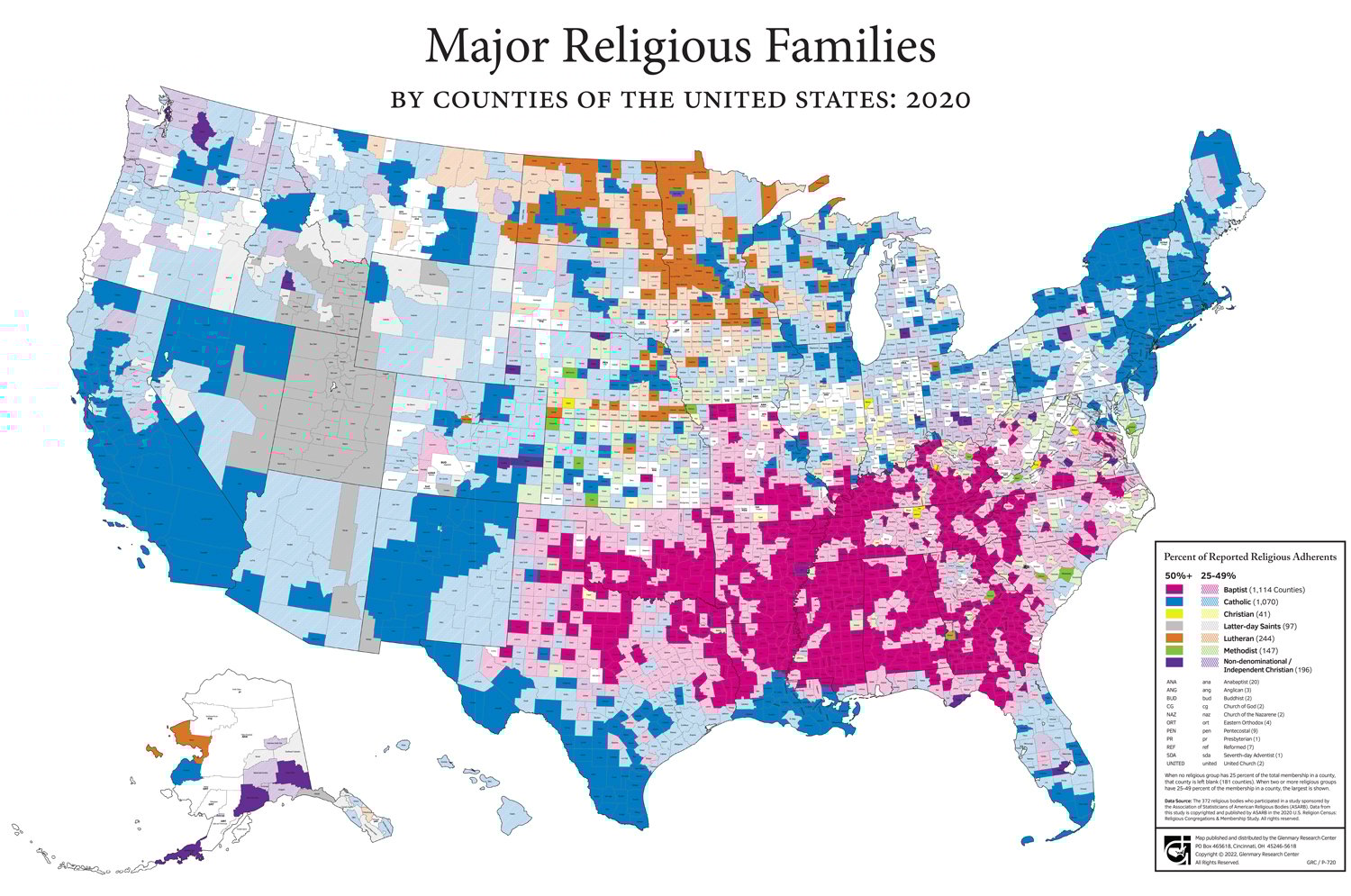
The U.S. Religion Census, conducted every 10 years by the Association of Statisticians of American Religious Bodies, concluded there were 356,739 religious congregations across the nation, and 161 million adherents, including children, in 2020. (Adherents is the formula researchers used to count those with an affiliation to a congregation, including children and people who attend but may not belong.)

Unlike polling, which asks questions from a small sample of the population and extrapolates to the general population, the religion census gathers information from denominations and other religious bodies and maps out the number of congregations and adherents on a county-wide basis. In the 2020 study, researchers collected data from 372 religious bodies, mostly denominations, but also 44,000 independent nondenominational churches. The count included synagogues, mosques and temples of Jewish, Muslim, Buddhist, Hindu, Sikh and Jain traditions

Courtesy Chart

Courtesy Chart

The study finds that the Catholic Church in the U.S. is the largest religious body, with 61 million adherents in more than 19,000 churches, comprising close to 19% of the U.S. population. That’s a modest growth of 2 million adherents from 2010, when the church had nearly 59 million adherents.

Sociologist who worked on the census said growth is almost entirely made up of Hispanic immigrants.

“If you took away the Hispanic population in the Catholic Church, it would look as bad as mainline denominations,” said Scott Thumma, director of the Hartford Institute for Religion Research, who counted independent churches for the census. (Mainline denominations, such as Episcopalian, Lutheran and Presbyterian, have been declining for more than 50 years.)

Perhaps the most striking growth was among Muslims. The number of Muslims who participate in mosque prayer increased from 2.6 million in 2010 to 4.5 million in 2020, a 75% increase. (Pew Research estimates there were 3.85 million Muslims in the U.S. in 2020, but those numbers do not include children.)

That growth is due mainly to immigration, said Ihsan Bagby, associate professor of Islamic Studies at the University of Kentucky, who collected the data for Muslims. Higher birth rates may be a secondary reason.

Bagby estimated the number of U.S. mosques at 2,771, a jump of 871 mosques in just a decade.

He suggested Muslims may be in a kind of golden age in the U.S. They are younger than the American population overall, and the Boomers among them are financially well off and able to contribute to the construction of new mosques. (First-generation mosques were often in retrofitted churches or warehouses.)

Mosques, Bagby said, “have mellowed and matured and become more moderate in their understanding of Islam and that has also been an attraction,” he said. “Many Muslims who had kept away feel more comfortable coming.”

Courtesy Chart

Courtesy Chart

U.S. mosques, like those overseas, do not typically keep memberships. Bagby said he arrived at his estimates by asking for information on weekly Jumah prayers as well as holiday or Eid prayers. (Muslims make up about 2.8% of all religious adherents and about 1.3% of the total population, the study estimates.)

Much of the value of the census is its county-level aggregation, which corresponds to how researchers in other fields, such as population studies and public health, collect and analyze data, said Rich Houseal, secretary-treasurer of the sociological group that conducted the study.

Houseal said the data is also useful to businesses, too. Walmart, he said, has contacted him to help determine what books to stock in their stores based on the dominant religious group in a county.

Among other interesting data points in the study:

  • Southern Baptists have the most churches of any religious group: 51,379.

  • There are some 44,319 nondenominational churches, a jump of nearly 9,000 over 10 years ago, and about 9 million adherents. Still, overall, they account for only 13% of the total number of religious adherents in the U.S.
  • Southern Baptists and United Methodists each lost 2 million members from 2010 to 2020.

“Denominational brands have weakened, and divisions have increased over issues such as female clergy or sexual orientation, Thumma said. “This likely led some adherents to seek or even start new nondenominational churches.”

Source: Religious groups with immigrant members grew fastest over past decade

Tensions rise in Toronto’s Persian community as activists try to expose regime links in Canada

Of note. More coverage on regime links and immigration:

As the uprisings continue in Iran, tensions between supporters of the regime and those who aspire to revolution are being felt in the Iranian diaspora.

In Toronto, anti-regime activists have moved to expose government insiders who they say live with impunity in Canada.

“This man sent me, along with many other students, to prison,” said Ardeshir Zarezadeh, an Iranian-born Toronto lawyer, pointing to his computer screen.

On the website of his organization, the International Center for Human Rights, the photo of Morteza Talaei, the former police chief of Tehran and officer of the Islamic Revolutionary Guard Corps (IRGC), seen on a treadmill, in a gymnasium in Richmond Hill, Ont., in January.

Since the beginning of the uprising in Iran, Zarezadeh has called on members of the Iranian diaspora in Canada to send him information concerning relatives of the Iranian regime who visit or live in Canada in order to expose them on his website.

There is an expression in Iran that Canada is the regime’s paradise.— Mohammad Tajdolati, Iranian journalist based in Toronto

“We all know that many people affiliated with the Iranian regime live in Canada. They come and go.”

“They take advantage of life in Canada,” maintains the lawyer who spent nearly six years in Iranian prisons for his involvement in student movements.

For Mohammad Tajdolati, there is no doubt that the presence of supporters of the Iranian regime in Canada has exacerbated tensions within the Iranian diaspora since the beginning of the uprising.

“There is an expression in Iran that Canada is the regime’s paradise,” says the Iranian journalist based in Toronto.

The activist claims to have contacted the federal government on several occasions in recent years to denounce the presence of relatives of the regime on Canadian territory, without concrete measures being taken by Ottawa.

“They tell us, ‘We know, we’re watching them,’ but that’s not enough. […] That is why we are taking matters into our own hands,” he said.

On Oct. 29, in a long-awaited speech by the diaspora, Prime Minister Justin Trudeau promised to maintain sanctions against the Iranian regime and its leaders. A promise received with skepticism by Zarezadeh.

You can’t do much legally, but by identifying them and exposing them, you can make people cut ties with them, or with their business.– Marjan

“We know that there are people today in Canada who have benefited from this horrible and corrupt regime and who are hiding in the middle of the community enjoying the opportunities that Canada offers. They are using the wealth they stole from the Iranians. We say: enough is enough,” Trudeau said.

He is not the only one. It was this same frustration that prompted Marjan* (her name has been changed) to begin investigating Iranian regime supporters in Canada. The young Torontonian left Iran to escape repression.

Radio-Canada granted her anonymity, because she fears reprisals against her or her family who still lives in Iran.

After arriving in Canada, she says she kept her distance from her home community. The uprising in Iran, however, ignited a new flame within her. On the opiran.toronto Instagram account, she now speaks out against government insiders whose families she says live freely in Canada.

“When I see these people here, it’s like post-traumatic stress disorder for me. I see them near my home, in the street, I see their children playing freely when I did not have this luxury in my country,” she said.

“You can’t do much legally, but by identifying them and exposing them, you can make people cut ties with them, or with their business.”

Even if he understands the anger of his compatriots, Tajdolti is worried about the abuses that some of their actions could cause, such as the denunciation of individuals online. “You have to be very careful because we live in a country of law. You can’t accuse someone very easily,” he warns.

Zarezadeh says he is aware of the risk of defamation. “We make sure that the information we publish is true,” he said, assuring that he will continue his fight.

Exacerbated tensions, broken wall of fear

Beyond online denunciations, tensions are also crystallizing in the community. In “Little Tehran,” a neighborhood located north of Toronto and which owes its name to its large population of Iranians, certain incidents have multiplied since the beginning of the uprising.

Opposite the famous Plaza Irania, in the heart of the Iranian quarter, a butcher shop has been the target of online vandalism and intimidation by netizens accusing it of having links with the Iranian regime.

Graffiti in Farsi saying “death to the mullahs,” for example, was painted on the walls of the Imam Mahdi Islamic Centre in Thornhill, north of Toronto. The mosque was quick to refute any political allegiance.

Both the butcher shop and the mosque declined our offer to comment on the matter.

In front of the same mosque, however, signs with the portrait of the young Mahsa Amini, whose death was the spark of the movement, have been removed, according to a video widely shared on the WhatsApp network. And still in the same place, a motorist tried to rush into anti-regime demonstrators before fleeing and being arrested by the police.

York Regional Police, which serves the territory, says it is not concerned about a possible increase in hateful acts related to the situation in Iran. However, the police say they are aware of the divisions that exist within the Iranian community in the Greater Toronto Area.

According to Tajdolati, tensions have always been underlying in the community, with supporters of the two ideologies living together. What changes this time is that fear has changed sides, according to the journalist.

“The people you see on the streets now, before, they didn’t come to demonstrations because they were afraid,” he said, explaining that being photographed at an event like this could make it difficult afterward to travel to Iran or could make things difficult for their families back home.

“Now, he continues, the situation is so atrocious in Iran, it is so brutal, so inhuman, that these people say to themselves, ‘No, that is enough. I want to participate, I want to do my duty as a human being, as an Iranian.”

“The wall of fear has broken down.”

Source: Tensions rise in Toronto’s Persian community as activists try to expose regime links in Canada

Akshay Kumar clarifies the status about his citizenship and Indian passport: “Having a Canadian passport does not mean I am not less of an Indian”

Instrumental citizenship. “Not less of an Indian” but his phrasing suggests he considers himself less of a Canadian:

Bollywood actor Akshay Kumar, who holds a Canadian passport and often gets trolled on social media for the same, recently clarified the status about his citizenship.

At the Hindustan Times Leadership Summit 2019, the actor addressed the trolling and shared an update on his Indian citizenship and said, “Having a Canadian passport does not mean I am not less of an Indian. I am very much Indian. I have been here since last nine years when I got the passport. And I don’t want to get into the reason of why, what happened, my films were not working, blah blah blah, chalo woh theek hai.”

“Yes, I had said it in 2019, I applied for it,” he added. “Then the pandemic happened and everything shut down for 2-2.5 years. My renounce letter is here and very soon my whole passport will be coming.” When said that he does intend to do it anyway, he said, “What do I do. I didn’t bring the pandemic.” Previously at the Hindustan Times Leadership Summit 2019, Akshay had shared that he is in the process of applying for an Indian passport.

The same year, Akshay also took to Twitter addressing the online fuss about his Canadian citizenship. “I really don’t understand the unwarranted interest and negativity about my citizenship,” he tweeted at the time. “I have never hidden or denied that I hold a Canadian passport. It is also equally true that I have not visited Canada in the last seven years.”

“I work in India, and pay all my taxes in India,” he further wrote. While all these years, I have never needed to prove my love for India to anyone, I find it disappointing that my citizenship issue is constantly dragged into needless controversy, a matter that is personal, legal, non-political, and of no consequence to others. I would like to continue contributing in my small way to the causes that I believe in and make India stronger and stronger.”

Decline in Chinese student mobility: It’s only temporary

Overly optimistic IMO, and discounts the impact of the Chinese government policies that have driven down travel and study. Study permits to Chinese nationals have declined more than most other countries 2021 compared to 2018. The view of recruiters:

Against some gloomy future predictions about Chinese students’ outbound mobility, we forecast that Chinese students’ drive to study overseas will stay strong due to strong ‘push’ factors in China, including economic factors, a competitive system, the value placed on intercultural learning and, more importantly, the Chinese educational culture. The current drop in numbers is temporary, mainly due to concerns over COVID.

One important reason behind the gloomy predictions for Chinese educational mobility is the forecasted slow growth in the Chinese economy over the next decade, if not the possibility of an immediate bust. 

Geopolitical tensions and the trade war with the United States do not help. However, Chinese doomsayers have been around for a long time and they have been proven wrong so far. The Chinese system has shown itself to be resilient and adaptable, perhaps more so than the Western system. 

Of course, no country can grow its GDP at an annual rate of 10% forever, not even the Chinese, but even a small positive growth every year would be very good news for international education. 

Given the large base of the Chinese economy today, an ever-increasing middle class, all equipped with the habit of saving (by a minimum of 30% of household income) and an extended family network of grandparents, uncles and aunts all willing to chip in, there is continued stability in the push for Chinese students’ outbound mobility.

Education: A quintessential value

There has been a vast increase in higher education provision in the past two decades in China, turning the Chinese higher education system from an elitist one to a mass one. The current enrolment rate is over 50%. 

The quality has also been immensely improved, with huge national investment in a select pool of universities. More Chinese universities enter top league tables year on year and the research output from China has outnumbered that from the US since 2019. 

However, Chinese higher education has stayed very competitive for Chinese students.

One of the quintessential values in China revolves around education. Every parent dreams of the best possible educational situations for their young people, no matter the personal or financial costs.

Stories of the extremes students and families will endure, endeavouring to score well on their Gaokao (university entrance exam), are ubiquitous in Chinese education conversations. The reason behind the continuing pressure is that the tiered post-secondary system is vastly overwhelmed by student demand. Yearly, many talented students are unable to gain entry into the top tier of Chinese universities, who then have to ‘settle’ or ‘look elsewhere’.

Furthermore, less talented students still hold the same motivation for a university education from a highly reputable institution but can’t hope to compete with their peers at the top. For those who are better off, there are much easier options abroad. 

The flattening of demographic growth in China is often seen as a negative push factor, but those who suffer most from that are more likely to be Chinese universities at the national bottom tier rather than universities overseas.

Intercultural acumen

Of course, not all Chinese international students land in an Ivy League school, but let us consider what other attractive forms of learning accompany an education abroad opportunity.

A trade-off in international ranking can, in some part, be assuaged by the experience and competencies of an intercultural education. Sound judgement is a deeply entrenched Chinese cultural pillar and, as the world shrinks and businesses expand in fast-moving world markets, even a less developed sense of judgement says international experience is beneficial. 

Since 2001, the Chinese economy has been brought firmly into the world trade system and, despite the Chinese government’s call to lighten students’ academic burden, English is still a school subject that is perceived to be as important as Chinese and maths, and after-school tutorials still continue. 

The idea of mastering English as a world language through English-medium instruction overseas remains very attractive, even if an overseas university is not in the same league as Oxford or Harvard.

A little historical perspective

Even without such educational motivation, the Chinese population has always been an extremely mobile group, contributing to the early building and development of much of North America, still evident in the Chinatowns in every major city on the American continent. 

Even the Chinese ‘Head Tax’ in Canada and the ‘Chinese Exclusion’ legislation in US history did not stop their interest in migration. 

Many in the diasporic communities have ties to their ancestral country and, in doing so, contribute to the flow of information home regarding current opportunities and potential spaces to develop.

After all, China holds close to a quarter of the world’s population crowded onto less than 8% of the world’s arable land. As the Chinese saying goes: “A good opportunity is not to be missed.” 

The Chinese have always looked for better living, learning and work opportunities elsewhere and everywhere. We would really be witnessing a sudden turn in this major historical trend if Chinese students really stopped looking abroad!

The pandemic

The current dip in Chinese student numbers is almost an exclusive result of the pandemic, or the success of the Chinese discourse in dealing with it. The zero case target with strict dynamic lockdown measures has indeed helped China to avoid a big loss of lives during the earlier and more serious waves. 

But the rationale of protecting lives at the price of all else, well propagated among the Chinese population, can create a psychological fear about countries that have adopted more relaxed policies. 

This is shown by the sharp increase of applications to Hong Kong and other nearby regions. The current pandemic might need to further settle before Chinese students return in larger numbers again. This setback, seen from a longer perspective, is likely to be very temporary.

A final note

Chinese mobility when it comes to international education has played a vital role in post-secondary institutions worldwide for decades. Though the number of students may wax and wane, we can expect Chinese students in our classrooms for generations to come. 

The Chinese education-first culture, pursuing the best possible opportunities anywhere in the world, will remain stable. A Western degree, and the accompanying benefits of language and intercultural competences, will be considered desirable by Chinese students for a long time to come.

Gavin Palmer works at University of Alberta International, in charge of international student programming. E-mail: gpalmer@ualberta.ca. Wei Liu also works at University of Alberta International, Canada, mainly responsible for the Global Academic Leadership Development Program. E-mail: weidavid@ualberta.ca. 

Source: Decline in Chinese student mobility: It’s only temporary

2022 Annual Report on Immigration, 2023-25 Levels Plan: “The More the Merrier”

The annual report, looking back, and the levels plan, looking forward, are narrowly focused on immigration and largely silent on the impacts of increased immigration, beyond generalities on demographics and filling labour market needs. No real surprises as the government’s intentions had either been announced or signalled in advance for both permanent and temporary migration.

There is no discussion of the impacts on housing, healthcare, infrastructure, the environment among others.

Some of the more interesting articles on the report and plan are below.

There is no discussion of the impacts on housing, healthcare, infrastructure, the environment among others.

In general, the government gets a pass on these omissions from the opposition, provincial governments (save Quebec), the Century Initiative, business and other stakeholders, settlement organization and media coverage. The report and plan came out the same day as the latest Focus Canada survey, showing ongoing and increasing support for immigration.

Media commentaries that exemplify this include John Ibbitson: Immigrants are the great insulators against the worst economic and political threats we face and Andrew Phillips’ Record immigration is a yawn in Canada, and that’s a good thing.

An odd analysis argued that How Canada’s new immigration targets will help housing recover — and push prices higher long-term. Is the objective to help housing recover or to make housing more affordable? High immigration hampers affordability.

Others were positive but former Liberal Minister from the Chrétien years, Canada bucks global trend on increasing immigration targets,  flagged the government’s poor record in delivery with high backlogs.

The Globe did a good deep dive into temporary workers, How Canada became a hotbed for low-wage foreign labour, highlighted the misplaced changes that made it easier for businesses to hire low-wage labour, including by expanding the amount of time international students could work rather than study, a mockery of the education objectives.

More negative commentaries included Annan Khan’s Increasing our population intake will not address the cynicism guiding Canada’s immigration policy. True, but self-interested immigration policy that priorizes economic immigration has greater public support than more altruistic alternatives favouring refugees.alternative of rebalancing in favour of refugees.

Rupa Subramanya’s Come One, Come All cites a number of statistics that highlight relatively poor outcomes for recent immigrants and posits that high levels are at least in part driven by political motives given that Liberals have traditionally done well with immigrant origin voters. IMO, largely obsolete as the Conservatives under Harper did the hard work of engaging new Canadians, only to blow it with citizenship revocation and the “barbaric cultural practices” tip line.

Colby Cosh’s High on Immigration similarly picks up on Subramanya’s points on economic outcomes and argues that the net effect on housing prices employers who are over-represented by “old-stock” Canadians.

Andrew MacDougall’s focus on the politics, Liberals’ immigration policy could set a trap for Pierre Poilievre, highlights the risks that the Liberals are making immigration a wedge issue, a likely reason that successive Conservative immigration critics have focused their critiques on administrative issues (backlogs etc) and Roxham Road irregular arrivals.

My sense is that the Conservatives are well aware of the need to engage immigrant-origin and visible minority voters, given the large number of ridings with large numbers of these voters, plus his personal biography (e.g., marriage to a Venezuelan immigrant) mean that it will be hard to paint him as anti-immigration unless he or high profile candidates misstep.

Even the generally “Trudeau derangement syndrome” outlet “True” North’s reporting on the immigration levels plan has been neutral and factual. The Toronto Sun was favourable to the plan, EDITORIAL: Rolling out a careful welcome mat, but flagged infrastructure needs to ensure successful integration.

2022 State Of New American Citizenship Report

The USA also has program delivery problems:

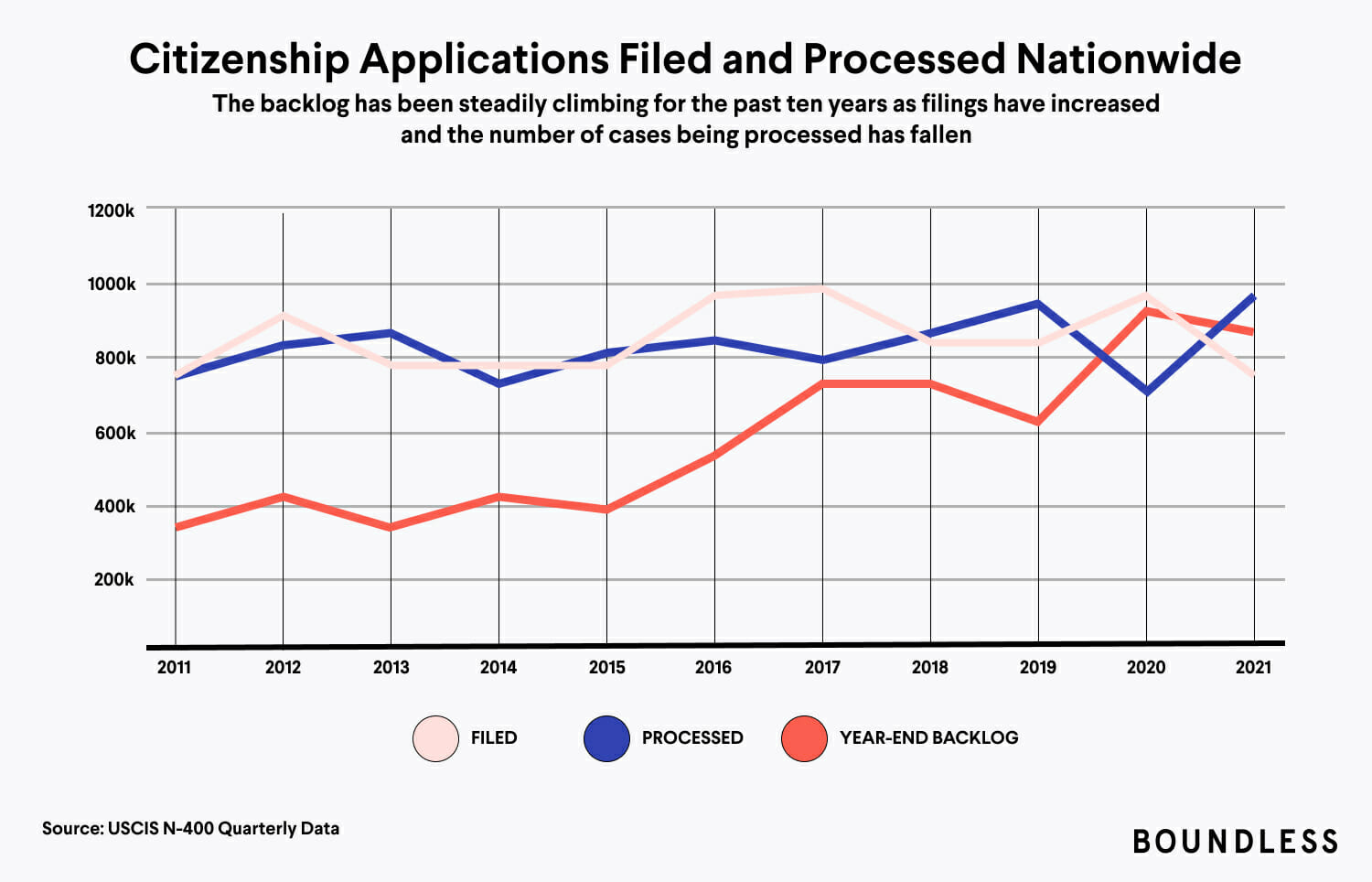
Surging BacklogCitizenship Application Filed Naationwide

A look at the past decade indicates a worrying trend.

Although application volume was expected to fall, the volume increased to almost 1.2 million applicants through the end of 2021, and although processing volume had begun to increase in 2019, the cessation of processing applications due to COVID-19 has led to a surge in the backlog of pending applications, with nearly 800,000 applications still pending by the end of 2021.

USCIS, the federal agency responsible for processing citizenship applications, has defended itself by noting that the backlog more than doubled during the Obama administration. This is true: the backlog rose from nearly 292,000 in September 2010 to over 636,000 by the time Donald Trump assumed office in January 2017.

But USCIS has also claimed that the surge in applications during 2016 and 2017 created a “record and unprecedented” workload. A look at the past 3 decades shows, however, that this is not true.

BACKLOGS IN CONTEXT

In 2007, citizenship applications surged to nearly 1.4 million, far higher than the recent uptick. This was driven in part by a looming 80% application fee hike that year, and an increase in newly eligible immigrants who had obtained their green cards 5 years earlier under the Legal Immigration Family Equity (LIFE) Act of 2000.

USCIS responded with a surge in processing volume the following year, and the backlog plunged to a 30-year low of about 257,000 in 2009.

In the mid-1990s, there was a truly “record and unprecedented” surge in citizenship applications, driven in part by a corresponding increase in newly eligible immigrants who had received green cards under the Immigration Reform and Control Act 1986 (IRCA, also known as the “Reagan Amnesty”). Between 1995 and 1998, application volume stayed well above 900,000, peaking at over 1.4 million in 1997. Although the backlog initially shot past 2 million in 1997-1998, USCIS responded with a comparable surge in processing volume that appears to have tamed the backlog by 1999-2000.

The data indicate that when USCIS devotes sufficient resources to a citizenship application surge, it is possible to dramatically reduce the backlog within one year. That’s what happened in 2000, 2007, and again in 2012.

On the other hand, when USCIS fails to devote sufficient resources, backlogs can get way out of hand. That’s what happened in the mid-1990s, and it appears to be happening again.

FALLING BEHIND

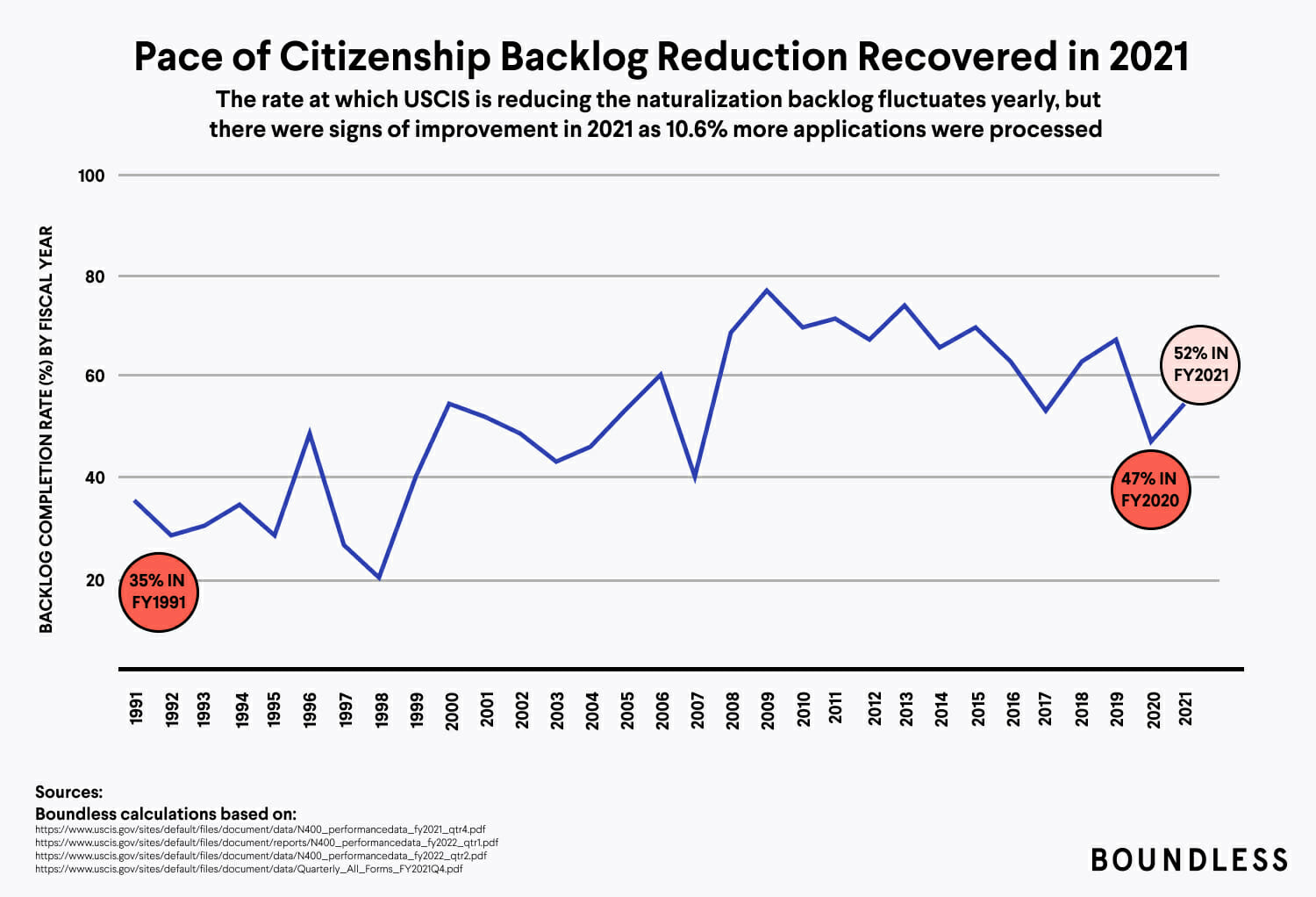
Pace of citizenship backlog reduction

Another way to evaluate this problem is to measure how efficiently USCIS beats back its backlogs. If USCIS processed every citizenship application it received in a given year, plus the applications that were pending from the previous year, that would yield a “backlog completion” rate of 100%.

In reality, USCIS achieved a backlog completion rate of 77% in 2009 — a 30-year high — and this number has been trending downward ever since. There was a 10-point drop in backlog completion between 2016 and 2017 (from 63% to 53%), but backlog completion crept back up to 67% in 2019 before falling drastically in 2020 to 47%, which was the lowest backlog completion rate since 2007 (39%).

By the end of fiscal year 2021, however, the rate at which USCIS was completing naturalization cases had recovered somewhat, to just under 52%. Unfortunately, comparing the fourth quarter of FY2021 with the first two quarters of FY2022, a trend is not immediately apparent: USCIS finished Q4 of 2021 with a backlog completion rate of 24%, but by the end of December 2021 it had dropped to 22% before recovering to 25% at the end of Q2 in March 2022. USCIS’s year-end data will reveal if the agency was able to maintain its improving overall pace of clearing the citizenship backlog.

SURGING WAIT TIMES

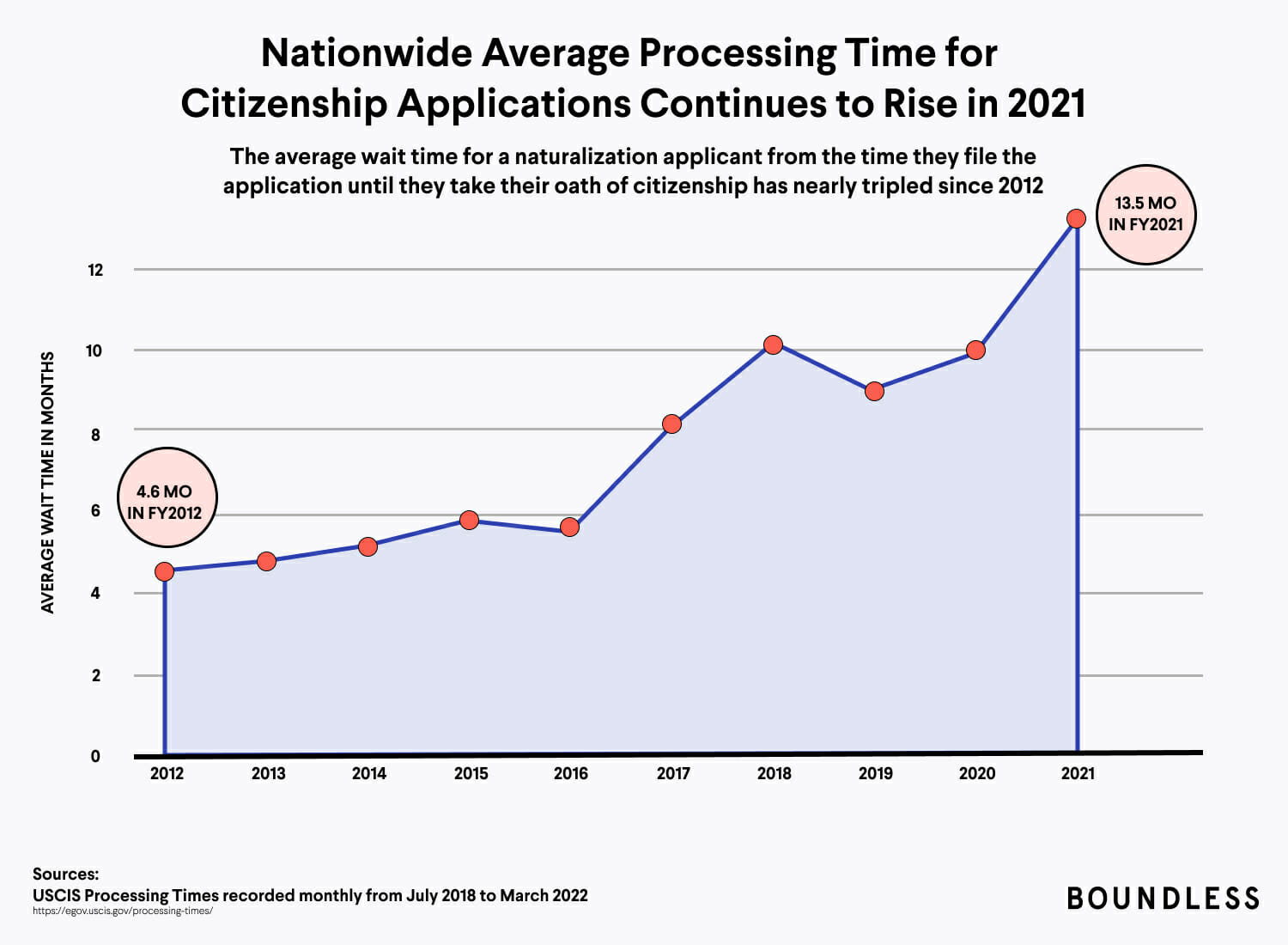
Processing times citizenship

Growing backlogs have direct and negative consequences for immigrants seeking to become U.S. citizens: They have to wait longer for their applications to be processed by the government.

Here the trend is unmistakable: Between 2012 and 2016, median application processing times hovered between about 4.5 to 6 months, before shooting past 8 months in 2017 and hovering at about 10 months in 2018 and 9 months in 2020. Compounding the worrisome trend, starting in March 2020 the coronavirus lockdown postponed the final steps for naturalization—interviews and oath ceremonies — until offices reopened in June 2020.

Source: 2022 State Of New American Citizenship Report

Wernick: Leaving the comfort zone: Difficult issues in public sector reform

Good diagnostique by former Clerk. If any of these were easy to resolve, they would have been addressed.

The one I am not sure of is the degree to which pay is an issue at senior levels. What does the data say about separations (departures) from the public service at the EX and DM levels? Is that really that much of an issue, particularly for the policy folks who are attracted by the influence they can have on policy? Do departures vary by level and department and, if so, what are the motivators? Money and/or others? I don’t believe it was money that attracted Barton or Sabia, to highlight two of the more prominent examples.

On classification, I remember the Universal Classification System attempt in the 1990s. A lot of work and effort that was abandoned and no doubt other former colleagues have similar scars or wasted time that went nowhere.

And yes, get rid of the bilingualism bonus although Francophone public servants will likely complain given their higher levels of effective bilingualism:

Much of the commentary on the public sector stays at the level of generalities. Exhortations to become more strategic, more inclusive, bolder in advice and better in delivery are impossible to contest. Too often, the discussion stops short of analyzing resistance or tradeoff among objectives. As in so many things, we are much better at diagnosis than agreeing on the remedies.

The list of issues in play these days for the federal public service is already daunting. As well, provincial, territorial and municipal governments have their own agendas. On top of the formal reviews of service delivery and spending launched earlier this year, an incomplete list would include: a new round of collective bargaining just as inflation has spiked; figuring out the post-pandemic workplace; replacing retirements and departures; fragile legacy IT systems; the reverberations of Black Lives Matter and Indigenous reconciliation; cybersecurity and foreign interference; and a trendline of eroding trust in public institutions.

What follows is a brief thought experiment. If the federal government took the advice – something that is unlikely in my view – to create some sort of royal commission or advisory panel on its public service, what are some of the more difficult or “wicked” questions – that would surface? We do not have to wait; we can start debating these issues now. There are more, but I set out just a few of the most uncomfortable ones here.

Insourcing, outsourcing and offloading 

The core question of what we should ask the public service to do for us usually comes up only in formal spending reviews, such as the Chretien government’s 1995 program review or the Harper government’s 2012 deficit reduction action plan. They sometimes provoke a re-examination of whether this area of responsibility should be done by public servants, rented from outside contractors, or offloaded to the private sector and civil society.

Sometimes, the federal government retreats from an area and leaves it to provincial and local governments. The mix has shifted and the federal public sector has waxed and waned. The truth is that there is no right answer and we will get an outcome heavily driven by the ideological and political preferences, and the view of federalism, of the government of the day. The point for public sector management is that you can drive for effectiveness or drive for spending cuts, but realistically you can’t do both well at the same time.

Dealing with poor performers 

An uncomfortable truth is that not every hire works out and not every employee or executive contributes as much as they should. Some are not effective and some actually drain energy and poison their workplaces. Many people are squeamish about discussing poor performers and toxic employees, and deny they exist in any significant numbers.

It is far too difficult to demote or terminate the small number of truly poor performers. An employee can use the multiple recourse processes to drag out proceedings for as much as two or three years. Instead of taking on the exhausting challenge, managers either do their best to work around them or sometimes try to fob them off on others with less than honest references. Colleagues see team members coast along as passengers without consequences and lose motivation.

The solution lies in changing the legal standard for dismissal to a lower bar than the current definition of “cause.” However, it is a wicked problem in practice because making it easier for managers to terminate employees may give some of them an instrument for bullying and harassment that may be wielded with bias. Striking the balance won’t be simple.

No longer letting middle managers do all the hiring

As long as I can remember people have lamented the slow pace of hiring, whether from outside the service or moving people within. The managers and the human resources community point fingers at each other. The uncomfortable truth is that not every middle manager or front-line supervisor is good at hiring – even the ones who struggle to find the time to wade through the huge pools of candidates. They default to looking for credentials and past experience because it is much more effort to assess future potential, but the tools for doing so aren’t very good.

The solution to slow staffing, and to recruiting more talent from outside, could lie in a more directive approach that gives much more authority to the human resource community or a central staffing agency to do the screening and proactively match candidates with vacancies. This is a really uncomfortable topic because the main bottleneck has been a cultural one – middle managers believe they should pick every person on their team, no matter how long it takes. Departments and agencies are culturally averse to shared hiring processes or relying on others. They are scared of false positives and believe they would do a better job. More leeway to remove poor performers could also be a key to faster hiring.

Which forms of inclusion matters more?

Bilingualism has been a cornerstone inclusion policy since 1968, a mindful strategy to ward off Quebec separatism by ensuring that the one-quarter of Canadians who are francophones see themselves in the federal government. The future of bilingualism is a wicked problem in the 2020s, not for externally facing services ­– which are now largely delivered on websites, apps and call centres – but for the workplace.

Requirements for a degree of proficiency in both of our official languages by supervisors and executives raise uncomfortable issues, including that they have come to be seen as a barrier for some racialized communities and for Indigenous peoples. Should the public service give in to pressure to loosen requirements for French-language proficiency in the pursuit of inclusion? Or would that marginalize francophones and harm recruitment, lead to a downward spiral in language capacity and erode national unity? The uncomfortable truth is that the subtle pressure to work in English is relentless unless the people convening and chairing meetings, asking for documents and performing basic supervision are mindful and proactive.

Even more baffling, why are we still paying bonuses to people who are bilingual instead of investing the same millions of dollars in language training for people who are not?

How flat can you go? How thin is too thin? 

One of the common criticisms of the federal public service is that there are too many managers in too many layers. It is contended that there has been a proliferation of new half-steps such as assistant directors, associate assistant deputy ministers and associate deputy ministers. The cumulative effect has been identified as a “clay layer” of management and it is widely believed that the leadership cadre could readily be made leaner, flatter and thinner.

It is an uncomfortable issue because many of the remedies that have been tried or suggested would make it more difficult for the most senior leaders to solve workload and personnel problems for which they are accountable and to keep their organizations up to date with evolving challenges. More constraints means less organizational agility. Any arbitrary reductions, caps or buyout schemes tend to land unevenly and unfairly. The larger organizations are always much more capable of coping than the more numerous smaller ones.

Little boxes 

The box-by-box model of jobs dates backs decades and is taken as a given. It is used to define in excruciating detail the duties and accountabilities of each individual position, which then is used to assess what it is worth and therefore what it should be paid.

That model and especially the job classification system used by the public service is well past its best-before date. It slows down staffing, falls behind the shifts in skills and competencies in the real-world labour market, adds enormous complexity to the pay system, and has long favoured policy-related jobs over operations and services. It creates a lot of unproductive busy work.

Past attempts to fix it or to negotiate change through collective bargaining always turned into a quagmire. There are no evident paths forward, but arguably we need a public service that is more nimble and able to shape shift – to move people more easily and to quickly create jobs around specific projects. The daunting and truly wicked challenge is to find a thoughtful approach to streamlining how jobs are classified and paid, and the courage and persistence to look at the core software of the employment model.

Are we serious about leadership or not? 

It is common to point to the crucial role of leadership but we don’t back up the rhetoric in practice. We need to find better tools for classifying and compensating executive positions than the ones that have caused us struggles for the past decades. We need to invest heavily in learning and development of the leadership cadre. Politicians are squeamish about what a serious review would tell them – that generally public service jobs are well-paid with attractive pension coverage and benefits, but the higher you go, the less compelling the comparisons with the private sector become. The uncomfortable truth is that compared to the private sector, the public sector underpays its leaders and underinvests in leadership development.

Part of it is ideological – some politicians are so averse to government that they don’t see what public sector leaders do as value-added. This is reinforced by a relentless flow of hostile punditry and media stories about executive “bonuses,” travel expenses and leadership programs. Some politicians are beholden to the public service unions who would balk at higher compensation for managers.

Is better possible? 

These are just some highlights of the challenges that would face serious public sector reform. My hope as a new academic is to provoke some research and dialogue that may create actionable options for a future government. As for a royal commission, why wait? Take up any of the issues or go even deeper into structural reforms and propose solutions, not just diagnosis. We can start by leaving the comfort zone.

Source: Leaving the comfort zone: Difficult issues in public sector reform