Pierre Poilievre is demanding it — but insiders reveal why Canada won’t brand this Iran military group as terrorists

The same day the Globe publishes commentary arguing the government should explain itself (it should publicly rather than indirectly), The Star provides a good explainer, and there have been a number of articles in various publications regarding some Iranian Canadians who have not been able to enter the USA given their having been low-level conscripts in the IRGC:

The Canadian government has not yet designated Iran’s revolutionary guard corps as a terrorist entity over concerns the action would be overbroad, difficult to enforce and unfairly target potentially thousands of Iranians in Canada who may have been conscripted by Iran’s military, sources tell the Star.

Prime Minister Justin Trudeau said Wednesday his government will hold the “bloodthirsty regime to account,” and that Canada will continue to sanction the leadership of the Islamic Revolutionary Guard Corps, but he stopped short of answering yes or no to Conservative Leader Pierre Poilievre’s demand he recognize the IRGC as a terrorist group.

Faced with growing calls for action by the Conservatives, families of Canadian victims killed when Iran shot down flight PS752 and now in the face of a global uproar over the death of a young Iranian woman who wasn’t wearing a hijab, the federal Liberal government says it intends to “do more” to sanction human rights abuses by the Iranian regime.

“Everything is absolutely on the table,” Deputy Prime Minister Chrystia Freeland said Wednesday.

“Some of this is very complicated, getting the details right is complicated, avoiding collateral damage is important,” Freeland said, the day after meeting with families of the 2020 plane crash victims.

Freeland added, “But from my perspective, there’s actually something very simple at the heart of this, which is Canada and Canadians need to be on the side of women — women and students who are brave enough to protest, and not on the side of misogynist repressive theocrats.”

Canadian government officials have “for years” looked at the question of putting the IRGC, a branch of Iran’s armed forces, on the terrorist list under the Criminal Code, three sources said.

But ministers this week have repeatedly declined to state why Canada has not done so already.

Source: Pierre Poilievre is demanding it — but insiders reveal why Canada won’t brand this Iran military group as terrorists

Embedded Bias: How medical records sow discrimination | New Orleans’ Multicultural News Source

Of interest and unfortunately not all that surprising.

One of the benefits of electronic data hospital records, at least the ones I have in Ottawa, is that I see my doctor notes.

Not sure how widespread these systems are but they do provide needed medical information on a close to real time basis as well as hopefully reducing discrimination given increased public accountability and transparency.

But during my various times at the hospital for my cancer treatments, I became very aware of just how privileged I was compared to other patients in terms of education, income and language:

David Confer, a bicyclist and an audio technician, told his doctor he “used to be Ph.D. level” during a 2019 appointment in Washington, D.C. Confer, then 50, was speaking figuratively: He was experiencing brain fog — a symptom of his liver problems. But did his doctor take him seriously? Now, after his death, Confer’s partner, Cate Cohen, doesn’t think so.

Confer, who was Black, had been diagnosed with non-Hodgkin lymphoma two years before. His prognosis was positive. But during chemotherapy, his symptoms — brain fog, vomiting, back pain — suggested trouble with his liver, and he was later diagnosed with cirrhosis. He died in 2020, unable to secure a transplant. Throughout, Cohen, now 45, felt her partner’s clinicians didn’t listen closely to him and had written him off.

That feeling crystallized once she read Confer’s records. The doctor described Confer’s fuzziness and then quoted his Ph.D. analogy. To Cohen, the language was dismissive, as if the doctor didn’t take Confer at his word. It reflected, she thought, a belief that he was likely to be noncompliant with his care — that he was a bad candidate for a liver transplant and would waste the donated organ.

For its part, MedStar Georgetown, where Confer received care, declined to comment on specific cases. But spokesperson Lisa Clough said the medical center considers a variety of factors for transplantation, including “compliance with medical therapy, health of both individuals, blood type, comorbidities, ability to care for themselves and be stable, and post-transplant social support system.” Not all potential recipients and donors meet those criteria, Clough said.

Doctors often send signals of their appraisals of patients’ personas. Researchers are increasingly finding that doctors can transmit prejudice under the guise of objective descriptions. Clinicians who later read those purportedly objective descriptions can be misled and deliver substandard care.

Discrimination in health care is “the secret, or silent, poison that taints interactions between providers and patients before, during, after the medical encounter,” said Dayna Bowen Matthew, dean of George Washington University’s law school and an expert in civil rights law and disparities in health care.

Bias can be seen in the way doctors speak during rounds. Some patients, Matthew said, are described simply by their conditions. Others are characterized by terms that communicate more about their social status or character than their health and what’s needed to address their symptoms. For example, a patient could be described as an “80-year-old nice Black gentleman.” Doctors mention that patients look well-dressed or that someone is a laborer or homeless.

The stereotypes that can find their way into patients’ records sometimes help determine the level of care patients receive. Are they spoken to as equals? Will they get the best, or merely the cheapest, treatment? Bias is “pervasive” and “causally related to inferior health outcomes, period,” Matthew said.

Narrow or prejudiced thinking is simple to write down and easy to copy and paste over and over. Descriptions such as “difficult” and “disruptive” can become hard to escape. Once so labeled, patients can experience “downstream effects,” said Dr. Hardeep Singh, an expert in misdiagnosis who works at the Michael E. DeBakey Veterans Affairs Medical Center in Houston. He estimates misdiagnosis affects 12 million patients a year.

Conveying bias can be as simple as a pair of quotation marks. One team of researchers found that Black patients, in particular, were quoted in their records more frequently than other patients when physicians were characterizing their symptoms or health issues. The quotation mark patterns detected by researchers could be a sign of disrespect, used to communicate irony or sarcasm to future clinical readers. Among the types of phrases the researchers spotlighted were colloquial language or statements made in Black or ethnic slang.

“Black patients may be subject to systematic bias in physicians’ perceptions of their credibility,” the authors of the paper wrote.

That’s just one study in an incoming tide focused on the variations in the language that clinicians use to describe patients of different races and genders. In many ways, the research is just catching up to what patients and doctors knew already, that discrimination can be conveyed and furthered by partial accounts.

Confer’s MedStar records, Cohen thought, were pockmarked with partial accounts — notes that included only a fraction of the full picture of his life and circumstances.

Cohen pointed to a write-up of a psychosocial evaluation, used to assess a patient’s readiness for a transplant. The evaluation stated that Confer drank a 12-pack of beer and perhaps as much as a pint of whiskey daily. But Confer had quit drinking after starting chemotherapy and had been only a social drinker before, Cohen said. It was “wildly inaccurate,” Cohen said.

“No matter what he did, that initial inaccurate description of the volume he consumed seemed to follow through his records,” she said.

Physicians frequently see a harsh tone in referrals from other programs, said Dr. John Fung, a transplant doctor at the University of Chicago who advised Cohen but didn’t review Confer’s records. “They kind of blame the patient for things that happen, not really giving credit for circumstances,” he said. But, he continued, those circumstances are important — looking beyond them, without bias, and at the patient himself or herself can result in successful transplants.

The History of One’s Medical History
That doctors pass private judgments on their patients has been a source of nervous humor for years. In an episode of the sitcom “Seinfeld,” Elaine Benes discovers that a doctor had condescendingly written that she was “difficult” in her file. When she asked about it, the doctor promised to erase it. But it was written in pen.

The jokes reflect long-standing conflicts between patients and doctors. In the 1970s, campaigners pushed doctors to open up records to patients and to use less stereotyping language about the people they treated.

Nevertheless, doctors’ notes historically have had a “stilted vocabulary,” said Dr. Leonor Fernandez, an internist and researcher at Beth Israel Deaconess Medical Center in Boston. Patients are often described as “denying” facts about their health, she said, as if they’re not reliable narrators of their conditions.

One doubting doctor’s judgment can alter the course of care for years. When she visited her doctor for kidney stones early in her life, “he was very dismissive about it,” recalled Melina Oien, who now lives in Tacoma, Washington. Afterward, when she sought care in the military health care system, providers — whom Oien presumed had read her history — assumed that her complaints were psychosomatic and that she was seeking drugs.

“Every time I had an appointment in that system — there’s that tone, that feel. It creates that sense of dread,” she said. “You know the doctor has read the records and has formed an opinion of who you are, what you’re looking for.”

When Oien left military care in the 1990s, her paper records didn’t follow her. Nor did those assumptions.

New Technology — Same Biases?
While Oien could leave her problems behind, the health system’s shift to electronic medical records and the data-sharing it encourages can intensify misconceptions. It’s easier than ever to maintain stale records, rife with false impressions or misreads, and to share or duplicate them with the click of a button.

“This thing perpetuates,” Singh said. When his team reviewed records of misdiagnosed cases, he found them full of identical notes. “It gets copy-pasted without freshness of thinking,” he said.

Research has found that misdiagnosis disproportionately happens to patients whom doctors have labeled as “difficult” in their electronic health record. Singh cited a pair of studies that presented hypothetical scenarios to doctors.

In the first study, participants reviewed two sets of notes, one in which the patient was described simply by her symptoms and a second in which descriptions of disruptive or difficult behaviors had been added. Diagnostic accuracy dropped with the difficult patients.

The second study assessed treatment decisions and found that medical students and residents were less likely to prescribe pain medications to patients whose records included stigmatizing language.

Digital records can also display prejudice in handy formats. A 2016 paper in JAMA discussed a small example: an unnamed digital record system that affixed an airplane logo to some patients to indicate that they were, in medical parlance, “frequent flyers.” That’s a pejorative term for patients who need plenty of care or are looking for medications.

But even as tech might amplify these problems, it can also expose them. Digitized medical records are easily shared — and not merely with fellow doctors, but also with patients.

Since the ‘90s, patients have had the right to request their records, and doctors’ offices can charge only reasonable fees to cover the cost of clerical work. Penalties against practices or hospitals that failed to produce records were rarely assessed — at least until the Trump administration, when Roger Severino, previously known as a socially conservative champion of religious freedom, took the helm of the U.S. Department of Health and Human Services’ Office for Civil Rights.

During Severino’s tenure, the office assessed a spate of monetary fines against some practices. The complaints mostly came from higher-income people, Severino said, citing his own difficulties getting medical records. “I can only imagine how much harder it often is for people with less means and education,” he said.

Patients can now read the notes — the doctors’ descriptions of their conditions and treatments — because of 2016 legislation. The bill nationalized policies that had started earlier in the decade, in Boston, because of an organization called OpenNotes.

For most patients, most of the time, opening record notes has been beneficial. “By and large, patients wanted to have access to the notes,” said Fernandez, who has helped study and roll out the program. “They felt more in control of their health care. They felt they understood things better.” Studies suggest that open notes lead to increased compliance, as patients say they’re more likely to take medicines.

Conflicts Ahead?
But there’s also a darker side to opening records: if patients find something they don’t like. Fernandez’s research, focusing on some early hospital adopters, has found that slightly more than 1 in 10 patients report being offended by what they find in their notes.

And the wave of computer-driven research focusing on patterns of language has similarly found low but significant numbers of discriminatory descriptions in notes. A study published in the journal Health Affairs found negative descriptors in nearly 1 in 10 records. Another team found stigmatizing language in 2.5 percent of records.

Patients can also compare what happened in a visit with what was recorded. They can see what was really on doctors’ minds.

Oien, who has become a patient advocate since moving on from the military health care system, recalled an incident in which a client fainted while getting a drug infusion — treatments for thin skin, low iron, esophageal tears, and gastrointestinal conditions — and needed to be taken to the emergency room. Afterward, the patient visited a cardiologist. The cardiologist, who hadn’t seen her previously, was “very verbally professional,” Oien said. But what he wrote in the note — a story based on her ER visit — was very different. “Ninety percent of the record was about her quote-unquote drug use,” Oien said, noting that it’s rare to see the connection between a false belief about a patient and the person’s future care.

Spotting those contradictions will become easier now. “People are going to say, ‘The doc said what?’” predicted Singh.

But many patients — even ones with wealth and social standing — may be reluctant to talk to their doctors about errors or bias. Fernandez, the OpenNotes pioneer, didn’t. After one visit, she saw a physical exam listed on her record when none had occurred.

“I did not raise that to that clinician. It’s really hard to raise things like that,” she said. “You’re afraid they won’t like you and won’t take good care of you anymore.”

Kaiser Health News is a nonprofit news service covering health issues. It is an editorially independent program of the Kaiser Family Foundation, which is not affiliated with Kaiser Permanente. This story also appeared on The Daily Beast.

Source: Embedded Bias: How medical records sow discrimination | New Orleans’ Multicultural News Source
UK Home secretary pledges to crack down on ‘unexamined drive’ towards multicultural Britain

Trying to change the channel after a disastrous mini-budget? Even more hardline that previous home secretaries. But again, a reminder that visible minorities and immigrants have diverse views:

In a sweeping speech which pledged to regain control of Britain’s borders and fight back against left-driven “identity politics”, Suella Braverman also said police in England will be given “all the powers necessary” to stop guerilla demonstrations and jail participants – and added that officers should never “take the knee” – a symbolic gesture against racism – or take part in any protests themselves.

Speaking at the Conservative Party Conference, Ms Braverman said she would create legislation to allow the government to send back refugees who crossed the Channel on small boats, or arrived in the UK helped by people smugglers, without giving them a chance to apply for asylum.

She told a fringe event at the conferrence earlier that it would be “her dream” to see a newspaper front page with a photo of a plane taking off to Rwanda with asylum seekers on board.

Unveiled earlier this year to heavy criticism, the scheme would send refugees who arrive in the UK and are considered “inadmissible” – ie have not arrived on a government-sanctioned scheme – to the African country, where they will stay if their application is granted.

“We cannot allow a foreign court to undermine the sovereignty of our borders,” she said, referring to a last-minute move by the European Court of Human Rights to stop the first plane of refugees from taking off in June. “We need to find a way to make the Rwanda scheme work.”

She said Britain needs to “cut down on the numbers” of migrants in the country, saying the current system was not “meeting the needs of our economy”.

“We mustn’t forget how to do things for ourselves,” she said. “There is absolutely no reason why we can’t train up enough of our own HGV drivers or fruit pickers. The way we build a high skilled high wage economy is by encouraging businesses to invest in capital and domestic labour not relying wholly on low skilled foreign workers.

She insisted that it was not “racist”, or “xenophobic or bigoted” to tackle immigration.

“This is the best place on earth to come and live,” she said, adding that her own parents had emigrated to the UK from Kenya and Mauritius. “But I feel that we are losing sight of the core values and the culture that made it so. The unexamined drive towards multiculturalism as an end in itself, combined with the corrosive aspects of identity politics, has led us astray.”

Ms Braverman also warned that the “left are attacking our profound elemental values”, to replace them with the “poison of identity politics”.

“When this poison seeps into the public sphere, it distracts our public servants from doing their real job,” she said. “And that’s why it’s not only wrong for the police to take the knee. It is wrong for them to join in with political demonstrations. It is wrong for biologically male police officers to strip search female suspects. And it’s not just that pandering to identity politics is a huge waste of time. They need to stick to catching the bad guys.”

Source: Home secretary pledges to crack down on ‘unexamined drive’ towards multicultural Britain

Government moves to dismiss class-action suit filed by Black civil service employees

Of note – jurisdiction grounds:

The federal government has filed a court motion calling on a judge to dismiss a class-action lawsuit filed by Black civil service employees on jurisdictional grounds.

The proposed class action — launched in December 2020 — accuses the federal government of systemic racism, discrimination and employee exclusion. It alleges that, since the 1970s, roughly 30,000 Black civil services employees have lost out on “opportunities and benefits afforded to others based on their race.”

The statement of claim says the lawsuit is seeking damages to compensate Black federal employees for their mental and economic hardships. Plaintiffs also are asking for a plan to diversify the federal labour force and eliminate barriers that employment equity laws have been unable to remove.

But a motion filed on behalf of the federal government this week says the court doesn’t have jurisdiction over the case and the claim should instead be pursued through labour grievances.

The motion says that all related claims should fall under either the Federal Public Sector Labour Relations and Employment Board or the Canadian Human Rights Act.

A statement from the Treasury Board of Canada, which oversees the federal workforce, said the government is working to create an inclusive and diverse public service but the issues brought forth in the class action shouldn’t be addressed in court.

“There is an existing process to deal with harassment and discrimination in the public service,” the statement said, adding that the government’s position is consistent with previous government responses to class actions.

Nicholas Marcus Thompson is executive director of the Black Class Action Secretariat, the group that filed the suit. He said he is “extremely disappointed” by the government’s motion.

“[The government] has acknowledged these harms and now they’re moving to strike the entire claim, to deny workers their day in court,” Thompson told CBC.

Thompson disputed the government’s suggestion that the claims could be dealt with as labour grievances.

“These systems are not equipped to address systemic discrimination, and within them … there’s inherent biases. The systemic discrimination exists in all of the institutions,” he said.

NDP MP Matthew Green called the government’s motion “callous” in a tweet on Tuesday.

“They’ve been working to dismiss the harms they have caused through perpetrating anti-Black racism within the public service for decades,” he said.

Group files UN complaint

Last week, the secretariat filed a complaint with the United Nations Commission for Human Rights Special Rapporteur on racism, racial discrimination, xenophobia and related intolerance.

“With this complaint, we are elevating Canada’s past failures and failure to act in the present to an international body,” Thompson told a press conference in Ottawa last Wednesday.

Thompson said the secretariat hopes the UN special rapporteur investigates its claims and calls on Canada to meet its international obligations to Black employees by establishing a plan to increase opportunities for Black women in the government and develop specific targets for hiring and promoting Black workers.

In response to the UN complaint, Mona Fortier, president of the Treasury Board, said that far too many Black Canadians still face discrimination and hate.

“The government is actively working to address harms and to create a diverse and inclusive public service free from harassment and discrimination. We passed legislation, created support and development programs and published disaggregated data — but know there is still more to do,” Fortier said in a media statement last week

Source: Government moves to dismiss class-action suit filed by Black civil service employees

Québec a «tous les outils» nécessaires en immigration, estime Pablo Rodriguez

Agree, but it will be interesting to see the tone of the discussions on immigration powers. Roxham Road concerns by Quebec (and others) legitimate, but substantive action may alway await SCC decision on the Safe Third Country Agreement:

Le lieutenant pour le Québec du gouvernement fédéral, Pablo Rodriguez, estime que Québec a déjà « tous les outils » à sa disposition pour sélectionner davantage ses nouveaux arrivants et protéger le français.

Celui qui est aussi ministre du Patrimoine s’est néanmoins dit, mardi, ouvert à discuter des demandes du gouvernement de François Legault, fraîchement réélu la veille.

« On pourra discuter du sujet de l’immigration éventuellement, mais je pense que Québec a tous les outils en main actuellement pour choisir la très grande majorité de ses immigrants », a dit M. Rodriguez dans le foyer de la Chambre des communes.

Il a affirmé que la province a les pouvoirs de sélectionner jusqu’à 28 % des immigrants qu’elle accueille et qu’elle n’en choisit dans les faits que 13 %.

« Ce qui veut dire qu’il y a un autre [pourcentage d’immigrants] que Québec pourrait choisir et qui seraient entièrement francophones », a ajouté le lieutenant pour le Québec du gouvernement Trudeau.

La Presse canadienne n’avait pas vérifié, dans l’immédiat, l’exactitude des données énoncées par M. Rodriguez.

Durant la campagne électorale québécoise qui vient de se terminer, le chef de la Coalition avenir Québec (CAQ), François Legault, a évoqué l’idée de tenir un référendum sectoriel sur l’immigration dans le but de rapatrier davantage de pouvoirs dans le giron provincial.

Actuellement, l’immigration est une compétence partagée entre Québec et Ottawa. L’idée de la consultation populaire serait de demander aux électeurs d’appuyer la démarche visant à ce que le Québec contrôle davantage son immigration.

Appelé à préciser s’il considère qu’un pareil exercice serait « voué à l’échec », M. Rodriguez a répondu qu’il n’avait jamais eu vent de l’intention de Québec de tenir un référendum.

« On ne m’a jamais abordé avec cette proposition-là », a-t-il soutenu.

Concernant le chemin Roxham

Le ministre a par ailleurs assuré qu’Ottawa travaillera en collaboration avec Québec pour trouver une solution face aux passages irréguliers de migrants par le chemin Roxham, en Montérégie.

Il a dit que les négociations progressent avec les Américains pour moderniser l’Entente sur les tiers pays sûrs, qui est au coeur de ces passages. Questionnés sur ce point durant la période des questions par les bloquistes, les libéraux ont évité de fournir tout détail sur l’avancement des discussions.

« Ça dure depuis cinq ans le chemin Roxham. Ça fait des années que le fédéral négocie. […] Rendu là, on est en droit de se demander comment les négos avancent », a lancé le porte-parole du Bloc québécois en matière d’immigration, Alexis Brunelle-Duceppe.

La secrétaire parlementaire du ministre de l’Immigration, Marie-France Lalonde, n’a fourni aucune information sur l’état des négociations. « Le Canada partage la plus longue frontière démilitarisée au monde. Le chemin Roxham permet aux fonctionnaires de recueillir les pièces d’identité de ces demandeurs d’asile et de prévenir les traversées dangereuses. Ce que nous devons faire, c’est moderniser l’entente et c’est ce que nous faisons », a-t-elle affirmé.

M. Brunelle-Duceppe a vu dans cette réponse une confirmation qu’Ottawa avait bel et bien l’intention de faire des passages par le chemin Roxham une chose permanente. « Carrément, ils viennent de nous le dire ! », s’est-il insurgé.

Le ministre Rodriguez a pris la réplique pour appeler le Bloc québécois à « baisser le ton un peu ». Selon lui, le parti doit faire attention à ses propos pour éviter « de faire de la petite politique sur le dos d’hommes, de femmes, d’enfants qui, plus souvent qu’autrement, quittent des situations extrêmement difficiles ».

L’Entente sur les tiers pays sûrs fait en sorte qu’un réfugié potentiel qui se présente à un poste frontalier officiel canadien et qui a d’abord foulé le sol américain est refoulé, puisqu’il doit poursuivre sa demande d’asile dans le premier « lieu sûr » où il est arrivé.

Ainsi, des personnes souhaitant tout de même demander l’asile au Canada traversent la frontière canado-américaine par des passages de fortune, comme le chemin Roxham. Une fois qu’ils sont au Canada, leur demande d’asile peut être traitée.

Les bloquistes et néodémocrates demandent depuis longtemps la suspension de cet accord. De leur côté, les conservateurs souhaitent l’application uniforme de l’entente, poste d’entrée officiel ou non.

Source: Québec a «tous les outils» nécessaires en immigration, estime Pablo Rodriguez

Canada’s Governor General to speak about immigration and reconciliation at event in Calgary

Of note:
Canada’s Governor General will speak at an event in Calgary on Thursday about the complex relationship between immigration and reconciliation.
Calgary was chosen as the location for this year’s LaFontaine-Baldwin Lecture, hosted by the Institute for Canadian Citizenship (ICC), because of the city’s exceptional work connecting Indigenous people and newcomers, said the ICC’s CEO Daniel Bernhard.

Source: Canada’s Governor General to speak about immigration and reconciliation at event in Calgary

Visible Minority Students and Professorial Time Use

Interesting notes on methodology and the opportunities:

Unfortunately, I’m not here to announce that Canada has overtaken Nigeria or Burkina Faso for the time it takes to release national-level enrolment data (we still lag, sadly).  But the only national statistical agency we have has still managed to put out a couple of interesting pieces of interest to higher education over the last few months.  Together they make a neat little post.

Let’s start with the Profile of Canadian graduates at the bachelor level belonging to a group designated as a visible minority, 2014 to 2017 cohorts, by Sylvie Brunet and Diane Galarneau.  This is a fascinating piece, but also, as I will show in a moment, because it shows all the amazing stuff that StatsCan is capable of producing through new data-matching techniques but is choosing not to.

So, the data first: among other things, the authors show that:

a) students belonging to a group designated as a visible minority made up about 30% of all graduates of Canadian universities between 2014 and 2017– a figure which mostly lines up with previous estimates from the Canadian Undergraduate Survey Consortium which suggested that 25% of incoming students in 2010 and 36% in 2013 were self-identified visible minority.

b) visible minority students as a whole are slightly overrepresented in the graduate population compared to non-visible minorities, but this is not true of all individual ethnicities in the sample (tl;dr Chinese students are significantly over-represented, others much less so).

c) visible minority students – especially those of Chinese origin – are somewhat more likely than non-visible minorities to be enrolled either in business or STEM programs – but this effect appears to be more pronounced among female rather than male students. 

d) visible minority students were much less likely to be living apart from their parents than were non-visible minority students.

e) Black, Arab and Latin American students were much more likely to have children of their own than were non-visible minority students or other visible minorities.

Not earth-shattering, but interesting.  There is some pretty cool methodology in here, which identifies students’ ethnicities by linking their record-level student data with data from the 2016 census, and their financial status by linking to the T1FF tax file.  In fact, it is so interesting that one must ask: why in the hell isn’t StatsCan using this data more regularly and to better effect?

For instance, using exactly this technique, one could report on the ethnic composition of the student body, nationally and by province, annually.  This is data we currently do not have, but apparently now it is possible to generate.  So why don’t we?  Similarly – and MUCH more importantly – the link to the T1FF means that it should be possible to identify incoming students every year and compare their parents income to the incomes of all families with kids aged 18.  That would allow us to annually monitor not only the extent to which the student body is economically representative of the population as a whole (nationally and in each province) but also stratification between institutional types and even among fields of study.

Technically, StatsCan has opened a gold mine with these linkage techniques, but they have yet to make these crucial links. The potential for genuinely useful data to drive accountability agendas in higher education is immense, and they are just sitting on it.  It’s kind of mind-bending.

Anyways, on to the second piece from StatsCan, which is a data release from a couple of years ago that somehow slipped my notice.  Every decade or so, StatsCan asks professors how they use their time.  Believe it or not, they do this solely to derive a largely fictious number for international comparison: namely, to derive how much of the national research enterprise is “paid for” by the higher education sector (as opposed to the government sector or the private sector).  Basically, this number is calculated by multiplying professors’ salaries by the fraction of the time they claim to spend on research, and you can’t do that without knowing anything about time-allocation, so…

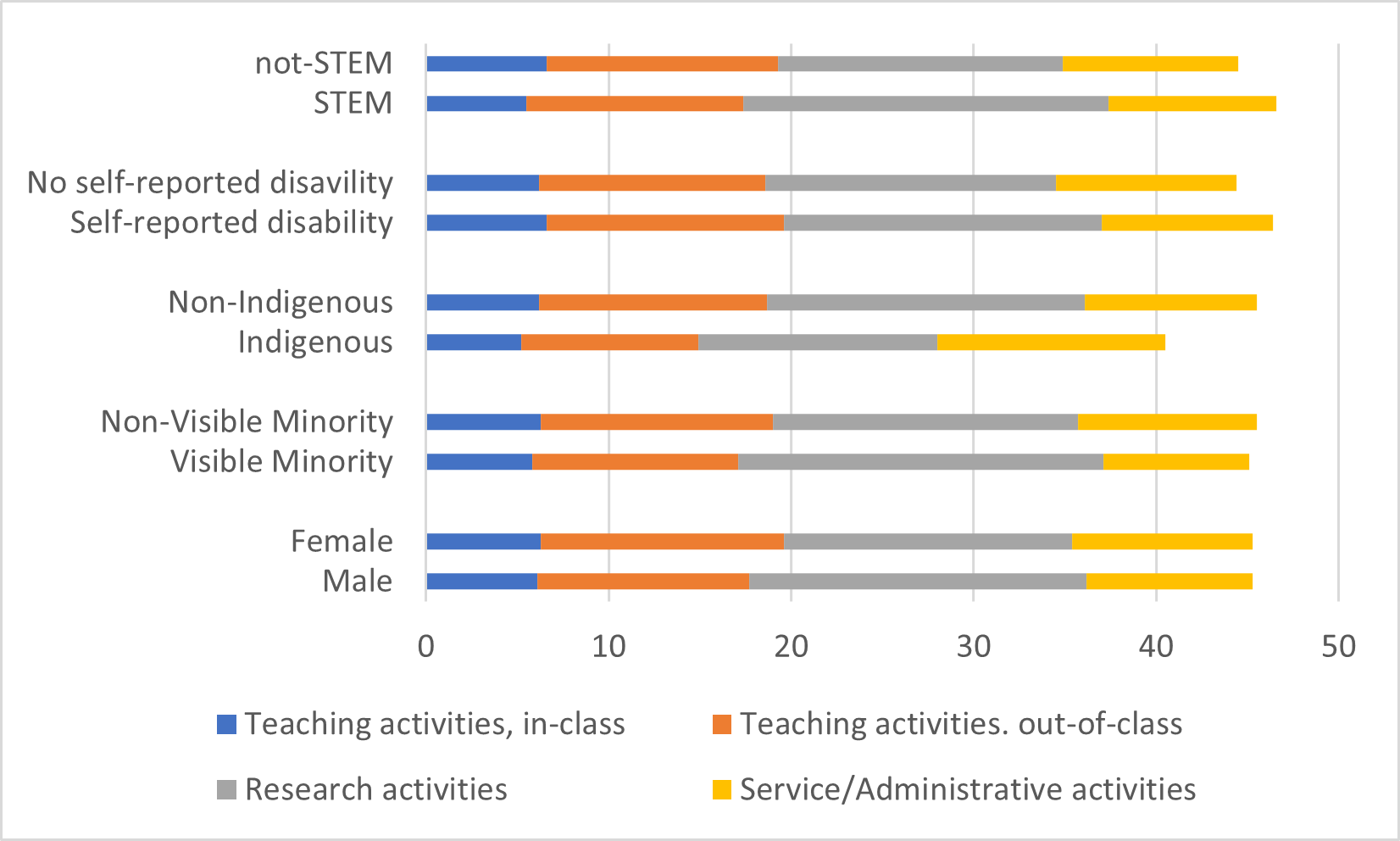
Figure 1 shows average hours per week spent by university professors on four different types of activities: teaching (in-class), teaching (outside the class), research, and service/administration (which includes everything from committee work to reviewing articles for journals.  Basically, it shows a profession that works a few more hours per week than other professions, on average, but not inordinately so (46 hours per week).  Remember: this is a self-report survey by professors, so if you disagree with what’s shown here, blame your fellow profs (though, to be fair, my guess is that had they split out some categories to include more specific categories on things like “keeping up with the literature”, the numbers probably would have been higher). 

Figure 1: Hours per Week, by Task, Full-Time Professors, 2019

This data shows us that professors work consistent hours across a range of factors.  There are not huge differences based on sex, disability, or visible minority status.  Even between professors in STEM fields and those not in STEM fields, the difference is only about two hours per week less on teaching and eight hours per week more on research than their colleagues in other fields.  The most significant gap listed here is between Indigenous and non-Indigenous profs, but I suspect the difference is at least partially accounted for by not accounting specifically for work in the community. 

(There is also data in this release for college teachers, but frankly it is much less interesting: they work about twice the teaching hours as university staff, 20% of the research hours and 60% of the admin hours for, in total, a work week which is about five hours shorter, on average, than that of university instructors).

Anyways, there you have it.  A national statistical agency which is by turns utterly infuriating yet technically skilled and occasionally illuminating.   

Source: https://myemail.constantcontact.com/One-Thought-to-Start-Your-Day–Visible-Minority-Students-and-Professorial-Time-Use.html?soid=1103080520043&aid=2db13gLh7vY

Manning: The link between growth and immigration: unpicking the confusion

One of the better explainers on growth, immigration and productivity (i.e., per capita not overall growth):

The new UK government with Liz Truss as PM and Kwasi Kwarteng as chancellor has told the Treasury to “focus entirely on growth” as the main objective of government policy. And it is rumoured that part of this dash for growth is to be loosening controls on immigration. As immigration restrictions have been argued to be the “greatest single class of distortions in the global economy”, that is perhaps not surprising for a government that seems ideologically committed to free markets. A more liberal immigration system is an idea that has been received favourably in some parts of the commentariat that are otherwise extremely critical of other policies such as directing tax cuts to the rich. For example, Lionel Barber, a former editor of the Financial Times, tweeted that it was good news “that Truss government plans to increase immigration to boost growth”.

Many of these commentators are people whose views I normally regard as sensible. But on the relationship between immigration and growth I think much comment is deeply confused. The root of the confusion is what we mean by ”growth”.  Growth might mean an increase in gross domestic product (GDP), the total amount of goods and services produced in the economy. Because immigration means more people and more people means a bigger economy, immigration almost certainly increases growth in this sense. But we normally think of growth as being desirable because it represents an improvement in the material standard of living in the country. Then, GDP per capita (per person) is a much better measure of growth and the relationship between immigration and growth more complicated as immigration raises GDP but also the capita bit of the formula.

The confusion over the link between growth and immigration is not new. A House of Lords reportfrom 2008 criticised the government for using the impact of immigration on GDP rather than GDP per capita in its analysis. With the benefit of hindsight, the garbled economics of immigration of the government at that time was one reason it got into trouble over immigration (the others being naïve visa design and a failure to monitor what was happening).

Before the pandemic disrupted the economy, UK GDP per capita was about £33,700. An extra immigrant will raise GDP per capita if their contribution is above this figure, reduce it if its below. Using this measure, immigration is no longer necessarily pro-growth; it depends. Assessing the contribution of migrants to GDP is critical to deciding whether more open immigration rules raise or reduce GDP per capita.

One contribution of immigration to GDP is the earnings of the migrants themselves. But their work also generates profits; labour income is about 60% of total income, meaning that 60p in earnings generates £1 in GDP on average. If a migrant’s earnings generate the same profit per pound as the average, this would mean that any single migrant earning above £20k would raise GDP per capita. The lowest visa salary thresholds are currently slightly above this level. But if the migrant has a non-working partner and child, they would have to earn over £60k to raise UK GDP per capita. Rules on rights to bring dependents, rarely discussed, make a big difference for the impact of immigration on GDP per capita.

But perhaps there are other effects on GDP per capita beyond the migrant and their employer. These effects might be positive or negative. As more immigration means faster labour force growth, some investment has to be directed to equipping the new workers with capital. If investment as a whole does not increase sufficiently, this means lower investment per worker in other jobs, which means lower GDP per capita. On the other hand, there is good evidence that higher-skilled migrants lead to more innovation, which is the underlying basis for productivity growth. Some studies also claim there are positive general effects on productivity of all migrants, not just the higher-skilled. The magnitude of the impacts in these studies are, for me, beyond what is credible. For example, some studies imply that the average immigrant is 2.5 times more productive than a Brit.

Also sowing confusion is a famous theoretical result in the economics of immigration; what is known as the ”immigration surplus” result. This says that in competitive markets, immigration of any type raises the average income of the locals as long as the skill mix of migrants and locals differs. There are two problems with the way this famous result is commonly interpreted. First, the impact works through changes in wages and prices. If, as the evidence suggests is the case, these do not change very much, if at all, with immigration, then the predicted benefits are small. More importantly, the growth measure being used is the GDP per capita of the locals only; it is as if the migrants themselves count for nothing. It is a country like the United Arab Emirates that probably comes closest to what this theoretical model would say is desirable. If the UAE is not your preferred model of the good society, don’t cite these results.

The effects of migration on GDP per capita may be more positive in the short run than in the long run. Initially, the migrants are on work permits, they have to work.  But if they settle, some will end up out of work (just like everyone else) and will eventually retire.  So settlement rules, again rarely discussed, matter for the impact of immigration on growth.

Productivity per hour worked is another measure of growth we might be interested in; the UK has a well-known problem with productivity; growth has been very weak since the financial crisis and we lag behind our competitors. ,We might want an immigration policy to raise productivity per hour worked.  That would lead to a more restrictive immigration policy than one that focused on current GDP per capita, as one now has to compare working migrants with working locals, not all locals.

So, the relationship between immigration and growth is likely to be far more complicated than widely assumed. The final migration advisory committee report produced when I was chair tried to estimate the likely impacts of different migration rules on the growth outcomes described here. Those estimates were based on assumptions that are not beyond criticism.  But the bottom line was that the impact of a well-chosen immigration policy on growth was very small unless one focused on total GDP, which is the wrong measure. For high-skilled immigrants, it is likely that GDP per capita is raised but for lower-skilled immigrants it is much more debatable. And a lot of the current discussion is about reducing restrictions on immigration to address labour shortages in sectors like agriculture and hospitality, where productivity and salaries are low.

I have discussed the impact of immigration on UK growth alone.  But perhaps we should take a global perspective. There is little doubt that immigration from lower-income countries to higher-income ones (like the UK) raises global GDP per capita even if it reduces GDP per capita in the UK. That is a strong reason to look to find ways to be open to immigration.  But we need to be aware that most of the benefits go to the migrants themselves, and that some controls are needed to avoid harm to some of the locals. Pretending there is a strong case that immigration always raises growth in the local economy may be in a good cause, but when that case is exaggerated, it runs the risk of undermining public confidence in the immigration system, something that tends to lead ultimately to more restrictive policies.

____________________

Alan Manning is Professor of Economics in the Department of Economics at LSE, and co-director of the community wellbeing programme at LSE CEP. His research generally covers labour markets, with a focus on imperfect competition (monopsony), minimum wages, job polarisation, immigration, and gender. On immigration, his interests expand beyond the economy to issues such as social housing, minority groups, and

Source: The link between growth and immigration: unpicking the confusion

Khan: To the ruling elites, be they secular or religious: Just leave Muslim women alone

Of note:

A long while back, a good friend of mine decided to take a stand on the hijab. She was Muslim, and grew up in a Muslim household. She had thought long and hard about her decision, and decided to start wearing it.

Her father disagreed, berating her. When that didn’t work, he beat her. But she would not be cowed by the physical abuse. She could have filed a complaint with the authorities here in Canada, but decided, for personal reasons, against it. These were deeply personal choices made under difficult circumstances. But they were hers to make.

I thought of my friend upon hearing of the death of Mahsa Amini, a young Iranian woman who died after being taken into custody by Iran’s “morality” policy for allegedly violating the country’s hijab laws. The authorities claim that the 22-year-old woman had a heart attack at a re-education centre. Her family disputes the account, indicating that she was in perfect health. Autopsy reports were not made public. The official account defied credibility, given endemic institutional corruption. The allegations are that Ms. Amini was beaten to death.

That a woman was arrested and died for showing wisps of hair is reprehensible. That such a law exists is a travesty to basic human dignity. Iranian women are rightfully fed up with edicts that suffocate their lives and violate their personal agency. But it goes beyond women. You cannot shove religion down peoples’ throats without missing the point entirely. As the Quran succinctly puts it: “There is no compulsion in religion.”

While the current upheaval in Iran is partially the result of a population chafing against a ruling elite, it is also, at its heart, about the position of women in Iranian society. Half the population could more fully help their country to flourish, provided they were given the opportunity to do so. Instead, women have been suppressed and society has suffered as a consequence.

Some believe one of the solutions to ending the suppression of women is to ban the hijab. But this simply repeats the initial cardinal violation of taking away a woman’s agency in making her own choices. In any instance, a grown woman is fully capable of weighing the necessary information, consulting her peers, if she’d like, and reaching to the inner recesses of her conscience to make a decision that suits her.

Back in grad school at Harvard, one of my closest friends was an Iranian exile, whose family had suffered under the rule of Ayatollah Khomeini. Understandably, she hated state-sanctioned “Islam,” and, in particular, the hijab. We used to debate long into the night about the place of religion in society. I learned a great deal from her. When I chose to wear the hijab during the final year of my doctorate, she was mortified, and tried ardently to dissuade me. Another Pakistani friend tried to do the same. He hated the mullahs and their edicts; an imam had tried to sexually assault him when he was a child.

I clearly saw that both of my friends’ choices were informed by their respective experiences. However, as I explained, my choice was predicated on my own path – not theirs. It was deeply personal, and remains so. I do not impose it on anyone. Nor do I appreciate when others try to impose their choices on me or other women. Many years ago, I stood by my friend who was beaten by her father for choosing to wear the hijab. I stand by my Iranian sisters for the right to choose not to wear it, and their right to be free from coercion and violence.

In the end, it is about power and control. This summer, a Leger poll found that as a result of Quebec’s Bill 21, which bans the wearing of “religious symbols” (including the hijab) by public-sector workers, more than 70 per cent of Muslim women in the province feel less safe and more than 80 per cent said they feel less hopeful for the next generation.

To the ruling elites, be they secular (in Quebec and France) or religious (in Iran and Afghanistan), I say this: Just leave Muslim women alone. Let us live our lives and contribute to society. We have so much to offer, and we want to be part of the greater whole. We are not enemies of the state.

To my sisters in humanity: As women, we rarely see life as a zero-sum game. Let us respect individual choices. Let us be supportive of each other and band together against the haters. Let us remember Mahsa Amini and the many women who struggle on the path of freedom. Our inner voice is our strength – and no one can take it away.

Source: To the ruling elites, be they secular or religious: Just leave Muslim women alone

Why Quebec’s election turned into a slugfest over immigration

Not a bad overview. Election will likely demonstrate the weakness of first-past-the-post in situations of one dominant party and a number of smaller parties:

David Heurtel walked into the room and immediately spotted the angry man at the back.

It was November 2017 and the Quebec Liberal Party’s immigration minister was hosting a town-hall meeting in Sainte-Claire, a town across the river from Quebec City, in a rural region that is considered the province’s nationalist conservative heartland.

The man he spotted was typical of the local population. Older, white and francophone.

And he emanated a lingering, pent-up frustration.

“I said, ‘Oh, that guy is going to give me trouble at some point,’” Heurtel, a lawyer, recalled in an interview.

And he did.

Toward the end of the meeting, the man raised his hand. Heurtel braced himself and invited the man to air his grievance.

But it was not what he was expecting.

Not a complaint about Muslims or hijabs. Not about clashes of cultures and Quebec values. Not about the thousands of asylum seekers who had begun streaming across the border the previous summer. Not about the French-language abilities of newcomers to the province.

Not about any of these sinkhole political debates that appear with troubling regularity in Quebec, sucking in elected officials, media commentators, activists and community associations.

“He says, ‘For Christ’s sake, I need workers! I don’t give a damn if they’re red, purple, yellow or green. I need workers right now and I’ll teach them French myself!’” Heurtel recounted, speaking in Quebec’s working-class joual to fully express the colourful language.

Five years later, after the economic ravages of the pandemic and the continued aging of the population, the “Workers Wanted” refrain has only grown in desperation. In this sense, Quebec is no different from Ontario, Alberta or any other Canadian province or territory.

Which is why the combination of political punches launched this week by candidates, in the final days of an otherwise sleepy Quebec election campaign that will be decided next Monday, was so difficult to comprehend.

The sequence opened with an innocuous jab, the likes of which have sadly become a routine occurrence in Quebec politics.

A candidate for the sovereigntist Parti Québécois, Lyne Jubinville, was exposed by Montreal’s Le Devoir and forced to apologize for anti-Islam rants about “hijabs” that “increasingly invade our public space,” and about mosques and Muslim calls to prayer taking the place of emptied Catholic churches and silenced church bells.

It was followed by a hook from Jean Boulet, Heurtel’s successor as immigration minister, who belongs to the governing centre-right party Coalition Avenir Québec. In a clip from a local election debate held a week prior, he appeared to write off newcomers to Quebec as good-for-nothings.

“Eighty per cent of immigrants go to Montreal, don’t work, don’t speak French or don’t accept the values of Quebec society,” he said in the debate.

Boulet apologized for the tone of his comments, which he said were not an expression of his beliefs, but he was denounced by Quebec Premier François Legault, who said the minister had talked himself out of his ministerial post if he is re-elected on Oct. 3.

But then Legault himself delivered the roundhouse shot that left so many in this province seeing stars.

He delivered a speech to the Metropolitan Montreal Chamber of Commerce — an audience of employers and big-business owners — and spoke about this summer’s census report, which showed declines in the number of people who speak French across the country.

Legault said that if his party is re-elected, it would put in place tougher French-language requirements for immigrants and try to ensure that more of them settle in outlying regions of Quebec.

“But until we have stopped the decline of French,” he continued, “I think that for the Quebec nation that wants to protect its language it would be a little suicidal to go and increase immigration levels.”

“Suicidal.” The comments set off waves of anxiety among Quebec immigrants and second-generation Quebecers.

A journalist with the TVA network, Chu Anh Pham, wrote on Twitter about her parents, who fled the Vietnam War and settled in Montreal.

“Since they arrived here, they have always worked. We all learned French in Montreal and have never relied on social assistance. I have a tonne of other examples.”

Mamadou Doukara replied to her message and expanded on his experience in a radio interview. He explained how he spent his father’s inheritance to get from Mali to Quebec on a student visa, but immediately set about looking for work to reduce the financial burden on his family.

“Every provincial election was a source of stress,” noted Bao Long Hoang, another immigrant to Quebec, who wrote that he now lives in Ottawa. “So much stupidity voiced without shame.”

Dr. Joseph Dahine, an intensive care specialist who immigrated with his family to Montreal when he was a young child, said he likely never would have been able to afford his studies in medicine if his family had parents had immigrated to the United States.

He said Quebec should be celebrating what it has to offer — affordable daycare, publicly funded health care, low tuition fees and other attractions — rather than eternally fretting about cultural differences and religious backgrounds and mastery of the French language.

“Language is not the menace. It’s not the threat,” Dahine said in an interview. “It’s actually the reason why people come here. It’s usually their second language and they feel they could get by. They see an opportunity.”

Dahine likened the immigration process to joining a team and wanting to fit in. “You want to see people having fun, celebrating their culture. You want to look at these people and be inspired and say, ‘I want to be just like them,’” he said.

“As long as it’s a speech about the fear of losing something, it’s not an inspiring speech. Who wants to fit in with a group that is always talking about the fear of losing?”

Apart from the message such comments send to immigrants and homegrown Quebecers alike, Legault’s dark, defeatist tone is at odds with the great efforts and investments that the CAQ has made as a government, said Catherine Xhardez, an assistant professor of political science who specializes in immigration at Université de Montréal.

“They have this discourse that is a little alarmist and make these dark declarations,” she said. “In fact, the numbers are good and with (the Coalition Avenir Québec’s) policies they have invested a lot of money in francization (teaching French to newcomers) and integration.”

She also noted that the number of permits for temporary foreign workers has “exploded” under the CAQ. Recent statistics show the number of permits more than doubled from 13,030 in 2017 — the year before Legault’s party came to power — to 30,340 in 2021, the CBC reported.

“That’s what I find a little paradoxical with these dark speeches,” Xhardez said. “Do they think it’s useful to make comments that are much harsher than their policies? Because their policies have not been hard on immigration.”

It’s not just the CAQ, though. The immigration platforms of three of the five major parties competing in Monday’s elections hit similar notes.

The Parti Québécois, a diminished political force in recent years, proposes that knowledge of the French language, Quebec culture and the obligations and expectations that accompany citizenship be mandatory before immigrants set foot in the province.

And the newly significant Quebec Conservative Party, led by former radio shock jock Éric Duhaime, has suggested that new immigrants be screened to ensure they are “civilizationally compatible” with Quebec’s values, though Duhaime has taken steps in the campaign to distance himself from the term.

The other two parties, the Liberals and Québec Solidaire, have pro-immigration platforms. The left-wing QS promises to make it easier to have foreign education and employment credentials recognized; the Liberals suggest that priority be given to immigrants to immediately fill the gaps in health care, education and other in-demand sectors of the economy.

“Immigration is a solution. It’s not a problem,” said Heurtel, who said he is no longer an active member of any party. “Companies want them. Society wants them in general and the fact is that they’re a positive, not a negative.”

But for now, that ugly “Make Quebec Great Again” discourse persists, if only to drive the votes of those who feel most threatened by living on a French-speaking island in the midst of an English-speaking ocean.

Heurtel said the tendency will only be reversed by a radical change in the province’s political culture or a change to the voting system. As things stand ahead of Monday’s vote, the Coalition Avenir Québec are expected to win about 99 of the National Assembly’s 125 seats with just 39 per cent of the votes, according to opinion poll aggregator QC125.com.

The Liberals (16 per cent) are projected to take about 20 seats, Québec Solidaire (15 per cent) 10 seats and the PQ (15 per cent) just three. Despite having 14 per cent support, the Conservatives are not projected to win any seats.

But in politics, opinions and policies and allegiances are always shifting.

In politicians’ attitudes toward immigration, toward newcomers, there will be changes as well, said Dahine, the doctor. It just might take a while.

“As immigration happens — because it’s going to happen, because people need workers and brains and hands and arms — kids are going to grow up with a different picture of what society is. It’s going to be the new normal and one day it won’t be about where you come from but, ‘Hey! You’re from here as well,’” he said.

“It’s as though you’ll have a different flavour you add to the original Quebec recipe. Let’s put it that way.”

Source: Why Quebec’s election turned into a slugfest over immigration