Liberals say Russia visa ban would trap dissidents, as more Canadians blacklisted

Agree, right call but diligence required with respect to those close to the Putin regime:
Foreign Affairs Minister Melanie Joly said she does not support following European countries in barring Russians from getting visas, arguing dissidents are facing increasing danger.
She also said Russia needs to be prosecuted for illegally invading Ukraine, a view Moscow rejected while adding dozens more Canadians to its blacklist Thursday.

Source: Liberals say Russia visa ban would trap dissidents, as more Canadians blacklisted

Canada’s immigration minister leaves door open to extending Afghan resettlement programs

Of note:

As Canada reaches the halfway point of meeting its commitment to resettle 40,000 Afghan refugees, Immigration Minister Sean Fraser says he’s not ruling out lifting the current cap and welcoming more into this country.

But for the moment, he says, his main focus is the 8,500 people to whom Canada has already promised refuge who remain stuck in Taliban-controlled Afghanistan.

“When we hit that target (and) we have the ability to continue to support all of the people through additional pathways, then we’ll do what we can,” Fraser told the Star in an interview Thursday, on the eve of the arrival of the 20,000th resettled Afghan in Toronto on a charter flight from United Arab Emirates.

“What we have done is made the commitments to the 40,000. But we have not taken a decision never to do more for people from Afghanistan.”

Fraser’s softened tone was in contrast to how his office had previously underlined to media Canada’s commitment to meet the target it announced last October.

In June, the Star reported that Ottawa planned to stop taking in Afghans after it had enough applications to fill the announced spots, despite the fact that many who risked their lives to help the Canadian mission were still waiting for a response to their applications.

“The unfortunate reality is that not everyone who expressed interest in coming to Canada will be eligible. … We are doing everything we can to help Afghans inside and outside of Afghanistan,” Fraser’s press secretary told reporters at the time.

Fraser said there are currently 8,500 Canada-bound Afghans still inside Afghanistan who need to get to another country to complete the resettlement applications and meet requirements such as biometrics and health screening.

These applicants to whom Ottawa has already committed are his top priority and he is working with the international community to find ways to get them out of the country, he said.

He would not reveal the different options officials are investigating.

“I learned through my experience with this effort not to expect a smooth ride. We’re dealing with a territory that’s under the control of a group that’s listed as a terrorist entity in Canadian law. There is very little patience that the Taliban has for people who are eligible to come to Canada,” he explained.

“These 8,500 people who are already in the process are still inside Afghanistan. We are not wavering on our commitment to bring those individuals here. If it was a matter of bringing in any 40,000 Afghan refugees to Canada, we could have done that.”

In terms of processing displaced Afghans who are now in a third country waiting to come to Canada, Fraser said the largest groups are in Pakistan and Tajikistan. But many of those are privately sponsored by community groups and their applications may fall outside the special resettlement programs.

This week, the Globe and Mail reported that a Manitoba senator’s office had issued an inauthentic Canadian government document to help facilitate an Afghan family’s travel.

Fraser said an internal investigation confirmed the document — known as “facilitation letter” to help eligible Afghans get through Taliban checkpoints — was inauthentic and that the matter has been referred to law enforcement.

“The integrity of the process has not been compromised because even the authentic letters that we did issue do not permit a person to enter Canada. An individual who used them to move through the airport still has to go through the application process and be issued an invitation to apply and complete the process and other steps required,” he said.

“To our knowledge, no one has been able to use an inauthentic facilitation letter to enter the program, but only to transit to and through the airport.”

Fraser said the Afghan resettlement project has been the most difficult but also rewarding task in his entire life and career as a parliamentarian.

He said it’s humbled him as he’s heard an Afghan woman arriving in Newfoundland saying “she finally has a home”; played soccers with the kids of a group of Afghan human rights defenders in Edmonton; and seen a new arrival kissing the ground of the tarmac in Toronto.

“It’s a great reminder of the lottery of birth that we win as Canadians, by virtue of being born in a country that is safe, where we take for granted that our communities will be peaceful places to grow up,” Fraser said.

“It’s not lost on me that we will have a lot of work ahead of us to make good on our commitment to hit 40,000.”

Source: Canada’s immigration minister leaves door open to extending Afghan resettlement programs

Canada’s immigration backlog decreases slightly to 2.6 million

Regular useful updates by cicnews.com, modest but limited progress:

Immigration, Refugees, and Citizenship Canada (IRCC) is reporting a decrease in its August 31 inventory.

A spokesperson from IRCC sent CIC News inventory data suggesting the backlog has been reduced by 95,204 persons in a matter of six weeks.

The inventory across all lines of business has progressed as follows since last July:

IRCC recently came out with a new webpage tracking the inventory. According to that webpage there were 2.4 million in IRCC’s inventory on July 31. Of those, 1.1 million were within service standards and 1.3 million were in the backlog.

CIC News has reached out to IRCC to inquire about the apparent discrepancy in data from the media department compared to data reported on the government website. This article will be updated if an explanation is obtained.

Immigration category Persons as of August 31, 2022
Permanent residence 513,923
Temporary residence 1,698,284
Citizenship 371,620
Grand total 2,583,827

The citizenship inventory stands at 371,620 applicants as of September 1, compared to 444,792 on July 15.

The permanent residence inventory stands at 513,923 people as of August 31, compared to 514,116 as of July 17.

Also on August 31, the temporary residence inventory stood at 1,698,284 people, compared to 1,720,123 persons as of July 17.

Therefore, there have been reductions across all three major groups.

Express Entry and PNP inventories

A total of 40,180 Express Entry applicants are waiting in the queue, a reduction from the previous month when there were 51,616 persons in the inventory.

IRCC has continued to hold rounds of invitations for Express Entry candidates from all programs. Between September 21, 2021 and July 6, 2022, IRCC only invited Provincial Nominee Program (PNP) candidates to apply for immigration. Under the PNP, certain programs (enhanced PNPs) are managed by the Express Entry system, while others (base PNPs) are managed by the provinces’ own systems.

Express Entry-managed PNPs have seen a reduction in inventory, but base PNPs have increased from 35,599 in July to 41,832 in August.

Family class inventory continues upward trend

Inventory for all family class immigration programs are up to 125,746, compared to July when it was 118,251.

The Spouses and Partners program has the second largest inventory compared to all immigration programs at 61,073. Privately sponsored refugees have the largest inventory at 68,123 persons.

The Parents and Grandparents Program (PGP) has 53,029 persons waiting for decisions, up from 47,025 in July.

IRCC efforts to reduce backlog

On August 29, Fraser highlighted how Canada is working to address the backlog and improve the immigration system by hiring up to 1,250 new employees by the end of the fall, modernizing IRCC operations, introducing application status trackers, and publishing monthly data on the IRCC website

Inventory in tables

The following tables show more details of IRCC’s inventory.

Permanent residence inventory

Permanent residency class Persons as of August 31
Economic class 206,688
Family class 125,746
Humanitarian and compassionate 29,224
Permit holders class 16
Protected persons class 152,249
Total 513,923

Economic class inventory

Immigration category Persons as of August 31
Agri-Food Pilot Program 866
Atlantic Immigration Pilot Programs 1,528
Atlantic Immigration Program 210
Canadian Experience Class (EE) 5,214
Canadian Experience Class (No EE) 118
Caring For Children Program 29,179
Federal Investor 4
Federal Self Employed 4,022
Federal Skilled Workers (C-50) 120
Federal Skilled Workers (EE) 11,669
Federal Skilled Workers (Pre C-50) 23
High Medical Needs Program 4
Live-in Caregiver Program 832
Provincial/Territorial Nominees (EE) 22,998
Provincial/Territorial Nominees (No EE) 41,832
Quebec Entrepreneur 259
Quebec Investor 10,727
Quebec Self Employed 82
Quebec Skilled Workers 23,559
Rural and Northern Immigration Pilot 1,103
Skilled Trades (EE) 299
Skilled Trades (No EE) 5
Start-up Business 1,314
TR to PR 50,721
Total 206,688

Express Entry inventory

Immigration program Persons as of August 31
Federal Skilled Workers (EE) 11,669
Canadian Experience Class (EE) 5,214
Skilled Trades (EE) 299
Provincial/Territorial Nominees (EE) 22,998
Total 40,180

Family class inventory

Immigration program Persons as of August 31
Children & Other Family Class 8,880
FCH-Family relations – H&C 2,764
Parents and Grandparents 53,029
Spouses & Partners 61,073
Total 125,746

Humanitarian and compassionate class inventory

Immigration program Persons as of August 31
HC & PH class-ADM Dependant Person Overseas 8,880
Humanitarian & Compassionate Straight 2,764
Humanitarian & Compassionate with Risk or Discrimination 53,029
Public Policy With RAP 61,073
Public Policy Without RAP 4,385
Total 29,224

Permit holders class inventory

Immigration program Persons as of August 31
Permit holders class 16
Total 16

Protected persons inventory

Immigration program Persons as of August 31
Blended Visa Office-Referred 148
Dependants Abroad of Protected Persons 26,919
Federal Government-assisted Refugees 32,365
Privately Sponsored Refugees 68,128
Protected Persons Landed In Canada 23,572
Quebec Government-assisted Refugees 1,117
Total 152,249

Temporary residence inventory

Application type Persons as of August 31
Study Permits 152,147
Study Permits Extensions 23,896
Temporary Resident Visas 896,772
Visitor Record 96,598
Work Permits 359,247
Work Permits Extensions 169,624
Total 1,698,284

Source: Canada’s immigration backlog decreases slightly to 2.6 million

Canadian passport offices took two years to return to pre-COVID staffing

Good example of meaningless reporting with no context and adding nothing to existing articles flagging departmental business plans and union comments on the expected upsurge:

Have passport, will travel post-COVID.

Unless you live in Canada where it took more than two years to restore pre-COVID in-person staffing levels at passport offices despite the feds being warned of an increase in travel document demand, according to Blacklock’s Reporter.

Inquiry Of Ministry data, requested by Conservative MP Dan Albas (Central Okanagan-Similkameen, B.C.)., show as late as this past summer more than 11% of staff continued to work from home.

On March 1, 2020, right as the COVID shutdown began, the passport office had 831 employees at public service centres.

By Jan. 1, 2022, only 757 were on the job, which is a 9% reduction.

Passport offices did not reach pre-pandemic staffing levels until all service counters were reopened on May 9.

The Inquiry data has not explained why there was a failure to address demand for passports that led to five and six-hour lineups at Service Canada offices and three month waits for mailed applications.

“We are doing everything we can,” Social Development Minister Karina Gould said July 23.

However, a June 23 briefing note called Passport Productivity And Staffing Measures said it knew last summer it should prepare for an increase in applications.

“In anticipation of increased volumes Service Canada began implementing a staffing plan last July,” it said.

However, the Inquiry said numerous passport offices had fewer staff in January 2022 than during COVID-related shutdowns starting in March 2020.

The Inquiry said prior to the pandemic in January 2020 the passport office issued 229,392 travel documents with monthly processing falling to 2,100 in May 2020.

Last month, 240,980 passports were issued.

“I completely understand the frustration Canadians are facing right now,” Gould said earlier.

Source: Canadian passport offices took two years to return to pre-COVID staffing

MP calls for parliamentary probe of inauthentic immigration documents, Afghan resettlement program

Of note:

Conservative MP Michelle Rempel Garner is calling for a parliamentary probe into the extent to which inauthentic Canadian government travel documents were used during efforts to rescue people from the Taliban last year, and into the fairness of the government’s resettlement programs for Afghans.

On Wednesday, The Globe and Mail reported that Senator Marilou McPhedran and her staff sent documents to an Afghan family shortly after the Taliban overthrew Afghanistan’s government in August, 2021. The documents, called facilitation letters, said the people named on them had been granted visas to enter Canada. The letters were meant to help those people get through Taliban checkpoints on their way to Kabul’s airport.

But the federal government told The Globe the documents the Senator and her office sent were not authentic, and that the people named on them had not been approved to come to Canada. Authentic facilitation letters were sent only directly by the federal government, Immigration Minister Sean Fraser told reporters on Wednesday.

The Immigration Department referred the matter to police. The RCMP and the Canada Border Services Agency declined to say whether they had launched investigations.

Ms. McPhedran, whom Prime Minister Justin Trudeau recommended for a Senate appointment in 2016, has defended her actions to The Globe. She has acknowledged using a template version of a government facilitation letter, but she denied that the documents were fake, or that she had used them in an unauthorized way.

She said she had worked around the clock to help vulnerable people get out of Afghanistan during an inadequate federal effort to save Afghans last year. She added that a senior government official had given her the facilitation letter template, and that people within government were aware of her work. Despite repeated requests to the Immigration Department and Global Affairs Canada, the government has refused to say whether any federal officials helped Ms. McPhedran.

Receiving the documents from the Senator and her office left the Afghan family with the mistaken belief that they had been approved to come to Canada. That belief led them to risk their lives attempting to reach the airport, and also delayed their efforts to secure valid visas.

The people who received the documents are family members of one of Ms. Rempel Garner’s constituents. They first reached out to the MP’s office because not everyone in the family had received the documents, and they wanted to know why some had been left out. The group is still in Afghanistan, where they say they are being hunted by the Taliban. To protect their safety, The Globe is not identifying them.

“This case raises a lot of questions about the integrity and the fairness of the initial program,” Ms. Rempel Garner said in an interview with The Globe. “There’s a lot of unanswered questions.”

For example, she said, it remains unclear whether her constituent’s family members were the only ones who received inauthentic documents. And she said it is also unclear how many spaces in Canada’s resettlement programs for vulnerable Afghans were taken by people with such unofficial documents.

Ms. McPhedran did not answer The Globe’s questions about whether she sent similar documents to other people.

The federal government has said no one arrived in Canada using invalid documents, but a government source was unable to say if anyone had successfully used them to get out of Afghanistan. The Globe is not identifying the source because they were not authorized to discuss the investigation publicly.

In the years before the Taliban takeover, the Canadian government promised Afghans who worked with Canada’s military and diplomatic missions in Afghanistan that they would receive asylum in Canada, because their work with a foreign government put them at risk of Taliban reprisals. But the government didn’t create resettlement programs for Afghans until last year. Its effort to process those immigrants came too late for many, and was unable to meet overwhelming demand.

Tens of thousands of people who had helped NATO in its war in Afghanistan were left behind by Canada and other allied countries. Some are being tortured by the Taliban.

Ms. Rempel Garner spoke to The Globe with the permission of the Afghan family. They had formally applied for resettlement in Canada in the first wave of applications last year, but they later discovered their initial application had been lost.

A letter from Mr. Fraser to Ms. Rempel Garner, which was obtained by The Globe, said the family had not received a valid invitation to apply, despite the fact that they had received an invitation from a government of Canada e-mail address.

A second application, which they made this year, was rejected because Canada’s immigration programs for Afghans had already reached capacity limits set by the government.

In Ottawa on Wednesday, Mr. Fraser said letters that inaccurately purport to be from the government of Canada are a “very serious” matter. He added that he is concerned by any case where vulnerable people “might not be able to rely on documents they have received.”

But Mr. Fraser said he is not concerned that there has been widespread fraud, because the government has not uncovered a significant number of inauthentic documents.

Ms. Rempel Garner said her constituent’s family’s case also raises questions about the overall process that the federal government used to approve or reject resettlement applications from Afghan nationals. She said it’s not clear why her constituent’s family members, who worked for an organization under contract with the Canadian government, didn’t qualify for the immigration programs.

And she said the family’s efforts to escape Afghanistan were not hampered just by the inauthentic documents, but also by long waits for answers from the government about the status of their case. It took almost a year for the government to confirm to Ms. Rempel Garner that the documents the family had received were not authentic.

In 10 years of constituency casework, she said she has never experienced the level of federal government stonewalling that her office dealt with in this case. “Why that happened is something that needs to be examined through Parliament, or the government needs to pro-actively address it, because that really raises concerns about integrity within the immigration system,” she said.

“For this particular family, they’re in a great degree of danger now in Afghanistan. And the government has essentially said there’s not a lot of options to help them.”

NDP MP Jenny Kwan said she was taken aback by the use of inauthentic documents reported by The Globe. She called for more “clarity and investigation.”

Ms. Kwan said the police should make clear whether they are investigating the case. If they are, she said, any parliamentary probe should begin only after the police work is completed.

She also repeated her earlier calls for the government to lift what she said is an arbitrary cap on the number of spots in its immigration programs for Afghan nationals. She said the programs should be expanded so that all Afghans who served Canada can qualify.

“We need to bring them all to safety,” she said.

Source: MP calls for parliamentary probe of inauthentic immigration documents, Afghan resettlement program

Will your immigration application be fast-tracked? It depends whether it hits Canada’s new ‘Green Bin’

Normal to triage applications as part of program management, reducing processing times and improving efficiency. As always, care needs to be taken with respect to criteria and systems but continuing with first-come-first-served basis also has fairness issues as well as greater costs:

More and more would-be immigrants to Canada may soon find themselves in the fast lane — or seeing others cruise past them — as a result of the government’s expanding use of an automated triage system for applications.

The system is going to become increasingly prevalent as Canada transitions, starting this Friday, to “100 per cent” digital applications for most permanent residence programs — from family reunification to skilled immigration — meaning people can only apply online, unless they have accessibility issues.

Canadian officials have generally processed applications within a given immigration program on a first-come-first-served basis, but occasionally people complain that their files get bumped by others because complex cases take longer to process and because some visa posts are more backlogged.

Now, experts say, there’s one more element that dictates which permanent immigration applicants could get an easier — and quicker — ride.

For at least some programs, it comes down to whether their applications are initially sorted into a “Green Bin” or “Standard Bin” for processing.

“It means that you have no control over whether you are left in a multi-year limbo or if your application supercharges through the application processing stream,” immigration lawyer Andrew Koltun told the Star.

“Any of those who wait years can continue to wait years, whereas new applicants can jump ahead of them.”

Since 2018, Immigration, Refugees and Citizenship Canada has used an automated system to triage temporary-resident visas applications for students and visitors in China and India.

Previously, in-paper or mailed-in applications could not be fed into the automated system. The move to almost exclusively online processing will see a bigger swathe of applications enter the automatic sorting system.

Officials found that “routine files” can be assessed 87 per cent faster using the system and decided to expand its use at visa posts around the globe in January.

The automated triage system has now also, it turns out, quietly started for the first time for a permanent immigration program.

Through an access-to-information request, Koltun learned the government signed off on the technology in April 2021 for use in processing sponsorship applications of foreign spouses who are in Canada.

Here’s how it works, according to an internal memo:

  • Based on “evidence-based, data driven rules” from past applications and decisions, the automated system identifies the low-complexity cases that would have a high likelihood of being approved without officer review;
  • These cases are placed in what’s known as the Green Bin, where officers will move on to conducting medical, criminal and security assessments to make sure the sponsored spouse is admissible to Canada; however,
  • The rest of the applications are referred to the Standard Bin, where they are assessed by officers for both eligibility and admissibility as per standard procedures.

The memo said the model was developed and tested using some 40,000 inland spousal applications processed in 2018 and 2019. It’s expected half of new applications would be slotted to the Green Bin for quicker processing.

The notes also pointed to “seven criteria” coded in the automated screening process, but redacted what those criteria were.

Immigration department spokesperson Rémi Larivière said the pilot program, launched in April 2021, showed the automated system was efficient and effective at identifying routine and straightforward cases for streamlined processing. Since June, it’s been used permanently to process inland spousal applications.

“The automated system never refuses or recommends refusing an application. Where there is a refusal decision, it is made by the officer based on their manual review of the application,” he noted.

Experts believe it’s just a matter of time before the triage system is adopted throughout the immigration system.

The pilot project comes amid ramped-up efforts by Canada to “modernize” the antiquated immigration system to cope with skyrocketing immigration backlogs that have reached more than two million applications in both temporary and permanent streams.

Since the project’s inception, about 25,000 applications have been triaged into the Green Bin while 24,620 have been referred to the Standard Bin. The automated system has been credited with driving down these applications’ overall processing time back to the 12-month pre-pandemic standard.

Larivière said the system uses a combination of rules developed by staff and rules generated through machine learning that have been assessed, adjusted if necessary, and reviewed.

Data used and rules developed through machine learning are vetted by lawyers, privacy experts, policy analysts and experienced immigration officers. The system is monitored to identify and mitigate risks related to bias, procedural fairness, privacy and accountability.

However, Koltun worries applications in the Green Bin would be less scrutinized and more likely to get a favourable decision by officers during the admissibility assessment as a result of the machine pre-screening.

“That can lead to unconscious bias, where if someone has been already approved (for eligibility), then you deem it more trustworthy,” he explained.

Permanent-resident applications take much longer to process than a temporary visa because of the extent of the scrutiny involved. Processing time for the federal skilled-worker program, for instance, averages 26 months, but a study permit only takes about 12 weeks.

“Now, all the applications are run through triaging and if I don’t meet the criteria, I will go into a slower processing queue,” said Koltun. “But if you meet the criteria, you will jump ahead of me. In a temporary-resident visa application, which is less complex, the impact of this is felt less.

“In spousal sponsorship, where processing times can range up to 24 months, the difference of being placed in this Green Bin versus the Standard Bin can be years. It’s also why applicants are very unhappy and confused with the process because they do see others who applied after them get their approvals, whereas they’ve been stuck.”

Critic Lou Janssen Dangzalan said the immigration department should communicate to the public that the first-come-first-served tenet the immigration system has run on is “out,” replaced with the automated triage.

“IRCC still continues this mythology that if you file now ahead of somebody else, your application is going to be treated first,” said Dangzalan, a founding member of the Canadian Immigration Lawyers Association.

“They’re dealing with people’s expectations. And in the context of a massive backlog, transparency and honesty is probably their best friend.”

The experts said the digital transformation of the immigration system is needed, but officials have to be more clear about the use of analytics and artificial intelligence in application processing.

Earlier this year, the parliamentary immigration committee studied the department’s advanced analytics program and another tool called Chinook software developed to fast-track processing of study permits.

The committee recommended officials publish information on all artificial intelligence software programs, and undertake proper public consultations regarding new technologies, as well as an independent oversight for the expanded use of artificial intelligence.

Koltun agreed that officials need to be more transparent about the rules used to triage in the automated system.

“IRCC’s overriding concern is program integrity and the notion that people will game the system, but you should know the case to meet for an enhanced processing,” said Koltun. “If IRCC is using objective criteria, it’s unclear to me how I could game the system.”

Larivière said the inland spousal sponsorship program is currently the only permanent immigration program that uses the advanced analytics for triage. He declined to comment if it will be expanded to other permanent streams.

Source: Will your immigration application be fast-tracked? It depends whether it hits Canada’s new ‘Green Bin’

Governments’ use of automated decision-making systems reflects systemic issues of injustice and inequality

Interesting and significant study. A comparable study on automated decision-making systems that have been successful in minimizing injustice and inequality would be helpful, as well as recognition that automated systems can improve decision consistency as Kahneman and others demonstrated in Noise.

As these systems will continue to grow in order to manage increased numbers of decisions required, greater care in their design and impacts will of course be necessary. But a mistake to assume that all such systems are worse than human decision-making:

In 2019, former UN Special Rapporteur Philip Alston said he was worried we were “stumbling zombie-like into a digital welfare dystopia.” He had been researching how government agencies around the world were turning to automated decision-making systems (ADS) to cut costs, increase efficiency and target resources. ADS are technical systems designed to help or replace human decision-making using algorithms.Alston was worried for good reason. Research shows that ADS can be used in ways that discriminateexacerbate inequalityinfringe upon rightssort people into different social groupswrongly limit access to services and intensify surveillance

For example, families have been bankrupted and forced into crises after being falsely accused of benefit fraud. 

Researchers have identified how facial recognition systems and risk assessment tools are more likely to wrongly identify people with darker skin tones and women. These systems have already led to wrongful arrests and misinformed sentencing decisions.

Often, people only learn that they have been affected by an ADS application when one of two things happen: after things go wrong, as was the case with the A-levels scandal in the United Kingdom; or when controversies are made public, as was the case with uses of facial recognition technology in Canada and the United States.

Automated problems

Greater transparency, responsibility, accountability and public involvement in the design and use of ADS is important to protect people’s rights and privacy. There are three main reasons for this: 

  1. these systems can cause a lot of harm
  2. they are being introduced faster than necessary protections can be implemented, and;
  3. there is a lack of opportunity for those affected to make democratic decisions about if they should be used and if so, how they should be used.

Our latest research project, Automating Public Services: Learning from Cancelled Systems, provides findings aimed at helping prevent harm and contribute to meaningful debate and action. The report provides the first comprehensive overview of systems being cancelled across western democracies. 

Researching the factors and rationales leading to cancellation of ADS systems helps us better understand their limits. In our report, we identified 61 ADS that were cancelled across Australia, Canada, Europe, New Zealand and the U.S. We present a detailed account of systems cancelled in the areas of fraud detection, child welfare and policing. Our findings demonstrate the importance of careful consideration and concern for equity.

Reasons for cancellation

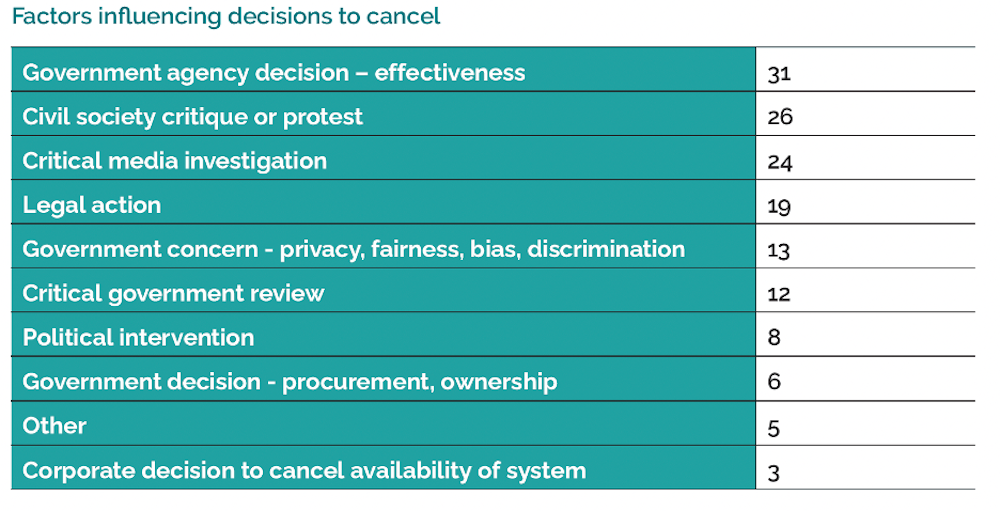
There are a range of factors that influence decisions to cancel the uses of ADS. One of our most important findings is how often systems are cancelled because they are not as effective as expected. Another key finding is the significant role played by community mobilization and research, investigative reporting and legal action. 

Our findings demonstrate there are competing understandings, visions and politics surrounding the use of ADS.

a table showing the factors influencing the decision to cancel and ADS system
There are a range of factors that influence decisions to cancel the uses of ADS systems. (Data Justice Lab), Author provided

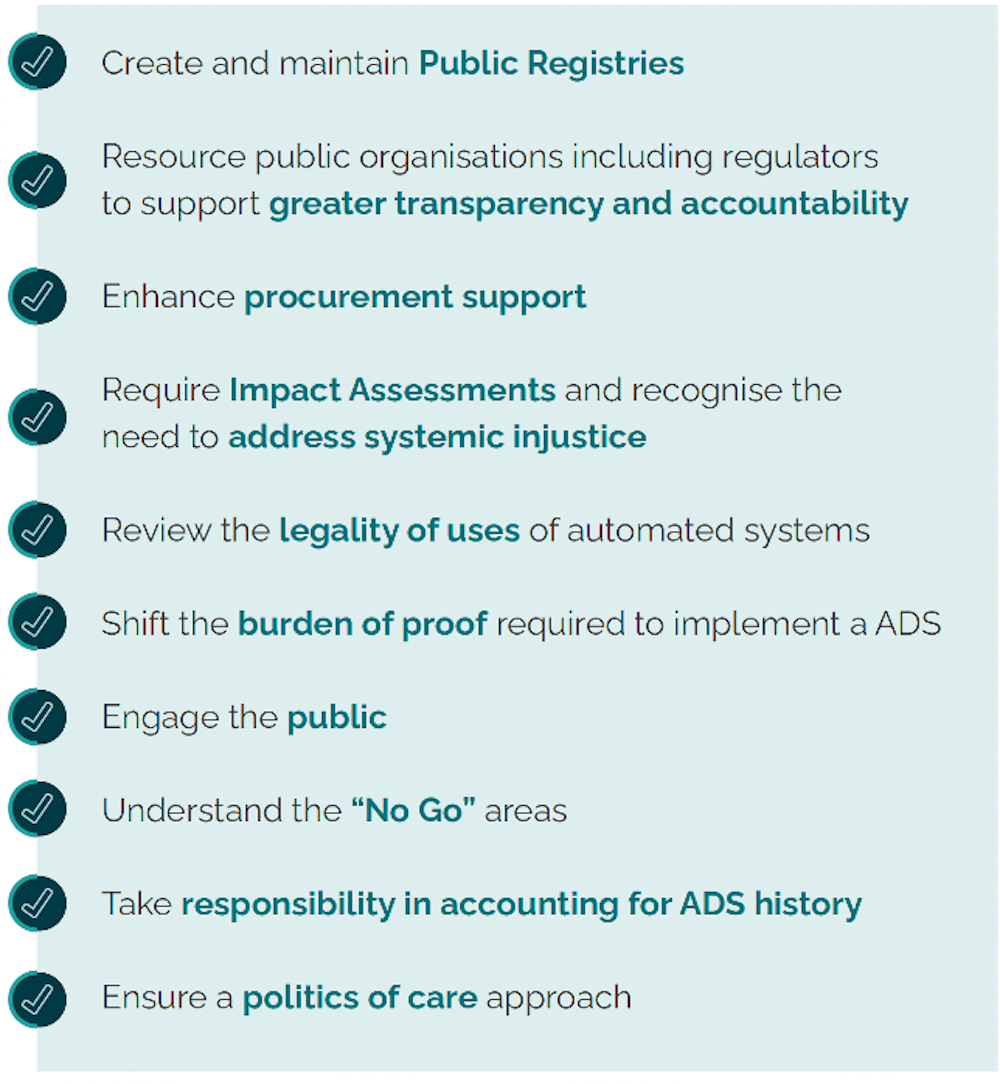
Hopefully, our recommendations will lead to increased civic participation and improved oversight, accountability and harm prevention.

In the report, we point to widespread calls for governments to establish resourced ADS registers as a basic first step to greater transparency. Some countries such as the U.K., have stated plans to do so, while other countries like Canada have yet to move in this direction.

Our findings demonstrate that the use of ADS can lead to greater inequality and systemic injustice. This reinforces the need to be alert to how the use of ADS can create differential systems of advantage and disadvantage.

Accountability and transparency

ADS need to be developed with care and responsibility by meaningfully engaging with affected communities. There can be harmful consequences when government agencies do not engage the public in discussions about the appropriate use of ADS before implementation. 

This engagement should include the option for community members to decide areas where they do not want ADS to be used. Examples of good government practice can include taking the time to ensure independent expert reviews and impact assessments that focus on equality and human rights are carried out. 

a list of recommendations for governments using ADS systems
Governments can take several different approaches to implement ADS systems in a more accountable manner.(Data Justice Lab), Author provided

We recommend strengthening accountability for those wanting to implement ADS by requiring proof of accuracy, effectiveness and safety, as well as reviews of legality. At minimum, people should be able to find out if an ADS has used their data and, if necessary, have access to resources to challenge and redress wrong assessments. 

There are a number of cases listed in our report where government agencies’ partnership with private companies to provide ADS services has presented problems. In one case, a government agency decided not to use a bail-setting system because the proprietary nature of the system meant that defendants and officials would not be able to understand why a decision was made, making an effective challenge impossible. 

Government agencies need to have the resources and skills to thoroughly examine how they procure ADS systems.

A politics of care

All of these recommendations point to the importance of a politics of care. This requires those wanting to implement ADS to appreciate the complexities of people, communities and their rights. 

Key questions need to be asked about how the uses of ADS lead to blind spots because of the way they increase the distancing between administrators and the people they are meant to serve through scoring and sorting systems that oversimplify, infer guilt, wrongly target and stereotype people through categorizations and quantifications.

Good practice, in terms of a politics of care, involves taking the time to carefully consider the potential impacts of ADS before implementation and being responsive to criticism, ensuring ongoing oversight and review, and seeking independent and community review.

Source: Governments’ use of automated decision-making systems reflects systemic issues of injustice and inequality

Automating Public Services: Learning from Cancelled Systems

Lederman: Ken Burns has a lesson for Ron DeSantis

Great column and reminder:

I can think of a few things that could benefit anyone involved in orchestrating last week’s shameful stunt of sending planeloads of desperate, unsuspecting migrants from Florida to Martha’s Vineyard in Massachusetts. For instance: sitting them down for six hours and 38 minutes to watch Ken Burns’ The U.S. and the Holocaust, which aired on PBS this week.

I’m unsure anyone who hatched this cruel plan has ever watched a minute of PBS, seen a Ken Burns documentary – or seen a documentary, period – but this three-part series should be required viewing for them. (For anyone, really.)

The central point of the documentary (co-made with Lynn Novick and Sarah Botstein) is that while Americans might see their country as a haven for immigrants, and a saviour during the Second World War, the U.S. in fact closed its doors pretty tightly during that critical period – to Jews, in particular. The State Department, lobby groups such as one called America First (sound familiar?), and average Americans didn’t want Jews entering the country. When asked two weeks after Kristallnacht whether the U.S. should allow more Jews into the country, 70 per cent of respondents said no.

“The exclusion of people and shutting them out has been as American as apple pie” says historian Peter Hayes, in episode one.

(Canada is not the focus of this project, but we do earn a mention in our turning away of the MS St. Louis, filled with hundreds of Jewish refugees, who were then sent back to Europe.)

Episode two opens with a scene from a Nazi rally, before the war, but after Hitler had made his thoughts about the Jews clear.

“You will make a statement as to whether you consider my work to be right, whether you believe that I have been diligent, that I have spent my time decently, in the service of my people, and thus entitle me to say that what I am declaring here and now is what Germany desires, what the German people desire.”

A roar of approval fills the packed house, as the crowds stand, arms outstretched.

It was particularly chilling to watch that scene shortly after photos emerged of an Ohio Trump rally where some attendees stood in a similar pose. Even if their outstretched arms included a pointed finger, associated with Trump’s “America First” rallying cry, it was a stomach-turning image. It happened last Saturday.

The Burns documentary is about history, but it is also a warning about what is happening now. Not just the references to Charlottesvilles Unite the Right rally (“Jews will not replace us!”) and the January 6 insurrection, including the guy in the “Camp Auschwitz” sweatshirt, but about increasingly alarming attitudes toward immigrants.

The parallels are striking. Sickening.

During the Second World War, Americans were concerned about the influx of Jews; that they were being “replaced” – the narrator emphasizes this word, surely a nod to the Great Replacement Theory that certain far-right, white nationalist elements have adopted.

In 1941, U.S. senator Robert Reynolds stated: “If I had my way, I would today build a wall about the United States so high and so secure that not a single alien or foreign refugee from any country upon the face of this Earth could possibly scale or ascend it.”

It was a humanitarian crisis, yet there was great reluctance to help. There were open calls for the status quo – a “white, gentile-ruled United States.” There was suspicion about German-Jewish refugees entering the U.S.

“Something curious is happening to us in this country and I think it is time we stopped and took stock of ourselves,” wrote first lady Eleanor Roosevelt. “Are we going to be swept away from our traditional attitude toward civil liberty by hysteria?”

Something is happening – again, still – in the U.S. There is probably a better word for it than “curious.”

It should be shocking to every American, to every human being, that officials paid by tax dollars – that anyone, in fact – devised this nasty scheme for these migrants. That others agreed to it, carried it out. That human beings approached these vulnerable people, lied to them, loaded them onto planes and dumped them not where they were told they were going.

And these prankster perpetrators maybe even laughed, amongst friends, about it. And in the case of Donald Trump, claimed that Florida Governor Ron DeSantis had stolen the idea from him. Mr. Trump wanted the credit.

This is the country that put children in cages, children who want to live in America. Well, who sends a child out alone to try to cross a border, some people tut-tut.

I’ll tell you who: Desperate parents willing to do the unthinkable for a shot at safety for their children, a good life. It happened during what we now call the Holocaust. And it’s happening now.

Historian Deborah Lipstadt says in the film, “The time to stop a genocide is before it happens.”

The time to stop anti-immigrant madness is before it happens. The next best time is now.

Source: Ken Burns has a lesson for Ron DeSantis

Usher: Viewpoint diversity [at universities]

Sound critique of the methodology used and resulting conclusions:

Last week, the MacDonald-Laurier Institute released a truly bad paper on “viewpoint diversity” at Canadian Universities.  How bad was it, you ask?  Really bad.  Icelandic rotting shark bad.  Crystal Pepsi bad.  Final Season of Game of Thrones bad. 

The basic thrust of the paper, co-written by Christopher Dummitt and Zachary Patterson, is that

  • The Canadian professoriate is well to the left of the Canadian public
  • Within the academy, those who describe themselves as being on the right are much more likely to say they “self-censor” or find work a “hostile environment”
  • This is an attack on academic freedom
  • There should therefore, in the name of academic freedom, be a significant government bureaucracy devoted to ensuring that right-wingers are hired more often and feel more at home within the academy.

Dummitt and Peterson are not, of course, the first to note that the academy is somewhat left-leaning.  Back in 2008, MR Nakhaie and Barry D. Adam, both then at the University of Windsor, published a study in the Canadian Journal of Sociology showing that university professors were about three times as likely to have voted NDP in the 2000 general election than the general population (the NDP got about 8.5% of the vote in that election), about as likely to have voted Liberal, and less likely to have voted Bloc, Conservative, or Reform.   Being at a more prestigious institution made a professor less likely to support the NDP, as did being a professor in business or in the natural sciences. 

(This effect of discipline on faculty political beliefs is not a Canadian phenomenon but a global one.  Here is a summary of US research on the issue, and an old but still interesting article from Australia which touches on some of the same issues). 

Anyways, this new study starts out with a survey of professors.  The sample they ended up with was ludicrously biased: 30% from the humanities, 47% from the Social Sciences and 23% from what they call “STEM” (where are health professions?  I am going to assume they are in STEM).  In fact, humanities professors are 13% of the overall faculty, social science profs 23%, and the rest of the professoriate 64%.  Despite having read the Nakhaie/Adam paper, which explains exactly how to get the data that would allow a re-weighting of the data (you can buy it from Stastcan, or you can look up table 3.15 in the CAUT Almanac, which is a couple of years out of date but hardly incorrect) , the authors claim that “relatively little information was available for the population of professors in Canada so no weights were developed”.  In other words, either through incompetence or deliberate feigning of ignorance, the authors created a sample which overrepresented the known-to-be most leftist bits of the academy by 2 times and underrepresented the known-to-be less leftists bits of the academy by a similar factor, and just blithely carried on as if nothing were amiss.

Then – this is the good one if you are familiar with conventions of Canadian political science – they divided respondents into “left-wing” and “right-wing” partially by asking them to self-locate on a four-point likert scale which left no space to self-identify as a centrist and partly by asking them about their views on various issues or how they self-described on a simple left-right scale.  If they voted Green, Bloc, NDP or Liberal they were “left-wing” and if they voted Conservative or People’s party they were “right-wing”.  Both methods came up with a similar division between “left” and “right” among professors (roughly 88-12, though again that’s a completely unadjusted figure).  Now, generally speaking, no one in Canadian political science forces such a left-right choice, because the Liberals really aren’t particularly left wing.  That’s why there is nearly always room for a “centre” option.  Certainly, Nakhaie and Adam did so – why didn’t Dummitt and Peterson? 

Anyways, having vastly exaggerated the degree of polarization and the pinkness of professorial views, and on this basis declared a “political monoculture”, the authors then go on to note that the embittered right-wing professors appear to have different feelings about the workplace than do the rest of their colleagues.  They are three times more likely, for example, to say their departmental climate is “hostile”, for instance, or to say that they “fear negative repercussions” if their political views – specifically, on social justice, gender, and Equity Diversity and Inclusion – were to become known. They are twice as likely to say they have “refrained from airing views or avoided pursuing or publishing research” (which is a hell of a conflation of things if what you’re interested in examining is academic freedom).  On the basis of this, plus a couple of other questions that conflate things like job loss with “missed professional opportunities” or that pose ludicrous hypothetical questions about prioritizing social justice versus academic freedom, they declare a “serious crisis” which has “disturbing implications for the ability of universities to continue to act as bastions of open inquiry and rational thought in modern Canada” which requires things like legislation on academic freedom, and a bunch of things which would effectively ban universities from anti-racism initiatives.

Look, this is a bad study, full stop.  The methodology and question design are so obviously terrible that it seems hard to avoid the conclusion that its main purpose was to confirm the authors’ biases, and clearly whatever editorial/peer review process the Macdonald Laurier Institute uses to oversee these publications needs major work.  But if a result is significant enough, even a bad methodology can find it: might this be such a case?

Maybe.  Part of the problem is that this paper spends a lot of effort conflating “viewpoint diversity” with “party identification diversity”, which is absurd.  I mean, there are countries which allocate academic places based on party identity, but I doubt that those are places where many Canadian academics would want to teach.  Further, on the specific issues where people apparently feel they have a need to “not share their opinions” on issues concerning race and gender, there are in addition to a censorious left a lot of bad faith right-wing concern trolls too, which kind of tempers my ability to share the authors concern that this is a necessarily “bad thing”.  And finally, this idea that the notion of being an academic means you should be able to say whatever you want without possibility of facing criticism or social ostracism – which I think is implicitly what the authors are suggesting – is a rather significant widening of the concept of academic freedom that wouldn’t find universal acceptance.

I think the most you can say about these issues really is first that viewpoint diversity should be a concern of every department, but that to reduce it to “party identification” diversification or some notion of both-sidesism (anti-vaxxers in virology departments, anyone?) should be seen for the grotesquerie that it is.  Second, yes, society (not just universities) is more polarized around issues like gender and race and finding acceptable and constructive common language in which to talk about these concepts is difficult, but, my dudes, banging on about why someone who happens to have a teaching position is absolved from the hard work of finding that language because of some abstract notion of academic freedom is not helpful. 

And in any event, you could make such points without the necessity of publishing a methodologically omnishambles of a report like this one.  Just sayin.’

Source: Viewpoint diversity

Documents senator sent to family trapped in Afghanistan weren’t authentic, says federal immigration department

Embarrassing for Senator McPhedran but good that IRCC caught the error. And I think the Senator has to be more forthcoming on which “trusted high level Canadian government official” reportedly provided advice.

That being said, understandable that those desperate to leave Afghanistan after its fall to the Taliban would resort to such means:

In the final days of a chaotic and inadequate government effort to rescue people from the Taliban last summer, Senator Marilou McPhedran and one of her staff members sent travel documents to a family attempting to flee Afghanistan. The documents, called facilitation letters, were supposed to help the Afghans bypass checkpoints that had been set up around Kabul’s airport, so they could catch one of the last evacuation flights out of the country.

The letters, copies of which were obtained by The Globe and Mail, have the appearance of official Canadian government documents. They say that each of the Afghans named on them has been “granted a VISA to enter Canada” and ask that the group be given “safe travel to the Hamid Karzai International Airport so that they can board their organized flight.”

A year later, the people who received those documents are still stuck in Afghanistan. And the Canadian government has at last explained why: The facilitation letters they received from the senator and her office were not authentic, and the people named on them had not been approved to come to Canada.

Behind the scenes, Immigration, Refugees and Citizenship Canada (IRCC), the federal immigration department, had conducted an internal investigation and referred the matter to police.

Ms. McPhedran, a long-time human-rights activist and lawyer, says she was trying to help, and that she acted in good faith. But communications obtained by The Globe show that receiving the documents from her office could have hampered the Afghans’ efforts to escape by giving them the mistaken impression that they had been cleared for travel.

The family had formally applied for resettlement in Canada, but they would later discover their application had been lost. A second application, which they made this year, was rejected because Canada’s immigration programs for Afghans were already at capacity. The group remains at risk in Afghanistan, hunted by the Taliban.

“The use of inauthentic facilitation letters is a serious matter,” IRCC spokesperson Rémi Larivière said in an e-mailed statement. Following the department’s internal investigation, he added, it “made a referral to the appropriate law enforcement partners.”

The RCMP and the Canada Border Services Agency declined to say whether they have launched investigations, adding that it is generally their policy not to comment on cases unless charges are laid.

E-mailed statements from IRCC about the matter do not name Ms. McPhedran, but two government sources said the internal investigation was directly related to the documents sent by the senator and her office. The Globe is not identifying the sources because they were not authorized to discuss the investigation publicly.

One source said the government is not aware of anyone coming to Canada using the inauthentic documents, but they were unable to say if anyone had successfully used them to get out of Afghanistan.

In an interview, in e-mails to The Globe and in letters sent by her lawyer, Ms. McPhedran defended her efforts to save vulnerable Afghans, who are now subject to the Taliban’s brutal fundamentalist regime. She acknowledged using a template version of a government facilitation letter, but she denied that the documents were fake, or that she had used them in an unauthorized way.

She said the facilitation letter template was sent to her by a “trusted high level Canadian government official,” whom she declined to identify. She also would not say who added the names to the facilitation letters sent by her and her office. And she did not answer a question about whether she knew the Afghans had not been approved for resettlement in Canada.

“There is nothing fraudulent or illicit about any actions I took with regard to the Afghanistan rescue efforts last August,” she said in an e-mail.

”That my good faith efforts to help save Afghan lives are now being mischaracterized as unauthorized or an overreach is a sad commentary about our governance and nothing more than a politically motivated smear campaign.”

Despite repeated requests to IRCC and Global Affairs Canada, the government has refused to say whether any federal officials helped Ms. McPhedran. IRCC’s Mr. Larivière said he would not comment further, to “protect the integrity and privacy of investigations.”

The senator said she had worked around the clock with advocates and non-governmental organizations in August, 2021, as she tried to rescue the people most at risk from hard-line Taliban rule – namely, women and girls. She has spent most of her life fighting for women’s rights. In 1985, she was invested into the Order of Canada for her work ensuring equal rights for women were enshrined in the Charter of Rights and Freedoms. Prime Minister Justin Trudeau recommended her for a Senate appointment in 2016.

For years before the events of 2021, the Canadian government had promised Afghans who had worked closely with the country’s military and diplomatic missions in Afghanistan that they and their families would be able to resettle in Canada. In 2012, embassy staff in Kabul asked the government to launch a special immigration program for those Afghans. Such a program was finally created in July, 2021, just weeks before the Taliban took over on Aug. 15.

On the same day as the takeover, 10,000 kilometres away from Afghanistan, Mr. Trudeau called a snap election, and the government shuttered its mission in Kabul and evacuated its staff from the city.

The speed of Afghanistan’s fall surprised NATO countries. They were left scrambling to evacuate Afghans whose work with foreign governments put them at risk of Taliban reprisals.

Ms. McPhedran’s lawyer, Matthew Gottlieb, said the senator received the facilitation letter template from a government official on Aug. 25. Flights out of Afghanistan were about to end, and the federal government’s immigration programs for Afghans had buckled under overwhelming demand and a cumbersome application process. Advocates say the eligibility criteria were opaque, and that the process was difficult to navigate in a war zone.

At the time, Kabul’s airport was constantly surrounded by thousands of Afghans hoping to be among the lucky minority allowed to pass through military guards and board flights out. The stakes were so high that some resorted to desperate measures. In at least one instance, parents passed an infant to American soldiers over a barbed wire barricade. In other cases, people tried to cling to the outsides of planes as they took off. On Aug. 26, a suicide bombing at one of the airport’s entrances killed scores of civilians.

Ultimately, tens of thousands of people who had helped NATO in its war in Afghanistan were left behind. Some are being tortured by the Taliban.

Ms. McPhedran told The Globe she acted how anyone would have in a life-or-death situation. She said her efforts “were known by high level government officials.” In some cases, she said, those officials “participated directly in these rescue efforts.” She added that there are e-mails that show people in government knew about her work.

Her lawyer, Mr. Gottlieb, said the senator lacked “the authority or permission” to provide those e-mails.

Mr. Gottlieb added that she “understood, and was told,” that the facilitation letters “could and should be used in assisting Afghans to get to the tarmac” at the Kabul airport.

IRCC’s Mr. Larivière said the government was using facilitation letters in August, 2021, to help ensure Afghans were able to get through security checkpoints on their way to the Kabul airport. But he said authentic documents were sent only by Global Affairs Canada and IRCC, and only through official government e-mail addresses.

Ms. McPhedran and her staff member sent at least two identical e-mails to a recipient of the facilitation letters in Afghanistan. The messages said Ms. McPhedran had learned the person’s name from the New York-based Global Network of Women Peacebuilders, where the senator is a board member. The organization did not reply to questions from The Globe.

The e-mails were brief. They said there was “no guarantee” the attached documents would help. They directed the recipient to a specific gate at the Kabul airport and ended by saying: “Please do not discuss; just present this document first to any Canadian soldier – flights end on the 26th!” The Globe is not naming the recipient of the e-mails or the other people named on the documents to protect their safety in Afghanistan.

The Globe also obtained a letter sent by MP Michelle Rempel Garner, whose constituent’s family members in Afghanistan are the people who received the inauthentic documents.

Ms. Rempel Garner’s letter, dated July 7, was sent to the constituent, as well as Immigration Minister Sean Fraser, Global Affairs Minister Mélanie Joly and Ms. McPhedran.

The letter detailed almost a year of work that Ms. Rempel Garner’s office had done to help the constituent’s family navigate the immigration system. It said her office at first believed the facilitation letters were legitimate government documents and tried to help the constituent understand why some members of her family had been approved to come to Canada while others had not been.

Over the course of that work, the letter said, Ms. Rempel Garner’s office began to have concerns about the validity of the facilitation letters. Ms. Rempel Garner wrote that, despite 10 months of work and after corresponding with government officials more than 30 times, no one in government had said whether the documents her constituent’s family had received were legitimate.

The letter also said that, because the family had believed they possessed legitimate documents, they had come out of hiding to travel to the airport and exposed themselves to danger.

Mr. Fraser clarified the status of the facilitation letters in a response to Ms. Rempel Garner later in July. He said IRCC did not issue the documents, nor did it have a record of the first of the family’s two resettlement applications.

“Since finding no record of the application, IRCC took steps to understand the nature of the letter you raised and related communication,” Mr. Fraser wrote. “The use of inauthentic facilitation letters is a serious matter, and IRCC has treated the matter with the attention it deserves.”
Source: Documents senator sent to family trapped in Afghanistan weren’t authentic, says federal immigration department