Que se passe-t-il avec les demandes de visa pour le Canada? [sigh…]

Another are of problems at IRCC. Surprising in one sense as visitor visas have been one of the programs that has advanced the most on AI, and thus should be reaping benefits of faster processing for most cases. Requiring applicants to resubmit applications is not, needless to say, good service practice:

En contradiction avec l’information affichée sur son site Web, le gouvernement fédéral demande à certains visiteurs de déposer une seconde demande de visa pour le Canada si leur première a eu le malheur de se retrouver dans la pile des dossiers non traités lors de la pandémie. Une « file d’attente » au sort incertain qui cause bien des maux de tête.

« Si vous devez voyager au Canada en ce moment, veuillez noter qu’une nouvelle demande devrait être soumise. »

L’avocat spécialisé en immigration Denis Girard a été surpris de la réponse que lui a envoyée le bureau des visas de Dakar le 13 décembre 2021, alors qu’il se questionnait sur l’important retard dans la délivrance du visa de visiteur d’une de ses clientes originaires du Mali.

Celle-ci voulait venir visiter sa fille et ses petits-enfants au Canada, un voyage pour lequel elle fait une demande le 25 juillet précédent. Mais voilà que dans ce courriel, que Le Devoir a consulté, on demandait sans explication à la dame de refaire le processus. C’est qu’un événement important est survenu entre-temps : le Canada a rouvert ses frontières aux voyageurs vaccinés venant au pays pour des raisons non essentielles.

Immigration, Réfugiés et Citoyenneté Canada (IRCC) en a profité pour balancer toutes les demandes de visa effectuées avant cette date dans un étrange purgatoire bureaucratique où sont coincés des milliers de dossiers sans que leurs auteurs en soient informés. Cela a eu pour effet de faire gonfler les statistiques d’attente pour l’obtention d’un visa dans certains pays.

Sur son site Web, IRCC recommande aux personnes qui ont soumis une demande de visa de visiteur avant le 7 septembre 2021 d’en soumettre une nouvelle si leur situation a changé. Une consigne qui a rendu perplexe Me Girard. « Une nouvelle demande de visa ne semble pas requise [pour ma cliente], si on se fie aux représentations d’IRCC, représentations qui se révéleront être fausses », souligne l’avocat, qui note une contradiction entre la directive envoyée par courriel et ce qui se retrouve sur le Web.

Sa cliente a finalement déposé une nouvelle demande, sans remboursement, pour un visa qui a été produit 16 jours plus tard.

Le Devoir a tenté d’obtenir des explications d’IRCC concernant l’exigence de dépôt d’une nouvelle demande. À cinq reprises, IRCC a refusé de dire quelle était sa recommandation pour les personnes sans nouvelles de leur dossier et dont la situation n’a pas changé, hormis l’impatience de l’attente. Le ministère recopiait chaque fois la procédure pour les personnes dont la situation a changé.

Manque d’informations

Ce manque de clarté cause beaucoup d’incertitude. Originaire d’Haïti, Michelet Joseph a déposé une demande de visa de visiteur en août 2021. Il fit face à un dilemme : la refaire, ou pas ? « Je n’ai pas envie de retirer ma demande sans être remboursé. Je la maintiens, mais cette dernière n’est pas traitée », laisse-t-il tomber.

IRCC souligne qu’« il n’y a pas de garantie de remboursement » si une nouvelle demande est déposée.

Celui qui travaille comme journaliste à Port-au-Prince, où « il gagne très bien sa vie », souhaite venir au Canada pour rencontrer des artistes de son pays qui se produisent en terre canadienne. « J’ai besoin de les connaître pour pouvoir parler d’eux, dit-il. J’hésite à renvoyer une demande parce que j’ai déjà soumis plein de documents et je ne sais pas s’ils les reçoivent ou s’ils les mettent de côté. C’est frustrant. »

« Je ne sais pas quoi faire », indique également Natasha, qui préfère témoigner sous un nom d’emprunt par crainte de répercussions sur son propre dossier d’immigration. « Si je dépose une nouvelle demande, est-ce qu’on va l’abandonner de nouveau et encore nous dire les mêmes choses ? »

L’étudiante haïtienne à Montréal tente de faire venir sa mère (qui vit toujours en Haïti, mais qui est une habituée des voyages au Canada) pour sa cérémonie de collation des grades au mois d’août. Le Devoir a confirmé que la demande de visa a été enregistrée avec un an d’avance, le 27 août 2021, mais Natasha n’a eu aucune nouvelle du dossier depuis 11 mois. Les délais de traitement pour un visa demandé depuis Haïti sont pourtant estimés à 91 jours, selon le site Web d’IRCC.

« L’information, honnêtement, n’est pas claire du tout. Personne n’est joignable », témoigne celle qui ignore toujours si elle doit ou non déposer une nouvelle demande pour la visite de sa mère.

Petite histoire d’une file d’attente

Trois sources diplomatiques contactées séparément ont confirmé que l’arriéré des demandes de visa pose un problème aux ambassades canadiennes. Deux d’entre elles affirment que des responsables d’IRCC, le ministère qui gère de manière autonome les dossiers d’immigration, leur ont carrément fait savoir que les demandes déposées avant le 7 septembre 2021 ne seraient jamais traitées.

Officiellement, le ministère dit continuer à examiner ces vieilles demandes. Mais par la même occasion, il présente un portrait peu rassurant pour ceux qui attendent leur visa depuis près d’un an.

D’abord, le ministère a suspendu le traitement des demandes non urgentes entre avril et juillet 2020, tout en permettant le dépôt de dossiers. « Ceux qui ont demandé à voyager au Canada pour des raisons non essentielles pendant cette période ont vu leur demande placée dans la file d’attente », explique la porte-parole d’IRCC, Julie Lafortune.

Ensuite, et durant les 14 mois qui ont suivi, les fonctionnaires ont traité principalement les demandes de visiteurs exemptés des restrictions de voyage. « Un arriéré de demandes de visa de visiteur s’est accumulé », admet sans détour un document du ministère.

Finalement, lorsque les restrictions de voyage ont été assouplies, le 7 septembre 2021, IRCC a décidé que les demandes déposées avant cette date tomberaient dans cette malheureuse « file d’attente », qui a pour caractéristique d’imposer un traitement beaucoup plus lent. Le ministère invoque la « complexité » des dossiers, comme des documents périmés ou l’évolution des circonstances.

IRCC soutient par ailleurs toujours suivre un modèle du « premier entré, premier sorti », soit le traitement des plus vieilles demandes de la file d’attente avant les plus récentes ; le ministère se permet toutefois de traiter d’abord des dossiers moins complexes.

Seulement en 2021, près de 250 000 demandes qu’IRCC n’est pas arrivé à traiter se sont ajoutées à la file. La majorité des demandes déposées en 2022 ont, elles, été traitées.

Source: Que se passe-t-il avec les demandes de visa pour le Canada?
‘A specific form of anti-Black racism:’ Scholars want Canadian apology for slavery

Not unexpected given the growing number of apologies. But as Senator Bernard notes “apology is empty without action.”

The federal government has shifted resources and initiatives towards anti-black racism, both inside and outside government, as have some provinces and parts of the business sector (e.g., BlackNorth Initiative). Legitimate to press for more and faster, based upon an assessment of which approaches are likely to be more effective:

More than a year after Canada proclaimed Aug. 1 as Emancipation Day, Black leaders and scholars are renewing their calls for Ottawa to make a formal apology for the country’s history of slavery and its intergenerational harms.

Author Elise Harding-Davis said Sunday that the federal government’s vote last March to recognize Emancipation Day shows Canadian leaders know that the country’s history of slavery has caused generations of harm to Black people.

To ignore years of calls for a proper apology is “shameful,” she said.

“An apology would mean recognition of the fact that we were enslaved in this country,” Harding-Davis said in an interview. “It would also be an amelioration of the harsh treatment Black people have received and the validation that we have honestly contributed not only to this country, but to the making of this country.”

Emancipation Day recognizes the day in 1834 that the Slavery Abolition Act came into force, thus ending slavery in most British colonies including Canada, and freeing over 800,000 people. Thousands of slaves from Africa were brought against their will to Nova Scotia, New Brunswick, Prince Edward Island and Newfoundland, as well as to Lower Canada and Upper Canada, which is now Ontario.

In the colony of New France — which became British territory in the 1760s — the majority of slaves were Indigenous, historians say.

The Slavery Abolition Act freed all enslaved people, including Indigenous people, Harding-Davis said, adding: “A determination to free Black people helped free all people, and that’s huge.”

She said she doesn’t feel most Canadians are even aware of the country’s history of slavery.

“It’s just been sidelined and brushed under the rug as much as possible,” she said. “This anti-racism movement that has happened … in the last10 years, but more focused since George Floyd’s death in the United States, has only highlighted that there’s a small awareness that there’s anything wrong with the treatment of Black people in Canada.”

Dalhousie University history professor Afua Cooper said Sunday that she first asked Ottawa in 2007 to apologize for slavery and its harms. The principal investigator for the Black People’s History of Canada project noted that in the meantime, other groups have received apologies for historical harms.

“There can’t be any other explanation except that this is a specific form of anti-Black racism,” Cooper said in an interview. “Black people are not seen as fully-fledged citizens and it’s the federal government’s way of saying, ‘Too bad.'”

Some will argue that an apology isn’t warranted, she said, since Canada was formed in 1867, more than three decades after slavery ended. But Cooper said that reasoning doesn’t hold up, adding that the country formed in 1867 was built from what it was in the years before.

“And OK, how about apologizing to the Black community for things that happened after 1967?” she asked, pointing to examples including segregation, and a 1911 proposal in government that sought to ban Black immigrants from entering the country.

The last segregated school in Canada — in Lincolnville, N.S. — didn’t close until 1983.

Harding-Davis also doesn’t buy that argument. Black people have been subject to marginalization because of laws and practices that allowed and came from slavery, she said.

“The mindset, the beliefs have been left in place,” she said. “We continue to face prejudice and discrimination and longtime disparities, and the government has really done little to nothing to change that.”

Nova Scotia Sen. Wanda Thomas Bernard said Sunday that it is “absolutely” time for a federal apology for the country’s practice of enslaving Black people and its lasting harms, but she said an apology is empty without action.

The question she is asking Canada after last year’s recognition of Emancipation Day is, “What’s next?”

“There’s such a significant need for education, there is such a significant need for us to create greater awareness, but there’s also a need for us to engage in actions,” she said in an interview.

“We really need more engagement from everyone to move forward to walk this path in a more positive way. We need allies to be more impactful, more committed as they go forward, and not just performing allyship.”

The federal Department of Housing, Diversity and Inclusion did not immediately provide a comment upon request.

Source: ‘A specific form of anti-Black racism:’ Scholars want Canadian apology for slavery

Visa denials denounced at Montreal AIDS conference, federal minister cancels speech

Of note. Wonder whether the organizing committee (and the Canadian government when agreeing to host it) foresaw the visa difficulties and the extent to which other international conferences in Canada have encountered similar visa issues or not:

The International AIDS Society will re-evaluate how it organizes international conferences as a result of visa denials by the Canadian government, the organization’s president said Friday in Montreal.

The comments came as International Development Minister cancelled a planned appearance at the conference.

Adeeba Kamarulzaman told attendees at the opening ceremony of the AIDS 2022 conference that she is “deeply upset by the high number of denials and pending visas that prevented many registered delegates, including IAS staff and leadership, from entering Canada.”

She said the International AIDS Society, the association of HIV/AIDS professionals that organizes the conference, wants to ensure its conferences include the communities most affected by HIV.

“We know that underlying the difficulty experienced by many attendees of AIDS 2022 to enter Canada, lies a broader problem of global inequity and systemic racism that significantly impacts global health,” she said. “HIV, in particular, has always disproportionately affected the most marginalized.”

Other speakers had strong criticism for Canada’s visa policies. Activist and writer Tim McCaskill told attendees that if countries like Canada aren’t up to allowing “all stakeholders” to attend, “then we need to hold these conference in places that are.”

At one point during the opening ceremony, a group of protesters took the stage, condemning the visa denials and inequalities in the global response to HIV. “No more AIDS conferences in racist countries,” one woman said as she made a short speech.

Sajjan had been scheduled to speak at the conference opening, but he cancelled and was not replaced by another Canadian government representative.

Sajjan’s office said “operational issues” prevented him from attending. “We remain steadfast supporters of UNAIDS, the Global Fund and our trusted partners,” Haley Hodgson, a spokeswoman for the minister, said in an email.

Omar Sharif Jr., the master of ceremonies of the opening event, said Sajjan had notified organizers of the cancellation “a short while ago,” drawing boos from the crowd.

Winnie Byanyima, the executive director of UNAIDS, said she was “sad the government of Canada isn’t here.”

In her speech, she called for a more just world, where everyone has access to quality health care and where those living with HIV don’t face stigma, “including a world where people from the global south are not denied entry into wealthy countries to bring their expertise,” she added.

The conference, which draws researchers, medical practitioners, activists and people living with HIV, focuses both on scientific progress in the fight against AIDS and the need for increased funding for HIV response.

UNAIDS, the Joint United Nations Program on HIV/AIDS, has said that millions of lives are at risk due to disruptions in HIV care caused by the COVID-19 pandemic and declining funding for HIV response.

“As new infections are rising in many regions and access to treatment is slowing, how can it be right also that funding is declining?” Byanyima said to reporters earlier on Friday.

One of the messages of the conference is that if treatment has rendered the viral load undetectable, the virus is no longer transmissible.

That applies both to sexual partners and to pregnant HIV-positive women who could pass the virus on to children, said Maurine Murenga, the director of the Lean on Me Foundation. Her Kenyan organization works with adolescent girls and young women living with HIV or affected by tuberculosis.

“When I was diagnosed with HIV 20 years ago, I was given six months to live because there was no treatment. I didn’t know I would live long enough to come to a point where people living with HIV, on effective treatment, cannot pass HIV to our partners,” she told reporters.

The conference runs through Tuesday, and more than 9,000 delegates are expected to attend in person, with another 2,000 registered to participate remotely.

Source: Visa denials denounced at Montreal AIDS conference, federal minister cancels speech

Noël: Quand les gouvernements trébuchent [call for policy and program modestly]

Echoes the calls by others but nevertheless important.

Money quote: “le gouvernement fédéral devrait probablement modérer ses ambitions dans ses propres sphères de compétence, en adoptant des objectifs plus réalistes en immigration par exemple, afin d’éviter les échecs récurrents de gestion.”

Je n’étais pas en avance, c’est vrai, mais au début juillet, tard en soirée, je faisais des réservations pour un séjour de camping à Terre-Neuve et en Nouvelle-Écosse. Les réservations pour le traversier entre les deux provinces, opéré par Marine Atlantique, une société d’État fédérale, se sont avérées plutôt simples, tout comme celles pour des parcs provinciaux dans chaque province. Mais pour réserver des sites au parc national du Gros-Morne et à celui des Hautes-Terres-du-Cap-Breton, c’était un peu plus stressant. Avant de pouvoir réserver, il fallait créer une « CléGC (Service de gestion des justificatifs du gouvernement du Canada) », avec un nom d’utilisateur (toutes les variantes de mon nom ont été refusées), un mot de passe, et des réponses à une panoplie de questions. Pas un obstacle majeur, mais un processus un peu lourd pour une si petite tâche. À Ottawa, les missions les plus simples semblent souvent devenir complexes.

Tout ne va pas mal au Canada. Une étude parue à la fin juin dans le Canadian Medical Association Journal montre que, pour les deux premières années de la pandémie, le pays s’est classé parmi les meilleurs pour le nombre de cas, le taux de vaccination et la mortalité excédentaire, avec un bilan économique somme toute satisfaisant. Au Canada, ce sont les provinces atlantiques et le Québec qui ont connu les plus faibles taux de mortalité excédentaire.

Mais quelque part sur l’interminable voie de sortie de la pandémie, le bilan du gouvernement fédéral s’est détérioré. Cafouillage dans l’émission des visas et des passeports, congestion dans les aéroports, délais inacceptables à l’assurance-emploi, accueil difficile des réfugiés, traitement déficient des dossiers d’immigration, les échecs semblent s’accumuler.

Tout ne va pas nécessairement mieux dans les provinces. Il y a même des domaines où les ratés sont habituels, voire pérennes. La gestion des soins de santé constitue un cas patent. Mais dans ce cas, c’est largement une question de ressources. En 2019-2020, les soins de santé représentaient 41,4 % des dépenses de portefeuilles des provinces, comparativement à 31 % en 1981-1982. La même année, la contribution fédérale, par le biais du Transfert canadien en matière de santé, était tombée à 22,4 %. Si les provinces ne font pas mieux en santé, c’est largement parce que d’une année à l’autre elles doivent faire plus avec moins.

Dans d’autres domaines, comme en environnement, il s’agit plus clairement d’un manque de volonté politique. Si le ministre de l’Environnement du Québec « avait les convictions, la volonté, le courage et l’autorité morale nécessaires pour relever le défi de l’urgence climatique », écrivait récemment le chroniqueur Michel David, François Legault ne l’aurait pas choisi pour ce poste.

Mais émettre des visas et des passeports, acheminer des prestations d’assurance-emploi, traiter des demandes à l’immigration ? Le gouvernement fédéral a sûrement les ressources pour accomplir ces tâches et il devrait même être capable de marquer des points dans des secteurs qu’il contrôle depuis toujours, qui sont visibles et significatifs pour les citoyens et ne demandent pas des ressources faramineuses. « Il ne fallait pas être un génie », déplorait récemment l’ancien greffier du Bureau du Conseil privé Paul Tellier, « pour prédire qu’il y aurait une hausse des demandes de passeport » au sortir de la pandémie.

M. Tellier attribue les difficultés du gouvernement Trudeau à la centralisation excessive de la gestion autour du premier ministre et à la méfiance qui en découle entre élus et fonctionnaires. D’autres auteurs blâment le jeu politique, qui amène les élus à négliger les conseils et les actions des fonctionnaires.

Plus plausible, à mon avis, est le constat de l’ancien haut fonctionnaire Ralph Heintzman selon lequel le gouvernement fédéral se désintéresse des services aux citoyens depuis au moins trente ans. Dans la fonction publique fédérale, le prestige est associé aux conseils et à la stratégie, pas à la gestion compétente des programmes en place. Une carrière ascendante se caractérise par des sauts rapides d’un ministère à l’autre, pour appliquer à des niveaux supérieurs des méthodes de gestion largement indifférenciées. Consacrer trop d’années à maîtriser un domaine d’intervention gouvernementale semble manifester un manque d’ambition. Les hauts fonctionnaires voient ainsi les choses de haut. Quant aux élus, ils préfèrent annoncer des programmes plutôt que de veiller à leur bon cheminement.

Mais pourquoi ces travers semblent-ils plus prononcés à Ottawa ? Pour le comprendre, il faut considérer le fonctionnement de la fédération canadienne. Un rapport récent de l’Institut sur la gouvernance rapporte les propos d’un haut fonctionnaire qui note que « nous ne sommes pas un pays cohésif. Nous sommes une grande fédération ». On pourrait interpréter ce constat comme un appel de plus à davantage de collaboration entre les ordres de gouvernement. Mais il semble plus juste d’y voir une caractéristique structurelle, une condition d’existence du Canada.

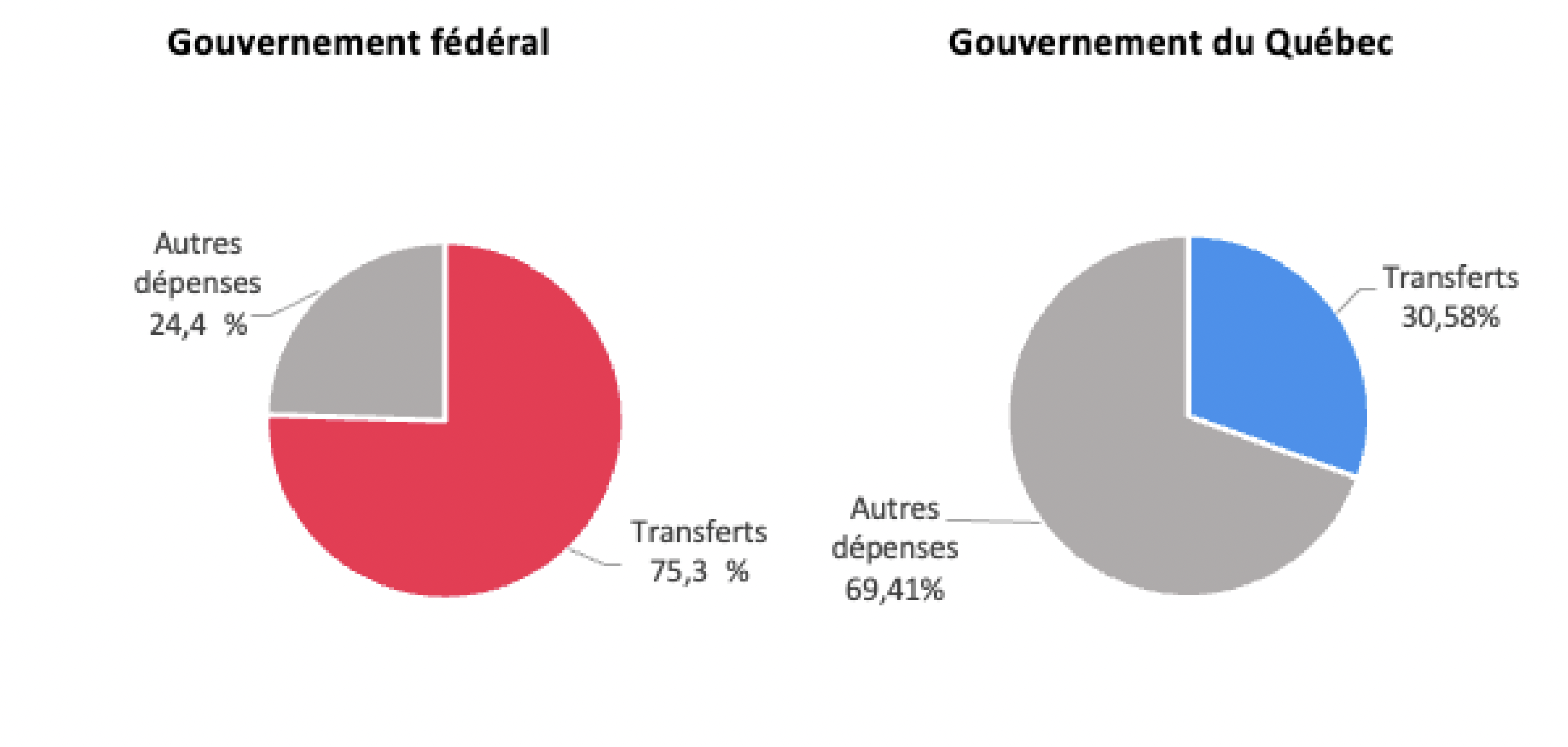
La figure 1 ci-dessous montre bien pourquoi la gestion quotidienne de services aux citoyens n’est pas le fort du gouvernement fédéral.

Figure 1 : Dépenses du gouvernement fédéral et du gouvernement du Québec, 2021Sources : Comptes publics du Canada ; Comptes publics du Québec

Le gouvernement fédéral est un animal particulier, plus habitué à émettre des transferts aux individus, aux entreprises et aux gouvernements, et à énoncer des normes associées à ces transferts, qu’à livrer des services à la population. L’année 2021 exagère un peu le trait, puisque la pandémie a engendré son lot de transferts exceptionnels. Mais la logique générale ne change pas. Il y a plus de vingt ans, le rapport de la Commission sur le déséquilibre fiscal faisait état de proportions assez semblables.

Les difficultés actuelles du gouvernement Trudeau ne sont donc pas si exceptionnelles. Le gouvernement fédéral demeure principalement une machine à récolter et à distribuer des ressources fiscales et il a tendance à se perdre quand il s’agit de gérer des programmes concrets.

La solution réside donc moins dans une réforme additionnelle de la fonction publique fédérale que dans une meilleure compréhension du fonctionnement de la fédération. En premier lieu, il faudrait améliorer l’équilibre fiscal en laissant davantage de ressources propres aux gouvernements provinciaux, dont la tâche principale consiste justement à livrer des services à la population.

Ensuite, pour des raisons évidentes, il conviendrait de prendre avec un grain de sel les volontés de leadership fédérales sur des questions de compétence provinciale. Notant dans une formulation bien à lui qu’en santé « ce n’est pas juste pitcher de l’argent vers le problème qui va le résoudre », M. Trudeau invitait récemment les provinces à des « conversations » afin de réduire les délais d’attente. Compte tenu de l’état de ses services, il devrait se garder une petite gêne.

En fait, le gouvernement fédéral devrait probablement modérer ses ambitions dans ses propres sphères de compétence, en adoptant des objectifs plus réalistes en immigration par exemple, afin d’éviter les échecs récurrents de gestion.

Mais les difficultés actuelles ne sont pas nouvelles, et elles ne se résorberont pas facilement.

Source: Quand les gouvernements trébuchent

Photos That Helped to Document the Holocaust Were Taken by a Nazi

Of interest, and the importance of what is “outside the frame” and context to understanding these and other photographs:

On June 20, 1943, bewildered and terrified families, laden with baggage and branded with yellow stars, were forced into Olympiaplein, one of this city’s most recognizable public squares. Few knew where they were going, or for how long, so they wore their winter coats despite the blazing sun as they registered with the Nazi authorities.

A Dutch photographer, Herman Heukels, moved through the crowd, taking pictures of people who would soon be deported to concentration camps. His images would be the final portraits of many of these people, who were among 5,500 sent that day from Amsterdam to Westerbork transit camp, and then on to “the east.” The vast majority would never return.

Heukels’s photos are some of the strongest visual evidence used by historians to illustrate the Holocaust in the Netherlands, which took the lives of more than 102,000 of the estimated 140,000 Jewish civilians who lived in the country before World War II.

Yet despite their ubiquity in books and films, few people outside of scholarly circles know that these images were actually taken by a Dutch Nazi. He intended to depict Jews in a demeaning light. Instead, he ended up paying stark witness to the atrocities of the Third Reich.

“These are very famous photos, some of the most requested photos in our archive from across the whole world,” said René Kok, a researcher at the NIOD Institute for War, Holocaust and Genocide Studies in Amsterdam. The institute holds an archive of about 30 original Heukels photos from the Dutch Ministry of Justice, which confiscated them as part of his postwar collaboration trial.

In recent months, a deeper sense of Heukels’s beliefs and motivations has emerged from a biography published in Dutch this spring that reveals how an ordinary young man from Zwolle became radicalized as a member of the Dutch Nazi party. The book, by Machlien Vlasblom, a Dutch World War II historian, provides new insights into how Heukels betrayed Jewish people from his town, looted their businesses and property, and recorded their history as a press photographer for the Dutch S.S.

“He captured them at their weakest moments,” Vlasblom said in an interview, “and the way he acted there was rude and brutal. Of course, he put the Nazi ideology into these images.”

How does this new information change the way we might look at these photos? Or how historians might use them, or contextualize them in the future?

The photos are “quite exceptional,” said a NIOD researcher, Kees Ribbens, a professor of Popular Historical Culture and Mass Violence at Erasmus University Rotterdam, because they “show the Holocaust taking place in a very well-known place in the center of Amsterdam. They show how the whole bureaucracy of deportation worked.”

Yet, these are “not innocent images,” said the Amsterdam-based Israeli artist Ram Katzir, who recently used one of Heukels’s pictures as the foundation for a memorial he created for the site of deportations. The artwork, “Shadows,” unveiled on the 79th anniversary of the raid in June, reproduced the shadows of the deportees from the photos, in the exact locations on Olympiaplein where they were last documented alive.

“We had no names of any of the victims,” said Katzir, so he deliberated a lot about whether to include Heukels’s name on the information plaque. In the end, he decided to do so. “It’s a double-edged image; and if you hide that, you hide the role of the collaborator.”

Katzir added, “When you look at the information plaque, you’re standing exactly where the photographer stood.”

In fact, a majority of the surviving images of Jewish persecution in the Netherlands were “made from the point of view of the persecutor,” Ribbens said. These include those by Bart de Kok, a member of the Dutch Nazi Party, known as N.S.B., and a German press photographer, Franz Anton Stapf, who captured some of the last images of Amsterdam’s Jewish community before it was decimated.

Janina Struk, author of the 2005 book “Photographing the Holocaust: Interpretations of the Evidence,” said that in the postwar period, photos taken by bystanders, perpetrators and victims were “all kind of mixed together,” and hardly anyone asked who had shot the photos or for what purposes.

“Until quite recently, historians have not really been so concerned about who took the pictures, and why they took them and what they were for,” she said. “It’s been rather historians using pictures as illustrations of a text, rather than being a text themselves.”

In recent years, she added, there has been a greater emphasis on contextualizing the images, explaining how they were made, so that viewers have a better understanding of what they’re looking at — and so people can make better ethical choices about how to present them.

Ribbens said that in learning that Heukels’s aim was to publish his photos in Storm S.S., a Dutch Nazi propaganda weekly (they were never published there), we can think about what he chose to leave out of the frame. In his series, he said, we don’t see the Nazi officials or the Dutch police who were forcibly rounding up civilians.

It doesn’t automatically raise the question: Who organized this, who is responsible for this persecution?” he said. “People show up, and it’s not clear what kind of stress they’re under, why they’re sent here, what choice did they have in leaving their homes, why they didn’t find a hiding place? What was so threatening about it?”

The official policy of the German occupiers was that no images of Jewish people could be published in the “legal” Dutch press, explained NIOD researcher and photography expert Erik Somers. Propaganda newspapers, however, could print such images alongside articles with expressly antisemitic content.

As a result, a high proportion of Holocaust images, both in the Netherlands and elsewhere, were taken by Nazi-endorsed propaganda photographers who had explicit permission to carry cameras, Struk said. Other images came from German soldiers who specifically sought out “souvenir” images of Jews who they thought fit a physical stereotype.

“We know that the Germans used photography as a weapon, and they invested a great deal in propaganda photography,” said Sheryl Silver Ochayon, program director for Echoes & Reflections, an educational arm of Yad Vashem World Holocaust Remembrance Center in Israel.

“Photographs never killed anyone,” she added, “but what photographs can do is they can justify an ideology. If you present your victims as low or passive, or like vermin, you can justify a genocidal plan of action, as the Germans did.”

Vlasblom began her research when a friend from church, Gerard Visser, asked her to look at a box of family letters he had inherited. Although he knew the papers concerned his two great-uncles, Herman Heukels and Jan Heukels, who was also a Nazi collaborator, he said in an interview, “I didn’t really know the family structure, so I didn’t know who sent what to whom or why.”

Not everyone in Visser’s family is pleased that Vlasblom’s book, “We waren supermannen (We Were Supermen),” which also includes information about Jan Heukels, called attention to these two ancestors who were collaborators.

“You hear all the heroic resistance stories from Holland,” Visser said, “but there are people like the Heukels, who really did bad things. I felt that part of a country’s history should also be told.”

Does knowing more about Herman Heukels’s personal biography imply that historians should use these photographs in a different way — or even use them less often?

Somers from the NIOD, the Dutch archive, said these images continue to be a valuable historical source, but the Heukelses’ story underscores the importance of providing context to pictures.

“You have to find out from the beginning the elements of those photos,” he said, “who made the photo and for what purpose, and in what context?”

Struk added, “We need to move away from the idea that a photograph is just a window on the world. It isn’t. It’s a very edited version of what the photographer chose to photograph.”

Source: Photos That Helped to Document the Holocaust Were Taken by a Nazi

Saskatchewan seeks the same autonomy on immigration that Quebec already enjoys

More ambitious than Ontario’s demands (largely focussed on expanded Provincial Nominee Program numbers) and accordingly unlikely to be met given immigration is shared jurisdiction and Quebec’s situation is different than other provinces.

But the interesting political twist is the reference by the Minister Harrison to backlogs: “By transferring selection of all immigrants to our province, including in the family class, the federal government can focus on addressing the outrageous processing times for admissions that are causing such issues for hundreds of thousands of potential new Canadians.”

Saskatchewan is pushing for Quebec-style autonomy over immigration with its Saskatchewan Immigration Accord.

Jeremy Harrison, the province’s Immigration and Career Training minister, met with federal and provincial immigration ministers earlier this week to put forward “a detailed proposal” that would give Saskatchewan similar authority over immigration that has already been guaranteed to Quebec.

The province announced Thursday that the accord would give Saskatchewan “sole authority” to nominate newcomers moving to the province, including control over the family class of immigration.

The plan includes “a transfer of federal resources for settlement services to the Province of Saskatchewan” and a guaranteed provincial allocation of nominees each year that would be proportionate to the population of Saskatchewan within Canada.

“Saskatchewan requires more autonomy and flexibility over immigration in order to meet its economic needs and address gaps in the labour market,” Harrison said in a news release Friday.

“Canada should be focusing its efforts on reducing processing times for applications and let the provinces select immigrants and ensure their effective settlement.”

The Quebec Accord grants that province the sole responsibility for the selection of economic immigrants, while Canada bears responsibility for admission based on national security.

While Quebec manages economic immigration to the province — a power other provinces and territories in Canada do not have — the federal government is responsible for family reunification and the admission of refugees, which represents close to half of newcomers to Saskatchewan every year.

“When it comes to immigration Saskatchewan expects the same deal as Quebec. Immigration is a key component of our government’s plan to grow the province to 1.4 million people and create an additional 100,000 jobs by 2030,” Harrison said.

“Provincial governments are in the best position to respond to local labour market needs with new Canadians. The provinces should not be limited by economic categories or caps on provincial nominee programs set by the federal government.”

Speaking to journalists about health-care staff shortages, NDP Leader Carla Beck said immigration could be a part of the solution.

“They seem to want to emulate Quebec. We want to have very clear criteria. I don’t think this is something that should be hidden from the people of Saskatchewan,” Beck said.

“That criteria should be fair to people who are looking to relocate here to Saskatchewan. It’s on any government to show that our immigration system is fair and doesn’t doesn’t contain any discrimination.”

The government expects to exceed its current cap of 6,000 under the Saskatchewan immigrant nominee program this year, and seeks a proportionate share of national immigration at a “minimum 13,000 positions allocated to the province in 2022.”

The transfer in settlement funding, according to the release, would translate to approximately $42 million transferred to the province annually.

“As Canada’s longest serving Immigration Minister, I have long maintained that the transfer of these authorities makes sense from the perspective of the provincial and federal government – and most significantly – for new immigrants coming to Saskatchewan,” Harrison wrote.

“Simply put — we know our province’s needs and labour markets better than the Government of Canada. By transferring selection of all immigrants to our province, including in the family class, the federal government can focus on addressing the outrageous processing times for admissions that are causing such issues for hundreds of thousands of potential new Canadians.”

Source: Saskatchewan seeks the same autonomy on immigration that Quebec already enjoys

Organ donations remain a hard sell among some groups

Of note. Wonder whether this changes for the second generation:

Religions, beliefs, culture, and even local history influence what Canadians — especially immigrants — think should happen to the body after death. These beliefs and traditions surrounding death could impact medical research opportunities. 

In Ontario, medical schools depend on donated bodies to train future medical professionals. ‘Body donation’ involves a whole body given to schools of anatomy for educational and research purposes.

Western University in London, Ont., is among the Canadian universities feeling the impacts of a lack of body donations, reporting that cadaver availability is down by 20 per cent during the COVID pandemic. Medical schools have been scrambling for bodies and even resorting to synthetic alternatives to continue their studies. 

Low supply

Although cadaveric whole-body donations are of utmost importance for medical education, the number of persons who choose to donate bodies remains low.  Organ donors, on the other hand, have more willing participants. According to a survey conducted by Ipsos Reid, 81  per cent of Canadian respondents are willing to donate their organs after death. Although most are willing and support the idea, the survey found that only 54 per cent actually carry documentation that indicates their consent to organ donation and 39 per cent have not discussed with their families their wishes when it comes to organ donation. 

Immigrants in Canada mostly stay clear of whole-body donations, and their numbers hardly make a dent in body supplies. Most of them owe allegiance to their faiths, religious practices and culture which do not encourage body donations.

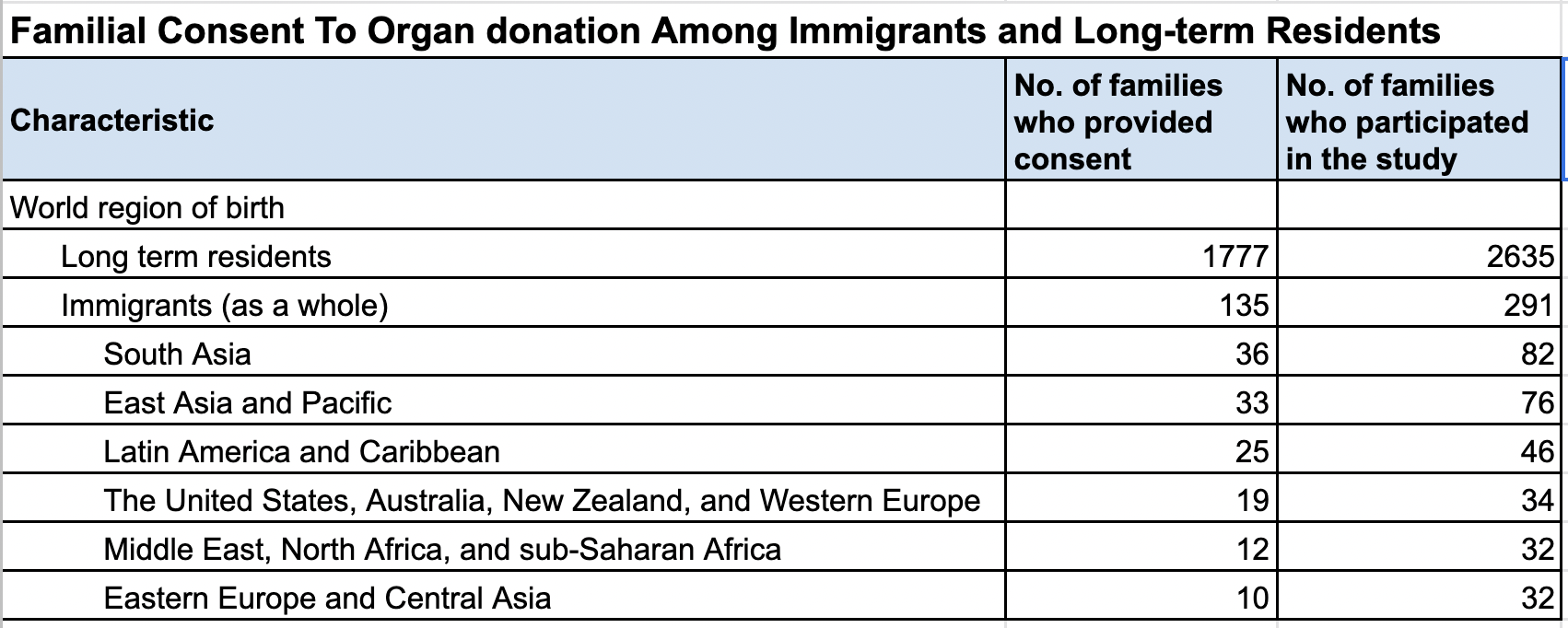
According to 2017 study, families of immigrants in Ontario are less likely to provide consent for organ donation compared with families of longterm residents (46.4 per cent versus 68.8 per cent). Another study shows that immigrants were much less likely to register for deceased organ and tissue donation in Ontario (11.9 per cent versus 26.5 per cent). The largest numbers of unregistered immigrants were from India, China and the Philippines.

Respect for dead bodies manifests itself in diverse ways in different cultures. According to Nazira Tareen, a prominent community builder and spiritual caregiver of Ottawa’s Muslim community, Muslims do not donate bodies for religious reasons.  

“[The] Quran wants bodies to be interred as soon as possible after death. Islam forbids defilement of the body whether by dissection, removal of tissues or organs. A dead body deserves dignity with a timely burial,” said Tareen.

“We pay spiritual importance to an ‘intact’ body by following the standard practices of shrouding the body with five yards of white cloth and a coffin,” according to Tareen.

Table above shows that families of immigrants were less likely to provide consent compared with families of long-term residents (46.4% [135 of 291] vs 68.8% [1777 of 2582]). It also showcases the number of immigrant families who provided consent to organ donation by region of birth. Table made by Daphné Dossios with data found on Familial Consent for Deceased Organ Donation Among Immigrants and Long-term Residents in Ontario, Canada: A Population-Based Retrospective Cohort Study

Another study with interviews and focus groups about Chinese Canadian beliefs toward organ donation found that among its participants, religion or spiritual beliefs, a lack of knowledge about donation, and generational impressions of organ donation were factors that influenced decisions on organ donation after death. The study notably found that values and beliefs about keeping a body intact after death is a major barrier to organ donation.

“There’s a saying in Chinese that in order to rest in peace, one needs to have everything intact in the body after one is dead. So if you take away something and then it’s considered to be something missing after death, then the person would not enjoy good after death or after life”, explains a participant of Chinese descent, interviewed for the study.

A similar study among Indo-Canadians in British Columbia also found religion and beliefs about dying and death could influence decision-making in organ donation. The study also highlights that Indo-Canadians have little information and are not familiar with the B.C. system of registering as an organ donor, which could constitute a hurdle. According to some participants, language could possibly be another barrier, as presentations about organ donation in B.C. are not provided in Hindi.

Vijay Dhavale, an Indian-born Canadian — who is a four-time recipient of two prestigious Government medals — chose to donate his parents’ bodies to medical colleges (in 2006 and 2009) and also donated his wife’s body in 2019.

Dhavale, who has been in Canada for 49 years and is currently based in Ottawa, is a Hindu. 

“My family believed in being useful even after death. In my will, I have asked that my body be donated for learning purposes.”

Dhavale said his decision to go for body donations was influenced by the example of Sage Dadhchi (a figure in Hinduism) who willingly gave up his life so that Lord Brahma (God of creation in Hinduism) could fashion weapons from his bones to defeat the demons. “In death, I am celebrating life, I want my body to be useful too like the Sage’s.”

In Canada, another challenge often faced by bereaved immigrants is the choice to inter the deceased in the host country or repatriate the remains for burial in the country of origin. Most often parents of immigrant students ask that the bodies are returned to the mother country so that they can conduct the last rites.

Impacting medical education 

The dearth of cadavers is causing a disturbing deficiency directly impacting the quality of medical education in Canada. Practicing on cadavers helps with the sensory modalities — the touch, the feel, the perception of depth.  “Students can listen to theories about the structure of the heart, see pictures of the structure, but it’s not until they hold the heart in their palm that they can really appreciate it,”  according to an anatomy professor at Queen’s University, Dr. Leslie Mackenzie. Queen’s University in Kingston, which actively runs donor campaigns and educates the public, receives 20 to 40 body donations every year. 

The University of British Columbia (UBC) on its website states that more than 1,000 students every year in different medical programs are trained in anatomy using cadavers. During pre-pandemic times, UBC received 80 to 120 human cadaver donations a year, “but programs now receive 50 per cent of that number,” observed Dr. Olusegun Oyedele, associate professor of teaching in the UBC department of Cellular and Physiological Sciences. 

In Canada, bodies can be donated by bequeathing the body to universities across the country. Haley Linklater who oversees the body bequeathal program at the Schulich School of Medicine and Dentistry, London, Ont., confirmed in an email the urgent need for bodies. 

“The University is currently accepting new donors,” Linklater wrote, “We need 100 or more every year to be able to assist in all of our teaching and to contribute to research, but we get a few less than that, usually 75 to 85.” 

Linklater isn’t sure what to attribute to the drop in body donations except for the fear of infection during the pandemic period. In many cases, she found the bereaved relatives desired to have the body available for conducting a traditional rite, and hence they held back on body donations. According to Linklater. In 2021 and 2022 thus far, “we’ve only had 60 to 65 donors.” 

In face of this cadaver shortage, some medical schools are using high-tech mannequins, computer software and digital simulators as an alternative. In 2018 for example, Wilfrid Laurier University (WLU) in Waterloo, Ont., received two full-sized, multi-functional synthetic human models from SynDaver making WLU the first institution in Canada to possess two full-body synthetic humans. As one can read on the company website, “the tissues are [even] a better representation of live tissue than the dead tissue of a cadaver.”

Source: Organ donations remain a hard sell among some groups

Two years after signing BlackNorth Initiative, majority of companies have failed to make substantial progress on diversity, survey shows

Good to see the tracking. Good highlighting of some of the better practices that can be more broadly applied (both for Blacks and other minorities):

Some of the largest companies in Canada that announced high-profile commitments to address anti-Black systemic racism two years ago have made major strides in improving the number of Black employees hired and elevated into executive roles, a Globe and Mail analysis has found.

But those companies remain among a minority of signatories of the BlackNorth Initiative – a 2020 pledge aimed at tackling systemic racism – to make substantial progress toward the diversity goals they committed to meet over five years.

On three prominent metrics – the number of Black employees, Black executives and Black directors – only about 10 per cent of the 481 companies that signed on have reported an improvement in any of those categories over the past two years.

Among 145 companies that responded to The Globe’s survey in the spring of 2022, the median percentage of Black employees increased to 4.8 per cent, up from 3.7 per cent in 2020, before companies signed the BlackNorth pledge.

But 70 per cent of companies that signed the pledge either did not respond to The Globe’s survey this spring about the racial composition of their work force, or said they did not track that data. Thus, improvements in the number of Black and other racialized employees since 2020 were only apparent among the minority of companies that responded to The Globe with detailed data.

“I think it’s safe to say that a low response rate correlates to the slow amount of change that is happening,” said Kike Ojo-Thompson, founder and chief executive of the KOJO Institute, a Toronto-based diversity, equity and inclusion consultancy.

While projects such as the initiative encourage companies to assess themselves and provide external accountability, they also highlight areas in which corporate Canada has yet to improve.

To Dahabo Ahmed-Omer, executive director of the BlackNorth Initiative, it’s no surprise that many companies are slow to make progress. “It’s not just about putting a signature on the dotted line. That’s not what this initiative is about,” she said.

The initiative, a Toronto-based non-profit organization, was founded by Bay Street financier and philanthropist Wes Hall in July, 2020, amid a wave of global Black Lives Matter protests sparked by the murder of Minneapolis resident George Floyd by a white police officer. Broadly speaking, the initiative encouraged employers to commit to targets to raise the number of Black employees, and to ensure no barriers exist for Black employees trying to advance.

Companies were challenged to commit to a seven-pronged pledge over five years, including promises to have at least 3.5 per cent of board and executive roles occupied by Black people by 2025, and ensure Black student hires make up 5 per cent of the overall intern population of a workplace. Signatories also committed to investing at least 3 per cent of corporate donations in organizations that create economic opportunities in the Black community.

The initiative was swiftly embraced by corporate Canada. Within days of its launch, more than 200 prominent companies, including Rogers Communications Inc., most of the Big Five banks, and multinational heavyweights such as Coca-Cola and Adidas signed on. Many were quick to issue news releases, reiterating their commitments to diversity, and promising to address anti-Black systemic racism within their workplaces.

Over the following 12 months, close to 500 companies of all sizes – including The Globe – signed on. BlackNorth itself expanded – in headcount and the value of corporate donations it received – as it became the pre-eminent entity advising corporate Canada on diversity and equity.

This spring, The Globe surveyed all 481 companies that have signed the pledge to assess progress toward the five-year goals. The survey was similar to The Globe’s survey last yearof 209 companies that signed the pledge in July, 2020.

The Globe asked companies to respond to an 18-question survey based on the seven goals in the pledge, and gave companies roughly six weeks to respond.

The questions were designed to determine how the diversity of the companies’ work forces – particularly the composition of Black employees – has changed since the summer of 2020. The Globe also collected data on the number of Black directors and executives.

The Globe showed some improvement itself in the number of Black executives and BIPOC (Black, Indigenous and People of Colour) employees in its work force. Currently, 10 per cent of executive roles are held by Black employees, up from zero in 2020.

The Globe doesn’t track the total number of Black employees, but says 30 per cent of employees are now BIPOC, up from 25 per cent before The Globe signed the pledge in late 2020. However, as a private company with a small board, The Globe does not have a Black board member.

Critically, just 30 per cent of BlackNorth signatories – or 145 companies – responded to The Globe’s survey, significantly lower than last year’s response rate. Twelve additional companies did not respond, but provided separate written submissions on how they worked toward meeting their diversity goals.

Among the companies that responded, many either chose not to disclose numerical data on the racial composition of their organizations, or said they did not track it.

However, almost all the companies that responded, even those that did not last year, said they have established diversity leadership councils and come up with a strategic “diversity and inclusion plan,” which were two requirements of the BlackNorth pledge.

Other key findings of The Globe survey from the 145 companies that responded:

  • The median number of Black employees across those companies increased over the past two years – from 3.7 per cent in 2020, to 4 per cent in 2021, to 4.8 per cent in 2022.
  • The median number of BIPOC employees also increased – from 25.6 per cent in 2020, to 31.9 per cent in 2021, to 33 per cent in 2022.
  • The median number of Black executives increased from 0 per cent in 2020, to 1 per cent in 2021, to 2 per cent in 2022.
  • A majority of companies tracked the number of Black directors on their boards. The median percentage increased from 0 per cent in 2020 and 2021, to 0.5 per cent currently.
  • There was a marked improvement in the number of companies that tracked diversity data since signing the BNI pledge. For example, before signing, just 40 per cent of the 145 companies said they tracked data on the number of Black employees. In 2022, the proportion increased to 60 per cent.
  • 30 companies with more than 5,000 employees – including Manulife Financial Corp., SickKids hospital and HSBC Canada – made significant gains in the number of Black directors. The median number of Black board members was 6.5 per cent in 2022, increasing from 2.35 per cent last year.

The results were, for the most part, better than last year, when a majority of companies made little to no improvement in hiring or elevating the number of Black people, mainly because they did not have the right systems in place to track diversity data.

Source: Two years after signing BlackNorth Initiative, majority of companies have failed to make substantial progress on diversity, survey shows