UK Conservative Leadership: Sunak’s hardline immigration plan includes a cap on refugees and floating detention centres for asylum seekers

Of note as the two contenders compete for the anti-immigration vote:

Rishi Sunak has sparked outrage as he set out a hardline plan to deal with immigration if he becomes prime minister. The package features a cap on annual refugee numbers and the withholding of aid from some of the world’s poorest countries if they refuse to take back failed asylum seekers.

The former chancellor, who is trailing Liz Truss in polls of Conservative Party members in the current leadership election, said he would ramp up the controversial plan to operate deportation flights to Rwanda and that he would seek to establish similar schemes with other countries

And he said he would bar anyone arriving by small boat across the Channel from remaining in the UK – despite the fact that the majority of unauthorised arrivals are currently awarded asylum status.

Meanwhile, Ms Truss has also doubled down on support for the controversial plan, calling it the “right” policy and indicating she could extend the scheme further.

“I’m determined to see it through to full implementation, as well as exploring other countries that we can work on similar partnerships with. It’s the right thing to do,” she told the Mail on Sunday.

Source: Sunak’s hardline immigration plan includes a cap on refugees and floating detention centres for asylum seekers

Russia moves to shut agency handling immigration to Israel amid Ukraine rift

Of note:

Russia has threatened to shut down a major Jewish agency that promotes immigration to Israel amid tensions between the two nations over the invasion of Ukraine.

The Justice Ministry seeks to liquidate the country’s branch of the Jewish Agency for Israel, according to a notice from Moscow’s Basmanny district court, where the case will be heard Thursday.

The court’s website does not say what laws the nonprofit agency had broken, and Russia’s Justice Ministry, which filed for its dissolution on July 15, did not respond to a request for comment.

Kremlin press secretary Dmitry Peskov said the dissolution was related to a breach of “compliance with Russian legislation.” He refused to give further details at a news conference Friday.

Acting Israeli Prime Minister Yair Lapid said in a statement Thursday that a delegation with representatives from his office and several other ministries would travel to Russia for talks ahead of the hearing about the agency, which operates in coordination with his government.

Lapid accused Russia of carrying out war crimes in Ukraine when he was foreign minister in April.

Established in 1929, the Jewish Agency, or Sochnut, was instrumental in the formation of the state of Israel in 1948.

It was banned by the Soviet Union, where state-sanctioned antisemitism barred Jews from many jobs and schools. Yuri Kanner, the president of the Russian Jewish Congress, told NBC News on Friday that an office opened in Russia shortly after the Soviet bloc collapsed in 1989.

Since then, it has helped to advance Israel’s Law of Return, which states that any Jewish person, or a person with one or more Jewish grandparents, has the right to settle in Israel and obtain citizenship.Hundreds of thousands of people have relocated from Russia.

“This is an old and reputable institution,” Kanner said, adding that it had never been embroiled in any scandals.

NBC News has asked the agency for comment.

Calls to combat Islamophobia prominent in record-setting June for federal advocacy

Of note. Reflects the anniversary of the London killings:

Representatives of Canada’s Muslim population were on Parliament Hill in June calling on Ottawa to do more to combat Islamophobia during an advocacy event held on the anniversary of the fatal attack against an Ontario Muslim family.

“That attack forever changed the way that Muslims view their relationships with Canada and the country as a whole, and so we noticed a need for more,” said Fatema Abdalla, the communications coordinator with the National Council of Canadian Muslims (NCCM). “We placed our call for more to be done against systemic Islamophobia, and we’ve been calling for that for many years, but there’s so much more that needs to be done.”

The NCCM led the way in federal lobbying in June, filing 64 communication reports for the month. This was more than twice the number of communication reports contributed by other leading advocacy groups during the month, which included the Grain Farmers of Ontario (GFO), which filed 29 reports, and the Canadian Association of Petroleum Producers (CAPP), which filed 26.

All but three of the NCCM’s communication reports for last month were for activity on June 6, when the organization’s representatives were on the Hill for a federal advocacy day.

Communities across Ontario held marches and vigils on June 6 to commemorate the lives of a Muslim family killed on the same date last year in London, Ont., On June 6, 2021, Yumna Afzaal, 15, her mother Madiha Salman, 44, father Salman Afzaal, 46, and her grandmother, Talat Afzaal, 74, were killed when a vehicle jumped a curb while they were out for a Sunday walk. Police believe the driver targeted the family because of their Muslim faith.

The youngest son, who family members have asked not to be named, was injured but survived.

Abdalla told The Hill Times that this wasn’t the only attack of its kind in Canada, and referred to the terrorist attack on Jan. 29, 2017, where 27-year-old Alexandre Bissonnette shot and killed six worshipers at a mosque in Québec City.

To help protect Canada’s Muslim population, the NCCM’s representatives are pushing for the Liberal government to develop a national action plan to combat Islamophobia. The plan should include a national support fund intended to help survivors of hate-motivated crimes, and funding to improve security at mosques, according to Abdalla. NCCM members would also like the federal government to create a provision in the criminal code that mandates a special process to deal with hate crimes, including stiffer penalties for violent offenders and a rehabilitation path for specific and relevant offenders.

NCCM representatives met with Prime Minister Justin Trudeau (Papineau, Que.), Deputy Prime Minister Chrystia Freeland (University-Rosedale, Ont.), and nine other federal ministers during the advocacy event on the Hill. The NCCM is represented on the federal lobbyists’ registry by CEO Mustafa Farooq and assistant advocacy officer Amar Abdisamed.

During the advocacy day, Minister of Diversity and Inclusion Ahmed Hussen (York South-Weston, Ont.) announced that Ottawa has begun the hiring process to find a Special Representative on Combating Islamophobia. This announcement fulfilled a Liberal government commitment made in January, according to an NCCM press release from June 27.

Islamophobia is a daily reality for far too many Muslim communities in Canada and around the world, according to Daniele Medlej, the director of communications in Hussen’s office, in an emailed statement to The Hill Times on July 20.

“From the Quebec Mosque shooting to the London attack just last year, we are reminded of the devastating consequences Islamophobia can have,” said Medlej in the email.

Medlej did not provide details on when the federal government is hoping to have filled the role of Special Representative.

In the email, Medlej said the Special Representative will serve as “a champion, advisor, expert and representative” to the Liberal government, and will collaborate with domestic partners, institutions and stakeholders to support Canada’s efforts to combat Islamophobia, anti-Muslim hate, systemic racism, racial discrimination and religious intolerance.

The Liberal government is committed to getting the appointment of the Special Representative right, and will share more details as they become available, she added.

“[The Special Representative] will impact Canada’s fight against Islamophobia by enhancing our efforts, addressing barriers faced by the community, and promoting awareness of the diverse and intersectional identities of Muslims in Canada,” said Medlej in the emailed statement. “Our government stands with, and continues to support, Muslim communities across Canada. We unequivocally condemn Islamophobia, hate and discrimination of any kind.”

Also on June 6, the NCCM welcomed an announcement by Liberal MP Salma Zahid (Scarborough Centre, Ont.), who said she plans to begin public consultations on a private member’s bill that would aim to hold intelligence and justice officials accountable for breaches of the “duty of candour” they have towards the Federal Court. The duty of candour refers to the responsibility that the Canadian Security Intelligence Service (CSIS) officials and Department of Justice lawyers have to present a judge with all the relevant facts, including information that may sway the judge against their request.

Zahid’s announcement followed complaints she has received from her constituents and from racialized Canadians in general about being unfairly targeted by CSIS, as previously reported in The Hill Times.

The NCCM argued in the June 27 press release that violations of the duty of candour by intelligence officials has caused serious and long-term harm to marginalized communities.

June was a record-breaking month for federal lobbying, with 2,587 communication reports in total posted for that month, according to a search of the federal lobbyists’ registry on July 21. June had the highest total of communication reports for that month since at least 2009, which is the earliest that online records are available for June. The previous record for June was 2,468 communication reports filed in June 2021.

Source: Calls to combat Islamophobia prominent in record-setting June for federal advocacy

ICYMI – Australia: Spike in racism compels national strategy

Of note:

Spikes in anti-Asian sentiment and discrimination against Indigenous, Jewish and Muslim groups since the COVID-19 outbreak have triggered moves for a new national framework to combat racism.

Incidents targeting Aboriginal and Torres Strait Islander people, amplified by the Black Lives Matter movement, and the rise of far-right extremism have also highlighted a need for change.

With no current coordinated national strategy to curb racism, the proposed framework – uniting governments, NGOs, businesses, educators, human rights agencies and civil society – sets out legislative improvements, and upgrades data collection and discrimination protections.

While the UK and the US have systems to collect data on racist incidents, Australia has no official statistics, instead adopting ad hoc indicators, all of which point to spikes in racism since the start of the pandemic.

Race Discrimination Commissioner Chin Tan says there is limited understanding of anti-racism and racial equality measures and their impact across Australia, increasing the need for improved data collection, evaluation and sharing.

“A National Anti-Racism Framework will provide a central reference point for actions on anti-racism to be undertaken by all sections of Australian society,” Mr Chin told AAP.

“It will identify opportunities to address racism through coordinated strategies, set measurable anti-racism targets and provide tools and resources to address racism.

“It’s not enough to simply condemn racism. We need clear goals and the means to ensure accountability to commitments if we are to make progress on tackling racism.”

Over the past year, the commission has held more than 100 consultations for the framework with about 300 organisations nationwide and received 171 submissions.

During COVID-19 restrictions right-wing extremist groups tried to further embed anti-government sentiment by portraying administrations as overreaching and “globalisation, multiculturalism and democracy as flawed and failing”, according to ASIO.

At a 2021 parliamentary inquiry into extremist movements and radicalism in Australia, the national security agency confirmed investigations into ideologically-motivated violent extremism comprised about 40 per cent of its cases, compared to 10 to 15 per cent in 2016.

Jewish communities have been documenting racist incidents since a 1989 national inquiry into racist violence, spokesman Jeremy Jones from the Australia/Israel & Jewish Affairs Council told AAP.

The inquiry was established by the then-Australian Human Rights and Equal Opportunity Commission.

“Since then, every Jewish organisation and Jewish person in Australia who experiences or hears about an anti-Semitic incident sends it to a central database,” he said.

“So we have a long-term way of saying what sort of incidents are happening and where, is the situation getting better or worse in a particular year, and what is effective, or what isn’t.”

Racial incidents taken to court in three states under the federal Racial Hatred Act delivered positive outcomes with anti-Semitism decreasing in those geographic areas.

Mr Jones said telephone threats which led to abusers’ identities being divulged also reduced anti-Semitic incidences.

It’s difficult to compare exact numbers of verbal incidents originating overseas because many were online, but the global trend shows more people are getting away with hate crimes and harassment.

“Particularly during the COVID lockdown, there were horrific anti-Semitism conspiracy theories and propaganda than at any time during the post-war period,” Mr Jones said.

The Jewish community is also addressing the rise in incidents in various ways through the Australian National Dialogue of Christians, Muslims and Jews – which aims to foster respect and mutual understanding of other faiths – and by multicultural dialogue and Jewish-Indigenous relations.

Any national anti-racism framework must balance freedom of expression with state and federal laws that protect people from racism, Mr Jones said. It should also look at overseas experiences for examples of best practice.

“It’s far too early to say whether this will be a successful campaign or if it was one well-intentioned,” Mr Jones said.

Racist attacks against Asians and Asian Australians surged after the outbreak of COVID-19, as Wuhan in China was recognised as the source of the virus.

Since April 2020, the COVID-19 Coronavirus Racism Incident Report, partnering with several groups including the Asian Australian Alliance, collected more than 410 reports of virus-related Asian racism.

Most involved physical and verbal attacks.

Of those, 37 per cent were in NSW, followed by 32 per cent in Victoria and 13 per cent in Queensland, with most attacks occurring in the capital cities.

Federation of Ethnic Communities’ Councils of Australia CEO Mohammad Al-Khafaji said incidents of racism were generally under reported, “so the same goes for reporting of Islamophobia”.

Fears over anti-Muslim sentiment were exacerbated by the 2019 Christchurch mosque attack in New Zealand and reflected in an Islamophobia Register Australia report.

In collaboration with Charles Stuart University Centre for Islamic Studies and Civilisation, the latest 2018-19 report found offline cases increased four times and online cases rose 18 times two weeks after the Christchurch killings.

The report analysed 247 verified incidents from January 2018 to December 2019 and found 138 occurred in physical circumstances, while 109 occurred online.

The research aims to raise awareness of the increase and normalisation of Islamophobia and take action to counter it.

“What is disturbing … is that Islamophobia continues to occur and that many of the victims are women, distinctively wearing hijabs,” Mr Al-Khafaji said.

“What is appalling is that Islamophobia and racism, in general, seems to still be socially acceptable to some Australians.”

A revamped Human Rights Commission advertising campaign has been designed to increase awareness of racism and equip Australians the tools to respond.

Source: Spike in racism compels national strategy

IRCC Anti-Racism Strategy 2.0: “Energy, Conviction and Courage” [too preachy for my taste]

Apart from the overly preachy tag line, this strategy reflects considerable work and reflection (disclosure I know some of the people involved). Like so many government reports, far too much emphasis on process and general messaging, but the strategy includes 24 specific action items under four pillars: leadership accountability, equitable workplace, policy and program design, and service delivery.

While it may be churlish to note, reading this detailed over 30 page strategy that clearly involved significant resources across the department is in sharp contrast with IRCC’s inability to deliver on its core responsibilities as seen in immigration and citizenship backlogs and the lack of oversight over Service Canada’s failures on passport.

A large department like IRCC should, of course, be able to “walk and chew gum” at the same time, but, as in so many areas, these kinds of initiatives, valid as they are, further distract or make it harder to deliver on core responsibilities.

Concrete measures highlighted in the report are highlighted below.

Starting with representation, the main gap is with respect to executives with the greatest gap being non-Black visible minorities.

In relation to the overall populations (Census 2016) – Indigenous 4.9 percent, visible minorities 22.3 percent of which Blacks represent 3.5 percent – Black representation at all three levels is the strongest. While the population of Black and non-Black visible minorities will likely be about 10 percent higher in the 2021 Census, the revised numbers are unlikely to change the overall picture significantly.

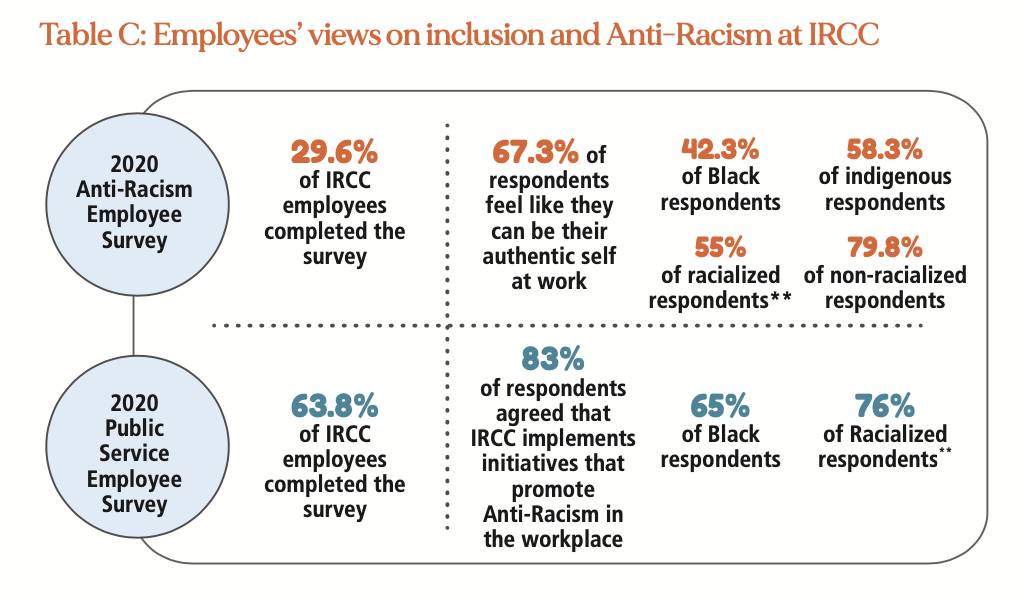
Usefully, the report provides a clear benchmark to measure success: the degree to which IRCC anti-racism initiatives moves the needle on the percentage that feel that “IRCC implements initiatives that promote anti-racism in the workplace.” Current numbers highlight the issue – only 65 percent of Blacks and 76 percent of non-Black visible minorities compared to 83 percent of not visible minorities.

But if the range of initiatives, engagement and comprehensiveness do not move the needle and reduce disparities, one will have to question their effectiveness, the reasons for lack of progress and the reasons why the perception by employees that not much has changed.

Failure to move the needle may also call into question the Clerk’s Call to Action on Anti-Racism, Equity, and Inclusion in the Federal Public Service, as in many ways IRCC was a model department in responding to the call.

And of course, service delivery failures in immigration and citizenship have a greater impact on Black and other visible minorities than than IRCC employees.

Source: Anti-Racism Strategy 2.0

Health care researchers need to ask, ‘Who is Black?’ University of Ottawa professor says

Why not just use Statistics Canada definitions, both visible minority and ethnic ancestry? Are the various terminologies used really that different or significant?

The real challenge lies more with respect to integrating this data with health card information, to allow this king of analysis and treatment, which of course will likely raise privacy issues.

For immigrants, I understand there is work underway to integrate immigration and health data but anonymized to allow for this kind of analysis in relation to health outcomes, information that could then hopefully be available through CIHI:

The inability to find a common term to describe Black people in Canadian health research can perpetuate inequities, a University of Ottawa professor says.

We need precise, accurate language because research informs public health policies, training for health-care workers and culturally appropriate and antiracist health-care practices, says Dr. Jude Mary Cénat, an associate professor of psychology and the director of University of Ottawa’s Interdisciplinary Centre for Black Health, Canada’s first academic research centre dedicated to studying the biological, social and cultural determinants of health for Black communities.

In Canadian health-care research, the definition of “who is Black” can vary widely. Terms such as “African-Canadian,” “Caribbean” and “African” are inconsistent and make it difficult to compare studies, he says.

The terms may include people who do not identify as Black, such as those who are from North Africa, and people from Caribbean nations including Cuba, the Dominican Republic and Puerto Rico, who consider themselves to be Latin American.

From a health research point of view, that can be a problem, Cénat says. One example: A 2019 review of breast and cervical cancer among “Black Canadian” women included 23 studies, but only seven had unambiguously Black participants. Some studies considered “Africa” as a single block and included participants from North Africa, who may self-identify as Arab.

“Most people from Africa are Black. But you can’t assume they are Black,” Cénat says. “You can’t say Elon Musk (who was born in South Africa) is Black.”

Meanwhile, studies rarely differentiate between Black people whose ancestors have lived in Canada for centuries and those who are recent immigrants, he says. The 2016 census found that the 10th most commonly listed country of origin for people in Canada self-identifying as Black was the United States.

Getting a more precise answer may be as simple as asking people “What is your skin colour?” says Cénat, whose commentary was published this week in the Canadian Medical Association Journal.

Researchers have to ask multiple questions, but the first one is how the subject identifies themselves, he says.

Cénat suggests asking research subjects the basic question: What is your skin colour? From there, it can lead to unraveling other questions about origins and ancestry. It’s also important to give research participants the opportunity to give more than one answer so that multiracial people can self-identify.

Asking questions related to race, ethnicity and region of origin may make some people uncomfortable. “We avoid that question. We ask people about their origin, not their skin colour,” Cénat says.

But health researchers can preface their questions by explaining why the questions are being asked and saying that the answers may help to improve health care for Black people in Canada.

“Researchers don’t have to be afraid of it,” he says.

If Black health research continues to be based on data that are unclear or inaccurate, there’s a risk that policies and programs will not meet the real needs of Black communities, Cénat warns.

Asking the right questions can also tease out more nuanced answers. For example, while the prevalence of diabetes is higher in Black communities than in the general population, some Black communities in Canada may be at more or less risk than others.

Cénat points out that, in Ottawa, racial minorities represent more than 30 per cent of the population.

“We need this because our population is a diverse population. We need to know more about the risk factors and the protective factors,” says Cénat, who studies the role that cultural factors play in vulnerability, trauma and resilience.

“We need to work with racial data that is precise. We need to say 10, 20, 30 years in the future that we have done something for these communities.”

Source: Health care researchers need to ask, ‘Who is Black?’ University of Ottawa professor says

How a Canadian lawyer is helping the growing number of ultra-rich looking to exit China

Interesting profile of Canadian immigration lawyer David Lesperance who specializes in business immigration.
Remain unconvinced that governments can design investor immigration or citizenship programs for the ultra-rich that provide meaningful benefits to Canada and Canadians as both the previous federal program, Quebec’s current program and programs of other countries largely demonstrate:
When a Chinese-Canadian billionaire faced a closed-door trial last month, four years after being snatched from Hong Kong, the event did not go unnoticed among China’s wealthy entrepreneurs.
It was the latest sign that they could be next as Beijing pushes down on the country’s most affluent business people, says a Canadian lawyer whose unique practice focuses on building back-up plans for “ultra-high-net-worth” individuals.
That nervousness is fueling a growing and urgent interest in leaving mainland China or Hong Kong, says David Lesperance.

The number of very-rich business people based in the region contacting him for help in getting out has tripled in the last couple of years, he says, as President Xi Jinping consolidates power, eliminates opponents and tightens his grip on once-free-wheeling Hong Kong.

And they tend to be wealthier, often worth billions, people who had been entrenched where they were until recently.

“These are clients who realize the chances of getting caught have increased dramatically — to not a will but a when question,” said Lesperance. “That group has now for the first time really contemplated ‘I’m going to have to leave some day. There is definitely a wildfire.’”

“We’ve been very busy since the beginning of the year.”

The resulting flight of “golden geese” could be an economic boon for the countries where they land. Canada is definitely among the mix of possible destinations but governments here should do more to attract the rich fleeing China — and their fortunes, said the lawyer

But luring such migrants is not without controversy. Ottawa’s investor immigrant program was actually cancelled in 2014 because of what the then-Conservative government said were an array of problems. Those immigrants had to fork out a relatively tiny investment, paid less taxes here, on average, than nannies, spent little time in Canada, and often learned neither English or French, critics said.

So far, China has not seen a major exodus of its richest citizens. It’s still home to 626 billionaires, second only to the United States’ 724, according to Forbes.

But Lesperance is not the only advisor noticing a growing trend among China’s wealthy to move at least their money out of the country.

Increasing numbers are parking assets in Singapore via the city state’s “family office” system, according to a survey in March by CNBC. Jenga, one of the firms that handles such transfers, told the news outlet it had seen demand double in just the previous 12 months.

Lesperance seems to come by the work honestly, having been raised in an almost borderless environment himself. A native of Windsor, Ont., his father worked in the auto industry across the river in Detroit and two of his siblings were born in a hospital there, giving them instant dual citizenship

He says his practice — which combines immigration and taxation advice — is divided about equally between clients in China/Hong Kong, the Middle East and the United States. He’s now based in Poland, where he can fit clients from multiple time zones into his daily schedule.

Many of Saudi Arabia’s wealthy are worried about Crown Prince Mohammed bin Salman rising to the throne when his father, the king, dies. In the U.S., clients looking to decamp are divided between those who fear Democrats will boost taxes on the wealthy, and others who worry about a sharp shift to the right if the Republicans regain power nationally.

But the case of China highlights the dramatic changes Xi has wrought since coming to power in 2012, and the shifting role of business tycoons in the nominally Communist country.

Anxieties began with the 2019 proposal of an extradition treaty from Hong Kong to China, said Lesperance. It has increased as Beijing tightened the screws on Hong Kong, introducing a widely criticized National Security Law, imprisoning dissidents including media mogul Jimmy Lai and curbing the limited amount of democracy in the city’s government.

And there have been further scares on the mainland. Beijing recently quashed the thriving private-education industry and applied new pressure on the high-tech sector. Jack Ma, billionaire head of the Alibaba technology conglomerate, disappeared for months in 2020 and 2021 after he publicly criticized Chinese regulators, as an IPO for his Ant Group was suddenly axed.

Other moguls have also disappeared mysteriously. Xi’s announcement of a “common prosperity” program to more evenly spread wealth across the Chinese population has further put the very rich under pressure. Many China experts speculate that such campaigns are also about eliminating rivals to the Party’s — and Xi’s — power and control.

And then there is Xiao Jianhua, the Chinese born-and-bred Canadian citizen who was taken from his home in a Hong Kong hotel in 2017, surfacing just recently for a hasty, secretly held trial in China on unclear charges. His family in Toronto is still waiting to hear the verdict.

The case is “often cited” by clients who fear they could similarly run afoul of the government, said Lesperance. His bottom-line advice is that they prepare in advance for just that happening, rather than wait and see if things turn bad.

“You want to prevent the problem and avoid the wildfire, as opposed to trying to put it out after your house is on fire.”

Lesperance tells clients they must focus on moving both “ass and assets” — finding a place for their money and themselves and their family. That means deciding on a new home that works both “at the board table and the breakfast table,” somewhere the children can get a good education and the entrepreneur can keep running his or her business.

Popular destinations include Australia, New Zealand, the U.K., the U.S. and this country.

To get into Canada, those wealthy migrants can set up a subsidiary of their business here and obtain work permits as corporate transfers. Provincial “nominee” programs provide a pathway to permanent residence but they’re a “dog’s breakfast,” said Lesperance.

He recommends Ottawa revive the investor immigrant class, with reforms to address past issues. That could include requiring the person to provide a clear financial benefit to Canada, a system to weed out money launderers and other “undesirables,” strict application of tax laws, and imposing a large fee to cover the cost of processing those and other applications, the lawyer said. With all of it done in a clear, timely way.

“The thing to remember is that Canada is in competition for these Golden Geese and must present an opportunity which is competitive with all the other countries which are also trying to get this group.”

Source: How a Canadian lawyer is helping the growing number of ultra-rich looking to exit China

Nepal’s Parliament endorses bill to amend Citizenship Act

Long time coming:

Nepal’s Parliament has endorsed the bill to amend its much-awaited Citizenship Act, 2006 through a majority vote, a decisive step that will help grant citizenship to the thousands of children born to naturalised Nepalese citizens.

Various provisions regarding granting status to foreign women married to Nepali men and children born in Nepal or from a Nepali mother were discussed by lawmakers before it was endorsed. The bill was endorsed in the House through a simple majority.

It will now move to the National Assembly before the president enacts this to become a part of the citizenship law. Once it passes the National Assembly, it will pave the way for thousands of children of parents who got citizenship by birth to acquire citizenship by descent.

All eligible Nepalis born before September 20, 2015, the day when the Constitution of Nepal was promulgated, were granted naturalised citizenship, according to media reports.

However, their children haven’t got citizenship in the absence of a law as the Constitution said the provision to grant them citizenship would be guided by federal law, it said. The federal law hasn’t been prepared even seven years after the promulgation of the statute, the report added.

The proposed amendment which takes the form of law and comes into effect, those who have not been able to get their citizenship through their mother will also be given citizenship by descent if he/she is living in Nepal.

The bill has been under discussion in the House of Representatives since 2020, but it failed to be endorsed due to differences among the political parties over various provisions. In 2018, the then KP Sharma Oli government registered the bill at the Parliament Secretariat.

Source: Nepal’s Parliament endorses bill to amend Citizenship Act

ICYMI – Khan: Every community has a responsibility to address intimate partner violence

Good column and reminnder:

Forty years ago, NDP MP Margaret Mitchell rose in Parliament to address the issue of domestic violence during question period, based on her experience hearing from battered women as a member of the Standing Committee on Health, Welfare and Social Affairs. But her opening remarks, in which she recounted that one in 10 husbands regularly beat their wives, were met with derisive laughter and heckling from a number of fellow MPs. “I don’t think this is very much of a laughing matter,” she was forced to respond.

Around the same time, in the early 1980s, budding journalist Anna Maria Tremonti was experiencing the very trauma recounted in the committee hearings. Like so many women, she carefully hid all signs of intimate partner violence (IPV) from the outside world, and she went on to become a high-profile reporter, hosting The Current on CBC for many years. However, the emotional scars never really healed. Now – in a tremendous act of public service – she has courageously shared details of the pain and shame that she has carried privately for decades, in the podcast Welcome to Paradise.

Canada has come a long way in recognizing the issue of IPV, but it remains damaging on many levels. According to the Canadian Women’s Foundation, a woman in Canada is killed by her intimate partner every six days, and children who witness violence in the home have twice the rate of psychiatric disorders as children from non-violent homes. Domestic violence also threatens a woman’s path to economic independence: roughly 40 per cent of victims found it difficult to return to work, while about 8.5 per cent said that they lost their jobs because of it.

As Nova Scotia’s inquiry into the worst mass shooting in modern Canadian history examines the role of intimate partner violence, a recent U.S. studyfound that more than two-thirds of mass shootings from 2014 to 2019 stemmed from violence toward partners or family members, or are perpetrated by shooters with a history of domestic violence toward their intimates.

While Canada may not have the prevalence of mass shootings as the United States, we are certainly not immune to the type of incidents described in that study. In 2015, Carol Culleton, Anastasia Kuzyk and Nathalie Warmerdam were murdered by a mutual ex-partner in Ontario. After hearing testimony into the triple femicide last month, an inquest jury made 86 recommendations in response to the murders, including a recognition of femicide as a distinct crime and manner of death. It also called on Ontario to declare intimate partner violence an epidemic.

Indeed, researchers have described the potential rise of IPV incidents during the COVID-19 pandemic as a “shadow pandemic”. Lockdowns increased the risk factors for IPV, owing to enhanced financial stressors, lack of space for women to leave the home, isolation from support systems and lack of privacy to call for help.

IPV occurs across faiths, cultures, and income groups. However, immigrant women may be more vulnerable to domestic violence owing to economic dependence on male partners, language barriers and a lack of knowledge about resources.

Within Muslim communities, there are a number of issues that exacerbate the potential for domestic violence. In some circles, there is tacit religious approval of beating one’s wife as a means of control and discipline. I still remember wandering into a bookshop on Toronto’s Gerrard Street while shopping for a wedding dress some 25 years ago, and reading a tract by an imam who counselled men to beat their wife on the wedding night. There needs to be unequivocal, repeated condemnation of all forms of domestic violence by imams when addressing their congregants.

Another issue is the concept of “sitr,” or concealment. Muslims are advised not to publicize the faults and mistakes of others. However, when the fault results in harm to another individual, there is a duty to report such behaviour to stop the harm. Unfortunately, some take “sitr” to an extreme, deeming spousal abuse as a “private matter,” without any consideration given to the harm inflicted. The limits of “sitr,” seen through the lens of harm prevention, need to be reconsidered.

In recent years, however, denial has given way to acknowledgement and efforts to remedy the problem. Sakeenah Homes, founded in 2018, has provided culturally appropriate services to women, children and families facing homelessness, violence and poverty. And since 2015, Nisa Homes has opened nine shelters across Canada, providing refuge and care to more than 1,000 women and children. These spaces can empower and give hope to the vulnerable, allowing the broken to be rebuilt.

The scourge of IPV will not disappear anytime soon. We must address it with resolve to protect the most vulnerable – and never lose sight of the inherent dignity, resilience and strength of each and every woman forced to traverse this most difficult path.

Source: Every community has a responsibility to address intimate partner violence

Tories, advocates call on Ottawa to remove bureaucratic hurdles to resettling Afghans

Needed:

Opposition Conservatives are calling on Prime Minister Justin Trudeau’s government to extend a special immigration program it set up to bring Afghans trying to flee the Taliban to Canada.

Tory MP Jasraj Singh Hallan says Ottawa has failed in its moral obligation to help people who assisted Canada with its military mission in Afghanistan and now face reprisals from the Taliban, which seized control of Kabul last year.

Trudeau’s government had announced plans to resettle 40,000 Afghans and put in place several programs through Immigration, Refugees and Citizenship Canada to help meet the goal.

Among those was a special immigration program to which Afghan nationals could apply if they had assisted members of the Canadian Armed Forces as interpreters or worked at Canada’s embassy.

Ottawa made room for 18,000 Afghans to come to Canada through this program.

According to the federal government’s website, it has received around 15,000 applications, 10,730 of which have been approved.

It reports that 7,205 Afghans have actually arrived through the program.

“It took the government a year to process less than half of the Afghans who applied through these measures,” Hallan said at a news conference Thursday.

He said a recent decision by the Ottawa to wind down the program because nearly all of the application spots are full is “shameful.”

Hallan also questioned why caps were placed on these programs in the first place, including the government’s overall commitment of taking 40,000 Afghans, when there are thousands more in danger.

Speaking in Nova Scotia on Thursday, Trudeau didn’t directly address whether Ottawa would expand the special measures program, but said one of the challenges is that there are hundreds of thousands of Afghans who would like to leave.

Hallan was joined at his news conference by two Afghans who managed to leave and make it to Canada.

Saeeq Shajjan, a lawyer, said colleagues have spent 11 months waiting to hear back from the federal immigration department, a delay he says is unacceptable.

He pointed out the situation is nothing like routine family reunification where a relative is waiting safely in another country to come to Canada.

“You’re talking about people who are at risk right now just because of the services they provided to the Canadian mission in Afghanistan, and it really needs to change now.”

Rahima Paiman, who was among those evacuated to Canada last year, said some Afghans are hiding in third countries, adding that women face particular risk under Taliban rule.

“Those women who did their best in Afghanistan are now in danger. Their very lives are at risk. I’m requesting you to please not stop supporting women in Afghanistan.”

Source: Tories, advocates call on Ottawa to remove bureaucratic hurdles to resettling Afghans