Parkin, Triandafyllidou, Aytac: Newcomers to Canada are supportive of Indigenous Peoples and reconciliation

Particularly relevant on National Indigenous Peoples Day and current high levels of immigration:

Public education about Canada’s treatment of Indigenous Peoples is an important component of the process of reconciliation.

Knowing the history can better help citizens understand current challenges and equip them with the tools to work respectfully with Indigenous Peoples to build a better future, in keeping with the section on “education for reconciliation” in the Truth and Reconciliation Commission’s final report

Much of this public education occurs in schools, through the media and even via discussions among friends and within families. But new immigrants to Canada might miss some of this socialization (depending on their age of arrival) because they’ll have less exposure to Canadian schools and media in their formative years. 

This could affect their attitudes to Indigenous Peoples and support for the process of reconciliation itself. Given that one in five Canadians was born abroad, this would pose a significant political risk. 

Alternatively, it’s possible that, despite less exposure to Canadian schools and media, immigrants might be more supportive of Indigenous Peoples because they could be more aware of the legacies of colonialism worldwide, more open to learn about their new country or more conscious of their responsibility as newcomers to learn Canadian history.

Supportive of Indigenous Peoples

The question of how immigrants perceive Indigenous Peoples in Canada, and vice versa, is therefore relevant but rarely explored. 

But data from the Confederation of Tomorrow 2021 survey, conducted by the Environics Institute and including sufficiently large samples of both immigrants and Indigenous Peoples, allows us to examine these issues.

Specifically, we can explore perceptions of immigrants towards Indigenous Peoples and reconciliation, and look at responses to three questions: 

  1. How familiar do you feel you are with the history of Indian Residential Schools in Canada?
  2. In your opinion, have governments in Canada gone too far or have they not gone far enough in trying to advance reconciliation with Indigenous peoples?
  3. Do you believe that individual Canadians do, or do not, have a role to play in efforts to bring about reconciliation between Indigenous and non-Indigenous people? 

The survey results generally show that, despite less familiarity or certainty about these issues among new immigrants compared to those born in Canada, they are more likely to support Indigenous Peoples.

Gap in knowledge

The survey shows a big gap between how familiar Indigenous Peoples and non-Indigenous people — both immigrants to Canada and non-immigrants — are with the history of Indian Residential schools.

The findings suggest first-generation immigrants are less likely than non-Indigenous Canadians to say they’re “very familiar” with this history, and are more likely to express no opinion.

These results indicate that first-generation immigrants don’t know as much as other Canadians about the history of Indian Schools in Canada. It is notable, however, that second-generation Canadians are more likely than third-generation Canadians to feel “very familiar” with the history of Indian Residential Schools.
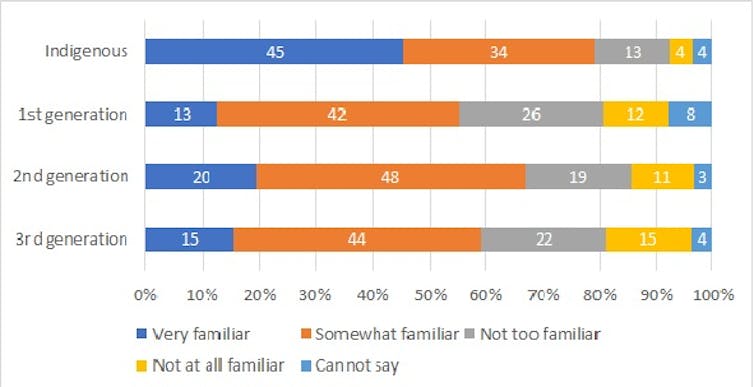
A graph shows how familiar immigrants to Canada feel they are with the history of Indian Residential Schools in Canada compared to Indigenous Peoples.
A graph shows how familiar newcomers to Canada feel they are with the history of Indian Residential Schools in Canada compared to Indigenous Peoples. Author provided, Author provided

This lesser familiarity among first-generation immigrants, however, does not translate into lower support for efforts to advance reconciliation. 

Government response

This support is evident when they were asked about whether governments have gone too far, or not far enough, to advance reconciliation. 

The most striking difference — not surprisingly — is that Indigenous Peoples are much more likely than non-Indigenous Canadians to say that governments have failed to go far enough to advance reconciliation. 

But first-generation immigrants are just as likely to hold this view than second- or third-generation Canadians. First-generation immigrants are also less likely to say that governments have gone too far in their efforts to promote reconciliation — a result that’s significant when controlling for education (which is an important step since first-generation immigrants are more likely to be university-educated than the rest of the population). 

First-generation immigrants are also less likely to take a definitive position either way, and are more likely to say “neither” or “cannot say.”
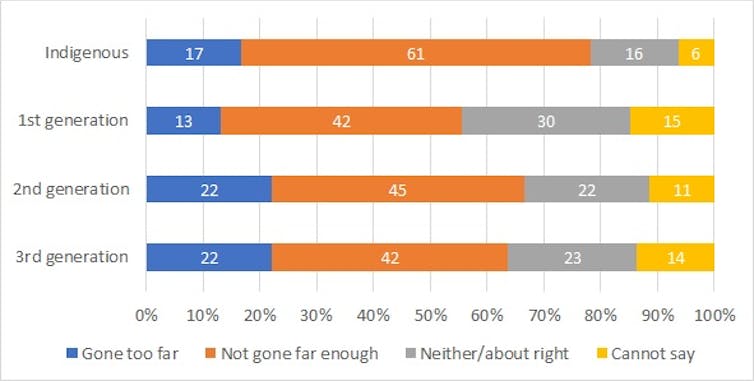
A graph shows whether Canadians believe governments have gone far enough in trying to advance reconciliation with Indigenous Peoples.
A graph shows whether Canadians believe governments have gone far enough in trying to advance reconciliation with Indigenous Peoples. Author provided, Author provided

The role of Canadians

Similarly, Indigenous Peoples are unsurprisingly the most likely to say that individual Canadians have a role to play in reconciliation. 

But first-generation immigrants are just as likely as second- or third-generation Canadians to hold this view (although first-generation immigrants are also more likely to have no opinion on this question). 
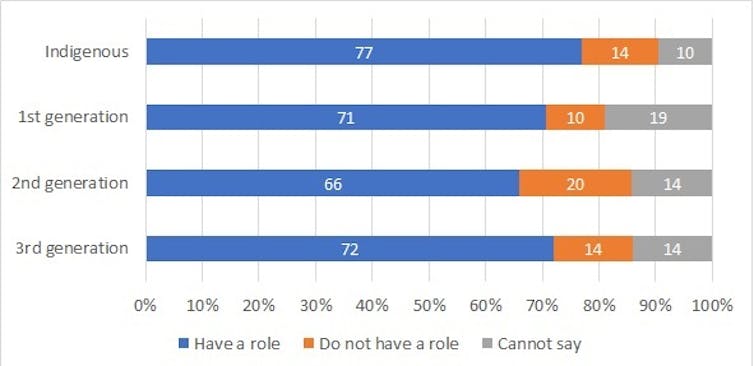
A graph shows whether individual Canadians have a role to play to bring about reconciliation between Indigenous and non-Indigenous Peoples.
A graph shows whether individual Canadians have a role to play to bring about reconciliation between Indigenous and non-Indigenous Peoples. Author provided, Author provided

These results are encouraging because they suggest that even if immigrants aren’t socialized in Canada at a young age, that’s not an obstacle to building understanding and support for reconciliation. 

Indigenous support for immigration

Interestingly, the survey also allows us to explore the other side of the relationship between immigrants and Indigenous Peoples in Canada, namely support among Indigenous Peoples for immigration. 

This is a potentially contentious issue. On the one hand, diverse sources of immigration in the post-Second World War period have already disrupted the narrative of Canada as a nation of two founding peoples (British and French). That in turn suggests a view of Canada that is not only multicultural but multi-national, and inclusive of Indigenous Peoples and nations. 

In this sense, the interests of immigrants and Indigenous Peoples could be aligned. But at the same time, the ongoing arrival of newcomers can be seen as a continuation of the settler/colonization process. 

Thoughts on immigration

We can explore this issue by referring to a question in the survey asking Canadians whether they agree or disagree that “overall, there is too much immigration to Canada.” 

The results show that there are significant differences in attitudes about immigration between the general population and Indigenous Peoples. Thirty per cent of Indigenous peoples “strongly agree” with the statement, the highest proportion among all groups. 
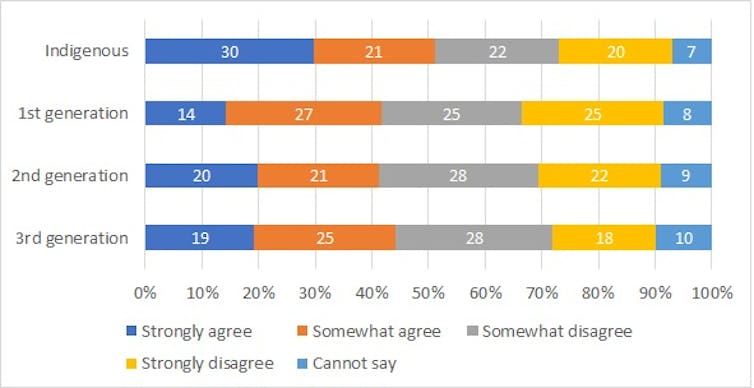
A graph shows whether Canadians and Indigenous people believe there is too much immigration to Canada.
A graph shows whether Canadians and Indigenous people believe there is too much immigration to Canada.Author provided, Author provided

However, this general difference about immigration levels is driven in large part by the difference in views between Indigenous Peoples and first-generation immigrants. While Indigenous Peoples, compared to first-generation immigrants, are more likely to strongly agree than strongly disagree that there is too much immigration to Canada, there are no statistically significant differences between Indigenous Peoples and second- or third-generation Canadians.

This suggests that the key factor influencing attitudes towards immigration might not be Indigenous identity, but being born in Canada.

Nonetheless, this finding is important because it’s a reminder to proponents of more immigration that they should be open to and engage with Indigenous Peoples’ perspectives on this issue. Immigration, as a policy objective, should be pursued with an eye on how it might be perceived by those who were displaced by the earlier arrival of settlers.

Source: Newcomers to Canada are supportive of Indigenous Peoples and reconciliation

Jussim: The Problem with Research on Microaggressions

Interesting discussion of microaggressions as racial insults or just being treated badly (equitably so):

If one were to read much of the psychological literature on microaggressionsuncritically, one would come away with the conclusion that they are a serious problem. If so, it is very hard to discern this from the vast literature on microaggressions.

A microaggression is often defined as some sort of subtle racial insult, often one that’s plausibly deniable as not racist. But this definition is complicated by the fact that people are treated badly all the time.

The day I wrote this, I had to wait for a ridiculous amount of time to pay $13 for a small, desiccated hamburger at an airport. Interestingly, this is exactly the type of incident that Sue et al (2007, p. 275) highlighted as a possible example of a microaggression: “When a Latino couple is given poor service at a restaurant…” Similarly, Nadal (2011) used this item to assess people’s experiences with microaggressions: “I received substandard service in stores compared to customers of other racial groups.”

As per Nadal (2011), if I believed customers of other races were given better service, I should consider this a microaggression. In this case, I am pretty sure my long wait for a bad burger was not a microaggression. And I am pretty sure it would not have been a microaggression if the burger shop provided the same overpriced, undersized, desiccated burger to a person of color (POC), notwithstanding Sue et al’s or Nadal’s analyses.

When Is Bad Treatment a Microaggression?

What makes some sort of bad treatment a microaggression versus just another form of people treating each other badly sometimes? Racism (or some other form of bigotry). The treatment needs to be motivated by, express, and reinforce racism or some other form of social bias. Long waits for bad burgers could be a microaggression—if, say, the burger joint made POC wait longer to order. But if everyone has a long wait for bad overpriced burgers, there is no racism involved, so no microaggression.

But how can one tell whether any particular insult or mean-spirited act or statement is a microaggression or just a person acting badly that has nothing to do with race (or any other identity)? One definition of microaggressions (Sue et al., 2007) is “brief and commonplace daily verbal, behavioral, or environmental indignities, whether intentional or unintentional, that communicate hostile, derogatory, or negative racial slights and insults toward people of color.” Did they literally mean “daily,” or is it just a figure of speech? Sue et al. (2008, p. 278) clarify: minorities don’t “just occasionally experience racial microaggressions.” Rather, “they are a constant, continuing, and cumulative experience” in their lives. They are, per this definition, disturbingly common racial slights.

Another more recent definition is that these are “deniable acts of racism that reinforce pathological stereotypes and inequitable social norms” (Williams, 2020). This is quite a scientific statement. They are racist but deniable as not racist. They have clear causal effects—reinforcing pathological stereotypes and inequitable social norms. This would seem to require researchers to do the following:

  1. Establish that an insult/slight is motivated by racism.
  2. Identify stereotypes that the insult/slight reinforces.
  3. Empirically establish the “pathology” of the stereotype.
  4. Show that the microaggression actually strengthens those particular pathological stereotypes.
  5. Identify relevant inequitable social norms.
  6. Show that the microaggression reinforces those norms.

Given that all of this is in Williams’s definition of microaggressions, to take this seriously scientifically, one would expect all of this to be empirically established for a particular slight before it would be labeled a microaggression.

Instead, I argue that the reverse occurs—some act is labeled a “microaggression” by one or more scholars, then all of the ills attributed to microaggressions are presumed rather than demonstrated. Then the act is heralded as scientific evidence of a microaggression.

The academic legerdemain by which the ills of microaggressions have been implicitly imported or declared by fiat rather than actually empirically demonstrated has been explored in each of the following articles (titles shown; all fully referenced at the end):

  • “Macrononsense in Multiculturalism”
  • “Microaggressions: Strong Claims and Inadequate Evidence”
  • “Microaggressions, Questionable Science, and Free Speech”

For example, Lilienfeld (2017) concluded that there is insufficient evidence to support any of these major claims by microaggression advocates:

  1. They are operationalized with sufficient clarity and consensus to afford rigorous scientific investigation.
  2. They are interpreted negatively by most or all minority group members.
  3. They reflect implicitly prejudicial and implicitly aggressive motives.
  4. They can be validly assessed using only respondents’ subjective reports.
  5. They exert an adverse impact on recipients’ mental health.

The “Best” Studies

Some of the “best” studies often held up by microaggression advocates as establishing the validity of these main claims fail to do so. For example, in defending the microaggression concept in light of Lilienfeld’s critique, Williams (2020, p. 12) invoked a study by Kanter et al. (2017): it provides “important empirical support for something that diversity researchers knew all along—microaggressive acts are rooted in racist beliefs…” This was a small-scale study, including only 33 Black and 118 white students, all from a single university. These numbers are so small and so unrepresentative of any population that the entire study should be viewed as little more than question-raising, regardless of other limitations, of which there are many, as we elucidated in Cantu and Jussim (2022).

Williams (2020, p. 13) also extolled “Another important measure of microaggression frequency—the Racial and Ethnic Microaggressions Scale (Nadal, 2011), which was validated with a large sample of African Americans, Hispanic Americans, Asian Americans, and multiracial participants.” Whether anyone should take Nadal’s scale seriously, given its numerous limitations, is, however, another issue. For example, consider the item “someone avoided walking near me on the street because of my race.” This would require mindreading. Even since Bem’s ESP article helped trigger the replication crisis, mindreading has been widely recognized as impossible.

However, I argue that one does not need to criticize the methods to understand how damaging Nadal’s study was for claims extolling the frequency with which POC experience microaggressions. Respondents were provided with supposed examples of microaggressions and were then asked how frequently they had experienced such discrimination in the prior six months. For a vast majority of the items, most respondents reported that they either had not experienced the microaggression in the past six months at all or, if they had, did so one to three times. In light of this result, I would argue that it’s difficult to characterize microaggressions as constituting a major social ailment. And that comes from taking his results at face value, which in itself may not be warranted.

Perhaps because we (Cantu and Jussim, 2022) highlighted the strange state of affairs whereby an article extolled as testifying to the importance of microaggressions actually found just the opposite, Williams recently highlighted a study (Anderson et al., 2022) as demonstrating that microaggressions are experienced very frequently by medical students. That is indeed what the authors claimed to have found: “Our first major finding was that medical students frequently experience microaggressions.” (p. 303).

Unfortunately, the authors’ claims notwithstanding, they did not assess “microaggressions.” They assessed variations on “How often do you think has someone been mean to you?” Here are just two items:

People trivialize my ideas in classroom discussions.

I am made to feel unwelcome in a group.

There is nothing about race or racism here (or in their other questions). These types of experiences have probably happened to everyone. To be sure, though, I have no doubt that people are subject to subtle insults, and that sometimes these are racially motivated. But if one wishes to know “how often?” one cannot possibly obtain much of an answer from even the supposedly best published psychological science on the topic.

Thus, it’s possible for peer-reviewed social science to create myths (much as I argue it has about stereotype threat and implicit bias) about the power of problems that it has not actually established to exist to any substantial degree.

Source: The Problem with Research on Microaggressions

Canada’s first Indigenous citizenship judge uses ‘best job in the world’ to champion Indigenous issues

Of interest:

With the Canadian flag, a portrait of the Queen, and a bright orange “Every Child Matters” T-shirt in her Zoom background, Suzanne Carrière, LLB’03, gets emotional when she talks about her work as a citizenship judge with Immigration, Refugees and Citizenship Canada.

“I still choke up sometimes delivering my speech, no matter if the ceremony is on Zoom or in-person, because you can see in the participants’ faces that the moment is so meaningful for them,” she says. “You can see some of them crying, hugging their children, and you can see that they’re thinking about their journey. It’s so special and a constant reminder of how lucky and privileged we are to be Canadian.”

Suzanne Carrière, LLB’03, is Canada’s first Indigenous citizenship judge.

Since being appointed in 2018 as Canada’s first Indigenous citizenship judge — Carrière is Red River Métis from Manitoba — she has presided over more than 1,300 ceremonies and has sworn in more than 65,000 new Canadians. She also presided the first virtual oath-taking in Canadian history when the COVID-19 pandemic shut down in-person ceremonies, and, in June 2021, Carrière presided over the first ceremony in the country using a revised Oath of Citizenshiprecognizing the rights of First Nations, Inuit and Métis peoples, a moment she considers a career highlight.

Growing up, Carrière never had any intention to pursue law. She studied Indigenous issues, criminology and psychology in her undergraduate studies at the University of Manitoba. While completing a field course on alternative justice initiatives in Indigenous communities, her supervisor asked her about her plans for her future. After telling him she was contemplating doing a master’s in criminology, he encouraged her to pursue a law degree.

When she questioned him about it, he said to her, “Anything you can do with a master’s degree, you can do with a law degree. You’re a woman, you’re bilingual and you’re Métis — with a law degree, there’s nothing you can’t do.”

“And that made sense to me,” Carrière says. “And he was right.”

Hearing stories from 200 residential school survivors 

After graduating from UCalgary Law, Carrière worked for a few years on the legal team at WestJet, but ultimately knew corporate law wasn’t what she wanted to do. When she eventually moved back to Manitoba to start her family, a friend told her that the federal Department of Justice (DOJ) was hiring lawyers to do work related to Canada’s residential school system. It was a no-brainer for Carrière as she knew that this work that would be incredibly fascinating, historic and important. She applied and was hired, and, for five years, she was involved in the Independent Assessment Process to resolve claims of abuse suffered at residential schools.

Through that claimant-centred, non-adversarial process, Carrière estimates she heard approximately 200 first-hand accounts from residential school survivors about the abuse they suffered and how it impacted their lives.

You don’t do that kind of work without it changing you and your life.

As for the conflicted feelings she had at times about representing the Government of Canada in that forum, she says she had to remind herself that it’s important to have Indigenous people in all spaces and arenas. “You need people with empathy and compassion doing that work, and it was a real honour for me to be there and to bear witness on behalf of the government,” Carrière says.

After the residential school work ended, she stayed with DOJ’s Aboriginal Legal Services team for another three years. However, she no longer felt fulfilled by the work she was doing. A friend showed her a posting for a citizenship judge and suggested she apply.

Still a champion of Indigenous issues

“I had some hesitation about leaving the Department of Justice to become a citizenship judge because my passion had always Indigenous issues and Indigenous culture. But I knew I was no longer happy at DOJ,” Carrière says. “Thankfully, I got the appointment, and the biggest surprise has been how there is still room within my role as a citizenship judge to champion Indigenous issues in my own small way.”

Each June, Canadians commemorate National Indigenous History Month to recognize the rich history, heritage, resilience and diversity of First Nations, Inuit and Métis peoples across Canada.

Indigenous Peoples are the first peoples of this land. They were here since time immemorial, and ultimately, Indigenous history is Canadian history.

“At the same time, it’s not just history. Indigenous People are still here and they’re still contributing to our society. It’s important to celebrate the beauty of Indigenous Peoples, cultures and languages — and the contributions, heritage and the unique stories that we gain from Indigenous people so that we can all move forward together with better understanding, compassion and relationships.

“I have a bit of a platform as a citizenship judge. I can talk about my Métis heritage, reconciliation and how that fits in with newcomers to Canada. I’m talking about these important issues more, meeting more Indigenous people and I feel like I’m making more of a difference now, with a different, and very receptive, audience. It’s been an incredible four years so far, and I truly feel I have the best job in the world!”

Source: Canada’s first Indigenous citizenship judge uses ‘best job in the world’ to champion Indigenous issues

What to consider when deciding to renounce U.S. citizenship for tax purposes

Interesting to see this practical guide in the Globe, says something about the readership. And a reminder of issues related to citizenship-based taxation in the USA and residency-based taxation in most of the world:

For Americans looking to give up their U.S. citizenship, the decision isn’t just about national identity but also how much taxes they might have to pay when leaving the country officially.

While an American who renounces their citizenship will no longer have to pay U.S. taxes on their worldwide income, they could be forced to pay an expatriation tax, also known as an exit tax, upon departure, depending on their net worth and other rules the Internal Revenue Service (IRS) has laid out.

“You can’t just hand your passport to the border agent and say, ‘I’m done,’” says Darren Coleman, senior portfolio manager with Portage Cross Border Wealth Management at Raymond James Ltd. in Toronto. “There’s a lot more to it than that.”

Mr. Coleman says advisors should be discussing with their American-citizen clientele the various steps of renunciation – and ensuring they have the proper legal and tax expertise when going through the process.

“You really can’t make any mistakes when you do it,” he says.

For advisors looking to help clients make the move, the goal is to not be considered what’s known as a “covered expatriate” in order to avoid paying the exit tax – a U.S. federal tax on assets with unrealized gains at the time someone cuts ties with the U.S.

Additional U.S. withholding taxes can apply later to payments from some types of deferred compensation arrangements, accounts and trusts, says Steven Flynn, a partner and Canadian and U.S. cross-border tax expert at Andersen LLP in Vancouver.

Americans can avoid the exit tax if they meet three conditions on the official date of expatriation:

  1. Their average annual net income over the past five years is less than US$172,000 (as of 2021, the rate changes annually with inflation);
  2. They’re fully compliant with their U.S. tax obligations for those five years;
  3. Their net worth is US$2-million or less.

With some planning, Mr. Flynn says the first two conditions are relatively easy to meet for those looking to avoid the exit tax.

However, the third condition on net worth can be a hurdle for many Americans, especially those who are older and whose assets have increased in value over the years.

Mr. Flynn also notes that since the conditions were put in place in 2008, the US$2-million threshold hasn’t increased with inflation.

He adds that Americans can still use strategies to lower their net worth, such as gifting assets to family members while they’re still U.S. citizens. Although the U.S. has a gift tax, he notes the exemption is currently about US$12-million, which is set to be reduced significantly by 2026.

Still, Americans who renounce their citizenship successfully but as a covered expatriate may not be done with the U.S. tax system, Mr. Flynn says. Any U.S. person who receives a gift or is a beneficiary of a former U.S. citizen who is a covered expatriate in their will is still subject to a 40-per-cent tax on the value of those assets.

“That’s pretty significant,” he says, “and a real concern for people with U.S. citizen or resident children.”

Importance of reason for renunciation

Alexander Marino, leader of the U.S. tax practice at Moodys Tax Law in Calgary who runs the firm’s renunciation group in Canada, saw a record number of people looking to renounce during the pandemic, in part because people more had time to go through the lengthy process.

The steps include not only working with experts to determine if renouncing is the right decision but also filing and addressing reams of paperwork before the final step of meeting in person with a consular officer at a U.S. embassy or consulate to officially renunciate.

In addition, Mr. Marino says U.S. persons need to ensure they’re communicating their reasons for renunciation properly, especially if they have plans to return as a visitor.

He points to the Reed Amendment, also known as the Expatriate Exclusion Clause, which bans certain former U.S. citizens from re-entering the country if they’re considered to have renounced for a tax avoidance motive or purpose.

“Knowing what to say in the interview is critical,” he says.

Mr. Marino says advisors also need to be aware of these issues to protect their clients – and themselves. He notes advisors have an obligation to identify who their U.S. citizen clients are under the Foreign Account Tax Compliance Act in Canada (FATCA), an international agreement signed between Canada and the U.S.

His team at Moodys works with advisors to help them determine if clients are U.S. citizens, particularly as some may not realize it or understand the impact of not disclosing it. For example, he says some people may have lived in Canada their entire lives but have American parents, which means they’re also U.S. citizens.

“You need to be asking the right questions,” he says.

Once it’s clarified if a client is a U.S. citizen, Mr. Marino says advisors can work with them – with the help of their U.S. legal professionals – to decide the pros and cons of renunciation. The process includes strategies to reduce or avoid the U.S. exit tax altogether when cutting ties with “Uncle Sam” properly.

Mr. Flynn adds that there are also non-tax implications to renunciation.

“If you change your mind years later, you’re not going to get any special status just because you were a U.S. citizen before,” he says. “You’ll go to the back of the line, like everyone else trying to become a U.S. citizen.”

The U.S. government publishes the names of Americans who renunciate, he adds.

Mr. Flynn also says that Americans who renunciate are still subject to taxes on assets or income made in the U.S., similar to a Canadian who works or owns assets in the U.S.

“The difference is that you avoid the bigger net, which is on your worldwide income and worldwide assets because you’re no longer a U.S. citizen,” he says.

Source: What to consider when deciding to renounce U.S. citizenship for tax purposes

‘Politically invisible’: temporary immigration soars in Quebec as official targets left unchanged

More on the Institut de Quebec report. Given that similar increases in temporary workers occurs in the rest of Canada, it may be time for the immigration levels plan to include temporary residents (IMP, TFWP and students) to provide a more comprehensive picture):

While Quebec’s official immigration targets have remained largely stable in recent years, the real number of newcomers in the province has surged due to an increasing reliance on temporary workers who often face more precarious conditions and long waits for permanent residency, a recent study has revealed.

The publication by the Institut du Québec found that while non-permanent residents represented nine per cent of international immigration to the province from 2012 to 2016, that number had climbed to 64 per cent by 2019.

Three experts who spoke with The Canadian Press said the growth in temporary immigration can help companies meet their needs in a tightening labour market, but the province needs to do more to adjust to the new reality in order to better serve both newcomers and its own goals.

Source: ‘Politically invisible’: temporary immigration soars in Quebec as official targets left unchanged

Curry: Permanent residents pay taxes but can’t vote

While Don and I disagree on municipal voting rights, he makes the case (given Canada’s relatively easy approach to citizenship, better to focus on all voting rights through citizenship). As municipalities are creations of provincial governments, the latter’s agreement would be required:

How would you like it if you paid your municipal and school taxes every year, your kids are in school, but you can’t vote for city council or the school board?

Hundreds of people in North Bay are in that situation.

They are permanent residents of Canada but are not entitled to vote because they are not yet Canadian citizens. If they would be any more motivated than the dismal 43 per cent of voters who bothered to cast a ballot in the recent Ontario election is beside the point. They don’t have the right to vote.

To become a citizen, you have to have lived in Canada for at least three of the past five years, with your time as a temporary resident only eligible for a half-day for every full day you were here. The government processing fee is $530 and the right of citizenship fee is $100.

You have to have filed taxes for each year you were in Canada, pass a citizenship test, which most Canadians would likely fail, and prove your language skills in either English or French.

The Liberal federal government said in the 2021 election campaign that it will eliminate citizenship fees. It said the same thing in the 2019 campaign, and the fees remain in place.

There are other obstacles. The paperwork is daunting to many.

One client I had speaks English as his first language and works in a professional occupation. He asked me to do the paperwork.

Others say becoming a Canadian citizen could jeopardize travel to their home country to visit relatives because dual citizenship is not recognized.

The Ontario government controls municipalities and all indications are that it has no plan to eliminate the citizenship requirement for municipal and school board elections. This is despite the fact that some municipalities, including North Bay, Toronto, and Waterloo in Ontario, plus Vancouver, Halifax, and others, have voted to allow permanent residents voting rights.

New Brunswick is set to allow permanent residents to vote in the next municipal elections, scheduled for 2026.

North Bay City Council went on the record in support of a motion on May 11, 2015, after a presentation I gave in support of the concept. As I recall, voting against were Tanya Vrebosch and Mark King, and the motion passed easily.

That endorsement has earned the city positive press across Canada, as other cities are urged to support the movement. However, when I visit city hall I see no diversity whatsoever among the staff, and there is none at the city council level. Clearly, there is more to be done to make the city a welcoming place for newcomers.

There are dissenting views, of course. They centre on the argument that this will devalue Canadian citizenship. My response is that people should have the right to vote municipally, as it is the government closest to the people and who gets elected is important. Retain citizenship as a requirement for provincial and federal elections.

Take the announcement recently by MP Anthony Rota that the federal government will contribute almost $26 million to the arena project at the Omischl complex. It was wonderful to hear.

But, if we had more diversity at city hall and on the city council, and permanent residents could vote, the conversation might include a desire for more soccer fields and cricket pitches as well. When you don’t have diversity in decision-making, which includes voting, you keep doing everything the way you have always done it.

Myer Siemiatycki, professor emeritus at Toronto Metropolitan University, where my granddaughter begins studies in September, (if you haven’t heard of it, it’s the new name for Ryerson), says there are more than 50 countries that allow non-citizens the right to vote.

So, it’s not a novel concept. Other countries are way ahead of us.

He told the CBC recently that changes are long overdue, because there’s currently a “ludicrous” double standard where people who own property in Toronto but live elsewhere can vote, while permanent residents actually living in the city can’t.

In the U.S., non-citizens can vote municipally in many cities. New York recently came on board and Boston may be next. Near Boston, Cambridge and Amherst have extended the ability to vote.

Good on North Bay City Council for being an early adopter of a motion to extend municipal voting rights. The barrier is the Conservative government of Doug Ford.

Perhaps our MPP, Vic Fedeli, could bend his ear on the topic.

Source: Opinion: Permanent residents pay taxes but can’t vote

En ligne avec Kafka

More harsh commentary on the passport wait times:

L’attente et le blocage inexcusables à Service Canada témoignent de la culture de non-responsabilisation à Ottawa.

Le moins que l’on puisse dire, c’est que la très ordinaire moyenne au bâton de Service Canada ne s’améliore pas. L’agence gouvernementale a déjà été passablement sur la sellette cette année avec des reports inexcusables pouvant atteindre jusqu’à des mois pour certains malheureux prestataires de l’assurance-emploi. Monsieur et madame Tout-le-Monde découvrent maintenant que cette apathie a gagné jusqu’aux bureaux des passeports, ce qui menace ainsi leurs vacances tout en éprouvant solidement leur patience.

Un problème de riches, le goulot d’étranglement qui paralyse la délivrance et le renouvellement des passeports d’un océan à l’autre ? Forcément. Mais pas seulement, en ce sens qu’il vient braquer les projecteurs sur tout ce qui fait défaut au point d’accès unique, et plus largement au gouvernement Trudeau, en matière de prestation de services.

Certes, les retards et les ratés du fédéral dans la prestation de service ne sont pas exclusifs aux libéraux, mais leur extrême frilosité à intervenir auprès de la fonction publique, elle, l’est. Épinglé plus tôt cette année pour des délais éhontés sur le front de l’immigration — le ministre responsable, Sean Fraser, a lui-même qualifié ces retards d’« incroyablement frustrants » —, ce gouvernement semble au surplus incapable de voir venir les crises. Pis, même une fois qu’il a les deux pieds dedans, sa courte vue l’empêche d’en prendre la pleine mesure, et donc d’intervenir en conséquence.

Il y avait quelque chose de douloureux à écouter la ministre responsable du dossier, Karina Gould, tenter de minimiser la crise il y a encore deux semaines. Mal informée, elle s’était embrouillée dans les temps d’attente, niant même jusqu’à l’existence de pratiques douteuses pourtant largement documentées sur le terrain, comme cette fameuse règle secrète voulant que seules les demandes déposées à moins de 48 heures, voire 24 heures, du départ soient traitées dans certains bureaux.

Pressée de toutes parts, la ministre Gould a finalement admis avoir dû clarifier plusieurs points la semaine dernière. Elle a en outre annoncé une panoplie de mesures (dont l’embauche prochaine de 600 personnes, des heures de service allongées, y compris le week-end, et un outil pour évaluer les délais d’attente). De belles promesses que les fonctionnaires sur le plancher, même avec la meilleure volonté du monde, n’arrivent toujours pas à concrétiser. Car il n’y a pas que les Canadiens qui font les frais de ce ratage spectaculaire, les employés de Service Canada paient aussi le prix fort de cette absence de vision.

Sur le terrain, c’est encore la débrouille qui règne (et un peu la colère, avec des interventions policières çà et là pour faire retomber la pression). Il était pourtant écrit dans le ciel que les Canadiens se bousculeraient au portillon de Service Canada sitôt que les conditions sanitaires le permettraient. Plus de deux ans de surplace pandémique donnent la bougeotte. Nous ne sommes pas les seuls. Les Américains, les Anglais ou encore les Australiens vivent des affres similaires, a mollement argué la ministre Gould. À la différence près, qu’ici, Service Canada a sciemment mis le couvercle sur la marmite.

Pendant qu’ils rêvaient d’évasion sagement confinés à la maison, les plus prévoyants qui ont voulu profiter de l’accalmie pour renouveler leur passeport ont plutôt été découragés. On a aussi fait complètement abstraction du fait que les premiers passeports valides pour dix ans (permis depuis le 1er juillet 2013) allaient bientôt massivement arriver à leur terme. Résultat : du 1er avril 2020 au 31 mars 2021, le Canada n’a délivré que 363 000 passeports, soit 20 % de son volume habituel. Normalement, Service Canada recense 5000 appels par jour en lien avec un renouvellement de passeport. Il en recense maintenant plus de 200 000.

Ces chiffres ont artificiellement mis la table pour la débandade que l’on connaît. Et les voyageurs ne sont pas au bout de leurs peines. Contre toute logique, Ottawa n’a jamais cessé de défendre bec et ongles sa très imparfaite application ArriveCAN, source de plusieurs mécontentements chez les voyageurs qui ont eu maille à partir avec elle. Pour certains, faute d’avoir rempli le formulaire à temps, cela s’est traduit par une quarantaine forcée, même si leur vaccination était en règle et que leur test PCR était nickel.

Disposé à jeter du lest, le gouvernement a annoncé que l’obligation pesant sur les voyageurs de fournir une preuve vaccinale contre la COVID-19 avant de monter à bord d’un avion ou d’un train au pays serait abrogée à partir lundi. La logique aurait voulu qu’ArriveCAN, dont la raison d’être est liée au statut vaccinal des voyageurs, passe à la trappe en même temps. Mais Ottawa la maintient, comprenne qui pourra.

Voilà de toute évidence un gouvernement plus attaché à dicter la norme qu’à mettre la main à la pâte pour la faire respecter. Cela dépasse largement l’anecdote. Réticent à intervenir auprès de la fonction publique, même quand celle-ci aurait besoin d’une direction plus affirmée, il cultive une culture de la non-responsabilisation dont témoigne cet épisode aussi navrant que kafkaïen.

Source: En ligne avec Kafka

LILLEY: Trudeau government not telling the truth on passport delays

Good hard hitting column and yet another of all too many instances of government management failures. As others have noted if government cannot deliver services in a timely manner, it undermines overall trust as well as the government’s failed “Deliverology” approach from 2016.

And it is not as if the government was unaware of the increase. IRCC’s department plan 2022-23 states:

“Due to travel restrictions associated with the COVID-19 pandemic, passport demand was low for the majority of 2021–22. Forecasts predict that a recovery to pre-COVID-19 demand will begin in Spring of 2022, and that demand for passports will continue to increase over the next three years. This growth will be due in part to applications being delayed by the COVID-19 pandemic, and an anticipated surge related to the renewal of the first wave of passports issued with a 10-year validity period.”

IRCC has the policy and program responsibility but Service Canada operates the public offices and the processing centres (and Global Affairs is responsible for international delivery). The disconnect between the plan and the lack of action to address the anticipated surge is striking.

Other areas of poor management can be seen in  the lack of passport data on open data since 2016, and the last Passport Canada report dating from 2017-18, with minimal data in both IRCC and ESDC departmental reports. The 2020 Evaluation Report highlights data weaknesses and unclear roles and responsibilities between the three departments involved.

On a personal note, when I worked at Service Canada 2004-7, we made a major effort to engage Passport Canada to provide application checking and verification through the Service Canada network (receiving agent). Our DM at the time was ambitious and insistent, wanting to roll the service across the network. In the end, a pilot project of three offices worked so well that Passport Canada overcame its resistance. But no appetite or discussion of delegating of authorities at that time:

The Trudeau government is once again lying to Canadians over why they can’t offer basic services, in this case passports.

The government is claiming there is a surge in applications when they are only dealing with about 55% of the volume they handled pre-pandemic.

According to the latest annual report of Passport Canada posted online, the department issued between 4.7 and 5.1 million passports per year from 2013 through 2018. That works out to a weekly average of between 90,000 to 98,000 passports.

In their statement Monday, the government said they had received 542,000 applications over the preceding 10 weeks, or an average of 54,200 applications a week and this is what is swamping the department.

“After two years of travel restrictions, Canada and many other countries around the world are seeing a significant surge in demand for passports. As is the case in many countries, the size and suddenness of this surge has created delays,” Minister Karina Gould said.

I get that this is more people than the department has seen since the pandemic started but staff should be able to handle 55% of normal volume. Instead, we’ve had months of long lines and delays.

Only an excuse

When I pushed the minister’s office on this, they presented a new excuse. Close to 80% of applications now come in via mail and about 25% of them have errors in the applications making the process longer. If the system were operating at capacity instead of just over half capacity, then I might buy this argument. But at this point it’s just another excuse to blame the public instead of a department that isn’t working properly.

One friend who applied for their child’s passport on April 2 still hasn’t seen it. Readers have written to me about waiting for more than seven months to get a passport they mailed away for.

Then there are the lines.

In Hamilton, a reader showed up just after 4 a.m. to find out they weren’t close to being the first person in line. In Victoria, the line started forming at 2 a.m. and in Prince Edward Island, they only wished they could line up at a local office instead of having to drive to Halifax or Moncton.

Truth about the lines

The people standing in lines outside of offices are doing so because they have travel booked in the next 45 days and the standard application process can’t handle them.

One gentleman I spoke to this week outside of Toronto’s downtown passport office said he had initially applied at a regular Service Canada office. After nearly completing the process, he was told his passport would go in the mail by the end of August, after his trip started. He was forced to stand in line for hours to get inside before navigating the bureaucracy to get his travel documents faster.

Canadians can normally turn to their Members of Parliament for help when they have trouble with an application or need something expedited. There’s a special line for MPs and their staff to call when helping deal with passport files.

John Brassard, the Conservative MP for Barrie-Innisfil, emailed to say his staff waited on that special line for five hours one day this week followed by an extra two hours on the line with the agent to process the files.

These problems have been going on for months and the government is only acting to deal with them now due to media and opposition pressure. It’s another example of the Trudeau government not working properly and not dealing with issues until they blow up.

Instead of wasting time trying to mislead Canadians by blaming this on a surge of applications Minister Gould should get busy whipping her department back into shape. If she can’t do that, she should resign.

Source: LILLEY: Trudeau government not telling the truth on passport delays

Ian Mulgrew: Refugee says foreign buyers property tax discriminates

Will be interesting to see how the court rules. Pretty wealthy refugee given the value of the property tax:
An Iranian refugee who has lived in Canada for 27 years but only recently obtained permanent resident status wants to be reimbursed for the $1.32-million foreign buyers property tax he paid for his West Vancouver home.
In a B.C. Supreme Court statement of claim filed recently, Kourosh Bakhtiari, who has been described in documents as an aspiring terrorist decades ago for convictions on weapons charges and who once escaped custody using s rope made of dental floss, maintains that a 61-month delay in granting him permanent resident status violated the Charter of Rights and Freedoms, causing him duress and unnecessary expense.“His case shows how the foreign buyers property surtax in part harms a group of homeowners it is intended to help — long-term residents of B.C. without formal immigration status who wish to express their roots in this territory through home ownership,” veteran Vancouver lawyer Jason Gratl said.

Bakhtiari, who has no criminal record in Canada, was initially ruled inadmissible to the country by the Immigration and Refugee Board because of his crimes in the U.S., and was issued a conditional deportation order on April 9, 1996.

But he fought that and was designated a refugee on May 27, 1998.Ten years earlier, Bakhtiari was caught attempting to buy a Manhattan apartment while impersonating a State Department employee.

His briefcase contained weapons — including a 9 mm M-11 semi-automatic pistol, a silencer for the gun, a knife, grenades, and a garrote.

He and two other inmates reportedly later escaped from New York’s Metropolitan Correctional Center using a rope fashioned out of 15 packages of dental floss braided together.

While recuperating in a New York hospital after being captured, he tried unsuccessfully to flee again.

Deported to Iran after a stint in a U.S. prison, Bakhtiari came to Canada and claimed political asylum on Dec. 10, 1995, fearing torture in Iran because in 1984 his father was captured, tortured, and killed for leading a revolt against the Islamic regime.

He applied to the immigration minister for permanent resident status in 1997, but was denied due to his U.S. convictions and his failure to pay a fine. Bakhtiari wrongly assumed that the fine would be paid from seized assets.On Dec. 15, 2011, more than 100 police officers converged on five locations, including Bakhtiari’s company offices, in a dramatic raid that netted more than $220,000 and four kilograms of methamphetamine.

Nevertheless, police apologized in 2017 for “Project Enape,” which targeted Bakhtiari’s firm for manufacturing legal pharmaceuticals and male hair-growth products allegedly because it was linked to organized crime. Civil proceedings in the case resulted in the forfeiture of seized cash.

In 2014, Bakhtiari again attempted to apply for permanent resident status. This application was again refused. He applied once more in January 2017.

Bakhtiari was finally granted permanent resident status this past Feb. 16, although no explanation was given for the delay.

He alleges the process took three times longer than average and was the product of gross negligence and bad faith by the minister.

During this waiting period, Bakhtiari, on July 1, 2021, was forced to pay $1.32 million in surtax on the June 14, 2019, purchase of a home registered in his company’s name on Groveland Road  in West Vancouver. He lives there.

He appealed, but on Feb. 29 was deemed ineligible for an exemption because he had not received permanent resident status within one year of the purchase — the process had taken 32 months.

The lawsuit, filed by Bakhtiari and his firm, Technocorp Venture Capital Inc., alleges the tax not only imposes an enormous financial burden on Bakhtiari but sends an implicit government-sponsored message that he is the kind of person who should be discouraged from owning a home in B.C.“The immigration minister’s delay in processing his application for permanent resident status contributed to the imposition of the surtax and loss of dignity, loss of social status, psychological distress and anxiety resulting from the imposition of the surtax and the implicit message of the surtax,” the lawsuit alleges.

Bakhtiari wants to be reimbursed for the surtax, the lien removed, the law amended, and paid damages.

“Discrimination against Bakhtiari, who has been a resident of British Columbia for 27 years, is contrary to the true intention of the legislature,” Gratl said.

He added that the purpose of the surtax is to promote home ownership by long-term residents and the one-year limit is arbitrary and unreasonable.

The attorney-general has told the court that persons in Bakhtiari’s position should not be subject to the surtax.

“The immigration minister’s unjustified delay of more than five years to process my client’s application for permanent resident status deprived him of an exemption from the 20-per-cent foreign buyer property surtax,” Gratl said.

“It might be tempting to believe that the wealthy are not entitled to civil liberties, but in law the right of equality belongs to everyone.”

The federal and provincial governments have roughly three weeks after they receive a copy of the suit to respond.

Source: Ian Mulgrew: Refugee says foreign buyers property tax discriminates

Expert opinion mixed on changes to N.S. student immigration program

One small point in this article struck me: “He says familiarity with the local economy allows greater success opening businesses such as restaurants and grocers stores.”

Highlights that for some, study is mainly an immigration pathway to relatively lower skilled jobs, rather than building an innovation economy:

Immigration experts in Nova Scotia have mixed views about how changes to a fast-track program for international students will affect over-all immigration.

Last week, the province disqualified students who studied outside the province from applying to the Nova Scotia Experience: Express Entry (NSEEE) immigration stream.

It was a shock to hundreds of foreign students who had already moved to Nova Scotia and worked for months toward the program’s one-year employment target. It offered the chance to apply for permanent residency after 12 months rather than the usual two years.

People have come here on the understanding that this program is available to them,” said Elizabeth Wozniak of North Star Immigration Law in Halifax, “To have that program pulled out from under them midway through doesn’t seem fair at all.”

On Thursday Labour, Skills and Immigration Minister Jill Balser announced a record boost in Nova Scotia’s immigration allocation from the federal government — 400 new spots for the provincial nominee program, and an extra 1,173 spaces under the Atlantic Immigration Program.

Wozniak thinks restricting the NSEEE could make it more challenging to fill those new spots.

Still a draw for students

“The changes to this program … really are going to make it the least attractive of the immigration programs, whereas in the past it was one of the ones that was the most popular,” she said.

But an immigration lawyer in Bridgewater believes Nova Scotia officials will still be able to fill the province’s expanded allocation.

“I don’t recall them ever falling below their quotas or allocations, so I expect that they will meet that,” said David Nurse of McInnes Cooper.

Nurse says the top tiers of Canadian student immigrants are graduating with master’s and PhD degrees, and usually find work right away in their chosen fields.

He says students in Nova Scotia’s immigration streams play an important role in local labour markets while upgrading their language and employment skills.

“They are adding to the labour market. They’re contributing here in Nova Scotia,” he said.

Support from a former student worker

Samual Shaji came to Nova Scotia from southern India to study.

He graduated from Cape Breton University in 2020 with a degree in environmental science.

Then he secured a job managing a McDonald’s restaurant in Bedford, and was able to apply for permanent residency after 12-months thanks to the NSEEE.

But Shaji says many international students in Nova Scotia aren’t so fortunate.

He says it’s difficult to get restaurant jobs in smaller communities such as Sydney and Antigonish, and that lack of experience means students from elsewhere often get hired first after graduation.

“There is a McDonalds and a Tim Horton’s in every street in Toronto or Edmonton, so they have more experience in that job,” Shaji said, “Employers tend to hire them.”

‘They know the market of Nova Scotia’

“A lot of international students are moving from county to county because they cannot get into any job that will help them in immigration,” he said.

While Shaji sympathizes with the struggle of all international students in Canada, he thinks focusing the fast track on Nova Scotia students will lead to more graduates sticking around.

He says familiarity with the local economy allows greater success opening businesses such as restaurants and grocers stores.

Source: Expert opinion mixed on changes to N.S. student immigration program