Nicolas: Le choix des mots

Another good column on the differences on how groups are portrayed differently, particularly Ukrainian compared to other refugees:

L’invasion de l’Ukraine par la Russie n’a débuté qu’il y a une semaine. L’issue de la situation demeure incertaine. Toutefois, il apparaît déjà clair qu’il s’agit d’un conflit pas comme les autres, et surtout d’un conflit dont on ne parle pas comme les autres.

D’abord, on assiste à un mouvement de solidarité quasi unanime envers le peuple ukrainien. Au Conseil des droits de l’homme de l’ONU mardi, la presque totalité des diplomates a quitté la salle lorsque le ministre des Affaires étrangères russe a commencé son allocution. Des manifestations en appui aux Ukrainiens sont organisées partout dans le monde, et la colère face à l’invasion de l’armée russe semble tout aussi forte même au Canada. Un sondage de la firme Maru publié cette semaine montre que 91 % des Canadiens sont en « opposition totale avec la tyrannie de la Russie de Vladimir Poutine ». J’aurais du mal à nommer une autre situation de guerre où l’opinion publique mondiale s’est montrée aussi campée, aussi rapidement, contre une agression armée. Il semble plus simple de décrire l’horreur d’une bombe qui tombe sur des civils innocents lorsque cette bombe n’est pas, par exemple, américaine.

Ensuite, la vague de solidarité pro-ukrainienne ne semble pas, du moins pour le moment, se traduire en tsunami de haine envers le peuple russe ou les personnes d’origine russe. Plusieurs leaders importants ont donné rapidement le ton, à commencer par le président ukrainien lui-même, Volodymyr Zelensky, suivi par la vice-première ministre du Canada, Chrystia Freeland, aussi d’origine ukrainienne. Tous deux ont lancé des messages au cours des derniers jours pour marteler que le conflit en cours n’est pas avec le peuple russe, mais avec le président Vladimir Poutine et son entourage. On relaie également des images de manifestations antiguerre dans les grandes villes de Russie — des rassemblements qui seraient certainement encore plus importants si ce n’était de la violence de la répression policière dans ce pays. À la télévision, on semble éviter d’utiliser des formulations comme « les Russes » pour désigner des responsables de l’agression militaire, préférant parler de Vladimir Poutine lui-même ou de son régime.

Cette conscience du poids des mots et du risque de dérapage est rafraîchissante. On sait que les débuts de la pandémie dans la région de Wuhan et que les relations diplomatiques pour le moins tendues avec la Chine ont donné lieu à toutes sortes de commentaires sur « les Chinois » et à une montée des crimes haineux envers les personnes d’origine asiatique.

On sait aussi qu’un nombre déplorable de nos concitoyens n’hésitent pas à dériver d’une critique du régime saoudien ou d’un groupe comme Daech vers des généralisations sur « les Arabes » ou sur « les musulmans ». Pas plus tard que l’été dernier, des imbéciles ont aussi commis une série d’actes antisémites dans l’arrondissement de Saint-Laurent, comme s’il s’agissait là d’une manière de critiquer l’État d’Israël. Et on se rappelle que, durant la Seconde Guerre mondiale, le Canada a notamment cru bon d’interner ses propres citoyens d’origine japonaise.

Puisque la liste de tristes précédents est longue, le souci actuel des mots détonne. Je ne vois personne de sérieux lancer l’hypothèse que l’autoritarisme de Poutine trouverait ses sources dans une tare particulière de la religion orthodoxe ou que la culture russe prendrait ses racines dans un éloge unique de la violence. L’analyse porte surtout sur les enjeux politiques, économiques et humanitaires. Enfin, croisons les doigts pour que ça dure.

Finalement, des réfugiés ne se sont pas présentés comme des menaces à refouler aux frontières. Le président de la Bulgarie, Roumen Radev, a peut-être eu la déclaration la plus candide à ce sujet. « Ce sont des Européens », a-t-il lancé plus tôt cette semaine. « Ces personnes sont intelligentes, éduquées… Ce ne sont pas les vagues de réfugiés auxquelles nous sommes habitués, des gens à l’identité incertaine, aux passés incertains, qui auraient même pu être des terroristes. » Des commentateurs, des experts et des journalistes ont aussi parlé de leur choc devant la guerre touchant le monde « civilisé » — omettant de transmettre du même coup une liste des régions du monde « barbares ». Cette nouvelle ouverture aux victimes de la guerre semble donc venir de l’identité des Ukrainiens : on leur ouvre les portes au nom de leur européanité et non de leur humanité. Le mauvais traitement réservé aux Africains et aux Asiatiques résidant en Ukraine à la frontière polonaise, dénoncé mardi par le Haut-Commissariat aux réfugiés de l’ONU, vient d’ailleurs démonter cette nuance importante.

L’humanisation particulière du peuple ukrainien joue un rôle positif très important dans le sort de cette population. Il y a la guerre, les blessés, la mort, les familles déchirées. Il y aura encore peut-être la faim, le manque d’eau et de ressources, et on ne sait quoi encore. Aucun individu ne devrait avoir à endurer ces horreurs, déjà. Il est encore plus abject d’avoir à affronter en plus, au milieu de ces tourments, l’indifférence du monde, ou son hostilité. Pour le moment, le respect de la dignité de la population ukrainienne semble être une préoccupation centrale d’une grande partie de la planète. Espérons que ça durera et que d’autres victimes des guerres contemporaines pourront bientôt en bénéficier.

Je ne veux pas ici faire un portrait jovialiste de la couverture de la guerre en Ukraine. L’actualité des dernières semaines est très difficile, ses implications sont historiques, et les défis qu’elle implique sont nombreux. Cela dit, j’ai rarement vu un souci d’humanisation aussi généralisé des parties prenantes d’un conflit, et je crois qu’il est important de le souligner. Plusieurs semblent regarder ce qui se passe dans l’est de l’Europe en se disant : « Ces gens sont comme moi, ça pourrait être moi. » La vérité, c’est que chaque être humain est en bonne partie comme soi, et qu’il offre un miroir de soi. C’est une chose de le dire, et une autre de transformer son regard sur les nouvelles internationales à partir de ce principe.

Source: Le choix des mots

Milloy: The role of religion in the Ottawa protest

Of interest:

The end of the “freedom convoy” in Ottawa has already led to much soul searching — how could it have happened? One of the topics certain to be discussed is the role that the Christian faith played in the protest. There wer

The end of the “freedom convoy” in Ottawa has already led to much soul searching — how could it have happened?

One of the topics certain to be discussed is the role that the Christian faith played in the protest.

There were a lot of Christians up in Ottawa — you could see it in protest signs and hear it in media interviews. There were numerous accounts of prayer services and Christian preachers addressing the crowd and an American Christian crowdfunding website helped funnel money to the cause.

As a CBC report concluded: “Christian faith — with an overtly evangelical feel — flows like an undercurrent through the freedom convoy in Ottawa.”

The situation puts me in a bind. Although I watched the protests in horror, I also regularly write, teach and speak about the positive contribution that faith, particularly my Christian faith, can make to public discourse.

So, in response, let me offer several observations.

First, I can’t criticize someone for holding strong religious beliefs. As a person of faith, I recognize that it is part of their identity. People are frustrated and scared, and these are often the circumstances where you most often look to God.

The situation is also far from black and white. Governments have made their share of mistakes in dealing with the pandemic and are not above criticism. I tried to think about the protesters with compassion and take their views seriously.

Source: The role of religion in the Ottawa protest

Mood shifts in Polish border town as alt-right supporters go after dark-skinned refugees from Ukraine

Sigh….:

The Przemyśl train station is a spot that’s come to be known in the last six days for its heartwarming scenes of volunteers welcoming tired and hungry refugees with a cup of hot tea and a smile. On a grey Wednesday morning, however, under a brooding, overcast sky, tension is building on the ground.

Yellow-vested volunteers, who days before held their positions alone outside, are now crowded out by a heavy police presence. Officers in green and blue uniforms pace through the parking lot of the square, and tall guards frame the entryway to the platforms, scanning everyone who makes their way in and out of the building.

“It’s really scary now,” says Soufiane, an Algerian volunteer who’s been offering translation services in Arabic, French, English and Polish. The change, he explains, was the immediate result of the actions carried out the night before by a group of alt-right supporters targeting refugees who fled the Russian invasion.

Tuesday evening, a Polish outlet shared video footage of a dozen black-hooded men descending on the train station. Their targets, explained the reporter who was quick enough to pull out her phone when she saw the men rushing the station, were the arriving refugees. But, she adds, only the ones who “looked like they weren’t Ukrainian.”

“They began shouting at the group of three Indian men, ‘go back to the railway station, go back to your country,’ ” says Anna Mikulska, a reporter with oko.agency.

Among hundreds of thousands of refugees from Ukraine arriving in Poland are Africans, Indians and others lacking Ukrainian passports. Some reported racist treatment by officials on the Ukrainian side.

Around the same time that night and a bit further down the road, a similar scene, albeit more contained, began playing out in the parking lot of the relief centre in the town of Medyka. There, we saw a similar group of balaclava-clad men prowling the aisles where volunteers were offering free food and clothing while a determined line of police followed closely behind.

While there were no reports of anything serious happening at Medyka, the same cannot be said for Przemyśl.

“We were just going to our car … when we were stopped by some people,” starts one of the three German men in the video captured by OKO. “They slapped us and tried to hit us.”

The group of Germans came to Poland with the NGO Humanity First to assist with volunteer efforts. The attacking football hooligans — as they’re called locally here — appeared to mark them because of their skin colour.

“We’re just trying to find another way to get to our car,” says the German man, timidly.

Football hooligans, Przemysław Witkowski tells me the morning after the incident, are called that because they’re all fans of specific teams. “But they all share similar affiliations of nationalist and anti-refugee sentiment,” says the academic, who specializes in studying the far right in Poland.

“These people represent a small minority of the Polish people,” he underscored. “But they’re still out there.”

Groups like these organize primarily on platforms like Facebook groups to communicate. In recent days, they have begun using the social media tool to co-ordinate street patrols.

“Two beige on beige walking down the street,” reads one of the posts uncovered by a freelance Polish journalist who specializes in tracking the movements of these groups.

This kind of sentiment isn’t new, Witkowski explains. Even before the Russian invasion of Ukraine prompted masses of people to arrive on Poland’s doorstep, these groups were rife with anti-refugee sentiment.

The recent violence can be traced back to a series of social media posts that began making the rounds in the last few days. The tweets and Facebook posts falsely allege that women and children are being targeted by those who had recently arrived from the Przemyśl train station.

“They then see it as a call to arms, to protect their Polish women,” says Mikulska, the reporter. The pressure from these posts eventually prompted the local police to issue a tweet to dispel the rumours.

The tweet says there is “false information in social media that there have been serious criminal offenses in Przemyśl and border counties: burglaries, assaults and rape. It’s not true. The police did not record an increased number of crimes in connection with the situation at the border.”

Some are attributing this flurry of fake news accounts to a Russia-fuelled disinformation effort. Witkowski agrees that, while he can’t confirm these specific stories were plants, that kind of strategy has been used in the past by the Kremlin and would be advantageous to them now.

“Presenting Poland as racist and aggressive towards other countries is exactly the kind of soft power that Russia could wield to destabilize the country’s standing on the global stage,” he said.

Indeed, later that day, Witkowski sends along the latest figures from the Polish Institute for Internet and Social Media Research, which found more than 120,000 attempts at disinformation in Poland under the hashtags #Ukraine, #Russia and #war in the last 24 hours. Much of the content related to fuelling anti-refugee hysteria.

The trains are still arriving in Przemyśl — 47,000 people in the last 24 hours, Soufiane tells me — but the feeling on the ground has certainly shifted. Blanket-huddled figures are now being quickly shuffled onto buses to their next destination and volunteers are encouraging people to move onto bigger cities like Warsaw and Krakow instead of lingering.

“I’m afraid today because I’m thinking: what if they think I’m a refugee?” Sanoufie tells me as we jockey between two officers in their own blue balaclavas. He’s been living in Poland for seven years, and this is the first time such thoughts have entered his mind.

“I took the bus home last night. Walking just didn’t feel safe.”

Source: Mood shifts in Polish border town as alt-right supporters go after dark-skinned refugees from Ukraine

Wagner: Work permit change urged for Afghans now needed for Ukrainians to come to Canada

More pressures:

Many thousands are leaving Ukraine with heartbreaking separations from spouses, parents and homes. Meanwhile, in Canada, a single change to work permits can support people in far larger numbers to come here after being forced from their homes. That change is waiving a rule that requires someone to prove they can leave Canada again.

All applicants to temporary visas must demonstrate their ability and willingness to leave Canada by showing they have somewhere else to go, even if they already applied for permanent residence, or intend to.

This is an old rule that predates Canada’s goal of retaining its international workforce, once they arrive, through permanent residence programs. If it’s arcane for others, it’s absurd and prohibitive for those in refugee circumstances.

Among the Afghans who left as the Taliban took power in August were lawyers, cooks, electricians, and software developers — skills needed across Canada — yet so many are in a humanitarian queue instead of here on work permits. The same barrier faces Ukrainians.

In effect, Canada’s largest immigration option is closed as soon as someone needs it most. In 2019, before the pandemic, Canada welcomed over 404,000 people on work permits, many of whom go on to become permanent residents. For comparison, the refugee resettlement target the same year was 46,450.

blob:https://multiculturalmeanderings.wordpress.com/27e4c896-162d-472c-8c0f-cf96eb3fe425

Only recently has the idea of using skilled immigration as an additional option to refugee resettlement gained traction globally and in Canada. Canada first launched the Economic Mobility Pathways Pilot in 2018 as a test to help people in refugee circumstances, who got job offers in Canada, to work through barriers, such as needing a valid passport and police certificates, which are impossible for many in displacement to get.

The test cases were a runaway success. But for all the pilot’s innovation, its main drawback is significant. The flexibility introduced, like accepting expired passports, only applies to permanent residence pathways and not to work permits and the barriers that come with them.

This disadvantages displaced talent for two main reasons: A lack of speed and space. Skilled immigration largely relies on a job offer and most employers can’t hire someone on a permanent residence timeline, which is eight months or longer. And only a portion of skilled immigration space is left open when work permits are off the table.

We analyzed 66 permanent residence pathways and found just 15 are free of a requirement for in-Canada work experience or points systems that reward it. In other words, 77 per cent of these pathways are either inaccessible by or disadvantageous to displaced applicants who can‘t access work permits.

Many people displaced by conflict have in-demand skills and, despite the timeline, incredible Canadian teams are already hiring and relocating them. More companies want to. We need to unlock these opportunities.

Work permits promise speed and scale. By waiving a single requirement and extending the flexibility now in place for displaced applicants under an innovative pilot, Canada can open a major route to safety and opportunity for Ukrainians, Afghans and others before them.

Dana Wagner is co-founder and managing director of TalentLift, a non-profit talent agency.

Source: Work permit change urged for Afghans now needed for Ukrainians to come to Canada

Doug Ford government scraps diversity hiring targets for transit projects

UPDATE: Reversed!

The Ontario government will no longer include hiring targets for disadvantaged groups in its agreements for provincial transit projects, a reversal of a groundbreaking policy intended to deliver jobs to marginalized communities where new lines are built.

Advocates warn the decision will undo years of progress toward bringing women, people of colour, and Indigenous and Black residents into the workforce, and raises questions about whether Premier Doug Ford’s subway program is eligible for federal funding.

The hiring targets were first included in a so-called community benefits agreement the previous Ontario Liberal government reached for the Eglinton Crosstown LRT in 2016, which was hailed at the time as setting a precedent that would inject funding, training and employment into neighbourhoods in need.

But the Toronto Community Benefits Network (TCBN), a coalition of labour and community groups, says the targets are being left out of plans already underway for Ontario’s $28.5-billion subway program, which consists of the Ontario Line, Yonge North Subway Extension, Scarborough Subway Extension, and Eglinton West LRT.

Metrolinx, the provincial agency responsible for transit construction in the GTA, will be “on the wrong side of history” if it scraps the hiring thresholds and other key aspects of the benefits framework, said Rosemarie Powell, executive director of TCBN.

The group is expressing “deep concern” about the province’s change of heart, which it says will undermine a program that has helped ensure people who get opportunities through public infrastructure investment “come from and reflect the diversity of local communities.”

Metrolinx is overseen by Ontario Minister of Transportation Caroline Mulroney. Asked why the province is dropping the hiring targets, the minister’s spokesperson Dakota Brasier said the province “will continue to facilitate a pathway for local communities to develop the skills and qualifications needed to find good-paying jobs in the sector.”

She said Ontario’s “historic” transit plans are on course to “generate thousands of jobs, create more connections for people across the province and boost our economy.”

The community benefits agreement signed by the province, Metrolinx, TCBN and the company building the Crosstown LRT six years ago set a target that 10 per cent of work hours for the project go to local groups that have historically faced employment barriers, like racialized residents, women and newcomers.

The target wasn’t a legal obligation under the LRT contract and was described as “aspirational,” but the signatories pitched it as a meaningful way to give hundreds of people from groups traditionally shut out of the construction industry a path to a decent career.

The Ontario government of the day said the agreement would serve as a framework for future projects, and a similar deal was struck for the Finch West LRT.

In addition to not including the 10 per cent hiring target in agreements for the new provincial subways, TCBN says Metrolinx hasn’t committed to other measures around consultation, transparency and local procurement that represent “a minimum standard” for a community benefits agreements.

In a Feb. 11 letter to the group, Metrolinx CEO Phil Verster confirmed the agency is taking a “different approach” to community benefits, but one that it believes will still deliver “the same objectives” and “meaningful change.”

Although it doesn’t include hiring targets, Verster wrote that Metrolinx’s strategy will provide local employment opportunities, require contractors to develop and report on apprenticeship and workforce development plans, and direct contractors to develop “shop local” campaigns and host trade shows to connect employers with job-seekers.

The agency is also committed to making public realm improvements and in some cases could provide amenities like community centres or affordable housing as part of transit projects.

Metrolinx spokesperson Fannie Sunshine said the “broader” approach will give the agency the “flexibility” required “to meaningfully engage” with communities, and allow it to “identify better opportunities.”

Powell acknowledged implementing the original agreement hasn’t been easy. Crosslinx, the private consortium building the Crosstown, hasn’t reached the 10 per cent hiring goal, and is instead hovering around five per cent, according to TCBN. A spokesperson for Crosslinx said she didn’t have up-to-date figures.

But Powell said Metrolinx has been a good partner on the benefits program to date, and she had expected the agency to address problems with the strategy, not weaken it.

“Don’t throw out the baby with the bathwater,” she said.

TCBN also points out that when the federal Liberal government announced more than $10 billion in financial support for Ford’s subway program in May 2021, it said the funding was dependent on the province satisfying a number of conditions, including community benefits agreements and “meeting employment thresholds for under-represented communities including Black, Indigenous, people of colour, and women.”

Sunshine said Metrolinx’s position is that the workforce development plans included in its new approach “will help to enable federal requirements.”

Zoltan Csepregi, a spokesperson for Infrastructure Canada, said community benefits agreements are still a condition of the funding, and the federal government will “work collaboratively with the government of Ontario to ensure that Metrolinx upholds these conditions.”

Source: Doug Ford government scraps diversity hiring targets for transit projects

Mintz: Reckoning With Inequality

Thoughtful analysis and discussion, along with some useful suggestions of how to approach inequality from a variety of lenses:

I was struck in the New York Times obituary of one of the great historians of race, Leon Litwack, by the casual and condescending way his landmark scholarship was dismissed. Sure, the article’s subtitle was positive: “One of Berkeley’s most popular professors, he brought passion and nuance—and a love for blues music—to his award-winning study of the marginalized and the oppressed.”

The obituary also mentioned that his scholarship “illustrated how racism had structured institutions and relations” and “focused on the way Black Americans experienced their freedom and shaped it.”

But toward the obituary’s end, the author observed that “many fellow historians complained that it placed unrelenting emphasis on Black people as victims and failed to tell a more nuanced tale about resistance.” It then quoted the Princeton historian emeritus Nell Irvin Painter:

“Litwack implies that African-American institutions function merely in response to white oppression, as though blacks had no existence beyond their connection with whites—Black Southerners as victims rather than Black Southerners as people … For all its picturesque appeal, ‘Trouble in Mind’ is stale.”

We mustn’t confuse an obituary with a eulogy, and without engaged and rigorous criticism, scholarship isn’t worthy of its name. But I fear that the Litwack obituary feeds into a common misconception: that scholarship in the humanities, like its counterpart in the natural sciences, is progressive, as more recent research supplants and supersedes its predecessors.

I consider this generational condescension utterly wrongheaded. Since the humanities disciplines are interpretive and analytic, humanities scholarship doesn’t necessarily progress and newer works certainly don’t sweep their predecessors into the dustpan of history.

Litwack’s historical scholarship, while focusing on highly specific historical topics—notably, Black lives during Reconstruction and the age of Jim Crow—also represented an attempt to grapple with race and racial inequality multidimensionally. He was as interested in racial socialization, racial etiquette and the intricacies of Black lives in extraordinarily difficult contexts as he was in Black resistance to racist violence.

Reality is multidimensional, but the academy is siloed.

At this historical moment, no issues draw more attention within the academy draw than those involving inequality and stratification. Departments across the humanities and social sciences offer a vast array of courses that speak to issues of anti-Semitism, homophobia, racism, sexism, xenophobia and other forms of bias, prejudice and persistent inequality.

But our students would be hard-pressed to study these topics holistically.

The reasons are obvious. Not only is the subject of inequality too broad to be treated with the nuance and complexity that it deserves, but none of us are knowledgeable enough to speak to the topic with the expertise that we take for granted in more specialized courses.

Also, there’s the danger of conflating inequalities that have different historical roots, trajectories and manifestations.

Classism, racism, sexism, homophobia, ageism and other forms of bias, prejudice and inequality have economic, historical, legal, political, psychological, sociological and even linguistic and theological dimensions. Inequality needs to be understood as ideological and institutional, but also as lived experience. Similarly, resistance to inequalities takes multiple forms: day-to-day resistance, cultural resistance, acts of collective protest and more

Efforts to eradicate inequalities not only involve policy and politics but philosophy, too, as we contemplate the host of ethical issues that the subjects raise involving personal and collective responsibility, atonement, forgiveness, and reparations.

As scholars, our expertise is rooted in particular disciplinary specializations. My discipline, history, focuses on change over time. Historians ask how inequalities are constructed socially and culturally, and their manifestation, meaning and function in specific economic, political and social contexts.

Yet, to take just one facet of the broader issue of inequality, gender inequities, any serious attempt to grapple with the subject would require us to examine, in addition to women’s history:

  • The ideological dimension: How various fields, including medicine and psychology, have pathologized women’s minds and bodies.
  • The legal, economic and political dimensions: How law, the market and policy embed and perpetuate gender inequities.
  • The representational dimension: How gendered depictions in art, advertisements and various media have distorted and misrepresented women’s realities.
  • The psychological dimension: How gender identities are socialized and how sexism has shaped women’s identities, expectations and behavior, pushing women to provide various forms of support to others.

I lead my life according to a series of mantras, one of which is “Anything worth doing is worth doing half-assed.” By that, I simply mean that we need to do the best we can even if we can’t accomplish everything we might wish.

So what if we, as a collective endeavor, tried to structure a multidisciplinary humanities and social sciences cluster around gender and racial inequalities, with a goal of providing students with “the big picture”? How might we address such an expansive and sweeping topic without lapsing into superficiality or punctuating broad themes with excessive narrowness?

Here, I can only begin to sketch what such a cluster might look like.

1. A history class might begin with the oldest, most long-standing form of inequality, patriarchy, and women’s systematic exclusion from “the creation of law, symbolic values, and structures of meaning.” Such a course might begin with the Middle Assyrian Laws of the 15th to the 11th centuries BCE, which required “women to wear head-to-toe veils and forbade them from speaking to non-family males or walking outdoors except in the company of a close male relative,” in the guise of protecting them from male predation.

The notion of separation or segregation as a form of guardianship and a shield against social conflict is a recurrent theme used to naturalize and legitimate restrictions and various forms of segregation.

Such a class might move on to Aristotle’s equation of women with slaves and domesticated animals—which served as the prototype for the “animalization” of other subordinate groups.

This class might also examine how anti-Semitism served as a seedbed for racism, and how, beginning in the 14th century, modern racism emerged, how European expansion and the slave trade reinforced racist thought, and how racism was institutionalized in the late 19th and early 20th centuries. This class would also need to look at the fluidity of definitions of race, which have varied geographically and chronologically, and the complex legacy of religious sectarianism and the Enlightenment, which at once offered new justifications for racial and gender inequalities while also fostering the first collective challenges to slavery and gender and racial inequalities.

2. An economics course might explore occupational and residential segregation; differentials in wages, owned assets and savings; debt levels; discrimination in loans, mortgages and patronage of businesses; and the concentration of women and Blacks in low-wage occupations. But it should also examine, through economic history, women’s unpaid labor, the intersection of labor systems and race, and efforts to contest subordination and labor exploitation.

3. A political science class might examine the role of law, public policy and civic institutions in promoting, reinforcing and perpetuating racial and gender hierarchies, as well as the political uses of racial and gender ideologies to preserve and exercise power, promote group solidarity, and distance subordinate classes from supposedly inferior groups.

4. A psychology class might reckon with the discipline’s racist and sexist past and examine the affective, emotional and psychological functions of gender and racial bias. Topics might include gender and racial socialization, stereotyping, implicit bias, scapegoating, and the role of emotional aversion in maintaining racial and gender boundaries. It might also examine the psychological costs of racism and sexism.

5. A sociology course might explore:

  • Racism and sexism as systems of structural, systemic and institutionalized privilege and advantage.
  • Racism and sexism through the lens of intersectionality: how gender, race, sexuality and other forms of social hierarchy and discrimination reinforce one another and help define status and power.
  • The relevance of caste, with its stress on heredity, group hierarchy and purity and pollution, to an understanding of gender and racial inequalities.
  • The complex relationship between race, gender and socioeconomic class.

6. A philosophy course might explore ideas of race and gender in the history of philosophy. It might also speak to some of today’s hottest topics: how best to address relics of a racist and sexist past; the meaning and value of meritocracy and the validity of the mechanisms used to assess merit; the desirability and practicality of reparations; and issues relating to atonement, forgiveness and closure.

I am convinced that many students crave the context and perspectives that the humanities and the social sciences offer on the issues of our time. But the discipline-based surveys and introductory courses and the narrow upper-division courses that reflect faculty members’ research interests fail, all too often, to capture students’ imagination or ignite their passions.

I understand the reluctance to tackle a topic as expansive and interdisciplinary as gender and racial inequalities. But please consider following my advice and remember my mantra—if it’s worth doing, it’s worth doing half-assed.

Steven Mintz is professor of history at the University of Texas at Austin.

Source: Reckoning With Inequality | Higher Ed Gamma

Feds deny delay as lawyer in multi-billion-dollar Black bureaucrats’ class-action suit calls Crown’s ‘overlap’ arguments ‘insulting’

Watching with interest. In terms of the data, clear that the lawyers have cherry-picked the worst departments, and not the overall picture which indicates that Blacks are not unduly under-represented compared to other visible minority groups (see Will the removal of the Canadian citizenship preference in the public service make a difference?):

The leading lawyer in a multi-billion-dollar class-action lawsuit representing current and former Black federal public servants, filed against the federal government and now involving nearly 1,300 individuals, says the government’s lawyers are attempting to delay proceedings by claiming the Black class action overlaps with other ongoing cases—an argument which he calls “insulting.”

“It’s not a secret, we’ve laid it out, we’ve argued it over and over in court. The government has one goal right now: do not let this matter go to court in September,” said Courtney Betty, a former Crown attorney at the federal Justice Department’s Toronto office in the early 1990s, who is leading the class action filed on Dec. 2, 2020.

In March 2021, The Hill Times reported that more than 520 class members had joined a proposed $900-milllion class-action lawsuit alleging decades-long government discrimination, lack of advancement opportunities, and harassment. As of Sept. 21, the number of class members had increased to 1,031, who are now seeking $2.5-billion in damages following an amendment to the claim made on May 13.

The number of class members has increased to 1,293, as of Feb. 28, according to Nicholas Marcus Thompson, who was among the first of the current and former federal employees who filed the class-action lawsuit as a representative plaintiff.

“The Crown’s argument really is that the government is facing a number of class-action lawsuits that raise the issue of systemic levels of discrimination against visible minority groups and racialized groups in government,” said Kofi Achampong, principal lawyer and government relations adviser with Achampong Law.

“Presumably, some of the pleadings in those class actions would cross over or would have some level of consistency with some of the pleadings in the Black class action lawsuit, and therefore it’s difficult for the government to determine who they are responding to in relation to the causes of action for racialized employees,” said Achampong, who is a lawyer and legal strategist for the class-action lawsuit.

“In essence, they are saying there is too much overlap,” he said.

Betty said the government “came up with a very creative argument,” calling it “insulting.”

“What the government says, is that any case in Canada … an Indigenous case, a woman’s case, could be any case—as long as there is racism and discrimination mentioned, then there’s an automatic overlap with the Black class action.”

“That argument carries no weight at all,” said Betty, who noted that this particular case deals with hiring and advancement within the public service.

“Our case is about the hiring and promotion of Black public service workers—there are no other cases that are out there that deals with the hiring and promotion of Black public service workers.”

“The reality is that the basis, the pith and substance of the Black class action, is really the unique experience that Black public servants have undergone across over 100 government departments,” said Achampong, adding that this is “the only legal action, the only class action in the history of Canada, that has ever explicitly sought to address that particular issue.”

Alain Belle-Isle, spokesperson for the Treasury Board Secretariat, said the Government of Canada “has no intention of delaying the certification hearing.”

“The parties in this case continue to discuss the best means of addressing the issue of overlapping claims with the Court, while also preparing for the certification hearing scheduled for September 2022,” wrote Belle-Isle in an emailed response to the The Hill Times. 

He reaffirmed the government’s commitment to creating a “diverse and inclusive public service free of discrimination, harassment and violence,” which was reflected in the most recent mandate letter to the president of the Treasury Board, Mona Fortier (Ottawa-Vanier, Ont).

The mandate letter for Treasury Board President Mona Fortier, pictured during a press conference on Jan. 25, 2021, cites the government’s commitment to a ‘diverse and inclusive public service free of discrimination, harassment and violence.’ 

Black employees ‘last to be hired, first to be fired’: law firm analysis

According to Betty’s legal firm, which has analyzed numbers regarding promotions and demographics within the federal public service, the number of “Black employees” within Natural Resources and the Department of National Defence (civilian staff), was less than two per cent.

In the Department of Justice, less than 20 individuals were appointed on an intermediate basis from 1970 to 2000 who were identified as “Black.”

In Fisheries and Oceans Canada, as of March 31, 2019,  the number of “Black employees” was less than one percent.

And for the 2005 to 2018 period, 35.4 per cent of “Black employees” within the federal public service received zero job promotions.

“What we’ve done is we’ve looked at 30 years of government data, and we’ve demonstrated that on a percentage basis, Black public service workers are the last to be hired, the first to be fired, last to be promoted,” said Betty, pointing to the above data analysis provided to The Hill Times.

“We’ve demonstrated that statistically, so with the harassment of the individual, none of that comes in,” said Betty. “It’s a data analysis case, there’s none of the other cases that are even similar to that.”

Thompson expressed his dismay that there’s “been no appointment in leadership positions” for Black employees in the public service in recent months.

“We’re still in the same position that we were in last year and the year before and the year before,” said Thompson, who added that the government is trying to create a mental health plan, are trying to create developmental opportunities under the mandate of the Treasury Board, “and have acknowledged all of things that we’ve raised as issues that exists for Black workers.”

“But in the courtroom, they are fighting to avoid having to pay for those damages,” said Thompson.

The leadership of the public service continues to remain “almost exclusively white,” said Thompson, as Black workers “continue to be at the bottom of the public service and racialized workers just above.”

“The work of eradicating bias, barriers, and discrimination demands an ongoing, relentless effort, said Belle-Isle. “We are committed to this effort and to using all available levers to improve the experiences of public servants, to ensure that they are able to realize their full potential, and for Canada’s public service to fully reflect the diversity of Canadians.”

Proceed on a ‘case-by-case basis,’ says Justice Gagné

Associate Chief Justice of the Federal Court Jocelyne Gagné said during a Feb. 16 hearing a motion to stay would need ‘substantial overlapping.’ 

The class action will be moving towards certification following a Federal Court justice’s direction for the government and the class action members to file additional documentation.

During the most recent court proceeding on Feb 16, Associate Chief Justice Jocelyne Gagné directed the plaintiffs to serve and file their additional submissions on the issue of overlapping with any other class action brought before the court no later than March 26.

Justice Gagné also directed the Crown to serve and file its record no later than June 29, with the plaintiff’s reply to be file no later than July 14. Certification hearing dates have been set for Sept. 21-23, 2022.

In the Feb. 16 hearing, Gagné said a meeting had taken place amongst the judges who were seized with other class actions, “however all of them, but the two last ones, which quite frankly have nothing to do with the issue before the court on this file—and I can tell you that at this point, it is the general view that these cases should be dealt with on a case-by-case basis.”

“In my view, and in the view of many, a carriage motion or a motion to stay, I think you need substantial overlapping, which is absent here in these cases,” said Gagné.

“That said, I understand that the case before me is broader, and although encompasses only one group of people, it encompasses many departments of the government,” she said.

Source: Feds deny delay as lawyer in multi-billion-dollar Black bureaucrats’ class-action suit calls Crown’s ‘overlap’ arguments ‘insulting’

Turkey rejected Uyghur citizenship applications over “national security” risks

Sigh….

The Turkish government has rejected the citizenship applications of some Uyghurs who have been outspoken about the detention of their families in China, citing risks they pose to “national security” and “public order,” according to interviews and documents reviewed by Axios.

Why it matters: Turkey has been an important refuge for Uyghurs, who have faced repressive policies in China for years. But Ankara’s growing economic and security ties with Beijing have led to fears among some Uyghurs that they’re no longer safe in Turkey.

  • The denial of citizenship for some Uyghurs in Turkey fits a broader pattern of China’s growing ability to extend repression beyond its own borders, Elise Anderson, a senior program officer at the D.C.-based Uyghur Human Rights Project, told Axios.
  • Chinese government authorities are “surveilling, tracking and hunting down Uyghurs, and in some cases, have succeeded in sending them backto the People’s Republic of China,” Anderson said.

Details: Alimcan Turdi, a Uyghur who moved to Turkey in 2013 for education opportunities for his children, told Axios he has numerous relatives in Xinjiang who were detained in mass internment camps in 2017 and he has not heard from them since.

  • He began organizing protests in Turkey and speaking out against the Chinese government on social media in 2019. In October 2021, Turdi’s application for citizenship in the country he had called home for more than seven years was rejected.
  • Turdi says he received no explanation other than a document that cited “obstacle to national security” and “public order” — allegations that he called “very upsetting,” given the loyalty he said he feels for Turkey. Turdi is now in the Netherlands, though his family remains in Turkey.

Axios spoke to four other Uyghurs who described similar experiences and provided documentation.

  • Amine Vahid, a Uyghur woman who has lived in Turkey since 2015, said both her and her 17-year-old son’s applications were rejected in October 2021 on “national security” and “public order” grounds.
  • Vahid said she has participated in protests in Turkey because she has relatives in the camps, but claims her son has never been involved in activism and is being unfairly punished.
  • One Uyghur woman who wished to stay anonymous told Axios she has never participated in protests or anti-China social media activity, but that applications for her, her husband and three children were all rejected for the same reasons.

Turkey’s Foreign Ministry, Interior Ministry and embassy in D.C. did not respond to repeated requests for comment.

The big picture: Many Uyghurs are worried about their ability to remain safely in Turkey, which is home to one of the largest Uyghur diasporas in the world, with estimates between 30,000 and 50,000 people.

  • The Chinese government has asked Ankara to extradite some Uyghurs back to China; many Uyghurs believe at least one Uyghur family in Turkey has been deported. Egypt, Thailand, Saudi Arabia and the United Arab Emirates have deported numerous Uyghurs at China’s request.
  • The inability to obtain citizenship and the loss of residency status can plunge Uyghurs into statelessness and make it difficult for them to keep jobs and go to school in Turkey.

Background: Turkish President Recep Tayyip Erdoğan was once critical of China’s repression of Uyghurs, including suggesting in 2009, years before the construction of the camps, that ethnic violence in Xinjiang amounted to “genocide.” Uyghurs and Turkish people share linguistic, ethnic and religious ties.

  • But as Erdogan has turned away from the West in recent years and strengthened economic links to China, Ankara’s criticism has grown muted.
  • On a visit to Beijing in 2019, Erdogan warned that to “exploit” the Uyghur issue would damage Turkey-China relations and that he believed it was possible to “find a solution to this issue that takes into consideration the sensitivities on both sides.”

The bottom line: “Turkish people know about Uyghurs and care about Uyghurs,” Anderson said. “But at other times, Turkish authorities make moves that leave Uyghurs in fear.”

Source: Turkey rejected Uyghur citizenship applications over “national security” risks

New report details how autocrats use the internet to harass and suppress activists in Canada

Thousands of miles away from her homeland in Syria, she organized protests and ran social media pages in Canada in support of opposition forces fighting President Bashar al-Assad’s regime.

Then anonymous complaints started rolling in and prompted Facebook to shut down her group page. Trolls left “nasty and dirty” comments on social media and created fake profiles with her photos, she said, while a Gmail administrator alerted her that “a state sponsor” was trying to hack her account.

“The Assad regime was functioning through this network of thugs that they call Shabeeha. Inside of Syria, those thugs would be physically beating up people and terrorizing them,” said the 42-year-old Toronto woman.

“Then they were also very much online, so they terrorized people online as well.”

As diaspora communities are increasingly relying on social media and other online platforms to pursue advocacy work, authoritarian states are trying to exert their will over overseas dissidents through what’s dubbed “digital transnational repression,” said a new study released Tuesday.

“States that engage in transnational repression use a variety of methods to silence, persecute, control, coerce, or otherwise intimidate their nationals abroad into refraining from transnational political or social activities that may undermine or threaten the state and power within its border,” said the report by the Citizen Lab at University of Toronto’s Munk School of Global Affairs.

“Thus, nationals of these states who reside abroad are still limited in how they can exercise ‘their rights, liberties, and voice’ and remain subject to state authoritarianism even after leaving their country of origin.”

Being a country of immigrants — particularly refugees seeking protection from persecution — Canada is vulnerable to this kind of digital attacks, amid the advancement of surveillance technology and rising authoritarianism around the globe, said the report’s authors.

“There is this misassumption that once people arrive in Canada from authoritarian countries, they are safe. We need to redefine what safety is,” said Noura Al-Jizawi, one of the report’s co-authors.

“This is not only affecting the day-to-day life of these people, but it’s also affecting the civic rights, their freedom of speech or their freedom of assembly of an entire community that’s beyond the individuals who are being targeted.”

A team of researchers interviewed 18 individuals, all of whom resided in Canada and had moved or fled to Canada from 11 different places, including Syria, Saudi Arabia, Yemen, Tibet, Hong Kong, China, Rwanda, Iran, Afghanistan, East Turkestan, and Balochistan.

The participants shared their experiences of being intimidated for the advocacy work they conducted in Canada, as well as the impacts of such threats — allegedly from these foreign states and their supporters — on their well-being and the diaspora communities they come from.

“Their main concern besides their privacy and the privacy of their family is the friends and colleagues back home. If the government targets their devices digitally, they would reveal the underground and hidden network of activists,” said Al-Jizawi.

“Many of them mention that they try to avoid the communities from their country of origin because they can’t feel safe connecting with these people.”

Many of the participants in the study said they have reached out for assistance to authorities such as the Canadian Security Intelligence Service but were disappointed.

“The responses were generally like, we can’t help you or this isn’t a crime and there’s nothing actionable here. In one case, they suggested to the person to hire a private detective,” noted Siena Anstis, another co-author of the study.

“Law enforcement is probably not that well equipped or trained to understand the broader context within which this is happening. The way that they handle these cases is quite dismissive.”

The anonymous Syrian-Canadian political activist who participated in the study said victims of transnational repression will stop reporting to Canadian officials if nothing comes out of their complaints.

“Every day we’re becoming more and more digital, which makes us more vulnerable to digital attacks and digital privacy issues. I hope our government will start thinking about how to protect us from this emerging threat that we never had to worry about before,” said the woman, who came here from Aleppo as a 7-year-old and has stopped her political activities to free Syria.

“If someone like me who is extremely outspoken and very difficult to stifle felt a little bit overwhelmed by all of it, you can imagine other people who recently came from Syria and still have a lot of ties there. I know a lot of people that will not open their mouth publicly because they’re scared what will happen.”

The report urges Ottawa to create a dedicated government agency to support victims and conduct research to better understand the scale and impact of these activities on the exercise of Canadian human rights. It also recommends establishing federal policies for the sale of surveillance technologies to authoritarian states and for guiding how social media platforms can better protect victims from digital attacks.

“It might seem at this stage it’s only happening to some communities in Canada and it doesn’t matter,” said Anstis. “But collectively it’s our human rights that are being eroded. It’s our capacity to engage in, affirm and protect against human rights and democracy. That space for dialogue is really reducing.”

Source: New report details how autocrats use the internet to harass and suppress activists in Canada

#COVID-19: Comparing provinces with other countries 2 March Update; Japan impact and policy changes

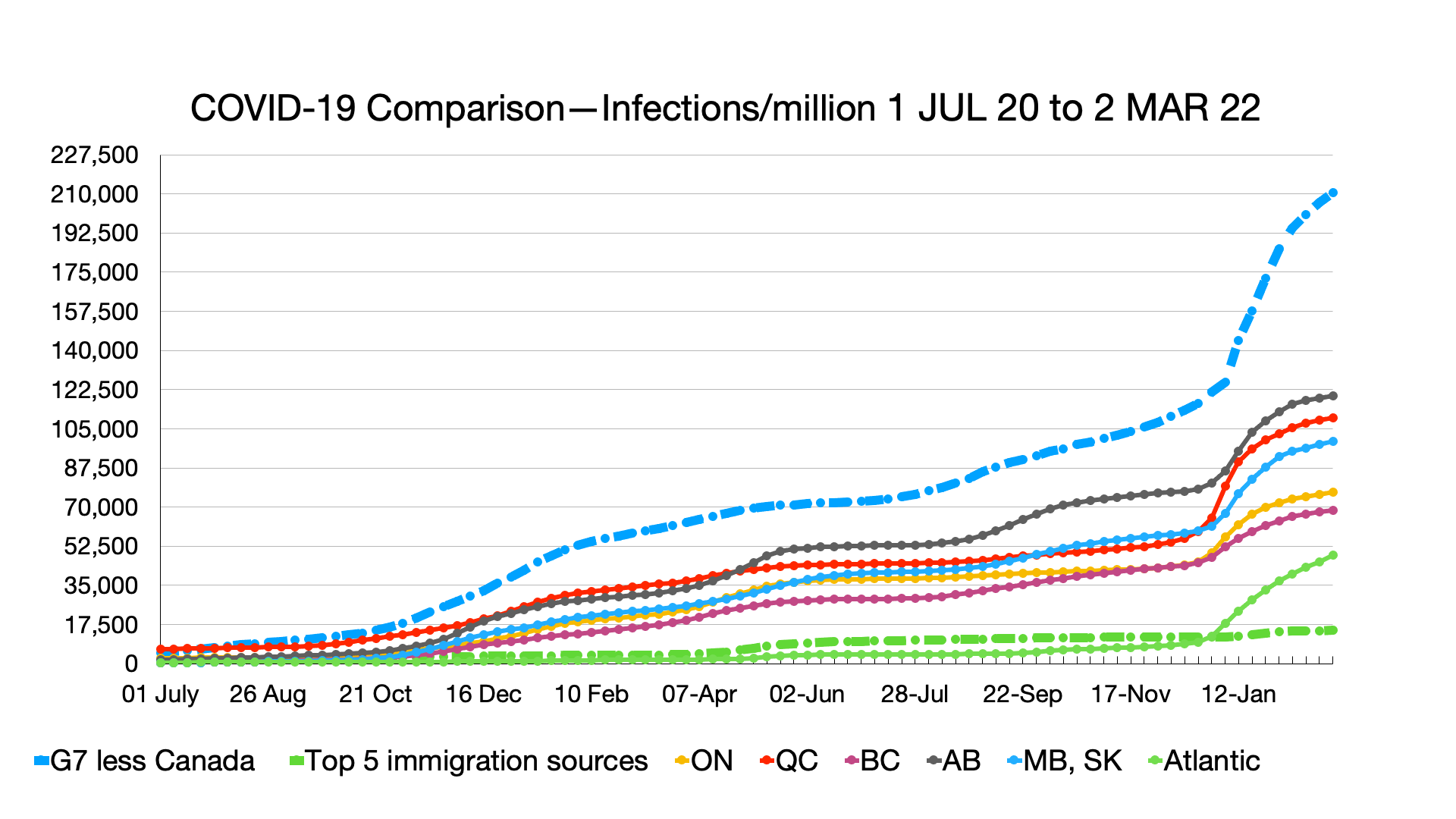
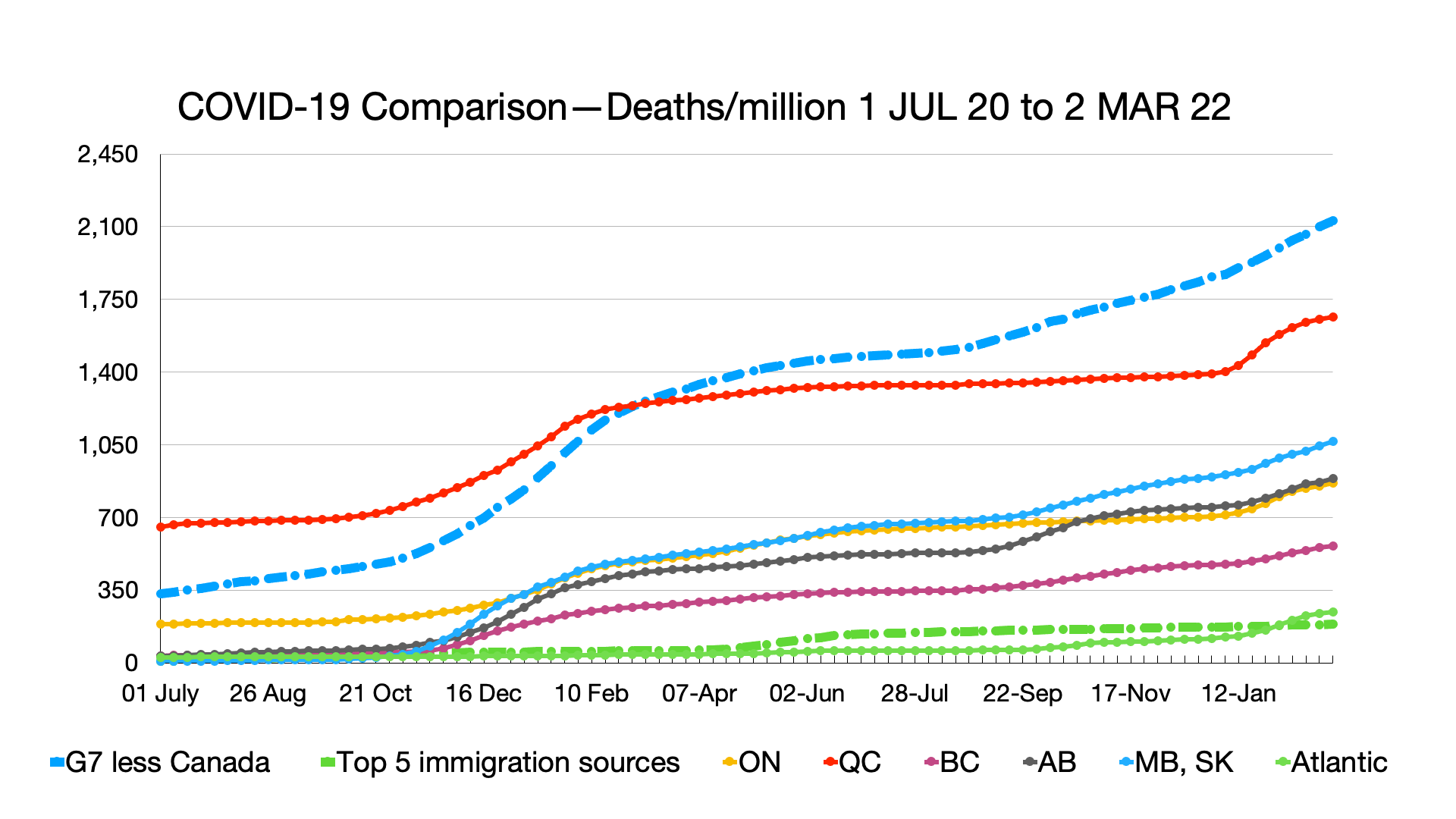
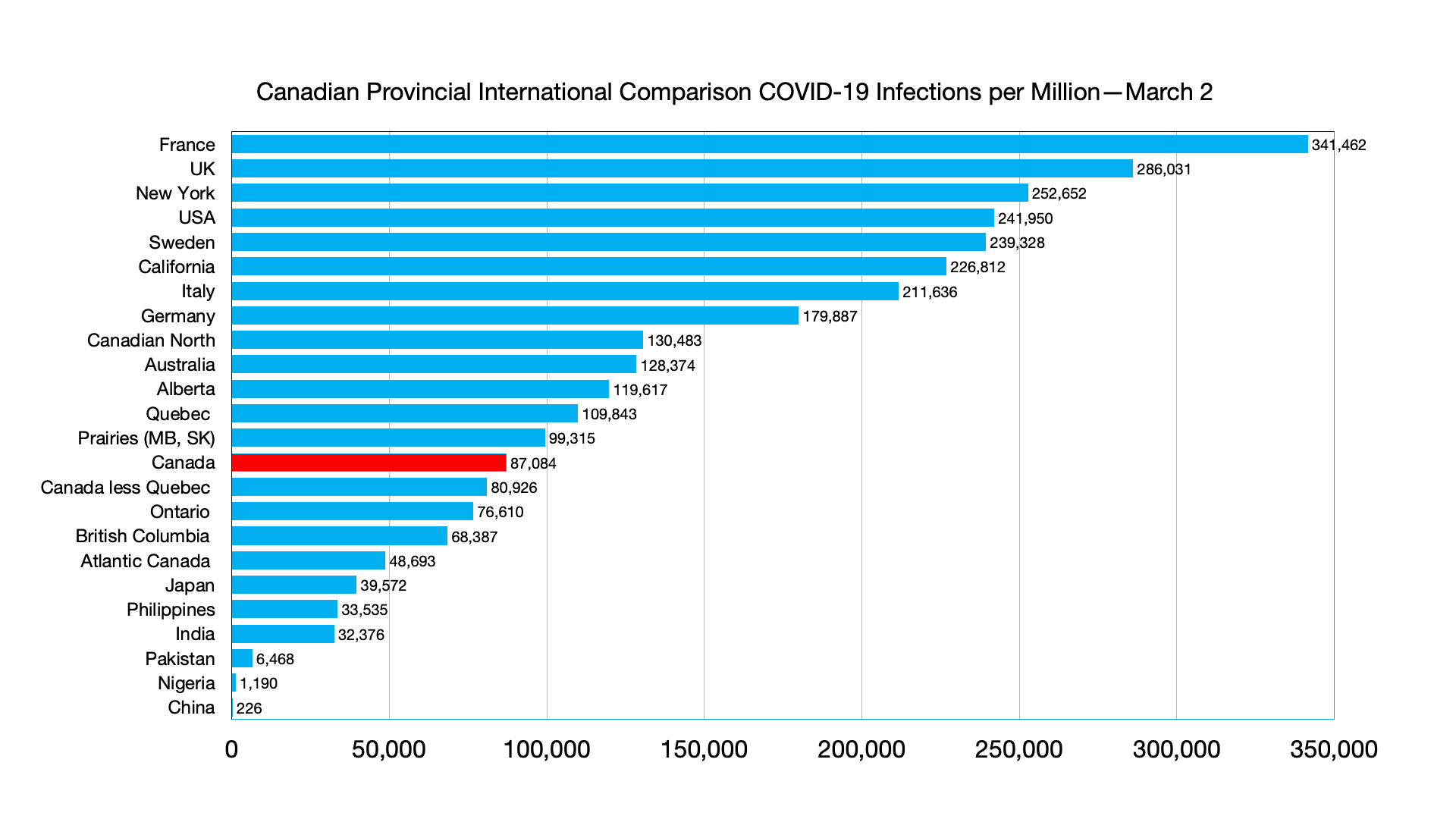
Overall decline in infections and deaths as omicron wave passes. The big news is that numbers from China have shown a significant increase in the past week, from 134,000 to 315,000 infections and from 4,936 to 5,380 deaths, perhaps reflecting suppression of numbers pre-and post-Olympics.

Vaccinations: Some minor shifts but convergence among provinces and countries. Canadians fully vaccinated 82.2 percent, compared to Japan 79.4 percent, UK 73.3 percent and USA 65.7 percent.

Immigration source countries are also converging: China fully vaccinated 88.3 percent (numbers have not budged over past four weeks), India 57.9 percent, Nigeria 4 percent, Pakistan 45.7 percent, Philippines 58.4 percent.

Trendline Charts:

Infections: Ongoing signs of omicron and other variants plateauing.

Deaths: Quebec continues to plateau with moderate increases in other provinces but G7 still not plateauing.

Vaccinations: No major relative changes.

Weekly

Infections: No relative changes. Infections per million in China have increased from 96 to 226 per million after relatively flat for over six months

Deaths: Major change again is with respect to China with deaths per million increasing from 3.5 to 3.9. Sweden is now ahead of Quebec.

COVID-19: New Immigration Rules Crack Open Japan’s Closed Door

In early December 2021, when the highly contagious Omicron variant started spreading globally, Japan slammed its border shut. In fact, except for the first months of the pandemic, it adopted a harsher border policy than during previous infection waves.

The country would essentially remain closed to all non-Japanese citizens other than existing residents.

Among the many stranded travelers were an estimated 150,000 international students who had enrolled in Japanese universities, but never made it into Japan after the borders closed in March 2020. Also affected were business people, foreign specialists and technical interns, the term used for foreign nationals who work on farms, in fishing, food processing, hotels, nursing homes or other industries faced with a serious labor shortage.

Japan’s isolationist approach was in tune with only a few other countries, such as China and Hong Kong. Australia and New Zealand  ーwhich previously had some of the strictest border rules, stopping even their own citizens from returning homeー have recently reversed their two year long isolation.

The Japanese government has been a lot more cautious. In the wake of criticism by industry leaders and academics it has now relaxed some of the entry rules. However, its general policy to ban most new entries has not changed. Tourists still remain shut out.

Nevertheless, there is some welcome positive news going into effect from March 2022.

Raised Cap on Daily Entries

In a first sign of hope, the current limit on arrivals at the Japanese border, capped to 3,500 (roughly the passenger load of 17 airplanes), has been raised to 5,000 from March 1.

Vaccination Status Matters

One of the biggest changes is that starting on March 1, Japan will distinguish between vaccinated and non-vaccinated travelers. This is a significant step for a country that was previously disinterested in vaccination status upon entry and has not adopted any kind of vaccination passport to use domestically.

Fully vaccinated travelers coming from high risk countries can isolate at home for seven days. This period can be shortened to three full days with a negative covid-test on day three.

Fully vaccinated arrivals from low risk countries have no quarantine obligation whatsoever.

Fully Vaccinated Means Three Shots

An arriving person only qualifies as vaccinated with proof of three shots. And the vaccines used need to have been approved by Japan.

Currently, there are only four approved shots: The COVID-19 vaccine from Pfizer, Moderna, Astra-Zeneca and Johnson & Johnson. Plus, the only recognized third shots are for Moderna and Pfizer.

…. New Visa Applications

Last not least among the big changes, schools and businesses can now apply for new visas on behalf of business partners, workers and students, if they pledge to monitor that the incoming person will follow any necessary quarantine rules and other measures imposed.

A new website has been set up by the Ministry of Health to facilitate applications, named ERFS or “Entrants, Returnees Follow-up System”. Once the application is approved foreign entrants will get a Certificate of Eligibility (COE), a necessary step to get a visa stamped into the passport at a Japanese embassy or consulate abroad.

Only organizations, not individuals can apply through this website. If you have a COE that has recently expired or is about to do so, a new policy on the period of validity for a certificate of eligibility may be of help as some COE holders may be eligible for an extension.

It is not clear if people who currently have an unexpired COE have to apply.

It also remains to be seen how quickly new visas will be issued and what kind of priorities will be given to whom. After two years of closed borders there is a significant backlog of old cases.

As a cap of daily arrivals remains in place, even though it has now been lifted to 5,000 persons daily, many people will still be in for a long wait.

Source: COVID-19: New Immigration Rules Crack Open Japan’s Closed Door