#COVID-19: Comparing provinces with other countries 9 February Update

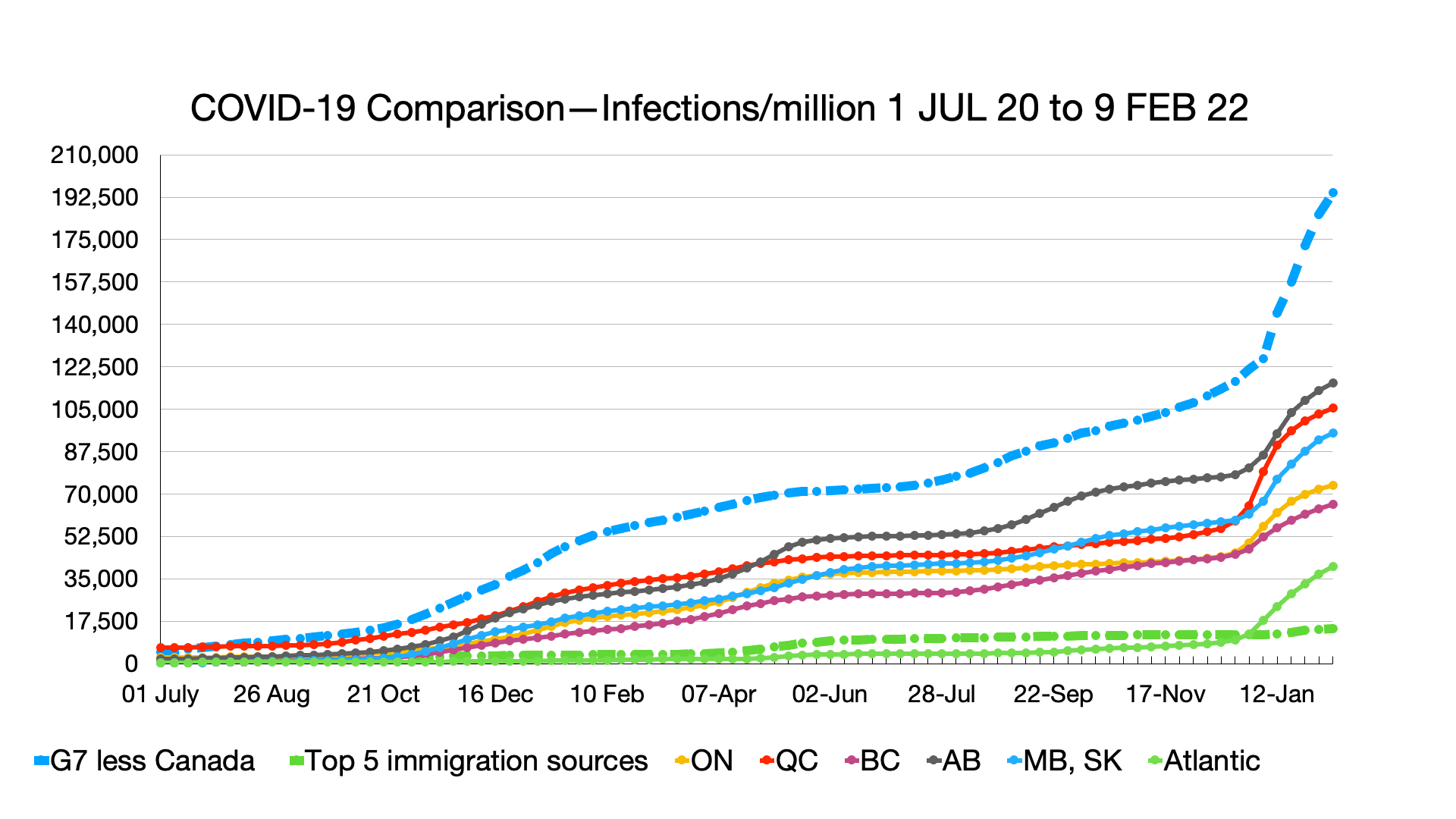
It will be interesting to see the effects of the decisions by Alberta and Saskatchewan to relax or end restrictions over the next few weeks will in terms of infections, deaths and hospitalizations. Probably not as disastrous as “best summer ever” but likely not with consequences.

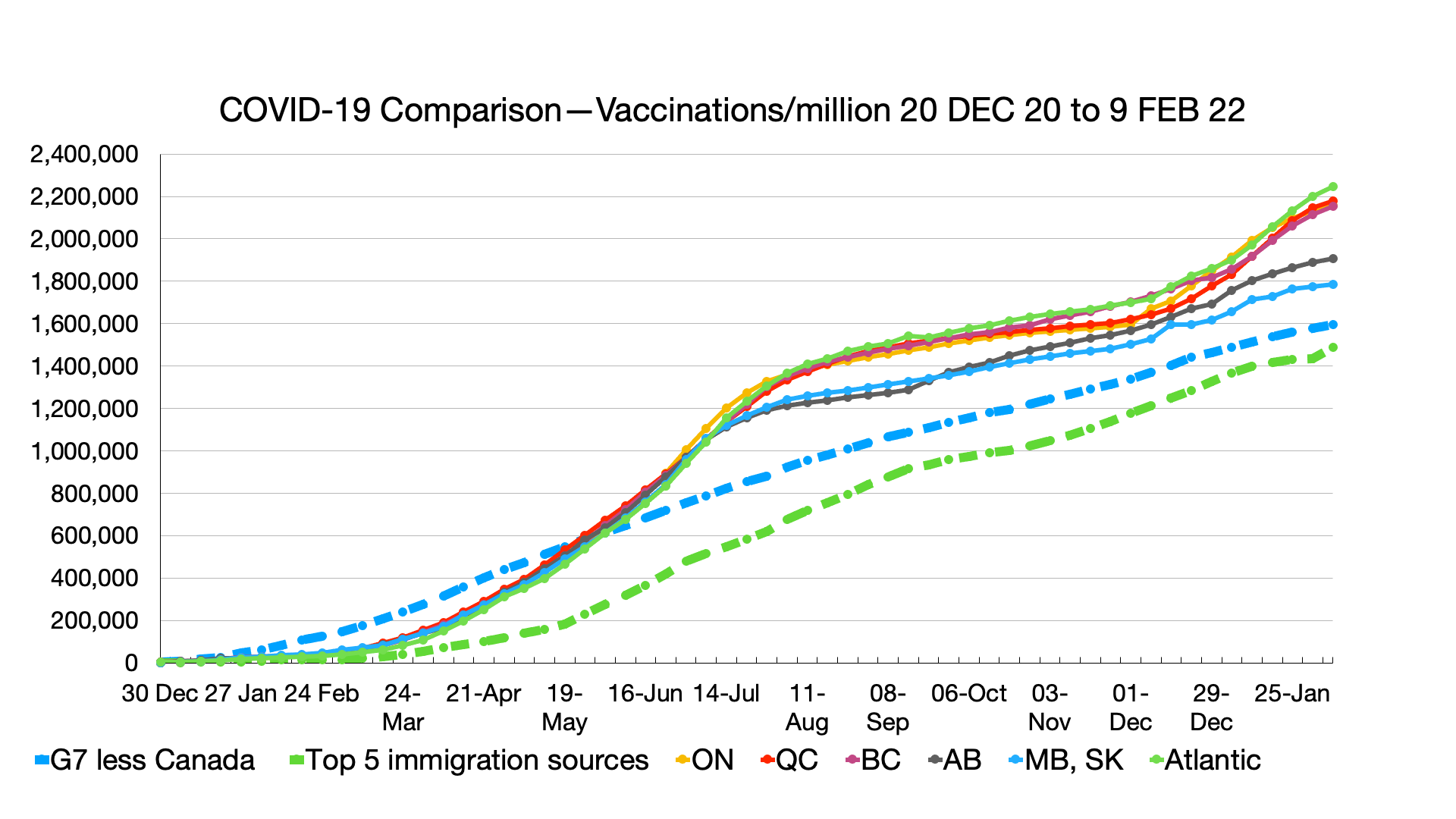
Vaccinations: Some minor shifts but general convergence among provinces and countries. Canadians fully vaccinated 81 percent, compared to Japan 79.1 percent, UK 72.7 percent and USA 64.9 percent.

Immigration source countries are also converging: China fully vaccinated 87.9 percent (numbers have not budged over past two weeks), India 53.9 percent, Nigeria 2.7 percent (the outlier, unchanged), Pakistan 40.6 percent, Philippines 55.6 percent.

Trendline Charts:

Infections: Signs of omicron and other variants plateauing.

Deaths: Quebec uptick appears to be plateauing.

Vaccinations: No major change but Alberta and Prairies continue to be laggards compared to other provinces. Ironic given they are among the first to relax and end restrictions.

Weekly

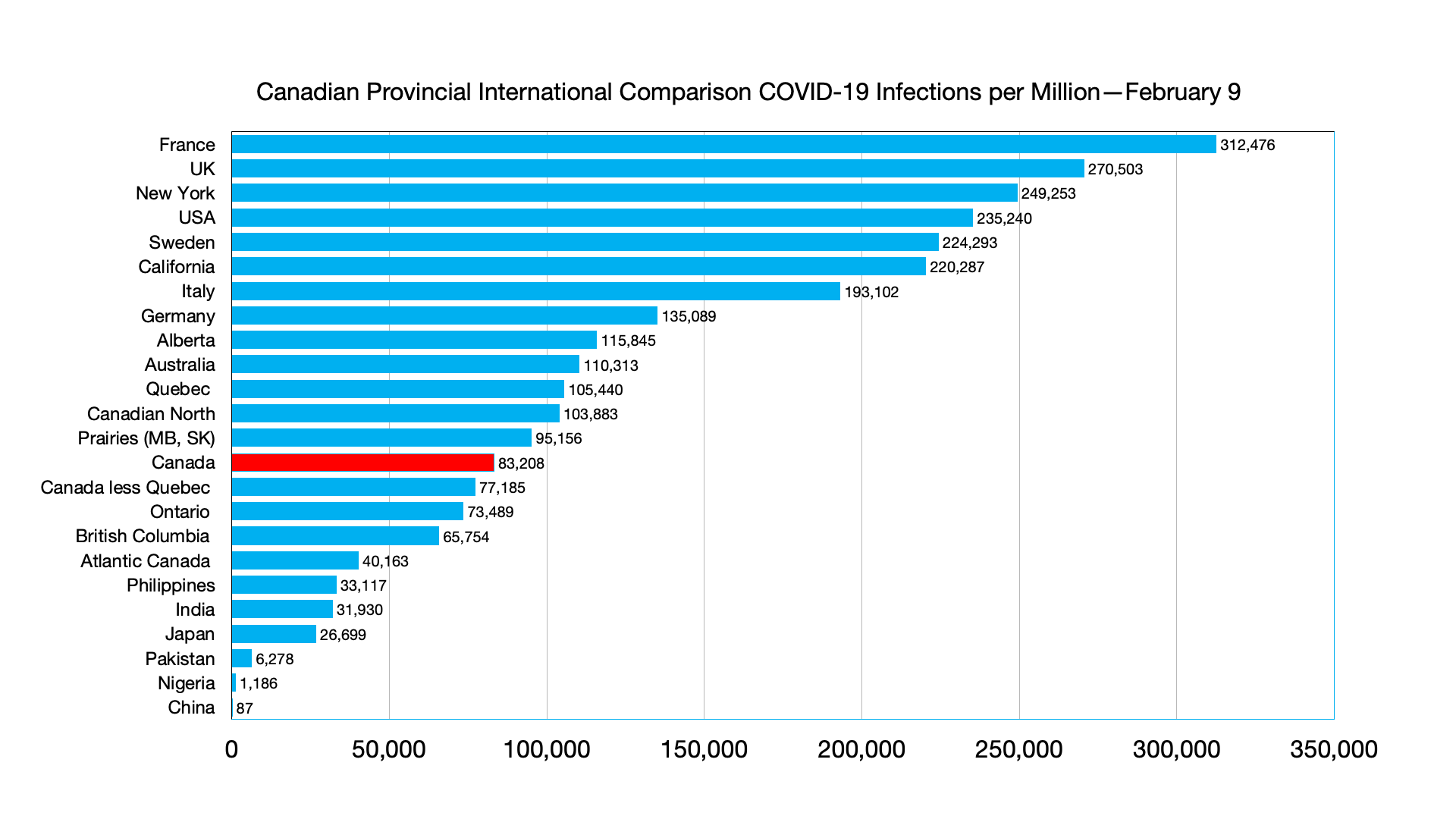
Infections: Sweden ahead of California, Australia ahead of Quebec, Canadian North ahead of Prairies.

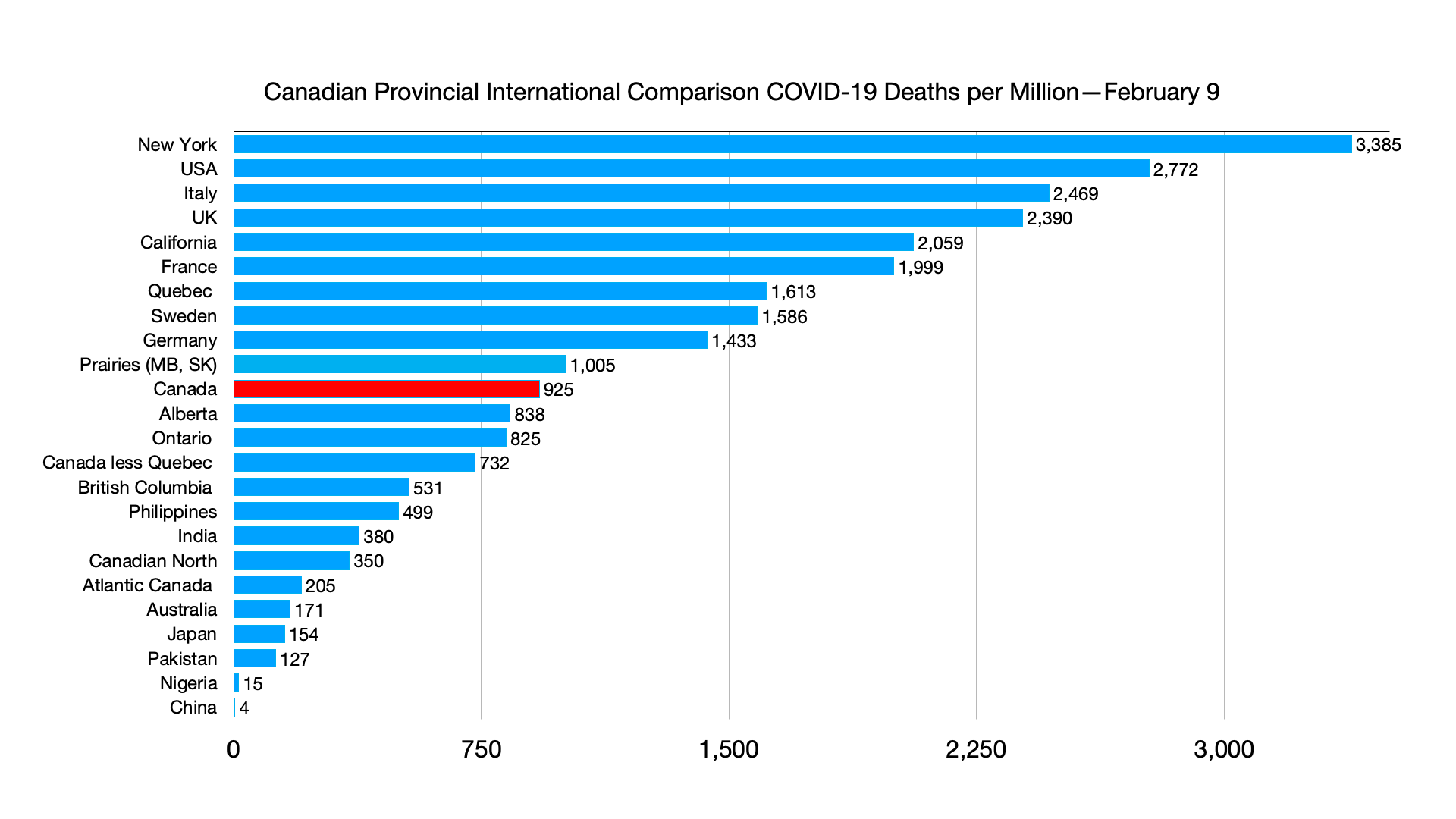
Deaths: No relative change.

The ‘Genocide Games’ Disruptors Giving Hell to Beijing

Creative, even if drowned out by the cheerleading media and others:

With the 2022 Winter Olympics well underway in Beijing, a coalition of activists from around the world is vowing to keep up its pressure on the International Olympic Committee (IOC) and the Chinese government throughout the two weeks of the competition, which they’ve dubbed the “Genocide Games.

The organizers, many of them women in their early twenties and thirties, have launched a series of events to run on each day until the end of the Games on Feb. 20. “During the month of February we will be continuing our campaign against Beijing 2022, shining a spotlight on China’s egregious human rights abuses,” Pema Doma, Campaigns Director for Students for a Free Tibet, told The Daily Beast. “Together we’ll continue to challenge Chinese propaganda at Beijing 2022.”

One of their main programs is the #IWillNotWatch campaign, heavily promoted on social media to discourage viewers around the world from watching the Olympics “and to counter Beijing’s propaganda show,” Zumretay Arkin, Program and Advocacy Manager for the World Uighur Congress in Munich, told The Daily Beast.

On Feb. 4, as Beijing was airing its glitzy Opening Ceremony, the coalition live-streamed Beijing 2022: The Alternative Opening Ceremony, where several young Tibetans, Uighurs, and Hongkongers convened to spotlight China’s human rights abuses.

NBC’s broadcast of the opening ceremony attracted just 14 million TV viewers, making it one of the least-viewed opening ceremonies in the history of the Olympics, according to statistics from NBC Sports. This marked a stark decline of about 43 percent from the 23.8 million viewers who watched the Opening Ceremony for the Winter Games in Pyeongchang in 2018.

The day before the ceremony, activists stepped up their pressure with a series of demonstrations in 65 cities around the world to protest what they called “the IOC’s failure to hold China accountable for their serious and worsening human rights abuses.”

At a protest in San Francisco, a Tibetan monk clad in a maroon robe walked at the front of the march holding a portrait of the Dalai Lama as he led some 100 marchers south across the Golden Gate Bridge to the Chinese Consulate in downtown San Francisco. Behind him, several Uighurs waved the flag of the East Turkestan independence movement, which is unofficially used by activists to represent China’s Xinjiang Province. Others carried placards that read, “No Rights, No Games,” and “No More Shame Games.” Another showed a skier standing in front of an Army tank, a reference to the iconic photo of the Tank Man, a Chinese citizen who used his body to stop a column of tanks rolling down a Beijing street in 1989 during an anti-democracy crackdown.

As the March wound its way through the streets of San Francisco, bystanders stopped to take photos and to applaud the protesters. Dozens of drivers beeped their horns and leaned out of their cars to shout support.

When China won the Summer Olympics in 2008, rights activists expressed concerns about the country’s dismal human rights record. In response, China and the IOC argued that the Games would actually improve human rights and rule of law in China.

Activists say that the opposite happened. China, encouraged by the legitimacy given to it by its successful hosting of the 2008 Games, stepped up its suppression of human rights.

Since 2008, an estimated 160 Tibetans have self-immolated in protest against China’s increasingly abusive policies in Tibet, which Freedom House has ranked the least free place on earth, tied with Syria. In Xinjiang, as many as 1 million Uighurs, a Muslim, Turkic-speaking people, have been thrown into brutal prison camps, which the Chinese refer to as “re-education schools.” Hong Kong has also faced a severe crackdown against democracy, with prominent politicians, activists and journalists arrested, and civic organizations shut down.

“The Chinese government has felt emboldened since 2008,” says Chemi Lhamo, a 25-year-old Canadian-Tibetan activist in an interview with The Daily Beast. “It got the message from the international community that it was okay with China’s abuses, that the world will turn a blind eye to this.”

This time around, no one is predicting that the Olympics will democratize the country. Touting an authoritarian one-party rule as an alternative to Western-style democracy, China has risen to become an economic, technological and military powerhouse. Chinese leader Xi Jinping still wants to be legitimized by holding the Olympics, but he sees no need to placate the international community.

“How in the world does it make sense for China to host the Games when it has such a brutal record?” said Lhamo. “Things have not gotten better—they’ve gotten worse.”

Activists representing disparate peoples in China began to strategize immediately after China was awarded the Winter Games. In October 2020, a delegation representing 160 human rights groups had a virtual meeting with the IOC hoping to convince the body to either cancel or relocate the Winter Olympics. The meeting didn’t go well, some of those who attended the meeting told The Daily Beast.

“The conversation was tense, and they were not very respectful of the activists,” says Frances Hui, the 21-year-old director of We The Hongkongers, who took part in the meeting. “Each of us shared our own firsthand, heartfelt experiences. I couldn’t believe it when they told us the Olympics was simply about people from around the world playing sports.”

Teng Biao, a Chinese human rights lawyer who also took part in the meeting, says the IOC responded with the same excuse that was given in 1936 when Nazi Germany was awarded the Games: politics and sports should be kept apart. “The IOC refuses to listen,” he told The Daily Beast. “Human rights are getting worse and there is growing evidence of that. The IOC is clear about what’s happening in China. But it doesn’t care.”

Source: The ‘Genocide Games’ Disruptors Giving Hell to Beijing

Kaplan-Myrth: Health-care workers have your backs. Please protect us too

From our family doctor:
Those of us who have been the recipients of harassment and intimidation over the last two years — who have experienced the overlap between antivax/antimask rhetoric and anti-semitism, racism, homophobia and misogyny — were overcome by a sense of foreboding as trucks rolled into downtown Ottawa more than a week ago. These events, now spreading to the rest of Canada, are a warning to us all.By now everyone has seen the photos of Nazi and confederate flags on the backs of trucks. Residents of downtown Ottawa are powerless against trucks honking their horns all night, diesel fumes wafting into their windows. Food was taken from the Shepherds of Good Hope shelter. Women survivors of violence, traumatized, cried out for help, unable to safely walk outside the Cornerstone shelter. An employee at a local business was physically assaulted. LGBTQ community members were confronted with transphobic placards; a shop window with a rainbow flag was broken. In a virtual townhall meeting led by Ottawa Centre MPP Joel Harden, the chat was disrupted at one point because of anti-Black, racist comments.

The mayor has declared that downtown Ottawa is “under siege,” in a state of “emergency.” As the hate spreads across the country, health-care workers in Toronto and Vancouver were warned not to dress in scrubs in the streets, to avoid being a target for hate. In response, Dr. Lisa Salamon-Switzman, an emergency room physician in Toronto, posted on Twitter that she would wear her scrubs, that as a granddaughter of Holocaust survivors, she would not cower from those espousing hate.

Source: Kaplan-Myrth: Health-care workers have your backs. Please protect us too

Immigrants. The working poor. Essential workers. Third doses lag in Toronto’s most vulnerable areas; Let’s celebrate Toronto’s vaccine success story

Not that surprising as they lagged with earlier doses as well.

Throughout the COVID-19 vaccine rollout, Torontonians have watched as neighbourhoods home to those experiencing some of the harshest outcomes of the pandemic have had among the lowest vaccination rates

Now, as public health and community organizations work on the ground to improve third-dose uptake, new data from the Gattuso Centre for Social Medicine at University Health Network lays bare the stark demographic differences between the Toronto neighbourhoods with the highest rates of third-dose vaccination and those with the lowest. 

What it shows in granular detail is that many of our most vulnerable citizens — immigrants, the working poor and essential workers in trades and manufacturing — live in areas where third-dose vaccinations just aren’t happening anywhere near the rates seen in some of Toronto’s richest and least-racialized neighbourhoods. 

For example, 71 per cent of the population is racialized in the bottom 20 per cent of Toronto neighbourhoods ranked by third-dose uptake. That compares to just 24 per cent in the top 20 per cent of neighbourhoods with the highest rates of third-dose vaccination. 

Similarly, the percentage of the population that meets low-income thresholds in the areas with the lowest third-dose vaccination rates is nearly double that in neighbourhoods with the most administered. 

“It doesn’t need to be this way. There was great success in narrowing the access gap for the rollout of Dose 1. It can be done again. We can’t afford not to,” said Dr. Andrew Boozary, executive director of the Gattuso Centre.

“If we don’t address the pathologies of poverty, if we don’t shift more public investment into these neglected neighbourhoods, we will continue to see worse health outcomes and wider health disparities than we’ve ever seen.”

The Gattuso Centre’s analysis also shows that neighbourhoods with the lowest third-dose uptake have higher proportions of essential workers in manufacturing, utilities, trades, transport and equipment operation — sectors that don’t conform to regular nine-to-five workdays and that are not conducive to allowing workers to take time off to get vaccinated during clinic hours.

Indeed, the percentage of the population working in manufacturing and utilities is 10 times higher in areas with the lowest rates of third-dose vaccination than in those with the highest rates. Likewise, the percentage of people employed in the trades, transport and equipment operation is more than four times higher in the bottom 20 per cent of Toronto neighbourhoods by third-dose vaccination than in the highest 20 per cent. 

“If racialized community members are getting their third doses at a third of the rate compared to non-racialized communities, we need to make specific, targeted interventions that are going to provide information in a culturally appropriate and safe way for these communities,” said Michelle Westin, senior analyst for planning, quality and risk at Black Creek Community Health Centre who has been leading mobile vaccination clinics in northwest Toronto.

“We need to be having ambassadors that are representative of these communities to help build that trust. We have to have vaccinators that are representative of these racialized communities. We need to make sure that vaccinations are accessible to people who are low income, so ensuring that they are in spaces that they can get to easily, assist with providing transportation if needed, ensuring that hours of the clinic work with folks that are having to work different hours of the day and multiple jobs,” she added.

The city of Toronto has been waging a three-pillared operation to get shots into arms in the neighbourhoods with the lowest uptakes. This includes hyperlocal clinics in malls, transit stations, workplaces and schools; outreach around these clinics through 155 community agencies and more than 400 neighbourhood vaccine ambassadors; and a get-out-the-vote style campaign, dubbed “VaxTO,” using text messages, phone calls, emails and town halls to get information out.

“We know that when we announced our target to reach 90 per cent of residents for their first dose, people told us it was impossible in a city as large and diverse as ours. We proved that it was possible when you commit to equity and you don’t stop,” said Coun. Joe Cressy, chair of the Toronto Board of Health. “You literally have to go door-to-door, building-by-building in every language with trusted local leaders. It’s not quick because tackling inequity is never quick. But it works.”

To date, 60 per cent of eligible residents in Toronto have received a third dose. 

But there is still a long way to go. The Gattuso Centre found that the gap between the neighbourhoods with the most and least third dose-uptake has widened substantially over the past seven weeks. In Kingsway South, for example, 68 per cent of eligible residents have received a third dose, compared to just 27 per cent in Mount Olive-Silverstone-Jamestown — a gap of 41 percentage points.

“The gap is striking, especially given what we’ve learned throughout the pandemic. We’ve seen real success in earlier stages of the vaccine rollout when community leadership has been supported with the resources and focus to ensure there is true access. It obliterated many notions of vaccine hesitancy early on,” Boozary said.

“But if we stray from that, we will continue to see this widening of a gap and it will not be recoverable if we do not ensure that those same investments and resources and supports are there for everyone.”

Luwam Ogbaselassie, implementation lead with the Gattuso Centre who has been supporting the vaccination effort in the Humber River-Black Creek region, said the involvement of community leadership is key to narrowing the third-dose uptake gap. 

“Wherever there are resources being allocated towards vaccines, it should be guided by community leaders around how best to structure those clinics and how best to reach the people who have been the hardest to reach and continue to be the hardest to reach,” she said, noting that she has seen first-hand the meaningful impact of community ambassadors who live in the same buildings and in the same neighbourhoods as those who may harbour mistrust of the health care system. 

“I’ve always said as a hospital partner, we bring the vaccines, we bring the clinical teams, but we look to our community partners to guide us on how to set up the clinics, how to engage with people who live in the community.

“Community leadership makes all the difference.

Source: Immigrants. The working poor. Essential workers. Third doses lag in Toronto’s most vulnerable areas

On a more positive note:

It’s a snowy Thursday afternoon in Toronto and the vaccination clinic at the Woodbine Mall is getting ready to welcome its first visitors of the day. The news is full of the demonstrations in Ottawa against pandemic restrictions. Similar protests are about to come to Toronto. But at the clinic, the mood is purposeful, unruffled, even buoyant.

Nurses sit at tables filling syringes with vaccine and loading them into trays. Helpers lay out colouring sheets to amuse kids coming in for their jab. One greeter brandishes a little Canadian flag that she waves to show visitors when a booth is free.

As opening time approaches, operations manager Simone Richards gathers everyone for the daily huddle, a combination of pep talk, check-in session and revival meeting. Smiling behind her mask, she warns the group: “We are running low on teddy bears.” The local police station donated a pile of the toys to soothe nervous kids and there are only a few left.

After singing a rousing Happy Birthday for their clinical manager Arturo Villasan, staffers put their hands in, like athletes before a game, for a go-team cheer – except that, pandemic style, their hands don’t actually touch. Then they open the doors to let people through. They get hundreds a day, most of them happy to get the protection offered by the vaccines against COVID-19.

The scene at the Woodbine clinic tells a different story than you see in the headlines. In a week in which all the oxygen was consumed by noisy and sometimes obnoxious protesters, it is worthwhile to remember that most Canadians don’t feel their rights are being trampled by a despotic government. Most believe in vaccines and are eager to get jabbed. Most wear their masks and obey the rules on gathering and distancing. Though it will disappoint the Russell Brands of the world, Canada is not in revolt. Quietly, capably mustering all the available tools of technology, science and human collaboration, the country is getting on with the task of combating a deadly and insidious virus.

Toronto’s vaccination campaign, the biggest in its history, is an impressive success story. More than 6.5 million doses have been administered. Ninety per cent of residents 12 and older have one dose and 87 per cent two. Sixty percent of eligible residents have a booster, the result of a stepped-up Team Toronto drive to meet the threat from the Omicron variant. More than half of kids have one dose and a quarter have two.

To inoculate all those people in a city of 180 languages, dozens of cultural groups and scores of neighbourhoods has been a staggering task. To reach the hesitant, the disadvantaged and the disengaged, the city has hired hundreds of community ambassadors and translators to get the word out. It has dispatched mobile clinics from one end of the city to the other. It has bombarded residents with text messages, robocalls and flyers.

On the same afternoon that Ms. Richards and her team were greeting visitors to their big clinic in a Hudson’s Bay store at Woodbine, workers were going door to door in a Parkdale seniors’ building and soothing nervous kids at a Mount Olive school. At a small clinic in a mall at Jane and Finch streets, they don’t just wait for people to walk in. They recently persuaded the busy lady at the local roti joint to sit for a vaccination right in her shop. Every vaccination counts.

Leading me on a clinic tour, Joe Cressy, a city councillor who is chair of the city’s board of health, called it a brilliant example of breaking down silos and bringing everyone together in a common cause: pharmacies, hospitals, public-health workers; community and neighbourhood associations; cops and firefighters; care homes and schools.

Though we hear a lot these days about conflict and anger, what really stands out is the way all these groups are working arm in arm. As Mayor John Tory puts it, “the city has been united.”

Of course, it’s taking a while. It’s only natural that people are frustrated with the persistence of this virus and the annoying, limiting measures put in place to control it. If some believe that governments are to blame for much of the misery, they have a perfect right to say so, as long as they do it peacefully and lawfully. But while thousands are taking to the streets, hundreds of thousands of others are still lining up to get their shots and do their bit to quell the virus.

Ms. Richards and her Woodbine crew are standing ready to help them, with kindness, efficiency and good cheer. More teddy bears are coming.

Source: Let’s celebrate Toronto’s vaccine success story

As Officials Look Away, Hate Speech in India Nears Dangerous Levels

Of note:

The police officer arrived at the Hindu temple here with a warning to the monks: Don’t repeat your hate speech.

Ten days earlier, before a packed audience and thousands watching online, the monks had called for violence against the country’s minority Muslims. Their speeches, in one of India’s holiest cities, promoted a genocidal campaign to “kill two million of them” and urged an ethnic cleansing of the kind that targeted Rohingya Muslims in Myanmar.

When videos of the event provoked national outrage, the police came. The saffron-clad preachers questioned whether the officer could be objective.

Yati Narsinghanand, the event’s firebrand organizer known for his violent rhetoric, assuaged their concerns.

“Biased?” Mr. Narsinghanand said, according to a video of the interaction. “He will be on our side,” he added, as the monks and the officer broke into laughter.

Once considered fringe, extremist elements are increasingly taking their militant message into the mainstream, stirring up communal hate in a push to reshape India’s constitutionally protected secular republic into a Hindu state. Activists and analysts say their agenda is being enabled, even normalized, by political leaders and law enforcement officials who offer tacit endorsements by not directly addressing such divisive issues.

After the monks’ call to arms went viral, Prime Minister Narendra Modi and his top leaders remained silent, except for a vice president with a largely ceremonial role who warned that “inciting people against each other is a crime against the nation” without making a specific reference to Haridwar. Junior members of Mr. Modi’s party attended the event, and the monks have often posted pictures with senior leaders.

“You have persons giving hate speech, actually calling for genocide of an entire group, and we find reluctance of the authorities to book these people,” Rohinton Fali Nariman, a recently retired Indian Supreme Court judge, said in a public lecture. “Unfortunately, the other higher echelons of the ruling party are not only being silent on hate speech, but almost endorsing it.”

Mr. Narsinghanand was later arrested after he ignored the police warning and repeated calls for violence. His lawyer, Uttam Singh Chauhan, said his speeches may have been a reaction to anti-Hindu comments by Muslim clerics.

Mr. Modi’s governing Bharatiya Janata Party did not respond to requests for comment.

“Does the prime minister or home minister need to address every small, trivial issue?” said Vinod Bansal, a spokesman for the World Hindu Council, a party affiliate. “The accused have already been arrested. The secular groups will always highlight such incidents, but not when Hindus, Hindu gods and goddesses are under attack.”

The hate speech is stoking communal tensions in a country where small triggers have incited mass-death tragedies. The monks’ agenda already resonates with increasingly emboldened vigilante groups.

Vigilantes have beaten people accused of disrespecting cows, considered holy by some Hindus; dragged couples out of trains, cafes and homes on suspicion that Hindu women might be seduced by Muslim men; and barged into religious gatherings where they suspect people are being converted.

In recent weeks, global human rights organizations and local activists, as well as India’s retired security chiefs, have warned that the violent rhetoric has reached a dangerous new pitch. With right-wing messages spreading rapidly through social media and the government hesitant to take action, they are concerned that a singular event — a local dispute, or an attack by international terror groups such as Al Qaeda or the Islamic State — could lead to widespread violence that would be difficult to contain.

Gregory Stanton, the founder of Genocide Watch, a nonprofit group, who raised similar warnings ahead of the massacres in Rwanda in the 1990s, told a U.S. congressional briefing that the demonizing and discriminatory “processes” that lead to genocide have been well underway in India.

In an interview, he said Myanmar was an example of how the easy dissemination of misinformation and hate speech on social media prepares the ground for violence. The difference in India, he said, is that it would be the mobs taking action instead of the military.

“You have to stop it now,” he said, “because once the mobs take over it could really turn deadly.”


The Dasna Devi temple in Uttar Pradesh state, where Mr. Narsinghanand is the chief priest, is peppered with signs that call to prepare for a “dharm yudh,” or religious war. One calls on “Hindus, my lions” to value their weapons “just the way dedicated wives value their husbands.”

The temple’s main sign prohibits Muslims from entering.

The monks’ anger is rooted in a sense of internalized victimhood that dates to the founding of India’s republic after independence from British rule in 1947. When Pakistan was carved out of India in a bloody partition that left hundreds of thousands dead, the Hindu right was incensed that the founding fathers turned what remained of India into a secular republic.

They celebrate a Hindu hard-liner’s assassination of Mohandas Gandhi — a renowned symbol of nonviolent struggle, but to them a Muslim appeaser. Pooja Shakun Pandey, a monk at the Haridwar event, has held re-enactments of Gandhi’s assassination, firing a bullet into his effigy as blood runs down.

The forces that shaped the ideology of Gandhi’s assassin, Nathuram Godse, have slowly risen from the fringes to dominate India’s politics.

Mr. Modi, the prime minister, spent decades as a mobilizer for the Rashtriya Swayamsevak Sangh, the century-old right-wing organization to which Mr. Godse belonged. Mr. Modi’s party sees the group as the fountainhead of its political ideology and has relied heavily on its vast network of volunteers to mobilize voters and secure victories.

When he was chief minister of Gujarat, Mr. Modi saw firsthand how unchecked communal tensions could turn into bloodletting.

In 2002, a train fire killed 59 Hindu pilgrims. Although the cause was disputed, violent mobs, in response, targeted the Muslim community, leaving more than 1,000 people dead, many burned alive.

Rights organizations and opposition leaders accused Mr. Modi of looking the other way. He rejected the allegations as political attacks.

After he rose to the country’s highest office in 2014 on a message of economic growth, there was hope that Mr. Modi could rein in the fury. Instead, he has often reverted to a Hindu-first agenda that inflames communal divides.

In 2017, Mr. Modi picked Yogi Adityanath, a monk who had started a youth group accused of vigilante violence, to lead Uttar Pradesh, India’s largest state with more than 200 million people.

In his saffron robe, Mr. Adityanath has legislated a ban on religious conversion by marriage, an idea that he calls “love jihad,” in which Muslim men lure Hindu women to convert them. His group has served as moral police, hounding interfaith couples and punishing anyone suspected of disrespecting cows.

As Mr. Adityanath campaigned for re-election, the group held a meeting in New Delhi around the same time as the monks’ event. With a picture of Mr. Adityanath behind them, attendees took an oath to turn India into a Hindu state, even if it meant killing for it.

Mr. Adityanath’s office would not address his current relations with the group, but said the chief minister “had nothing to do” with the meeting.

Dhirendra K. Jha, a writer who has studied the rise of Hindu nationalism, said he worried that extremists now dominate India’s politics in such a way that those who call for violence feel protected.

“Unless this is dealt with, the kind of consequences that may happen — I can’t even imagine, I don’t dare to imagine,” said Mr. Jha.

The choice of Haridwar as the venue for a bold call to violence was strategic — the city attracts millions of visitors annually, often for religious festivals and pilgrimages.

The riverbank was recently busy with seers and worshipers. Families picnicked and took dips in the chilly water. Even as some religious authorities appeared troubled by the calls for violence, they were reluctant to condemn them.

Pradeep Jha, the main organizer of the city’s largest pilgrimage festival, said he shared the vision of a Hindu state, not through violence but by urging India’s Muslims to convert back; in such a view, everyone in India was Hindu at one point.

“I believe we need to pursue our goals with patience, with peace,” he said. “Otherwise, what is our difference with others?”

Mr. Narsinghanand has made a name for himself doing the exact opposite.

As he sees it, India’s Muslims — who account for 15 percent of the population — will turn the country into a Muslim state within a decade. To prevent such an outcome, he has told followers that they must “be willing to die,” pointing to the Taliban and Islamic State as a “role model.

In 2020, Mr. Narsinghanand was among the hard-liners stoking tensions during monthslong protests over a citizenship amendment seen as discriminatory toward Muslims. He called for violence, using the language of a “final battle.” “They are jihadis, and we will have to finish them off,” he said.

Riots followed in New Delhi, with 50 people killed, a majority of them Muslims.

Mr. Narsinghanand was always observant, but not an extremist, according to his 82-year-old father, Rajeshwar Dayal Tyagi.

He was a top college student, earning a scholarship to study food technology in Moscow. There, he helped open a vegetarian restaurant for Indian students that still operates.

Returning to India in 1996, he started a computer training institute with money from Mr. Tyagi’s pension. He soon dedicated his life to being a monk, leaving behind his wife and young daughter, said his father.

“I feel pained, I feel angry, it gives me stress,” his father said. “It’s not a good idea to use harsh words against anybody.”

Despite the police warning, Mr. Narsinghanand and his fellow monks repeated their messages of hate, including on national television and social media.

“This Constitution will be the end of the Hindus, all one billion Hindus,” Mr. Narsinghanand said at a virtual event. “Whoever believes in this system, in this Supreme Court, in these politicians, in this Constitution, in this army and police — they will die a dog’s death.”

When the police came to arrest an associate, he threatened the officers, who politely urged him to calm down. “You will all die,” Mr. Narsinghanand is seen in a video telling them.

The police arrested Mr. Narsinghanand on Jan. 15, and he was charged in court with hate speech.

“He said nothing wrong,” said Swami Amritanand, an organizer of the Haridwar event. “We are doing what America is doing, we are doing what Britain is doing.”

Mr. Amritanand said the call for arms was justified because “within the next 10 to 12 years there will be a horrible war that will play out in India.”

Late last month, the monks again sounded a violent call to create a Hindu state, this time at an event hundreds of miles away from Haridwar in Uttar Pradesh. They threatened violence — referencing a bombing of India’s assembly — if Mr. Narsinghanand was not released.

Ms. Pandey described their actions as defensive. “We must prepare to protect ourselves,” she said.

To the Haridwar police, the event in Uttar Pradesh did not count as a repeat offense. Rakendra Singh Kathait, the senior police officer in Haridwar, said Mr. Narsinghanand was in jail because he had acted again in the city; others like Ms. Pandey got a warning.

“If she goes and says it from Kolkata, it doesn’t count as repeat here,” Mr. Kathait said.

Source: As Officials Look Away, Hate Speech in India Nears Dangerous Levels

New Research Reveals Best Real Estate Investments for Residence and Citizenship Rights

More from the citizenship-by-investment industry with focus on real-estate (rather than more productive investment):

Henley & Partners in partnership with Deep Knowledge Analytics has launched the Best Investment Migration Real Estate Index — a unique new analytical tool to assess investment migration programs offering real estate investment as a pathway to residence rights or citizenship acquisition.

The leading international residence and citizenship advisory firm saw an 80% increase in enquiries over the past 12 months off the back of an already record-breaking year in 2020 as wealthy investors scrambled to diversify their domiciles at the same time as their investment portfolios in a bid to secure greater global access and optionality as a hedge against unrelenting market and political volatility.

The Best Investment Migration Real Estate Index is a first-of-its-kind metric for those in the market for a secondary residence or citizenship. It considers over 30 parameters and over 300 data points to score and compare 16 program options worldwide according to key considerations such quality of life, GDP, minimum real estate investment amount, potential rental income, associated property costs, the real estate holding period, residence requirements, and saleability, as well as crypto-friendliness, which is gaining importance among global investors.

Henley & Partners Group Head of Private Clients, Dominic Volek, says the Covid-19 pandemic has convinced even those investors from wealthy nations with premium passports of the benefits of alternative residence and/or citizenship. “International real estate has always been a reliable asset class due to its long-term staying power. Real estate–linked investment migration programs have the additional advantages of enhancing your global mobility through multiple passports and expanding your personal access rights as a citizen or resident of additional jurisdictions, creating optionality in terms of where you and your family can live, work, study, retire, and invest.”

The Emirate of Dubai claims 1st place overall on the new index, scoring highly for rental income potential, and the price of property per square meter which is lower than other major international centers. Spain comes in 2nd, bolstered by its economic strength, with the highest score in the GDP parameter. The 3rd spot is occupied by Montenegro, which has emerged as a key second-home and property-investor market in the Mediterranean, and transcontinental Turkey is placed 4th overall, with high scores for its relatively low investment amount and minimal residence requirements. Sharing 5th spot with Thailand, the Portugal Golden Residence Permit Program continues to outstrip all others in terms of demand. With high scores for its low investment amount, saleability, and crypto-friendliness, investing in real estate in this EU member state is a move many global investors, particularly those from the USA, have already made over the past 12 months.

Commenting on the Best Investment Migration Real Estate Index, CEO of the international Engel & Völkers Group, Sven Odia, says the premium segment has seen a sharp increase in demand during the pandemic. “We recorded a 97% rise in residential property transactions in the EUR 5 million to EUR 10 million segment last year compared to the previous year, and an increase of 90% in the top segment of properties valued over EUR 10 million.”

Group Head of Real Estate at Henley & Partners, Thomas Scott, says “aside from potential gains over the lifetime of the asset, an additional property can provide rental income in a strong and stable currency and geographical diversification via permanent residence or another citizenship, while at the same time as offering distinct lifestyle or business advantages.”

Source: New Research Reveals Best Real Estate Investments for Residence and Citizenship Rights

BRAUN: Ugly truths about trucker protest coming out

Refreshing commentary in the Toronto Sun:

Maybe the first big clue on Ottawa’s trucker occupation should have been the Confederate flags.

Or maybe the tip-off was former U.S. president Donald Trump calling Prime Minister Justin Trudeau a, “far left lunatic … who has destroyed Canada with insane Covid mandates,” — this from the guy whose administration oversaw the deaths of 412,000 Americans in the pandemic he once claimed, “Is going to disappear.”

Certainly, there were people claiming from the get-go that the trucker convoy had been hijacked by far right-wing U.S. factions.

A week ago, police in Ottawa said they were working with the FBI and had voiced concerns that there was a hefty U.S.presence in the funding of the trucker protest ensconced in Ottawa.

The GoFundMe kitty had crossed $10 million when the platform was asked to take a closer look; GoFundMe did indeed shut down the “freedom convoy,” stating that evidence from law enforcement and “reports of violence and other unlawful activity” made it clear that the fundraiser for the truckers was in violation of their own terms of service.

The trucker convoy organizers then went to GiveSendGo , a platform that bills itself as the No. 1 free Christian fundraising site.

The Guardian did an expose of GiveSendGo after a data breach last year revealed the platform’s alt-right associations with vigilantes and hate groups such as the Proud Boys — groups banned from other platforms for hate speech and violence.

CNBC reiterated Sunday that Ottawa police said they were investigating threats against public figures jointly with the FBI.

They reported, “The well-organized blockade, which police say has relied partly on funding from sympathizers in the United States, saw protesters bring in portable saunas on Saturday to combat frigid temperatures.”

Twitter was full of bizarre material on Sunday from U.S. Republicans, with Attorney General Ken Paxton, of Texas, for example, tweeting:

“Patriotic Texans donated to Canadian truckers’ worthy cause using GoFundMe. This BLM-backing company went woke, froze the funds, & failed to deliver Texans’ money. Today, I assembled a team to investigate their potential fraud & deception. Texas donors will get Justice! #GoFundMe.”

This retort from “Unbranded” (@unbranded63) is fairly typical of the outraged responses: “American Trumpists, tired of losing, turned their efforts to upending their northern neighbor. A few million dollars raised by insurrectionist Americans, and they thought they could topple the democratically elected government of Canada in a week. They’re deluded as always.”

Source: BRAUN: Ugly truths about trucker protest coming out

Best countries for birthright #citizenship, 2022

From the citizenship-by-investment industry, interesting that Canadian advantages include, in addition to visa-free travel, no taxes on those not living in Canada and the ability to sponsor parents for permanent residency:

Parents today want better facilitation for their children and this is where the new trend of birth tourism comes into the picture. But better facilities are not the only motive of parents while giving birth to their children in other countries. They can also obtain second citizenship for their future generation with advantages like residences and passports.

So, if you want to know about the best countries for birthright citizenship to secure your children’s future, this article sheds light on countries that practice Birth Tourism.

  1. Chile: Chile is the most robust country that grants birthright citizenship. The nation has outstanding facilities like education, medical and secures 6th place on the best travel document globally. Chile acts on the jus soli abstraction when the outsider wants to give birth, and the child can automatically become a citizen of the country.The nation also practices the legal process after completing the Spanish language test and time for naturalization, which helps parents acquire lifelong citizenship and residency. The passport offered to Chileans has surprising and robust properties worldwide because citizens can access visa-free traveling to many countries like the UK, US, Japan, Canada, Europe, and Russia.
  2. Canada: Canada also facilitates birthright citizenship, as the child can automatically get their second passport after birth. The Canadian passport is laden with strong aspects that help citizens travel to approximately 190 countries visa-free. Not only this, but the nation is also well-known for its best education, health and citizens do not need to pay taxes if they do not live. All children with Canadian citizenship can also subsidize their families for permanent residency which acts as a major advantage.
  3. Mexico: Mexico like other countries also has many distinctive properties and amazing vacation places which makes it stand out on our list. The destination is lauded as the 25th best passport globally which offers the right of soil concept. Whenever parents decide to give birth in Mexico, the child can automatically obtain Mexican citizenship. Mexican citizens have the right to travel to many enormous destinations globally with visa-free properties. After becoming a Mexican, children who live for a stipulated time can apply for permanent residency along with their parents and grandparents after two years.
  4. Panama: Panama offers birthright citizenship to children with the help of the right to the soil principle. They have the best medical facilities with a provincial tax system for their citizens. The family members of Panamanian citizens can acquire their permanent citizenship in about 3 years after living there.
  5. Barbados: Barbados is a part of the United Kingdom, that provides birthright citizenship to the children born there. Barbadian citizens can travel across 140 countries without a visa with special access to the United Kingdom. Children also enjoy the complete right to healthcare, education, and social life, and if the parents have any British forefathers, they can apply for a British passport for their child too.
  6. Brazil: Brazil offers visa-free travel access to approximately 150 countries besides the right to the soil principle through birth tourism. The Brazilian passport secures the 20th position globally for providing the best facilities to its citizens. Apart from this, what makes Brazilian citizenship click with people is the parameters such as cheap and desirable environment to live in. Children who take birth in the country have access to all the benefits which include living, studying and working.

Final Verdict: If you are concerned about your child’s future then offering them a second passport, can help resolve your issues. All the mentioned countries have different and amazing rights to their citizens and dependents which make them an apt choice for birth tourism today.

Source: Best countries for birthright citizenship, 2022

Canadian soccer proves the power of citizenship

Sharp contrast.

While I have little patience with the Ottawa protesters/occupiers, there is a range between the organizers, who are extremists, and others who are frustrated (as all of us are).

But given the nature of the organizers, the many symbols of hate and the aggressive and abusive behaviour of many of those protesting, those who tolerate r don’t call out that behaviour are complicit:

It was a tale of two screens last Sunday.

On my phone, I was watching a stream of mostly white protesters rampaging around Ottawa, brandishing swastikas and Confederate flags, desecrating monuments, harassing journalists, assaulting homeless people and hurling racial slurs at those who stood in their way — even attacking ambulances rushing to patients in distress.

On TV, I watched the Canadian men’s soccer team pull off a gutsy, determined 2-0 victory over the United States — epitomizing the very best of the Canadian spirit and inching ever closer to qualifying for Canada’s first World Cup since 1986.

Two screens. Two Canadas. One closed to the world, fearful, and drenched in hate. The other, open to the world, confidently competing with the best in the world, made up of people from around the world who are proud Canadians by choice.

Canada’s new-found soccer success would not be possible without our ambitious immigration policy, which both Conservative and Liberal governments have supported over decades.

Just look at the makeup of the team. Canada’s star player, Alphonso Davies, was born in a Ghanaian refugee camp after his parents fled civil war in Liberia. Sunday’s goals were scored by Cyle Larin (Jamaican parents) and Sam Adekugbe (U.K.-born to Nigerian parents), with assists by Jonathan Osorio (Columbian parents) and Jonathan David (U.S.-born to Haitian parents). The Americans had a golden chance to tie the game late in the first half, but were denied by a highlight-reel save from Canada’s Yugoslavian-born goalkeeper, Milan Borjan, who celebrated emphatically before the sold-out crowd in his family’s chosen hometown of Hamilton, Ont.

But Canada’s immigration story is not the immaculate success we might think. This year marks the 75th anniversary of Canada having its own citizenship independent of Great Britain, yet the proportion of immigrants who become citizens dropped by 20 per cent between 1996 and 2016, the latest year for which data is available. It doesn’t help that, right now, more than 400,000 citizenship applications are sitting in a warehouse somewhere, awaiting processing by an outmatched bureaucracy that is only just getting around to allowing online applications. Citizenship applications now take more than two years to process — which doesn’t seem like evidence of a country eager to welcome new citizens.

Canadians continue to strongly support immigration, but too often it’s framed in purely economic terms. For example, in her last fall economic statement, Finance Minister Chrystia Freeland devoted $85 million to reduce processing times. This is because “immigration is critical for Canada’s economic growth, especially when it comes to attracting top global talent, meeting the needs of employers and addressing labour shortages,” as the government’s Economic and Fiscal Update 2021 put it.

Source: Canadian soccer proves the power of citizenship

Court lets Priti Patel keep charging children £1012 for citizenship

Of note, law should to be changed from this “profiteering:”

The Home Office will continue to make a £640 profit on each child charged for British citizenship, as of a court ruling on 2 February.

The Supreme Court ended the four-year long fight against fees charged for children, some of whom were born in the UK, to become British citizens. Even if they were born in the UK, some children whose parents have a certain immigration status are not automatically British citizens – their families have to apply for citizenship for them.

While the court recognised that the £1,012 charged for each child was far above the administration cost of registering them as British citizens (£372) it concluded that parliament had allowed the government to set a fee above the ability of applicants to pay – which means it’s up to MPs or peers to change it.

The previous home secretary, Sajid Javid, described the fee as “a huge amount of money for a child to pay”, but failed to change it while in office.

Members of the House of Lords last week attempted to amend the Nationality and Borders Bill to reduce the fee to £372, covering the administrative costs, and to scrap it for children in care.

Child O, who was at the centre of the case, was born in the UK and has never left the country but their family was unable to pay the fee when applying for citizenship when Child O was ten. The now 14-year-old said they felt “very let down and alone”.

Campaigners say excluding these children and young people from British citizenship causes them to feel alienated, excluded and isolated in their home country, and are calling for the fee to be lowered or scrapped entirely for children in care or who are unable to afford it.

Their case was taken up by Amnesty International UK, and the Project for the Registration of Children as British Citizens (PRCBC).

“This fee deprives thousands of children of their citizenship rights, yet the Home Office has chosen to keep overcharging, despite the alienation and exclusion this is causing,” said Steve Valdez-Symonds, Amnesty International UK’s refugee and migrant rights director.

Sam Genen, the lawyer who represented Amnesty in the case, said: “It is disappointing that the Supreme Court granted permission to hear arguments [on international law] but chose not to decide them.”

He added that the current composition and judgments by the court “show a reductive approach to the rights of the vulnerable. There is a general sense that the court seems less interested [in] individual rights and expertise.”

Amnesty and PRCBC had appealed a ruling by the Court of Appeal last year, which followed a ruling by the High Court in 2020 that the fee was excluding children from their citizenship rights.

Both lower courts found the Home Secretary, Priti Patel, had not given consideration to the best interests of children when setting the fee.

While the Home Secretary continues to have discretion in setting the citizenship fee for vulnerable children, parliament could choose to change that – all eyes are now on whether the Nationality and Borders Bill could be amended to reduce or remove the fee for children in care or who cannot afford to pay.

The Supreme Court ruling paradoxically highlighted the importance of British citizenship, noting: “It can contribute to one’s sense of identity and belonging, assisting people, and not least young people in their sensitive teenage years, to feel part of the wider community. It allows a person to participate in the political life of the local community and the country at large.”

Source: Court lets Priti Patel keep charging children £1012 for citizenship